Friendship Triangulation: Care Without Becoming the Go-Between

The Unpaid Project Manager of Friendship Triangulation
“You are the friend who spends all day coordinating projects, then opens two private chats after work and realizes you have become the unpaid project manager of someone else’s conflict,” I said to Maya when she sat down across from me in my Toronto studio.
She had described the previous Sunday at 10:56 p.m. in precise, exhausted detail. She had been standing in her condo kitchen with one hand on a mug of tea gone cold while the refrigerator hummed behind her. Blue phone light lay across the dark counter. A lock-screen preview read, “Can you tell her I’m not coming next weekend?” Her thumb hovered over the notification, her chest tightened, and both private chats opened almost by reflex.
“Why do I keep relaying messages between friends who avoid talking?” she asked. “I’m not taking sides. I’m just trying to make sure they understand each other.”
I could see the cost in the way her shoulders stayed lifted and her restless hands kept returning to the phone on the table. The responsibility seemed to sit inside her like a live wire running from her chest to both chat threads. She wanted to keep the messages moving, but the more efficiently she carried them, the less reason either friend had to speak directly.
“It makes sense that helping feels safer than watching a group you love sit in silence,” I told her. “We can respect that protective instinct without letting it run your evenings. Today, we’ll use the cards to draw a map of the pattern, then find one boundary that lets you care without becoming the communication channel.”

Choosing a Map for a Friendship Triangle
I asked Maya to silence the relevant notifications, place her phone face down, and take one slow breath while she held the question in mind. I shuffled slowly, treating the movement as a practical transition from reacting to observing. Nothing in the process required her to surrender judgment; it gave her attention somewhere steady to land.
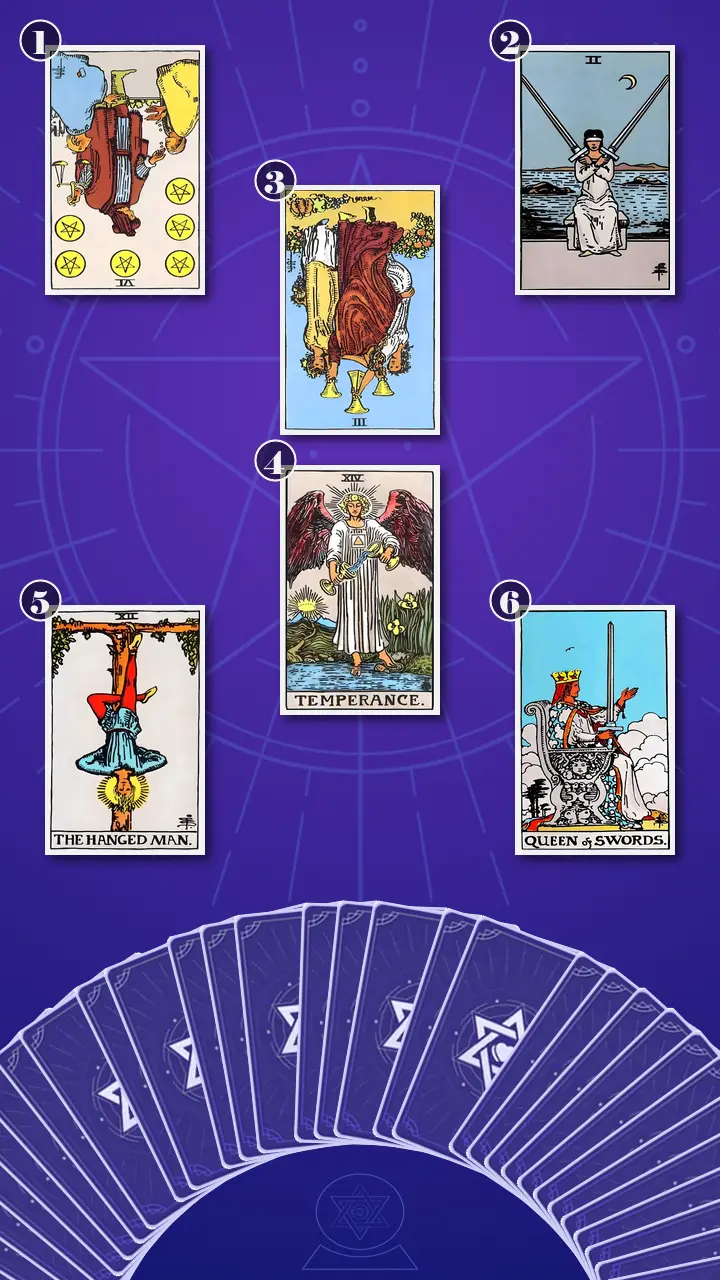
I chose the Relationship Spread · Context Edition, a six-card tarot spread for friendship triangulation, indirect communication, and boundaries. For anyone wondering how tarot works in a conversation like this, I use the images as an objective cognitive tool: each card gives us a visual structure for examining behaviour, responsibility, and choice. It is not a verdict about either friend, and it cannot force a reconciliation. It helps make a vague relational pattern specific enough to think about.
This spread suited Maya because the issue was interactional rather than a decision between two external options. A Decision Cross would have implied that she had to choose one path over another. The Relationship Spread could instead show her role, the friends’ shared avoidance, the triangle created between them, the kind of care that could remain, the cost of self-suspension, and the boundary that would return agency to her.
I explained the route before turning anything over. The first card would show Maya’s observable message-carrying role and emotional labour. The second would examine the friends’ stance toward direct communication. The third would reveal the shared relationship pattern. Temperance would point to a form of support with proportion, The Hanged Man would expose the pressure keeping her suspended, and the final card would offer a self-directed communication practice rather than a prediction about what anyone else would do.
Reading the Map in a Shadow Inbox
Position 1: The Uneven Weight of “Just Helping”
“Now I’m turning over the card representing Maya’s role in the relationship dynamic: the observable message-carrying behaviour and emotional labour identified in the presenting problem and defence strategy.”
The card was the Six of Pentacles, in reversed position.
At 12:36 p.m., Maya had two private chats open beside an unfinished agency task. One friend had asked, “What did the other one mean?” Maya had checked the second thread, reread three earlier messages, softened the wording, and distributed reassurance to both sides while her lunch went cold. The reversed scales on the card reflected that invisible allocation of time: both friends received interpretation and emotional access through her, while her own break, attention, and choice received almost nothing.
In an upright position, the Six of Pentacles can describe a balanced exchange of giving and receiving. Reversed, its energy becomes excessive and uneven. Maya was not simply offering support; she was holding the information, performing the labour, and paying for short-term harmony with time she had not freely chosen to give. “I said I was only helping,” I said, “so why are you now responsible for the wording, the delivery, and the reaction?”
After fifteen years as a perfumer, I developed a diagnostic I call Boundary Permeability Diagnosis. I use it to notice when someone else’s unprocessed tension is bleeding into a person’s space until that person can no longer tell where care ends and responsibility begins. I was not diagnosing Maya or judging her friends. I was identifying the point at which two people’s avoided conversation had entered her workday, lunch break, and body.
Maya gave a short laugh with no joy in it. She looked at the two phones on the table, then at her untouched water. “Damn,” she said. “That is exactly what I do. It’s almost rude how accurate that is.”
“The impulse to help is not the problem,” I replied. “The question is whether you offered support or quietly took ownership of an entire communication system. You are not ‘just helping’ once you become responsible for the wording, delivery, and reaction.” Her fingers rubbed the rim of the glass, and I saw recognition arrive with a little bitterness rather than immediate relief.
Position 2: The Empty Channel Between Two Closed Doors
“Now I’m turning over the card representing the two friends’ shared stance toward direct communication: the avoidance that creates the empty channel Maya keeps filling, without requiring us to guess their private motives.”
The card was the Two of Swords, in upright position.
Its traditional meaning includes stalemate, guarded judgment, and a decision held in suspension. Here, the crossed swords and blindfold translated cleanly into two read receipts appearing in separate chats while the shared group chat remained silent. Both friends had seen the awkward comment. Both had spoken privately to Maya. Neither had sent a direct question to the other.
The upright card was not a sign that Maya had failed to communicate well enough. It showed blocked air: difficult words held behind a defensive posture, calm on the surface because the actual issue had been moved somewhere else. “The empty channel between them is not automatically your shift to cover,” I said. “You can notice that the conversation is frozen without becoming the person who has to thaw it.”
I asked her to consider the last tense group-chat exchange. What had each friend said privately that they had not said directly? What verb had each request used: listen, interpret, forward, reassure, schedule, persuade? The distinction mattered. A request to be heard was not the same job as a request to deliver a message.
Maya’s chest tightened slightly. Her eyes moved toward the phone, as if she could see two separate message previews under the screen. “They’ve both seen the problem,” she said quietly. “So why does it feel like I’m the only person who can touch it?”
“Because the silence has been handed to you as an empty space,” I said. “But an empty space is not an assignment. Their choice not to speak directly may be uncomfortable to witness, yet it is still their choice to own.” Her breathing lengthened by one count. It was a small change, but the room no longer felt quite so dependent on her next reply.
Position 3: Three Glasses and a Shadow Inbox
“Now I’m turning over the card representing the friend-group triangulation itself: how private complaints, indirect messages, and divided loyalties keep the communication loop active.”
The card was the Three of Cups, in reversed position.
I brought her back to the Friday dinner at a crowded Queen West restaurant. Three glasses had stood on the same table. Low bass had pulsed through the floor, citrus cleaner had lingered in the air, and condensation had slicked the water glass beneath Maya’s fingers. Her two friends had avoided eye contact while one privately texted, “Why is she being so cold?” Maya had begun composing an explanation before the server had taken their orders.
The upright Three of Cups speaks of friendship, mutual support, shared celebration, and community. Reversed, the shared emotional field becomes misaligned. The three cups become three phones that appear connected to the same social circle while the honest conversation occurs in side channels. Each private exchange offers one friend a moment of closeness with Maya, but the group itself becomes less able to speak openly.
“Side-channel closeness can keep a group connected on paper while making honest contact less likely,” I said. “This is friendship triangulation as an observable pattern, not a moral failure and not proof that the friendship is fake.”
I asked her to map the information flow: what stayed in the group chat, what moved into private messages, and what she was expected to do with it. Maya went quiet. I watched her remember selective screenshots, softened paraphrases, and the way she had explained one friend’s tone before the other could react.
“Everyone is technically here,” she said, “but I’m still carrying two separate versions of the evening.”
That sentence held the knot. Belonging had become entangled with information control, and intimacy had become divided loyalty. The reversed Three of Cups did not ask Maya to expose private messages in the name of transparency. It asked her to stop feeding the shadow inbox and allow direct contact to exist, even when it was awkward.
The Care That Leaves Room to Breathe
Position 4: Temperance and the Measured Offer
“Now I’m turning over the card representing the form of care and belonging Maya can preserve without becoming the messenger, directly addressing the fear that boundaries will cause exclusion.”
The card was Temperance, in upright position.
Temperance brings moderation, integration, patience, and the ability to hold differences without forcing them into immediate agreement. Its two cups do not show an endless transfer of messages. They show a measured exchange, one foot on solid ground and one in water, with the figure remaining connected to both without dissolving into either.
I offered Maya a modern translation. A friend could call to vent. Maya could listen for ten minutes, say, “That sounds painful,” and ask, “Do you want help identifying what you want to say directly?” If the friend then asked her to deliver the complaint, Maya could decline. Care would remain available, but the words would stay with the person who had chosen them.
As I spoke, I thought of my work with fragrance. A balanced composition does not erase every strong note; it gives each note enough space to remain recognisable. If too much of one accord bleeds into the next, the whole atmosphere becomes difficult to breathe in. My job as a perfumer has taught me that boundaries are not walls against connection. They are the spacing that allows connection to remain clear.
Maya leaned back and let her hands rest flat on her thighs. “I always thought the options were either fixing it or being cold,” she said.
“Temperance offers a middle path,” I told her. “You can listen without fixing, support without interpreting, and care without arranging the conversation. The useful question is not ‘How do I make them resolve this?’ It is ‘What support can I freely offer without taking over the exchange?’”
Position 5: The Life Kept in Pending
“Now I’m turning over the card representing the sacrifice-agency split: the specific point where Maya suspends her own boundary and confuses self-abandonment with keeping the group stable.”
The card was The Hanged Man, in upright position.
This card is the main blockage in the spread. Its traditional meaning includes suspension, sacrifice, surrender of control, and a changed point of view. Maya had been calling self-suspension patience. She waited to sleep until both friends’ tones looked calm. She postponed her own preferences until everyone else seemed comfortable. She treated discomfort as proof that intervention was required.
At 10:56 p.m., she had held her phone above her pillow and waited for both reply indicators before allowing herself to close her eyes. “Not yet,” the thought had run. “I can’t step away while this is unresolved. If I leave it alone, I’m abandoning them.” But the message belonged to the friend who had written it. Maya’s sleep and agency had been placed on hold while someone else avoided pressing send in the correct chat.
Her stomach dropped as I said this. First, her thumb stopped moving and her breath caught. Then her gaze went unfocused, replaying late nights, postponed plans, and the quiet dread that followed every delayed reply. Finally, she gave one reluctant nod, her shoulders lowering by a fraction as she admitted, “I can handle being tired more easily than I can handle everyone being upset with me.”
“That is the fear underneath the messenger role,” I said gently. “You have been trying to prevent a rupture because a rupture might seem to prove that you only belong when you are useful. But guilt can arrive when a role changes; it does not get the final vote on your boundary.”
The Hanged Man did not demand a dramatic withdrawal. It asked Maya to pause the automatic intervention long enough to discover whether non-intervention could be a conscious choice rather than abandonment. The uncomfortable gap was not evidence of danger. It was the first place where her own decision could appear.
When the Queen of Swords Cleared the Air
Position 6: The Boundary That Returns the Message
The room grew quiet before I turned the final card. This was the antidote position: the self-directed communication practice that could return each person’s words to them and answer Maya’s question through agency rather than a decision made for anyone else.
“Now I’m turning over the card representing a clear, self-owned way to engage with the relationship: a boundary that allows you to care without becoming the group’s channel.”
The card was the Queen of Swords, in upright position.
Her upright sword, direct gaze, open hand, and solid stone throne offered discernment without cruelty. In everyday language, this was the friend texting, “Can you tell her why I’m upset?” and receiving: “I care about you, but I won’t pass messages or interpret what they meant. Please ask them directly.” No screenshot. No softened version. No monitoring of both replies.
As a perfumer, I also use a second diagnostic lens called Vibe Contamination Auditing. I do not use it to call a person toxic or to decide whose feelings are valid. I audit the atmosphere that enters someone’s space: whose unprocessed tension is being carried into work, dinner, sleep, and self-worth? With Maya, the message itself was not contamination. The unowned responsibility attached to it was. Her boundaries had become permeable enough for every pause, vague caption, and private complaint to alter the air around her.
The Queen of Swords changed that architecture. Her sword did not cut either friend out. It separated the message from Maya’s responsibility. The direct gaze refused to invent hidden motives. The open hand kept compassion available. The throne stayed still when someone else felt disappointed.
The Sentence That Returned the Weight
At 10:48 p.m., I asked Maya to picture the next notification: “What did she mean by that?” Her phone would glow beside a cold mug, her chest would tighten, both private chats would open, and she would start rewriting a sentence whose original speaker had not agreed to own it.
“That is the old route,” I said. “It offers ten minutes of relief by making you responsible for the whole road.”
You do not need to sacrifice your agency to keep the group connected; let the Queen of Swords' upright blade separate your responsibility from theirs, then speak one clear boundary directly.
For several seconds, Maya did not move. Her breath stopped first, and her fingers remained suspended above the blank screen. Then her eyes lost focus as the week replayed across her face: the cold lunch, the Queen West dinner, the late-night waiting. Her jaw tightened once. When she looked down, her hands slowly opened, as if she had been holding invisible coins.
Her shoulders sank, but the release brought a brief, almost dizzying emptiness with it. The responsibility had been heavy, and the absence of it felt unfamiliar rather than instantly comfortable. Her eyes grew wet. “So I can care about this person,” she said, her voice low and slightly unsteady, “without becoming the delivery method.”
“Exactly,” I said. “Care does not require you to become the route between two people who will not speak. Clarity begins when each person carries their own words.”
I invited her to use the new perspective to recall the previous week. “Was there a moment when this distinction could have made you feel different? Not perfectly calm, but less recruited?”
Maya closed her eyes. I watched a thought move through her expression, from resistance to recognition. “Sunday night,” she said. “I could have let the person who wrote the message decide whether to send it. I would have hated the silence, but the silence wouldn’t have been mine to solve.”
This was the first real movement from hypervigilant message-carrying and usefulness-based belonging toward direct self-owned communication, compassionate boundaries, and steadier belonging. The cards had not solved the friendship. They had shown Maya where her responsibility ended, and she was the one who could choose to honour that line.
From the Shadow Inbox to Finding Clarity
When I placed the six cards together, I could see a coherent system rather than a villain. Maya’s project-coordinator instincts had taught her to unblock every stalled process. The reversed Six of Pentacles showed that skill becoming unequal emotional labour. The Two of Swords showed the friends’ direct communication held behind separate private chats. The reversed Three of Cups showed side-channel closeness turning belonging into divided information. Temperance offered care with proportion, while The Hanged Man exposed the hidden price of waiting for everyone else’s comfort. The Queen of Swords gave Maya a direct line back to herself.
The blind spot was subtle: Maya had been treating the group’s temporary calm as proof that her intervention was necessary. She had mistaken usefulness for belonging and guilt for a reliable moral signal. Her relaying created short-term movement, but it also protected the original speakers from experiencing the conversation that belonged to them.
The transformation direction was therefore not from caring to detachment. It was from managing other people’s connection to choosing her own participation. Care could stay. The courier role could end. A friendship boundary did not need to be hostile, public, permanent, or forced. It needed to be clear enough that Maya could act without translating someone else’s feelings into a safer version.
“Let’s make this practical,” I said. “A boundary becomes easier to trust when you test it in small situations and record what actually happens, rather than asking your fear to predict the entire future of the group.”
- Separate listening from carryingDuring the next private conversation in which one friend asks, “What did they mean?” ask, “Do you want me to listen for ten minutes, or help you plan what you want to say directly?” Choose only one role. Do not open the other private chat or offer to forward anything.If listening without fixing feels useless, use the minimum version: “Do you want listening, or are you asking me to pass something on?”
- Use the Return-to-Speaker BoundarySave this sentence in your phone Notes app and use it once this week in response to a real triangulating request: “I care about you, but I won’t pass messages or interpret what they meant. Please ask them directly.” After sending it, put the phone face down for ten minutes instead of monitoring the reply.If the request comes again, send only: “My answer is the same: I’m not going to be the go-between.” You do not need to build a case for why your boundary deserves approval.
- Practise the Space Calibration RitualWhen a message about the other friend arrives at night or during work, mute only that relevant thread, move the phone to a physically blank space for seven minutes, and open a note with three lines: “What was I asked to carry?”, “Who actually owns it?”, and “What support can I freely offer instead?” Then draw two headings, “Mine” and “Theirs,” and place your feelings and chosen words on one side, their message, reaction, and decision to speak on the other.Do not paste private screenshots into the note. If seven minutes feels too much, name only the owner of the message and take one slow breath before deciding whether to reply.
I reminded Maya that these next steps were experiments, not tests of whether she was a good friend. She could still book the table, listen to a difficult feeling, or show up with warmth. She did not have to arrange everyone’s emotional weather before earning the right to enjoy dinner herself.

A Week Later, the Air Stayed Clear
Four days later, Maya sent me a message: “I used the sentence. I didn’t forward the screenshot. I put my phone face down for ten minutes.” One friend eventually chose to speak directly; the other did not answer that night. Nothing dramatic happened, and nothing was magically repaired. Maya simply discovered that the group could survive one honest limit.
At the next group dinner, she booked the table but did not choose the least awkward seats. One friend spoke directly; the other stayed quiet. Maya noticed the familiar pinch, ordered her own dessert, and let the silence belong to them.
“I still felt guilty,” she told me afterward. “But the guilt didn’t feel like a command this time.”
That was her small proof. The knot had not vanished forever, and the path was not perfectly bright. But she had created a little breathable space between caring and carrying. Tarot had offered a map; Maya had reclaimed the right to decide which road was hers.
When your phone lights up with another message to carry, that familiar knot in your stomach may not be only about keeping the peace. It may also be the fear that your place in the group will disappear if you stop being useful. If your belonging did not have to be earned by carrying someone else’s words, what is the smallest return-to-speaker sentence you might allow yourself to imagine saying: “I care about you, but I won’t be the route between you”?