After a Public Breakup: A Seven-Day Boundary Toward Private Closure

The 12:40 a.m. Comment Thread
If you are a freelance creative in a high-rent city whose job requires being online, Public Breakup Anxiety can look like opening Instagram to post client work and ending up forty minutes deep in your ex's comments.
When Jordan sat across from me in my Toronto studio, I could still picture the scene she had described: 12:40 a.m. at a small kitchen table, a client document glowing on her laptop while an old Instagram comment thread refreshed on her phone. The refrigerator hummed. Streetcar wheels scraped faintly somewhere beyond the window. Her phone was warm against her palm, her jaw clenched, and her fingers kept editing an unsent statement.
Jordan told me, 'I want closure, but I keep treating the breakup like an argument I can still win. I know checking will hurt, but not checking feels like letting them control the story.' She had been checking the ex-partner's posts, scanning comments from mutuals, collecting screenshots, asking friends what people were saying, and drafting public explanations she never sent. The problem was not simply whether to mute, block, archive, or post. It was the collision between reclaiming personal closure and feeling trapped by the breakup's public exposure.
I watched her exposed hurt move through her body like a smoke alarm wired directly to her hands: a tight chest, an unsettled stomach, restless fingers reaching for the phone whenever uncertainty spiked. Anger gave her enough energy to investigate, then shame and longing pulled her back into the same mental replay. I said, 'I can understand why checking feels like protection when the public version seems capable of erasing what you lived. We do not have to make you disappear from the internet or force you to forgive anything today. Let us make a map through the fog, so closure can become something you author rather than something an audience grants.'
Choosing a Map When the Feed Feels Like a Verdict
I invited Jordan to put both feet on the floor, take one ordinary breath, and focus on the question beneath the question. I shuffled slowly, using the movement as a practical transition from reacting to observing. The cards were not a verdict or a supernatural command; they were a structured way to notice the pattern, name the choices inside it, and test a boundary in real life.
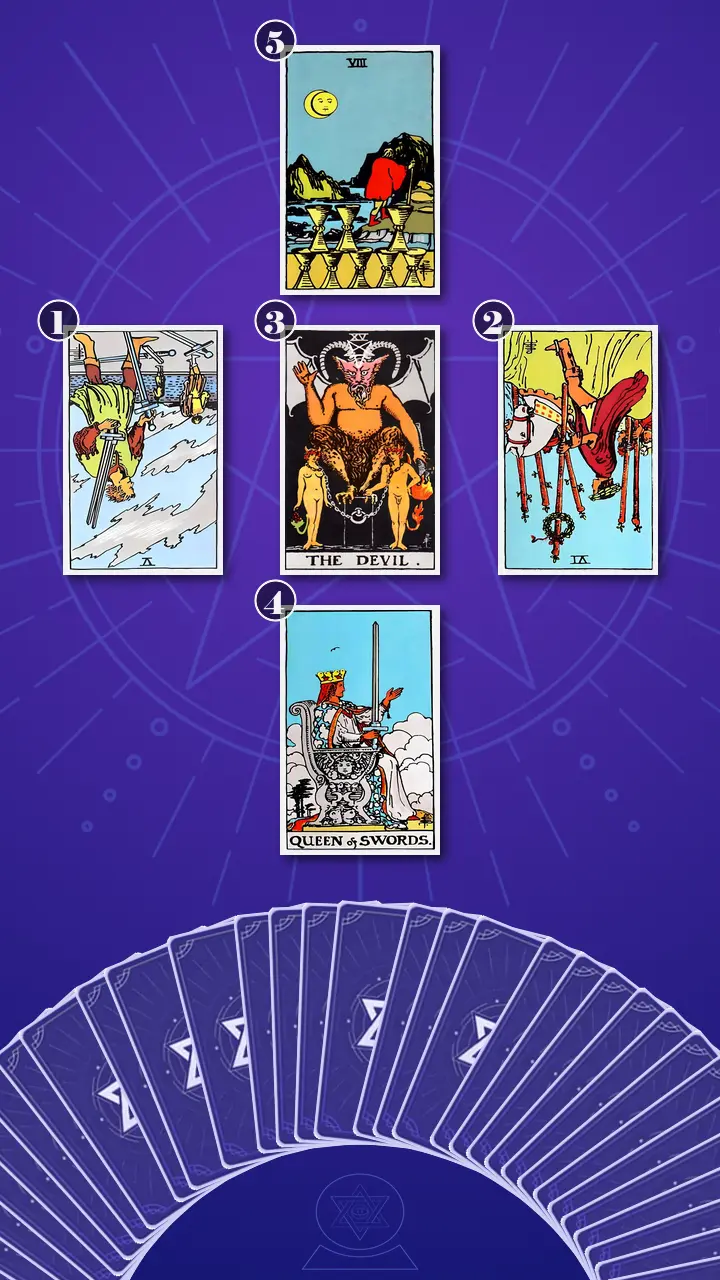
Today, I used the Relationship Spread · Context Edition, a five-card relationship tarot spread for breakup closure and digital boundaries. I chose it because Jordan's difficulty was organized around one relational and public axis: her present behaviour, the observable online field, the bond that kept the loop alive, the lesson that could interrupt it, and a self-directed way forward. A ten-card Celtic Cross would add environmental and outcome layers that were not necessary here. The smaller spread gave us enough structure to hold the emotional truth without pretending to know the ex-partner's private motives or predicting the relationship's future.
For anyone wondering how tarot works in a situation like this, the positions create a sequence. The first card reveals the current behavioural and emotional knot. The second looks only at visible public signals and the audience response Jordan has turned into an external verdict. The central card exposes the attachment loop. The card beneath it names the boundary lesson, and the card above it points toward an actionable next step. I would begin at the left, cross the public field, return to the knot, descend to the grounding lesson, and then rise toward movement.
Reading the Map, One Public Signal at a Time
Position 1: The Argument Still Running After Everyone Left
I began with the card representing the present behavioural and emotional knot: Jordan's repeated checking, rebuttal drafting, and inability to let the public conflict become finished. I turned over the Five of Swords, reversed.
The central figure in this card is still gathering swords while two people walk away toward the water. That contrast immediately connected with the scene Jordan had brought me. At 12:40 a.m., no practical response was required, no client was waiting for a breakup statement, and nobody had asked her to produce a timeline. Still, she kept one more screenshot, one more reconstructed conversation, and one more paragraph within reach. Putting the evidence down felt less like rest and more like conceding the public argument.
Reversed, the Five of Swords turns the energy of conflict inward. The fight may have ended in the room, but its logic continues through mental rehearsals, notes-app rebuttals, and the question of who gets the last word. This is not a lack of information. It is an overactive form of air, thought circling the same sharp object until analysis begins to feel like safety. Its hidden potential is discernment: Jordan can notice the exact conflict behaviour she is still practicing and decide whether to stop practicing it for one week.
I asked, 'The last time you opened that comment thread, what did you hope the next edit would settle?'
Jordan gave me a short, bitter laugh instead of nodding. 'That is painfully accurate. I know another edit will not end this, but putting the draft down feels like admitting their version won.' Her fingers hovered above the mug between us, then closed around it without lifting it. I could see recognition arrive with a small sting: winning the final exchange was not the same as actually finishing the conflict.
I did not ask her to prove that she was ready to let go. I said, 'The card is showing a private rehearsal, not judging you for having one. We can be precise about what it gives you for thirty seconds and what it costs you for the next hour.'
Position 2: The Crowd's Unappointed Scoreboard
Next, I turned to the card representing the ex-partner's observable public signals and the surrounding audience response that Jordan had made into an external verdict. I was careful with this position: it could show what was visible, but it could not tell us what the other person privately felt or intended. The card was the Six of Wands, reversed.
The rider's wreath and the crowd around the raised wand became likes, supportive comments, follower changes, tags, story views, and mutuals going quiet. In Jordan's real life, she opened a post and read every name beneath it. A supportive comment from someone she knew made her stomach drop. A silence became a side taken. A follow or unfollow became evidence. She even considered posting an unusually polished update so her composure could answer a verdict nobody had formally delivered.
The reversed Six of Wands shows recognition becoming unstable when it is used as a measure of credibility or worth. It resembles opening an Instagram analytics dashboard to decide whether a memory is trustworthy, even though likes and story views can measure attention but not truth. I mentioned the social-rating anxiety of Black Mirror's Nosedive as a shorthand, but I kept the focus on the ordinary mechanics of her phone: a metric appears, the body reacts, and the mind assigns it a meaning larger than the data can carry.
I asked, 'When you saw the latest post, what did you observe directly, and what verdict did your mind add to it?'
Jordan looked down at her hands. 'If they liked that post, they must believe that version. If they stayed silent, they must have chosen a side.' She named comments first, then story views, then one mutual contact's silence. Her face warmed with embarrassment, but I saw her relief too; separating visibility from credibility gave her something sturdier than reassurance.
I told her, 'An audience can witness a breakup; it cannot certify your experience.' A public field can contain fragments, reactions, and incomplete context. It cannot become the courtroom in which Jordan's memory is either admitted or rejected.
Position 3: The Loose Chain of Protection
I placed my hand over the central position, the card that would expose the Betrayal-Closure Lock linking attachment, lost narrative control, compulsive monitoring, and renewed emotional attachment. I turned over The Devil, upright.
I brought Jordan back to the packed 504 streetcar. A friend had sent a screenshot captioned, 'You probably need to see this.' Wet coats smelled faintly of rain. The brakes shrieked at the next stop. Before the doors opened, Jordan had searched the ex-partner's profile, compared likes, scanned the comments for mutuals, and felt a brief flash of certainty. Then three new questions appeared, and the morning she needed for client work was gone.
The Devil made the pattern physical. The notification was the trigger. The profile search and comment scan were the action. The few seconds of feeling prepared were the reward. Renewed exposure was the cost. The card's chains hang loosely around the figures' necks, and that detail mattered more to me than the imposing figure above them. The loose chain is not a blame symbol; it is a choice point. Access can feel mandatory without being entirely outside choice.
I said, 'Monitoring feels like protection when uncertainty feels like danger. That does not make you foolish, and it does not mean the original betrayal was acceptable. It means your nervous system has learned to treat access as preparation.'
I watched three small reactions move through Jordan in sequence. First, her breath paused and her phone hand went completely still. Then her eyes lost focus as if the streetcar scene were replaying behind them: the screenshot, the search bar, the names, the momentary relief. Finally, a low sound left her chest, almost an 'ah,' and her shoulders dropped a fraction. She whispered, 'I hate what this does to me, but the next update might finally make me feel prepared.'
I answered, 'Prepared for what? To feel less exposed, or to have one more reason to stay exposed?' The question was not meant to corner her. It was meant to show the difference between monitoring and protection, between access and control. The Devil did not say Jordan was powerless. It showed where the loop had begun impersonating power.
When the Queen of Swords Raised Her Blade
Position 4: The Boundary That Can Hold Grief
The room grew very quiet when I reached the card representing the central challenge and lesson: separating factual self-knowledge from public approval through clear language, discernment, and an enforceable boundary. I turned over the Queen of Swords, upright.
Her sword was raised, but her other hand remained open. To me, that combination said that clarity did not require emotional numbness. Jordan could acknowledge betrayal, anger, shame, and longing while still deciding which channels of contact and exposure no longer served her healing. The Queen's upright air was disciplined rather than frantic. She did not ask, Who believes me? She asked, What do I know, and what will I permit next?
The modern-life translation was concrete. Jordan could write a private account divided into facts, unresolved questions, and audience speculation. From that account, she could choose one observable rule: for seven days, she would not request, accept, or search for social updates unless a concrete safety, work, legal, property, or essential logistical issue required it. The rule would not erase the betrayal. It would stop public reaction from serving as evidence about her experience.
This is where I used one of my signature lenses, Toxic Script Identification. I named the roles the loop had been assigning: Jordan as the Prosecutor, the feed as the courtroom, and mutual contacts as an unappointed jury. Every screenshot became Exhibit A. Every unsent paragraph promised to make the case airtight. I was not diagnosing Jordan, assigning motives to the ex-partner, or claiming that every mutual had chosen a side. I was identifying a repetitive, destructive script so Jordan could stop auditioning for it.
Then I used my Dialogue Loop Auditing lens. The triggering phrases were small but consistent: 'You probably need to see this.' 'Send it, I need to know.' 'I should explain one more time.' Each phrase moved her from uncertainty to evidence gathering, then from evidence gathering to an imagined public reply. The loop always ended at the same dead end: another explanation waiting to be perfected.
At 12:40 a.m., the client document is still open while your thumb returns to the same comment thread. You edit the statement again, because closing the app feels less like rest than surrendering your side of the story.
You do not need the crowd to deliver a verdict; name what you know, enforce the boundary, and let the Queen of Swords' raised blade separate your healing from the public argument.
Closure becomes private property the moment public agreement stops being your evidence.
I let the sentence remain between us. Jordan's thumb froze above the screen. For one beat, her face went blank, then her eyes widened as the words reached the part of the problem that more screenshots had never touched. Her clenched jaw loosened unevenly. She looked at the blank space beside the phone, as though a private document might be waiting there. Her fingers curled into a fist, released, and flattened against the table. When she spoke, her voice was quiet and rough. 'My experience does not become less true because I stop presenting evidence to people who are not deciding my life.' She inhaled, but the breath wavered halfway through. Relief arrived first as a physical lowering of her shoulders, followed by a brief, almost dizzying emptiness. Without the argument to manage, there was room for grief. Without the crowd to persuade, there was also responsibility: she would have to choose the boundary and keep choosing it. I asked, 'Now, use this new perspective to revisit last week. Was there a moment when this insight could have made you feel different?'
Jordan thought of the screenshot that had arrived during her commute. She could not change the person who sent it, the comment that followed, or the version of events someone might privately believe. She could change whether the next hour belonged to the feed. This was the key shift from exposed hurt and audience-driven vigilance toward self-trust, private closure, and emotional steadiness. Not a perfect ending. A first separation between grief and public proof.
The Path That Does Not Need a Witness
Position 5: Leaving the Incomplete Version
For the final card, I turned over the one representing the self-directed next step and constructive direction emerging from the reading. It was the Eight of Cups, upright.
The red-cloaked figure walks toward difficult, moonlit terrain while the stacked cups remain behind, with a visible gap among them. I connected that image to a small decision Jordan could make without redesigning her whole digital life: mute the ex-partner's account for seven days, ask one trusted friend not to forward screenshots, and decide in advance what would receive the recovered attention. The public story might remain incomplete. Some mutuals might never know the full timeline. Feelings might still arrive uninvited. None of that prevented a deliberate departure.
The Eight of Cups did not predict what the ex-partner would do next, and it did not demand permanent blocking, forgiveness, silence, or reconciliation. It offered a practical direction: leave one emotionally depleted channel while remaining present for work, safety, legal matters, and essential logistics. This was different from the Five of Swords, where other figures walked away while Jordan kept collecting arguments. Here, Jordan could become the person who redirected her own attention.
I said, 'You do not have to complete the public story to leave its comment section.'
Jordan's hand moved toward her phone, then stopped. She did not mute anything in that instant, and I was glad she did not turn insight into a performance for me. Instead, she wrote down one channel she might leave and one thing that could receive the time: finishing a client invoice, eating dinner with a friend without reviewing screenshots, sleeping, or grieving somewhere no audience could interrupt. I saw a small, believable loosening. The cups were not magically full. She was simply no longer treating their incompleteness as a command to stay.
From Public Proof to Private Clarity
When I placed the five cards together, I saw a coherent story. The reversed Five of Swords showed the old conflict being kept alive through rebuttals and reconstructed timelines. The reversed Six of Wands showed that public reactions had become a scoreboard, even though a scoreboard cannot measure truth. The Devil gathered both forces into a bond: every update promised protection, delivered a few seconds of control, and renewed the exposure. The Queen of Swords supplied the missing standard, and the Eight of Cups gave that standard somewhere to go.
I told Jordan that the cognitive blind spot was not caring too much or failing to move on. It was assuming that more information was the missing ingredient, when the missing ingredient was a container for the information she already had. Because no Pentacles appeared in the spread, insight and emotion needed a practical routine beneath them. A boundary written only as an intention could be renegotiated by the next notification. A boundary attached to a duration, an observable action, and clear exceptions could give her nervous system something steadier to follow.
The transformation direction was from exposed hurt and audience-driven vigilance to self-trust, private closure, and emotional steadiness. I said, 'The Queen of Swords gives you the sentence. The Seven-Day Signal Boundary gives that sentence a body. The Eight of Cups gives your attention a destination. None of these asks you to pretend the betrayal did not happen. They return authorship to you.'
I also offered Jordan my Pattern Interruption Script, a short role-play directive for changing a default response when a known trigger appears. We rehearsed it once, without trying to make it sound polished.
'The trigger is a message that says, You probably need to see this,' I said. 'The old line is, Send it, I need to know. The interruption is, I am protecting my attention for seven days. Please do not send breakup screenshots or updates unless this concerns safety, work, legal matters, shared property, or essential logistics. If it does, send only the practical information.'
That script did not control the sender, rewrite the public record, or promise that Jordan would never feel the urge to check. It gave her a response ready before the spike, which was exactly when her usual language disappeared. A boundary is what your clarity does next.
I asked Jordan to treat the following as a small experiment rather than a permanent declaration.
- Write My Account, Not My ArgumentOn one evening this week, set a ten-minute timer and open a private phone note with three headings: What I know; What I may never get confirmed; What I will no longer monitor. Move the public-statement draft into a private archive folder and add a 24-hour hold before publishing anything about the breakup. Under the final heading, write one observable rule, such as: For seven days, I will not open the ex-partner's profile or search their name from another account. Add one factual exception for safety, work, legal matters, shared property, or essential logistics.Use one sentence per heading if ten minutes feels heavy. The note is a record, not a perfect account that needs anyone else's approval.
- Create a Seven-Day One-Channel ExitChoose one exposure route this week: the ex-partner's profile, a shared hashtag, archived tags, a mutuals group chat, or unsolicited screenshots. Use mute, restrict, hide, archive, keyword-filter, or notification controls on that one channel for seven days. Text one trusted friend with the Pattern Interruption Script, then place a replacement beside the old checking cue: open the client task list, walk one block, text about a non-breakup topic, or play one saved audio track.If seven days feels too large, begin with one evening or one commute. This is an attention experiment, not a permanent decision and not a statement about forgiveness.
- Protect Work Without Reopening the BreakupBefore the next workday, remove social apps from the phone's first home screen and turn off breakup-relevant push notifications. Schedule two fifteen-minute, work-only social windows for client replies, posting, and analytics, then close the platform when each timer ends. Mark one of seven boxes for whether the boundary was kept, without scoring your mood or demanding perfection.If the boundary is crossed, write the trigger in five words or fewer, reset at the next hour, and do not turn one check into a reason to abandon the experiment. Keep work access intact while reducing the known route of emotional exposure.
A Week Later, the Quiet Proof
Six days later, I received a message from Jordan while I was making tea. She had written the three-line note, moved the statement out of her drafts, muted one account, and asked a friend not to send screenshots. The next time Instagram was necessary for a client upload, she posted the asset, closed the app when the work window ended, and used the recovered twenty minutes to send an invoice. It was a small act, but it belonged entirely to her.
She also told me that the public story was still incomplete. She had slept a full night, but woke with the old thought, 'What if I am wrong?' This time, she smiled, wrote the thought in the margin of her private note, and made coffee before opening her work account.
I did not read that as a magical resolution. I read it as the first evidence of emotional steadiness: the urge could arrive without automatically becoming an instruction. Our Journey to Clarity had not made the audience agree. It had helped Jordan stop appointing the audience to finish her life. She had taken the pen back, one sentence and one boundary at a time.
When a breakup becomes public, I know how the tight-chested urge to turn back and correct the room can feel like the only proof that what happened mattered. Walking away can resemble letting strangers erase what you lived. But clarity is not the crowd's verdict; it is the moment your own account remains true even when you stop presenting evidence.
If your experience could remain true without a public verdict, what small piece of your attention might you feel ready to bring back to yourself, perhaps one quiet hour you can reclaim from the comment section and give to your work, your rest, your friendships, or your private grief?