Six Career Tabs, Then One Three-Line Message: Owning the Choice

Finding Clarity in the 10:43 p.m. Career Spiral
If you are a 27-year-old Toronto project coordinator with six career tabs open after work, one confident voice note can turn an almost-made choice into full career pivot anxiety. Maya brought that exact moment into our late video consultation.
At 10:43 p.m., I could see her sitting under the yellow range-hood light in her small apartment kitchen. A spreadsheet occupied most of her laptop screen, with LinkedIn, three job postings, and a half-finished internal application behind it. The fridge hummed. Her tea had gone cold. Her phone, still warm in her palm, held two unplayed voice notes from friends.
“Everyone has a convincing reason, which is exactly the problem,” she said. “I can explain every option, but I cannot seem to pick one. What if the advice I ignore is the advice that would have saved me?”
As she spoke, I watched her jaw lock and her fingers drum against the trackpad. What she called confusion looked less like ordinary fog and more like trying to read a TTC map while six strangers peeled off the line labels and stuck them somewhere new. She wanted to make a career choice, yet every recommendation seemed to create another condition she had to satisfy before she was allowed to move.
“More advice is not always more clarity,” I told her. “And nothing about this suggests that you are incapable of choosing. It suggests that your current method gives every outside voice equal authority. I am not going to use tarot to tell you which career guarantees success. I want us to use it as an objective map of the decision process itself, so we can find where your own judgment has become difficult to hear.”
I invited her to leave the spreadsheet open without touching it. “Let us see whether we can draw a map through this crowd of opinions. You will still be the person who decides where to walk.”

Choosing a Map for the Advice Maze
I asked Maya to place both feet on the kitchen floor, take one unforced breath, and hold one question in mind: “Why does every new piece of advice make my choice harder?” I shuffled slowly. The pause was not a mystical performance; it was a practical transition from reacting to the latest message toward examining the whole pattern.
I chose the Four-Layer Insight Ladder · Context Edition. For anyone wondering how tarot works in a case of analysis paralysis, this spread does not rank career paths or predict a predetermined outcome. It examines a system. A conventional decision spread might compare operations, project management, UX, or another route, but Maya's deeper problem was that every new route automatically reopened the entire case.
The four cards would form a narrow line from left to right. The first position would reveal the visible habit of resetting the decision. The second would expose the fear that kept that habit in place. The third, the reading's catalyst, would identify the discernment needed to separate relevant evidence from external noise. The fourth would turn that discernment into one small, reversible career experiment.
I placed the cards so the first two formed the diagnosis and the final two formed the response. Between the second and third cards, I left a little more space. To my eye, it resembled a constricted path opening toward a garden gate.
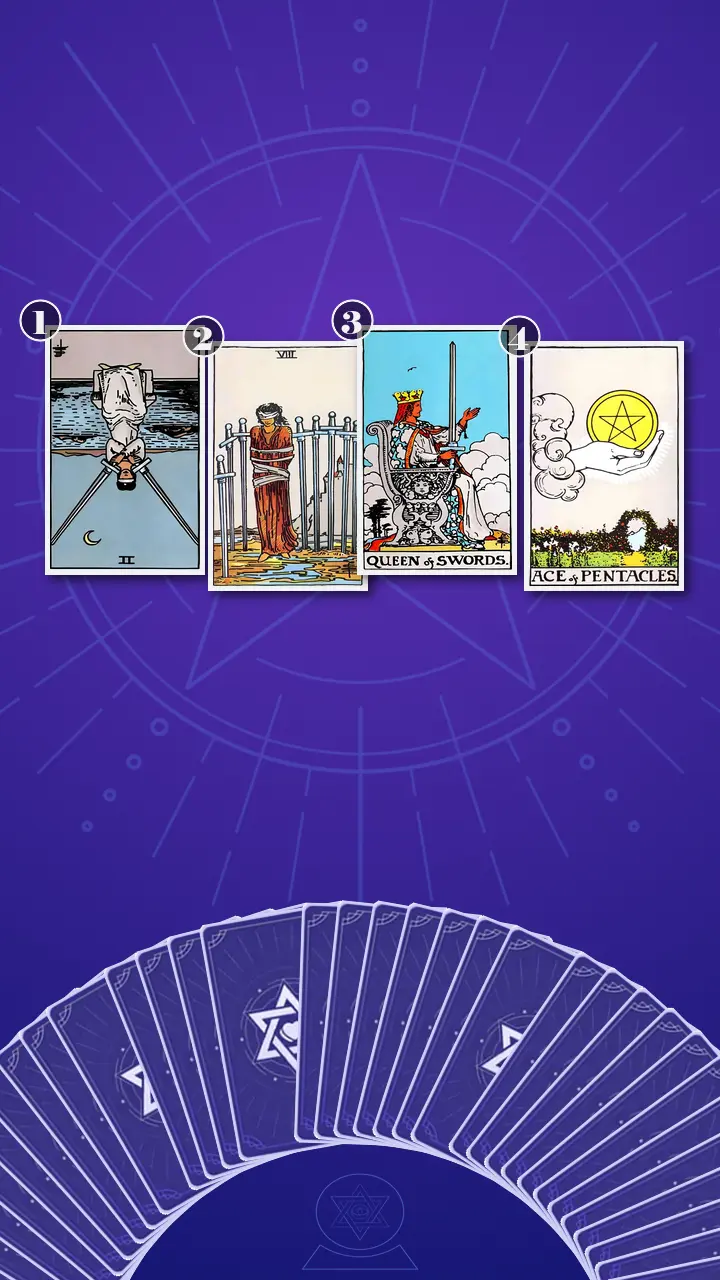
Reading the Loop That Looked Like Research
The Surface Pattern: Two of Swords Reversed
I turned over the card representing the surface pattern: reopening the choice whenever a new opinion arrives. It was the Two of Swords, reversed.
The traditional image shows a blindfolded figure holding two crossed swords in a tense equilibrium. In Maya's life, those swords were not two neatly defined career options. They were the spreadsheet columns, saved posts, Slack messages, salary videos, Reddit threads, and incompatible recommendations she was trying to hold in a permanent tie.
At 10:43 p.m., she had a half-finished internal application and enough information to take one exploratory step. Then a friend recommended staying in operations. Instead of receiving that suggestion as one data point, Maya added a column labelled “What Jess said,” revised the scoring system, and postponed the application again. Each incoming opinion pushed the actual decision farther off-screen, like a Google Sheet expanding until nobody could remember what question it was built to answer.
I described the reversed card as a combination of blocked judgment and excessive comparison. The problem was not a deficiency of information. It was that no information was permitted to become less important than anything else. Her private contrast was stark: “I am being thorough” on one side, and “I have postponed the same decision three times” on the other.
“When was the last time you were nearly ready to send something, then one new opinion made you reopen the whole decision?” I asked.
Maya gave one short laugh, but no smile followed it. She looked at the open spreadsheet and rubbed the heel of her hand along her jaw. “That is so accurate it feels a little brutal. Yesterday I drafted a message to my manager about cross-functional work. Then someone told me project management was a dead end, so I deleted it and researched three completely different jobs.”
“The accuracy is not an accusation,” I said. “This card is naming a strategy that has been trying to protect you from regret. It gives short-term relief because you do not have to own a choice tonight. The cost is that tomorrow arrives with more material and less trust in your judgment.”
I also cautioned her against the reversed card's overcorrection. The answer was not to reject every friend, close every tab in a burst of frustration, and make a rushed choice. The useful shift would be quieter: decide which criteria matter before the next piece of advice arrives.
The Maintaining Mechanism: Eight of Swords Upright
I turned over the card representing the maintaining mechanism: the fear that an imperfect choice would prove a loss of control. It was the Eight of Swords, upright.
I do not treat upright cards as automatically positive or reversed cards as automatically negative. Here, the Eight showed constricted Air energy: thought had stopped functioning as a tool and had become an enclosure. The blindfolded figure appears surrounded by swords, yet her hands are only loosely bound and open ground remains nearby. The restriction feels total from inside the image, but it is not absolute.
I asked Maya for the exact sentence that appeared when she imagined replying to a recruiter or submitting one application.
She looked away from the camera. “If I get this wrong, it means I should have known better. It means I am not actually in control of my life.”
She then described standing in her downtown office lobby at 8:16 one Thursday morning, coffee cooling through its cardboard sleeve while she reread a polished Instagram post about someone who had “pivoted successfully” at 27. The lift chimed, but she barely heard it. Her shoulders had crept toward her ears as the same thought returned: “What if the one opinion I ignore is the one that would have saved me?”
The Eight of Swords translated that moment precisely. Maya was treating a 20-minute exploratory call like an irreversible terms-and-conditions agreement. It had the logic of a Severance-style office maze: from inside the system, every corridor looked permanent. Yet the available action was only a reply, a conversation, or an application. None of those required her to declare a permanent identity.
“The fear is real,” I said, “but the permanence is not verified. You have made perfect certainty the entry requirement for movement, so research has become a loading screen whose progress bar can never reach 100 percent.”
Her thumb stopped moving across the phone case. First her breathing paused. Then her gaze lost focus, as though she were replaying several almost-sent messages. Finally, her shoulders lowered by a fraction and she released a quiet breath.
“So delaying feels like control,” she said, “even though it is making me feel less in control.”
“Exactly. And you are not behind because you cannot turn every opinion into a plan. The opening in this card is the freedom to treat your next move as a test instead of a permanent verdict.”
When the Queen Raised Her Sword Against the Noise
The Transformation Lens: Queen of Swords Upright
The room seemed to become quieter when I reached for the third card. Even the refrigerator hum receded beneath the brief silence. I turned over the card representing the transformation lens: discernment that separates relevant evidence from persuasive noise. It was the reading's key card, the Queen of Swords, upright.
Her uncovered gaze immediately changed the visual language of the spread. The first two figures were blindfolded; the Queen looked directly ahead. Her sword stood upright, not as a weapon against caring friends, but as a clean instrument of distinction. Her energy was balanced Air: analysis used deliberately, with boundaries, instead of analysis circling without an exit.
In practical terms, the Queen receives a friend's confident recommendation without automatically adding that friend's preferred career to the active decision. She extracts the useful fact, checks it against her own standards, and leaves the rest where it belongs. She can value the relationship without outsourcing the judgment.
I used a lens I call Historical Crossroad Matching. On archaeological digs, I learned that an old junction rarely proves one road was universally correct. Each route served a destination. A merchant recommended the road to the market; a pilgrim cared about the shrine; a military planner prioritised defensible ground. Their certainty could be sincere while their maps still answered different questions.
“Your friends are offering routes from their own destinations,” I told Maya. “One values rapid salary growth. Another values creative identity. Another has survived layoffs and prioritises stability. Their advice may contain real evidence, but their definition of success does not automatically become yours. The Queen asks which facts endure when the speaker's destination is removed.”
I brought her attention back to the cold tea, the incoming voice note, and the hand that had moved toward a new spreadsheet column before she had decided whether the message contained a needed fact or simply a life someone else preferred.
Stop treating every outside voice as a veto; use the Queen's raised sword to separate relevant evidence from noise and choose by your own criteria.
I let the sentence settle between us. Then I gave the central insight its plainest form.
You do not need advice to erase uncertainty; you need criteria that tell you which advice belongs in your decision.
Maya's breath stopped first. Her fingers remained suspended over the trackpad, neither typing nor withdrawing. Her pupils widened, and I watched her eyes move across the old recommendation columns as though each one had acquired a new label. Then her mouth tightened. A brief flash of anger crossed her face before her eyes grew wet. “But doesn't that mean I have been doing this wrong the whole time?” she asked, her voice low and unexpectedly sharp.
Before I answered, she leaned back. Her shoulders dropped, her hands slowly opened, and a trembling exhale escaped her chest. The release did not look entirely comfortable. It had the slight dizziness of setting down a heavy bag and discovering that the next direction was now hers to choose. The clarity created relief, but it also removed the shelter of saying that one more opinion was required.
“No,” I said. “It means research protected you when uncertainty felt unbearable. A strategy can be intelligent and still outlive its usefulness. We are not putting your past self on trial. We are giving your present self a better tool.”
I leaned a little closer to the screen. “Now, with this new perspective, can you think of a moment last week when this insight might have made you feel different?”
Maya mentioned a friend who had insisted she should do a UX bootcamp. She had nearly added UX design to her spreadsheet, although she had never named it as a goal before that conversation.
“What useful fact was inside the advice?” I asked.
“That some UX roles have portfolio-based entry paths,” she said.
“And what was your friend's preference?”
“That creative tech work is a better version of success than staying close to operations.” She paused, then looked directly at the camera. “That may be true for them. Does it meet my criteria?”
“That is the Queen's question,” I said. “Advice can be useful without becoming a veto. This is not independence versus connection. It is care without compliance.”
During the session, I asked her to open a note titled “For this decision.” She wrote three provisional criteria: more ownership, stable income, and transferable skills. Then she labelled the UX comment “useful fact” and “someone else's preference.” I told her she could stop after that single item if the sorting began to feel too high-stakes. The exercise was a boundary around input, not pressure to force a final answer that night.
I watched the shift take its first visible form. Maya had not travelled from doubt to perfect confidence. She had moved from comparison-driven uncertainty and repeated reassurance-seeking toward grounded discernment and cautious self-trust. That smaller crossing was more credible, and more useful.
The Single Coin Beyond the Garden Gate
The Grounded Action: Ace of Pentacles Upright
I turned over the card representing the grounded action: one small, reversible step that creates Maya's own evidence. It was the Ace of Pentacles, upright.
After three Swords cards, the Ace changed the elemental atmosphere. The reading had been dense with Air: competing narratives, analysis, and mental restriction. The Pentacle introduced Earth through one finite object held in one hand. Its energy was grounded potential, available but not guaranteed. A seed becomes useful through contact with soil, time, and ordinary care, not through another hour of describing every possible garden.
I translated the card into a scene Maya could actually enter: one 20-minute informational conversation, one internal-role question, or one application that met at least two of her three criteria. She could place it on her calendar, complete it, and record what she learned. The purpose would not be to prove that a path was perfect. It would be to replace second-hand certainty with first-hand evidence.
“One real step can teach what ten more tabs cannot,” I said. “Which option meets at least two criteria, and what could you do in under 30 minutes without promising it the next five years of your life?”
Maya looked at the half-finished application, then shook her head. “Not that one yet. I want to message a former colleague who moved from coordination into operations. I could ask what a normal week actually looks like.”
“Good. That is an experiment, not an oath. What would make it bounded?”
“One message. Three questions. A 20-minute call if she says yes. Then I review what I learned before I ask anyone else.”
As she spoke, her hand moved away from the trackpad and settled around the cold mug. Nothing in the Ace promised that operations would become her final destination. Its value was more modest and more empowering: Maya could make contact with reality, observe her own response, and use that evidence in the next decision.
A Criteria-First Path Through the Career Crossroads
When I read the four cards as one story, the pattern became coherent. Maya's past strength was her ability to be organised, dependable, and ready to justify a recommendation at work. At her career crossroads, that same strength had expanded into an endless stakeholder consultation. The reversed Two of Swords showed the visible reset after every opinion. The Eight revealed the fear beneath it: if a choice later felt wrong, she believed it would prove she had never been in control. The Queen restored a resource she already possessed, precise judgment, while the Ace gave that judgment somewhere tangible to land.
The central metaphor was an intersection where every passing stranger redrew the map. Maya's cognitive blind spot was assuming that more maps would eventually remove the need to choose a destination. She had also mistaken the physical sensation of confinement for evidence that no freedom existed. In reality, she could not control every career outcome, but she could control the criteria, the input boundary, and the size of the next experiment.
This was how tarot served the reading: not by replacing her agency, but by making the feedback loop visible enough to interrupt. The card meanings in context turned a vague sense of feeling stuck into a sequence she could observe: new opinion, demand for a fully defensible answer, more comparison, short-term relief through delay, then deeper choice paralysis.
The transformation direction was equally clear. Maya did not need to stop listening to people who cared about her. She needed to decide in advance which two or three priorities made their information relevant. A clear filter is not closed-minded; it is how your priorities stay audible.
When I introduced the practical next steps, Maya frowned. “But three criteria feels too simple for a career decision. What if I filter out something important?”
“Then we keep basic facts about cost, deadlines, eligibility, and safety outside the experiment's filter,” I said. “The criteria are provisional, not sacred. We are testing them for seven days. Complexity can be added when reality supplies a reason, rather than every time somebody speaks confidently.”
I built the following plan with her:
- Run the Time Stratigraphy FilterBefore opening LinkedIn, TikTok, Reddit, or a career newsletter during the next seven days, set a 10-minute timer and imagine looking back from Maya's life ten years from now. Write exactly three qualities her future self would still respect in this decision, such as stable income, more ownership, and transferable skills. For the next piece of advice, add one sentence beginning “The useful fact here is...” and one beginning “The preference here is...”Treat this as a one-week archaeological layer, not a permanent identity statement. If three criteria feel heavy, begin with two and stop after sorting one piece of advice.
- Book One Owned StepBy Friday, place a 25-minute calendar block titled “One owned step.” Close the comparison tabs and send one three-line message to the former colleague in operations, asking for a 20-minute conversation about the ordinary working week. Afterward, spend five minutes recording what happened, what felt energising or draining, and what Maya wants to test next.Name it accurately: this is a bounded test, not a lifetime contract. If pressing send feels too large, draft the message, pause for five minutes, and then make a separate decision about sending it.
The first practice drew on what I call the Time Stratigraphy Exercise. On a dig, the object found in the top layer may be the newest and most eye-catching, but it is not automatically the most important. Career advice behaves similarly. The latest LinkedIn post or voice note sits closest to the surface of attention. Looking back from ten years ahead helps distinguish what may endure from what is merely fresh, loud, or well-presented.
I reminded Maya that she was allowed to save extra advice on a “Not for today” list. She did not have to delete support or pretend uncertainty felt pleasant. She only needed to keep new recommendations out of the active comparison sheet until the experiment and review date were complete.

A Week Later, the Cursor Became a Sent Message
Six days later, I received a photo of a rain-streaked library window. Maya's message read: “I sent it. My first thought this morning was, What if this is the wrong lane? Then I made coffee instead of reopening the spreadsheet.”
Her former colleague had replied and scheduled a call. Maya had not solved her entire career, and the old reflex had not vanished. She still felt the pull to ask the group chat whether operations was objectively “worth it.” This time, she put the question on her “Not for today” list and kept the appointment.
I thought of the Ace's single pentacle and the garden gate behind it. The proof was not that the cards had selected a future for her. The proof was that Maya had used the reading to recognise a loop, choose her own standards, and produce one piece of evidence that belonged to her. She remained the author of every next step.
That was the quiet end of our Journey to Clarity: not certainty, but ownership. Not the disappearance of every outside voice, but a steadier ability to decide which voices received a place in the active plan.
When every new opinion makes your jaw tighten and your notes multiply, choosing imperfectly can feel as if it would expose that you were never in control enough to choose at all. If that struggle is familiar, noticing the difference between support and surrender already places you beyond the starting point.
For the next seven days, what single criterion would you let the Queen's raised sword keep audible, and what low-stakes step through the Ace's garden gate might become easier to imagine without anyone else signing off on it?