From Two Voice-Note Threads to One Fair Boundary and a Phone Set Aside

The 11:40 p.m. Shift of the Neutral Friend
I met Alex, a 28-year-old Toronto hybrid worker everyone called "the diplomatic one," after one quiet group chat had put them back on unpaid mediator duty. Their day job in customer success rewarded calm wording, fast replies, and tidy resolutions. After work, the same instincts had turned two friends' fallout into a second shift they could never quite log out of.
I asked Alex to walk me through the previous Sunday. At 11:40 p.m., they had been sitting at the small kitchen table in their apartment with two voice-note waveforms glowing beside next weekend's dinner in Google Calendar. The fridge hummed. Cold tea left a metallic taste on their tongue. Their phone felt warm in one palm while the other hand rewrote "I understand" for the third time, trying to remove any phrase that could be screenshotted as evidence of taking sides.
"First I just need to answer one of them, then reassure the other, then move Saturday's dinner, and then I can switch off," Alex told me. Their mouth tightened before they added, "Except I never switch off. Being neutral somehow turns into being on call for everyone. I want both friendships without becoming the customer support desk for their fallout."
Their worry did not look like a vague cloud to me. It looked like a phone vibrating inside their rib cage: every clipped reply tightened their jaw, every missing reaction shortened their breath, and every suspiciously final "fine." felt like an alarm they had been appointed to investigate. What Alex called fairness had quietly become friend-group mediator burnout, because stepping away seemed to carry a much larger risk: if the group split while they were not managing it, perhaps one or both friendships would disappear with it.
I said, "I hear how much care is inside this. I also hear the resentment of having your evening consumed by a conflict you did not start. We are not going to use tarot to predict who stays friends or to decide who is right. I want us to map why you keep getting pulled into the middle, where your responsibility actually ends, and what staying connected could look like without managing the outcome."

Choosing the Hourglass Map
I invited Alex to place their phone face down, feel both feet on the floor, and take one unforced breath before I shuffled. I treat this pause as a change of attention, not a mystical performance. It gives the nervous system a moment to stop answering notifications and start noticing the pattern beneath them.
I chose the Energy Diagnostic Map · Context Edition, a seven-position tarot spread for friend-group mediation and boundary setting. Its cards form a compact hourglass: a visible symptom at the top, inner and external pressures widening beneath it, a central blockage at the narrow point, then a resource and transformation opening toward one grounded next step.
I want to be transparent about how tarot works in my practice. The cards are not orders and their meanings are not detached definitions. They are structured prompts. Card meanings in context help me separate elements that feel fused when someone is overwhelmed. In Alex's case, a standard two-person relationship spread would have blurred three distinct forces: Alex's emotional pull, the friends' actual disagreement, and the learned rule that disorder must be managed. A ten-card Celtic Cross would have added breadth without making that recurring feedback loop any clearer.
The first position would show the visible labour Alex was already performing. The second and third would separate their inner sensitivity from the pressure created by the two friends. The fourth would locate the rule keeping the cycle alive. Justice and the Queen of Swords would then test a fairer division of responsibility and convert it into language, while the final card would show one observable way out of the messenger role. I laid the cards accordingly, like two crowded transit lines converging at an interchange before a new route led away.
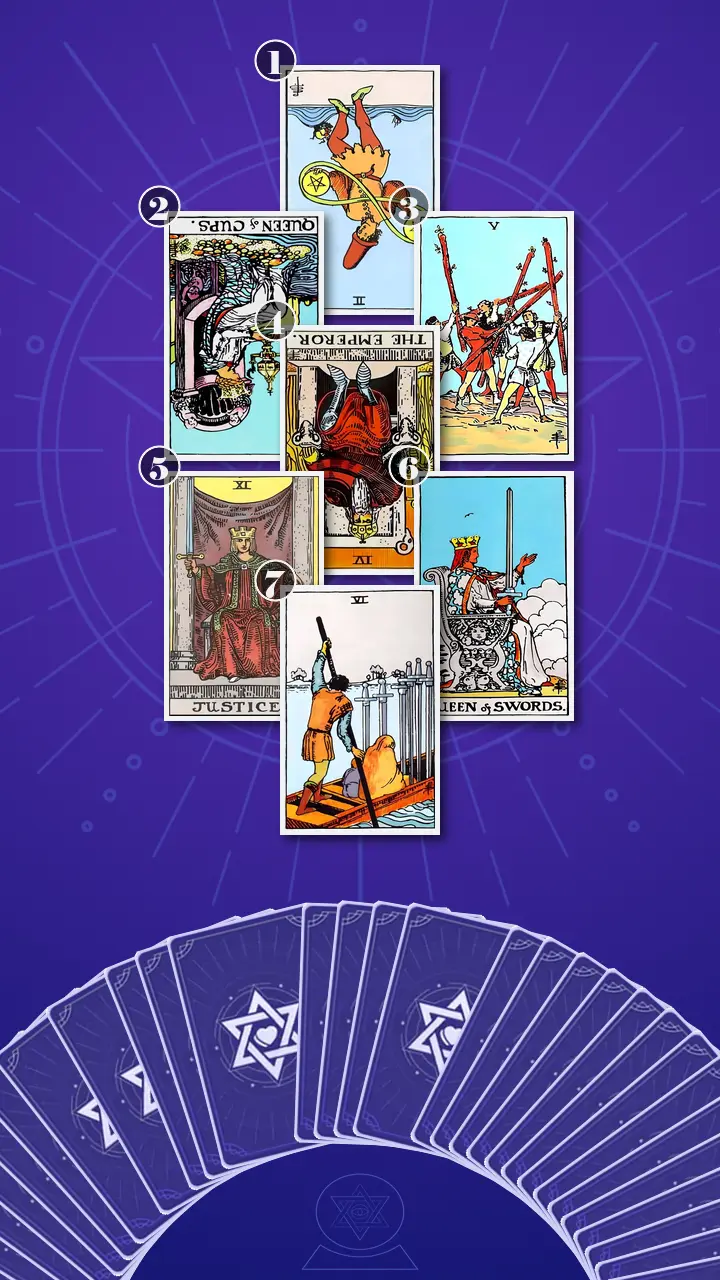
Reading the Loop, Not Predicting the Fallout
Position One: The Juggle That Looked Like Fairness
The first card I turned represented the observable symptom: Alex juggling separate debriefs, carefully balanced replies, and shared plans until neutrality became unsustainable work. It was the Two of Pentacles, reversed.
I pointed to the infinity-shaped ribbon binding the two pentacles and the ships pitching on uneven water behind the figure. Upright, the card can describe responsive adaptation. Reversed here, I read its Earth energy as Excess motion meeting a Deficiency of practical capacity. Everything remained in circulation, but nothing reached resolution.
The image matched Alex's Sunday exactly. At 11:40 p.m., they were switching between two voice-note threads, editing each reply to erase any hint of allegiance, and opening the group calendar to move Saturday's dinner before anyone had asked. The activity felt like impartial care. Their aching jaw, unfinished tea, and delayed sleep showed the real workload. It was like keeping two apps active in the background all day: nothing looked dramatic on-screen, but the battery kept draining.
I repeated the loop back to them: "First I answer A. Then I reassure B. Then I adjust the plan. Then I can rest." I asked, "When does the rest actually arrive?"
Alex did not nod. Their lips parted, then closed, and a brief, bitter laugh escaped. "That is painfully accurate. I call it being neutral, but it looks like a second job when you say it out loud."
I answered, "The card is not criticising your ability to care. It is showing a capacity problem. Continuous motion can briefly lower your fear, but it cannot resolve a disagreement that belongs to two other adults. Being neutral should not mean being on call."
Position Two: When Someone Else's Voice Note Enters the Body
The next card represented the inner pull behind the behaviour: the urge to absorb each friend's distress and restore their emotional stability before checking Alex's own limits. It was the Queen of Cups, reversed.
The Queen usually embodies emotional receptivity and nuanced care. Reversed, I read her Water as a Blockage in self-reference and an Excess of absorption. Her gaze becomes so fixed on the ornate cup that her own position at the edge of the sea disappears from awareness.
In Alex's life, this was the moment a four-minute voice note ended and the sender's anger seemed to continue inside Alex's upper chest. Before asking whether they had time, energy, or even a useful role, Alex drafted reassurance, postponed winding down, and messaged the other friend to reduce the emotional temperature. The silent rule was simple: "They are upset, so I cannot settle until they are settled."
I sometimes call this Vibe Contamination Auditing. I do not use that phrase to brand a friend as negative or toxic. I use it to inspect the route by which another person's unprocessed emotional charge enters someone else's psychological atmosphere before consent or capacity has been checked. In digital life, it can resemble accepting emotional AirDrop files automatically: the anger arrives in the body before there has been a conscious decision to receive it.
I asked, "After the last voice note, did you check what you felt, or did you immediately work on changing what they felt?"
Alex's fingers moved to their upper chest as though confirming the location. Their shoulders lifted, held, and then dropped a fraction. "I do not even notice the handover," they said. "Their mood just becomes the room I am standing in."
"That is the distinction," I said. "Empathy lets you perceive the room. Emotional responsibility tells you that you must redecorate it before you are allowed to leave."
Position Three: Five People Talking, No One Owning the Traffic
The third card represented the external pressure: the mutual friends' unresolved disagreement, competing accounts, loyalty questions, and disruption of shared social spaces. It was the Five of Wands, upright.
Five figures raise staffs at different angles, each moving according to a separate position. I read this as active Fire: not a defect inside Alex, but scattered external friction with no shared method. The card looked like two incompatible stories arriving through DMs while the group chat filled with clipped replies, missing reactions, and awkward questions about Saturday. It had the overlapping pressure of an argument in The Bear, where everyone is speaking from a real concern and coordination becomes another source of noise.
Alex had interpreted that lack of coordination as a job opening. If nobody was directing the emotional traffic, they assumed somebody had to. Yet each figure on the card still held their own staff. The original words, the direct conversation, and the consequences belonged to the people participating in the conflict.
I asked, "What did either friend explicitly ask you to own, and what did you appoint yourself to organise because their disagreement remained unresolved?"
Alex looked away from the cards and toward the rain gathering on the window. After a few seconds, they said, "They asked what the other person had said. Nobody asked me to redesign the entire weekend."
"You can hear both sides without becoming the route between them," I said. "The conflict may be uncomfortable in a shared space, but discomfort is not the same thing as an assignment."
The Operations Manual No One Asked For
Position Four: The Throne Built Against Uncertainty
The fourth card represented the core blockage: the learned rule that social safety depends on Alex organising other people's reactions and preventing disorder. It was The Emperor, reversed.
The stone throne, concealed armour, and bare mountains made the protective logic visible. Structure is one of the Emperor's gifts, but reversed here, that energy had become Excess control and a central Blockage. Healthy authority governs one's own participation. Shadow authority tries to govern the entire field because uncertainty feels unsafe.
When neither friend followed a clean route toward reconciliation, Alex constructed one: separate invitations, approved wording, a suggested conversation date, revised seating, and backup plans for every gathering. It was like building a detailed Notion workspace for a conflict nobody had appointed them to run. The internal instruction underneath it was, "If I can design the right system, nobody can leave and nothing can blindside me."
I connected this gently to what Alex had told me about growing up around indirect disagreement. Reading the room and becoming useful had once made tension more predictable. Their customer-success role later rewarded the same reflex. The strategy had not appeared from nowhere, and I did not treat it as a character flaw. It had simply expanded beyond its proper jurisdiction.
My mind went briefly to a perfume formula overloaded with fixative. A fixative can give volatile material stability, but too much can flatten the composition until nothing has room to develop. Alex was trying to preserve the group by fixing every variable in place. The result was not security. It was a social atmosphere in which their own freedom had become the first note to disappear.
Alex's expression tightened. "So my helping is actually controlling?" they asked, their voice sharper than before.
"Some of the behaviour attempts to control uncertainty," I replied. "That is not the same as saying you are a controlling person. I see a caring strategy that once created predictability. Now it also prevents you from discovering something important: whether your belonging can survive without your constant management."
Their hand closed around the edge of the table, then slowly released it. The rain tapped harder against the glass. For a moment, the room seemed to underline the card's question: could protection become spacious enough to let other people make their own weather?
Position Five: Justice and the Responsibility Audit
The fifth card represented Alex's available resource: their capacity to distinguish impartial care from equal over-functioning and return accountability to each participant. It was Justice, upright.
I framed the scales and sword as separate tools. The scales assess what belongs where. The upright blade states the conclusion. This was Balance in its cleanest form, not a demand that everyone receive equal access to Alex's time, sleep, and emotional labour.
I invited Alex to imagine a responsibility audit with three headings: Mine, Friend A's, and Friend B's. Alex's words, availability, invitations, and choice of participation belonged under Mine. Each friend's messages, motives, reactions, and decision to communicate directly belonged under their own heading. Relaying a message did not become Alex's responsibility merely because someone handed it to them.
In daily life, Justice could sound the same on both sides: "I can listen to what is happening in our friendship, but I will not carry messages or interpret the other person's motives." One friend might dislike that answer. Fairness did not require Alex to prevent the dislike. It required an honest and consistent division of responsibility.
I asked, "What have you picked up because you fear how it will look if you leave it down?"
Alex's breath left in a long stream. Their eyes stayed on the scales. "Their reactions to each other," they said. "And whether either of them thinks I am fair."
"Exactly," I said. "You can behave fairly. You cannot manage the verdict each person reaches about you. Equal care does not require equal over-functioning."
When the Queen of Swords Cleared the Air
Position Six: One Blade, One Open Hand
The sixth card represented the key transformation: replacing two private mediation roles with one clear, compassionate boundary applied consistently. It was the Queen of Swords, upright, the antidote at the heart of the reading.
The card held two gestures at once. The vertical sword established a precise limit. The open left hand remained available for honest human contact. I read her Air energy as Balance: independent judgement without emotional coldness, and direct language without an attempt to dominate anyone's response.
In practical terms, the Queen described Alex sending one concise statement to both friends: "I care about each of you, but I will not relay messages, arbitrate this conflict, or manage what happens next." The transformation was not finding language so perfect that nobody felt disappointed. It was allowing the same compassionate limit to stand while each friend owned their interpretation and next choice.
I brought us back to 11:40 p.m.: two voice-note threads beside a half-edited weekend plan, Alex rewriting one neutral reply as though the right wording could keep the entire group intact. Their mind was still asking how to make a boundary painless before permitting the boundary to exist.
After fifteen years as a perfumer, I have learned that separation is part of accurate perception. Two scent blotters held too close can bleed into one another until neither material is legible. A healthy boundary is not an airtight stopper. It is calibrated distance: enough openness for contact, enough space for each note to remain itself.
I used my Boundary Permeability Diagnosis on three specific points in Alex's pattern: messages, motives, and outcomes. Their boundary had become highly permeable at all three. Friends' messages passed through Alex, friends' motives became Alex's subject to interpret, and friends' outcomes became Alex's result to manage. The Queen's sword did not cut off compassion. It stopped those responsibilities from diffusing through Alex's care.
I said, "A boundary is not choosing a friend; it is choosing not to become the route through which their conflict keeps travelling."
Stop treating constant mediation as proof of care; choose one clear boundary and let the Queen of Swords' raised blade separate compassion from responsibility.
I left the sentence alone. The fridge in Alex's apartment clicked off, and the sudden quiet felt wider than the room.
Alex's breath stopped halfway in. Their fingers hovered over the face-down phone, perfectly still, while their gaze lost focus as if they were replaying every softened message and rearranged dinner. Their eyes widened, then their brow pulled tight. "But doesn't that mean I have been doing this wrong the whole time?" they asked. The words came low and clipped, with a flash of anger protecting something more tender underneath.
I said, "It means a strategy that once helped you feel safer is costing you too much now. That is information, not a verdict. You were not wrong to care. You are allowed to update how that care is expressed." Their fist loosened one finger at a time. Their shoulders lowered, their eyes reddened, and a shaky breath left their chest. Relief crossed their face first. Then came a brief, almost dizzy blankness: the vulnerability of realising that clarity would require them to let other people remain uncomfortable. "Oh," they said softly. "Then I have to stop fixing the part where they might be unhappy with me."
I asked, "Now, with this new perspective, think back over last week. Was there a moment when this insight could have changed how the situation felt?"
Alex returned to Thursday in the grocery store, when both friends had asked what the other had said and the freezer fan rattled beside them. "I could have answered for myself instead of giving two reports," they said. "I could have left their questions with them and finished buying dinner."
I then asked them to open Notes and write one sentence: "I care about both of you, but I cannot carry messages, interpret their motives, or manage what happens between you." I invited them to read it once and notice the first physical response. Their jaw reacted most strongly to "manage what happens." They did not have to send the sentence that day. Naming the task they no longer wanted to carry was already the minimum version of the exercise.
This was the reading's pivotal crossing: from hypervigilant responsibility for both friends toward confident, compassionate connection without managing their conflict. It was not certainty that both friendships would remain unchanged. It was the first evidence that Alex could trust their own boundary even when the social atmosphere had not yet settled.
Leaving the Ferryman Role
Position Seven: A Phone That Carries Less
The seventh card represented the grounded next step: stop transporting messages, reduce reactive availability, and direct each friend back toward direct communication. It was the Six of Swords, upright.
I showed Alex the six swords standing inside the boat. The visual irony was almost too exact. Their phone had become the boat, while screenshots, voice notes, softened explanations, and theories about motives were the cargo. The card's Air moved in a deliberate, Balanced direction away from turbulence. It did not promise that the friends would reconcile. It asked Alex to stop making their own nervous system the transport network for the dispute.
In real life, the card looked modest: mute the conflict-heavy chat for one chosen period, leave the weekend plan unchanged, and answer "Can you tell them?" with "That needs to come from you directly." Alex could keep both contacts, speak honestly about each individual friendship, and decline the function that linked the two conflicts through them.
"I am not leaving either friendship," Alex said, testing the sentence slowly. "I am leaving the ferryman role."
Their voice still held caution, but their hand moved the phone several inches away without my prompting. It was not a dramatic release. It was a small change in distance, and for this reading, distance was the point.
Two Blank Spaces and One Consistent Answer
When I read the seven cards together, they formed one coherent systems story. Alex had learned early that reading the room and keeping people calm could make disagreement more predictable. Their work later strengthened the habit of treating discomfort as an open ticket. The Two of Pentacles showed the visible task-switching, the Queen of Cups showed why distress entered their body so quickly, and the Five of Wands located the original friction between the friends. The Emperor revealed the rule that converted that friction into Alex's management assignment. Justice restored an accurate division of responsibility. The Queen of Swords gave the division a voice. The Six of Swords gave it a repeatable behaviour.
The cognitive blind spot was not simply "I care too much." It was the equation of neutrality with equal availability, and usefulness with secure belonging. Alex had been reading every uncomfortable reaction as evidence that their boundary was unfair. The transformation direction was more precise: own only their words, time, invitations, and participation, while allowing each friend to own their messages, choices, and response to the limit.
I explained that the spread was a map, not the person holding the steering wheel. Tarot had helped us distinguish the loop's components. Alex would decide which action fit, how much contact felt sustainable, and whether either friendship needed further change. Finding clarity here did not mean producing a perfect social outcome. It meant identifying the next choices that were genuinely Alex's to make.
To make that insight usable, I introduced my Space Calibration Ritual. In a perfumery, blank space between blotters prevents one material from contaminating the reading of another. In a friendship conflict, digital and physical blank spaces create the same kind of discernment. A pause before replying lets Alex detect the difference between care and compulsion. A phone placed out of reach gives the body evidence that a notification can exist without becoming an immediate assignment.
Alex looked doubtful when I suggested a two-hour mute. "Honestly, I do not know if I can leave it for two hours without checking," they said. I adjusted the scale without removing the principle. Twenty minutes could be the first calibration. The purpose was not to perform detachment. It was to create enough breathable distance for Alex to choose a response instead of being drafted into one.
- The Same-Answer Boundary.Before the next conflict reply, create a pinned phone note titled "Same answer, both sides" containing: "I care about both of you. I am not going to relay messages, interpret what they meant, or arbitrate this, but I can talk about my friendship with you." When either friend asks what the other said, use the same core sentence and wait at least ten minutes before sending anything else.Keep the opening warm, but do not explain the absent friend. If the full version feels too charged, start with: "I cannot be the go-between."
- The Space Calibration Ritual.Choose one evening this week and mute the conflict-heavy chat for a defined two-hour block. Put the phone out of reach while eating or watching one episode of a show, and leave the next shared plan unchanged for twenty-four hours unless the host or a directly affected attendee requests a practical change.If two hours feels unrealistic, begin with twenty minutes. Record the urge to check or redesign the plan without acting on it; the blank space is an experiment, not a punishment.
I reminded Alex that neither action required the friends to approve. A boundary about Alex's own speech and availability was not a demand for anyone else to behave differently. The friends could feel disappointed, ask again, communicate directly, avoid the issue, or take time. Alex's task was not to engineer the preferred response. It was to remain clear about their own participation.

A Week Later, the Quiet Proof
Five days later, I received a short message from Alex. One friend had asked, "Did they tell you why they left the chat?" Alex had felt the familiar pressure rise under their collarbone, opened the pinned note, and sent the same boundary they had rehearsed. They did not add a theory, a screenshot, or a second paragraph proving their neutrality.
The friend replied, "Okay. I do not love being shut down, but I get it." Alex's fingers immediately wanted to compose a warmer explanation. Instead, they set a twenty-minute timer, muted the thread, and finished dinner while the phone stayed on the bookshelf.
That night, Alex slept through until morning. Their first thought was still, "What if they think I chose a side?" The thought had not vanished, but this time Alex smiled at it, made coffee, and left the weekend plan alone.
I did not see that as proof that the whole friend group was fixed. It was quieter and more credible than that. Alex had allowed another person's discomfort to exist without turning it into an emergency, and both friendships were still permitted to be relationships rather than support tickets. The cards had offered distinctions. Alex had made the choice.
For me, that was the real Journey to Clarity: not a guarantee about who would reconcile, but a movement from managing everyone's reactions to trusting one fair boundary. Alex remained caring. They simply stopped treating emotional suffocation as the price of belonging.
I want to leave the same distinction with anyone whose chest tightens at every clipped reply. When usefulness has become the bridge holding an entire group together, setting down one message can feel less like relief and more like risking your place in the circle. Yet noticing that fear already creates the first breathable space between compassion and responsibility.
If you could stay connected without carrying the next message across, which voice note, interpretation, or softened explanation might you be ready to leave on its original shore?