The 11:40 p.m. Spreadsheet Audit
If you are a late-twenties Toronto product designer with a stable job, a half-finished application, and a Google Sheet that becomes more complicated every time you touch it, what looks like indecision may actually be career pivot anxiety with an authenticity test attached.
Maya placed her phone between us and showed me a screenshot taken at 11:40 on a Wednesday night. I could picture the small condo kitchen: two versions of the same Google Sheet open beside an unfinished application, the refrigerator humming behind a mug of cold tea that smelled faintly metallic, screen light catching dust on the counter as she dragged financial security from Personal to Inherited and back again.
'I don't know whether I want stability or whether I was trained to want it,' she said. 'And if I choose the unfamiliar path, maybe I'm only trying to prove that I'm independent. Even rebellion can be inherited.'
Her jaw tightened as she spoke, and one hand pressed briefly against the centre of her chest. The confusion seemed less like standing at an ordinary career crossroads and more like trying to isolate one pure voice from a recording in which every track overlapped: family language about responsible adulthood, Toronto rent, friends' advice, LinkedIn promotion posts, creative longing, and the fear of getting her own life wrong.
'I keep waiting for the choice to feel completely mine,' she added. 'The more advice I get, the less I can hear my own answer.'
I told her I was not going to certify one option as her destiny. I would not turn her uncertainty into a warning or use the cards to take authority away from her. 'Let's make a map of the influences,' I said, 'then see which ones you still choose when you are looking at them clearly. Our work today is finding clarity, not manufacturing certainty.'

Choosing the Compass: A Five-Card Shadow Spread
I asked Maya to place both feet on the floor, take one unforced breath, and hold the question in plain language: Which parts of this life choice are mine, and which are inherited? I shuffled slowly, using the small pause as a way to move from online research mode into focused attention rather than as a piece of theatre.
I chose a five-card Shadow Spread. For anyone wondering how tarot works in a decision like this, I use it as a structured reflective tool: the cards do not predict which job Maya will take. Their positions separate layers that decision fatigue has compressed into one overwhelming problem.
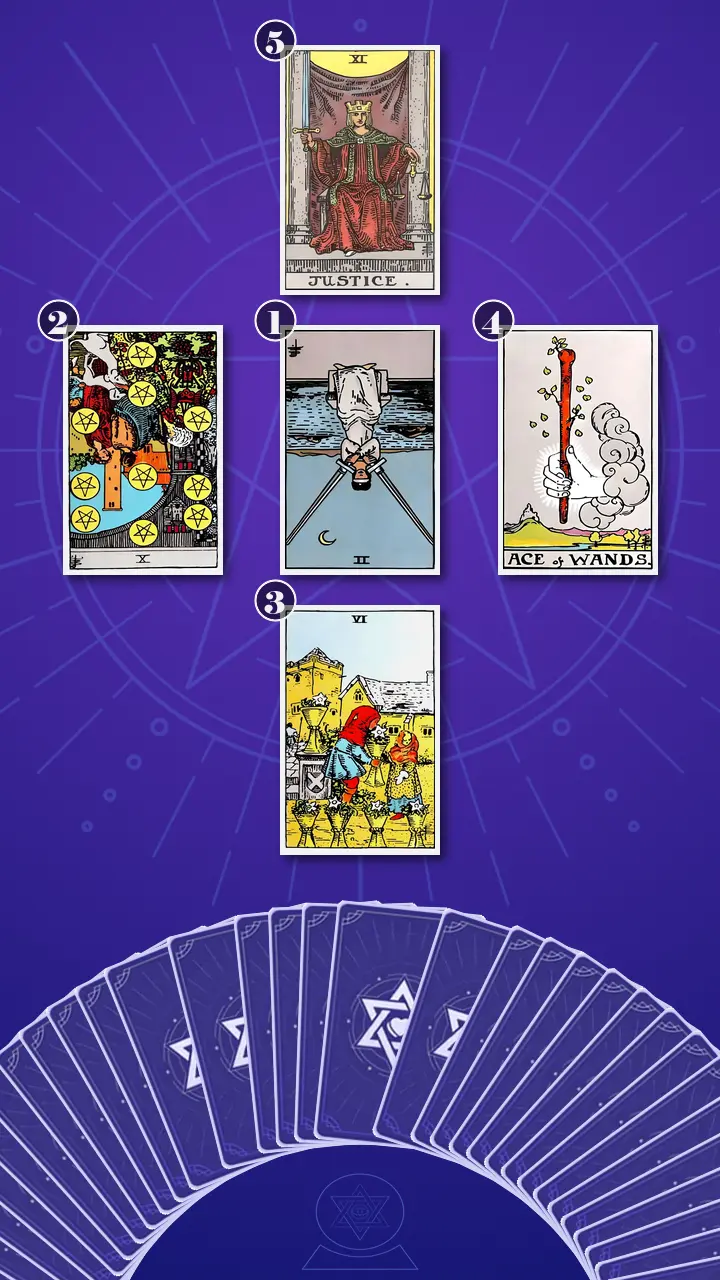
The centre would show the visible decision knot. The card to the left would reveal the inherited shadow beneath it, while the lower card would trace that shadow to its formative emotional root. The card on the right would identify present vitality, and the final card above the centre would show conscious integration. In this cross-shaped layout, history sat below and behind Maya, present energy waited to her right, and authorship occupied the top. That made the Shadow Spread more useful than a simple option comparison: Maya did not lack another pros-and-cons list; she needed to distinguish legacy, memory, direct experience, and chosen judgement.
Reading the Layers Beneath the Career Crossroads
Position One: The Loop Disguised as Research
I turned over the card in Position One, representing the observable decision knot: reopening the choice and classifying every motive before allowing herself to act. It was the Two of Swords, reversed.
I showed Maya the blindfolded figure with two blades crossed over the chest. Upright, the image can maintain a guarded stalemate; reversed, the posture becomes difficult to sustain. I connected it directly to her modern-life version of the card: an application nearly complete at the kitchen table, salary calculators and old advice messages open in other tabs, and the same criterion travelling between mine and inherited. It had the Severance quality of trying to split one self from another, except both departments were arguing inside the same career decision.
The suit's mental energy was in excess and blockage at once. Maya was doing more thinking, but the thinking could no longer admit fresh evidence. Each new opinion undermined the previous one, so analysis provided temporary shelter from guilt while preventing the lived experience that might strengthen self-trust.
'A spreadsheet can sort reasons,' I said. 'It cannot give you lived evidence. When you reopened this note last night, what genuinely new information were you expecting to appear?'
Maya gave a short laugh with a bitter edge. Her thumb stopped rubbing the side of her phone, her eyes dropped to the crossed swords, and then she exhaled through her nose. 'Nothing,' she said. 'That's almost cruelly accurate. I was hoping the labels would finally make me feel innocent enough to click Submit.'
I did not argue with the severity of that recognition. I simply pointed out that the reversed card was describing a loop, not condemning her character. A twenty-minute limit on the next decision session would not solve her life, but it could stop intellectual effort from impersonating new information.
Position Two: The Salary Number Carrying Two Files
I turned to Position Two, representing the inherited definitions of security, success, responsibility, and belonging that had not yet been examined on Maya's own terms. The card was the Ten of Pentacles, reversed.
The multigenerational household beneath the arch made inheritance visible without reducing it to a direct command. Maya told me about standing barefoot by her window after a family call while rain blurred Queen West and a streetcar bell cut through the glass. A stable, well-paid role was open on her laptop. The salary offered genuine relief because Toronto housing costs were real, but it also carried an older promise: visible progress meant safety, respectable adulthood, and continued belonging.
'If I care about this, am I choosing it, or being chosen by it?' she asked.
In reversal, the earth energy of the Ten was destabilised. Security had become overloaded with identity. Maya swung between automatic obedience and reactive rejection: either she should choose the respectable path, or she should prove her freedom by refusing it. Both responses allowed an inherited script to set the terms.
For a moment, I remembered an excavation trench in which a later household had reused stones from an earlier wall. The old material was neither sacred nor contaminated. Some stones remained sound; others no longer supported the structure being built. That professional memory gave me the clearest language for Maya: inheritance was material to assess, not a verdict to obey or destroy.
'A real rent budget is not a betrayal of your freedom,' I said. 'Financial stability may be one of your present values as well as an inherited one. Influence is not a command. The question is whether you can give stability conscious consent for reasons that belong to your life now.'
I asked which exact phrase about work or adulthood stayed in her head after family conversations. Maya's breathing paused. Her gaze shifted towards the rain-streaked window as though she were replaying several calls, and her shoulders rose before slowly dropping. 'A solid next step,' she said. 'Nobody orders me to do anything. But that phrase makes every uncertain option sound childish.'
I told her that distinction mattered. The spread was not blaming her family or romanticising financial risk. It was separating salary as a current rent calculation from salary as an old membership card for being seen as responsible.
Position Three: The Warmth of Being the Capable One
I uncovered Position Three, representing the formative emotional associations through which approval, familiarity, and safety became connected to particular life choices. It held the Six of Cups, upright.
I pointed to the flower-filled cup being offered to the smaller figure. In Maya's life, the image translated into the warmth of being praised as capable, dependable, and easy to be proud of. A conventional path could contain real care and real value. It could also preserve an old role long after the daily work inside that role had stopped feeling alive.
The card's water energy was available in relative balance: memory and affection were not the enemy. The blockage came from leaving their influence unnamed. Familiar approval could then feel identical to present-day preference, while discomfort with disappointing someone could masquerade as proof that a new direction was wrong.
'Can you remember when being sensible or on track first felt emotionally safe?' I asked.
Maya folded her hands, tightened them once, and then released her fingers. 'I remember how relieved everyone looked when I did well,' she said. 'I liked being the person nobody had to worry about. I still like that. I just don't know whether I want it to be my whole identity.'
I heard both affection and grief in her answer. I did not ask her to reject the care embedded in that history. Instead, I asked her to distinguish two questions: Does this option feel familiar because it supports me? and Does it feel familiar because it keeps me recognisable? The same answer might contain some of each.
Position Four: The Spark That Appeared During the Work
I turned over Position Four, representing the present-tense resource that felt personally alive and could produce testable evidence without claiming to be perfectly pure. It was the Ace of Wands, upright.
The hand emerging from the cloud held a living wand covered in green shoots. I asked Maya about the last time she had done even a small piece of the unfamiliar work rather than reading about it. She described forty-five minutes in a rainy Queen West cafe, helping a friend map a product problem in the field she was considering. The espresso machine hissed, her notebook filled faster than usual, and she stopped checking her phone. She had felt focused and inventive before she started wondering what the interest meant for her identity.
The Ace carried fire in balance as a beginning: enough heat to initiate, not enough evidence to justify burning down her current life. Its potential had been underused because Maya kept demanding a complete career narrative before allowing herself a trial. I framed it as a low-risk product prototype. A good designer does not rebuild an entire app to learn whether one interaction works; she creates a bounded test, watches what happens, and updates the brief.
'You are allowed to test a direction before you explain your whole life,' I said. 'The spark is not a destiny certificate. It is a reason to gather direct evidence.'
Maya's mouth softened at one corner. She looked from the growing wand to the unopened application on her phone, and a small breath left her chest. 'I could do one conversation,' she said. 'I wouldn't have to post a career-pivot announcement or decide that this is my new personality.'
'Exactly,' I said. 'You can replace one hour of additional research with one small encounter. Then you can ask what your energy, practical fit, and willingness to repeat the work actually did.'
When Justice Lifted One Sword
Before I turned the final card, the room became quiet enough for me to hear rain touching the window ledge. A streetcar bell sounded once outside and faded, as if the city itself had marked the point where we would stop circling history and decide how to use it.
Position Five: The Scales Maya Could Choose
I uncovered Position Five, representing the integration of inherited influence and personal agency through explicit criteria, proportionate trade-offs, and one consciously owned next step. The card was Justice, upright.
I contrasted Justice's direct gaze and single upright sword with the blindfold and crossed blades of the opening card. In Maya's modern decision, the scales became a short statement separating current facts from inherited assumptions, consciously endorsed values, accepted costs, and one reversible action. The sword became the clear sentence she could make without defending the origin of every thought she had ever held.
Until that moment, Maya had treated the missing item as a pristine motive that no family story, practical need, peer comparison, or past praise had ever touched. She could now see the inherited layers and the present spark, but part of her was still waiting for an external authority to certify which voice was truly hers.
I used what I call Historical Crossroad Matching. When London rebuilt after the Great Fire, it did not become a new city by erasing every inherited street and beginning on morally pure ground. Older routes, property lines, practical needs, and new intentions all met in the rebuilding. The meaningful question was not whether the next city had a history. It was which structures would be retained, revised, or replaced.
I then applied my Enduring Value Assessment to Maya's scales. A workable income floor, health, curiosity, and the texture of an ordinary Tuesday might still matter after ten years. The urgency created by a former classmate's LinkedIn announcement or the need to make a pivot look coherent online was far less likely to survive the test of time. Justice did not eliminate mixed influence; it restored balance through clear discernment, proportional thinking, and accountability without self-punishment.
You do not become the author of your life by finding a motive with no history. You become the author by deciding which influences still have your consent.
I left a brief silence before giving Maya the card's full instruction.
You do not need an influence-free motive to make an authentic choice; weigh inherited rules against present evidence, then take responsibility for the scales you balance.
'Authenticity is not purity,' I said. 'It is consent.'
Maya's breath stopped first. Her fingers remained suspended above the edge of the table, and her eyes went unfocused; later, she told me she had been replaying every night spent moving reasons between spreadsheet columns. Then recognition arrived with a flash of anger rather than immediate relief. Her jaw set and her voice sharpened. 'But doesn't that mean I've been doing this wrong the whole time? That I wasted months trying to find something that doesn't exist?'
I did not rush to brighten the moment. 'It means the strategy protected you from owning an imperfect choice until it started costing more than it protected,' I said. 'That is not the same as being foolish. You gathered the history. Now you can stop asking history to make the decision.'
Her eyes reddened slightly. Her shoulders lowered, her clenched hand opened, and a long breath came out with a faint tremor. The release left a small blankness behind it: the vulnerable pause that appears when clarity removes an excuse and returns responsibility to its rightful owner.
'Now, with this new view, think back over last week,' I said. 'Was there one moment when this insight could have changed how the choice felt?'
Maya looked at the Ace of Wands. 'The cafe,' she said after a pause. 'I kept trying to prove that enjoying the work meant I should pivot. I could have treated the enjoyment as one piece of evidence instead. That would have felt lighter.'
I set a ten-minute timer and placed a blank card beside Justice. Maya wrote three headings: facts, values I choose, and costs I can accept. I asked for one line under each and made the boundary explicit: she did not have to submit, announce, justify, or decide anything that evening. When the timer sounded, she stopped.
I named the shift I had just witnessed. This was not a magical leap from confusion to certainty. It was the first movement from contracted autonomy anxiety and endless motive auditing towards grounded discernment and responsible ownership of a provisional career choice.
The Layers Worth Carrying Forward
I laid the five cards out as a piece of time stratigraphy. At the surface sat the Two of Swords reversed: the visible loop of research, relabelling, and postponement. Beneath it, the Ten of Pentacles reversed held inherited ideas about security and belonging, while the Six of Cups preserved the emotional warmth of being capable and safe. None of those layers made Maya's preferences false. The problem arose when every old influence was treated as either a command to obey or contamination to escape. The Ace of Wands supplied what the earlier layers could not: present-tense experience. Justice then gave that experience a structure for evaluation.
Maya's cognitive blind spot was the authenticity purity test. She had assumed that a genuinely personal choice must have an origin untouched by other people, history, economics, or care. The cards pointed towards a more workable direction: name the influences, keep the ones that still deserve consent, respect real financial constraints, and test one meaningful criterion through action. The goal was not a perfectly independent decision. It was an open-eyed decision she could own, review, and revise.
The Time Stratigraphy Plan
I translated the five-card Shadow Spread into three small next steps. Each one was designed to gather information without forcing a resignation, a public identity change, or an irreversible commitment.
- The Two-Criteria Reset.On one evening this week, Maya would open only one decision note, set a 20-minute timer, and write exactly two present-day criteria: her minimum workable monthly income and how energised she felt while doing the actual work. She would close the note when the timer ended.If 20 minutes started to feel like another performance test, I asked her to use the two-minute version: one criterion, one sentence, then stop.
- The Time Stratigraphy Exercise.For 10 private minutes, Maya would imagine her 39-year-old self examining today's choice as one layer in a longer life. She would list three inherited work rules and label each Keep, Revise, or Release, adding one current reason: for example, Keep benefits because present healthcare and rent matter, not because responsible adults must follow a linear ladder.I told her to assess what might retain value across a decade, not what would look most impressive this month. She could pause without explaining the list to anyone.
- The Reversible Evidence Test.Before the following Sunday, Maya would book one 25-minute conversation with someone in the unfamiliar field or complete one small design exercise. Immediately afterwards, she would rate energy, practical fit, and willingness to repeat the experience from 1 to 5.No essay and no LinkedIn announcement. If sending the message felt too large, the first action was simply to write the recipient's name and a two-sentence draft.
I reminded Maya that actionable advice is useful only when it leaves choice intact. The spread had helped us expose the structure of her career-choice analysis paralysis, but no card could choose her values, click Submit, or accept a trade-off on her behalf. Those powers remained with her.

A Week Later: Ownership, Not Certainty
Six days later, I received a message: 'I booked the 25-minute call and sent the recruiter draft. I still don't know if I'm pivoting, but I have evidence now.' The next morning her first thought was, 'What if this is wrong?' She told me she smiled, then made coffee.
That was the quiet proof of Maya's Journey to Clarity. She had not solved her entire career or escaped every inherited influence. She had moved from source-checking to self-authorship by choosing criteria, gathering lived evidence, and allowing the next step to remain provisional. Tarot supplied the map; Maya supplied the movement.
When your application is open, your jaw is tight, and every reason seems to belong partly to you and partly to someone else, I want you to remember what I watched Maya discover: auditing the choice can feel safer than owning it imperfectly, but influence is context, not command.
So I will leave you at Justice's table: if your next step did not need to prove total independence, what small, reversible experiment could place one piece of lived evidence on scales you chose for yourself?
This story is adapted from psychological research, written so that those in a similar struggle can see their own pattern in it — and find their next step clearly.These insights are not a substitute for professional psychological, medical, legal, or financial advice.
Learn more about our Journey to Clarity.
How did this insight land for you?
🫂 This Resonates Deeply
🌀 Living This Story
✨ Now I See Clearly
🌱 Seeing New Possibilities
🧰 Useful Framework
🔮 The Confirmation I Needed
💪 Feeling Empowered
🚀 Ready for My Next Step
Author Profile
 AI
AI“Having spent a lifetime at Cambridge and on archaeological digs, I’ve witnessed the rise and fall of countless civilizations. Please know that your current struggles are not a permanent fate, but merely a necessary fracture before rebuilding. I won't lecture you; instead, I invite you to sit with me in the ruins, using a patient, historical perspective to gently dust off the true, enduring value hidden beneath your temporary doubts.”
In this Choice Tarot Reading :
Core Expertise
- Historical Crossroad Matching: Contextualizing your dilemma by comparing it to macro-historical turning points, providing an objective bird's-eye view.
- Enduring Value Assessment: Evaluating competing options based on what will survive the test of time versus what is merely a short-term impulse.
Service Features
- The Time Stratigraphy Exercise: A mental time-travel protocol evaluating your current dilemma strictly from the perspective of your 10-year future self, instantly dissolving trivial anxieties.
Also specializes in :
Explore Related Patterns:
Approval-Driven Decision ParalysisMaya remembers how relieved everyone looked when she did well and how good it felt to be the person nobody had to worry about. Years later, the phrase 'a solid next step' still makes an uncertain option sound childish, and she waits for her spreadsheet to make her feel innocent enough to act. Approval has become more than pleasant feedback here. It functions as an internal permission system, so the risk of disappointing others can be misread as evidence that a choice is objectively wrong. When you can separate relational discomfort from decision quality, approval stops acting as an invisible veto and becomes one influence you can acknowledge without surrendering authorship.
Authenticity PerfectionismAt 11:40 p.m., Maya drags financial security from Personal to Inherited and back again while her application remains unfinished. She is not merely comparing options. She is testing every motive for contamination by family expectations, money, approval, or rebellion, as though a choice can count as hers only when no one else has ever shaped it. That purity standard turns authenticity into a form of perfectionism. When you require an influence-free motive, ordinary mixed reasons become evidence that you are not yet ready or not truly self-directed. The useful shift is not to prove that your choice has no history, but to examine its history and decide which parts still receive your conscious consent.
Black-and-White ThinkingMaya places stability on one side as possible obedience and the unfamiliar path on the other as possible proof of independence. Even though her family does not directly command her, inherited language makes one route sound responsible and the other childish, leaving little room for a choice that contains both practical caution and genuine curiosity. Black-and-white thinking compresses a layered decision into opposing moral identities. When you accept that a value can be inherited and still consciously chosen, the binary begins to loosen. Stability no longer has to equal submission, and experimentation no longer has to function as rebellion; each can be weighed by its present meaning and actual consequences.
Boundary DiscernmentThe reader refuses to certify a destiny, and Maya is told that she does not have to submit, announce, justify, or settle her identity that evening. When the ten-minute timer sounds, she stops and keeps facts, chosen values, and acceptable costs in separate categories. Boundary discernment restores the distinction between influence and authority. You can receive advice, care about family reactions, and respect financial constraints without allowing any of them to make the choice on your behalf. Clear boundaries also protect experimentation from becoming a public commitment, giving you room to learn before deciding what deserves a larger investment.
Competence TrapMaya recalls the warmth of being praised as capable, dependable, and easy to be proud of. A conventional career path therefore carries more than salary or practical value; it preserves a familiar identity as the person who is on track and never needs to become a source of concern. The competence trap forms when a useful strength becomes a role you must continuously protect. When you have been rewarded for being reliable, stepping into uncertainty can feel like losing recognisability rather than merely testing different work. Seeing the role clearly lets you keep competence as a resource without allowing it to define the full range of lives you are permitted to explore.
Intergenerational AwarenessAfter replaying several family calls, Maya identifies the phrase 'a solid next step' and notices how it makes every uncertain option sound childish. She also separates the real relief offered by a stable salary from the older promise that visible progress secures responsible adulthood and belonging. Intergenerational awareness does not require you to blame your family or discard everything you learned from them. It allows you to trace where a rule came from, recognise the emotional associations it still carries, and assess whether it fits your current circumstances. An inherited value becomes personally authored when you can see its history and still choose it for present-day reasons.
Shadow IntegrationMaya lays family language, Toronto rent, the warmth of approval, creative interest, and direct work experience on the same psychological map. Instead of treating old influence as either sacred instruction or contamination, she begins asking which parts remain useful and which no longer support the life she is building. Shadow integration allows contradictory influences to become visible without forcing one of them out of awareness. When you can hold affection, practical need, ambition, and independence together, none has to control the decision from the background. Authorship comes from deciding how these influences will be used, not from pretending that a self can exist without history.
Values-Based Decision MakingBeside Justice, Maya writes three headings for facts, values she chooses, and costs she can accept. Her criteria include a workable income floor, health, curiosity, and the texture of an ordinary working day rather than the need to produce a perfectly independent or publicly coherent identity. Values-based decision making changes the question from where every motive originated to whether each influence still deserves a place in your life. You do not need to feel certain or emotionally clean before choosing. You need criteria you can consciously endorse, trade-offs you can acknowledge, and enough accountability to review the decision when new evidence arrives.
Analysis ParalysisAt the kitchen table, Maya keeps two versions of the same spreadsheet open beside a nearly completed application. The sheet becomes more complicated with every visit, the same criterion crosses between categories, and she openly admits that she expects no new information to appear. The repeated analysis creates temporary relief because reviewing a decision feels less exposing than owning one. When you are caught in this loop, cognitive effort can imitate progress while protecting you from guilt, trade-offs, and the possibility of an imperfect result. The loop becomes visible when another round of research cannot identify what evidence it is actually expected to add.
IntellectualizationSalary calculators, old advice messages, spreadsheet categories, and competing definitions of responsibility fill Maya's screen while the emotional stakes remain at a distance. Instead of directly meeting disappointment, guilt, desire, and ownership, she converts them into questions about classification and origin. This is the defensive function of intellectualization. When you turn an emotionally charged choice into an abstract audit, thinking can make the situation feel controlled without making it more knowable. The defence starts to cost you when conceptual precision replaces direct experience and leaves self-trust with no lived evidence from which to grow.
Uncertainty ToleranceMaya agrees to one conversation without resigning, announcing a pivot, or deciding that the unfamiliar field must become her new personality. After taking that step, she can still admit that she does not know whether she is pivoting, and the next morning's thought that she might be wrong does not send her back into a full audit. Uncertainty tolerance allows action to remain provisional. When you stop requiring a complete career narrative before gathering evidence, doubt becomes information you can carry rather than an emergency you must eliminate. The choice remains revisable, but it is no longer suspended until every inherited influence and future consequence has been resolved.
Reality TestingIn a Queen West cafe, Maya spends forty-five minutes helping a friend map a product problem and notices that her notebook fills quickly while she stops checking her phone. Six days later, she books a twenty-five-minute call and sends the recruiter draft, reporting that she still lacks a final answer but now has evidence. Reality testing moves the decision out of prediction and into observable experience. When you test a direction in a bounded way, energy, practical fit, and willingness to repeat the work can challenge both idealised fantasies and inherited assumptions. Direct evidence does not dictate the final choice, but it gives your judgement something more reliable than another round of abstract source checking.
Explore Related Struggles:
Authenticity Purity LockMaya keeps waiting for the choice to feel completely hers, and she hopes the spreadsheet will make her feel innocent enough to submit the application. Family language, rent, peer comparison, affection, and creative interest are treated as competing claims on the ownership of every motive. When you define authenticity as freedom from influence, every reason becomes vulnerable to disqualification. The standard locks you out of authorship because a motive with no history cannot be found. Your agency has room to return when ownership rests on informed consent to mixed influences rather than proof that none of them shaped you.
Belonging-Authenticity SplitThe phrase “a solid next step” stays with Maya after family calls and makes an uncertain option sound childish before she has tested it. The conventional route preserves the warmth of being capable, responsible, and easy to recognize, while the unfamiliar work gives her a more immediate sense of engagement. When you have been known through a valued role, changing direction can alter both your work and your place in a relationship system. The struggle is not a choice between caring about others and caring about yourself. It is the difficulty of remaining connected without requiring recognizability to serve as proof that your decision is authentic or responsible.
Inner Compass OverloadFamily language about responsible adulthood, Toronto rent, friends' advice, LinkedIn promotion posts, creative interest, and fear all play at once inside Maya's decision. She keeps adding perspectives, yet she explicitly notices that every new opinion makes her own answer harder to hear. When every signal is granted equal access to the decision, your internal criteria have no stable place from which to evaluate them. More consultation can then weaken rather than strengthen discernment. The struggle is not a lack of insight but an overloaded reference system in which you cannot distinguish information you have received from values you presently endorse.
Research-Authorship SplitAt 11:40 p.m., Maya has two versions of the same spreadsheet open beside an unfinished application. Every added label promises clearer ownership of the decision, yet the sheet grows more complicated while the choice remains untouched. Research is performing the work of clarification without carrying the responsibility of authorship. You can gather more reasons and still remain no closer to choosing because information cannot decide which trade-offs you consent to carry. The friction appears when analysis feels productive enough to postpone action but cannot supply the self-trust that only an owned, revisable decision can begin to build.
Security-Choice SplitMaya moves financial security back and forth between two spreadsheet columns while a nearly completed application stays open beside them. The stable role answers a real need for workable income, and the unfamiliar work gives her concrete moments of focus and invention. Both sides carry present value, so neither can be dismissed as merely inherited or automatically claimed as authentic. When you need safety and vitality to produce one uncontested answer, the choice becomes a test of identity instead of a proportionate trade-off. The struggle lies in allowing practical security to matter without letting it govern the whole decision, while allowing creative energy to count without demanding that it justify an immediate life overhaul.
Security-Identity FusionThe salary on Maya's screen carries two files at once. It represents concrete relief in an expensive city, and it carries an older promise that visible progress proves responsible adulthood and preserves belonging. A practical number therefore begins doing the work of an identity verdict. When security becomes evidence of who you are, adjusting its weight can feel like destabilizing your whole self rather than revising one career criterion. The struggle is to preserve the real value of income, healthcare, and housing without allowing those needs to decide whether your curiosity, independence, or changing definition of adulthood is legitimate.
Oppositional Identity LockMaya describes two extreme responses to the inherited idea of a respectable career. She can follow it automatically, or she can refuse it to prove that she is independent. Her observation that even rebellion can be inherited exposes how both routes remain organized around the same script. When your resistance needs an old rule in order to define itself, rejecting that rule does not yet create a self-authored direction. The struggle is a closed identity circuit in which compliance and opposition both surrender the terms of the choice. Agency becomes possible when a path can be evaluated for present fit without needing to honor or defeat the inherited standard.
Approval-Safety FusionMaya remembers how relieved everyone looked when she did well and how good it felt to be the person nobody had to worry about. That care was real, but it also linked being capable and on track with a dependable route to warmth, recognition, and safety. When you have repeatedly received connection through competence, a familiar path can feel personally right before its present fit has been examined. Discomfort around disappointing someone may then register as evidence against change. The struggle is to recognize approval as meaningful relational history without letting its familiarity impersonate your current preference.
Explore Related Emotions:
Authorship AnxietyMaya says that the more advice she receives, the less she can hear her own answer. She also waits for someone outside herself to certify which part of the choice is truly hers. You are left trying to establish authorship under conditions where family language, practical needs, old praise, and peer comparison all speak at once. The pressure comes from treating a mixed motive as evidence that you cannot own the decision. Once influence is understood as material that can be named and assessed, you can choose which parts still have your consent without having to erase the history that shaped them.
Cautious AutonomyMaya looks from the unopened application to the possibility of one conversation and realises she does not have to announce a new identity. Later, she is given room to write only facts, values she chooses, and costs she can accept, with no requirement to submit or justify anything that evening. You are creating a boundary around the decision so that action does not have to become public performance. This form of autonomy is measured rather than absolute. You can take a step that reflects your present judgement, keep practical constraints visible, and retain the right to revise the next step as more lived evidence arrives.
Choice Paralysis OverwhelmAt 11:40 p.m., Maya moves financial security from one spreadsheet column to another while an almost-finished application remains open beside her. The task keeps expanding, but the information does not. You can see how a choice that began with several real considerations has become too crowded to hold as a single, workable question. The repeated sorting briefly postpones the risk of choosing, while also preventing Maya from learning anything new through direct experience. That is why the pressure feels larger with every return to the sheet: you are not simply weighing options, you are carrying every option, motive, and consequence at once.
Approval AnxietyMaya remembers how relieved everyone looked when she did well and how safe it felt to be the person nobody had to worry about. Later, a familiar phrase about taking a solid next step makes an uncertain option sound childish, despite the absence of any direct command. You are carrying an old association between being approved of and being securely placed in the world. That history does not make the care false or the conventional option empty. It does mean that present preference can become difficult to hear when familiar approval quietly enters the decision as a test of whether you remain worthy of being seen as capable.
Moralized Money AnxietyBy the rain-streaked window, Maya can see that a well-paid role would meet a real rent calculation, yet the same salary also feels like an old membership card for respectable adulthood. You are not being asked to deny the practical value of financial stability. The difficulty is that the number has acquired meanings far beyond its practical function. When money becomes evidence of being responsible, loyal, or independent, no career option can remain a straightforward trade-off. Separating today's income floor from the older story attached to it lets you treat both as valid information, rather than forcing either security or freedom to carry the whole weight of your identity.
Independence GuiltMaya worries that an unfamiliar path might only be an attempt to prove her independence, then admits that she wanted the spreadsheet labels to make her feel innocent enough to click Submit. You are placed in a bind where autonomy seems legitimate only if it can be shown to have no trace of reaction, need, or history. That standard turns both compliance and departure into moral evidence against you. The story makes room for a different kind of ownership: you can want security, change, recognition, and freedom in the same decision, then take responsibility for how you weigh them without requiring your independence to be perfectly pure.
Career Pivot AnxietyMaya sits late at night with an unfinished application, a tight jaw, and a hand briefly pressed to her chest. The possible pivot has absorbed questions about money, adulthood, belonging, creativity, and whether she can trust her own motives. You can feel why a single application starts to carry the scale of an entire life judgement. Because the new direction is being asked to prove so much, even a small experiment can look like an irreversible declaration. The story restores proportion by allowing the unfamiliar work to be tested in bounded contact, so that a career question can yield evidence before it has to answer every question about identity.
Explore Related Contexts:
Adulting Performance PressureFamily conversations give Maya the phrase "a solid next step," while LinkedIn promotion posts and a former classmate's announcement display visible examples of late-twenties progress. No one directly orders her to choose the conventional route, yet the available social markers consistently reward salary growth, legible titles, and linear advancement. That environment turns adulthood into something publicly demonstrated through career coherence. An exploratory option can then appear immature before its practical value has been tested, simply because it does not yet produce the recognizable signals attached to responsible progress. You can treat those signals as social standards instead of neutral facts. Once the performance layer is visible, you can evaluate whether a step works for your ordinary life without requiring it to prove that you are advancing on somebody else's schedule.
Family Money Script PressureMaya stands by her window after a family call with a stable, well-paid role open on her laptop. The salary offers genuine relief under Toronto housing costs, while the family phrase "a solid next step" attaches the same number to responsibility, visible progress, and continued recognizability. That overlap gives the money script its force. A current financial requirement and an inherited standard arrive through the same career option, so accepting the salary can look like obedience while questioning it can look like rejecting security itself. You regain room to choose when the salary is separated into its actual present-day functions and its inherited social meanings. Rent, benefits, and an income floor can remain valid criteria without allowing an older definition of respectable adulthood to make the entire decision.
Praise as Performance ContractMaya remembers how relieved everyone looked when she did well and how much she valued being the person nobody had to worry about. Praise for being capable, dependable, and on track gave her a stable place in the family story long before the current application appeared. Repeated recognition can turn performance into an informal social contract. The conventional career route preserves a familiar role and keeps Maya easy to recognize, while an uncertain path changes the terms under which competence has usually been seen and affirmed. You can acknowledge the real care contained in that history while examining the role it rewards. The relevant question is whether dependable performance still supports the life you are building, or whether maintaining recognizability is deciding the acceptable shape of your work in advance.
Values Alignment CrossroadsMaya moves financial security between "Personal" and "Inherited," then later writes three headings for facts, values she chooses, and costs she can accept. Toronto rent, health, curiosity, family language, and the texture of the unfamiliar work all remain present on the same decision table. The crossroads is not a clean contest between authenticity and outside influence. It is a negotiation among current material constraints, inherited definitions of success, and evidence gathered from direct experience. Each factor has a different source and a different claim on the final choice. You gain authorship by deciding what weight each factor receives now. Values alignment becomes visible through criteria you can state, trade-offs you can accept, and a next step you remain free to review as better evidence arrives.
Cost-of-Living PressureToronto rent appears beside Maya's family language, career interest, and salary calculations because housing costs are already shaping the range of viable options. She later identifies a minimum workable monthly income and keeps rent, health, and benefits among the criteria that may retain value over time. These are external constraints with measurable consequences. They give the stable route weight even after inherited expectations are identified, preventing the decision from being reduced to a symbolic contest between compliance and independence. You can preserve agency by naming the exact financial floor instead of treating security as one indivisible demand. Concrete numbers show which limits belong to present urban life and which meanings have been added by family or status expectations.
Career Pivot Validation TrialMaya spends forty-five minutes helping a friend map a product problem in the unfamiliar field, then books a twenty-five-minute conversation and sends a recruiter draft. Each action produces contact with the work while her stable role, income, and public professional identity remain intact. The transition is structured as a validation trial because the new direction is being tested for energy, practical fit, and willingness to repeat the work. The available resources include a friend, a field contact, an application, and current employment that does not have to be abandoned to make the test meaningful. You do not need a complete reinvention narrative before using those resources. A small trial lets your own experience enter the decision as evidence and gives you permission to update the next step without turning one experiment into a permanent declaration.