When Intimacy Acceleration Begins at 11:40 p.m.
I have watched capable people run product launches without spiralling, then let one read receipt turn initiative into intimacy acceleration.
Maya, a 28-year-old product marketing specialist in Toronto, brought that contradiction into our session. The previous Tuesday, she had sat in her apartment at 11:40 p.m., watching the word “Read” beneath a message sent after lunch. A streetcar scraped along the wet road. The radiator clicked beside her sofa. Her phone had grown warm in her palm while three follow-ups waited in drafts and her calendar remained open to two possible dates.
“I know it has only been three dates,” she told me, “but I hate pretending I do not care. Why do I keep moving faster than a new relationship can handle?”
She had already sent one clear sign of interest. Still, nothing new had been confirmed, so she wanted to create movement. Movement brought a few minutes of relief, but it also removed the space in which the other person’s effort could become visible. Her longing felt like standing before an elevator and pressing the button again: the extra click could not make it arrive sooner, yet her fingers wanted the momentary proof that she was doing something.
“A pause never feels neutral when you have made momentum responsible for your sense of belonging,” I said. “I am not here to tell you to care less or play texting games. Let’s use the cards to map the difference between creating closeness quickly and discovering the pace this connection can actually support.”

Choosing a Map for Two Full Lives
I asked Maya to put both feet on the floor, breathe once without changing anything, and hold her question in mind while I shuffled. I use that brief transition to focus attention, not to manufacture mystery.
I chose a six-card Relationship Spread. This was not a prediction about whether the other person would stay, and I would not use tarot to claim access to their private thoughts. I chose it because the layout could separate Maya’s contribution from the other person’s observable bandwidth, reveal what uncertainty activated in the bond, and compare her available resource with the communication pattern maintaining the problem. The final position would translate those card meanings in context into one grounded direction.
This is how tarot works best in my practice: as a structured reflection tool. The cards provide distinct lenses; the querent tests those lenses against facts, choices, and lived experience. Maya, not the spread, would remain the authority on what happened next.
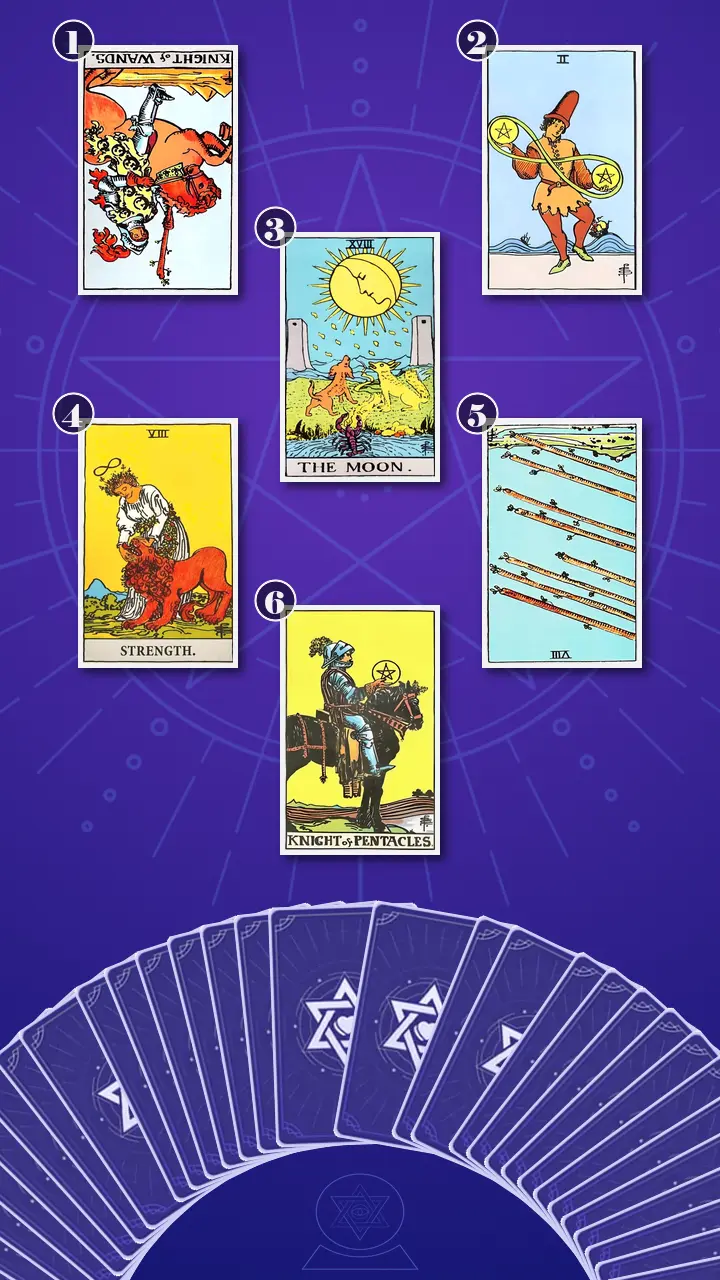
When Movement Stops Meaning Progress
Position 1: The Horse Already in Motion
“The card I am turning now represents your current contribution to the pacing problem,” I said. “It is the Knight of Wands, reversed.”
I pointed to the rearing horse and raised wand. I read the reversal as an excess of fire with too little direction: Maya could leave a strong third date, send a warm follow-up from the rideshare, open her calendar, suggest two more dates, and begin imagining exclusivity before mutual follow-through had appeared.
“The enthusiasm is real,” I said. “The blockage begins when every surge of desire is converted into immediate action. The inner line becomes: I call it being honest, but right now I am hoping this action will make the uncertainty stop.”
Maya gave one short, bitter laugh. Her fingers tightened around her mug and then released. “That is painfully accurate. I turn chemistry into a deadline.”
Position 2: Chemistry Meets the Calendar
“The card I am turning now represents the new connection’s observable capacity, not a verdict on anyone’s hidden feelings,” I said. “It is the Two of Pentacles, upright.”
The figure moved between two coins while ships rose and fell behind him. I read that earth energy as balance through adjustment. A deadline, a friend’s birthday, or an early meeting could make Thursday impossible without making interest impossible. The useful evidence would be what followed: did the other person propose Sunday, confirm it, and show up?
“Chemistry is a feeling; capacity is a pattern,” I told her. “Two full lives do not need uninterrupted messaging. They do need enough mutual coordination that one person is not carrying every next step.”
Position 3: The Story Built from a Read Receipt
“The card I am turning now represents the deeper emotional root activated inside the undefined bond,” I said. “It is The Moon, upright.”
I traced the partly visible path between the towers. The card did not announce danger. It showed incomplete information and the excess projection that can enter when only a few feet of the road are visible. At 11:40 p.m., Maya knew that her message had been read. Within minutes, she had imagined fading interest, another person, and a quiet ending.
“Try the sentence beneath the sentence,” I said. “I know only that they have not replied; my body is already reacting as if I know why.”
Her breathing paused. Her eyes moved away from the table as if she were replaying the apartment scene, then she pressed a palm lightly against her chest. “A pause means I am about to be replaced,” she said. The Moon had separated the visible reply gap from the private story attached to it. That distinction was not certainty, but it was the beginning of clearer evidence.
When Strength Put Calm Hands on Urgency
Position 4: Warmth Without Acceleration
The radiator in my room went quiet just before I turned the central card. For a moment, the only sound was rain touching the window.
“The card I am turning now represents your available resource for staying open while choosing your pace,” I said. “It is Strength, upright.”
I brought Maya back to 11:40 p.m.: the warm phone, the three drafts, and the quiet evening beginning to feel like a verdict. She had been trying to choose the correct message while her body was demanding immediate relief.
You are not proving care by outrunning uncertainty; practice steady, gentle restraint, and let Strength's calm hands turn the lion's urgency into chosen action.
I let the sentence settle. Then I used a lens I carried from my years on Wall Street: Asymmetric Risk-Benefit Analysis. Another follow-up offered a small, short-lived benefit, but it risked crowding the channel and obscuring who would move toward her freely. A thirty-minute pause preserved every honest option while producing cleaner information. I was not treating affection like a trade; I was protecting Maya from paying a high opportunity cost for very little durable clarity.
Desire is not the problem. Urgency becomes the problem when it starts making decisions before reciprocity has had time to speak.
Maya’s breath stopped first. Her thumb froze against the mug, and her eyes lost focus as though several old message threads had opened at once. Then her jaw tightened. “But doesn’t that mean I have been doing it wrong this whole time?” she asked, with anger flickering underneath the words. I did not rush to turn that anger into a positive lesson. “It means your strategy protected you from waiting,” I said. “It also prevented you from seeing some answers. You were not wrong for wanting closeness. You are responsible only for what you choose now.” Her shoulders lowered, but the release left a brief, unsteady blankness on her face: choice felt lighter than compulsion and more vulnerable than certainty.
“Now, with this new perspective, can you recall a moment last week when this insight might have changed how you felt?” I asked. She remembered offering three backup nights after an unconfirmed plan. Quietly, she said, “I could have wanted an answer without making myself act before I had chosen how.”
I opened a note with her and wrote four lines: “What happened,” “What I am imagining,” “What I want reassurance about,” and “What one proportionate message could say.” The exercise would take no more than ten minutes. If a reply was already pending, it could end in the Notes app, followed by a thirty-minute timer. It was regulation, not suppression, and it never applied to urgent communication about consent, safety, or a clear boundary.
I named the transition I could see beginning: from urgent longing and fear-driven monitoring toward grounded closeness and confidence built through consistent, reciprocal pacing. It was one step, not a personality transplant. Maya could want the answer without making urgency answer for her.
Position 5: The Crowded Message Thread
“The card I am turning now represents the blind spot maintaining the cycle,” I said. “It is the Eight of Wands, reversed.”
I read its reversal as blocked and misdirected communication energy. A quiet afternoon became a problem, so Maya added context, a meme, and a new invitation before the first question had been answered. The thread looked active, but most of the momentum was hers.
“If I can restart the rhythm, I will not have to ask what the changed rhythm means,” I said, giving language to the loop. Maya winced and glanced at her phone. Message volume had been acting as an activity metric while hiding the higher-quality signals: initiation, follow-through, repair, and practical availability.
“Space is not a test,” I added. “It is where unprompted reciprocity becomes visible. That means no flooding the thread, but also no strategic coldness or delayed replies designed to provoke pursuit.”
Position 6: The Stationary Horse
“The card I am turning now represents the integrated pacing practice,” I said. “It is the Knight of Pentacles, upright.”
The opening horse had reared; this horse stood still before cultivated fields. I read its earth energy as balanced, deliberate progress. In daily life, Maya could send one clear invitation for Thursday, keep Wednesday dinner with her friends, and observe whether the other person suggested an alternative if Thursday failed. The apparent lack of speed was the point: repeated behaviour would reveal more than accelerated planning.
“I am still interested,” Maya said, testing the new language, “and I am leaving enough room to learn what they repeatedly choose.”
“Exactly,” I replied. “One clear invitation tells the truth; repeated mutual action tells you what the connection can hold.”
The Third Option Between Chasing and Disappearing
I gathered the six cards into one story. Maya’s work had trained her to remove ambiguity, protect momentum, and own every next step. In dating, that same strength had become a rearing horse: a pause triggered an old fear about belonging, and extra communication produced relief while making reciprocity harder to measure. Her blind spot was not that she cared too much. It was the assumption that more activity created more clarity.
I compared the pattern to trying to secure a young plant by pulling on its stem. The intention was care; the effect was strain. The transformation was specific: replace acceleration with one direct pace check, then leave enough space to observe reciprocal action while keeping her own life intact. Strength supplied the pause, the missing air supplied direct language, and the Knight of Pentacles supplied repeatable behaviour.
- Run the 3rd-Option Leverage Test. For the next 72 hours, spend five minutes in Notes whenever a reply gap activates you. Map Option A: send more to restore momentum. Map Option B: withdraw or play cold. Then write Option C: one warm, present-tense pace check followed by a return to your existing plans. The third option must preserve honesty and autonomy for both people; it is never a tactic for producing a particular response.
- Use Fact, Story, Direct Question. Before interpreting a reply gap, write one line for each: “Fact: they have not replied since yesterday. Story: they are losing interest. Question: are we still on for Thursday?” Stop after ten minutes. If ten minutes feels impossible, write only the fact. Do not postpone communication about safety, consent, or a stated boundary.
- Make one clear invitation and protect one plan. Offer one activity and one time, such as, “Want to try the place on Ossington Thursday at 7?” Keep one existing friend plan, class, workout, or solo evening while you wait. For seven days, observe initiation, workable alternatives, follow-through, and repair rather than response minutes. Reciprocity need not mean identical texting habits. Look for enough freely offered effort to make the connection workable for both people.

A Week Later: One Invitation Standing Alone
A week later, I received a message from Maya. She had sent one invitation, kept dinner with her friends, and resisted supplying backup dates when Thursday did not work. The other person proposed Sunday without prompting. That did not prove the future of the relationship, but it gave her something generated momentum never could: clean evidence of another person making room.
She also told me she had slept through the night. Her first thought in the morning was still, “What if I got it wrong?” This time, she smiled, made coffee, and did not reopen the thread.
I did not credit the cards with changing Maya’s life. They helped us make the pattern visible; she created the change by tolerating a little space, asking a proportionate question, and keeping hold of her own routines. That was her Journey to Clarity: not perfect certainty, but ownership of the next action.
When a reply gap makes your fingers reach for the phone before your mind has caught up, you may be trying to turn fast closeness into proof that you belong. Simply noticing that moment means urgency is no longer operating entirely unseen.
If you let one warm, clear invitation stand like the Knight of Pentacles’ carefully held coin, what might you become curious about in the space where the other person’s choice can finally be seen?
This story is adapted from psychological research, written so that those in a similar struggle can see their own pattern in it — and find their next step clearly.These insights are not a substitute for professional psychological, medical, legal, or financial advice.
Learn more about our Journey to Clarity.
How did this insight land for you?
🫂 This Resonates Deeply
🌀 Living This Story
✨ Now I See Clearly
🌱 Seeing New Possibilities
🧰 Useful Framework
🔮 The Confirmation I Needed
💪 Feeling Empowered
🚀 Ready for My Next Step
Author Profile
 AI
AI“I spent years in the intense, high-stakes world of Wall Street. I know exactly how isolating and heavy the weight of uncertainty can feel in the dead of night. I use strategic, commercial logic not to be cold, but to protect you from unnecessary friction. Think of me as a fellow traveler who has walked the same rocky path—offering sharp but deeply supportive wisdom to help you clear the fog and confidently win your narrative back.”
In this Choice Tarot Reading :
Core Expertise
- Sunk Cost Neutralization: Objectively decoupling past investments (time, money, emotion) from future opportunity costs in your decision matrix.
- Asymmetric Risk-Benefit Analysis: Evaluating high-stakes choices for structural advantages and long-term scalability.
Service Features
- The 3rd-Option Leverage Test: A rigorous 72-hour strategic exercise to map out a hidden 'third path' when Option A and Option B both appear to be zero-sum dead ends.
Also specializes in :
Explore Related Patterns:
Anxious AttachmentAt 11:40 p.m., Maya sees that her message has been read and quickly imagines fading interest, replacement, and an ending. When you experience a routine pause as an emerging attachment threat, accelerating contact can feel less like a choice and more like a way to keep belonging from disappearing. The speed is therefore not evidence that you care too much. It is a protective strategy that tries to establish closeness before uncertainty can become rejection, even though that strategy leaves less room to observe reciprocal interest. Recognising the sequence gives you the option to remain warm and direct without making momentum responsible for your security.
Defensive OverfunctioningMaya offers multiple backup nights, adds context and another invitation, and keeps the message thread moving before the first question has been answered. This protects the connection from going still, but it also places most of the planning and initiation on her side. Defensive overfunctioning uses competence and extra effort to avoid the vulnerability of not knowing what another person will choose. When you manage both sides of the pace, you gain temporary control while losing access to evidence about reciprocity. Allowing one clear invitation to stand is not passivity; it stops your effort from concealing the other person's actual contribution.
Reassurance SeekingAfter already sending a clear sign of interest, Maya drafts three follow-ups and prepares additional date options. Each possible message offers a few minutes of relief because doing more creates the feeling that the connection is still moving. That short relief reinforces reassurance seeking, teaching you to answer uncertainty with another bid for confirmation even when no new communication is needed. The result is a self-maintaining loop in which relief depends on restarting contact, while the other person's spontaneous effort becomes harder to see. One proportionate message interrupts the loop without requiring you to suppress genuine interest.
Action BiasWith no new plan confirmed, Maya opens her calendar, prepares two possible dates, and feels compelled to create movement. Like pressing an elevator button again, the additional action cannot make the answer arrive sooner, but it provides immediate proof that she is doing something. Action bias turns activity into a defence against relational ambiguity. When you equate motion with progress, sending, planning, and checking can feel more trustworthy than waiting, even when those actions produce less useful evidence. Separating the urge to act from the decision to act allows initiative to remain intentional rather than automatic.
Reality TestingMaya identifies one established fact, that the message has not received a reply, and separates it from the story that she is being replaced. She then shifts attention toward initiation, workable alternatives, follow-through, and repair instead of treating response speed as the decisive signal. Reality testing helps you compare an emotionally convincing interpretation with observable evidence without dismissing the emotion itself. When the other person later proposes Sunday without prompting, Maya receives information that additional messages could not manufacture. This approach replaces premature certainty with a clearer basis for deciding what the connection can support.
Boundary DiscernmentMaya sends one clear invitation, keeps dinner with her friends, and resists supplying backup dates when Thursday does not work. Her interest remains visible, but it no longer requires her calendar, routines, and attention to reorganise around an unconfirmed connection. Boundary discernment lets you distinguish expressing what you want from taking responsibility for another person's response. Preserving your existing life gives both people room to make independent choices while staying open to closeness. The boundary is not a withdrawal tactic; it protects the conditions under which voluntary reciprocity can become visible.
Emotional RegulationMaya puts both feet on the floor, separates what happened from what she is imagining, and gives herself thirty minutes before choosing an action. These steps allow the bodily urgency to remain present without letting it determine the next message. Emotional regulation does not require you to care less or pretend that a reply gap feels neutral. It creates enough internal capacity to choose a response that matches the facts and your values. Her later decision to send one invitation, keep dinner with friends, and leave the thread closed shows regulation becoming observable behaviour rather than emotional suppression.
CatastrophizingFrom a single read receipt, Maya imagines fading interest, another person, and a quiet ending. The observable fact remains limited to an unanswered message, yet the interpretation expands until the evening feels like a verdict. Catastrophizing makes the most threatening explanation feel urgent enough to require immediate prevention. When your mind compresses several uncertain possibilities into one feared conclusion, faster contact can seem necessary rather than optional. Naming the fact separately from the forecast restores room for proportionate communication and cleaner evidence.
Emotional ReciprocityWhen Thursday does not work, Maya leaves her invitation standing instead of immediately offering alternatives, and the other person proposes Sunday without prompting. The pause produces a piece of relational evidence that self-generated momentum had previously obscured. Emotional reciprocity is visible through mutual initiation, coordination, follow-through, and repair, not identical texting habits or perfectly matched response times. When you stop filling every available space, you can assess whether effort moves in both directions. That information supports closeness based on demonstrated capacity rather than chemistry alone.
Explore Related Struggles:
Accelerated Intimacy TrapAfter three dates, Maya sends a warm follow-up, opens her calendar, offers more dates, and starts imagining exclusivity before mutual follow-through has appeared. Each action is sincere, but the sequence asks speed to do a job that only repeated reciprocity can do. When you convert every surge of interest into immediate movement, closeness becomes something you try to secure before the connection has shown what it can carry. The trap is not caring too much; it is losing the ability to let desire, choice, and the other person's pace remain separate long enough for the relationship to reveal its actual shape.
Clarity-Timing SplitMaya opens two possible dates and prepares three follow-ups while the first reply is still pending. She wants a clear answer now, but the answer she needs depends on what the other person coordinates, confirms, and repeats over time. You can be honest about wanting clarity while recognizing that some relational information cannot be accelerated without being distorted. The split appears when your need to know moves faster than the evidence can form, leaving you caught between asking a proportionate question and trying to manufacture enough activity to end the uncertainty immediately.
Read Receipt Worth LockAt 11:40 p.m., Maya knows only that her message has been read, but the unanswered screen quickly becomes a story about fading interest, another person, and replacement. A single communication fact is forced to carry a much larger verdict about whether she still has a place in the connection. When you attach belonging to the speed of another person's reply, waiting stops functioning as incomplete information and starts functioning as evidence against your worth. The lock forms because another message can briefly restore a sense of access, while leaving your place in the relationship dependent on the next response signal.
Relief-Progress FusionA pending reply gives Maya a reason to add context, a meme, another invitation, or several backup dates. The extra activity settles the waiting for a few minutes, yet it neither confirms the plan nor clarifies the other person's willingness to participate. When you experience action as proof that something is moving, short-term relief can begin to stand in for relational progress. You work harder and the thread looks busier, while the durable markers of connection such as initiation, follow-through, repair, and practical availability remain unanswered.
Evidence DisconnectionMaya fills the thread with context, a meme, invitations, and backup dates before the first question has been answered. The conversation contains more activity, but less independent evidence about whether the other person will initiate, suggest an alternative, confirm, or show up. When you generate most of the motion, your effort changes the very situation you are trying to assess. You receive many signals created by your own intervention while the evidence you actually need, what the other person repeatedly chooses without prompting, remains difficult to see.
Explore Related Emotions:
Certainty HungerMaya says that creating movement gives her a few minutes of relief, even though the extra message cannot make an answer arrive sooner. Context, a meme, and another invitation keep the thread active without resolving what the changed rhythm means. You feel Certainty Hunger when not knowing becomes so difficult to hold that any available action starts resembling information. The added activity briefly creates a sense of control, but the deeper appetite remains unsatisfied because certainty about another person's capacity can only come from what they repeatedly choose to do.
Disciplined CalmMaya puts both feet on the floor, takes one breath without trying to change anything, and later gives herself a thirty-minute pause before acting. She does not erase her interest; she gives the physical surge enough time to stop making the decision on its own. You experience Disciplined Calm when steadiness is maintained through a deliberate pause rather than emotional shutdown. Desire remains present and honest, but it is held inside a pace that protects your ability to choose, preserve your plans, and notice what the relationship is actually showing you.
Mutuality HungerBefore the first question has been answered, Maya adds context, a meme, and a new invitation, leaving most of the thread's momentum on her side. She wants evidence of interest, but carrying every next step makes initiation and follow-through from the other person harder to observe. You feel Mutuality Hunger when what you most want is not simply contact, but the experience of someone moving toward you without being managed into motion. Repeated outreach can temporarily fill the channel while leaving that deeper need untouched, because freely offered effort needs enough room to become visible.
Read Receipt AnxietyThe word 'Read' remains beneath Maya's lunchtime message while her phone grows warm and three follow-ups accumulate in drafts. Nothing beyond the receipt is known, yet her grip tightens and the quiet apartment begins to feel like a verdict. You experience Read Receipt Anxiety when a small digital signal becomes an emotionally loaded measure of your standing with someone. The screen supplies proof that the message was seen but no explanation for the pause, leaving your body to respond to the missing information as though an answer has already been delivered.
Relational UrgencyAt 11:40 p.m., Maya holds a warm phone while three follow-ups wait in drafts and two possible dates remain open on her calendar. The unanswered message is immediately converted into tasks: add context, offer another plan, and restart the rhythm. You can feel Relational Urgency when wanting closeness becomes pressure to manufacture movement before mutual effort has time to appear. The feeling is not evidence that you care too much; it is the internal acceleration that makes waiting feel connected to losing your place, so action briefly steadies you while making the relationship's actual pace harder to see.
Replaceability DreadWithin minutes of seeing the unanswered read receipt, Maya imagines fading interest, another person, and a quiet ending. She eventually names the private meaning directly: a pause feels as though she is about to be replaced. You feel Replaceability Dread when incomplete contact begins to threaten your sense that there is still a place for you in the connection. The dread does not come from confirmed rejection in this story; it grows in the space between limited facts and the expectation that belonging can disappear unless you keep proving your presence.
Cautious Self-TrustMaya says she could have wanted an answer without making herself act before she had chosen how. A week later, she sends one invitation, keeps dinner with her friends, makes coffee the next morning, and does not reopen the thread despite still wondering whether she got it wrong. You feel Cautious Self-Trust when uncertainty remains present but no longer removes your authority over the next action. The trust is tentative because the old question still appears, yet your routines and choices begin demonstrating that you can stay connected to yourself while the relationship remains undefined.
Cautious TrustMaya sends one clear invitation and resists supplying backup dates when Thursday does not work. The other person proposes Sunday without prompting, giving her one observable act of practical interest rather than a guarantee about the future. You feel Cautious Trust when you allow real behaviour to support openness without asking one positive sign to carry the entire relationship. It is a measured willingness to remain receptive while continuing to watch for initiation, alternatives, follow-through, and repair across time.
Clarity ReliefA week later, the other person proposes Sunday after Maya lets one invitation stand on its own. She sleeps through the night, makes coffee in the morning, and notices the familiar question without reopening the message thread. You feel Clarity Relief when observable effort replaces the exhausting work of generating and interpreting momentum by yourself. The relief does not depend on knowing the relationship's future; it comes from having cleaner evidence, a proportionate next action, and a clearer view of what belongs to you and what must be freely contributed by the other person.
Explore Related Contexts:
Digital Intimacy Boundary ConfusionA quiet afternoon becomes additional context, a meme, and a new invitation before Maya's first question has been answered. The thread gains volume and movement, yet the connection has not gained equivalent evidence of mutual availability, initiative, or follow-through. Digital channels make repeated access possible long before two people have established what their relationship can support. Digital Intimacy Boundary Confusion emerges when message activity begins standing in for earned closeness, making it harder for you to distinguish constant contact from reciprocity and to see whether the relationship can sustain momentum without being continually prompted.
Planning Labor ImbalanceMaya sends the follow-up, opens the calendar, suggests two dates, offers three backup nights, and restarts a quiet thread with added context, a meme, and another invitation. The conversation looks active, but nearly all of its planning and coordination labor is coming from one side. When you own every next step, you are not only moving quickly; you are occupying the space where the other person's initiative would otherwise become observable. Planning Labor Imbalance describes a relationship structure in which one person maintains the momentum for two, leaving you with more activity but less reliable information about whether the connection can move under shared effort.
Premature Commitment PressureAfter only three dates, Maya sends a follow-up from the rideshare, opens her calendar, proposes two more dates, and begins imagining exclusivity before mutual follow-through has appeared. An early connection is being asked to carry future-facing expectations while its basic capacity for coordination is still unknown. When you turn chemistry into a deadline, plans and expectations can accumulate faster than shared evidence. Premature Commitment Pressure names the strain placed on a new relationship when the pace of implied commitment outruns what both people have repeatedly chosen, and recognizing that mismatch lets you test capacity without concealing your interest.