The Sunk-Cost Identity Trap: From Career Progress to Present Evidence

The 10:40 p.m. Sunk-Cost Identity Trap
If your answer to next year’s goals is another milestone—even though your chest tightens at the thought of another year on the same track—you may be dealing with something more complicated than ordinary ambition or career-crossroads decision fatigue.
At 10:40 p.m. on a Tuesday, Jordan joined my video call from their Toronto apartment. In my headphones, I could hear the radiator clicking behind them and the low hum of a laptop fan. Their journal lay open to the unfinished prompt What matters to me now? Beside it, a newly purchased analytics course was loading in one browser tab while a colour-coded promotion tracker filled another. Jordan had reorganised that tracker three times that week. Their phone glowed in one palm; they shifted it between their hands and told me it had gone warm.
“My manager asked about next year’s goals today,” they said. “I heard myself ask for another management milestone. Then I got home and thought, I don’t even know if I want this anymore. I keep reaching the next milestone and feeling less convinced when I get there.”
I watched their shoulders rise as they spoke. Their legs looked heavy beneath the desk, and they pressed a hand briefly against the centre of their chest. The disillusionment sat on them like a wet winter coat: cumbersome, cold at the seams, and difficult to remove without first admitting how long they had been wearing it. The conflict was visible on the split screen. Jordan wanted to stop feeding a career path that no longer felt meaningful, but stepping away seemed to threaten the value of every year, credential, relationship, and competent version of themselves already built around it.
“You know the path feels empty, but when changing direction becomes real, you reopen the system that once made you feel successful,” I said. “That pattern has a name: a sunk-cost identity trap. It doesn’t mean you are foolish, ungrateful, or secretly incapable of commitment. It means visible progress is giving you temporary shelter from a harder question.”
I told Jordan I would not use tarot to issue a verdict about whether they should stay or leave. “You can value what a path gave you without owing it your future,” I said. “Let’s make a map of the mechanism, then look for one next move that protects both your agency and your practical reality.”

Choosing the Corridor: The Four-Card Shadow Spread
I asked Jordan to place their phone face down, close the course and promotion tabs, and leave the journal open. We took one slow breath before I shuffled. That pause was not mystical theatre; it was a deliberate transition from compulsive optimisation to focused observation.
For anyone wondering how tarot works in a career reading like this, I treat the cards as an external cognitive map. Their symbols give us something concrete to examine together, which can make a hidden loop easier to see without pretending that cardboard predicts a resignation, promotion, or perfect future.
I chose The Shadow Spread, a classic four-card sequence laid in one horizontal line. Jordan’s question was not, “Which job will I have?” It was, “What keeps me investing in a path that no longer feels meaningful?” A larger predictive spread would have added noise. This one could trace the complete internal chain: repeated recommitment, the fear being protected, the truth requiring acknowledgement, and a grounded way to respond.
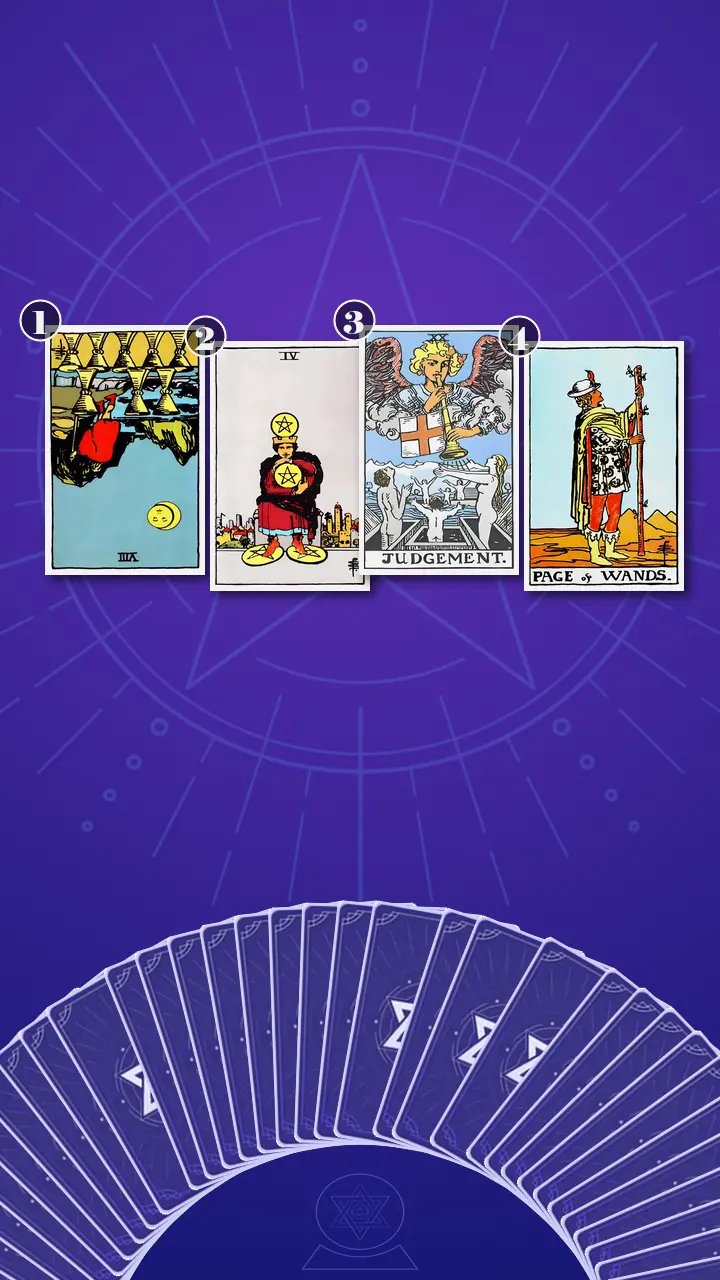
I placed the first two cards close together on the left, then left a slightly wider gap before the final pair. I explained that the opening position would reveal the observable shadow pattern—the behaviour Jordan could see on their screen and calendar. The second would uncover the protective root beneath it. The third, our catalyst, would name the truth Jordan had not yet allowed to carry equal weight with past investment. The final card would translate insight into a reversible experiment. The line looked less like a sentence imposed by fate and more like a corridor opening toward a workable door.
Reading the Loop Behind the Promotion Tracker
Position One: Eight of Cups Reversed and the Return to the Same Route
“Now I’m turning over the card representing the observable shadow pattern: how continuing to invest in this no-longer-meaningful path appears in your repeated choices and routines,” I said. “It is the Eight of Cups, reversed.”
On the card, the cloaked figure would ordinarily be leaving an intact arrangement of eight cups and walking toward a moonlit mountain route. Reversed, the departure cannot complete itself. I read that reversal as blockage, not as a bad omen and certainly not as an order to quit. The emotional information is already present, but movement keeps circling back toward what is known.
In Jordan’s life, the eight cups were easy to recognise: a credible product-operations title, stable income, completed projects, years of training, respected colleagues, and a plausible route toward management. None of those things was fake. The problem was that their continued existence no longer answered the deeper question. The moonlit route was every alternative Jordan researched but never contacted directly.
“This is the moment when you close the values journal, reopen the promotion tracker, and add another milestone,” I said. “The known route gives you a task. The unfamiliar route gives you uncertainty. So you choose the task, not necessarily because you want its destination, but because completing it briefly quiets the pressure to decide.”
The energy here was reversed water: feeling without completed movement. Jordan’s dissatisfaction had not disappeared; it had become trapped in a return loop. Another course or visible project offered twenty minutes of momentum, but the limbs remained heavy afterward. Another milestone could be progress on paper and avoidance in the body.
I told Jordan the pattern reminded me of the identity split in Severance: the working self continues performing competently inside a system while the whole person increasingly notices that competence is not meeting every human need. Jordan was not failing at the system. They had become skilled enough to maintain it almost automatically, which made questioning it more difficult.
“When you opened the promotion tracker last night, what exact action did you take, and what feeling did it quiet?” I asked.
Jordan gave a brief laugh, but it carried no amusement. Their mouth pulled to one side, and their fingers stopped on the journal page. “That’s too accurate. Kind of brutal,” they said. “I added a quarterly leadership objective. For maybe half an hour, I felt organised. I didn’t have to feel guilty about wanting something else.”
“Then we won’t call the tracker the enemy,” I replied. “It performed a protective job. Our task is to notice the price of hiring it for that job every time doubt appears.” The card was not accusing Jordan of weakness. It was showing the exact point where a search for meaning got converted into a familiar productivity ritual.
Position Two: Four of Pentacles and the Security That Pins the Feet
“Now I’m turning over the card representing the protective root: the fear of wasted investment and lost control that makes the existing path difficult to release,” I said. “This is the Four of Pentacles, upright.”
The figure held one pentacle against the chest, balanced another over the head, and planted both feet on two more. A city stood at a distance behind the rigid posture. I asked Jordan to look at the body before thinking about the traditional card meaning. Value was being protected so tightly that movement had become physically impossible.
For Jordan, the pentacle at the chest was professional identity: dependable, analytical, sensible, management material. The coins beneath the feet were salary, benefits, Toronto rent, credentials, and years of experience. The distant city represented the stable future those assets seemed to promise. In daily life, the card appeared when Jordan checked savings before allowing a curiosity to become a real possibility, asked respected colleagues whether leaving would be foolish, or chose another path-specific course because enrolment created temporary control.
I read the upright earth energy here as excess. Stability is useful; it pays rent, protects health, and creates room to make careful choices. But when preservation hardens into a total decision rule, security stops being a foundation and becomes immobility. I had no interest in shaming Jordan for wanting income and benefits in an expensive city. I wanted to separate legitimate financial constraints from the additional belief that protecting those constraints required indefinite loyalty to one professional identity.
“The inner sentence beneath this card may sound something like this,” I said. “I am not staying because I love this; I am staying because leaving would make the investment feel exposed.”
Jordan’s thumb pressed against the edge of their phone even though it was still face down. Their shoulders moved toward their ears, then held there. I could see the interpretation landing at the same body level as the card: one value against the chest, two commitments beneath the feet.
“The next time you calculate salary, rent, credentials, or years invested,” I asked, “what are you afraid would become true about you if you stopped adding to this path?”
Jordan looked away from the cards toward the dark apartment window. Their own screen reflection floated over the lights outside. “That I can’t trust myself,” they said eventually. “I’ve spent years telling everyone this was the sensible route. If I change my mind, it feels like proof that I misread myself from the beginning.”
“That is deeper than a salary calculation,” I said. “You are protecting the identity of someone who makes reliable decisions. But reliability does not mean forcing every earlier decision to remain correct forever. It means responding honestly when the evidence changes.”
Their shoulders lowered by less than an inch. It was not relief yet. It was the uncomfortable recognition that the grip had protected more than money. It had protected Jordan from grief, from other people’s questions, and from the possibility that a capable earlier self could have made a reasonable choice that no longer fit the present.
When Judgement Broke the Old Career Verdict
Position Three: The Truth That Needed a Present Tense
As I moved across the wider gap in the spread, the radiator on Jordan’s side stopped clicking. Even the laptop fan seemed to ease. The sudden quiet made the next card’s central image—the sounding trumpet—feel almost audible.
“Now I’m turning over the card representing the truth requiring conscious acknowledgement: what you must recognise about past effort, present meaning, and your right to revise direction,” I said. “This is Judgement, upright. It is the catalyst of the reading.”
An angel sounded a trumpet over figures rising from grey containers with open arms. I did not frame it as destiny calling Jordan toward a specific career. Upright Judgement carries the balanced energy of honest self-appraisal: reviewing the past without defending it, condemning it, or allowing it to monopolise the future.
I translated the image into a scene Jordan could actually use. I pictured them at a café on Dundas Street West with two columns on a page: What this path taught me and What I am continuing only to justify it. Stakeholder coordination, process design, operational judgement, and calm under pressure could fill the first column. Another management cycle and another credential might appear in the second. The trumpet was one sentence spoken clearly above both lists: I am good at this, and I am not sure I want more of it.
I returned us to the 10:40 p.m. split screen: tired body, unfinished prompt, analytics course, LinkedIn pivot post, promotion tracker. Jordan had been trying to find the correct permanent answer while three efficient forms of research protected them from one present-tense admission.
“The years you invested do not have to become a contract with the future,” I said.
Past effort is not a final verdict; answer the honest present-tense question, and let Judgement's trumpet turn accumulated experience into a consciously revised direction.
I stopped speaking and let the sentence remain in the quiet.
Jordan’s breath stopped first. Their right hand stayed suspended above the journal, fingers curved as if they had forgotten what they were reaching for. Then their eyes moved from Judgement to the tracker on the shared screen and went slightly unfocused; I could almost see the previous week replaying—the praise, the project offer, the course receipt. Their pupils widened. The line between their brows sharpened, and a flush rose beneath their eyes. “But doesn’t that mean I got the last six years wrong?” they said, quicker and louder than before. The resistance had heat in it, then grief. I let the question land. “No,” I said. “It means the last six years produced information. Revision is what a reliable decision-maker does when the evidence changes.” Their jaw trembled once. Their fist loosened against the desk, one finger at a time, until both hands rested open beside the journal. A long breath left their chest—not triumphant, more like the careful exhale after setting down a box they had forgotten they were carrying. Their shoulders dropped. Their eyes shone. Then came a small, dizzy pause: clarity had removed the excuse, and the freedom to review now felt like responsibility.
“Now, using this new perspective, think back: was there a moment last week when this insight could have made you feel different?” I asked.
Jordan wiped beneath one eye and nodded toward the promotion tracker. “After my performance review,” they said. “My manager praised my work and offered me another cross-functional project. I treated the praise like proof that I should want the management track. I could have let it mean I’m skilled without making it mean I’m obligated.”
That distinction gave me the opening to use one of the decision tools I carried from my former life on Wall Street: Sunk Cost Neutralization. I drew a line down a page. On the left, I placed everything the past had produced that remained portable—skills, relationships, savings, judgement, resilience, evidence of competence. On the right, I placed the future opportunity costs of automatically continuing—hours, attention, energy, and less room to discover what felt meaningful now.
“Neutralising a sunk cost does not mean pretending the investment never mattered,” I explained. “It means decoupling what has already been spent from the next allocation decision. Your experience keeps its value. It simply loses the right to cast every vote.”
I had seen intelligent people on trading floors defend a weak future position because too much had already gone into it. The spreadsheets could become increasingly sophisticated while the underlying premise remained untouched. Looking at Jordan’s promotion tracker, I recognised the same human impulse in a gentler but more intimate form: the wish to make yesterday’s investment guarantee tomorrow’s meaning.
I wrote a shorter version beneath the line: Past effort is evidence, not a final verdict. Then I added another distinction: being good at the path is not the same as still wanting the path.
For the next ten minutes, I asked Jordan to write two headings: Skills I can carry and Things I am continuing to justify the past. I asked for only one item beneath each. No resignation, message, course purchase, announcement, or final decision had to follow. If the exercise became too activating, Jordan could close the note, make tea, or leave it unfinished.
Under the first heading, Jordan wrote turning messy stakeholder needs into a workable process. Under the second, they wrote another promotion cycle. They read both aloud. Their voice caught slightly on the second line, but neither line erased the other.
I told Jordan this was the first movement from disillusioned stagnation and fear of wasted effort toward grounded self-trust guided by present values and current evidence. It was not a complete career decision. It was the moment past experience became source material rather than a sealed verdict, leaving room for grief about an identity being released and curiosity about what might be tested next.
The Page of Wands and the Experiment No One Had to See
Position Four: Beginner Fire Without a LinkedIn Announcement
“Now I’m turning over the card representing the grounded integration step: a low-risk experiment that creates present evidence without demanding an immediate, irreversible decision,” I said. “This is the Page of Wands, upright.”
The Page stood in an open landscape, studying one living wand with fresh leaves sprouting from it. The figure was not surveying a completed empire or presenting a polished five-year roadmap. The Page was simply close enough to one emerging interest to learn from direct contact.
In Jordan’s life, this card did not mean quitting their stable role or inventing a new professional identity overnight. It looked like spending sixty to ninety minutes at a Toronto library, a community workshop, or a quiet desk building, observing, or discussing something chosen for genuine interest rather than résumé value. The sprouting wand was not yet a job title. That was its strength.
I read the upright fire as balanced activation: enough energy to begin, bounded tightly enough that curiosity could not immediately become another obligation. Jordan had been trying to solve a crisis of meaning with more earth—more credentials, plans, and measurable milestones. The Page introduced a controlled amount of fire: one experiment, one observation, no promise of permanence.
“You do not need a new identity before you can collect one piece of new evidence,” I said. “The inner sentence here is: I am not choosing forever; I am finding out what happens when I give this one thing real contact.”
I applied a second strategic lens, Asymmetric Risk-Benefit Analysis. A private seventy-five-minute experiment had a bounded downside: a small amount of time, no new tuition, no public commitment, and no loss of salary or benefits. Its potential upside was structurally larger because it could produce information Jordan’s existing tracker could never supply—whether attention held naturally, whether energy returned, and whether they would voluntarily come back.
“What have you been curious about but dismissing because it does not support the management track?” I asked.
Jordan looked down, then opened the journal to a blank page instead of reopening the laptop tabs. “I’ve been saving things about civic technology and service design,” they said. “Work that makes complicated public systems easier for people to use. But I keep telling myself it’s not relevant enough to count.”
“For this card, relevance is not the entry requirement,” I said. “Attention is.”
Their fingers loosened around the pen, but a wary smile appeared. “I can turn anything into a KPI,” they said. “Give me one workshop and I’ll have a five-year pivot plan by midnight.”
“Then the experiment needs an anti-performance boundary,” I replied. “No LinkedIn post, no new headline, no paid course, no asking whether this can become your forever career. You only record what held your attention, what drained it, and whether you would freely return once.”
Jordan nodded slowly. Their shoulders remained lower, though not completely loose. The path ahead was clearer, and that clarity carried a new vulnerability: they could no longer claim that more research was the only responsible move. But the Page did not ask them to leap. It asked them to touch one living possibility and notice what happened.
The Parking Meter and the Third Door
When I looked across the full four-card Shadow Spread, the story was coherent. The Eight of Cups reversed showed that Jordan already recognised the emotional depletion but kept circling back to the established roadmap. The Four of Pentacles revealed why: salary, credentials, status, and the identity of being a reliable decision-maker were being held so tightly that protection became immobility. Judgement separated portable experience from outdated obligation. The Page of Wands converted that reassessment into one bounded encounter with something currently alive.
The elemental progression mattered. Reversed water had feeling without movement. Fixed earth supplied safety without flexibility. Judgement introduced breath, sound, and honest language. The Page brought a modest flame—enough to test, not enough to burn down the existing structure. Jordan did not need to destroy practical security to restore movement. They needed to let emotional knowledge become speakable, then testable.
“Your blind spot is not simply that you are counting past costs,” I told them. “It is that you count the cost of changing direction in exquisite detail while barely measuring the opportunity cost of staying on autopilot. You also treat the immediate relief produced by a cleaner tracker as evidence that the path itself still has meaning.”
I compared it to feeding a parking meter after deciding the location no longer serves you. Another coin may postpone the discomfort of leaving, but it does not make the place more meaningful. Jordan did not need to know that night whether they would leave the parking space. They only needed to notice who was choosing the next coin: present values, past investment, or the need for immediate relief.
The transformation direction was therefore precise: stop asking how to justify the existing investment, and let one small alternative produce current evidence. This protected Jordan from two equally unhelpful extremes—doubling down automatically or making a dramatic exit before an alternative had been tested.
The 72-Hour Third-Option Leverage Test
I call the practical framework I gave Jordan The 3rd-Option Leverage Test. Option A was to remain on the management track and keep deepening it. Option B was to quit before Jordan felt financially ready. Both appeared to demand a verdict. The hidden third path was to keep income and core responsibilities intact while pausing optional recommitments long enough to gather one piece of independent evidence.
I wanted the actionable advice to be small enough to begin without adrenaline and rigorous enough to interrupt the sunk-cost career trap. We agreed on three next steps:
- Tag the next recommitment. For the next 72 hours, before enrolling in an optional course, accepting another stretch assignment, or updating the promotion tracker, pause for two minutes. Write one label: present meaning, past investment, or immediate relief. Add one sentence naming the discomfort the action would temporarily remove. Tip: Use this on one live decision, not your entire career. If no decision appears, review the most recent course purchase instead.
- Schedule the hidden third path. Before the 72-hour window ends, reserve Thursday from 6:30 to 7:45 p.m. at Toronto Reference Library. Jordan would use one free civic-service-design tutorial to build a tiny workflow chosen for interest, not résumé value. No job change or new identity was required. Tip: Keep the first version private. Spend no money, make no LinkedIn announcement, and contact no employer unless you freely choose to later.
- Capture present evidence. Within ten minutes of finishing, record three observations: what held attention, what drained energy, and whether you would voluntarily return one more time. Stop after those three lines rather than turning the experiment into another roadmap. Tip: A flat result is useful evidence, not failure. If sixty minutes feels overwhelming, reduce the test to saving one event and writing one honest question.
These steps did not answer Jordan’s whole career question. That was deliberate. The leverage came from creating a third option whose downside was limited while its informational value was high. Tarot had helped expose the loop and organise the evidence, but Jordan—not the cards—would decide what the evidence meant and what happened next.

A Week Later: Quiet Proof by the Library Window
Six days later, I received a message from Jordan. They had paused before volunteering for the next phase of a visible project and written immediate relief in their journal. They had not rejected the assignment dramatically or announced a career pivot. They had simply asked for twenty-four hours to consider the workload instead of answering from reflex.
Jordan had also kept the Thursday appointment with themselves at Toronto Reference Library. They spent seventy-five minutes using a free service-design exercise to map how a confusing public process might feel from a resident’s point of view. They did not buy a course or post about it. Their three observations were simple: the human interviews held their attention; polishing presentation slides drained it; they wanted to try one more session.
“I didn’t solve my career,” Jordan wrote. “But I got information that didn’t come from the old plan. That feels different.”
They added: “I slept through the night. My first thought was still, What if I’m wrong? But it didn’t sound like a verdict this time. Just a question.”
That was the quiet proof of Jordan’s Journey to Clarity. Their circumstances had not transformed into a perfect answer, and the grief around a once-certain identity had not vanished. What changed was the location of authority. Past effort had become transferable experience; present attention had earned a place in the decision; and Jordan had begun replacing defensive mental accounting with grounded self-trust.
I did not see tarot make Jordan’s choice. I saw four card meanings, read in context, help them observe a pattern they were already living. The agency appeared in the pause before another commitment, the honest sentence spoken aloud, and the seventy-five minutes they chose to give an unproven interest.
When Sunday-night heaviness returns and both staying and leaving tighten your chest, it can feel safer to keep feeding the parking meter than to ask whether the location still serves you. But noticing whose hand is holding the next coin—past investment, immediate relief, or present meaning—is already a thinning of the fog.
If the years you have invested could travel with you as transferable experience rather than masquerade as a final verdict, what small, sprouting-wand interest are you quietly curious enough to give sixty unposted minutes of real contact this week?