An Added Ask Meets a One-Line Pause: Saturday Stays Put This Time

The Yes That Ate Saturday: What Strings Attached Really Cost
If your first response to an opportunity is yes and your second is figuring out what it will cost, this may feel familiar.
At 10:47 p.m. on a Tuesday, Maya joined our video session from the shared Toronto apartment she could barely afford to treat as a place of rest. Her laptop fan hummed beneath the call. Blue screen light floated in the dark window, the radiator clicked behind her, and an untouched dinner sat beside the keyboard, cold enough for the oil to turn dull.
A professional contact had offered her an introduction. Maya had accepted immediately. Then came the follow-up: since the contact was making the introduction, could Maya also build a presentation deck? It should only take an hour. She had dragged a Saturday appointment into the following week, typed “No problem at all,” and opened her laptop before checking how much work the deck would actually involve.
I watched her rub the hinge of her jaw. The apprehension did not look like a vague cloud; it looked like a checkout timer installed behind her breastbone, counting down toward the same command: agree now, keep access, inspect the price later.
“This is literally the message I send,” she told me. “I say yes, delete the boundary, and work out the cost after everyone else has gone to bed. I already said yes, so changing the terms now feels rude. But it is never just the favor they first mentioned.”
Then she asked the question that had brought her to me: “What do I lose when I keep saying yes to strings attached?”
I told her I was not going to use tarot to predict whether this contact would punish her, reward her, or keep a door open. The cards could not establish another person's motives, and I would not turn an unclear agreement into a frightening prophecy. I wanted to help her see the pattern objectively: where her authentic wish for connection ended, where fear-driven compliance began, and what a fair next answer could look like.
“You want access,” I said, “and you also want your time, voice, and autonomy to remain yours. We do not have to shame either need. Let us make a map of the place where they keep colliding.”

Choosing the Compass: The Five-Card Shadow Spread
I asked Maya to put both feet on the floor, take one unforced breath, and hold the question in mind while I shuffled. I use this small pause as a psychological threshold, not a mystical performance. It lets the nervous system arrive before the interpretation begins.
I chose the five-card Shadow Spread. In Jungian work, the shadow is not evidence that someone is bad, broken, or secretly doomed. I understand it as a protective pattern that once made emotional sense but now operates too quickly to be examined. Maya's repeated word, “keep,” told me we were looking at such a pattern: not one inconvenient favor, but a recurring sequence of consent, relief, added conditions, and resentment.
For anyone wondering how tarot works in a reading like this, I treat the spread as a structured set of cognitive prompts. A Celtic Cross would have added timelines, outside influences, and possible outcomes that Maya's focused question did not require. This smaller pattern-root-cost-resource-integration layout could trace one loop precisely without pretending to know more than the evidence allowed.
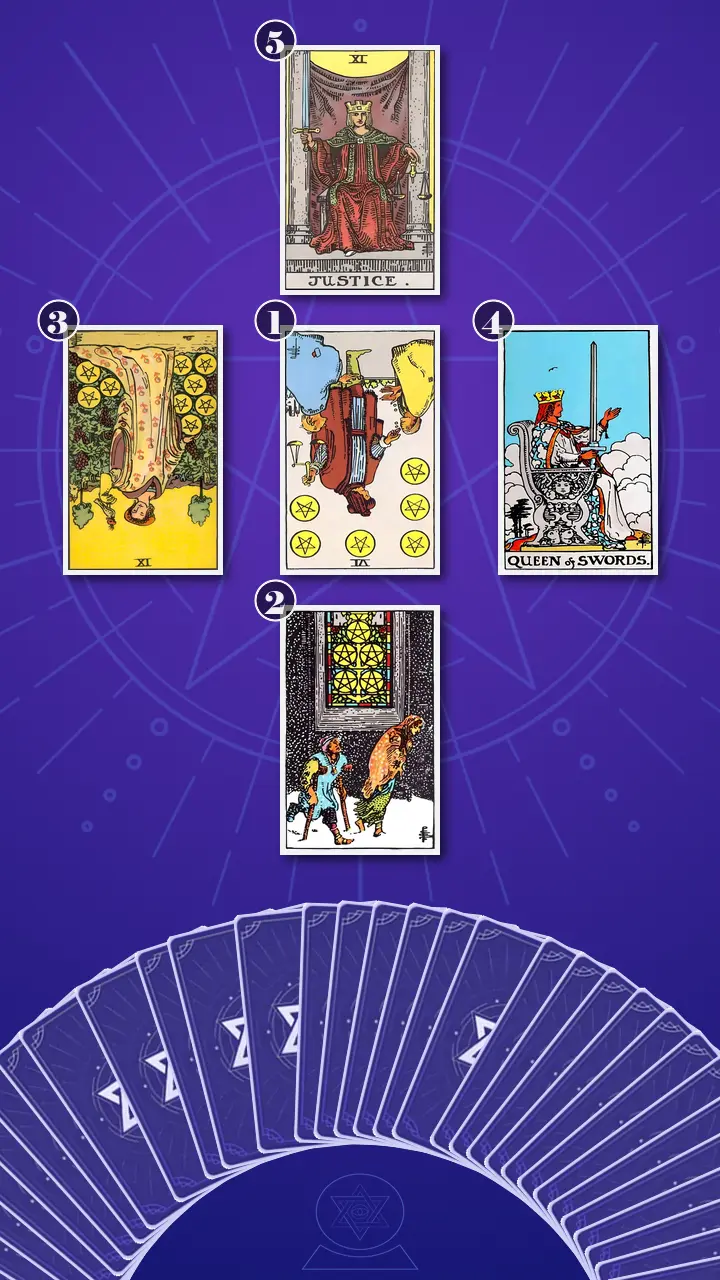
I placed the first card in the center to reveal the present shadow behind her repeated yes. The second went below it, where it would show the fear feeding the pattern. The third went to the left to identify the concrete cost. The fourth went to the right to uncover the capacity she already possessed. The fifth went above the center to establish a conscious principle for fair consent.
The cross resembled a compass built around one conditional yes. Its lower point asked what pulled Maya into the agreement. Its side points compared what she surrendered with what she could reclaim. Its upper point asked what standard could guide her when approval, urgency, and gratitude became noisy. The cards would offer meanings in context; Maya would remain the person deciding what fit and what she wanted to do with it.
The Scales in Someone Else's Hand
Position 1: The Gift That Behaved Like an Open Invoice
I began by turning over the card representing the present shadow pattern behind Maya's repeated yes: accepting access or support while allowing the giver to control unspoken terms. It was the Six of Pentacles, reversed.
I pointed to the standing figure holding both the coins and the scales. The same hand distributed the resource and controlled the measure of fairness. Reversed, that concentration of authority showed an imbalance: too much power to define the exchange sat on one side, while Maya's participation in defining the terms had become blocked.
I brought the image directly into her week. A senior contact offers an introduction. Maya feels the quick relief of being included and says yes. Only afterward, an unpaid deck, event attendance, and follow-up support begin appearing around the original offer. Because the contact seems to control both the opportunity and the standard of gratitude, every add-on feels less like a fresh request and more like a bill she is already late paying.
“The inner script sounds like this,” I said. “They are opening a door for me, so I should not make this awkward by asking what it costs.”
The card did not prove that the contact was intentionally manipulative. It made something observable visible: the scope had changed, and Maya no longer felt free to evaluate it. It was the relationship equivalent of a checkout page with every add-on box preselected. Unless she stopped to review each item, convenience quietly became consent.
Maya gave one short laugh, but bitterness caught at the end of it. “That is so accurate it is almost cruel.” Her fingers tightened around the mug beside her, then released it without lifting it.
“I can see why it lands sharply,” I said. “But I do not read this card as an accusation against you. Your fast yes has been protecting something important: access, approval, and the relief of not risking an awkward moment. We are simply making the full price visible before that protective reflex spends more than you chose.”
I asked her to think of the last offer she had accepted quickly. What had been offered first? What was added later? At what point had she stopped feeling free to reconsider? She looked toward her open calendar and said, “The moment they mentioned the introduction again. After that, it did not feel optional.”
That was the Six of Pentacles reversed in context: generosity and debt had become difficult to distinguish because the scales remained in the same hand as the opportunity.
Position 2: The Lit Window Outside the TTC
I turned the card representing the underlying fear of exclusion and conditional belonging that made unclear terms feel safer than refusal. The card was the Five of Pentacles, upright.
Two figures crossed through snow beneath an illuminated stained-glass window. Support was visible, but it appeared psychologically distant. In this position, the card showed a blockage created by scarcity: Maya could see the professional room she wanted to enter, yet one clarification question felt capable of putting her permanently outside it.
I asked her about Monday mornings on the TTC. She told me about standing on Line 1 with a wet coat pressed against her sleeve, train brakes shrieking, and a manager's Slack notification warming the phone in her palm. While LinkedIn filled with promotion announcements from former colleagues, the manager asked for “one more quick thing” attached to a client meeting.
“Before you calculate the hours,” I said, “your mind produces a more frightening equation: If I ask what this involves, they may decide I am not worth the trouble.”
Her thumb stopped tracing the mug's rim. I saw her breath pause first. Then her eyes moved away from the cards as if she were replaying a row of old message threads. Finally, a low exhale left her chest, and her shoulders dropped by less than an inch.
“It is not really the deck,” she said. “It is the idea that everyone else knows how to stay in the room, and I am one question away from being removed.”
I did not tell her that a good contact would definitely welcome the question. That would have been another promise neither of us could make. I told her the Five of Pentacles was separating a present uncertainty from a feared verdict. A request might lead to negotiation, disappointment, silence, or agreement. The image of total exclusion was one possible outcome her protective mind was treating as a certainty.
“The discomfort is real,” I said. “But discomfort is not proof that your limit is wrong. Sometimes it is simply the unfamiliar gap between a request and your answer.”
The window on the card stayed lit. I saw it not as a guarantee that every door would remain open, but as a reminder that belonging was larger than one person's invitation. Maya could value the opportunity without letting fear decide the terms before the conversation had even begun.
Position 3: The Polished Profile and the Editable Life
I turned the card showing how the pattern manifested and what Maya was losing through it, especially time, voice, negotiating power, and autonomy. It was the Nine of Pentacles, reversed.
The hooded falcon drew my attention first. The surrounding vineyard looked abundant. The figure appeared accomplished and secure. Yet the trained bird's field of vision remained restricted. Reversed, the card showed a deficiency of self-directed choice inside an impressive-looking environment. Access existed, but autonomy had become conditional.
I asked Maya to show me the private calendar behind her polished LinkedIn surface. The public version displayed introductions, events, and visible partnerships work. Google Calendar told another story. The blocks marked “dentist,” “portfolio,” and “quiet night” had been dragged around decks, follow-ups, and “quick” requests. Her own plans looked like shared documents to which everyone else had admin rights.
Seeing the hooded falcon, my mind went to the familiar Little Mermaid bargain: entry into a desired world purchased by surrendering a voice. Maya's version did not involve a fairy-tale contract. It involved deleting one clear sentence at a time until the network looked expansive but her available choices had narrowed.
I used my Hidden Cost Deconstruction lens. I drew an imaginary invoice beside the card and itemized what the visible opportunity had not priced: two expected hours becoming most of an evening; a postponed health appointment; takeaway bought because dinner had gone cold; sleep shortened; creative work pushed into an indefinite future; and the quiet loss of confidence that her calendar could hold anything simply because she had chosen it.
“Resentment can be the receipt for a cost your yes never got to name,” I said.
Maya inhaled sharply and looked at the Saturday block she had moved. “I keep calling it an opportunity even when it takes over my week,” she said. “I look connected, so why does none of my time feel fully mine?”
I told her the card was not advising total independence or the rejection of every favor. That would turn protection into another rigid rule and cut her off from healthy reciprocity. The real question was smaller and more precise: each time she accepted another person's terms, which personal choice became less available?
Her gaze remained on the falcon. I watched her hand open on the table, palm up, as though she were noticing for the first time that the lost object was not merely Saturday. It was authorship.
The Open Hand and the Clear Sword
Position 4: A Boundary That Leaves the Conversation Open
I turned the card representing the constructive capacity hidden inside the pattern: Maya's ability to ask direct questions, distinguish reciprocity from debt, and communicate a limit. The Queen of Swords appeared upright.
The Queen held her sword vertically while extending her other hand in an open gesture. I lingered on that pairing. Receptivity and distinction occupied the same body. Her energy was balanced Air: language sharp enough to separate an offer from an obligation, but not sharpened into hostility.
Three Pentacles cards had kept the reading dense with access, work, scarcity, and practical cost. With the Queen, the atmosphere changed. I could almost feel the room clear as the radiator stopped clicking. Air entered through a sentence Maya could actually use.
I asked her to return to the message thread and draft, without sending, “I am open to discussing the deck, but it was not part of what I agreed to. What scope and timeline did you have in mind?”
She typed it. Then she hovered over the empty space beneath it, where she would normally add three apologies, disclose her entire weekend, and volunteer a smaller free version before the other person had replied.
“Leave the next message bubble empty,” I said. “You can stay interested without filling every silence with another concession.”
The Queen's open hand meant the conversation could continue. Her sword meant the introduction and the deck did not have to blur into one obligation. Directness was not the same as hostility; openness was not the same as unlimited availability. Maya could clarify a changed request while allowing the other person to have a reaction she did not control.
“Clarity is not ingratitude; it is how consent stays current,” I told her.
Her shoulders lowered. She read the draft aloud once, stumbled over “not part of what I agreed to,” and read it again in a steadier voice. Then she saved it to the Notes folder where her softer, unsent boundaries usually disappeared.
“This one sounds like me,” she said. “Not an angry version of me. Just a version who is actually in the agreement.”
I nodded. The Queen was not giving Maya a new personality. She was restoring a capacity that apprehensive compliance had kept muted: the ability to remain relationally present while making a limit audible.
When Justice Took Back the Scales
Position 5: The Sentence That Made Consent Visible
I told Maya we were turning over the key card, the one representing integration through visible terms, mutual responsibility, and genuine freedom to decline. The room seemed to narrow around the small rectangle of space above the spread. I turned the card. Justice appeared upright.
I saw the visual answer immediately. The scales from the Six of Pentacles had returned, but they were no longer held by the person distributing access. Justice held them from a centered seat, with an upright sword and two stone pillars establishing a standard that could be examined. The energy was balance: neither automatic compliance nor automatic refusal, but informed choice.
I brought us back to 10:47 p.m. Her dinner was cooling beside an open laptop while she moved Saturday's appointment for a deck that had never belonged to the original ask. Her typed yes and locked jaw were carrying two different accounts of the agreement.
Justice asked her to write down the original offer, the added expectation, what each person would contribute, her actual capacity, and whether declining remained possible. From there, she could accept, renegotiate, or decline the revised agreement. The aim was not to produce a universally correct verdict. It was to restore her participation in deciding what was fair.
This was where I used Fear-Driven Logic Decoupling, one of the lenses I rely on when a decision matrix has been crowded by the subconscious fear of failure. I drew two columns. In the first, Maya named her authentic desire: “I want the introduction, and I am genuinely interested in the relationship.” In the second, she named the fear-driven conclusion: “If I ask about scope, I will lose access and prove I do not belong.”
Separating the two showed her something decisive. Wanting the introduction did not logically require consenting to an undefined deck. The desire could remain true while the fearful prediction lost its authority to answer on her behalf. Their access mattered, and her consent still got a vote.
I said, “A yes is only yours when the terms are visible and no remains a real option.”
You do not have to purchase belonging with open-ended consent; examine the scales, name the terms, and choose only agreements that remain fair to you.
I let the sentence settle without rescuing either of us from the silence.
For one beat, I watched Maya stop breathing. Her fingers remained suspended above the keyboard, and her pupils widened as if the cold dinner, the shifted appointment, and a dozen deleted boundaries had appeared at once on an internal screen. Then her mouth tightened. Colour rose beneath her eyes, and the recognition did not arrive as relief first.
“But doesn't that mean I was wrong all those times?” she asked. Anger sharpened the question before her voice thinned. “That I gave all that away for nothing?”
I saw her shoulders brace again, then slowly release when I answered. “No. It means your earlier yeses were made with the tools, fears, and visible information you had. Clarity is not a prosecution of your past. It gives your next answer more room.” Her fist loosened against the table. She blinked twice, looked away, and exhaled with a slight tremor. The release left her momentarily unsteady, as though putting down a heavy bag had made her newly aware of the hand that would now choose what to carry.
I asked, “Now, with this new perspective, think back: was there a moment last week when this insight might have made you feel different?”
She returned to a Wednesday mentorship conversation. The senior contact had offered introductions, then requested a full deck that evening. “I wanted the mentorship,” she said. “But I answered the fear of losing it. I never actually answered the deck request.”
I gave her up to ten minutes to open a private note titled “Before I Answer.” I asked her to write four lines: “Original offer,” “What was added,” “What they expect from me,” and “What I can freely give.” Beneath them, she drafted one unsent sentence: “Before I confirm, what would you expect from me in return?”
I reminded her that she did not need to begin with the most powerful person in her network. She could practise on a low-stakes invitation, shorten the note to one line, draft without sending, or stop if the reflection felt too exposing. A useful tool should increase choice, not become another demand she has to satisfy perfectly.
Maya read the four lines again. Her face still held the vulnerability of someone discovering that a clearer path also carried responsibility. Yet the shift was visible. This was not a leap from fear to certainty. It was a first movement from apprehensive compliance and approval-seeking toward cautious self-trust and grounded reciprocity.
Justice did not promise that every relationship or opportunity would survive clearer terms. It showed Maya that another person's response was information, not a verdict on her belonging. She was allowed to evaluate the person who was evaluating her.
The Terms-Before-Yes Plan
When I read the spread as one connected story, the logic became plain. The Five of Pentacles showed why conditional access could feel safer than possible exclusion. That fear fed the Six of Pentacles reversed, where Maya accepted the coins while leaving the scales in someone else's hand. The Nine of Pentacles reversed revealed the hidden bill: her calendar, voice, rest, and confidence in her own limits. The Queen of Swords restored precise language. Justice turned that language into a repeatable standard for informed consent.
The core contradiction was not that Maya wanted too much. She wanted to keep valuable doors open and protect her autonomy from strings attached. Her blind spot was treating a clarification after changed scope as though she were breaking her original promise. But she was not changing the agreement first. She was responding to an agreement that had already changed.
“An opportunity that expands after your yes is a revised agreement, not a test of gratitude,” I said.
The key shift was therefore practical: move from immediate agreement to a defined decision pause, ask what is expected in return, and decide only after the terms are visible. I did not ask Maya to become colder, reject collaboration, or stop caring about relationships. I asked her to add what the spread lacked. Water would mean naming the feeling beneath the fast reply. Fire would mean taking one small, observable boundary action.
- The 10-Minute Terms-Before-Yes CheckBefore one non-urgent yes from a manager, friend, professional contact, or date, open “Before I Answer” and write four lines: the original offer, the added expectation, what they provide, and what you can freely provide. Add one scope question, such as “How many hours are you expecting?” or “Is this required for the introduction to go ahead?” Then choose accept, renegotiate, or decline.If ten minutes feels too formal, write only the added term and ask, “What would that involve?” The point is participation in the decision, not a perfect fairness audit.
- The One-Line Decision PauseWhen the next non-urgent request arrives, send only, “I need to check my capacity before I confirm. I will get back to you tomorrow.” Put a reminder in Google Calendar so the decision does not circle in your head all night. Before replying, take 60 seconds to name the first response in your body: a locked jaw, compressed chest, lifted shoulders, or genuine ease.Use a shorter version if needed: “Let me check and get back to you.” A pause can be brief and still interrupt the automatic yes.
- The 48-Hour Shadow Choice ExperimentChoose one low-stakes revised request and, on paper only, act as if you have decided to renegotiate or decline it. For 48 hours, record every prediction your mind produces: “They will think I am difficult,” “The invitation will disappear,” or “I will owe them forever.” Beside each prediction, label what is observable evidence and what is fear-driven logic. At the end, decide freely whether to send a boundary, reduce the scope, propose another time, or accept.This is a private experiment, not a command to confront anyone. No message has to be sent. Stop, shorten, or choose an easier request if the exercise feels unsafe or too exposing.
I asked Maya to protect one existing calendar block while she tried the plan. It did not matter whether the block held a dentist appointment, portfolio work, dinner with a friend, or an hour of unplanned quiet. She did not have to prove that her reason was important enough. The block already represented a choice she had made before somebody else's add-on arrived.
“A yes is only yours while no remains available,” I reminded her. “These steps are not new rules you have to obey. They are ways to keep all three options visible: accept, renegotiate, or decline.”

Six Days Later: Saturday Stayed Put
Six days later, I received a screenshot from Maya. A contact had added event support to a conversation about an introduction. Instead of replying immediately, she had written, “Let me check my capacity and get back to you tomorrow.” The message was one line long. There was no defensive paragraph beneath it.
The next morning, she used the four-line note. She separated the introduction from the event work, checked the hours, and replied, “I am still interested in the introduction. The event support is a separate ask, and I cannot take it on this week.”
The other person's response had not arrived when Maya sent me the screenshot. That mattered. The first proof of change was not external approval. It was the Saturday appointment still sitting in her calendar, unmoved, while someone else's reaction remained outside her control.
She later told me she slept through the night, then woke with the old thought, “What if I got it wrong?” This time, she smiled, checked that Saturday was still hers, and made coffee.
I did not see tarot make that choice for her. I saw the cards give form to what her jaw, calendar, and resentment had already been reporting. Maya supplied the pause, the sentence, and the courage to let a revised request receive a revised answer.
That was her Journey to Clarity: not perfect certainty, but the return of the scales to her own hands. Connection no longer had to mean open-ended debt, and belonging no longer had to be proven through permanent availability.
When a request lands and your jaw tightens before your fingers type yes, losing another evening can feel safer than finding out whether the door closes when you name a limit. I would ask you to remember that noticing who holds the scales already begins to return your voice to the agreement.
If your next yes did not have to prove that you belong, which term would you place on those scales before answering?