Finding Clarity in the Buzzing Kitchen Light
If you refresh your banking app three times in a row even though nothing changed, and your jaw is clenched the whole time, that’s not “being responsible”—that’s anxiety wearing a budget spreadsheet as armor.
Jordan sat across from me with the kind of stillness that isn’t calm—it’s contained. She was 27, Toronto-competent in the way early-career people learn to be: capable at work, polite in group chats, good at making things happen. And yet her body was telling on her. Tight chest. Jaw set like she was holding a secret between her teeth.
She described a scene so specific I could practically hear it: 8:47 PM on a Tuesday, in her condo kitchen. The overhead light buzzing. Socks on cold tile. Phone in one hand with her TD app open, laptop on the counter with a spreadsheet tabbed like a browser you don’t want anyone to see. Refresh. Refresh again. Not because she was buying anything—because she wanted the numbers to feel quiet.
“It’s my parents’ old budget notebook,” she said, like she was confessing to a crime that had no name. “I found it at their place. I keep rereading it. Like… redoing the math. And then I’m stricter with myself immediately. I’ll literally opt out of a plan while I’m staring at a balance that’s fine.”
What she wanted was insight—What scarcity script did that notebook install in her? What she feared was the script itself: that one unexpected expense would prove she was never actually safe, and all her adult choices were just… temporary luck.
The way her anxiety moved through her sounded like mental math done in a storm: short, stacked calculations, no room to breathe. And in her body it looked like trying to inhale through a zipped-up winter coat—air technically available, but not accessible.
I let my voice soften on purpose. “You’re not bad with money—you’re running an inherited safety protocol. Let’s not fight it. Let’s understand it. We’ll use the cards to map what the notebook awakens—and what your own wisdom is trying to build underneath the noise. This is a Journey to Clarity, not a test you have to pass.”

Choosing the Compass: The Celtic Cross · Context Edition
I asked Jordan to take one slow breath—not to “calm down,” but to locate the question in her body. Then I shuffled, steady and unhurried, the way I used to do on long ocean crossings when travelers would come to me at 2 a.m. with something heavy they couldn’t name. Shuffling isn’t a spell. It’s a threshold: a way to move from spiraling to seeing.
“Today we’ll use a spread called the Celtic Cross · Context Edition,” I told her.
For you reading this: the classic Celtic Cross is one of the best spreads for moments like this because it holds two truths at once—what’s happening right now (the notebook trigger, the clamp-down reflex) and what’s underneath it (the conditioning, the inherited rules, the nervous system logic). It doesn’t force a yes/no prediction. It lays out context so you can make cleaner decisions.
In this version, I pay special attention to the root and the past positions—because when money anxiety is inherited, your “present” is often just an old story reactivated.
“Here’s the structure,” I said, keeping it simple. “The first card shows what your current money behavior looks like in the moment. The crossing card shows the main friction—the pressure point. The root reveals the inherited belief underneath. And the final outcome shows the most empowering way to rewrite the script into something livable.”
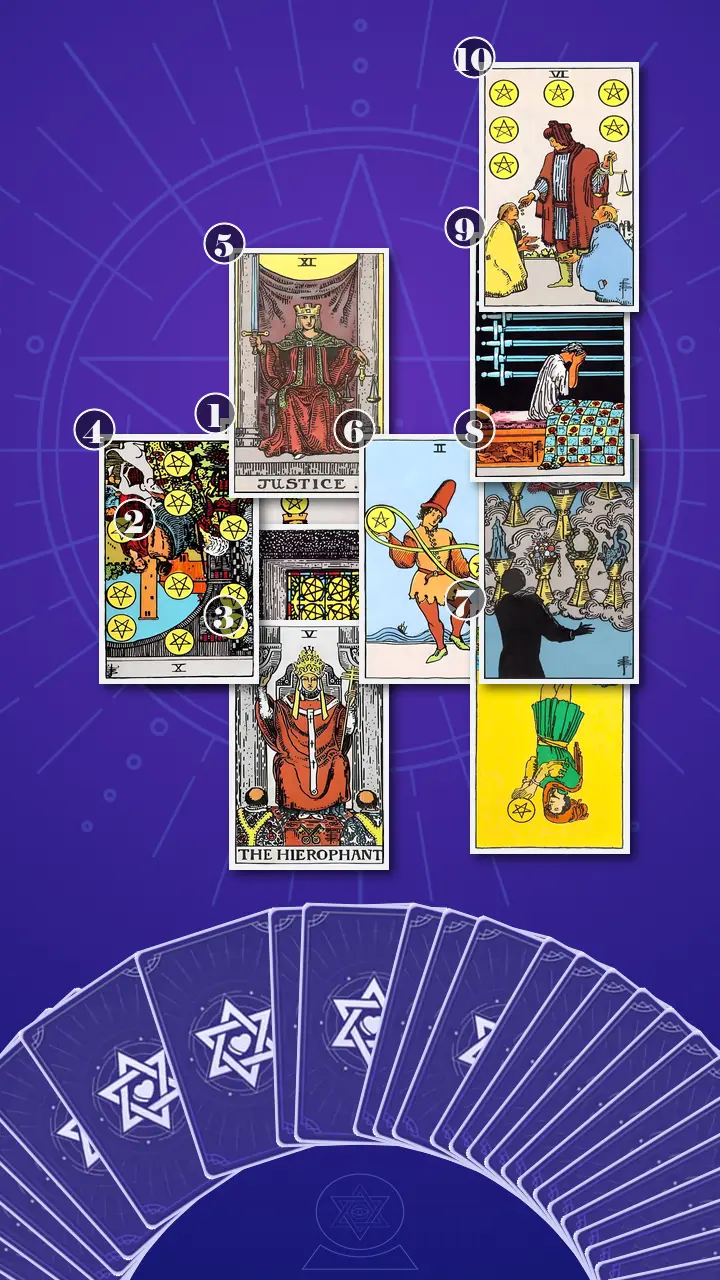
Reading the Map: Card Meanings in Context
Position 1 — The Clamp-Down Reflex in Real Time
I turned over the first card. “Now we open the card representing what your current money behavior looks like in the moment—that immediate tightening response after seeing the notebook.”
Four of Pentacles, upright.
“This is the card of grip,” I said. “And it’s specific.” I tapped the center coin. “It’s 9 PM and you’re not ‘shopping’—you’re policing. You’ve got your bank app, your budget spreadsheet, and a mental rulebook open at the same time. You move tiny amounts between categories so the totals look safe, and you delay clicking buy or replying yes to plans until the numbers feel locked down. Life keeps moving in the background while you grip the coins under your feet.”
In energy terms, the Four of Pentacles is contraction—security-seeking through control. Not inherently “bad.” But here it’s over-tightened. Like gripping the subway pole so hard your hand hurts even after the train has stopped moving.
Jordan gave a short laugh—thin, bitter. “That’s… yeah. That’s exactly me. And it sounds kind of brutal when you say it out loud.”
“Brutal, but not shameful,” I replied. “This card isn’t judging you. It’s showing you the mechanism.”
Position 2 — The Pressure That Makes Control Feel Non-Negotiable
“Now we open the card representing the main friction—how the scarcity script shows up as pressure, restriction, or mental spirals.”
Five of Pentacles, upright.
“A rent notification or a surprise fee hits and your brain instantly jumps to ‘I’m on my own,’” I said. “Even if you have savings, options, or people who would help you troubleshoot, your nervous system treats support as inaccessible—like warmth behind glass. So you tighten rules, cancel plans, and make scarcity your identity in real time.”
This card is blockage—not a lack of resources, but a felt sense of being shut out. It’s the difference between “I have options” and “my body trusts I have options.”
I let the moment land, then zoomed in the way I do as a Jungian psychologist: “Here’s the loop the spread is already naming. Control gives relief fast. It also charges interest in decision fatigue.”
And I did what the Five of Pentacles always asks me to do—freeze-frame it.
“Thumb hovering over ‘transfer.’ Moving $10 from fun to groceries because it looks cleaner. Hovering over a $28 cart total for something you actually want. Telling a friend ‘I’ll confirm’ and then checking RBC/Scotia/TD again before you can say yes. Inner script: If I tighten this one rule, I’ll feel okay.”
Jordan’s eyes flicked down to her hands. She hadn’t noticed she’d been holding her fingers together like a clamp until I described it. She loosened them, then tightened again, like her body didn’t trust the release.
Position 3 — The Inherited Belief Underneath the Anxiety
“Now we open the card representing the inherited core belief underneath the anxiety—the script you absorbed before you had adult choices.”
The Hierophant, upright.
“You’re budgeting with someone else’s doctrine running in the background,” I said gently. “The notebook isn’t just numbers—it’s a ceremonial rulebook: ‘Responsible people do it this way.’ You feel like you have to earn safety by obeying the script, and any deviation triggers guilt or shame like you broke a vow. Money becomes proof of being ‘good,’ not a tool for your actual adult life.”
The Hierophant is structure—but here, the structure is inherited. It’s the parents’ operating system running default settings you never chose.
Jordan swallowed. “I hate that it feels… moral. Like if I can’t explain every dollar, I’m reckless.”
“Exactly,” I said. “This card explains why your spreadsheet doesn’t feel like a tool. It feels like a confessional.”
Position 4 — The Family Imprint That Still Hums in the Background
“Now we open the card representing the family or early imprint that shaped your relationship with budgeting and safety.”
Ten of Pentacles, reversed.
“The family story underneath the notebook feels unstable or conditional,” I said. “Security is something you manage anxiously, not something you can rest inside. When you read the notebook, you don’t just see budgeting—you see the pressure to keep the ‘house’ from cracking. You scan your own life for weak points—‘How many months could I survive?’—as if stability is always one bad month away.”
Reversed, this is foundation-with-a-wobble. Not necessarily financial collapse—often emotional. Like the structure looks fine from the street, but inside, everyone learned to listen for the creak.
Jordan’s face tightened, then softened. “My parents were always… braced. Even when things were okay.”
I nodded. “A notebook like that can be a record of survival—not a prophecy you have to keep reenacting.”
Position 5 — The Standard Your Mind Thinks You “Should” Meet
“Now we open the card representing what your mind says you should do—the ideal rule-set you aim for.”
Justice, upright.
Jordan leaned forward before I even spoke. Something in her recognized the image—scales, sword, a clean stare.
“You’re craving a way to handle money that’s fair, factual, and clean—where a purchase isn’t a character flaw,” I said. “This looks like making one clear decision based on real constraints—rent, bills, income—and your actual values, rather than endlessly tweaking categories to soothe anxiety. Justice is the moment you say: ‘Numbers are data. The shame is extra.’”
Justice is balance when it’s used well. But Justice can also become harsh if you confuse clarity with punishment. Here, though, the energy feels like a doorway: the first real mental space in the reading.
And my mind flashed—just for a second—to my old work on cruise ships: the guest services desk, the forms, the clean lines that made chaos manageable. Fairness isn’t a vibe. It’s a structure. Justice doesn’t ask you to feel perfect. It asks you to see clearly enough to choose.
I offered Jordan a split-screen, exactly as the card demanded. “One side: facts—what’s actually true today. The other side: commentary—the inherited voice narrating what the facts mean about you.”
Her shoulders lowered by maybe half an inch. It was small, but it mattered.
Position 6 — The Near-Future Shift: From Cage to Rhythm
“Now we open the card representing a near-term way the pattern can shift when you try a more flexible practice.”
Two of Pentacles, upright.
“You start practicing budgeting like a rhythm instead of a cage,” I said. “You allow one category to flex. You rebalance once or twice a week—not after every purchase. You notice you can handle small fluctuations without declaring emergency mode. The win isn’t perfect control—it’s staying steady while life moves.”
This card is movement. It’s a controlled wobble, the way you adjust your stance on icy sidewalks. The energy here is balance-through-adaptation—not balance-through-freezing.
And I used one line I’ve seen change people’s entire relationship with “systems”: “You don’t need a perfect system—you need a livable rhythm.”
Jordan exhaled like she’d been waiting for permission to stop optimizing her Notion budget template into a work of art she never actually lived inside.
Position 7 — Your Stance Toward Yourself When Fear Activates
“Now we open the card representing how you relate to yourself when money fear is activated—self-trust versus self-judgment.”
Page of Pentacles, reversed.
“This is the part where you become your own strict teacher,” I said. “You start researching the ‘right’ budgeting method—YNAB, cash stuffing TikTok, a Ramit Sethi ‘money as a system’ video, a Financial Diet checklist—save a bunch of advice, and then freeze before taking one simple step because you don’t want to do it wrong.”
Reversed, this Page is deficiency of beginner-trust. It’s competence anxiety. Not ‘I can’t do money,’ but ‘I’m not allowed to relax until I master money.’
Jordan’s mouth pulled to one side. “I literally have a folder called ‘Money Stuff’ that stresses me out just by existing.”
“That’s the reversal,” I said. “Learning becomes a way to delay living. The antidote isn’t more content. It’s one tiny practice you repeat until your nervous system believes you.”
Position 8 — The External Noise: Comparison and Choice Fog
“Now we open the card representing the external noise around money—comparison, mixed messages, and choices that amplify uncertainty.”
Seven of Cups, upright.
“This is the feed,” I said, and Jordan immediately nodded. “Too many options. Too many philosophies. Someone is #loudbudgeting, someone is doing a no-spend challenge, someone is posting a $65 tasting menu like it’s a Tuesday necessity. It’s not just envy—it’s cognitive overload. Every choice starts to feel like an identity decision.”
The Seven of Cups is excess—too many images, not enough reality-testing. It doesn’t mean you’re shallow. It means you’re trying to choose while standing in a cloud of other people’s highlight reels and advice threads.
Jordan rubbed her forehead. “My group chats turn into ‘wanna do dinner?’ and suddenly it’s a whole itinerary and I’m like… I can’t even predict the tax and tip and Uber home.”
“Exactly,” I said. “External noise makes the Four of Pentacles grip feel justified. If you can’t predict, you clamp down.”
Position 9 — Hopes and Fears: The Night-Watch Spiral
“Now we open the card representing what you secretly hope for and what you’re afraid will be proven true.”
Nine of Swords, upright.
“1:26 AM, phone glow in a dark bedroom,” I said, and Jordan’s eyes widened because it was too exact. “You replay the week’s spending like it’s footage you can re-edit. The room is still, your chest feels tight, and your tongue presses to the back of your teeth. Inner script: ‘What if I missed something? What if I’m the kind of person who doesn’t notice until it’s too late?’ You promise yourself you’ll be stricter tomorrow—and the promise briefly calms you, even though it shrinks your life again.”
This card is blockage in the mind: thought mistaken for truth. It’s not “intuition.” It’s an alarm system going off because the notebook hit an old wire.
Jordan’s voice went small. “I don’t even want luxury. I just want to stop bracing.”
“That hope is real,” I told her. “And it’s not going to be met by stricter rules. It’s going to be met by a different kind of safety.”
When the Six of Pentacles Balanced the Room
I touched the last card before turning it over. “This is the integration card,” I said. “The most empowering way to rewrite the scarcity script into a lived practice.”
The kitchen light outside her memory seemed to buzz louder in the silence between us. Even my room felt quieter, like the air was waiting.
Six of Pentacles, upright.
I spoke slowly, making it modern, making it real. “This is like when you allow money to be a two-way system—accepting help, sharing costs fairly, using resources, and letting budgeting support life rather than shrinking it.”
In energy terms, the Six of Pentacles is balance—but it’s not abstract balance like Justice. It’s embodied balance. It’s the nervous system learning: I can give, I can receive, I can set a boundary, and I don’t have to do adulthood alone to be ‘good.’
Setup: You’re standing under that buzzing kitchen light again, bank app open, spreadsheet tabs multiplying—trying to make your body feel safe by making the numbers behave. You keep reaching for restriction because it works fast, even though the next day your life feels smaller and meaner.
Not ‘hold tighter to feel safe’; choose measured reciprocity and let the scales of the Six of Pentacles teach your nervous system what enough actually feels like.
Jordan went still in a three-step cascade I’ve learned to trust as the moment something true gets through.
First: a physical freeze—her breath caught, fingers hovering above the edge of the chair like she’d been interrupted mid-scroll.
Second: cognitive seep—her gaze unfocused, not blank but replaying; I could almost see Saturday afternoon in Scarborough, the drawer opening, the notebook’s tight handwriting, the old tone sliding into her present like a soundtrack.
Third: emotional release—her shoulders dropped and her jaw unclenched with a tiny click, like a lock finally letting go. She looked irritated for a heartbeat—an unexpected flare. “But if I stop holding tight,” she said, “does that mean I’ve been doing it wrong this whole time?”
I held her eye contact. “It means you’ve been surviving with the tools you were handed. And now you’re ready to upgrade. The notebook taught containment. This card teaches circulation—with discernment.”
This is where I brought in my signature lens—what I call Generational Echo Mapping. “In Venice, if you speak under an archway, the sound returns to you altered,” I said. “Not because you’re wrong—but because the canal amplifies certain frequencies. Your parents’ hardest-season voice is an archway in your psyche. The notebook isn’t the truth. It’s an echo chamber. Our work is to notice when you’re responding to the echo instead of the present water.”
I paused, letting that land like a stone dropped gently into a quiet canal.
“Now,” I asked her, “use this new frame and look back at last week. Was there a moment—an invite, a purchase, a bill notification—where this insight could’ve changed how your body felt? Not what you did. Just how it felt.”
Jordan blinked hard. “There was this group chat,” she said. “They wanted to do dinner. I was already in my head, calculating. I didn’t even ask if we could do something cheaper. I just… disappeared.”
“That’s the before scene,” I said, echoing the card’s imagery. “Kneeling to old rules: obedience, isolation.”
“And the after?” she asked, voice quieter.
“Kneeling as receiving,” I said. “Not begging. Not owing. Just practical support without shame. A clear split bill. A low-key plan. Using a benefit you already have. Letting your life include other people again.”
And I named the transformation out loud, because naming turns fog into a path: “This isn’t just about money. It’s a step from tight, urgent control toward grounded calm—where you can plan responsibly and still let yourself live.”
The One-Page Shift: From Scarcity Script to Actionable Next Steps
I gathered the whole spread into a single story for her—because integration is where tarot becomes practical.
“Here’s what I see,” I said. “The notebook triggers the Four of Pentacles: your body tries to create safety by gripping. The Five of Pentacles crosses it with the belief that you’re on your own and one surprise will end you, so the grip feels non-negotiable. Underneath, The Hierophant reveals why this feels moral: you inherited a doctrine, not just a method. And Ten of Pentacles reversed shows the emotional wobble in the family legacy—security modeled as constant vigilance. Your mind reaches for Justice because you want clean reality. Two of Pentacles offers a rhythm you can actually live. But Page of Pentacles reversed shows how self-judgment stalls you into over-research, and Seven of Cups adds external noise and comparison fog. Then Nine of Swords tells the truth of the cost: nighttime rumination, bracing, a life that gets smaller.”
“And the outcome,” I continued, “is the Six of Pentacles: enoughness learned through fair exchange, not isolation.”
The cognitive blind spot I wanted her to see—without shaming her—was simple: she was treating the budget as proof she was safe, instead of feedback she could update and test. That’s the core shift. A budget is feedback, not a verdict.
“Let’s make this actionable,” I said. “Small. Measurable. Seven-day experiments. Not a personality overhaul.”
- The 7-Minute Justice SplitOnce this week, open Notes and write two columns: Facts (numbers you can verify today—rent, bills, payday, current balance) and Rules I inherited (like “every dollar must be accounted for” or “comfort is suspicious”). Stop at 7 minutes even if it’s unfinished.Set a hard timer. If your chest tightens, do one slow breath and write Facts only for the last minute—no interpretation.
- The Two of Pentacles Range ExperimentFor the next 7 days, choose ONE category to flex on purpose (groceries, social, transit). Give it a range instead of a cap (e.g., $90–$120). Track the range, not every item.Keep it deliberately small so you don’t “optimize” it into a new system. If anxiety spikes, track every two days instead of daily—controlled flexibility, not chaos.
- A Six of Pentacles “Bollard” Boundary + One Receiving MoveThis week, send one simple boundary text to a friend—“I’m doing a low-spend week—can we do a walk/coffee instead?”—and pair it with one receiving move: ask for a low-key suggestion, use a workplace benefit, or put a library hold on something you’d otherwise buy.Think of it like mooring a boat to a dock bollard: one clear tie-off point so you don’t drift into apology or over-explaining. Send it once, no extra justification.

A Week Later: The Quiet Proof
Six days later, Jordan messaged me. Not an essay—just a screenshot and two lines.
It was a Notes app page with the two columns: Facts and Rules I inherited. Under Rules she’d written, “If I can’t explain every dollar, I’m being reckless.” Under Facts she’d written, “Rent is scheduled. Bills are covered. I have options.”
Then: “I texted my friend the walk + coffee thing. I didn’t apologize. We did it. I didn’t check my bank app before I went.”
Her win wasn’t that anxiety vanished. It was that her life expanded by one honest inch. Clear, but still tender: she told me she slept through the night, and in the morning her first thought was still, “What if I’m wrong?”—but this time she noticed her jaw wasn’t clenched when she thought it.
That’s the Journey to Clarity I trust: not certainty. Ownership. A nervous system learning, through lived evidence, that it can loosen without falling apart.
When an old money script gets activated, it can feel like your chest tightens and your whole life has to shrink—just to prove you’re not one surprise away from falling apart.
So if you treated your budget as feedback—not a verdict—what’s one tiny, fair experiment you’d be willing to try for just seven days?
This story is adapted from psychological research, written so that those in a similar struggle can see their own pattern in it — and find their next step clearly.These insights are not a substitute for professional psychological, medical, legal, or financial advice.
Learn more about our Journey to Clarity.
How did this insight land for you?
🫂 This Resonates Deeply
🌀 Living This Story
✨ Now I See Clearly
🌱 Seeing New Possibilities
🧰 Useful Framework
🔮 The Confirmation I Needed
💪 Feeling Empowered
🚀 Ready for My Next Step
Author Profile
 AI
AI“Having traveled across cultures... I've learned that what we often lack isn't a simple answer, but a moment of being truly understood. I use a Jungian psychological lens to help you deconstruct your subconscious patterns—not to prove anything, but to be the gentle companion who helps you unravel your knots, free of judgment, so you can reconnect with your inner wisdom.”
In this Family Tarot Reading :
Core Expertise
- Adult-Child Regression Auditing: Decrypting the specific environmental triggers that force you to regress into an anxious, defensive teenager around your parents.
- Emotional Blackmail Deconstruction: Identifying guilt-trips, silent treatments, and subconscious manipulation tactics used to enforce family loyalty.
Service Features
- The Regression Circuit Breaker: A cognitive grounding protocol to maintain your adult psychological sovereignty and objective reasoning during high-stress family interactions.
Also specializes in :
Explore Related Patterns:
Guilt ConditioningJordan does not describe the notebook as a neutral record. She experiences it like a rulebook, where responsible people account for everything and any unexplained dollar starts to feel like a character flaw. Guilt Conditioning appears when a learned rule becomes emotionally enforced before You have chosen it for Yourself. The pressure is not just to manage money well; it is to obey a standard that makes safety feel earned through moral correctness. That is why deviation triggers shame even when the facts are stable. The useful shift is separating care from punishment. A budget can reflect values, limits, and reality without becoming a confessional. When You can name the inherited guilt as extra commentary, the numbers can return to being data instead of a verdict on who You are.
Scarcity MindsetThe old budget notebook does not simply remind Jordan of money; it wakes up a rule that safety is always conditional. She can be looking at a balance that is fine and still feel one unexpected expense away from collapse, because the notebook turns present-day numbers into evidence for an older survival script. That is the core mechanism of Scarcity Mindset here: attention locks onto what could disappear, while current resources, support, and flexibility become psychologically harder to access. The mind treats caution as proof of responsibility, but the body experiences ordinary spending as exposure. For You, the useful audit is not whether budgeting matters. It is whether the budget is giving feedback or issuing a verdict. When the numbers become a test of whether You are safe enough, good enough, or prepared enough, scarcity has stopped being a financial fact and has become an inherited cognitive frame.
CatastrophizingA rent notification, surprise fee, or small purchase does not stay small in Jordan's mind. It becomes the first frame in a worst-case sequence: maybe she missed something, maybe she is reckless, maybe one expense will prove that her adult stability was temporary luck. Catastrophizing turns uncertainty into a threat simulation. The mind tries to protect You by scanning ahead for collapse, but it overweights danger and underweights present facts. That is why stricter rules feel calming in the moment; they offer a quick answer to an imagined emergency. The story makes this pattern especially clear because Jordan is not responding to actual financial ruin. She is responding to the meaning her nervous system assigns to unpredictability. The audit point is simple: when a practical variable becomes proof that everything could fall apart, the fear is no longer reporting reality cleanly.
Compulsive CheckingJordan refreshes the banking app even when nothing has changed, rereads the notebook, redoes the math, and checks again before she can say yes to ordinary plans. The checking is not information gathering anymore; it is a body-level attempt to make uncertainty stop buzzing. Compulsive Checking works through a tight relief loop. A refresh lowers anxiety for a moment, but because it does not answer the deeper fear of being unsafe, the mind quickly demands another check. The ritual creates the feeling of responsibility while quietly training the nervous system to distrust stillness. For You, the key distinction is whether a check produces a decision or only resets the urge to check. When the same numbers must be verified again and again before life can move, the pattern is no longer financial diligence. It is certainty-seeking disguised as budgeting.
Control CopingJordan stands under the buzzing kitchen light with the bank app open, the spreadsheet ready, and the old rulebook running in her head. Nothing has changed in the account, but refreshing, transferring, and tightening categories create a fast sense that the situation is being handled. Control Coping shows up when regulation comes through grip. The numbers become something to discipline so the body can stop bracing, which makes sense as a protective strategy, but the relief is short-lived. Each act of control teaches the nervous system that safety depends on tightening again. For You, the pattern becomes visible when a practical tool starts functioning like armor. Budgeting can support adult choice, but when it becomes the only way to feel safe, it stops being clarity and becomes a containment ritual that keeps life smaller than the facts require.
Family Pattern RecognitionJordan's parents' notebook carries more than old math; it carries the tone of a household that stayed braced even when things were okay. When she finds it, the old vigilance slides into her present and makes her current choices feel governed by someone else's doctrine. Family Pattern Recognition is the moment that inherited logic becomes visible as inherited logic. Instead of treating the notebook as truth, You can see it as an echo of how safety was modeled, practiced, and emotionally reinforced around You. That recognition does not blame the family system; it separates the original context from the present one. In the story, this is the opening that makes change possible. Jordan can respect that the notebook may have recorded survival while also refusing to reenact it as prophecy. Once the pattern is named, adult choice has room to enter.
Boundary DiscernmentJordan's later text to her friend is small but psychologically precise: she names a low-spend week, suggests walk and coffee, and does not apologize. That is a different move from disappearing, overexplaining, or forcing herself into a plan that activates panic. Boundary Discernment is the capacity to separate a real limit from a shame story. It lets You say what works without turning the limit into a confession, a rejection, or a moral failure. The boundary is not a wall against connection; it is the condition that makes connection livable. In this story, that distinction gives the nervous system new evidence. Jordan can spend less, stay connected, and avoid checking the bank app before she goes. The budget becomes part of honest participation instead of a reason to vanish.
Hyper-IndependenceWhen a surprise fee or group chat plan activates money fear, Jordan's first inner message is that she is on her own. Even when savings, options, or supportive people exist, her body treats help as inaccessible and makes solitary control feel like the only clean path. Hyper-Independence here is not confidence; it is a protective refusal to rely on anything outside the self. It keeps You from the shame of needing adjustment, but it also blocks practical reciprocity, like asking for a cheaper plan or letting a friend meet You in a low-spend choice. The Six of Pentacles shift matters because it redefines safety as fair exchange rather than isolation. You do not have to do adulthood alone to be responsible. Receiving, negotiating, and setting limits can be part of mature self-trust rather than evidence that You failed.
Explore Related Struggles:
Inherited Vigilance LoadJordan finds a notebook that records more than spending; it carries the posture of a household that listened for the creak even when things looked fine. You read the numbers and your body replays the bracing: scan for weak points, calculate how many months you could survive, prepare before anything has actually gone wrong. The load is inherited because the alertness did not begin with today's balance. It arrives as a safety protocol handed down through repetition, making calm feel irresponsible and vigilance feel like maturity. Even when your own life has options, the old system asks you to keep standing guard. Inherited Vigilance Load gives language to that background hum. It does not blame the people who used the notebook to get through hard seasons; it clarifies that their survival posture does not have to remain the operating system for your present choices.
Money Shame BindJordan looks at the old budget notebook and the math starts speaking in a moral voice: responsible people do it this way, every dollar needs a defense, comfort is suspicious. You are not only asking whether a purchase fits the budget; you are asking what the purchase proves about your character. That turns the spreadsheet into a confessional instead of a planning tool. A small deviation triggers guilt before it triggers analysis, and a normal expense can feel like evidence that you are reckless. The bind is that shame demands perfect accounting while real adult life requires flexible judgment. Money Shame Bind names the pressure of trying to be good through financial self-policing. Once that pressure is visible, you can begin separating verified facts from inherited commentary, letting money decisions answer your life rather than a moral courtroom.
Scarcity Compass LockUnder the buzzing kitchen light, the balance is fine, but the notebook pulls your attention away from the present and toward the possibility that one surprise could undo everything. You reread old math, redo categories, and opt out of plans not because the facts demand it, but because scarcity has become the compass that decides what counts as safe. The struggle sits in the gap between current evidence and inherited orientation. Rent can be scheduled and bills can be covered, yet your body still treats adult stability as temporary luck. That makes every ordinary choice feel like a test of whether you are secretly one expense away from losing ground. Scarcity Compass Lock names that structural bind: the map you use to navigate is calibrated to an old emergency. Seeing the lock gives you room to separate present data from inherited direction, so a budget can become feedback again instead of the verdict that shrinks your life.
Monitoring-Safety FusionYou refresh the banking app even though nothing changed, keep a spreadsheet open, and move tiny amounts between categories until the totals look quieter. The checking ritual gives your body a fast hit of order, so monitoring starts to feel like the thing that is keeping danger away. The friction is that the tool cannot deliver the safety it is being asked to produce. Each refresh answers the alarm for a second, then hands you another reason to check, tighten, or delay a normal yes. The more the numbers are watched, the less trusted they become. Monitoring-Safety Fusion captures the moment a feedback system turns into an emotional security system. The work is not to stop being responsible; it is to notice when responsibility has been replaced by surveillance, and when the screen is being used to soothe a threat that the balance itself is not showing.
Security-Choice SplitJordan can be staring at a balance that is fine and still opt out of a plan, delay a small cart, or wait to answer a dinner invite until the numbers feel locked down. You are not choosing between spending and saving in a simple way; you are choosing between feeling secure and letting life move. The split tightens because every ordinary choice carries a safety charge. Saying yes to dinner, buying something wanted, or allowing a category to flex can feel like betraying the system that keeps you stable. So security is purchased by shrinking options, and choice starts to look like exposure. Security-Choice Split captures that cost. It helps you see where responsible planning ends and life reduction begins, so the next experiment can be measured without turning every bit of flexibility into emergency mode.
Support Access SplitSupport is visible in Jordan's story, but it does not feel reachable: people could help troubleshoot, a friend could agree to a walk and coffee, a plan could be adjusted before it becomes too expensive. You still disappear from the group chat before asking, because needing accommodation feels riskier than handling the pressure alone. The split is not a lack of resources; it is the distance between available support and usable support. When your body cannot register help as safe, independence hardens into isolation, and practical reciprocity feels like owing, failing, or exposing too much. Support Access Split names that blocked pathway. It points toward a smaller, cleaner kind of receiving: a clear split bill, a lower-cost plan, a benefit you already have, or one honest boundary that lets other people back into your life without handing them control.
Explore Related Emotions:
Cautious Self-TrustSix days later, Jordan's Notes app has two columns: facts and rules she inherited. Rent is scheduled, bills are covered, and she writes that she has options; then she sends the walk-and-coffee text without apologizing. Cautious Self-Trust fits because the change is real but not inflated. She does not become suddenly certain, and the old question still appears in the morning. The difference is that her jaw is not clenched when it appears, and her behavior has one piece of lived evidence that she can choose without over-checking. This is the kind of trust You can actually build. It comes from small, repeatable proof that the present can be handled without handing control back to the old rulebook.
Rulebook ShameThe parents' notebook does not land as old paper with old math. It lands like a rulebook, and the spreadsheet starts to feel less like a tool than a private confessional where every dollar has to justify itself. Rulebook Shame fits because Jordan is not only asking whether she can afford something. She is asking whether a purchase makes her irresponsible, whether comfort is suspicious, whether deviating from the inherited method means she has failed some invisible standard. The emotional charge comes from money being fused with goodness. For You, this label separates budgeting from self-punishment. A rule can be reviewed, updated, or retired; shame tries to make the rule feel unquestionable.
Scarcity AnxietyAt 8:47 PM, the TD app, the spreadsheet, and the old budget notebook are all open while Jordan refreshes numbers that have not changed. The balance is fine, but her body treats the screen like a thin wall between the present and one bad month. Scarcity Anxiety fits because the fear is not about one purchase or one bill. It is the inner weather of enough never feeling stable unless it is constantly proven. You can see how the notebook turns safety into something that has to be earned through restriction, even when the current facts are not signaling danger. Naming this emotion gives You a cleaner place to stand. The numbers are present-day data; the old notebook is an inherited alarm that can be examined instead of automatically obeyed.
Verdict DreadJordan delays clicking buy, delays saying yes to plans, and waits for the numbers to feel locked down before she lets herself move. The budget is no longer just tracking rent, bills, income, and plans; it is silently deciding what kind of person she is allowed to be. Verdict Dread names the fear of being judged by the evidence of ordinary life. A $28 cart, a dinner invite, or an unexplained dollar can start to feel like a ruling against her character. The dread is not that the math exists; it is that the math has been given the power to condemn. You get more agency when the verdict frame is named. A budget can give feedback without becoming a courtroom, and a number can be true without being allowed to define You.
Grounded AgencyThe seven-day experiments are deliberately small: split facts from inherited rules, give one category a range, send one clear low-spend text. Nothing asks Jordan to become a different person overnight; the practice asks her to test reality in a way her body can survive. Grounded Agency fits because the budget stops being a verdict and becomes feedback she can update. Agency here is not reckless freedom or perfect confidence. It is the ability to make a measured choice, observe the result, and let lived evidence matter more than the old alarm. For You, this label points to the most practical form of clarity in the story. The win is not certainty; it is ownership that can be repeated in ordinary life.
Hypervigilant AnxietyThe bank app gets refreshed again, the spreadsheet stays open, and later the phone glow returns in the dark bedroom as Jordan replays the week like footage she can re-edit. No new information appears, but her body keeps scanning as if missing one detail would cost her safety. Hypervigilant Anxiety names that watchtower state. The mind keeps checking because checking gives a short hit of order, yet the body never receives the message that the checking is complete. You can feel the loop in the clenched jaw, the hovering thumb, and the late-night review of spending that cannot actually change the week. The value of naming it is precision. The problem is not that You care about money; it is that care has been pushed into constant surveillance, and surveillance is a very expensive way to seek peace.
Cautious ReceptivityThe earlier group-chat invite sends Jordan into calculations until she disappears. A week later, she offers a walk and coffee instead, does not apologize, and goes without checking the bank app first. Cautious Receptivity fits because the opening is careful, practical, and bounded. She is not abandoning discernment; she is letting support, fair exchange, and low-key connection exist inside her money life. Receiving does not have to mean owing, failing, or losing control. For You, this emotion marks the social repair inside the money script. Life can include other people again when support is allowed to be measured, mutual, and free of over-explanation.
Beginner ShameThe Money Stuff folder stresses Jordan out just by existing, even though it is full of advice meant to help. She saves methods, watches systems, compares approaches, and then freezes before one simple step because doing it imperfectly feels too exposing. Beginner Shame fits because learning has become another arena where she has to prove she is responsible before she is allowed to begin. The internal rule says she cannot relax until she masters money, so practice gets delayed by the fear of getting practice wrong. For You, this emotion is useful because it makes the threshold visible. The next step does not have to certify competence; it only has to be small enough to repeat without turning learning into another private trial.
Control FatigueMoving $10 from fun to groceries makes the totals look cleaner for a moment, and promising to be stricter tomorrow briefly settles the alarm. Then the next day arrives with a smaller life, more rules, and less room to breathe. Control Fatigue fits because the strategy works just enough to keep repeating, but not enough to restore real steadiness. Each tightening buys short-term relief while charging attention, spontaneity, and social participation. You can see the cost in the canceled plans, the late-night replay, and the constant need to make the numbers behave. This emotion matters because it does not shame the need for structure. It simply shows where structure has stopped supporting You and started consuming the energy it was supposed to protect.
Clarity ReliefWhen the old rule is named as an echo, Jordan's jaw unclenches with a tiny click. Later, the facts column and the inherited-rules column put rent, bills, options, and old commentary into separate places on the page. Clarity Relief fits because the same numbers become easier to face once they are no longer carrying every layer of meaning at once. Relief arrives through separation: data on one side, inherited interpretation on the other. You can feel the room inside that split. This is not a fantasy of never being activated again. It is the cleaner feeling that appears when the mind can finally see what belongs to the present and what belongs to an old script.
Cognitive OverwhelmThe feed is crowded with loud budgeting, no-spend challenges, money advice, tasting menus, and other people's polished choices. Then a group-chat dinner stops being a simple invite and becomes tax, tip, Uber, timing, and what the decision says about who Jordan is. Cognitive Overwhelm fits because the external noise multiplies every choice until the mind cannot find a clean signal. The issue is not lack of intelligence; it is too many frameworks competing for authority at once. You can feel how the excess makes clamping down seem rational, because saying no starts to feel easier than sorting through the fog. Naming this emotion protects the decision field. It lets You notice when the problem is not the actual plan, but the stack of comparison, advice, and identity pressure sitting on top of it.
Explore Related Contexts:
Family Script PressureJordan keeps returning to her parents' old budget notebook, rereading the entries and redoing the math until her own spending rules tighten immediately afterward. The notebook is not treated as a neutral record; it operates like an inherited rule system that tells her what responsible adulthood is supposed to look like. That makes the external pressure larger than personal preference. A family document has become a living standard of proof, where every dollar must be explainable and any deviation carries the weight of being reckless. You can see the script turning budgeting into a moral audit rather than a practical tool. Family Script Pressure fits because the story centers on an old household rulebook still governing a 27-year-old's present-day choices. The pressure is not coming from a current bill alone; it comes from a family-coded model of safety that keeps asking You to obey an older version of survival even while building an adult life of your own.
Measured Reciprocity TrialJordan's week-later proof is concrete: she texts her friend the walk-and-coffee option, does not apologize, follows through, and does not check her bank app before she goes. That scene turns the reading's idea of fair exchange into a real social action. The new structure is measured rather than extreme. She is not abandoning boundaries or pretending costs do not matter; she is using a clear low-spend plan, letting another person stay in the picture, and allowing money to circulate through fair, manageable choices. You can see a social rhythm forming where restriction used to be the default. Measured Reciprocity Trial fits because the story ends with Jordan testing support, boundary, and participation at the same time. The trial is still early, but it gives You a practical stage for rewriting scarcity: not holding tighter, and not overspending to prove freedom, but building enoughness through fair exchange.
Scarcity Lifestyle Lock-InJordan is looking at a balance that is fine, yet she still opts out of plans, moves small amounts between budget categories, and waits for the numbers to feel locked down before life can continue. The visible resources are present, but they do not convert into permission, ease, or ordinary participation. The lock-in comes from the way scarcity becomes the organizing logic of the day. A surprise fee, a dinner invite, or a $28 cart total can push the whole system into restriction mode, as if one unplanned cost could prove that safety was never real. You are not seeing simple frugality here; You are seeing a lifestyle being narrowed by defensive financial rules. Scarcity Lifestyle Lock-In is the strongest fit because the story repeatedly shows Jordan's world getting smaller around a protective money script. The issue is not that she has no choices; it is that the inherited scarcity frame keeps converting available choices into risks that must be contained.
Support Access BarrierJordan is described as having savings, options, and people who would help her troubleshoot, yet those supports do not feel usable when the notebook script activates. Instead of asking for a cheaper plan, sharing costs clearly, or using available resources, she tightens rules and withdraws. The barrier is external in practice because support has to be accessed through real social moves: texting a friend, naming a low-spend week, using a benefit, or accepting practical help without turning it into debt or shame. You can see the difference between having support nearby and being able to enter it. Support Access Barrier fits because the story repeatedly shows help existing behind glass. The Six of Pentacles outcome matters precisely because it turns support into a concrete exchange system, where You can give, receive, set limits, and still stay connected to other people.
Budget Ownership TrialJordan's bank app, spreadsheet, and inherited notebook are all open at once, but they are not doing the same job. The app shows today's numbers, the spreadsheet tries to control the categories, and the notebook supplies an older rule about what responsibility is supposed to look like. The shift begins when the budget is separated into facts and inherited commentary. Rent, bills, payday, and current balance become data that can be checked, while rules like 'every dollar must be accounted for' are treated as learned standards that can be tested. You can see the external structure moving from copied authority into an owned practice. Budget Ownership Trial fits because Jordan is not being asked to abandon planning; she is learning to make the system livable and personally governed. The trial is practical, small, and real: one flexible category, one seven-minute fact split, one low-spend invitation that proves money can support life instead of shrinking it.
Algorithmic Comparison LoopJordan's money choices are happening in a feed where #loudbudgeting, no-spend challenges, tasting-menu posts, and advice threads all sit beside each other. The comparison field is crowded enough that a single spending decision starts to feel like a statement about who she is. That digital environment adds a structural layer to the notebook trigger. The family script supplies the rule that good people account for everything, while the algorithm supplies endless examples of how other people perform discipline, ease, luxury, restraint, and taste. You are left choosing inside a cloud of other people's signals. Algorithmic Comparison Loop fits because the story names the feed as external noise that makes clamping down feel justified. It is not just envy or distraction; it is a modern money stage where every choice is surrounded by visible alternatives, and the search for the right identity can overwhelm the actual facts.
Financial Adulting PressureJordan is 27, working, managing a condo kitchen life in Toronto, and still treating ordinary money decisions as evidence that she is either handling adulthood correctly or failing at it. Rent, bills, payday, bank balances, and category caps become more than logistics; they become the scoreboard for whether she is allowed to trust herself. That is the social pressure inside the story. Early adult competence is being measured through flawless financial control, even when the actual task is just to make a workable choice with current information. You can see how the external demands of adult life harden into a constant proof cycle. Financial Adulting Pressure fits because Jordan's budget is carrying the burden of legitimacy. The question underneath the notebook is not only 'Can I afford this?' but 'Am I doing adulthood correctly?' Naming that pressure gives You room to separate real constraints from the performance of being perfectly prepared.
Personal Finance Content SpiralJordan has a folder of money advice that stresses her out just by existing, with YNAB, cash stuffing TikTok, Ramit Sethi videos, and Financial Diet checklists all competing for authority. The content is framed as help, but the pile-up makes one simple step harder to choose. The external system matters here because modern personal finance culture turns budgeting into a stream of methods, identities, and optimized routines. Each framework claims to offer clarity, yet together they create a noisy marketplace where You can keep researching the correct system instead of testing one small practice. Personal Finance Content Spiral fits because the story shows advice becoming part of the blockage. Jordan is not missing information; she is surrounded by too much prescriptive content, and that overload keeps the inherited script active by implying there is always one more rule she should master first.