The 10:38 p.m. Yes That Hid the Workload Risk
If you are the reliable account coordinator at a city agency who turns an urgent Slack request into a private scheduling crisis before anyone defines the scope, you may know pressure-driven risk minimization by heart.
Maya, a 28-year-old digital marketing account coordinator in Toronto, appeared on my screen with her shoulders angled towards her laptop as if another notification might arrive before she finished speaking. She wanted to progress. She also paid Toronto rent, worked inside the compressed timelines of agency life, and knew that an undefined stretch assignment could be presented as both a burden and a privilege.
She took me back to 10:38 on a Tuesday night. Three deadlines glowed across her kitchen-table laptop while the refrigerator hummed behind her. Blue light washed over a cold mug, her phone felt warm in her palm, and a Slack draft waited under her manager's request to absorb another client portfolio.
She had typed, "Who would cover urgent requests when I'm already at capacity?" Then she deleted it and sent, "Happy to help." Before anyone had clarified the scope, decision authority, backup coverage, or which existing priority would move, she began dragging her own plans out of next week's calendar.
"I can see that the workload details are missing," she told me, pressing her tongue against a tight jaw. "But because they seem to need certainty, I tell myself it probably isn't as bad as it looks. Maybe the risk is real, but naming it would make me the difficult one."
Her apprehension seemed to sit in her body like a phone vibrating silently against a conference table: easy for everyone else to ignore, impossible for her nervous system not to register. Her question was direct. "What risk do I keep minimizing because I feel pressured?"
"I don't think you need a lecture about being more assertive," I said. "You need enough room to separate a real opportunity from an unclear agreement. Let's make a map of the pressure, the warning signal, and the facts required for a genuine choice."

Choosing a Ladder Out of the Deadline
I invited Maya to place both feet on the floor, take one slower breath, and hold the work request in mind while I shuffled. I use this brief pause as a transition from reacting to observing, not as a mystical test she could pass or fail.
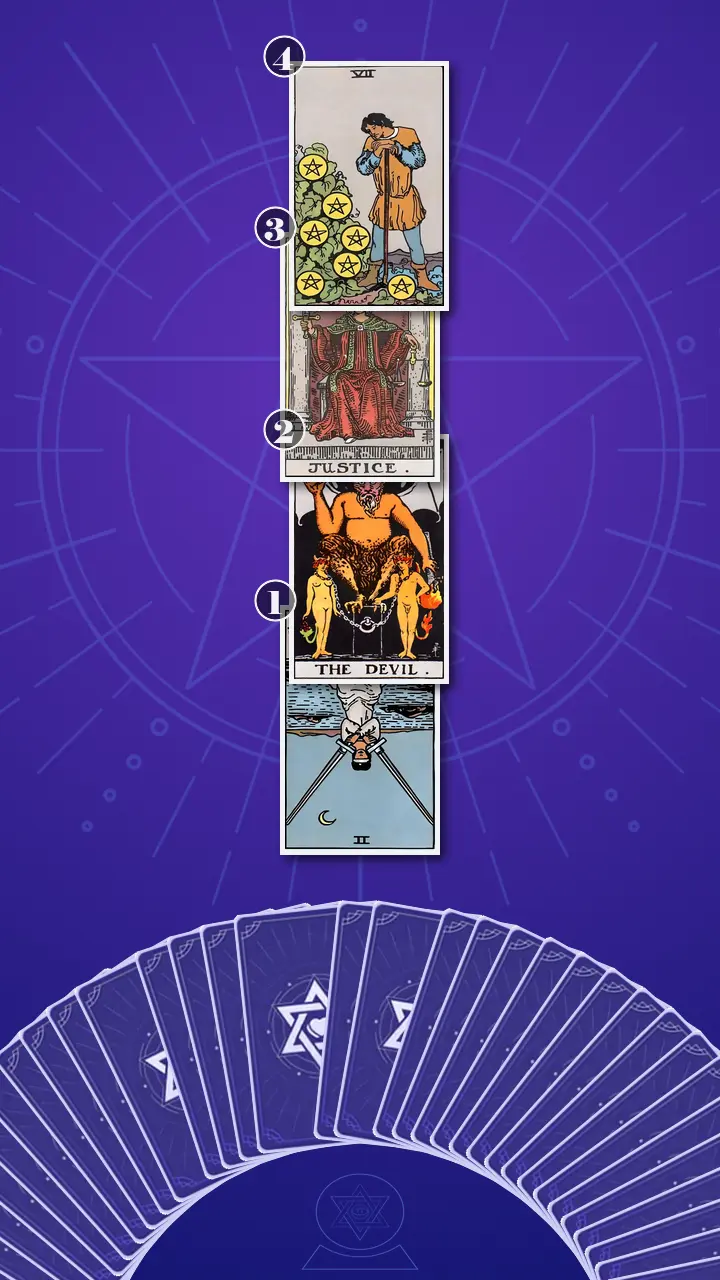
I chose the Four-Layer Insight Ladder, a four-card tarot spread for pressure-driven workplace decisions. For a reader wondering how tarot works in a situation like this, its value is structural: it moves from the visible behaviour to the belief beneath it, then to the pivotal insight and the smallest practical integration. A larger spread would have added possibilities we did not need. Maya was not asking me to predict whether accepting the portfolio would end well. She was asking what became difficult to see when pressure entered the room.
I explained that the first position would show the observable symptom: the agreeable answer, deleted caveat, and premature planning. The second would reveal the protective rule that made immediate compliance feel necessary for belonging. The third would identify the minimized risk and restore a fair basis for consent. The fourth would ground that clarity in a review of capacity, support, and long-term return.
That sequence is why card meanings in context matter more to me than isolated keywords. The cards would not issue Maya a verdict. They would give us four angles from which she could inspect her own evidence and decide whether to accept, negotiate, ask for more information, or refuse.
The Blindfold Inside the Slack Draft
Position 1: The Reply That Ended the Feeling
"The card turning over now represents the observable symptom," I said. "It shows what happens when you give an agreeable answer, remove the caveat, and start reorganizing your life before the risk has been assessed."
I revealed the Two of Swords, reversed. The blindfold covered the seated figure's eyes; two swords crossed defensively over the chest; rocky water waited behind her. In its reversed position, I read the card as blocked discernment mixed with excess mental motion. Maya was not failing to think. She was directing most of her thought towards making compliance work while giving too little space to the evidence that might justify a pause.
I connected the image to the scene she had described. She had stared at an incomplete workload request, typed a fair question about backup coverage, deleted it, and sent an agreeable reply because ending the tension felt more manageable than holding the decision open. Afterwards, she checked the thread for reassuring details and treated the brief quiet after sending as evidence that the commitment was sound.
"The inner script sounds something like this," I said. "I can already see the missing information, but if I send the agreeable reply now, at least this feeling will stop."
I let the distinction settle before adding, "Relief is not the same as clarity. Closing an unresolved support ticket may improve the response-time dashboard, but it does not resolve the issue underneath it."
Maya gave one short laugh, then looked away from the cards. The laugh had no amusement in it. "That's so accurate it's almost rude," she said. Her thumb stopped rubbing the edge of her sleeve. "I've called that relief a decision."
I asked her to think of the most recent quick yes and name the sentence she had removed. She repeated the backup-coverage question. Once spoken aloud, it did not sound negative, dramatic, or ungrateful. It sounded operational.
Position 2: The Workplace Rule Nobody Could Produce
"The next card represents the underlying fear and protective rule," I said. "It shows what converts felt pressure into quick compliance and makes the risk easier to minimize."
I turned over The Devil, upright. I focused first on the loose chains around the figures' necks. The card did not tell me that Maya's workplace pressure was imaginary. The hierarchy was real. So were agency culture, job-market uncertainty, and the cost of living. What the loose chains exposed was the extra certainty her fear had added: the assumption that asking one clarifying question would carry a confirmed penalty.
In its upright expression, The Devil showed an excess of attachment to external approval and a blockage of perceived agency. Maya heard "visibility opportunity" and silently translated it into "capable people do not negotiate." She began surrendering evenings and personal plans before anyone had established the scope, authority, support, or consequences in writing.
"It is like an unwritten workplace policy stored in your nervous system," I told her. "Fast availability equals belonging. Yet if we searched the employee handbook, no one could show us that exact clause."
The Devil Wears Prada offered a familiar shorthand here, not because Maya's life had to follow its plot, but because status, access, and career identity can become tied to escalating availability. Like endlessly scrolling LinkedIn posts about "saying yes to growth," the repetition can train a personal algorithm to treat sacrifice as the only credible evidence of ambition.
"No one explicitly said I couldn't negotiate," Maya said. Her breathing paused; her gaze drifted towards a point beyond the screen as if she were replaying the Monday meeting; then her fingers slowly opened on the tabletop. "But I've been planning as though the penalty was already confirmed."
I asked, "If you said, 'I need to check the scope first,' what specific consequence do you imagine, and which part of it is known rather than inferred?"
She named the possibility of being considered less promotable. When I asked what evidence established that outcome, she could identify pressure, silence, and one manager's urgency, but no explicit answer. I did not tell her the feared consequence was impossible. I told her uncertainty deserved to remain uncertainty. A real power imbalance could be handled more carefully when her mind stopped presenting its worst forecast as settled policy.
When Justice Made the Terms Visible
Position 3: The Risk Beneath the Extra Work
On Maya's side of the call, the refrigerator motor stopped. The sudden quiet felt almost architectural, like a doorway appearing where a wall had seemed solid. I told her we were turning over the pivotal card, the position that would identify the minimized risk and shift authority from urgency to evidence, consequences, and consent conditions.
I revealed Justice, upright.
Justice met us with an unobstructed gaze, an upright sword, and evenly balanced scales. I read this as balanced energy rather than automatic refusal. The card asked Maya to become a fair witness to all the evidence: neither exaggerating the danger nor deleting it to preserve approval.
I pictured a two-column decision document. On one side, I placed the promised visibility, new client exposure, and potential career value. On the other, I placed the actual hours, displaced work, undefined authority, absent backup coverage, and lack of a review date. Justice did not require the two columns to be identical. It required both to remain visible before Maya consented.
I returned her to the setup we now understood. It was 10:38 p.m. Three deadlines were glowing on her laptop, "Happy to help" was waiting in the Slack draft, and the reasonable question about backup coverage had just disappeared. Instead of examining the gap, she had started moving her own life around it.
The risk is not simply that you will become busy. It is that pressure will make the terms feel settled before you have had a real chance to choose them.
I allowed a few seconds of silence. Then I gave her the sentence at the centre of the reading.
Pressure is not proof that a risk is small; weigh the evidence in Justice's scales before you let urgency make the decision.
Maya's breath stopped first. Her fingers remained suspended above the table, neither gripping nor releasing the pen beside her. Then her eyes lost their focus, and I watched recognition move across her face as if she were replaying every clean, upbeat message followed by a cancelled dinner or earlier alarm. Her brows drew together. "But doesn't that mean I've been doing this wrong the whole time?" she asked, with a sudden edge of anger. The anger lasted only a moment before her jaw trembled. Her shoulders dropped, her hand closed around the pen, and her eyes reddened without spilling over. She released a long, uneven breath. "If I can see it now," she said more quietly, "then I have to admit those choices weren't as free as I wanted them to be." The relief had arrived, but so had the vulnerable space of responsibility.
"It means a strategy once helped you end interpersonal pressure quickly," I replied. "It does not make your past self foolish, and it does not erase the conditions around you. We are not putting your history on trial. We are deciding whether that strategy still deserves authority over the next request."
This was where I reached for a lens I call Historical Crossroad Matching. At major historical turning points, a temporary measure can acquire permanence because each renewal is treated as too urgent to review. I was not comparing one client portfolio to the fate of a civilization. I was matching the structure: an undefined stretch assignment accepted as temporary can quietly become the baseline against which all future capacity is judged.
My years around Cambridge archives and archaeological trenches had taught me a related discipline. When pressure encourages an excavator to lift an object before its context has been recorded, the object may survive while the information needed to understand it is lost. I saw the same danger here. Maya could preserve the appearance of cooperation while losing the context required for informed consent.
I paired that perspective with my Enduring Value Assessment. "Ten years from now, what is more likely to retain value," I asked, "one afternoon of appearing instantly agreeable, or a record of taking responsibility with clear authority, realistic capacity, and conditions that let you do the work well?"
Maya looked back at Justice. "The question isn't whether I'm grateful enough," she said. "It's whether the terms are clear enough for a real yes."
"Now, using this new perspective, think back to last week," I invited her. "Was there a moment when this insight might have made you feel different?"
She returned to the Thursday Slack message marked urgent. Instead of deciding her whole professional future at 4:52 p.m., she said she could have restored the deleted question and written, "I want to understand backup coverage and which current priority would move before I confirm." That would not have been a refusal. It would have been the next honest step.
I asked her to open a blank note and title it "Before I Say Yes." In under ten minutes, she completed three lines: "One downside is...", "One fact I still need is...", and "One condition I would need is..." I reminded her that this was information gathering, not a commitment to accept or refuse. She did not have to share it. If her body became more activated, she could stop after one line.
That small act marked the central emotional transformation of the session: from pressured apprehension and automatic compliance to evidence-based self-trust and conditional consent. It was not certainty. It was the recovery of enough room to choose.
The Work Already Growing in the Garden
Position 4: The Pause Before Further Investment
"The final position grounds the shift in daily behaviour," I said. "It asks you to review capacity, return, missing information, and required support before investing further effort."
I turned over the Seven of Pentacles, upright. The worker paused over a cultivated vine instead of planting blindly into every available patch of soil. I read its upright Earth energy as balanced, patient assessment. After the disordered Air of the reversed Two of Swords and the disciplined Air of Justice, this card brought the decision into hours, calendars, labour, and material limits. The absence of active Wands in the spread mattered too. Maya did not need to manufacture more urgency and call it courage.
In Maya's life, the card looked like standing over a crowded Notion board without dragging another ticket into "In Progress." It meant refusing to solve the request by instantly rearranging her private life. She could spend ten minutes reviewing current commitments, realistic weekly hours, offered support, likely return, and the date on which the arrangement would be reassessed.
"Before I invest more, what is my current work already sustaining, and what return is actually being offered?" I asked. "Visible opportunity is only one side of the exchange. Invisible maintenance counts. Sleep counts. A dentist appointment counts. Dinner with a friend does not become empty capacity because a client cannot see it."
Maya pulled her calendar closer. I watched her circle one block that would have to move if she took the portfolio. Her mouth tightened briefly, then softened. "I keep treating personal time like the blank margin around the real schedule," she said.
"Your capacity is evidence, not a character flaw," I replied. "The Seven of Pentacles does not tell you never to invest more. It asks whether the conditions make the investment sustainable and whether the promised return survives contact with reality."
The possible outcome was still open. Maya could accept, negotiate, collect more information, or decline. The change was that any yes would now have visible trade-offs and review conditions rather than requiring her to absorb whatever followed.
A Decision That Could Survive Daylight
When I laid the four cards back into their ladder, their story was concise. Repeated urgent requests, professional comparison, and the wish to be seen as capable had trained Maya to end discomfort with a fast agreement. The Two of Swords showed the deleted question. The Devil exposed the internal contract that equated belonging with immediate availability. Justice restored direct sight and accountable consent. The Seven of Pentacles required that clarity to enter the calendar, the task board, and the actual distribution of labour.
The blind spot was not that Maya could never recognize a red flag. She recognized it quickly. The blind spot was treating the act of naming it as more dangerous than the unclear commitment itself. She kept trying to organize her way out of a structural capacity gap, like muting a low-battery alert because everyone in the meeting wanted the screen left on, then blaming time management when the device shut down.
The shift was practical: before any pressured yes, she would write down one plausible downside, one missing fact, and one boundary required for informed consent. An unclear yes could cost more than a clear pause. She could remain open to the opportunity without consenting to undefined terms.
The Time Stratigraphy Exercise and Three Next Steps
I added my Time Stratigraphy Exercise to prevent the loudest five minutes from impersonating the whole future. I asked Maya to imagine herself ten years ahead, looking back at the decision in layers. Which concern was a temporary wave of social discomfort? Which condition would still matter because it protected her work, health, authority, or professional reputation? Her future self was not allowed to dismiss present-day rent, hierarchy, or job security. The exercise simply separated documented consequences from forecasts that urgency had made feel permanent.
- Run the Justice Before-Yes Check. Before the next non-emergency request for extra work, open a private phone note and spend no more than 10 minutes completing three lines: "One downside is...", "One fact I still need is...", and "One condition I would need is..." Then use the Time Stratigraphy Exercise to mark each concern as enduring, temporary, or still unknown. Keep the first version private and factual. If three lines feel like too much, write only the missing fact. The note gathers information; it does not force a yes or a no.
- Create a 20-minute conditional-consent pause. Save this Slack draft for a manager or project lead: "Thanks for thinking of me. I want to check current commitments and a couple of scope details before confirming. I can come back to you by [specific time]." During the pause, ask, "Which current priority should move if I take this on?" Use neutral operational language and request one clarification at a time. A defined operational emergency may require a faster response; an urgency label by itself does not.
- Complete a Seven of Pentacles capacity-and-return review. On one sheet, list current weekly commitments and circle the exact item the new work would displace. Create two columns titled "What this requires" and "What this returns," with no more than five factual entries in each. If the work is accepted, schedule a 15-minute review at the end of week two. Use rough numbers and stop after 10 minutes so the audit does not become another over-planning project. Personal time counts as unavailable time even when nobody else has booked it.
I reminded Maya that the quality of the reading would not be proven by whether she refused the portfolio. It would be proven by whether her eventual response belonged to her: informed by actual capacity, explicit terms, and a steadier relationship with her own warning signals.

A Week Later, the Question Stayed In
Six days later, I received a short message from Maya. At 9:12 that morning, another Slack request had arrived. She used the saved pause, completed the three-line note, and sent the question she would normally have deleted: "Which current priority should move, and who will cover urgent requests when I am already committed elsewhere?"
Her manager moved one launch deadline and agreed to a two-week workload review. Backup coverage remained unresolved, so Maya did not pretend the whole agreement was settled. She replied that she was open to taking the portfolio once that condition had been clarified.
That night she slept through. Her first thought on waking was still, "What if they think I'm difficult?" She smiled, checked the sent message, and did not retract it.
I did not regard the manager's partial accommodation as proof that every boundary will be rewarded. The quieter proof was Maya's behaviour. The cards had made a pattern inspectable; Maya had restored the question, counted her capacity as evidence, and kept ownership of her consent.
That was her Journey to Clarity: not a prediction, not perfect confidence, and not a life without pressure. It was one movement from automatic availability towards informed choice, with enough historical perspective to recognize that a pressured moment is not a permanent fate.
When an "urgent" message tightens your jaw and pulls your body towards an instant yes, the hardest part may not be the workload alone. It may be the fear that saying what you can already see will move you outside the circle. Noticing that fear does not settle the decision, but it does stop the fear from speaking as if it were the only fact.
If your next pause had nothing to prove to anyone, which one downside, missing fact, or condition would you let back into view before the blue Slack notification turns discomfort into a yes?
This story is adapted from psychological research, written so that those in a similar struggle can see their own pattern in it — and find their next step clearly.These insights are not a substitute for professional psychological, medical, legal, or financial advice.
Learn more about our Journey to Clarity.
How did this insight land for you?
🫂 This Resonates Deeply
🌀 Living This Story
✨ Now I See Clearly
🌱 Seeing New Possibilities
🧰 Useful Framework
🔮 The Confirmation I Needed
💪 Feeling Empowered
🚀 Ready for My Next Step
Author Profile
 AI
AI“Having spent a lifetime at Cambridge and on archaeological digs, I’ve witnessed the rise and fall of countless civilizations. Please know that your current struggles are not a permanent fate, but merely a necessary fracture before rebuilding. I won't lecture you; instead, I invite you to sit with me in the ruins, using a patient, historical perspective to gently dust off the true, enduring value hidden beneath your temporary doubts.”
In this Choice Tarot Reading :
Core Expertise
- Historical Crossroad Matching: Contextualizing your dilemma by comparing it to macro-historical turning points, providing an objective bird's-eye view.
- Enduring Value Assessment: Evaluating competing options based on what will survive the test of time versus what is merely a short-term impulse.
Service Features
- The Time Stratigraphy Exercise: A mental time-travel protocol evaluating your current dilemma strictly from the perspective of your 10-year future self, instantly dissolving trivial anxieties.
Also specializes in :
Explore Related Patterns:
Boundary DiscernmentMaya asks which current priority should move and who will cover urgent requests when she is already committed elsewhere. She does not turn the question into a refusal, and she does not treat openness as unconditional agreement. When one deadline moves but coverage remains unresolved, she keeps that condition visible instead of pretending the entire arrangement has been settled. When you distinguish a boundary from rejection, you can remain receptive to an opportunity while defining what a real yes would require. The manager's urgency belongs to the manager, Maya's capacity belongs in Maya's decision, and the allocation of work belongs in the agreement between them. This restores consent before temporary pressure can quietly establish permanent terms.
Defensive OverfunctioningMaya begins moving her own plans before the agency has defined the new portfolio's scope, authority, backup coverage, or displaced priorities. She converts an organizational capacity gap into a private scheduling problem and then applies more effort to making the unclear arrangement function. Doing more temporarily restores a sense of competence and control, but it also conceals where responsibility has not been allocated. When you privately compensate for missing structure, your efficiency can make an unsustainable arrangement look workable to everyone else. The minimized risk is that temporary extra effort becomes the baseline against which future capacity is judged. A capacity review interrupts this defense by returning the unresolved decisions to the agreement instead of asking your calendar to absorb them silently.
Fawning ResponseMaya deletes a fair question about backup coverage and sends "Happy to help" because ending the interpersonal tension feels safer than leaving the decision open. Under manager urgency and anticipated career judgment, the fast agreement functions as an appeasement response. It lowers the immediate sense of social threat by making her maximally cooperative before she has enough information to choose. When you use agreement to regulate pressure, the first reward is relief while the workload cost arrives later. That timing can hide the real risk, which is not simply becoming busy but allowing a feared reaction from someone in authority to replace informed consent. Recognizing the response creates room to respect the hierarchy without treating automatic compliance as your only route to belonging.
Self-AbandonmentMaya drags her own plans out of the calendar before anyone identifies which existing priority will move. She later describes personal time as "the blank margin around the real schedule," revealing how quickly her sleep, appointments, and relationships become expendable when work pressure arrives. The agency's need for certainty remains visible while her capacity and consent conditions disappear from the exchange. When you preserve cooperation by removing your own stakes from the decision, the arrangement can look consensual while its costs remain privately assigned to you. The minimized risk is not only overwork. It is losing contact with the information that would make the yes genuinely yours. Keeping personal time and warning signals inside the evidence restores choice without requiring you to dismiss the opportunity.
Self-SilencingMaya's most operationally relevant sentence is the one she deletes. The question about coverage contains information the agreement needs, but she suppresses it because naming the gap feels likely to make her "the difficult one." The self-censorship protects her cooperative image in the moment while removing her own evidence from the decision. When you repeatedly edit out the concern that would protect your capacity, other people receive a cleaner yes than the situation justifies. The minimized risk is therefore embedded in what goes unsaid. Restoring the question does not require perfect confidence or confrontation. It allows your warning signal to participate in the agreement instead of forcing it to remain a private cost.
Conditional Self-WorthMaya hears "visibility opportunity" and translates it into the rule that capable people do not negotiate. Fast availability becomes evidence that she belongs, while clarification begins to look like evidence that she is less ambitious or less promotable. Her professional value is therefore tested through sacrifice rather than through the quality of her judgment or work. When your sense of competence depends on appearing immediately available, a scope question can feel like an identity threat rather than ordinary due diligence. That makes undefined responsibility seem less dangerous than being seen as difficult. Treating capacity as evidence allows you to remain ambitious without making self-erasure the admission price for professional legitimacy.
Reality TestingMaya examines the feared promotion penalty and separates what is known from what has been inferred. She does not deny the agency hierarchy, rent pressure, or the possibility of a negative reaction. She simply stops presenting an uncertain consequence as settled workplace policy and reviews the actual hours, displaced work, authority, coverage, and potential return. When her manager later moves one deadline but leaves backup coverage unresolved, Maya treats the response as partial rather than forcing it into either a success story or a rejection story. This evidence-based stance prevents both the worst forecast and the most reassuring interpretation from taking over. The workload risk becomes clearer because you can acknowledge real pressure without allowing pressure to decide which facts count.
Urgency BiasThe 10:38 p.m. Slack request moves Maya directly from missing information to agreement and calendar changes. The message's urgency determines the speed of her response even though it does not supply the missing scope, authority, coverage, or reprioritization. Her attention narrows to making compliance work before she has established what the work actually requires. When you treat someone else's urgent timeline as proof that your consent must be immediate, pressure can impersonate evidence. Repeated exposure strengthens the shortcut until a fast yes feels more responsible than a measured pause. The risk being minimized is an undefined agreement whose consequences continue after the urgent moment has passed. A bounded pause separates the sender's pace from the quality of your decision.
Reflective DistanceMaya places both feet on the floor, takes a slower breath, and holds the request in mind before evaluating it. Six days later, she uses the saved pause and completes the three-line note before answering another Slack message. These actions create an observational gap in which pressure, downside, missing information, and required conditions can coexist without demanding an instant conclusion. When you establish this distance, you do not have to eliminate apprehension before making a sound choice. Maya still thinks, "What if they think I'm difficult?" but she does not retract the question. The fear remains present without being promoted to decision-maker. That shift lets your warning signals become inspectable information rather than commands to comply or reasons to avoid the opportunity entirely.
Explore Related Struggles:
Agreement-Agency SplitBefore anyone defines the portfolio's scope, decision authority, backup coverage, or displaced priority, Maya sends a usable yes and begins moving her own plans. The agreement advances into her calendar even though the information required for a genuine choice has not arrived. When pressure makes agreement happen ahead of evaluation, your answer and your agency separate. Other people can act on the commitment while you are still discovering what it requires from you. The central risk is therefore larger than being busy: the terms can acquire authority before your consent has enough evidence behind it.
Availability-Worth FusionMaya hears the phrase visibility opportunity and translates it into a demand for immediate availability. Before the agency confirms what support will exist, she starts surrendering evenings and personal plans so that her ambition will remain legible to the people evaluating her. When availability becomes proof of worth, every request carries two decisions at once: whether the work fits and whether you still count as capable if you do not absorb it immediately. That structure makes a capacity question feel like a character test. Seeing the fusion allows you to evaluate the opportunity without using access to your private time as the sole evidence of professional value.
Urgency-Compass FusionThe urgent message reaches Maya at her kitchen table while three deadlines are already open, and its tempo immediately becomes the tempo of her answer. The request moves from Slack into next week's calendar before she has reviewed the hours, support, return, or work that would need to move. When urgency becomes your main navigation signal, speed starts deciding which facts deserve attention. You may remain highly active, yet most of that activity is directed toward making the request work rather than determining whether it should proceed under the proposed conditions. Separating the deadline's volume from the decision's actual requirements gives your own judgment a place in the room again.
Voice-Safety FusionMaya's question about backup coverage is already written in the Slack draft, and it accurately names a missing condition. She removes it because allowing the question to remain visible seems more professionally dangerous than allowing the workload gap to remain unresolved. When stating what you can plainly see appears capable of costing you belonging, reputation, or future opportunity, your voice becomes tied to perceived safety. The result is not an inability to notice risk; it is a narrowing of what feels speakable once the risk involves someone with more power. Restoring the factual question separates clear professional communication from the feared verdict that asking makes you difficult.
Capacity-Identity FusionMaya begins dragging plans out of her calendar before anyone decides which existing work should move. Later, she describes personal time as the blank margin around the real schedule, even though sleep, appointments, and time with friends are already using that capacity. When your limits are treated as evidence about your character rather than information about your workload, each capacity review can become an identity verdict. You may try to prove capability by shrinking whatever the workplace cannot see, leaving the underlying mismatch untouched. Counting those limits as evidence restores a distinction between having finite capacity and lacking commitment or ambition.
Responsibility-Authority SplitThe additional portfolio arrives without defined decision authority, backup coverage, or agreement about which current priority will move. Maya is nevertheless preparing to become responsible for the delivery outcome, using her private schedule to compensate for resources and authority that only the workplace can establish. When you are expected to own results without receiving matching control over scope, priorities, or support, responsibility expands while authority stays elsewhere. The friction can make personal effort appear to be the answer to a structural gap. Naming the split clarifies which part of the commitment belongs to your effort and which part still requires an explicit decision from the people assigning the work.
Explore Related Emotions:
Ambiguity DreadThe request arrived with scope, decision authority, backup coverage, priority changes, and a review date still undefined. You recognized those gaps, then told yourself the risk probably was not as bad as it looked and allowed an imagined professional consequence to stand in for evidence. Ambiguity Dread names the discomfort of open terms that becomes easier to manage when the blank spaces are filled with a forecast. It helps explain why pressure can make an unresolved agreement appear safer than it has been shown to be: uncertainty is narrowed prematurely instead of being kept visible for inspection.
Conditional Belonging FearAt 10:38 p.m., you deleted the question about backup coverage and sent "Happy to help" while the request was being framed as a visibility opportunity. You began planning as though being seen as capable required immediate availability, and the imagined loss of promotability turned an unverified consequence into a working rule. The pressure is therefore relational as well as logistical. The unanswered coverage question became tied to whether you would remain inside the circle of capable and promotable people. Conditional Belonging Fear names the unease of protecting access or approval by accepting terms before you have evidence that the relationship actually requires that sacrifice.
Invisible Labor DreadThree deadlines were glowing on your laptop when the undefined portfolio arrived, and you began moving your own plans before hours, authority, coverage, or displaced priorities were agreed. The visible opportunity was counted, while the actual labour and the private time required to sustain it stayed outside the frame. That lets the workload expand invisibly, with your calendar absorbing what the agreement has not defined. Invisible Labor Dread names the apprehension that the cost will arrive as uncredited maintenance while the yes continues to look clean, cooperative, and professionally useful.
Self-Betrayal AcheYour draft contained a fair operational question about backup coverage, but you removed it and sent an agreeable reply while the terms were still missing. You then started shifting your own plans around an arrangement that had not yet earned a genuine yes. Self-Betrayal Ache names the pain of watching a valid warning signal be edited out to keep an interaction smooth. It does not require you to condemn the person who made the earlier choice. It shows where pressure was given authority over your consent, even though the facts needed for a free choice were not yet available.
Visibility PressureThe phrase "visibility opportunity" made the extra portfolio carry a message about your career identity as well as a demand on your time. When you imagined that clarification could make you less promotable, availability began to function like proof of capability. Visibility Pressure names the emotional demand to demonstrate ambition through immediate access to your labour. It narrows the choice by making a careful question feel like a public signal about who you are at work, which makes the actual hours, authority, and coverage easier to minimize.
Cautious Self-TrustYou used a short pause, counted current commitments as evidence, and kept the unresolved backup condition in view. The next morning, the thought that you might seem difficult was still present, but you checked the sent message and did not retract it. Cautious Self-Trust names the careful return to your own warning signal. It does not demand perfect certainty or promise that every boundary will be rewarded. It describes the steadier capacity to let a concern remain valid while you continue gathering information and deciding what conditions you need.
Grounded AgencySix days later, you restored the question you would normally have deleted and asked which current priority should move and who would cover urgent requests. When backup coverage remained unresolved, you kept the response conditional instead of pretending that the arrangement was complete. Grounded Agency names the recovered position in which urgency no longer owns the decision. You can accept, negotiate, gather information, or decline, and the eventual response belongs to a documented choice with visible conditions rather than to the first pressure-driven answer.
Relief HungerAfter you sent "Happy to help," the immediate tension dropped, and the quiet in the thread began to look like evidence that the commitment was sound. You later named the mechanism yourself when you said you had called that relief a decision. Relief Hunger names the pull to end interpersonal pressure now, even when the underlying agreement remains unresolved. The easing is real but incomplete: it can make an unfinished commitment feel safer simply because the conversation has gone quiet, allowing the unanswered coverage question to remain outside your attention.
Explore Related Contexts:
Opportunity Pile-OnMaya receives the additional portfolio while three deadlines are already active, yet the request arrives wrapped in the language of visibility, client exposure, and career progression. The promised upside is easy to name; the hours, displaced work, authority, backup coverage, and review date are absent. Packaging extra labor as privileged access makes the exchange difficult to assess on equal terms. The opportunity may carry real value, but that value has not yet been connected to a defined advancement path or enough organizational support to make delivery sustainable. If you are facing an Opportunity Pile-On, the risk you minimize is the cumulative cost hidden inside each individually flattering request. You can remain open to growth while requiring the organization to identify what will move, what support will appear, and how the additional responsibility will produce a reviewable return.
Responsibility Without AuthorityMaya is asked to take responsibility for another client portfolio without knowing her decision authority, who will cover urgent requests, or which current priority will move. The assignment therefore enlarges what she can be held accountable for before enlarging her control over the conditions needed to deliver it. That separation between ownership and power is the central structural risk. A manager can allocate the portfolio, but Maya initially tries to resolve the resulting resource conflict through her own evenings and personal calendar rather than through an organizational priority decision. In this position, you may appear to own an outcome while lacking the authority, staffing, or protected capacity required to shape it. Naming those missing conditions is not a refusal of responsibility; it clarifies whether the responsibility being offered is operationally real or merely being transferred downward.
Slack Scope CreepAt 10:38 p.m., Maya has three deadlines open when her manager asks her through Slack to absorb another client portfolio. She deletes a reasonable question about urgent-request coverage, sends "Happy to help," and begins moving personal plans before the scope, authority, support, or displaced priority has been defined. The communication channel allows a major workload expansion to pass as a quick conversational response rather than a documented operating agreement. Urgency closes the discussion while the practical cost remains open, leaving Maya's calendar to supply whatever resources the request omitted. When you are facing Slack Scope Creep, the minimized risk is larger than one extra task: an informal yes can become the baseline for future workload expectations. Treating scope, tradeoffs, authority, coverage, and review timing as prerequisites restores your ability to distinguish a genuine opportunity from an undefined commitment.
Conditional Belonging PressureMaya types a practical question about backup coverage, deletes it, and sends an agreeable reply because naming the gap could mark her as difficult or less promotable. She later confirms that no one explicitly prohibited negotiation and that no written rule equates immediate availability with career commitment. The pressure comes from the combination of a real hierarchy, an urgent manager request, agency norms, and an unwritten test of professional identity. Because the expected penalty is never clearly stated, Maya is left to enforce the presumed rule herself by removing questions before anyone else has to answer them. Under Conditional Belonging Pressure, you are not simply deciding whether to accept more work; you are being pushed to prove that you deserve inclusion through unrestricted compliance. Distinguishing documented expectations from socially amplified assumptions helps you test whether belonging actually depends on silence or whether the operational question can remain in the room.
Always On AvailabilityThe portfolio request reaches Maya at 10:38 p.m. while three deadlines glow on her kitchen-table laptop. Instead of waiting for a defined work conversation, she begins reorganizing the following week, and another Slack request arrives six days later with the same pull toward an immediate answer. Compressed agency timelines have extended the practical response window beyond scheduled work. Availability becomes an unofficial workplace signal: speed communicates commitment, while a pause can appear to require justification even when the request is not a defined emergency. When this norm reaches you, the risk is that your evenings become standing organizational capacity rather than time that must be deliberately negotiated. Separating a genuine emergency from an urgency label lets you respond professionally without allowing constant reachability to become the hidden condition of your role.
Work Life Boundary CreepBefore anyone decides which work priority should move, Maya starts dragging her own plans out of the following week's calendar. The request has already entered her kitchen at night, and she later describes treating personal time as the blank margin around the schedule that counts. The organization has not yet created capacity by reducing work or confirming backup. Instead, the capacity gap is provisionally filled by time that remains invisible to the client and manager, allowing the job to expand without an explicit decision about its impact outside work. When Work Life Boundary Creep is active, you can end up negotiating against your private life before the workplace has negotiated with its own constraints. Counting sleep, appointments, social plans, and unbooked time as real capacity evidence makes the tradeoff visible at the level where the additional work is actually being paid for.
Upward Management TrialMaya sends the two questions she previously would have deleted: which current priority should move, and who will cover urgent requests when she is committed elsewhere. Her manager responds by moving a launch deadline and agreeing to a review, while Maya keeps the unresolved coverage issue visible. This exchange returns organizational prioritization to the person with authority to make it. Maya supplies accurate capacity information rather than privately solving a management conflict through canceled plans, and the manager's response becomes observable evidence about how the reporting relationship handles operational limits. During an Upward Management Trial, you are testing whether direct information can travel up the hierarchy without being converted into disloyalty. The goal is not to guarantee approval; it is to establish whether responsibility, priority control, and support can be discussed in the same conversation before you take ownership of the result.