Finding Clarity in the 8:41 PM HR Portal Peek
If you opened the HR portal, built a terrifyingly detailed comparison sheet, and then rage-closed it halfway through because the fine print made your chest go tight (hello, decision fatigue).
Jordan met me on a video call from her tiny Toronto condo kitchen. The stove fan rattled like it was losing patience, and the whole room smelled faintly like microwaved garlic and dish soap. She had her laptop open on the counter—HR portal on one side, a Google Sheet on the other—blue light making everything look sharper and harsher than it needed to.
“I keep telling myself I’m just going to peek,” she said. Her fingers hovered over the trackpad the way you hover over a text you don’t want to send. “And then I’m thirty tabs deep. I can’t tell if I’m being responsible or just scared.”
Even through the screen, I could see it in her body: her jaw clenched as if she were holding a secret between her molars, her throat tight like a hoodie drawstring pulled too far, and a restless buzz in her hands whenever the portal showed the words deductible and out-of-pocket max.
Her question wasn’t actually “Which plan should I pick?” It was: how do money, fear, and burnout keep looping until the deadline turns into a mini crisis?
I nodded slowly. “Freezing isn’t a character flaw—it’s your nervous system calling this ‘high stakes.’ We’re not here to become insurance experts tonight. We’re here to map the loop, find where your energy leaks, and give you a decision container that protects you.”
Choosing the Compass: How Tarot Works with the Celtic Cross Spread
I asked Jordan to take one breath that was slightly slower than her usual—not as a mystical ritual, just as a reset. Then I shuffled while she held the question in her mind: When I open that email, why do I spiral, and what’s the next best move that doesn’t cost me my sleep?
For this, I chose the Celtic Cross spread. It’s one of the most practical layouts I know for a situation like this—because it separates surface behavior from deeper drivers, and then reconnects them into something you can actually work with.
Money decisions under burnout are rarely just about numbers. They’re loops: a visible freeze, a crossing pressure, an unconscious story, and then an environment that either supports you or keeps grading you. The Celtic Cross is built to show: what’s happening now, what blocks it, what’s running underneath, and what a grounded integration direction looks like (not a prediction—an outcome state you can choose to move toward).
I told her what to watch for: “The center card will show the moment the spiral begins. The crossing card will tell us what turns it into a loop. And the final card—up at the top—will show the healthiest direction for finding clarity and choosing with steadier self-trust.”
Reading the Map: A Money-Safety Loop at a Career Crossroads
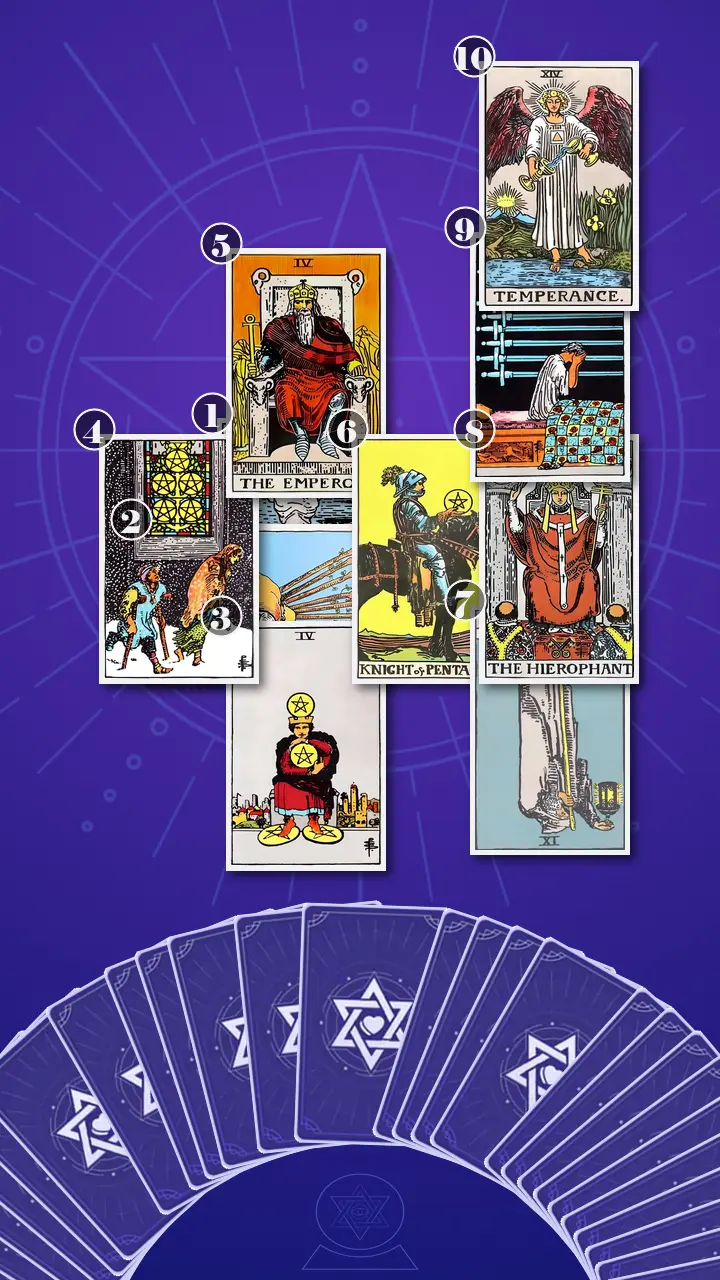
Position 1 — The first 90 seconds after the email: What it activates right now
“Now we turn over the card representing what the open enrollment email activates right now: the most visible loop behavior and felt pressure point,” I said.
Two of Swords, reversed.
In modern life, this is painfully specific: you open the open enrollment email after work and immediately split into two selves—one that wants to be responsible and lock in the smartest choice, and one that can’t tolerate being wrong. You build a comparison sheet, toggle between two plans, and the more you try to think your way out, the more your body tightens—until you close the tab for relief and tell yourself you’ll do it later.
The reversed energy here isn’t “no decision.” It’s overload breaking through the stalemate. The mind is trying to force clarity while the body is already waving a white flag.
Jordan gave a short laugh that didn’t sound amused. More like a wince with sound attached. “That’s… honestly kind of brutal,” she said. “Like, yes. Exactly that.”
I let that land. “It’s brutal because it’s accurate. The blindfold isn’t ignorance—it’s too much information and no felt clarity. And the crossed swords? That’s your jaw and chest trying to keep you safe by holding everything tightly.”
Position 2 — The immediate block: What crosses the situation and turns it into a loop
“Now we turn over the card representing the immediate block: what crosses the present situation and turns it into a loop,” I said.
Ten of Wands, upright.
This is the part people miss when they shame themselves for procrastinating. The benefits decision isn’t hard in a vacuum—it’s hard on top of everything else. Meetings. Slack pings. The hybrid schedule whiplash. Laundry you keep rewashing because you forget it in the machine. The pressure turns the portal into a threat: not just “choose a plan,” but “prevent a disaster while exhausted.”
This is excess energy: too much load, too little capacity. And here’s the line I needed Jordan to hear: “If the research makes you numb, it’s not clarity—it’s overload in disguise.”
She swallowed, her throat moving like it hurt. Her shoulders rose a fraction, then dropped. “I literally do it after work like it’s a punishment,” she said. “I’m already on low power mode.”
In my Jungian work, I call this the Overburdened Carrier shadow: competence that keeps volunteering you for suffering. On ships—back when I trained intuition crews across transoceanic voyages—I watched brilliant people try to make high-stakes choices while sleep-deprived. The pattern is universal: when you’re carrying ten grocery bags up condo stairs, you don’t do math better. You just get closer to dropping everything.
And this is where I used my Energy State Diagnosis—my three-dimensional check: environment, relationships, self. “Your environment is noisy and deadline-based (the portal, the emails). Your relationships are adding ‘What did you pick?’ pressure. And your self system is running on depletion. The energy leak isn’t intelligence. It’s bandwidth.”
Position 3 — The hidden driver: The money story underneath the loop
“Now we turn over the card representing the hidden driver: the money story underneath the loop that’s operating automatically,” I said.
Four of Pentacles, upright.
Underneath the tabs and spreadsheets is a tight, protective reflex: if I can control every variable, I can’t be exposed. Every deductible line reads like a warning. Every premium increase feels personal, like a character assessment.
This is blockage energy—security turning into rigidity. It tries to keep you safe by gripping harder: money, time, certainty. But the tighter the grip, the less flexible you are, and paradoxically the less safe you feel.
I asked, gently but directly, “When you imagine picking the wrong plan, what are you afraid it would prove about you?”
Jordan’s eyes flicked away from the screen, unfocusing like she was rewatching something. “That I can’t keep myself safe,” she said. “That I’m… not actually in control.”
Position 4 — What shaped the pattern: The earlier experience that trained money decisions to feel threatening
“Now we turn over the card representing what shaped the pattern: the earlier experience or learned association,” I said.
Five of Pentacles, upright.
This is the old imprint: a season—sometimes years ago—when money felt cold, scary, embarrassing. Even if you’re stable now, the nervous system remembers what it felt like to be “outside.” Like support exists, but not for you.
This is deficiency energy: not a lack of competence, but a lack of felt support. The portal doesn’t just show numbers; it touches the memory of being alone with consequences.
Jordan’s mouth tightened, then softened. One hand pressed briefly against her sternum, like she was checking whether she was still there. “I hate that this still gets me,” she said.
“Of course it gets you,” I answered. “Your body recognizes the temperature of that old fear before your mind even starts reading.”
Position 5 — What you think you need: The conscious goal you’re reaching for
“Now we turn over the card representing what you think you need: the conscious goal you’re reaching for,” I said.
The Emperor, upright.
This makes total sense: when fear is loud, you want structure. A rule set. A single correct answer that proves you’re competent and lets you stop thinking about it. It’s the part of you that wants to run benefits like a work project: criteria, deadline, decision, done.
This is balance energy when it’s used cleanly. The Emperor doesn’t need omniscience—he needs boundaries. But when fear hijacks him, he can become over-controlling: “If I just tighten the rules enough, nothing can go wrong.”
Jordan nodded quickly, like she’d been waiting for someone to say that without making fun of her. “Yes,” she said. “I want it to be a checklist so badly.”
Position 6 — The next short-term tendency: What you’re likely to do if nothing changes
“Now we turn over the card representing the next short-term tendency: what you’re likely to do next if nothing changes in your approach,” I said.
Knight of Pentacles, upright.
This is the most encouraging kind of “near future” card: not a lightning bolt, but a method. One calendar block. One simple comparison. One step completed without drama. It’s the opposite of the midnight sprint through Reddit threads and calculators.
The energy here is steady balance: slow enough to be real, practical enough to finish. This Knight doesn’t care if the spreadsheet looks gorgeous. He cares if the task gets done without costing your nervous system.
I watched Jordan’s hands. They weren’t buzzing as much. She’d stopped clicking. Her shoulders were still tense—but not climbing her ears anymore.
Position 7 — Your role in the loop: Your self-image and coping style when money tasks hit
“Now we turn over the card representing your role in the loop: your self-image and coping style,” I said.
The Hermit, reversed.
This is the late-night isolation scene in one image: phone glow, Reddit rabbit holes (r/personalfinancecanada), rereading the same PDF paragraph because you’re too tired to translate it, and not wanting to ask anyone because you don’t want to look “behind at adulting.”
The reversed energy is blockage: inner guidance dimmed by shame and exhaustion. You’re not introspecting—you’re self-containing.
I said it the way I would say it to a friend, not a client. “One question to one source beats five opinions and a midnight spiral.”
Jordan exhaled through her nose, not quite a laugh this time—more like relief with friction. “I literally drafted ‘which plan did you pick?’ in Slack last week and deleted it,” she admitted.
“That’s the lantern turned inward,” I said. “This week, we turn it outward—one precise question, to the right person, and then we stop.”
Position 8 — External pressures and norms: What the workplace system is broadcasting
“Now we turn over the card representing external pressures and norms: what the workplace system, culture, and other people’s opinions are broadcasting,” I said.
The Hierophant, upright.
This is the HR portal as a vibe: keys, rules, official language, and that subtle feeling that you’re being graded on reading comprehension while burnt out. Coworkers talk in confident soundbites—“Obviously I picked the cheaper premium”—and Instagram makes it look like benefits selection is a breezy part of financial adulting.
The Hierophant’s energy is structure. It can be helpful, but it can also trigger: “There is a correct way, and I’m failing it.”
I told Jordan, “The system isn’t your judge. It’s a tool. We’re going to use it strategically—without making it an authority over your worth.”
Position 9 — The emotional engine: Hopes and fears
“Now we turn over the card representing the emotional engine: what you secretly hope for and what you’re afraid will happen if you choose ‘wrong’,” I said.
Nine of Swords, upright.
This is the 1:13 AM montage: surprise bill, sick day, regret, “I should’ve picked the other plan,” and the familiar punch of panic like a notification you can’t swipe away. The secret hope under it is heartbreakingly simple: If I could be certain, I could finally rest.
The energy here is excess: too much mental rehearsal. Fear is trying to protect you, but it’s stealing sleep and leaving you with less capacity the next day—which restarts the loop.
Jordan’s eyes got glassy for a second, then she blinked hard and looked down at her mug. “I hate that my brain does this at night,” she said, voice smaller. “It’s like… I’m trying to earn the right to relax.”
When Temperance Spoke: The Decision Container That Changes Everything
Position 10 — Integration direction: The healthiest outcome state available
I paused before turning the final card. The call went quiet enough that I could hear Jordan’s fridge kick on in the background. “This is the integration direction,” I said. “Not a promise. A way out.”
Temperance, upright.
Here’s the image: one foot on land, one in water. In real terms, it’s numbers on one side—monthly premium, worst-case out-of-pocket—and body reality on the other—sleep, bandwidth, actual medical needs, the fact that you are a human and not a spreadsheet.
This is balanced self-trust energy: using enough information to choose, then letting the choice settle without compulsive re-checking.
Setup: It’s late, you’re back in the portal again, and the numbers start feeling like a verdict. Your shoulders rise. Your throat tightens. You’re not just choosing a plan—you’re trying to choose a future where nothing goes wrong.
Stop chasing perfect certainty and start mixing what you know with what you can tolerate, like Temperance blending the cups one steady pour at a time.
Reinforcement: Jordan’s reaction came in layers—exactly the way the body accepts truth when it’s been bracing for impact.
First, a tiny freeze: her breath stopped mid-inhale, and her hand hovered above the trackpad like she’d forgotten what clicking even was.
Then the thought landed: her eyes unfocused, not blank—processing. As if she could see every Sunday-night portal spiral replaying behind her eyelids, and also see, for the first time, that the spiral was a strategy, not a personality.
Then the release: a slow exhale that seemed to come from under her ribs. Her jaw unclenched, and she rubbed the side of her thumb with her index finger, gentler now. “So… I don’t need to be fearless,” she said. “I need rules I can live with.”
I nodded. “You don’t need perfect certainty—you need a clear container for a good-enough choice.”
I continued, making it concrete: “Set a 10-minute timer and write three lines only: (1) monthly cost, (2) worst-case out-of-pocket, (3) one personal non-negotiable. Stop when the timer ends—even if you don’t feel ‘done.’ If you feel yourself escalating (tight chest, shaky hands, doom thoughts), you’re allowed to pause and come back later; the goal is a bounded container, not pushing through.”
And because I’m from Venice, I gave her my favorite metaphor—my Venetian Wisdom Integration. “Think of this like regulating canal currents. You don’t control the ocean. You guide the flow with gates. Your decision container is the gate. It protects your energy from getting swept into midnight catastrophizing.”
I asked her, gently, exactly as I always do when the light clicks on: “Now, with this new frame—rules, not perfection—can you think of a moment last week when this would have changed your night?”
Jordan’s lips pressed together, then she smiled with something bittersweet in it. “Tuesday,” she said. “I literally rage-closed the spreadsheet and doomscrolled. If I’d had rules, I could’ve stopped without feeling like I was failing.”
That was the shift: from dread and mental noise toward grounded, practical confidence. Not “I will never worry again.” Just: “I can choose without punishing myself first.”
The One-Page “Decision Container” for Open Enrollment (Actionable Advice)
I pulled the whole spread into one story, the way I would in a therapy session when someone needs the mechanism named clearly: Two of Swords reversed shows the instant freeze and tab-hopping that feels like research. Ten of Wands explains why it happens now—burnout turns admin into a second job. Four of Pentacles reveals the hidden belief gripping the whole thing: “One wrong choice will cost me and I won’t recover.” Five of Pentacles shows where that belief learned its coldness. The Emperor is your understandable desire for structure. The Hermit reversed shows the shame-isolation pattern that keeps you from using support. Nine of Swords shows what the loop costs: sleep. And Temperance offers the middle way: enough information, contained, followed by letting it settle.
The cognitive blind spot wasn’t that Jordan “didn’t know enough.” It was that she was treating benefits selection like a moral verdict: if I choose wrong, it proves something about me. That turns a bounded decision into a life-or-death feeling, and then burnout makes the fear louder.
The transformation direction was simple, but not easy: shift from treating benefits selection as a high-stakes test you must ace to treating it as a bounded, good-enough decision guided by clear criteria and self-trust.
Jordan winced a little and said the practical thing people always say when we move from insight to action: “But I genuinely don’t have the bandwidth. I can’t add another thing to my week.”
I believed her. And I didn’t argue with her reality. I used my Instant Adjustment Techniques—micro-steps that fit into a coffee break. “Then we’re not adding a thing,” I said. “We’re removing the all-night version.”
- The 10-Minute, 3-Line ContainerSet a timer for 10 minutes. In a Notes app or on paper, write only: (1) monthly premium, (2) worst-case out-of-pocket max, (3) one personal non-negotiable (e.g., therapy coverage, a specific medication, predictable copays). When the timer ends, stop—even if you want to keep digging.If your chest tightens or your hands start buzzing, treat that as a stop sign, not a reason to research harder. Come back for a second 10-minute round later, not the same night.
- One Question to One SourceSend one targeted question to one appropriate person (HR benefits contact, trusted coworker, or financially savvy friend). Example: “Between Plan A and Plan B, can you confirm whether therapy visits apply to the deductible?” Then stop once you get a clear answer.Copy/paste the question into a draft email first. If shame flares, remind yourself: you’re not asking for a life lesson—you’re asking for one fact.
- Commit Once, Then Close the Canal GateWhen you submit your choice, take a screenshot of the confirmation page and save it in a folder named “Benefits — Done.” Then close the portal. No “just one more check.”Tell yourself: “Commit once, then let the choice settle like snow—no re-opening the portal just to re-open the fear.” If you feel the urge to re-check, do a two-minute reset: stand up, drink water, look out a window.
And because Jordan’s spiral was also digital, I added one modern cleanse from my toolkit: “If you need a ‘do something’ outlet that doesn’t reopen the portal, do a 12-minute digital detox through photo album organization. It gives your nervous system the feeling of control and completion—without feeding the loop.”

A Week Later: Ownership, Not Certainty
Eight days later, Jordan messaged me a screenshot: a Notes app page with three lines and a tiny checkmark emoji beside it. “I did the 10-minute container,” she wrote. “I picked inside my rules. I didn’t reopen the portal. I slept.”
It wasn’t a movie-ending transformation. It was quieter than that—more real. She told me she woke up the next morning with the first thought still hovering: What if I messed up? Then she paused, put her phone down, and the thought didn’t turn into a spiral. “It was just… a thought,” she said. “Not a whole night.”
That’s the Journey to Clarity I care about: not forcing fear to disappear, but learning to contain it so it stops running your week. Temperance doesn’t demand brilliance. She asks for a steady pour.
And if tonight you recognize that wall of fine print—if it’s not just confusion, but that tight-chest fear that one wrong money choice could expose you, and you’ll be stuck proving you can’t keep yourself safe—please know this: being able to name the loop is already movement.
If you let this be a bounded, good-enough decision—just for this one enrollment cycle—what would you want your “decision container” to protect: your money, your energy, or your sleep?
This story is adapted from psychological research, written so that those in a similar struggle can see their own pattern in it — and find their next step clearly.These insights are not a substitute for professional psychological, medical, legal, or financial advice.
Learn more about our Journey to Clarity.
How did this insight land for you?
🫂 This Resonates Deeplyx 1
🌀 Living This Storyx 1
✨ Now I See Clearlyx 1
🌱 Seeing New Possibilitiesx 1
🧰 Useful Frameworkx 1
🔮 The Confirmation I Needed
💪 Feeling Empowered
🚀 Ready for My Next Step
Author Profile
 AI
AI“Having traveled across cultures... I've learned that what we often lack isn't a simple answer, but a moment of being truly understood. I use a Jungian psychological lens to help you deconstruct your subconscious patterns—not to prove anything, but to be the gentle companion who helps you unravel your knots, free of judgment, so you can reconnect with your inner wisdom.”
In this Personal Growth Tarot Reading :
Core Expertise
- Limiting Belief Deconstruction: Auditing the subconscious self-sabotage mechanisms that trigger when you are on the verge of leveling up.
- Imposter Syndrome Decoding: Separating your authentic potential from the fear of being 'found out' or unworthy of your success.
Service Features
- The Cognitive Reframing Protocol: A structured psychological journaling exercise to translate a vague fear of failure into actionable, logical risk-management data.
Also specializes in :
Explore Related Patterns:
Shame BindingJordan drafts a Slack question about which plan someone picked and deletes it because she does not want to look behind at adulting. The workplace system already feels like she is being graded on reading comprehension, so asking for one fact becomes tangled with fear of being exposed. Shame Binding fits because the practical task becomes attached to self-worth. You can see how shame keeps the loop private: she researches alone, stays up late, and treats a benefits choice like a moral verdict. The intervention is not just information; it is loosening the bind enough for you to ask one precise question without turning it into a character trial.
Analysis ParalysisJordan's 'just going to peek' at the HR portal turns into a comparison sheet, thirty tabs, plan toggling, and a shutdown when the fine print makes her chest tighten. The behavior looks responsible on the surface, but the function is not simple research; it is an attempt to force enough information to quiet the fear of choosing wrong. When burnout is already draining your bandwidth, more data stops acting like clarity and starts acting like pressure. Analysis Paralysis fits because the decision gets stuck at the point where thinking is supposed to resolve uncertainty, but instead multiplies it until your body demands escape. The loop is not a lack of intelligence; it is a cognitive overload cycle using research as a safety ritual.
Certainty SeekingJordan's wish for a single correct answer, a clean checklist, and a choice that proves she is competent turns open enrollment into a demand for impossible certainty. The line underneath it is explicit: if she can control every variable, she cannot be exposed. Certainty Seeking fits because the mind is not only asking which plan is practical; it is asking for a guarantee that nothing painful will happen later. You are watching uncertainty become morally loaded, where rest feels unavailable until the future has been fully secured. That is why the 1:13 AM rehearsal keeps returning even after more research.
Compulsive CheckingJordan's portal peek turns into thirty tabs, Reddit threads, rereading PDF paragraphs, and the urge for one more look before she can feel done. The check is supposed to reduce uncertainty, but every return to the fine print reopens the fear it was meant to settle. Compulsive Checking fits because the behavior is repetitive, reassurance-seeking, and temporarily soothing. You can see why the later shift matters: she chooses inside her rules and does not reopen the portal. The psychological win is not knowing every possible detail; it is breaking the ritual where checking becomes a way to re-enter doubt.
Control CopingJordan's comparison sheet, checklist craving, and eventual three-line timer all show the same protective move: turn fear into structure. She is not trying to be dramatic; she is trying to create rules strong enough to hold a money decision that feels emotionally unsafe. Control Coping fits because structure is her main way of regulating threat. In its workable form, the container gives you one timer, one source, and one non-negotiable so the decision can stay bounded. When fear hijacks it, the same control reflex hardens into over-management, and every deductible line starts feeling like something that must be mastered before you are allowed to choose.
Freeze ResponseJordan's hand hovering above the trackpad, clenched jaw, tight throat, and buzzing hands show the decision landing in her body before it becomes a spreadsheet problem. The portal is not being processed as neutral admin; it is being tagged as high stakes, so her system slows action to prevent a wrong move. Freeze Response fits because the stuckness is embodied, not just intellectual. You can see the nervous system trying to buy safety through stillness, tab-closing, and delayed action. That makes the deadline feel like a mini crisis, because every return to the portal reactivates the same body alarm.
Productivity as SafetyJordan says she does the portal after work like it is a punishment, already on low power mode, while still trying to run benefits like a work project. The emotional line at night is even clearer: she feels like she is trying to earn the right to relax. Productivity as Safety fits because competence becomes the price of rest. You can see the burnout loop forming when the exhausted part of her seeks relief by working harder, researching harder, and performing adult competence harder. The pattern does not fail because she is lazy; it fails because it asks a depleted system to produce enough performance to feel safe.
CatastrophizingJordan's 1:13 AM montage moves from plan choice to surprise bill, sick day, regret, and the thought that she should have picked the other option. The future is not being imagined as a range of manageable outcomes; it is being rehearsed as a chain of consequences that will expose her lack of control. Catastrophizing fits because fear is trying to protect her by previewing danger, but the preview becomes the danger signal. You can see how the mind turns one bounded choice into an irreversible future verdict. The cost is practical as well as emotional: the rehearsal steals sleep, lowers capacity the next day, and feeds the same loop it was trying to prevent.
Scarcity MindsetJordan's fear that choosing the wrong plan would prove she cannot keep herself safe sits on top of an older money imprint where support felt cold, scary, embarrassing, or unavailable. Even if the present is more stable, the portal touches the old template of being alone with consequences. Scarcity Mindset fits because money details are filtered through threat before they are evaluated as facts. You can see this when deductibles read like warnings and premium increases feel personal. The pattern makes the decision feel larger than one enrollment cycle, as if one mistake could confirm that resources, support, and recovery are never fully reliable.
Explore Related Struggles:
Certainty-Safety FusionThe HR portal opens beside a Google Sheet, and the first promise is only a quick peek. Within minutes, the scene becomes thirty tabs, toggled plan details, a clenched jaw, and the relief of closing the tab before a choice is made. You are not simply looking for more information in that loop. You are trying to make certainty function as a safety signal, as if the right plan could protect you from every future bill, sick day, and regret scenario before it happens. The struggle locks in when a good-enough decision feels unsafe unless it can guarantee no future pain. Every new detail gives the fear another surface to attach to, so clarity stops being a tool and becomes a demand for impossible protection.
Identity Verdict LockEvery deductible line reads like a warning, every premium increase feels personal, and the HR portal carries the vibe of being graded while already burnt out. The question stops being only which plan fits and starts becoming what a wrong choice would say about Jordan. You can feel the verdict structure in the sentence she finally names: choosing wrong would prove she cannot keep herself safe. That turns a bounded money decision into a test of adulthood, competence, and self-protection. The struggle is the collapse of outcome into identity. A plan selection becomes too heavy to hold because it is no longer allowed to be an imperfect choice under imperfect information; it has to defend your entire sense of being capable.
Monitoring-Safety FusionThe quick peek becomes a comparison sheet, plan toggling, PDF rereading, Reddit rabbit holes, and the urge for just one more check. Jordan keeps turning toward monitoring because it looks like the responsible route. You are using the act of checking as if it can deliver safety, but the body keeps sending the opposite feedback. More tabs do not create more trust; they create more places where fear can demand another pass. The bind forms when observation replaces decision. Monitoring keeps the portal open emotionally even when the facts are already sufficient, so the task cannot end until the checking ritual itself is interrupted.
Support Access SplitThe Slack question is drafted and deleted before it reaches another person. Around Jordan there are HR contacts, coworkers, Reddit threads, and possible sources of clarification, but the live route to support gets blocked by the fear of looking behind at adulting. You are not unsupported in a literal sense; you are split at the access point. Getting one useful answer would require being seen in the middle of uncertainty, and that exposure can feel more threatening than another hour alone with the portal. The struggle keeps the loop private. Public information expands endlessly, while human support stays just out of reach, so the task becomes lonelier and more complicated than it needs to be.
Mental Bandwidth DepletionThe benefits decision does not arrive in an empty room. It lands after meetings, Slack pings, hybrid schedule whiplash, unfinished chores, and the kind of after-work exhaustion Jordan names as low power mode. You are being asked to make a high-stakes administrative choice with the exact part of you that is already spent. The portal becomes heavier because the task is stacked on top of the day, and the more you force research through depletion, the less usable your thinking becomes. The core strain is not a lack of intelligence or discipline. It is bandwidth being mistaken for character, so a normal benefits decision starts to feel like proof that you should be able to perform clarity even when your system has nothing left to spend.
Scarcity Compass LockThe story gives the current portal an older temperature: a season when money felt cold, scary, and embarrassing, even if the present situation is more stable. The numbers on the screen do not stay neutral because they touch the memory of being alone with consequences. You are not only reading deductibles and out-of-pocket maximums. You are navigating them through a scarcity compass that points toward exposure, exclusion, and the fear that support might exist but not for you. That makes the decision feel colder than the facts require. The struggle is not poverty or incompetence; it is an old money map still guiding the body through a current choice, making every line item feel like a door that could close.
Explore Related Emotions:
Cautious Self-TrustJordan’s key sentence is not that she needs to be fearless; it is that she needs rules she can live with. That distinction lets her move from chasing perfect reassurance toward making a choice that can hold some uncertainty without collapsing. Cautious Self-Trust is the right texture because the fear still appears afterward. A week later, the thought that she might have messed up still hovers, but she puts the phone down and it stays a thought rather than becoming a whole night. This is self-trust in a realistic form. You are not pretending the stakes do not matter; you are learning that your decision can be good enough without requiring endless proof before you are allowed to rest.
Certainty HungerJordan says she wants the benefits choice to be a checklist so badly: criteria, deadline, decision, done. Under the late-night worry is a simple hope that if she could be certain, she could finally rest. Certainty Hunger is not the same as wanting to control everything for sport. In this story, the craving for certainty is a body-level attempt to stop bracing. You keep reaching for one more detail because a clean answer seems like the only thing that might let the nervous system unclench. The trouble is that the portal cannot give perfect certainty. The healthier movement begins when you stop asking the decision to eliminate all future uncertainty and start asking it to hold enough truth to choose without punishing yourself first.
Choice Paralysis OverwhelmJordan opens the HR portal with the intention of taking a quick look, then finds herself thirty tabs deep, splitting attention between a portal and a spreadsheet until her body forces the shutdown. The choice does not become clearer through research; it becomes heavier, sharper, and more physically expensive. That is the core logic of Choice Paralysis Overwhelm here. You are watching a practical decision turn into an overloaded self-audit, where every additional plan detail creates another possible way to be wrong. The mind keeps asking for more data, while the body is already saying that the container has broken. The emotional pressure comes from being trapped between responsibility and threat response. You want to choose wisely, but the act of comparing starts to feel like standing in front of too many doors with no felt sense of safety behind any of them.
Contained OverwhelmThe 10-minute, three-line container changes the shape of the task: monthly premium, worst-case out-of-pocket, one personal non-negotiable, then stop. The pressure is still there, but it no longer gets unlimited access to the night. Contained Overwhelm fits because Jordan does not need to feel fully calm before she can choose. You can still feel the weight of the decision while giving it edges, time limits, and rules that protect your sleep. Eight days later, she picks inside her rules and does not reopen the portal. The emotional shift is not a dramatic disappearance of fear; it is the quieter experience of pressure becoming bounded enough that it stops running the whole evening.
Decision FatigueJordan is trying to make the benefits decision after work, in the same life that already contains meetings, Slack pings, hybrid schedule whiplash, and laundry that has to be rewashed because it was forgotten. The portal is not entering an empty system; it is landing on a week that is already using more energy than it gives back. Decision Fatigue fits because the story shows the machinery of choosing wearing down in real time. You can see the point where research stops functioning as clarity and starts becoming another drain, especially when the body goes numb and the mind keeps pushing for one more answer. The deleted Slack draft matters because it shows how fatigue narrows the field of action. Instead of asking one clean question and stopping, the tired system folds inward, keeps scanning alone, and burns more energy trying to avoid the vulnerability of needing help.
Grounded AgencyThe portal starts as something that seems to judge Jordan’s worth, then becomes a tool she can use strategically. One calendar block, one simple comparison, and one completed step replace the midnight sprint through calculators and threads. Grounded Agency names the return of usable choice. You are not trying to dominate every variable or erase every future risk; you are reclaiming the part of the decision that is actually yours to shape. By choosing inside her rules and closing the portal, Jordan proves something different from perfection. She shows that agency can feel practical, quiet, and protective: a way to act without letting the system take over her sleep, energy, or sense of self.
Scarcity AnxietyThe story names an earlier season when money felt cold, scary, and embarrassing, even though Jordan is more stable now. When she reads deductible lines and premium increases, the portal touches that older temperature before her rational mind has a chance to sort the details. Scarcity Anxiety is the inner weather that forms when money information feels like a warning instead of a tool. You are not reacting only to the present cost comparison; you are reacting to the felt possibility of being left alone with consequences. This is why the spreadsheet cannot fully calm her. A spreadsheet can compare numbers, but it cannot instantly answer the deeper body question underneath the loop: will there be enough, and will support be available if something goes wrong?
Survival Mode FatigueJordan says she is already on low power mode, and the scene backs her up: a tiny kitchen, rattling stove fan, harsh blue light, after-work tabs, and a week full of meetings, Slack pings, schedule whiplash, and slipping domestic tasks. The portal is asking for careful judgment in a room and rhythm that offer almost no recovery. Survival Mode Fatigue names the exhaustion underneath the money loop. You are not simply tired; your system is making decisions from a narrowed state where every extra variable feels like one more demand on a battery that is already flashing red. This matters because the story keeps separating intelligence from bandwidth. Jordan can understand the decision, but she cannot keep paying the full emotional cost of researching it as if she has unlimited capacity.
Wrong Choice PanicJordan’s jaw clenches and her hands buzz when the portal shows deductible and out-of-pocket max, then the night scene expands into surprise bills, sick days, regret, and the thought that she should have picked the other plan. The numbers are no longer just numbers; they become previews of everything that could hurt later. Wrong Choice Panic names the feeling of a decision turning into a future-threat simulator. You are not only choosing a benefits plan in that moment. You are trying to protect a future version of yourself from consequences that feel impossible to fully calculate. The pressure is intensified by the belief that one wrong choice would expose something personal: that you cannot keep yourself safe, that you are not actually in control. That makes the portal feel less like an admin task and more like a test your body cannot afford to fail.
Capability ShameJordan drafts a Slack message asking which plan someone picked, then deletes it because she does not want to look behind at adulting. Around her, coworkers sound confident, HR language feels official, and the whole system carries the vibe of being graded while already depleted. Capability Shame appears when needing a simple fact starts to feel like evidence that you are failing at adulthood. You are not just uncertain about the plan; you are bracing against the idea that uncertainty itself makes you less competent. That shame keeps the loop private. Instead of letting one targeted question relieve pressure, it pushes you back into isolated research, where every reread of the PDF quietly asks whether you should have already known how to handle this.
Explore Related Contexts:
Financial Adulting PressureJordan drafts a Slack message asking which plan someone else picked, then deletes it because she does not want to look behind at adulting. Around her, coworkers speak in confident shortcuts, the HR portal uses official language, and social media makes benefits selection look like a breezy part of being financially grown. Financial Adulting Pressure names the social layer sitting on top of the money decision. The story is not only about picking a health plan; it is about being evaluated, even informally, as someone who should already know how to handle premiums, deductibles, coverage tradeoffs, and institutional paperwork without needing help. You are facing a hidden competence test built into modern financial life. The fear loop gets stronger because asking for one fact can feel like admitting you have failed a life stage, even though the actual system is complex enough that needing clarification is reasonable.
Life Admin Deadline Pile-UpJordan is not opening the portal in a clean, spacious moment. The story stacks the benefits decision on top of meetings, Slack pings, hybrid schedule whiplash, laundry, late-night kitchen light, and a week already running on low power. Life Admin Deadline Pile-Up names the way ordinary adult logistics become heavier when they arrive in clusters. The enrollment deadline is only one task, but it lands on a pile of other unresolved demands, so the decision starts carrying the weight of everything that has not had enough time, energy, or attention. You are being asked to make a clear choice while your real-life operating system is already overloaded. The money fear keeps looping because the task is not just administratively complex; it is competing with work recovery, household maintenance, sleep, and the pressure to keep functioning as if those limits are invisible.
Decision Criteria ResetJordan’s shift begins when the sprawling comparison sheet is replaced by a 10-minute, three-line container: monthly premium, worst-case out-of-pocket, and one personal non-negotiable. The story turns the decision from an open-ended research maze into a small set of criteria with a stop point. Decision Criteria Reset is the constructive outer context because the environment becomes more usable once the rules are reduced. You still have to engage the HR portal and the plan details, but the task now has a frame that limits how much information can enter and when the process ends. This context matters because it restores agency without pretending the system is simple. You are not solving every possible healthcare scenario; you are building a decision structure that can survive real bandwidth limits and still produce a choice.
Work Life Boundary CreepThe HR portal is open in Jordan’s tiny Toronto condo kitchen, not during a protected benefits meeting or a focused work block. Her stove fan is rattling, the laptop is on the counter, and the blue light of the portal has moved an employer-administered decision directly into her evening. Work Life Boundary Creep shows up because the workplace system does not stay inside work hours. Benefits selection follows Jordan into personal space, recovery time, and sleep-adjacent hours, making the kitchen feel like a satellite office for a decision she does not have the bandwidth to finish. You are not simply procrastinating on an HR task. You are trying to handle a workplace obligation in the same zone where your body is supposed to decompress, cook, clean, and shut down for the night, so the portal becomes one more way work keeps claiming attention after the day should be over.