Fourteen Tabs to One LinkedIn Note: Letting Meaning Gather Evidence
The 11:40 p.m. Career Crossroads
I met Jordan, a 29-year-old business operations analyst in Toronto, at the exact point where competence had started to feel like a trap. They were good at the permanent role. Their paycheque was predictable, their benefits mattered, and their career pivot anxiety arrived precisely where a meaningful job listing mentioned a twelve-month contract. I recognised a specific kind of career decision paralysis in which financial predictability overrides direct exploration of meaningful work.
I asked Jordan to take me back to the previous Wednesday night. At 11:40 p.m., they had been sitting at a narrow apartment desk with fourteen job tabs open beside a colour-coded Google Sheet. The laptop fan hummed against the silence. Cold peppermint tea left a bitter film on their tongue, while blue screen light caught the rain threading down the window.
One tab held a community-impact operations role that had made them sit forward. Then they reached the words "twelve-month contract." Their shoulders rose. Their chest tightened as if a smoke alarm had been wired directly to that phrase. They added columns for renewal probability, benefits, promotion speed, and five-year earnings, but forty minutes of analysis produced no new fact. Finally, they closed the half-finished application and submitted one for another permanent operations role they already understood.
"The relief was immediate," Jordan told me. "Then, three days later, I felt flat again. I can explain why the safe role makes sense, but I can't explain why it leaves me so flat. Why does it keep winning?"
I could hear the real conflict beneath the question: they wanted work that felt alive, useful, and aligned with their values, but they did not want to gamble with Toronto rent, benefits, or control over their future. Those material concerns were not a mindset failure, and I said so.
"I don't think you need to prove you're brave by being reckless," I told them. "We're not asking the cards to choose a job or predict whether a contract will be renewed. I want to help you see the pattern that currently decides before you do. Let's make a map of the fog, then look for one piece of ground you can actually test."

Choosing the Map: The Five-Card Shadow Spread
I invited Jordan to take one slower breath and hold the question in mind while I shuffled. I treat that pause as a transition for attention, not as a performance of mystery. It gives the mind a chance to stop arguing long enough for the underlying pattern to become visible.
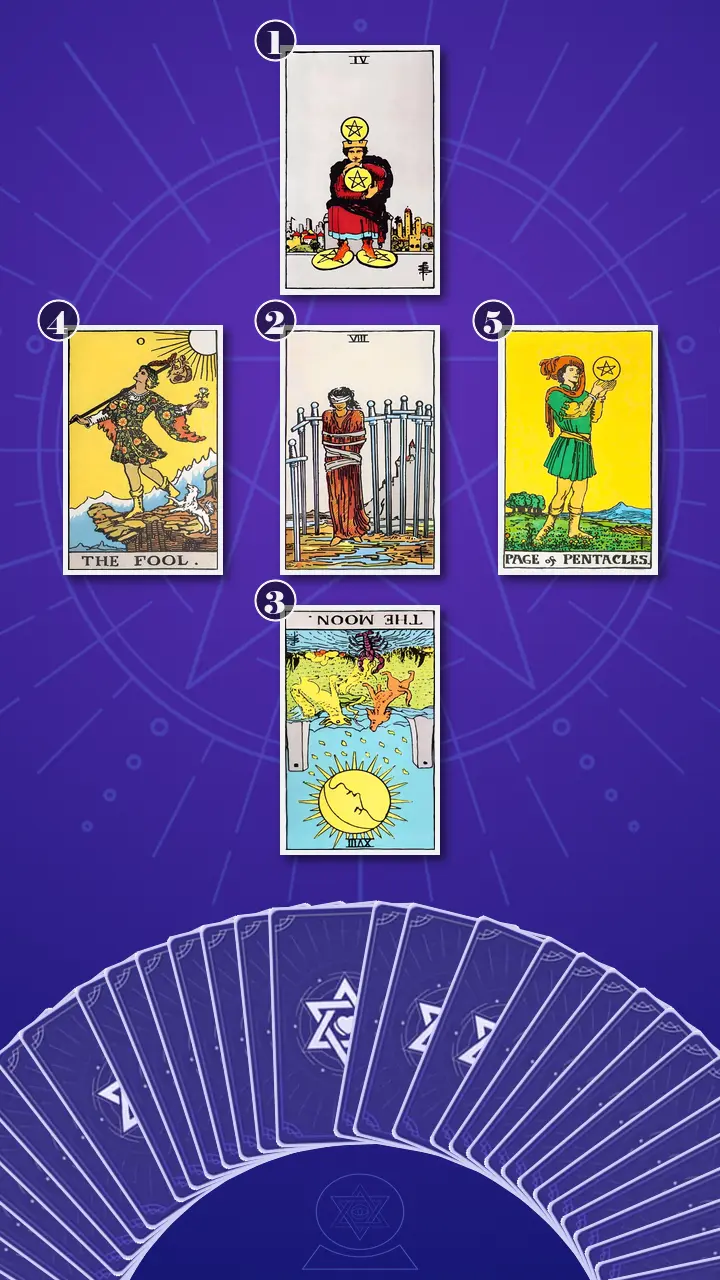
I chose The Shadow Spread, a five-card tarot spread designed to trace a visible pattern, the automatic protection beneath it, the root fear giving that protection urgency, the hidden resource, and the method of integration. I use this career shadow tarot reading when the question is not "Which job will guarantee the best future?" but "Why does the same internal strategy keep selecting for me?"
This is also how tarot works in my practice. The cards do not issue a verdict. Their symbols create enough distance for us to examine thoughts, body responses, and decision rules as objects rather than unquestioned facts. Through a Jungian lens, the shadow is not something sinister. It is usually a protective response that has been pushed outside conscious examination, even while it continues running the system.
I placed the second card at the centre. Above it, the first would show Jordan's observable safe-job pattern. Below it, the third would reveal the fear underneath. To the left, the fourth would uncover an unclaimed resource. To the right, the fifth would turn insight into grounded action. The arrangement looked like a compressed crossroads opening into a path.
I told Jordan that card meanings in context mattered more than isolated definitions. A symbol of security could represent a healthy boundary or an immobilising rule. A symbol of risk could describe recklessness or a carefully contained experiment. Our task was to determine which expression matched the evidence of their life.
Where Safety Becomes Stillness
Position One: The Coin Against the Chest
I began with the card representing the observable career behaviour Jordan could already recognise: holding tightly to predictable roles and withdrawing from meaningful options when uncertainty appeared. I turned over the Four of Pentacles, upright.
I pointed to the seated figure pressing one pentacle against the chest while two more pinned the feet to the ground. The city stood at a distance. I read the card's earth energy as conservation pushed into excess. The instinct to protect income was valid, but protection had become a posture so contracted that Jordan could not approach an option closely enough to investigate it.
In their everyday life, this was the exact moment they reached the contract section of a meaningful vacancy, felt their chest tighten, and gave permanent status, salary, and benefits veto power over every other consideration. The concern was materially real. The automatic veto was the part worth examining.
"The sentence underneath the card sounds like this," I said. "I am not saying meaning doesn't matter. I am saying I need to secure permanent status first. Then, once I'm secure enough, I can explore."
Jordan let out a short laugh, but there was no amusement in it. Their mouth tightened at one corner as they looked away from the card.
"That's so accurate it's a little brutal," they said.
"Then let's make it less brutal by being precise," I replied. "The card is not criticising you for caring about financial stability. It is asking when a budget guardrail became a full road closure. A minimum salary, benefits requirement, or savings threshold can be a boundary. It does not automatically have to become a ban on sending a message, asking a question, or testing one skill."
I have heard the language of responsibility change across cities and cultures, but I have often seen the body tell a similar story: the shoulders rise around uncertainty, then drop when the familiar choice is restored. The release can be so convincing that it gets mistaken for clarity.
"Relief can end the anxiety without answering the career question," I told Jordan. "The safe role wins before meaning is allowed to present evidence."
Position Two: The Browser That Looked Like a Locked Room
I moved to the centre card, representing the automatic defence strategy: converting incomplete information into reasons that exploratory movement was impossible. I revealed the Eight of Swords, upright.
I drew Jordan's attention to the blindfold and the loose bindings. The surrounding swords looked threatening, but they did not form a complete enclosure. I read the air energy here as a blockage. Thought, which could have been used to ask a direct question, had become an architecture of restriction.
The modern version was already open on Jordan's laptop. An unfamiliar title or unclear progression path triggered a spreadsheet forecasting five years of possible losses. Fourteen tabs created the impression of exhaustive evidence, even though none contained a direct conversation with the employer, a person in the field, or Jordan's own experience of the work.
"The inner script is, 'I can't do this because the contract might not be renewed,'" I said. "The next question is less comfortable but more useful: Have I verified that outcome, or have I repeated it until it feels verified?"
Jordan's fingers stopped circling the rim of their mug. Their gaze settled on the small opening between two swords, and I watched their jaw press forward before easing back.
"I keep calling it research," they said slowly, "even when I know I'm postponing the one conversation that might tell me something."
I nodded. "Your research ability isn't the enemy. It is simply being asked to perform a job it cannot complete. Glassdoor, Reddit, and a salary model can identify questions. They cannot answer every question about fit, renewal history, daily work, or what happens to you when you actually try the task."
I gave them the distinction I use when thought starts presenting assumptions as policy: A real constraint needs a boundary; an assumed constraint needs a question. Toronto living costs were a real constraint. A salary floor could protect it. The conclusion that every temporary role would end in financial collapse needed evidence, not repetition.
When the Moon Autocompleted the Worst Case
Position Three: The Road Visible One Block at a Time
I turned to the position representing the root fear: that an uncertain career choice could destabilise Jordan's control and expose poor judgement. The card was The Moon, reversed.
I focused on the winding path between two towers. Under moonlight, the route existed, but its full length could not be seen. Reversed, The Moon showed uncertainty being internalised and filled with projected consequences. Its water energy was not offering clear intuition; it was clouded by an urgent need to complete every blank with the most threatening answer.
I asked Jordan to say the autocomplete sequence out loud.
"Twelve-month contract means it might not be renewed," they began. "No renewal means no income. No income means I can't cover rent. Then I have to explain a bad decision, and everyone sees that I didn't know what I was doing."
As they spoke, rainwater tracked a crooked line down the window behind them. For a moment, the reflected edges of their monitor looked like the card's two towers. The environment seemed to underline the point: Jordan could see the next section of road, but their mind was demanding daylight across the entire journey.
"The first statement contains a real possibility," I said. "The rest is a chain. Some links might be plausible, but plausible is not the same as verified. The Moon reversed isn't asking you to dismiss risk. It is asking you to bring one fear into daylight before letting it close the route."
I used one of my diagnostic lenses, Hidden Cost Deconstruction, and added a missing column to Jordan's decision model. Beside the visible costs of a temporary contract, I asked them to name the unspoken emotional bills attached to always selecting the familiar role: four evenings lost to circular research, the return of flatness by Thursday, another month without firsthand evidence, and the growing belief that they could not trust themselves near uncertainty.
"Those costs don't prove the meaningful role is right," I said. "They do prove the safe role isn't free. Your spreadsheet has been pricing salary and permanence precisely while leaving the column labelled Meaning almost blank. That is not an equal comparison."
Jordan's eyebrows lifted, then pulled together. They looked exposed for a second, but their shoulders moved down by a fraction.
"I thought I was comparing two jobs," they said. "But I haven't really let one of them gather evidence."
When The Fool Made the Leap Smaller
Position Four: A Beta Test, Not a Resignation
I reached the position representing Jordan's hidden resource: permission to take one bounded step without first securing the entire outcome. The room seemed to quiet as I turned over the reading's bridge card, The Fool, upright.
I showed Jordan the traveller's lifted gaze, the light bundle, and the visible cliff. The Fool's energy was not deficient, blocked, or excessive here. It was a balanced form of beginner's openness, with the edge still clearly in view. The card did not tell Jordan to resign tomorrow. It restored a missing option between reckless escape and permanent immobility.
In practical terms, The Fool looked like Jordan keeping their current job, defining a non-negotiable income floor, and requesting one twenty-minute conversation with someone doing adjacent, meaningful work. The call would not be a career announcement, a request for a referral, or a promise to continue. Its only job would be to reveal one fact about the work or a possible transitional route.
I reframed the experiment as a beta release: limited time, limited exposure, a clear rollback, and evidence gathered before expansion. Online career-pivot stories often compress the uncertain middle into a polished thirty-second reveal. The Fool returns the deleted footage, the beginner questions, tentative calls, and reversible trials through which a real transition is usually investigated.
I then used my Fear-Driven Logic Decoupling lens. I separated two statements Jordan's decision matrix had fused together. The first was authentic desire: "I want work with visible contribution, more learning, and closer contact with what I care about." The second was fear-driven logic: "If I explore that desire and it doesn't become permanent, I will have proved I cannot trust my judgement."
The desire described what Jordan wanted to learn. The fear tried to make exploration itself carry a verdict on their identity. Once separated, the fear could be treated as a protective adviser with useful questions, not as the chair of the entire decision committee.
I could see the old binary holding Jordan in place. If they honoured meaning, they imagined gambling their income and credibility. If they honoured safety, they assumed exploration had to stop. The pressure came from treating the next movement as a final career decision instead of an information-gathering step.
Meaningful work does not require a blind leap; it begins with one conscious step, like The Fool carrying only what the next stretch of road requires.
For a beat, Jordan did not exhale. Their index finger stopped halfway to the trackpad, and their eyes lost focus as if the previous week were replaying behind them: the draft LinkedIn message, the Glassdoor detour, the familiar application submitted for relief. Their brow tightened before their face softened, but the release did not arrive cleanly.
"But doesn't that mean I've been wrong this whole time?" they asked, the words sharper than anything they had said earlier.
I let the question stay in the room. Then I answered, "No. It means a protective strategy gave you short-term relief when you needed control. Now you're noticing the bill it sends later. Understanding that is not an indictment of your previous choices. It is new information about what those choices can and cannot do for you."
Their hand flattened against the desk. Their breathing dropped lower into their chest, then released in one long, uneven exhale. Their eyes shone slightly, and their shoulders finally descended from the position they had held since the contract line appeared. I also saw the brief blankness that can follow a genuine insight: if the path was not completely closed, Jordan now had some responsibility for choosing a small movement. Relief had opened space, and the space felt vulnerable.
"Now, using this new perspective, can you think of a moment last week when this insight might have made you feel different?" I asked.
"Thursday," Jordan said. "I had a message drafted to someone in climate tech. I thought sending it meant I was starting a whole career change. If its only job had been to teach me one thing, I might have sent it."
I asked them to open one saved role and set an eight-minute timer. They made two columns titled Verified and Assumed, then circled one unknown that could be checked with a neutral question. Drafting the question counted; sending it was not required. I reminded them that they could stop if their body became too activated and reduce the exercise to one verified fact and one assumption.
"You do not need proof that meaningful work will last forever before you let one small experiment show you what is actually possible," I said.
This was the reading's pivotal movement: from contracted certainty-seeking and temporary relief to evidence-based curiosity, steadier self-trust, and grounded engagement. It was not a promise that Jordan would never feel fear at a contract line again. It was permission to obtain evidence before fear completed the story.
Position Five: One Pentacle, Not Fourteen Tabs
I turned over the final card, representing the grounded practice through which the insight could become a repeatable choice. It was the Page of Pentacles, upright.
I pointed to the Page studying a single pentacle at eye level in a cultivated landscape. The same earth element that the Four had clutched defensively was now being held for observation and development. I read this as balanced, constructive earth energy: focused learning, practical preparation, and one tangible opportunity receiving sustained attention.
For Jordan, the modern-life scenario was deliberately unglamorous. They would choose one meaningful direction and spend ninety minutes on a realistic sample task using a free or familiar tool. Afterwards, they would record three observations: what held their attention, what drained them, and what they needed to learn next. The experiment would respect explicit time and money limits while producing better evidence than another broad evening of comparisons.
"The Page isn't asking you to prove you're already a credible career changer," I said. "It asks you to observe what happens when you practise one small part of the work. Self-trust grows from reviewed evidence, not perfect forecasts."
Jordan reached for their phone and opened their calendar. I saw them pause before creating one ninety-minute block instead of three. That restraint mattered. The Page's lesson was not to convert career exploration into a second full-time job. It was to cultivate one object of attention long enough for reality to answer back.
The Guardrail, Not the Roadblock
I gathered the five cards into one sequence. Jordan's established competence and reliable pay had taught their nervous system that the familiar role could end the immediate physical alarm. The Four of Pentacles showed that relief becoming stillness. The Eight of Swords revealed research turning into a closed mental system. The Moon reversed exposed the deeper fear that an uncertain outcome would not merely cost money, but would prove poor judgement and a loss of control.
The Fool then reopened movement without romanticising risk, and the Page of Pentacles grounded that movement in practical learning. The elemental story moved from earth as containment, through air trapped in analysis and water clouded by projection, into a spark of initiative and finally back to earth as capability. Safety was never cast as the enemy. Its role changed from something Jordan had to clutch into something that could support careful cultivation.
I named the central blind spot plainly: Jordan had been treating incomplete information as objective evidence against meaningful work. At the same time, meaning was expected to justify itself without receiving a direct conversation, a sample task, or even one finished application. The safe role kept winning because only safety had been allowed to submit data.
The transformation direction was equally plain. Jordan did not need to demand certainty before acting, and they did not need to abandon financial responsibility. They needed one bounded, low-cost career experiment inside explicit guardrails. The point was to move from forecasts to firsthand evidence, then decide what the evidence justified.
I turned the five-card Shadow Spread into three actionable next steps:
- Run the 48-Hour Shadow Choice Experiment. On paper only, Jordan would intentionally "choose" the most feared meaningful option for exploration, not acceptance. They would spend ten minutes writing every objection that appeared, then label each one Financial Fact, Untested Assumption, or Identity Fear. After 48 hours, they would add one available fallback, such as keeping the current job, using a notice period, or stopping the experiment. Nothing would be submitted, announced, purchased, or resigned from. The exercise was designed to reveal the defence mechanism, not override consent or practical limits.
- Complete the Eight-Minute Verified-Assumed-Askable Check. On Tuesday evening, Jordan would open one saved meaningful role and sort its salary, contract length, benefits, progression, and required experience into three columns: Verified, Assumed, and Askable. They would circle one askable unknown and draft a neutral question such as, "How often has this role been renewed or converted during the past three hiring cycles?" The timer would stop at eight minutes. Drafting one question would count as completion. If even that felt too charged, the minimum version was one verified fact and one assumption.
- Book One Page-of-Pentacles Test. Jordan would either request one twenty-minute informational conversation or block one ninety-minute sample task for the weekend. The request would state that they were seeking perspective, not a referral. The sample would use a familiar tool and end with three notes: what held attention, what drained energy, and what skill needed development. Success meant obtaining one piece of firsthand evidence, not deciding on a career change. One direction, one task, and one review date were enough.
"I can already see myself turning the eight-minute check into another entire evening," Jordan said.
I adjusted the plan immediately. "Then the timer is part of the experiment, not a suggestion. When it rings, close the sheet even if it looks unfinished. Your task is to practise leaving one question open without letting it multiply into fourteen tabs. Curiosity does not create an obligation to continue."
I wanted Jordan to leave with a structure sturdy enough to hold both sides of the conflict. Their income floor mattered. So did the recurring lift in their chest when work promised visible contribution. Finding clarity did not require declaring either side irrational. It required giving each side the right job: the financial boundary would define acceptable risk, while the experiment would gather evidence about meaning.

A Week Later: The Quiet Proof
Six days later, I received a message from Jordan. They had completed the Verified-Assumed-Askable check, then sent the LinkedIn note that had been sitting in drafts. The person replied and offered a twenty-minute call for the following Tuesday. Jordan had not resigned, announced a pivot, or solved their career. They had simply allowed a meaningful option to present one piece of evidence.
Jordan told me they slept through that night. Their first thought on waking was, "What if this is a mistake?" Then they saw the reply, smiled once, and made coffee. The fear remained; it simply no longer had admin rights.
I did not attribute that change to the cards making a decision for them. Tarot had provided an objective symbolic map, but Jordan had created the proof by changing one behaviour. They moved from guarding certainty to investigating reality, and the first result was not a perfect answer. It was a little more room to trust themselves while the larger answer remained open.
When your chest tightens at the contract details and releases as you return to the familiar role, it can feel as though staying in control matters more than admitting how deeply you want work that feels alive and useful. If you can notice that the same security coin may be clutched against the chest or lifted for careful study, you are already no longer standing at the beginning.
If one small experiment did not have to prove anything about your judgement or decide your future, what single pentacle would you lift out of the spreadsheet and allow real life to teach you about this week?