Family Help with Strings: The Question Returned; Saturday Stayed Put

The E-Transfer with Invisible Edit Access
I recognised the search phrase family help with strings attached becoming painfully literal when I met Maya, a 27-year-old junior UX designer, at her Toronto kitchen counter. An unexpected dental bill had eaten through her small emergency buffer, and a family Interac e-Transfer had just restored it.
At 9:40 p.m. on that rain-heavy Tuesday, Maya held her warm phone while the refrigerator hummed and water ticked against the window. She typed, “What would you expect from me if I accept this?” Then she deleted the question, sent a heart and a thank-you, and opened Google Calendar. After another family message mentioned previous support and asked whether she could be available that weekend, she dragged Saturday’s portfolio review to another date. I watched practical relief lower her shoulders before something tightened in her throat like a scarf being pulled from both ends: receiving the help felt right, but naming its strings felt dangerous.
“It feels like love until I try to disagree,” she said. “I know plenty of people don’t have this kind of help. Why make it awkward if it works? I can say no later. I just don’t want money to turn every boundary into a debt.”
I heard no ingratitude in that. I heard someone trying to protect financial stability, family closeness, and adult autonomy with a single cheerful reply. That is a lot to ask of one heart emoji.
“The help can be real, and the cost can be real too,” I told her. “We do not need to decide tonight that your family is entirely generous or entirely controlling. We only need to make the exchange visible enough for you to choose. Let’s draw a map through this fog and find out what you keep editing out when the help feels familiar and right.”

Choosing the Compass: The Five-Card Relationship Spread
I invited Maya to take one slow breath and hold the question in mind while I shuffled. I do not use the breath as a mystical performance; I use it as a transition from reacting to observing, especially when a phone notification has already put the nervous system on fast-forward.
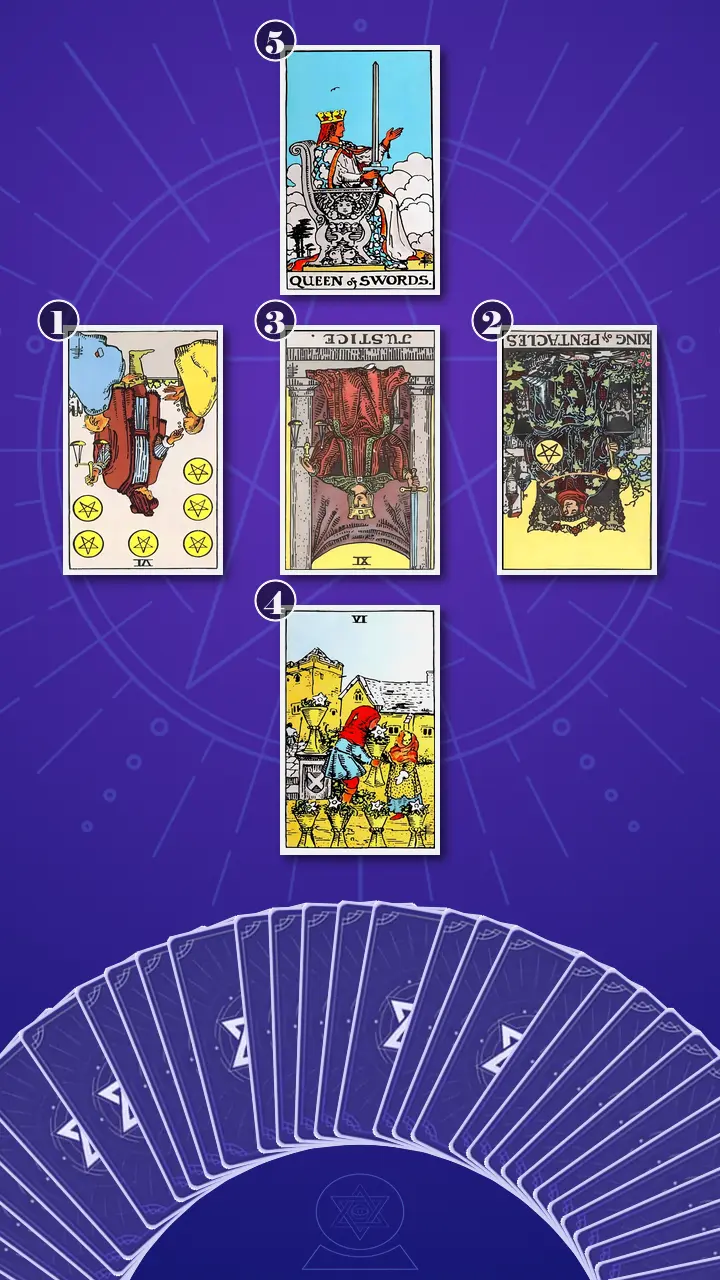
I chose a five-card Relationship Spread. This was not primarily a yes-or-no question about whether Maya should accept one transfer. It was a relationship question about how resources, obligation, belonging, consent, and decision-making authority interacted after support changed hands.
I placed the cards in a cross. The first card would show Maya’s observable stance when relief arrived. The second would examine the family’s observable contribution and any link between provision and authority, without pretending I could read anyone’s private motives. The central card would reveal the exchange mechanism Maya kept overlooking. Beneath it, the fourth card would show why the pattern felt emotionally familiar. Above it, the fifth would offer a constructive boundary practice.
The arrangement looked like a balance scale crossed by a vertical plumb line: two sides of the exchange, the emotional history beneath it, and a clearer standard above it. For me, this is how tarot works at its best. It does not issue a supernatural verdict or replace an adult decision. It externalises patterns so that intuition and evidence can sit on the same table long enough to be compared.
Reading the Exchange Without Reading Minds
Position 1: Relief Before the Terms
“The card turning over now represents your observable stance toward conditional help, especially the habit of accepting relief before clarifying what you are agreeing to,” I said. It was the Six of Pentacles, reversed.
I pointed to the standing figure holding the scales while coins fell from one hand toward two kneeling recipients. In an upright expression, this card can describe generosity, reciprocity, and resources moving where they are needed. Reversed here, that energy was blocked and tilted. The problem was not that Maya needed help; the problem was that the person controlling the resource also appeared to control the timing, the distribution, and the first definition of the exchange.
In Maya’s modern life, this was the exact moment an Interac e-Transfer covered one bill while a later expectation reached into her Saturday, personal information, or decisions. By answering with a heart before asking what the offer included, she entered a reduced negotiating position. The immediate financial pressure disappeared, but the conversation about terms became harder to begin because the benefit had already been received.
“When the offer arrives,” I asked, “what changes first in your body: does your throat tighten before you ask a question, or does your stomach drop after the later request appears?”
Maya gave a short laugh with a bitter edge. “That’s so accurate it feels almost cruel.” Her fingers tightened around the phone, then loosened. “I say thank you before I know what I’m agreeing to. Then I call myself selfish when I want my Saturday back.”
“Accuracy is not a punishment,” I said. “It gives us leverage. This card is not ordering you to reject every offer, overwork, or put an emergency expense on expensive credit just to prove nobody can influence you. It is asking for a pause before relief silently becomes negotiating debt.”
Position 2: When Provision Expands into Oversight
“The card turning over now represents how family support is observably offered and linked to authority or expectations, without making any claim about private intention,” I said. It was the King of Pentacles, reversed.
The King held his pentacle close within a scene crowded by vines, bull carvings, a fortified throne, and a castle. Upright, that material energy can express dependable stewardship. Reversed, it can become excessive or blocked: stability hardens into gatekeeping, and providing a resource begins to look like a licence to supervise the person receiving it.
I connected the image to the Sunday video call Maya had described. A relative had helped with an expense, then mentioned that help while asking for a detailed budget and more input into a possible UX role. Maya had opened her spreadsheet and started explaining every line item. The original offer covered a bill; the later conversation expanded into oversight of her career, spending, and availability.
“A money transfer can pay for one expense without becoming an admin login to your whole life,” I told her. “Providing a resource and receiving authority over another adult’s choices are separate agreements. This card asks us to notice when one is treated as proof of the other.”
Her jaw shifted to one side. She reached for her mug, found the coffee cold, and set it down without drinking. “I send too much information because I think transparency will prove I’m responsible,” she said. “But then the amount of access keeps growing.”
I nodded. “That is the overcorrection to watch. You do not need to submit complete budget records, live location updates, or a defence of your character when one clear practical answer would address the offer. The question is not whether your family deserves suspicion. It is whether the access being requested was actually included in the agreement.”
When Justice Found the Missing Column
Position 3: The Incomplete Relational Ledger
“The card turning over now represents the central relational mechanism you keep overlooking: the incomplete accounting between practical support and personal access,” I said. At the centre lay Justice, reversed.
The scales and double-edged sword appeared destabilised by the reversal. Justice usually asks for a complete record, proportionate consequences, and informed agreement. Reversed, its energy was blocked by selective accounting. Maya could name the exact dollar amount she had received, but her internal ledger had no rows for changed plans, unwanted disclosure, extra availability, or decision-making space surrendered after past help was invoked.
Looking at that card, I thought of the charts I have worked with over a decade of studying cycles. An elegant calculation can still point to the wrong part of the sky when one critical variable has been omitted. Precision is not the same as completeness. Maya’s financial spreadsheet was precise; the relational equation was not complete.
“You counted the dollars and deleted the permissions,” I said. “Gratitude is a feeling, not unlimited access.”
Maya opened her Notes app. At the top of a page, she had written the exact amount of the transfer. Below it was nothing. She stared at the blank space and quietly repeated the explanation she usually gave herself: “It was never explicitly promised, so it probably doesn’t count.”
“The money was named,” I replied. “The permissions were assumed. That blank is not proof that you failed or that someone else had a secret plan. It is information. Maybe the awkwardness is the information.”
I asked her to type two headings: Support Offered and Expectations Stated. Under the first, she wrote the transfer amount. Under the second, her finger hovered. Her breath paused; her gaze went unfocused as if she were replaying the moved calendar event; then a low “Oh” came from somewhere deeper than speech. One shoulder dropped a fraction.
“Saturday was never part of the offer,” she said. “Neither were updates about the job. I linked them because the help was mentioned.”
“Exactly,” I said. “Justice reversed does not demand a verdict about the whole relationship. It asks you to compare support offered with expectations stated. Every blank or assumed term becomes a neutral question rather than an automatic debt: Is this a gift or a loan? Are you asking me to be available Saturday? Does accepting this change who decides about my job?”
The central blockage was beginning to act as a catalyst. Once the missing column existed, Maya no longer had to argue with herself about whether she was grateful enough. She could assess whether the exchange was transparent, proportionate, and freely agreed.
The Flower-Filled Cup Beneath the Ledger
Position 4: Why Familiar Care Feels So Right
“The card turning over now represents the familiar history of care and belonging that makes this support feel emotionally right even when its adult terms remain unclear,” I said. It was the Six of Cups, upright.
I drew Maya’s attention to the child offering a cup filled with white flowers inside an old protected courtyard. The card carried balanced Water: tenderness, memory, familiar generosity, and care received long before adult negotiation was expected. It explained why Maya did not experience the transfer as a simple financial transaction. The gesture carried the emotional texture of being looked after.
In her family group chat, an offer could arrive with the same warmth and speed she remembered from childhood. That familiarity made the support feel safe before she had checked whether the present-day terms suited her adult life. Questioning the conditions therefore felt less like clarifying a current offer and more like questioning the whole history of love behind it.
The two Sixes created an important contrast. Both depicted giving. The reversed Six of Pentacles showed a material exchange whose balance was unclear; the upright Six of Cups showed that the affection and remembered care could still be genuine. One truth did not cancel the other.
Maya pressed two fingers lightly to the base of her throat. “That’s the part I don’t want to lose,” she said. “If I question the terms, am I saying the love was fake?”
“No,” I said. “You can honour what was tender without copying every condition into adulthood. The fact that a pattern is familiar explains why it feels right; familiarity does not decide whether every present term is freely chosen. The help can contain real affection and still deserve a clearer agreement.”
Her eyes softened, though her mouth tightened for a moment. I could see that this brought relief and grief together: relief that she did not have to turn her family into villains, and grief that protecting the warmth might now require a conversation she had spent years avoiding.
When the Queen Changed the Permissions
Position 5: A Raised Sword Beside an Open Hand
The rain thinned as I reached for the final card, and a streetcar bell sounded below the window in one clean note. For a moment, a narrow line of city light rested across the centre of the spread like the edge of a blade.
“The card turning over now represents the boundary practice that can integrate gratitude, fairness, and autonomy through explicit communication before consent,” I said. It was the Queen of Swords, upright.
Her sword stood vertical in one hand while the other remained open. That combination mattered. The Queen’s Air energy was balanced: precise without being punitive, receptive without becoming porous, independent without requiring emotional disappearance. She did not ask Maya to choose between connection and autonomy. She showed Maya how to separate connection from access.
In modern terms, the Queen was a clean permissions screen. This offer could cover the dental bill without giving anyone approval rights over Maya’s career, private spending, relationship, or Saturday plans. Her sentence could be direct: “I appreciate the offer, and accepting it will not give anyone approval rights over this decision.” Her open hand kept the conversation available; her sword defined what remained out of scope.
Decision Timing Calibration at Low Tide
At this point I brought in a lens I call Decision Timing Calibration. It asks whether the current cycle is structurally suitable for a high-stakes consent decision. Maya’s surprise bill, thin emergency buffer, Toronto cost of living, and fear of losing immediate relief had created a natural low tide. None of that meant she was weak or incapable. It meant urgency was compressing her decision window.
After years of watching people blame themselves for choices made under temporary pressure, I have learned to distinguish a difficult cycle from a defective self. A low tide does not choose for Maya, but it can make the first available lifeboat feel like the only possible route.
I paired that timing check with Cyclical Variable Filtering. We stripped away the temporary friction of this particular bill and identified the variables that would affect her longer orbit: whether the help was a gift or loan, what availability was expected, what information remained private, and who retained authority over her decisions. Those were the terms that would still matter after the bill disappeared from her banking app.
At 9:40 p.m., Maya had deleted the question beneath the family transfer, sent a heart, and moved Saturday’s plan after a reminder about past help. The bill was lighter, but her body was already waiting for the implied request.
I let the base meaning settle before I gave her the sentence at the centre of the reading.
Familiar care is not automatically fair care; ask for clear terms, then let the Queen's raised sword separate gratitude from consent.
For one beat, Maya stopped breathing. Her thumb froze above the screen, and her pupils widened as if the last month had started replaying behind her eyes. Then her jaw set. “But doesn’t that mean I’ve been wrong every time I took the help?” she asked, sharper than before. I let the anger have room. “No. It means a strategy that protected relief and belonging has reached its limit. New information does not turn your younger choices into evidence against you.” Her eyes reddened, but she did not look away. The hand curled near her mug slowly opened; one shoulder dropped, then the other. A long breath left her with a small tremor. Relief arrived, followed by the brief, almost dizzy blankness of realising that clearer terms would also ask her to choose. She looked back at the Queen, softer but not suddenly certain.
“Now, with this new perspective, think back to last week,” I said. “Was there one moment when this insight could have made you feel different?”
Maya looked toward the rain-dark window. “When they brought up the course they helped pay for and asked to see my whole budget,” she said. “I could have asked whether those two things were actually linked. I might still have felt scared, but I wouldn’t have felt like a defendant.”
That was the bridge the Queen offered: not instant fearlessness, but clear-eyed self-trust, precise communication, and a compassionate boundary in the same sentence. I named the shift for Maya. This was a movement from uneasy gratitude and anticipatory compliance toward grounded, self-respecting connection. The tarot had not made the choice for her; it had helped her see where a choice had previously been hidden.
The 72-Hour Orbit and the Consent Ledger
I drew the cards into one coherent story. At the foundation, the Six of Cups showed that help arrived through a genuine and familiar language of care. In the present, the reversed Six of Pentacles showed Maya accepting relief before clarifying the exchange. The reversed King of Pentacles showed how observable provision could then expand into assumed oversight. Reversed Justice revealed why the pattern stayed confusing: Maya measured the visible resource while omitting the cost to time, privacy, and decision-making. The Queen of Swords preserved the warmth worth keeping while returning language and consent to Maya.
The pattern was like signing a blank cheque because the handwriting looked familiar. It was also like accepting a calendar invitation without noticing that someone else had been given edit access. Maya’s cognitive blind spot was not gratitude itself. It was the selective ledger and the false binary beneath it: either the help was loving and she should not question it, or the help was controlling and she had to reject it completely.
The transformation direction was simpler and more adult than either extreme. Before accepting family support, Maya could ask what was expected in return, decide which terms she genuinely consented to, and accept, renegotiate, or decline from there. A clear term would not be a rejection of care; it would be a way to consent to it.
No Wands appeared in the spread, so I did not prescribe a dramatic confrontation, sudden financial cutoff, or sweeping declaration of independence. Fire-like action was not yet habitual. The next step needed to be one small conversation, not a scorched-earth performance.
- Use the Orbital Pause before replying. For the next non-urgent family offer involving money, transport, housing, or another practical favour, wait 72 hours before accepting. Save the cheerful thank-you as a draft, then write: “What would you expect from me if I accept this?” Name one term you can consent to and one area that remains yours. For example: “I can repay this on the first of next month, and my job decision remains mine.”Tip: If a real deadline makes 72 hours impossible, use a ten-minute version. The pause is a decision tool, not a test you can fail.
- Build one Two-Column Consent Ledger. On one evening this week, spend ten minutes on a single recent offer. Under “Support Offered,” record the amount or practical help and the words actually used. Under “Expectations Stated,” record only what was explicit. Check money, time, privacy, availability, and decision-making. Turn one blank into a neutral question such as, “Is this a gift or a loan?” or “Does accepting this change who decides about my job?”Tip: Keep the exercise observational rather than prosecutorial: one offer, two columns, three questions at most. You do not have to send the note.
- Rehearse the Permission Boundary Script. Before one upcoming family conversation, record a voice note under sixty seconds using three parts: appreciation, a specific boundary, and an invitation to clarify. Try: “I appreciate you offering to help with the bill. This offer covers the bill; it does not decide the rest of my life. Is that what you meant too?” After asking, take one full breath before adding any explanation.Tip: If speaking feels too charged, send a text. Keep the boundary tied to the current offer, and use the exit line, “I need time to think before I answer.”
Maya looked at the first action and frowned. “But what if I really don’t have 72 hours? Sometimes the bill is due the next day.”
“Then we calibrate the pause to reality,” I said. “Seventy-two hours is useful when the decision is non-urgent and the terms could affect your life beyond the immediate expense. Ten minutes may be enough to interrupt an automatic yes when the deadline is real. The point is not to perform perfect boundaries. The point is to recover one usable moment in which you can ask what you are entering.”
I also reminded her that the conversation could produce information she did not enjoy. A clear question might be met with warmth, awkwardness, defensiveness, vagueness, or a withdrawn offer. None of those responses would prove that Maya had asked wrongly. They would simply give her more complete information for deciding whether the proposed terms worked for her.

A Week Later, One Saturday Stayed Put
Seven days later, I received a message from Maya: “I used the note. I asked if the transfer was a gift or a loan, and whether they expected me to change Saturday. They said it was a gift but still wanted Saturday. I said I could do Sunday afternoon, not Saturday.”
There was no cinematic reconciliation. The family group chat went quiet for eighteen minutes, and the eventual response was a thumbs-up rather than the usual heart. Maya told me the colder little icon stung. She also told me that her portfolio review remained exactly where it was in Google Calendar.
She slept through that night. In the morning, her first thought was, “What if I made this weird?” Then she laughed once, made coffee, and left the Saturday block where it was.
I considered that the quiet proof of her Journey to Clarity. The five-card Relationship Spread had not told her whether family support was good or bad, and it had not guaranteed that one boundary would repair every exchange. It had helped her distinguish affection from terms, support from permissions, and gratitude from consent.
The cards did not keep the Saturday plan in place. Maya did. Tarot held the variables still for a moment; she used her own judgement to decide what access the help did and did not include.
When a family transfer makes your shoulders loosen and your throat close at the same time, you may be trying to protect belonging by giving up the very voice that could tell you whether the care is fair. Noticing both sensations does not solve the whole relationship, but it means you are no longer standing at the original starting point.
If the next offer could remain warm while you drew one Queen-of-Swords permissions line, what is the smallest question you might quietly leave in the draft during your Orbital Pause: “Is this a gift or a loan?”, “What would you expect from me if I accept this?”, or “Does this include access to my Saturday?”