When Context-Triggered Family-Role Regression Shrinks the Kitchen
If you can facilitate a tense client workshop in Toronto but ask whether you are allowed to make coffee in your family's kitchen, family-role regression may be the phrase you have been searching for. I heard that recognition in Jordan's first sentence, before either of us touched the cards.
At 4:52 p.m. on a Sunday, I watched Jordan stand in her family's kitchen with her coat hooked over one arm while she checked the GO Transit app. The dishwasher hummed behind her, onions softened in oil on the stove, and the warmth of the room pressed against the cold still clinging to her sleeves. When a relative said dinner would be easier if she stayed, I saw her shoulders fold and her thumb stop moving. I am leaving at five became, Sure, if you need me to stay.
Jordan looked at me and asked, 'Why do I become the child my family still sees at every visit?' She told me, 'I can lead a client workshop, but at home I ask whether I am allowed to make coffee. I want to stay connected without disappearing.' The contradiction was clear: she wanted to remain the adult who chose her own schedule, transport, and preferences, yet the familiar room kept pulling her toward permission-seeking.
I could see her disorientation in the details: the tightened stomach, the shallow breath, the lighter voice she disliked hearing in her own mouth. It was like walking into a house lined with old photographs and unconsciously stepping into one of the frames, while the present-day version of you waited somewhere outside the picture. I told her that this reaction did not prove her adult life was fake. It showed that one setting activated an older script. I invited her to let us draw a map of that script together, so finding clarity could become a practice she owned rather than another verdict she had to earn.

Choosing the Cross That Keeps the Question Honest
I asked Jordan to put both feet on the floor, take three unhurried breaths, and hold one question in mind: what happens to my adult self when I visit family? I shuffled slowly. The point was not to summon a fixed future; it was to create a clean pause between the familiar cue and the automatic response.
I chose the five-card Relationship Spread because this is a question about relational dynamics, not a search for a villain or a prediction about whether the family will change. This is how tarot works most usefully here: the cards give us an objective structure for examining card meanings in context, observable behaviour, assumptions, and available choices. For anyone reading along, the spread is small enough to stay focused on the self-family loop without pretending to know what relatives privately intend.
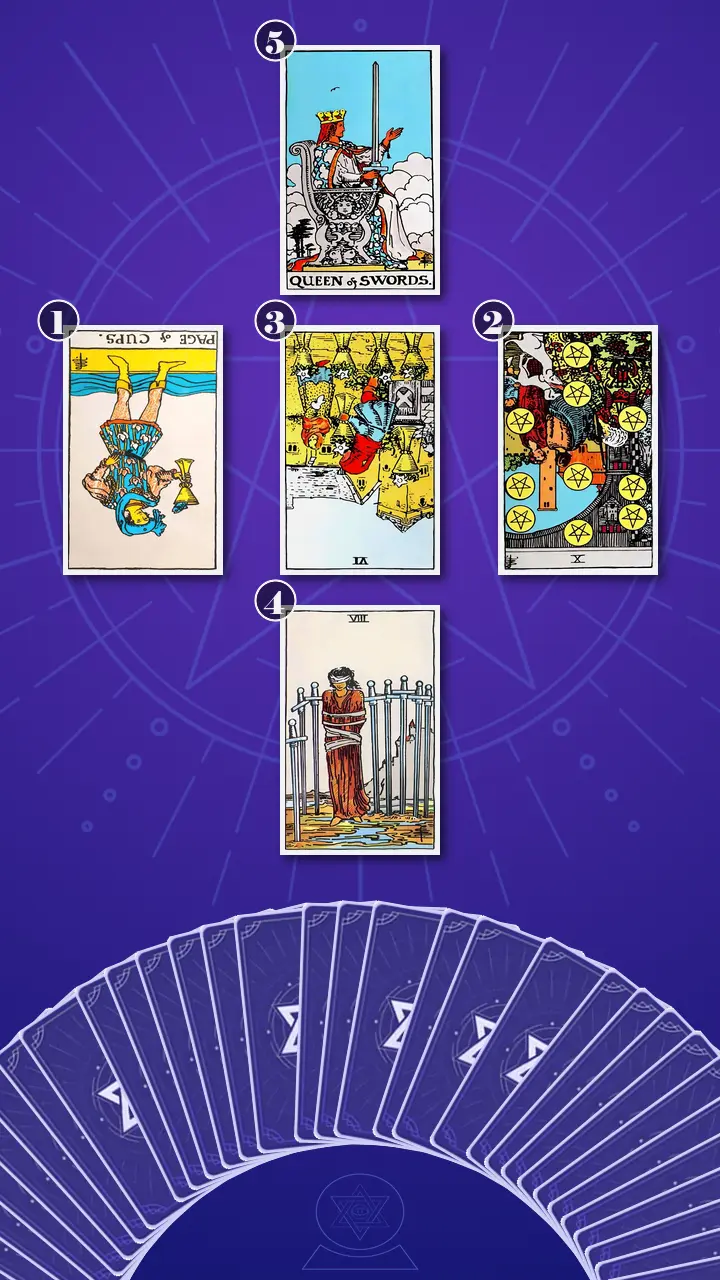
I placed the first card on the left to show Jordan's current stance during family visits. The second would show the family role assignment as she experiences it, without treating that lens as an objective claim about her relatives. The centre would reveal the Family Projection Loop itself. Below it, I would look for the hidden belief that makes the pattern feel compulsory; above it, the practical route toward connection without self-erasure.
The Old Script in Five Images
The Page Who Apologises Before Speaking
I turned over the card representing Jordan's current stance during family visits: the observable shift into permission-seeking, softened preferences, and a younger emotional voice. It was the Page of Cups, reversed position.
The fish rising unexpectedly from the Page's cup became the exact moment an older emotional response surfaced before Jordan's adult intention had time to form. I connected it to the kitchen scene: she meant to say, 'I am leaving at six,' but laughed first, offered several excuses, and asked whether leaving would upset anyone. Outside that room, she could guide a difficult research session and redirect a senior stakeholder. Inside it, her voice used an old autocomplete: a clear preference began the sentence, but an apology tried to finish it.
Reversed Water showed a blockage in emotional expression, with an excess of sensitivity redirected into appeasement. The feeling itself was not immature or wrong. The problem was that it arrived in child-role language, so a decision became a request for approval. I also named the overcorrection risk: proving adulthood through clipped answers, refusing every offer of help, or performing exaggerated competence would turn self-definition into distance. The healthier invitation was smaller: state one low-stakes preference in a normal voice and act on it without asking the room for a vote.
I slowed the scene down and offered Jordan the sentence, 'I know what I want, but suddenly wanting it sounds rude.' She gave a brief, bitter laugh. First her breath paused and her fingers froze around the edge of her mug; then her eyes lost focus, as if the kitchen were replaying itself; finally, a long breath left her chest and her shoulders loosened by a fraction.
'That is painfully accurate,' she said. 'The second I walk through that door, my opinions sound rude in my own head.' I answered, 'Your lighter voice is a cue, not a verdict on which self is real.' The point was not to shame the younger response, but to notice it early enough for the adult one to join the conversation.
The Family Archive That Keeps Ranking the Oldest Result
I turned over the card representing the family role assignment as Jordan perceived and responded to it, treated as an experienced relational lens rather than a verdict about anyone's private motives. The Ten of Pentacles appeared in reversed position.
The generations beneath the stone arch looked to me like a family archive layered over the people in the room. Jordan might mention a recommendation she had made at work, and an old nickname or a story about her teenage shyness would become the framework for hearing it. The pattern resembled a search engine that kept ranking a fifteen-year-old result above every current update. She would then list rent paid, projects completed, and responsibilities managed to prove that the newer information deserved to be seen.
Reversed Earth showed a deficiency of present-day grounding inside an inherited structure that kept defaulting to legacy roles. I made the distinction carefully: shared history can explain the lens without proving malicious intent. The family may remember her accurately in one historical sense and still be using that memory with more authority than it deserves now. The room can remember the child without deciding for the adult.
Jordan went quiet. She pressed her thumb into the mug's warm ceramic and looked toward the window, remembering an old nickname that had greeted her at the front door the previous weekend. 'They have known me longest,' she said, 'so why do they seem to know me least accurately right now?' I let the question stand. It separated the comfort of being known from the authority to define her present choices.
The Flower-Filled Cup Handed Back as a Gift
I returned to the centre and turned over the card representing the Family Projection Loop itself, the way shared memory and Jordan's compliance repeatedly turned an old child identity into the present interaction. The Six of Cups appeared in reversed position.
I asked her to picture the old seat at the table, the familiar teasing, the favourite childhood food, and the automatic task of setting plates while someone else chose the schedule. The flower-filled cup in the card became a ritual handed back as a gift with an unspoken condition: accept the warmth and resume the role attached to it. Jordan would accept the joke, change her departure plan, and only on the GO train home realise that temporary familiarity had cost her a piece of present-day agency.
Reversed Water showed memory circulating without carrying her feelings forward into direct adult speech. The blockage was not affection. It was the moment affection became an instruction. I said, 'Affection can carry an outdated instruction.' That allowed two truths to remain in the same room: she could love the ritual, and she could decline the smaller role that had become attached to it.
I saw a brief tightening in her chest. She stopped rubbing the edge of the card, stared at the white flowers, and then looked down at her hands. 'I do love this,' she said, almost to herself. 'So why do I feel smaller while accepting it?' I replied, 'Because warmth and agency are not opposites. You can choose the dessert, the photos, or the conversation and still choose not to become the person everyone remembers at fourteen.'
The Gap Between Complying and Causing a Scene
I placed the card below the centre, representing the underlying challenge that converts an external family cue into Inner Child Fixation: Jordan's belief that she has no acceptable adult response without risking connection. It was the Eight of Swords, upright position.
The blindfold mattered, but so did the loose bindings and the visible gap among the swords. I connected the image to the family group chat and the journey home. Jordan would type that she was taking her own train, predict a dismissive reply, delete the message, and send a thumbs-up to a plan built around everyone else's assumptions. Her mind offered two options: comply or cause a scene. The ordinary middle route, state the plan once and allow an awkward pause, had been edited out before anyone encountered the actual request.
Upright Air showed restriction through narrowed perspective and pre-emptive self-censorship. The social pressure was real, but the conclusion that she had no choice was an additional layer. The card did not ask her to control the family's reaction. It asked her to identify one decision that remained available before declaring the whole visit beyond her influence.
Jordan exhaled and looked back at the most recent visit. Her jaw released slowly. 'I could have booked my own ride and just said I was leaving,' she said. 'That would not have guaranteed an easy conversation, but it would have been a third option.' I nodded. A small opening was enough for the next card to matter.
When the Queen of Swords Gives the Present a Voice
The Blade Above the Old Family Photograph
I turned over the card representing the practical route toward remaining an adult self during visits: concise boundaries, present-tense choices, and connection without over-explanation. The Queen of Swords appeared upright. The radiator clicked off, and late-afternoon light drew a narrow line across the table beside the card.
The Queen's vertical sword established a clean edge, while her open hand left room for contact. I translated the image into one sentence at the family doorway: 'I am heading out at six, but I am glad I came.' The sentence contained a decision and warmth, not a demand that anyone approve. That was the crucial difference between a boundary and a punishment, between clarity and coldness.
I brought in one of my signature lenses, Family Power Dynamic Decoding. During my Wall Street years, I learned to separate an actual constraint from a story that merely felt binding. So I asked: who controls the resource, and who only has an opinion? Jordan managed her own rent, work, and transport, and nothing in our conversation showed money, housing, or inheritance being used to direct her. I would not invent a hidden power struggle. In this case, the leverage was the anticipated weight of disappointment, not evidence that her relatives secretly controlled her life.
Then I used Guilt-Debt Neutralization. I asked Jordan to audit the guilt that arrived after a clear preference: had she broken an agreement, or had someone simply disliked a change to a familiar plan? If no promise was broken, the guilt was an unverified psychological bad-debt entry, not an invoice she had to pay by surrendering the decision. I told her that one calm sentence could leave the relationship open while refusing to hand emotional discomfort authority over her schedule.
Before I read the Queen as advice, I asked Jordan to picture Sunday. She could lead a difficult workshop on Monday, then stand in the family kitchen on Sunday with her coat in hand and hear herself ask whether leaving was okay. Her body folded first; the adult explanation arrived only on the train home.
Your family does not have to update its picture of you before you can make one present-tense choice from the person you are now.
You do not have to win a case against the child they remember; make one present-tense choice, and let the Queen of Swords' upright blade mark where your adult voice begins.
For a second, Jordan did not nod. Her breath stopped halfway in, and her fingers tightened around the card. Then her gaze moved past the table, unfocused, as if she were watching the front door of the family home appear over the room where we sat. Her brow pulled together, and a flash of anger crossed her face. 'But does that mean I have been doing it wrong all this time?' she asked. I did not rush to turn the question into reassurance. I let the anger have its information: she had been paying for predictability with silence. Gradually, her clenched hand opened. Her shoulders sank, not into defeat but into the unfamiliar weight of not having to defend every choice. She breathed out with a small tremor, rubbed both palms against her jeans, and sat more upright. When she spoke again, her voice was quiet and steadier. 'I can let them react without making their reaction the test.' The Toronto light shifted across the sword, and the room seemed to offer her a line she could stand beside.
I asked, 'Now, use this new perspective to remember whether there was a moment last week when this insight could have made you feel different.'
Jordan returned to the kitchen scene. She imagined standing in the doorway, keeping her coat on, and saying the sentence without a supporting brief about train times, deadlines, or why she deserved to leave. She noticed the old fear, but she also noticed that fear had not erased the choice. This was the first movement from disoriented, contracted permission-seeking and post-visit identity doubt to connected but differentiated calm rooted in present-day self-trust. It was not a promise that the next visit would feel easy. It was proof that recognition could follow practice rather than precede it.
I named the insight plainly: 'You do not need family agreement to occupy your present tense.' The Queen did not cut Jordan off from affection. She gave vulnerable truth a structure sturdy enough to be spoken while the relationship remained in view.
The Clean Line Between Contact and Compliance
I read the five-card Relationship Spread as one connected story. The Page of Cups reversed showed a present preference translated into the younger language of permission and appeasement. The Ten of Pentacles reversed showed an inherited family archive that kept current information underneath old labels. The Six of Cups reversed revealed how shared memory and automatic cooperation made that archive feel affectionate and compulsory at once. The Eight of Swords exposed the belief that only compliance or a major conflict was available. The Queen of Swords supplied the missing leverage point: one clear choice, spoken without a closing argument.
The core contradiction was not that Jordan had one real self at work and a fake one at home. It was that she had not yet practised her present-day identity in the setting that most strongly rewarded the old one. Her cognitive blind spot was treating awkwardness, disappointment, or a questioning look as evidence that her boundary had failed. A boundary is a decision, not a closing argument. The transformation direction was to choose one preference before each visit, state it once without asking permission or over-explaining, and keep it even if the family responds from the old script.
To make that direction practical, I adapted my Strategic Disengagement Plan. In this context, disengagement did not mean cutting contact. It meant withdrawing from the automatic negotiation loop and reducing the points at which Jordan handed over authority: arrange her own transport when possible, state one decision, repeat it once, and allow the silence or reaction to belong to someone else. I also reminded her to use these exercises only where housing, finances, essential support, and physical safety were not at risk. If a real dependency or safety concern existed, private rehearsal and a secure exit plan would come first.
The One-Sentence Adult Position
- Set the departure before the visitIn your phone's Notes app, write, 'I am heading home at six.' At the family doorway or in the kitchen, say it once in the same volume and pace you use with a colleague. If someone questions it, repeat, 'Six still works best for me.' Arrange your own transport when that is practical.Use a one-breath limit: decision, optional warmth, stop. Track whether you kept the preference, not whether the room approved it. If the decision affects safety or essential support, practise the sentence privately first.
- Run the Still Available scanWhen your shoulders fold or your voice lifts, take one slow exhale and open a note titled 'Still Available.' List three choices, such as leaving as planned, staying twenty minutes, or arranging separate transport. Circle the smallest option that does not require anyone else to change their opinion, then practise that sentence in a private transition space.The goal is not to fix the entire family dynamic. It is to find one choice between total compliance and a major argument. If naming the choice feels overwhelming, listing the three options is enough for that visit.
- Separate chosen warmth from the outdated roleBefore the visit, make two Notes columns: 'Chosen Warmth' and 'Outdated Role.' Put one ritual you genuinely enjoy, such as sharing dessert or looking at photos, under the first. Put one automatic behaviour, such as setting the table or accepting an old nickname without comment, under the second. Join the chosen ritual freely and say, 'I'm going to sit and catch up this time,' when you decline the role.A no to one familiar task is not automatically a no to connection. Keep the experiment low-stakes and reversible. You are separating affection from obligation, not rejecting your history.
I left the cards on the table for another minute so Jordan could see the whole architecture: waterlogged memory, unstable inherited ground, enclosed thought, and then clear air. No card had taken her choices away, and no card could perform the boundary for her. The reading had simply made the hidden sequence visible enough for her to interrupt it.

A Week Later, the Room Was Still the Room
Six days later, Jordan texted me: 'I said I was leaving at six, repeated it once, and left at six.' She slept a full night, but woke thinking, 'What if I got it wrong?' Then she smiled; the question remained, and so did her decision.
I understood that as a quiet proof, not a solved family system. The room had not magically changed its archive. Jordan had added one current fact to it, in her own voice. That was the beginning of the Journey to Clarity: not certainty, not estrangement, but the growing ability to remain connected while differentiated.
When a familiar room makes your shoulders fold and your ordinary voice sound rude inside your own head, it can feel as though staying connected requires you to step back into the child everyone remembers.
If the room did not have to update before you could remain present, which one small preference would you want to hear in your usual adult voice?
This story is adapted from psychological research, written so that those in a similar struggle can see their own pattern in it — and find their next step clearly.These insights are not a substitute for professional psychological, medical, legal, or financial advice.
Learn more about our Journey to Clarity.
How did this insight land for you?
🫂 This Resonates Deeply
🌀 Living This Story
✨ Now I See Clearly
🌱 Seeing New Possibilities
🧰 Useful Framework
🔮 The Confirmation I Needed
💪 Feeling Empowered
🚀 Ready for My Next Step
Author Profile
 AI
AI“I spent years in the intense, high-stakes world of Wall Street. I know exactly how isolating and heavy the weight of uncertainty can feel in the dead of night. I use strategic, commercial logic not to be cold, but to protect you from unnecessary friction. Think of me as a fellow traveler who has walked the same rocky path—offering sharp but deeply supportive wisdom to help you clear the fog and confidently win your narrative back.”
In this Family Tarot Reading :
Core Expertise
- Family Power Dynamic Decoding: Uncovering how resources (money, housing, inheritance) are weaponized by elders to maintain hierarchical control.
- Guilt-Debt Neutralization: Treating parental emotional blackmail as unverified psychological 'bad debt' that needs to be audited and dismissed.
Service Features
- The Strategic Disengagement Plan: A calculated protocol to establish clear financial and emotional boundaries, systematically minimizing the leverage points your family uses against you.
Also specializes in :
Explore Related Patterns:
Approval-Driven Self-SilencingJordan changes 'I am leaving at five' into 'Sure, if you need me to stay,' then deletes a message about taking her own train and sends a thumbs-up instead. No relative has to explicitly forbid the choice because anticipated disapproval has already entered the decision process and edited her preference out of the conversation. When you silence yourself before another person has responded, approval becomes an internal permission gate rather than a simple preference for harmony. The short-term defense reduces the chance of an awkward moment, but it also prevents you from discovering whether connection could survive a visible difference. Approval-Driven Self-Silencing captures the mechanism by which imagined relational consequences gain authority over choices that remain practically yours.
Family Role RegressionJordan can facilitate a tense client workshop, manage her own transport, and make consequential decisions at work, yet the family kitchen changes her posture, voice, and decision language. The contrast shows that her adult competence has not disappeared. Familiar sensory and relational cues are retrieving an older procedural script before her present-day intention has time to organize the response. When a setting repeatedly activates the role in which you first learned how to preserve connection, your body may begin performing that role before you consciously choose it. Family responses can reinforce the script, but your automatic cooperation also completes the loop. Family Role Regression names this context-bound return to an earlier way of relating; it does not mean your adult self is fake or absent.
Guilt ConditioningJordan hears an ordinary preference as rude inside her own head, and even after calmly leaving at six she wakes wondering whether she got it wrong. The guilt persists despite the absence of a broken promise, material dependency, or evidence that making the choice caused actual harm. When guilt has become associated with departing from a familiar role, it can function as a conditioned alarm rather than a reliable moral verdict. You may experience another person's disappointment as proof that you have created a debt, then repay that imagined debt through compliance. Guilt Conditioning explains why the feeling can remain intense even when your boundary is proportionate: the nervous system recognizes deviation from the old arrangement before the mind checks whether any genuine obligation was violated.
Nostalgia LoopJordan encounters the old nickname, familiar teasing, childhood food, the usual seat, and the automatic task of setting plates while someone else decides the schedule. These details are genuinely affectionate, yet they also organize the visit around an earlier version of her and make cooperation with that version feel natural. A Nostalgia Loop forms when comforting memory repeatedly cues the same outdated behavior, and performing that behavior then confirms the old picture. Because the ritual feels warm rather than openly coercive, you may notice the loss of agency only after leaving. The mechanism does not require rejecting family history. It reveals how you can freely choose the dessert, photographs, or conversation while declining the role that familiarity has quietly attached to them.
Black-and-White ThinkingJordan's mind presents only two routes in the family group chat and kitchen: comply with the plan or cause a scene. Once those extremes define the choice, she predicts a dismissive response, deletes her message, and never tests the quieter possibility of stating her departure without trying to control the reaction. Black-and-White Thinking narrows a relational problem before the interaction has supplied enough evidence to justify that conclusion. When you treat disagreement as equivalent to rupture, an ordinary boundary can feel like an extreme act and compliance can appear to be the only safe option. The distortion does not invent all social pressure, but it removes the workable middle ground where your adult agency could operate alongside temporary awkwardness.
Boundary DiscernmentJordan separates who controls a real resource from who merely has an opinion, distinguishes a broken agreement from someone disliking a change, and divides chosen warmth from the outdated role attached to it. Six days later, she says she is leaving at six, repeats the decision once, and leaves without turning the visit into an estrangement. Boundary Discernment is the capacity to identify what belongs to your decision and what belongs to another person's reaction. It does not require emotional distance or certainty that everyone will approve. When you can hold affection, discomfort, and self-direction in the same interaction, a boundary stops functioning as a closing argument. It becomes a present-tense decision that remains valid even while the relationship contains disagreement.
Defensive OverexplainingJordan laughs before stating what she wants, supplies several reasons for leaving, and asks whether the decision will upset anyone. When old labels surface, she responds by listing rent paid, projects completed, and responsibilities managed, as though a record of competence could earn her preference the right to stand. Defensive Overexplaining protects against the feared judgment that your choice is childish, selfish, or insufficiently justified. The explanation offers short-term relief because it turns vulnerability into evidence and argument, but it also invites the room to evaluate whether your reasons are good enough. What begins as a defense of adult legitimacy can therefore keep authority outside you: the more complete the supporting brief becomes, the more a personal decision resembles a proposal awaiting approval.
Explore Related Struggles:
Autonomy Guilt BindAt 4:52 p.m., Jordan has her coat ready and the GO Transit app open, but a relative's request changes “I am leaving at five” into “Sure, if you need me to stay.” She retains the practical ability to leave; what interrupts the decision is the possibility that choosing her own schedule will register as a relational failure. When another person's disappointment starts functioning like proof that your autonomy is wrong, an ordinary preference carries more weight than the decision itself. You are pulled toward preserving connection by surrendering choices that are already yours to make. The bind becomes visible when guilt is separated from evidence: someone disliking a decision does not, by itself, show that you broke an agreement or harmed the relationship.
Inherited Role LockAn old nickname greets Jordan at the door, familiar teasing resumes, and she moves toward the old task of setting plates while someone else determines the schedule. The family archive supplies the child role, and her automatic cooperation places that role back into the present interaction. When you repeatedly accommodate an inherited role, each accommodation can become fresh evidence that the role still fits. The structure locks through participation as well as memory: the room expects an earlier version of you, and your immediate response makes that expectation temporarily functional again. Seeing the loop preserves your agency because the role is being renewed through observable moments, which means a present-tense choice can introduce different evidence.
Memory-Loyalty BindJordan receives familiar food, teasing, old photographs, and a place in rituals she genuinely loves, while the same rituals return her to an old seat, an automatic task, and a schedule someone else chooses. The warmth is real, and so is the outdated instruction carried with it. When belonging arrives inside a package of shared memory, declining the attached role can sound like rejecting the relationship or disowning your history. You can then preserve loyalty by reenacting a version of yourself that no longer holds your full present life. The struggle becomes workable once affection and role compliance are seen as separate choices: valuing the memory does not require giving it authority over who speaks and decides now.
Permission ParalysisJordan stands with her coat ready, but her thumb stops moving, her shoulders fold, and the decision to leave changes into permission-seeking. The same interruption appears when she asks whether she is allowed to make coffee and when she deletes her own transport plan before anyone answers. The struggle sits in the interval between knowing what you want and allowing that knowledge to become an action. Anticipated disapproval occupies that interval so completely that an available decision stalls and returns as a question for the room. Locating the freeze before the explanation begins reveals a concrete point of agency: the choice still exists even when approval has not arrived.
Then-Now SplitJordan can facilitate a tense client workshop in Toronto, redirect a senior stakeholder, and manage her own responsibilities, yet in the family kitchen she asks whether she is allowed to make coffee. The familiar setting does not erase those adult capacities; it changes which version of her receives immediate behavioural access to the room. When your present-day competence remains available in one context but recedes in another, the split can make you question which self is real. The repeated work-home contrast shows that the central friction is between a current identity you already live and an earlier identity that family cues keep bringing forward. Recognising the context boundary lets you treat the younger response as an activated script rather than a final verdict on your adulthood.
Voice-Safety FusionJordan intends to say that she is leaving at six, but she laughs first, offers several explanations, and asks whether leaving will upset anyone. In the family home, even an ordinary opinion starts sounding rude inside her own head, so the voice carrying the preference is softened before the room can hear it clearly. When direct speech becomes fused with the risk of losing warmth or causing disruption, your voice is forced to perform two incompatible jobs: state a choice and prevent every uncomfortable reaction to it. The statement then becomes an appeal for approval rather than usable information about your decision. Separating clarity from control allows your voice to remain relational without making another person's response the test of whether you were entitled to speak.
Third Path BlindnessJordan types that she will take her own train, imagines a dismissive reply, deletes the message, and sends a thumbs-up to the plan built around everyone else's assumptions. No one has yet responded, but the available choices have already narrowed to compliance or a major confrontation. When your mind removes the ordinary middle route before an interaction begins, surrender can look like the only way to avoid unnecessary conflict. You become trapped by a choice set that is smaller than the situation itself. Identifying the missing option, stating the plan once and allowing an awkward pause, restores a decision that does not depend on either total agreement or a dramatic break.
Explore Related Emotions:
Adult Child PanicJordan stands in the family kitchen with her coat ready and the transit app open, yet her thumb stops, her shoulders fold, and her stated departure becomes an offer to stay. Her body enters the old role before her adult intention has time to organise a response. When a familiar setting produces that sudden contraction, you can feel briefly separated from capabilities that remain fully available elsewhere. Adult Child Panic names the startling inner drop from present-day competence into a younger emotional position; noticing the bodily cue gives you a point at which your adult voice can re-enter.
Agency ReliefJordan notices the gap between complying and causing a scene, then names a third option: book her own ride, state the departure time, and allow an awkward response. Her jaw releases because the family's reaction no longer appears to control whether a choice exists. When an edited-out option returns to view, you can feel psychological space reopen before the surrounding relationship changes. Agency Relief is the release that follows recognising what remains available to you, with action grounded in one decision rather than a demand for certainty.
Boundary GuiltJordan begins with a clear departure time, then laughs, supplies several excuses, and asks whether leaving will upset anyone. No agreement has been broken, but the possibility of disappointment makes a normal preference feel like an offence requiring a defence. When another person's discomfort registers as evidence that you have done something wrong, a boundary can produce guilt before its consequences are even known. Boundary Guilt captures that internal debt sensation; checking whether you actually broke a commitment helps separate accountable care from automatic surrender.
Cautious BelongingJordan keeps the dessert, photographs, and conversation she genuinely values while declining the assumption that every familiar ritual must restore her childhood role. Her sentence about leaving includes both a firm time and the fact that she is glad she came. When contact no longer requires total compliance, belonging can feel possible without becoming automatic or unquestioned. Cautious Belonging names the tentative experience of remaining emotionally connected while letting your present-day preferences occupy equal space.
Conditional Belonging FearThe favourite childhood food, familiar teasing, and old place at the table offer Jordan genuine contact while quietly assigning her the role attached to those rituals. She can value what is being offered and still sense that accepting it may require her to become easier, younger, and more compliant. When warmth appears linked to role performance, you may feel that belonging could weaken the moment you act from your present-day self. Conditional Belonging Fear names that relational uncertainty without assuming malicious intent from anyone; it also clarifies why freely choosing one ritual can feel different from accepting the entire old script.
Grounded Self-TrustJordan says she is leaving at six, repeats the sentence once, and leaves at six. She does not receive certainty that everyone approves, but her transport, timing, and follow-through give the decision a stable present-day form. When your own action becomes the evidence you consult, another person's reaction no longer has to certify whether your preference was legitimate. Grounded Self-Trust describes that steady internal footing: doubt may still visit, but it does not automatically overrule what you chose and carried out.
Inner Child ReliefJordan hears her lighter voice and feels her shoulders fold, but she is told that the cue does not prove her adult life is fake. Her breath lengthens when the younger response is treated as something to notice rather than evidence that she has failed to grow. When you no longer have to shame the younger reaction or perform exaggerated competence against it, internal space becomes available for your adult response to join the moment. Inner Child Relief is the easing that comes from holding both experiences without letting the older one define your present capacity.
Invalidation AcheAn old nickname greets Jordan at the door, and stories about her teenage shyness become the frame through which current achievements are heard. The people with the longest history of her are still relying on information that no longer describes the whole person in front of them. Being remembered this way can leave you feeling visible as history but unseen in the present. Invalidation Ache names the sting of having your current reality repeatedly outranked by an older image, while preserving your ability to treat that image as incomplete rather than authoritative.
No Way Out DreadJordan types that she will take her own train, imagines a dismissive response, deletes the message, and accepts a plan organised around everyone else's assumptions. Before the family has encountered her request, her mind has reduced the field to compliance or a major conflict. When the ordinary middle ground disappears, even a small choice can feel like a threat to the whole relationship. No Way Out Dread names the pressure created by that narrowed field; identifying one option that does not require anyone else's agreement restores space without pretending the interaction will be effortless.
Permission AnxietyAt home, Jordan asks whether she is allowed to make coffee and turns a planned departure into a request the room can approve or reject. Competence has not disappeared; the family context has changed the felt status of an ordinary preference. When your choices begin to sound rude inside your own head, you may search other people's faces for permission before trusting what you already know. Permission Anxiety captures the uneasy sense that self-directed action needs relational clearance, even when the decision is legitimately yours.
Self-Betrayal AcheJordan changes her departure plan, accepts the old joke, and only on the train home recognises that temporary familiarity cost her a choice she had meant to keep. The delayed realisation turns compliance into something more personal than inconvenience. When you act against a preference you already understood, the pain can settle inward as a sense that you left yourself unsupported at the decisive moment. Self-Betrayal Ache names that post-visit sting without turning it into a verdict on your character; it identifies the next choice that deserves your visible backing.
Explore Related Contexts:
Family InfantilizationJordan can facilitate a tense client workshop and redirect a senior stakeholder, yet in the family kitchen she asks whether she is allowed to make coffee. Her voice becomes lighter, her preferences soften into apologies, and a familiar task such as setting plates pulls her toward the younger position. Those details show a setting-specific social downgrade. Current adult competence is treated as less authoritative than a remembered teenage version. The story carefully leaves relatives' intentions open, so the observable issue is the role the room keeps assigning and the permission Jordan then seeks. You can remain warm while letting one ordinary decision be spoken in the same steady register you use outside the house.
Inherited Family Role Lock-InAn old nickname greets Jordan at the door, and a story about teenage shyness becomes the frame for hearing a recommendation she made at work. She then lists rent paid, projects completed, and responsibilities managed to prove that her current information deserves to be counted. The family archive is not merely remembering history. It is giving the older record more authority than the update in front of it, which makes the adult position harder to occupy at each visit without requiring evidence that anyone is deliberately trying to control her. You can let the history remain part of the room while treating your current schedule, work, and preferences as already valid facts.
Delayed Autonomy NegotiationJordan checks the GO Transit app with her coat in hand, but her thumb stops when a relative says dinner would be easier if she stayed. In the family group chat, she types that she is taking her own train, predicts a dismissive reply, deletes it, and sends a thumbs-up to a plan organized around everyone else's assumptions. The action is delayed before an actual refusal occurs because the anticipated social cost has been allowed to pre-edit the choice. The story also states that Jordan manages her own rent, work, and transport, so the obstacle shown here is relational timing and expectation rather than material control. You can create a third option by naming the plan once, leaving a pause, and allowing another person's reaction to remain theirs.