The Family Secret in the Deleted Sentence
If you can coordinate a dozen moving parts at work but keep rewriting one family text on the ride home, family peacekeeper burnout may begin with the moment the group chat lights up.
Jordan, a 27-year-old nonprofit operations coordinator in Toronto, came to me after one of those moments. At 8:47 on a Tuesday evening, they had been riding north on TTC Line 1 while the carriage hummed and fluorescent light flickered against the black window. Their phone felt warm in their palm. A relative had written, "You know what really happened," and someone else had answered with three question marks.
Jordan typed the sentence that named the missing piece, stared at it, and deleted it. They sent, "I think everyone is overwhelmed right now." The typing indicators vanished, but their shoulders stayed lifted and their jaw remained locked.
"I made the fight stop," they told me, rubbing the heel of one hand against their chest. "For an hour, anyway. Then everyone called me separately. I know what they want me to keep quiet about, but I can't tell where privacy ends and protecting the problem begins."
I heard the contradiction clearly: Jordan wanted to preserve family belonging, yet every attempt to contain the secret made them more responsible for the unresolved conflict. Their guilt felt less like an emotion than a smoke alarm strapped behind the ribs, ready to sound whenever one honest sentence came near the keyboard.
"You can love your family and still refuse to be the place where every consequence gets stored," I said. "I won't use tarot to tell you whether to reveal anything. Let's use it to map what happens inside you before you go silent, and then find a form of clarity that leaves the choice in your hands."

Choosing a Floor Plan for the Fog
I invited Jordan to put both feet on the floor, take one unforced breath, and hold the question in mind while I shuffled. I treat this pause as a shift of attention, not a mystical performance. It gives the nervous system a moment to arrive before the analysis begins.
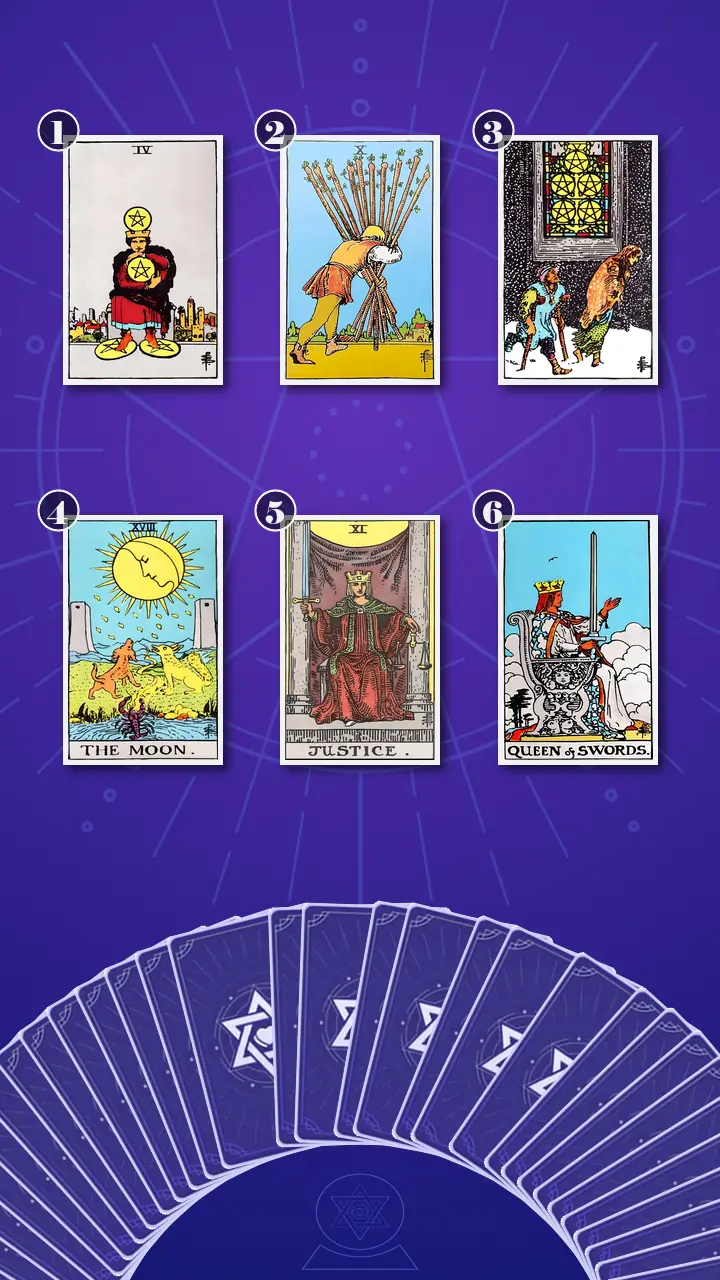
I chose the Transformation Path Grid (6) · Context Edition, a six-card family-boundaries tarot spread. For anyone wondering how tarot works in a situation like this, the cards are not evidence about what relatives intend and they do not issue a verdict about disclosure. They create a structured sequence for examining behavior, burden, root fear, activation, action, and integration.
This mattered because Jordan's problem was not a single disagreement between two people. It was a repeating system: conflict approached the secret, Jordan deflected, temporary quiet followed, and the next fight returned with more resentment attached. The first position would show the visible secrecy-keeping pattern. The third would uncover the belonging fear beneath it. The fifth, placed at the visual center of change, would identify a self-directed action that did not require Jordan to decide what anyone else should say.
I arranged the cards in two rows of three. To me, the layout looked like a floor plan: a guarded entrance across the top row, then a route toward a clearer exit below.
The Grip, the Load, and the Fear of Being Left Out
Position 1: The Closed Permissions System
I turned over the card representing the current state, the observable way Jordan protected family secrets through deflection, minimization, and message editing. It was the Four of Pentacles, upright.
I pointed to the figure's arms locked around one pentacle and both feet braced over two more. In Jordan's life, this was the TTC message: the phone held close, the sensitive sentence locked in Notes, and a neutral reply sent through a permissions system in which Jordan had become the sole administrator. The card showed an excess of protective control. Privacy was no longer one conscious boundary; it had expanded into an attempt to manage who knew what, what everyone inferred, and how each person reacted.
"What do you give up when you edit out the sentence closest to your own experience?" I asked.
Jordan gave a short, bitter laugh. "That is so accurate it's almost rude." Their fingers tightened around the water glass, then loosened. "I give up having a position."
"That sting matters," I said. "The card is not calling protection wrong. It is showing the cost when protection requires you to disappear."
Position 2: Every Emotional Task Assigned to One Person
I turned over the card representing the blockage, the responsibility and protective labor Jordan accepted whenever a fight approached the secret. It was the Ten of Wands, upright.
I saw the bent figure carrying a bundle so large that the road ahead was almost hidden. I asked Jordan about the quiet stairwell at work where they had taken separate family calls while Slack vibrated in their pocket and their coffee went cold. They described remembering each relative's version, promising discretion to both, and returning to a meeting with a flat, controlled voice.
The card showed responsibility in excess. It was an operations board with every emotional task assigned to Jordan: calm one person, reassure another, protect the secret, explain the silence, and somehow remain functional. I reflected the unspoken sentence back to them: "I promised discretion, I promised reassurance, and now I cannot find the part where I am allowed to have a position."
Their breath caught. Their gaze dropped to their folded shoulders, and then one shoulder rolled back as if they had only just noticed its weight. I told them, "A quiet group chat is not always a resolved conflict."
Position 3: The Lit Window of Conditional Belonging
I turned over the card representing the root fear, the belief that speaking might cost Jordan their place in the family or make them responsible for its fracture. It was the Five of Pentacles, upright.
The card's figures moved through snow beneath a lit stained-glass window. Jordan connected it to seeing photos of a family brunch on Instagram after a tense call and immediately wondering whether the missing invitation was punishment. The card did not predict abandonment. It revealed a deficiency in felt security: when belonging seemed conditional, even a modest boundary could register in the body as exile.
Here I used a lens I call Family Casting Analysis. I described the role Jordan appeared to have been handed: The Peacemaker, the reasonable person whose place in the ensemble depended on absorbing tension without changing the script. That role had made usefulness feel like an admission ticket.
"If I stop being useful, will anyone still want me there?" Jordan said quietly.
Their mouth pressed into a line, their eyes moved toward the window, and a long breath left their chest. I answered carefully: "Being useful to the family is not the same as belonging to it. The fear is real, but this card does not claim the feared outcome is certain."
Position 4: The One-Line Text That Became Five Futures
I turned over the card representing the activation point, the ambiguity and mixed signals that intensified Jordan's conflict whenever the secret came close. It was The Moon, upright.
I asked about the 11:16 PM message: "We need to talk about what you know." Under the blue light of the phone, Jordan had treated the period, the late hour, and the absence of context as several possible futures at once: blame, exclusion, a public confrontation, or a holiday invitation withdrawn. They answered vaguely and then lay awake rehearsing all of them.
The Moon showed uncertainty in excess, with instinctive warning signals amplified until facts and forecasts occupied the same mental notification stream. I drew three lines on my notepad: What I know. What I fear. What I am treating as certain. The winding path between the towers did not promise an easy route, but it suggested that Jordan could move through incomplete information without treating every shadow as a verdict.
Jordan's thumb hovered over an imaginary keyboard. Their focus drifted as if old messages were replaying behind their eyes; then their jaw unclenched. "I almost never ask what the text actually means," they said. "I answer the disaster I imagined."
When Justice Put Down the Scales
Position 5: One Accountable Sentence
As I reached the visual center of the grid, the room seemed to become quieter. Even the radiator's ticking paused between cycles. I turned over the card representing action and the key shift: a small, self-directed way to distinguish privacy from concealment without deciding for anyone else. It was Justice, upright.
I pointed to the level scales and upright sword. In Jordan's life, Justice was a blank note divided into "Private," "Mine," and "Theirs": information that was not theirs to share, an impact or boundary they could state accurately, and reactions that belonged to other adults. Its energy was balanced discernment, not forced confession, punishment, or total silence.
Jordan had been treating the choice as a brutal binary: expose the secret and become the family breaker, or keep it and continue disappearing. Under that binary, even a careful boundary looked like betrayal, and every imagined reaction arrived as their responsibility.
Silence is not the only form of loyalty; use Justice's balanced scales to distinguish privacy from concealment and choose one bounded, accountable statement.
For a second, Jordan's breathing stopped. Their fingers remained suspended above the table, slightly curled, while their eyes lost focus as though the Tuesday train carriage had started moving behind them again. Then their brow tightened.
"But doesn't that mean I've been doing this wrong for years?" they asked, anger sharpening the first few words before their voice thinned.
I let the question settle. "It means you used the strategy that helped you preserve connection when you did not yet see another option. Justice is not a retroactive conviction. It is permission to choose with more information now."
The anger loosened first. Their fist opened against their thigh; their shoulders dropped; their eyes reddened without spilling over. A shaky breath came out, followed by a small, disoriented laugh, the kind that arrives when a familiar burden leaves and the empty space feels almost as vulnerable as the weight did. Clarity had handed responsibility back to them, and I could see that freedom carried its own sober edge.
"Now, using this new distinction, can you remember a moment last week when it might have changed how the situation felt?" I asked.
Jordan returned to the group chat. "I could have said, 'I can talk about how this conflict affects me, but I can't confirm information that isn't mine to share.' I wouldn't have fixed it. But I also wouldn't have vanished."
I recognized the deeper shift through another of my working lenses, Narrative Enmeshment Diagnosis. Jordan's personal story had been pulled into an inherited plot in which The Peacemaker had to protect everyone else's unfinished scenes. Justice did not recast them as The Exposer or The Judge. It handed them the pen for their own dialogue and allowed every other adult to remain responsible for theirs.
This was the first real movement from guilt-driven silence and hypervigilant peacekeeping toward discerning, bounded communication without responsibility for every family reaction.
The Queen's Open Sky
Position 6: Compassion Without Disappearance
I turned over the card representing integration, the mature communication style Jordan could practice after releasing the job of controlling every response. It was the Queen of Swords, upright.
Her sword was visible, her gaze direct, and the sky behind her open. I read that as balanced clarity: enough warmth to remain connected, enough precision to refuse the roles of family vault, referee, and spokesperson. In daily life, it sounded like Jordan's sentence: "I can speak about what this conflict is doing to me, but I will not confirm information that is not mine to share or manage everyone's reaction to it."
I thought of film editing, where removing every difficult scene does not create coherence; it creates a jump in the story that everyone can feel but nobody can explain. The Queen offered a cleaner edit. Keep the line that belongs to you. Leave other people's dialogue in their hands.
Jordan sat back. The tightness had not vanished, but their voice no longer sounded flattened for universal approval. "That feels clear," they said. "And a little terrifying."
"Both can be true," I replied. "A boundary can be right-sized and still feel unfamiliar."
A Responsibility Matrix, Not a Verdict
I gathered the cards into one causal story. The Four of Pentacles showed Jordan gripping information to create stability. The Ten of Wands revealed how that grip became unpaid emotional labor. The Five of Pentacles exposed the fear beneath the labor: if Jordan stopped being useful and quiet, belonging might disappear. The Moon turned every ambiguous signal into evidence for that fear. Justice interrupted the loop by separating privacy, personal impact, and other adults' reactions; the Queen of Swords turned that distinction into a sustainable voice.
The cognitive blind spot was not that all secrecy was wrong. It was measuring success by the immediate volume of the argument. Jordan had been holding a lid over a boiling pot and treating each quiet minute as proof that the kitchen was safe, while pressure continued building underneath. The transformation was not "tell everything." It was moving from automatic silence to conscious privacy, and from approval-focused editing to accurate language.
Jordan frowned at the practical part. "What if I freeze and start explaining anyway?"
"Then we make the next step smaller," I said. "Your job is to speak for your experience, not to manage every reaction."
- Make the Private / Mine / Theirs note. Before the next family call, set a seven-minute timer. Add one fragment under each heading: one fact that is private and not yours to share, one impact or limit you can state, and one reaction another adult must own. The note can remain private or be deleted. Stop at one item per column. Do not build a complete family history, and omit details that could create a safety, housing, legal, or financial risk.
- Run the Script-Flipping Rehearsal. Choose one upcoming call, group-chat reply, or family gathering. Draft an intentionally out-of-character response under 25 words, such as: "I can speak about my experience, but I won't carry messages or confirm information that isn't mine." Read it aloud once at home or during a walk. Sending it is optional. Remove any explanation beginning with "because everyone." If your body locks up, shorten the sentence or rehearse only its first clause. The goal is practice, not forced confrontation.
I told Jordan that the rehearsal mattered because a family script often survives through predictability. One bounded response can interrupt the established power dynamic without exposing the secret, demanding agreement, or making Jordan responsible for the next scene.

A Week Later: One Sentence, Still Tender
A week later, I received a message from Jordan. Before answering a relative's call, they had waited ten minutes and used the sentence we rehearsed. The relative was irritated. Jordan did not carry a message to anyone else.
That night, they slept through until morning. Their first thought was still, "What if I handled it wrong?" They told me they smiled at the thought, opened the Private / Mine / Theirs note, and went to work anyway.
I did not see tarot solve Jordan's family or reveal a predetermined outcome. I saw it give visible structure to an intuition they already possessed: privacy can be chosen without turning one person into the storage place for the entire family's silence. Jordan made the change by owning one sentence and leaving the outcome outside it.
When every family notification tightens your chest because accuracy feels like losing your place and silence feels like losing yourself, it makes sense that even a neutral reply can leave you exhausted. Noticing that conflict means you are already beginning to step out of the role.
If privacy could become a choice rather than a character you must keep performing, what is the smallest sentence you might place under "Mine" and let yourself imagine owning?
This story is adapted from psychological research, written so that those in a similar struggle can see their own pattern in it — and find their next step clearly.These insights are not a substitute for professional psychological, medical, legal, or financial advice.
Learn more about our Journey to Clarity.
How did this insight land for you?
🫂 This Resonates Deeply
🌀 Living This Story
✨ Now I See Clearly
🌱 Seeing New Possibilities
🧰 Useful Framework
🔮 The Confirmation I Needed
💪 Feeling Empowered
🚀 Ready for My Next Step
Author Profile
 AI
AI“I’ve always felt our lives are films currently in production. As an artist, I know that when you feel stuck, it’s often because you’ve bravely stayed in a painful scene for just a little too long. I’m not here to coldly analyze you. I want to sit closely with you, look at those difficult moments with profound empathy, and gently hand you the pen so you have the courage to write your next beautiful act.”
In this Family Tarot Reading :
Core Expertise
- Family Casting Analysis: Identifying your forced role (e.g., The Scapegoat, The Golden Child, The Peacemaker) within a toxic family script.
- Narrative Enmeshment Diagnosis: Recognizing when your personal life story has been hijacked to fulfill your parents' unfulfilled plotlines.
Service Features
- The Script-Flipping Rehearsal: A role-play directive to deliberately deliver an 'out-of-character' response at the next family gathering, permanently disrupting the established power dynamic.
Also specializes in :
Explore Related Patterns:
Boundary DiffusionJordan cannot tell where privacy ends and protecting the problem begins, while separate promises and calls turn them into the family's vault, referee, and spokesperson. Information that belongs to others, Jordan's own experience, and each relative's reaction are handled as one combined responsibility. When those categories remain fused, a request for discretion can silently expand into a demand that you suppress impact, carry messages, and prevent conflict. Boundary diffusion makes the secret feel inseparable from the relationship itself, so setting down any part of the burden can register as abandoning everyone. The Private, Mine, and Theirs distinction matters because it separates care from enmeshment without requiring disclosure.
Boundary DiscernmentJordan's Private, Mine, and Theirs note creates distinctions that were missing from the earlier group-chat exchange. Instead of treating the secret, its impact, and every relative's reaction as one undivided burden, Jordan identifies what can be protected, what can be stated, and what must remain with other adults. When you have learned to equate privacy with total silence, a boundary can feel like betrayal even when it reveals nothing that belongs to someone else. Boundary discernment interrupts that confusion by allowing you to protect confidential information without editing yourself out of the relationship. The later phone call shows the mechanism becoming behavioral: Jordan owns one sentence, does not carry another message, and permits irritation to exist outside their responsibility.
Conflict AvoidanceJordan deletes the sentence that would name the missing issue and sends a neutral statement that stops the group chat for about an hour. That immediate reduction in conflict rewards the deflection, even though separate calls follow and the next argument returns with more resentment attached. When you measure success by how quickly tension disappears, avoidance can feel responsible rather than avoidant. The defense protects you from the immediate risk of confrontation, guilt, and possible exclusion, but it also prevents the underlying conflict from being processed. This is why the secret can keep making fights worse while silence still feels compelling: the strategy is reinforced by short-term quiet, not by long-term resolution.
Emotional Hyper-ResponsibilityJordan takes separate calls, remembers each relative's version, promises discretion to more than one person, and then returns to work while still trying to remain composed. The public argument may pause, but the emotional workload is transferred almost entirely onto Jordan. When you treat other adults' distress as a task assigned to you, responsibility expands beyond your own conduct into managing everyone's interpretation and reaction. That over-responsibility offers a temporary sense of control because there is always another call to take or person to reassure. It also keeps the secret protected by making disclosure, disagreement, and even another person's irritation feel like consequences you personally failed to prevent.
Family Role RegressionJordan can coordinate a dozen moving parts at work, yet a family notification reactivates the familiar sequence of editing, reassuring, carrying messages, and absorbing tension. The contrast shows that the difficulty is not a general inability to decide; it is tied to the specific Peacemaker role Jordan occupies inside the family. When an established family role is activated, your current judgment can be displaced by older relational rules about who you must be to remain included. Family role regression makes usefulness, neutrality, and emotional containment feel less like choices than conditions of membership. Protecting the secret preserves the role and its promise of belonging, even as the repeated performance worsens the conflict and erases your separate position.
Guilt-Driven People-PleasingJordan wonders whether anyone will still want them in the family if they stop being useful, while guilt activates whenever an honest sentence approaches the keyboard. The neutral reply, repeated reassurance, and willingness to absorb separate calls therefore serve more than conflict reduction; they help Jordan protect access to belonging. When usefulness has become an admission ticket, saying what is accurate can feel selfish even when it violates no one's privacy. Guilt then functions as a conditioning signal that pushes you back toward approval-preserving behavior before anyone has actually rejected you. Guilt-driven people-pleasing keeps the secret in place because silence is experienced as proof of loyalty, while a boundary is misread as evidence that you have failed the relationship.
Self-SilencingJordan types the sentence closest to their own experience, deletes it, and replaces it with language designed to offend no one. Their later admission, "I give up having a position," makes the psychological cost observable: the secret is protected by removing Jordan's perspective from the exchange. When you expect honest language to threaten belonging, editing yourself can become a defensive ritual. It does more than keep information private; it suppresses your impact, limits, and interpretation so that no one has to respond to a separate you. Self-silencing explains why peacekeeping feels exhausting even when the argument stops: connection is being maintained through your absence from the relationship.
CatastrophizingThe 11:16 PM message becomes blame, exclusion, public confrontation, and a withdrawn invitation before Jordan knows what the sender means. A missing brunch invitation is similarly pulled into a possible punishment narrative, and Jordan responds to these forecasts with vagueness and hours of mental rehearsal. When uncertainty rapidly expands into several high-cost futures, silence can feel like the only move that does not trigger disaster. Catastrophizing collapses the distinction between a possible reaction and a confirmed outcome, so your nervous system begins defending against exile before anyone has imposed it. Protecting the secret then becomes less about the information itself and more about preventing the worst future your mind has already staged.
Explore Related Struggles:
Inherited Role LockOn the quiet stairwell at work, you took separate family calls, remembered each relative's version, promised discretion to both, and returned to your meeting with a controlled voice. The family had handed you a part to play, the reasonable Peacemaker who absorbs tension so the larger script can keep moving. That role makes usefulness feel like an admission ticket. When you edit out your own sentence, you are not only protecting information; you are preserving the position that has kept you included, even though it leaves no room for your own account. Inherited Role Lock names the moment a role passed through the family becomes a fixed condition for participation. Seeing the role as a role lets you keep care and connection in view without allowing the part to speak for your whole identity.
Privacy-Belonging SplitWhen you typed the sentence that named the missing piece and deleted it on the TTC, the choice was not simply whether to share information. You sent 'I think everyone is overwhelmed right now' to keep the exchange quiet, while the sentence closest to your own position disappeared from the conversation. The later private calls made the tradeoff sharper. Keeping the secret seemed to protect your place in the family, but it also made belonging depend on being discreet, useful, and absent from the conflict as a person with an impact. Privacy-Belonging Split names the bind without telling you to disclose anything. It shows why a bounded statement can feel like a threat to connection even when it only describes what the conflict is doing to you.
Emotional Secrecy SpiralConflict moved toward the secret, you edited out the sentence, a neutral reply lowered the volume, and the next fight returned with more resentment attached. The deleted line did not disappear from the system; it reappeared as separate calls, held shoulders, a locked jaw, and another demand to keep quiet. Because the surface became calmer, silence could look like care or loyalty while the unresolved issue kept accumulating underneath. The strategy preserved the conversation's appearance of peace by removing your position from it. Emotional Secrecy Spiral names the way concealment can become its own repeating engine. Clarity here does not require revealing what is not yours to share; it begins with refusing to confuse a quieter exchange with a resolved one.
False Responsibility LoopAfter you deflected the group-chat exchange, the immediate fight stopped for an hour, and then each relative called you separately. You calmed one person, reassured another, protected the secret, explained the silence, and still had to return to work as if the system were functioning. The temporary quiet became a misleading measure of success. Each new message then pulled you back into managing possible blame, exclusion, and other adults' reactions, so the effort to prevent one consequence created another round of responsibility. False Responsibility Loop captures that self-reinforcing circuit. The useful boundary in the story is small and precise: you can state your impact, leave information that is not yours private, and allow other adults to own what follows.
Explore Related Emotions:
Boundary GuiltJordan types the sentence that names the missing piece, deletes it, and sends a neutral statement about everyone being overwhelmed. They later admit that they cannot tell where privacy ends and protecting the problem begins. When those categories blur, you can feel guilty for drawing a boundary even when the boundary reveals no private information and speaks only to your own experience. The internal smoke alarm sounds before any disclosure has occurred because a limited, accurate sentence has become associated with betrayal. That guilt helps explain why silence arrives so quickly during conflict. Separating what is private from what is yours to say does not dictate the decision; it lets you examine whether the guilt reflects an actual violation or the unfamiliarity of no longer carrying everything.
Grounded AgencyJordan divides a note into Private, Mine, and Theirs, then uses one bounded sentence before a family call. They speak about how the conflict affects them, decline to confirm information that is not theirs to share, and do not carry the relative's irritated response to anyone else. You can feel steadier when the choice becomes specific enough to act on without requiring control over the whole family. The resulting agency is grounded because it stays within observable limits. It does not depend on exposing the secret, achieving universal agreement, or eliminating uncertainty before speaking. By owning one accurate sentence and leaving other adults' reactions with them, you recover a felt sense of authorship without pretending the relationship has become effortless.
Hypervigilant AnxietyThe typing indicators disappear, yet Jordan's shoulders remain lifted and their jaw stays locked. Later, a period, a late timestamp, and missing context are scanned for signs of blame, exclusion, confrontation, or a withdrawn invitation. Even after the screen becomes quiet, you can remain braced because the next consequence still feels as though it might arrive from any direction. That constant monitoring turns secrecy into an attempt to prevent alarms rather than a considered boundary. You protect the information partly because controlling the immediate message seems capable of controlling the next reaction. Recognizing the scanning process makes room to separate a signal that is actually present from a consequence your mind is preparing to manage in advance.
Usefulness-Based Belonging FearJordan sees photos of a family brunch after a tense call and immediately wonders whether the missing invitation is punishment. Later, they ask whether anyone will still want them there if they stop being useful. When absorbing tension starts functioning like an admission ticket, you can experience silence as the price of remaining included rather than as a freely chosen form of privacy. Protecting the secret then becomes connected to a deeper question about whether you have a place when you are no longer managing the room. The fear is real because the role has been repeated, but the feared exclusion remains a forecast rather than a confirmed outcome. Seeing that distinction returns the choice to you instead of letting usefulness decide what belonging must cost.
Voice Erasure DreadJordan looks at the deleted sentence and says plainly, "I give up having a position." They can preserve discretion, reassure several relatives, and return to work with a controlled voice, but the part of the message closest to their own experience never reaches anyone. When peace depends on that repeated edit, you can remain visible as a function while feeling absent as a person. The dread comes from sensing that every successful act of containment may require another piece of your voice to disappear. It helps explain why protecting the secret feels both necessary and corrosive. A sentence about your own impact does not have to expose someone else's information; it can preserve your authorship inside a conversation that previously made room only for your usefulness.
Ambiguity DreadThe message saying, "We need to talk about what you know," becomes five possible futures before Jordan asks what the sender means. Blame, exclusion, public confrontation, and a lost invitation all enter the gap left by one unexplained sentence. When incomplete information repeatedly carries that much relational weight, you can experience the gap itself as threatening. Vagueness then offers short-term shelter because it avoids testing which interpretation is real. The dread is not proof that any imagined future will happen; it is the felt pressure of having facts and forecasts occupy the same mental space. Naming that pressure allows you to seek clarity where possible without surrendering your boundary or answering every imagined outcome at once.
Clarity AmbivalenceJordan's fist opens and their shoulders drop when privacy, personal impact, and other adults' reactions are finally separated. The release is followed by anger, reddened eyes, a shaky breath, and a disoriented laugh. When a new distinction exposes the cost of an old strategy, you can experience clarity as both relief and an unsettling revision of what previously felt necessary. The bounded sentence feels clear and a little terrifying because it returns responsibility without guaranteeing approval. That mixed response does not invalidate the insight; it shows that the insight reaches a long-standing relational role. You are allowed to let understanding arrive with a sober edge while deciding how much of it you are ready to practice.
Resentful ExhaustionJordan takes separate family calls in a quiet work stairwell while Slack vibrates and their coffee goes cold. They remember each relative's version, promise discretion in multiple directions, and return to the meeting with a flat voice. When every emotional task is routed toward one person, you can feel drained not only by the volume of work but by the absence of room for your own position. The bitter laugh and folded shoulders give that depletion a resentful edge. Care has not disappeared; it has been mixed with the recognition that the workload is unequal and repeatedly renewed. Protecting the secret keeps the assignment intact, while identifying the resentment clarifies which responsibilities were accepted and which were silently transferred to you.
Cautious Self-TrustA week later, Jordan waits ten minutes before answering a relative's call and uses the sentence they rehearsed. The relative is irritated, but Jordan does not carry a message to anyone else. You can begin trusting your judgment through a small completed action even while the old question, "What if I handled it wrong?" remains present. This trust is cautious because it does not require certainty, approval, or the disappearance of bodily tension. Jordan checks the responsibility note and goes to work rather than reopening the entire conflict for management. The inner shift lies in treating doubt as a feeling that can accompany a boundary, not as automatic evidence that the boundary was mistaken.
Conflict HangoverThe group chat goes quiet, but Jordan's shoulders stay raised and their jaw remains locked. Within an hour, relatives begin calling separately, and the unresolved argument follows them beyond the original exchange. When the visible noise ends before your body and responsibilities can stand down, the conflict continues as an aftereffect rather than a completed event. That lingering state helps explain why immediate quiet can be mistaken for success. Silence lowers the volume without removing the pressure, leaving you to carry the argument into work, sleep, and the next notification. Recognizing the hangover makes it easier to evaluate peace by what has actually been resolved, not only by how briefly everyone stopped typing.
Explore Related Contexts:
Conditional Family BelongingJordan sees photos of a family brunch after a tense call and immediately considers whether the missing invitation is punishment. Jordan also asks whether anyone would still want them there if they stopped being useful. These details place access to family connection inside a conditional arrangement where silence and service appear to protect membership. You protect the secret partly because speaking plainly has been linked to losing your place in the family, even though the feared exclusion has not been confirmed. That social uncertainty gives the hidden information more power than the information itself, turning one honest sentence into a perceived test of whether belonging will continue.
Designated Peacekeeper BurdenJordan takes separate family calls in a workplace stairwell, remembers each relative's version, promises discretion to both, and returns to a meeting with a controlled voice. The assignment includes calming one person, reassuring another, protecting the secret, explaining the silence, and remaining functional. You are carrying a full set of emotional tasks without a corresponding authority to resolve the conflict. The role also makes usefulness function like an admission ticket. Protecting the peace becomes the work through which you maintain your place, so each temporary quiet transfers more responsibility back to you instead of distributing it among the adults involved. The family fight keeps generating work for the same person even when no issue has been settled.
Family Privacy NegotiationJordan writes a Private / Mine / Theirs note that separates information not theirs to share from an impact or limit they can state accurately. The proposed sentence allows you to say what the conflict is doing to you without confirming another person's information or deciding what anyone else should disclose. Jordan later waits ten minutes, uses the rehearsed line before answering a relative's call, and does not carry a message to anyone else. That creates a practical negotiation between privacy and participation. You can remain connected while keeping one clear piece of responsibility, rather than treating total silence or total disclosure as the only available options.
Triangulated Family MediatorAfter Jordan sends a neutral group-chat reply, every relative calls separately. Jordan remembers each version and promises discretion to both, which turns the family conflict into a chain of private exchanges passing through one person. You are being asked to hold different accounts at once while the people involved remain connected to you individually. This arrangement rewards mediation with temporary quiet, then returns the dispute with more resentment attached. Protecting the secret keeps you in the middle because each side can continue using you as a confidential route around the unresolved conversation. A bounded statement changes the structure by letting you speak for your own experience without becoming the family's message carrier.
Family Peacemaker Role ResetJordan says they can speak about how the conflict affects them without confirming information that is not theirs to share. A week later, they wait before answering a relative, use the sentence they rehearsed, and do not carry a message to anyone else even when the relative is irritated. That action gives you a different position inside the same family system. You remain available for your own dialogue, while the family vault, referee, and spokesperson roles are no longer treated as your automatic assignment. The reset is small and still tender, but it replaces universal approval with a defined responsibility you can actually own.