Three Group Chats at 10:48 p.m.: From Calendar Tetris to a Warm No

Finding Clarity in the 10:48 p.m. Calendar Tetris
I began by saying, 'If you are a 27-year-old early-career creative in Toronto who replies I'm in before opening Google Calendar, your social battery may be carrying more Friendship FOMO than your week can actually hold.'
I welcomed Jordan (name changed for privacy) into my reading room and watched them sit on the edge of the chair as if they were still balancing on the edge of their bed. At 10:48 p.m. the night before, they had been comparing TTC routes for brunch, a birthday dinner, and a late event across three group chats. The phone was warm in their palm, the radiator clicked beside the window, and their jaw ached from clenching while they typed yes to everything.
'I know I can technically fit it in,' Jordan told me. Then they looked down at the cards waiting to be drawn. 'Why do I say yes to every plan just to keep my friendships secure? I do not want them to stop asking me. Saying no feels so much bigger than missing one night.'
I heard the central contradiction clearly: Jordan wanted to honor their limits and keep their friendships secure, but every invitation had started to feel like a referendum on whether they still belonged. Fear of exclusion had become a smoke alarm wired directly to every group-chat buzz; it sent a sharp pulse through their chest, then left them with wired fatigue and heavy limbs after too many consecutive plans. The relief of saying yes was often shorter than the week required to carry it.
'I am not going to tell you what your friends secretly think or predict what they will do,' I said. 'We can use tarot as an objective reflection tool: a way to separate the facts of your calendar from the story fear adds to them. We can look closely at the difficult scene, then I can gently hand you the pen. Today, we are going to draw a map toward clarity, but you remain the person writing the next act.'

Choosing a Compass for Friendship Boundaries
I invited Jordan to take one slow breath and hold the question without trying to solve it immediately. I shuffled at an unhurried pace, using the movement as a psychological transition from instant reaction to deliberate attention, not as a performance of hidden certainty.
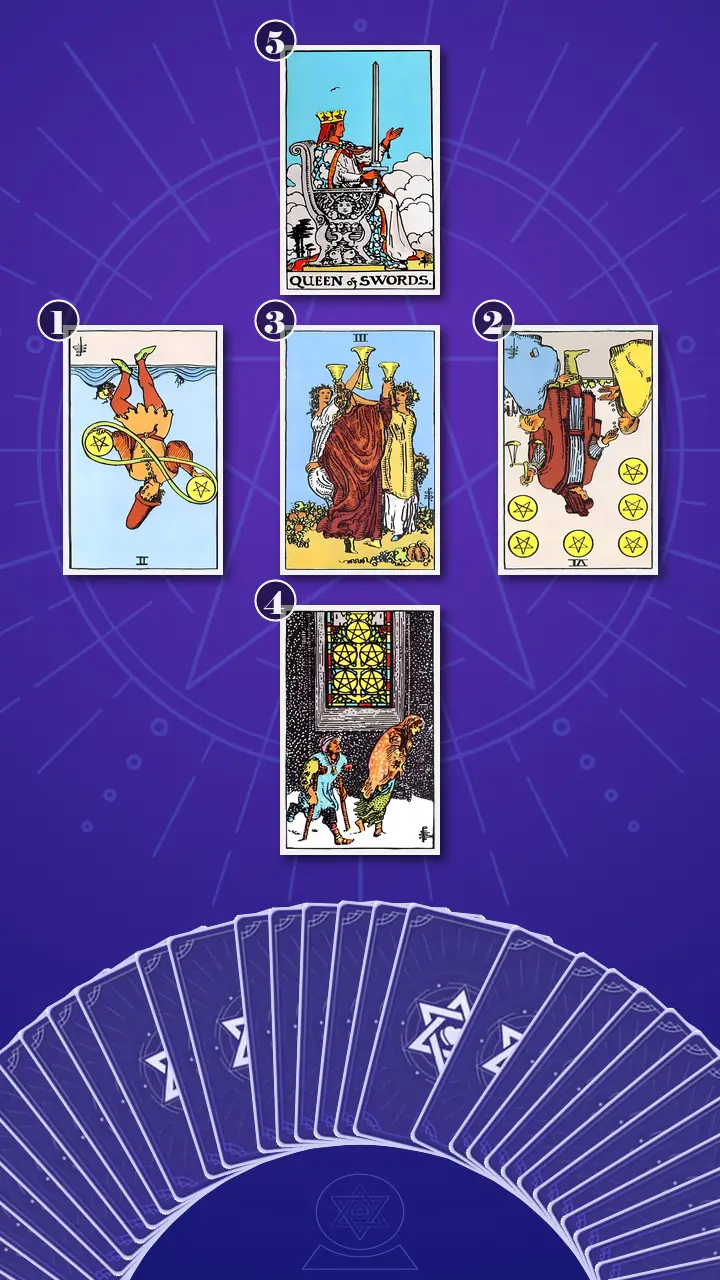
For this reading, I chose the Relationship Spread · Context Edition, a focused five-card relationship tarot spread for friendship anxiety, people-pleasing, and social overcommitment. I use it because it is small enough to keep the question visible while still distinguishing five different layers: what Jordan visibly does, what they assume friends require, what friendship is actually meant to feel like, the fear that sustains the pattern, and the boundary practice available now. It examines the relationship dynamic without claiming access to anyone else's private thoughts or promising a particular outcome.
I explained the route before turning over a card. The first position would reveal the observable symptom: the automatic yes and the overloaded calendar. The second would examine the projected belief that constant attendance or usefulness proves loyalty. The center would restore the emotional purpose of friendship. Below it, I would name the exclusion fear. Above it, the final card would offer present integration: a clear, warm way to answer from real capacity.
Reading the Map: When Availability Becomes a Loop
Position 1: The Loop That Pretends to Be Flexibility
I turned over the card representing the observable symptom in the diagnosis: Jordan's automatic yes, overloaded calendar, and diminishing ability to be genuinely present.
The card was the Two of Pentacles, in reversed position. In the Rider-Waite-Smith image, a figure keeps two pentacles moving inside a looping ribbon while ships rise and fall on oversized waves. Reversed, the flexible energy has tipped into excess. The juggling is no longer helping Jordan adapt to life; it is hiding the fact that work, commuting, money, sleep, and recovery are already moving beneath the plans.
I connected the image to the scene Jordan had described: at 10:48 p.m., brunch, a birthday dinner, and a late event were circulating across three chats. They had typed yes before counting TTC travel, recovery time, or the commitment already sitting in the calendar. The modern version of the looping ribbon was Google Calendar blocks dragged around after the answer had already been sent: 'I can technically fit it in, as long as nothing runs late and I do not count travel or recovery.'
'I can technically fit it in,' Jordan repeated, and then gave a short, bitter laugh instead of nodding. 'That is almost too accurate. It is a little cruel.'
'I hear the cruelty in the cost, not in the card,' I said. 'This does not say that you are too social or that you have failed at scheduling. It shows a practical system being recruited to manage a relational fear. Before the next invitation, the useful question is not only, Can I force this into the week? It is, Do I have the capacity and genuine interest to be present?'
As an artist, I saw the ribbon as an editing timeline with every scene left active. My mind flashed to the moment in film production when travel, meals, silence, and recovery are cut from the schedule because they do not look like plot. I knew the result: the story still technically fits, but nobody has enough energy to inhabit it. Jordan glanced at their calendar, exhaled through their nose, and moved one thumb away from the group chat.
Position 2: The Imaginary Splitwise Ledger
I turned over the card representing the projected belief that friends require constant attendance, usefulness, and quick agreement as proof of loyalty.
The card was the Six of Pentacles, in reversed position. Upright, the six speaks to giving, receiving, resources, and exchange. Reversed, the exchange has become distorted. The scales now resemble a private social ledger, and the elevated hand distributing coins mirrors the position Jordan kept placing themselves in: someone who needed to keep paying for access through attendance, planning labor, money, favors, or elaborate explanations.
Jordan told me about declining one birthday dinner, reading the reply 'No worries!' several times, and then offering to book the next brunch and send a rideshare credit. No friend had issued a debt. Still, the missed evening had felt like a negative balance that needed immediate repayment. I described the imaginary Splitwise account: one missed plan entered as an unpaid charge, followed by a reservation, a covered Uber, or a long apology designed to restore the account to zero.
Here I brought in my Clique Power Dynamics lens. I do not use it to accuse a tight-knit group of jealousy, micro-aggressions, or secret hierarchy. I use it to notice how informal roles can form even among caring people: who coordinates, who smooths tension, who gets treated as the dependable one, and who starts believing the group cannot function without their unpaid labor. I then ask what is observable and what has been projected.
Jordan went quiet. I saw their fingers tighten around the edge of the chair, then loosen. 'If I cannot attend,' they said, 'I need to make myself useful another way.'
'That sentence is the exchange rule,' I replied. 'It may explain why the automatic yes brings relief so quickly. But a friendship is not a Splitwise balance of invitations, favors, and apologies. For one small experiment, you can answer honestly without adding a compensating offer, then record what your friend actually does rather than what you predicted.'
Position 3: Three Cups, Not a Perfect Attendance Streak
I turned over the card representing the central bond, the shared foundation, and the current meaning Jordan was seeking beneath the attendance metric.
The card was the Three of Cups, in upright position. Three cups meet above a circular dance. No single figure distributes belonging from a higher place; the image holds mutual participation, shared enjoyment, and emotional support among equals. The energy here is balanced and restorative. It does not demand more activity. It returns social activity to its purpose.
I asked Jordan to remember a friendship that had survived slow replies, separate plans, or a quiet week. They told me about a friend who had sent a low-key voice note after two weeks apart, picked up an old joke immediately, and never asked for an explanation. I watched Jordan's shoulders lower as they described the ordinary warmth of it.
'Maybe the point was never to be at everything,' Jordan said. 'Maybe it was to be real when I am there.'
'Exactly,' I said. 'Presence is not the same thing as perfect attendance. This card does not guarantee that every friendship will respond perfectly to every boundary. It gives you a more accurate question: which plans create mutual attention and enjoyment, and which ones are being accepted mainly to prevent an imagined loss?'
The looping pentacles had been a solitary circle, maintained by Jordan's effort. The Three of Cups offered another circle, one carried by several people over time. I could see the first opening in the pattern: belonging might be something participated in, not something Jordan had to keep purchasing.
Position 4: The Warm Window in the Instagram Story
I turned over the card representing the principal challenge sustaining the pattern: the attachment-related fear that one declined plan could lead to exclusion or replacement.
The card was the Five of Pentacles, in upright position. Two figures move through snow beneath an illuminated stained-glass window. The card speaks to the felt experience of scarcity and being outside support. It does not predict rejection. It shows how cold and convincing the possibility of exclusion can feel when attention narrows around it.
I brought Jordan back to the scene after a declined gathering: a dark living room, rain ticking against the glass, Instagram Stories casting blue light across their face while friends laughed beneath warm amber restaurant lights. Their inner sentence had arrived instantly: 'They look fine without me, so maybe they are learning they do not need me.' One photo had become stronger evidence than months of messages, shared jokes, invitations, and practical care.
'You are not missing one dinner,' I said. 'Your fear thinks you are risking your membership. The feeling deserves attention, but it is not a forecast. We can place it beside the observable facts instead of letting one glowing screen decide what the whole friendship means.'
Jordan's breath paused first. Their finger hovered over an imaginary Story, and their eyes lost focus as if a familiar image were replaying itself. Then their hand pressed flat against their chest; a long exhale moved through them, not quite relief, but recognition. I let the quiet remain. The Five of Pentacles was naming the weather Jordan had been walking through, not declaring that the door was locked.
When the Queen of Swords Kept the Hand Open
Position 5: The Boundary Above the Fear
The room grew quieter before I touched the fifth card. I turned over the card representing the relationship's present integration practice: pausing, checking capacity, and communicating a concise boundary without excessive repair.
The card was the Queen of Swords, in upright position. Her sword rises in a clean vertical line, while her open hand remains receptive. Upright, her energy is discernment, honest communication, and self-respect without emotional withdrawal. The sword separates capacity facts from fear forecasts; the open hand keeps care available.
The modern scene was simple. The next invitation arrived. Jordan waited thirty minutes, checked the calendar, noticed their energy was three out of ten, and asked whether they genuinely wanted to go. They drafted, 'I cannot make Friday, but I hope you have a great night. Thanks for inviting me.' Then they stopped before adding the defensive paragraph or replacement favor.
At this point, I used my Sidekick Syndrome Diagnosis as a personal interpretive lens, not as a clinical label. I use it to identify whether someone has been boxed into a restrictive group role, such as the clown, the therapist, or the always-on sidekick, because the familiar arrangement keeps moving. In Jordan's case, the role looked like the reliable coordinator who absorbed inconvenience and made attendance feel effortless for everyone. I could not claim that Jordan's friends had consciously assigned it. I could observe Jordan reinforcing it because the role made their place feel harder to lose.
'The question is not whether you can perform the role better,' I said. 'It is whether you can remain a caring friend without letting the role decide every answer. The Queen is not telling you to disappear from the group. She is asking you to become the person who interprets their own capacity and communicates it clearly.'
The Sentence That Changed the Equation
At 10:48 p.m., three chats and Saturday TTC times had been open on the same warm phone. Jordan's body wanted a blank evening, yet they were drafting the version of yes that made every plan technically fit. Fear was asking them to confuse availability with belonging.
You do not have to stay endlessly available to deserve a place; give one honest answer from your real capacity, and let the Queen's upright sword draw a clear boundary without closing the open hand of friendship.
For a second, Jordan stopped breathing. Their thumb hovered above the phone, their pupils widened, and the screen light caught the sudden stillness in their face. Their eyes then went unfocused, as if they were watching every overstuffed weekend and every late cancellation run backward. Their jaw worked once before they whispered, 'But if I stop being the reliable one, what am I bringing to the group?' The question carried a flash of resistance, followed by a deeper ache. When the answer did not have to arrive immediately, their clenched hands slowly opened. Their shoulders dropped, and a shaky breath left the center of their chest. Relief came with a small dizziness, the vulnerability of seeing a clear path and realizing that no card could walk it for them. I asked immediately, 'Now, use this new view to remember last week. Was there a moment when answering from your real capacity could have felt different?'
I named the crossing carefully. This was not proof that Jordan's friendships were guaranteed or that every no would be easy. It was the first movement from fear-driven automatic availability and imagined social debt toward evidence-based self-trust, reciprocal belonging, and compassionate directness. The Queen's sword did not cut the circle of friendship. It cut the false equation between constant attendance and secure belonging.
The Open-Hand Boundary: From Insight to Action
I gathered the cards into one story. The Two of Pentacles reversed showed practical overload; the Six of Pentacles reversed revealed the self-imposed exchange rule beneath it. The Three of Cups restored the purpose of friendship as mutual enjoyment and care. The Five of Pentacles named the old scarcity fear that made one absence resemble exile. The Queen of Swords supplied the unused resource: clear language, factual capacity, and a boundary that still leaves warmth in the room.
'The blind spot is not simply that you have too many plans,' I told Jordan. 'It is that the urgency to answer has started to feel like evidence that the friendship is in danger. You are treating an imagined requirement as a fact, then using overcommitment to calm the fear. The shift is from automatic yes to a capacity pause, from perfect attendance to genuine presence, and from reassurance seeking to observing reciprocal care over time.'
Jordan looked at the thirty-minute pause and frowned. 'But I cannot always spare thirty minutes. Sometimes the group needs a headcount, and I am at work or halfway through a TTC transfer.'
'Then use the longest pause the situation reasonably allows,' I said. 'You can ask when they need an answer. A neutral holding line is still a boundary: I want to check my week and I will reply by eight. If even that is impossible, put the phone face down for sixty seconds and ask whether you are answering the invitation or the fear. The pause is an experiment, not a loyalty test, and accepting remains available when the plan genuinely fits.'
I gave Jordan three pieces of actionable advice for the coming week:
- The Thirty-Minute Belonging PauseFor the next non-urgent invitation in the active group chat, start a thirty-minute phone timer before giving a final answer. Check Google Calendar, TTC or rideshare time, the commitments on both sides of the event, energy from 0 to 10, and genuine interest from 0 to 10.If thirty minutes is impractical, take one slow breath, put the phone face down for sixty seconds, and ask, 'Am I answering the invitation or the fear?' The numbers are information, not a pass-fail score.
- The Role Resignation ActIn the next group interaction where Jordan would normally book the table, coordinate transport, or repair a missed plan, gracefully refuse the assigned reliable-coordinator character. If Jordan cannot attend, send two warm sentences: 'I cannot make Friday, but I hope you have a great time. Thanks for inviting me.' Then let another person handle the logistics.Draft the long explanation privately if needed, then delete each unnecessary apology, justification, and replacement favor. A friend may feel disappointed and the boundary may still be respectful; Jordan does not have to manage every reaction.
- The Friendship Ledger Reality CheckBefore one honest answer, write two headings in Apple Notes or on paper: 'What I predict' and 'What actually happens.' Over the next several days, record only observable events, such as a meme, a check-in, a future invitation, or a friend remembering something important. Compare the prediction with the evidence at week's end.Do not engineer a decline to test anyone or turn the note into compulsive monitoring. The minimum version is one prediction and one later fact. Stop if the exercise becomes another way to demand reassurance.
I reminded Jordan that the goal was not to become unavailable, win a group-dynamics argument, or prove that every friend was perfectly secure. The goal was to make one honest choice while staying connected to reality. That was how tarot worked here: not as a verdict, but as a structured conversation that made a hidden pattern visible enough to change.

A Week Later, One Quiet Data Point
Four days later, I received a message from Jordan while I was sketching at my desk. They had let a Friday invitation sit for thirty minutes, checked their calendar, rated their energy three out of ten, and sent the warm concise no. The reply had been ordinary: 'No worries. Catch you next week?' Jordan wrote, 'I almost sent three paragraphs after that. I did not.'
That night, Jordan slept a full night; in the morning, the first thought was, 'What if they are annoyed?' They laughed softly, sent no follow-up apology, and let the question remain unanswered for a while.
I did not treat that exchange as a guarantee or a final answer about the friendship. It was one small piece of evidence, and it mattered because Jordan had gathered it without abandoning their needs. The social overcommitment spiral had not vanished, but the loop had acquired a pause. A friendship could now be evaluated through accumulated care rather than a perfect response streak.
When I think back on our Journey to Clarity, I remember the Queen's upright sword beside her open hand. Jordan's work was not to choose between boundaries and belonging. It was to let a clear limit and genuine care occupy the same sentence, then allow the next chapter to be written by their choices rather than by fear.
When the next group chat lights up and one small no feels like watching your place in the friendship disappear, noticing that tightening before replying is already a step beyond the old automatic yes.
If you let the next invitation sit for thirty minutes, what quiet fact about your own capacity might you become curious enough to hear?