Changing One Spreadsheet Weight, Then Naming the Cost to Own
The Google Sheet That Wouldn't Accept a Verdict
I know it is analysis paralysis when a Google Sheet gives someone a clear answer and their first move is to change the scoring weights until the answer stops feeling morally uncomfortable.
Alex (name changed for privacy) was twenty-nine, non-binary, and working as a project coordinator at a Toronto nonprofit when they brought that exact loop to my table. On the rainy Saturday morning of our consultation, they set their coffee beside their laptop and showed me a screenshot timestamped 11:47 p.m. The sheet glowed blue-white beside three advice articles and an unsent iMessage. In the kitchen scene they described, the refrigerator had been humming, the tea had gone cold and metallic, and their cursor had hovered over a scoring cell after the formula produced a winner.
"Then I lowered one of the weights," Alex said. Their jaw tightened as they admitted it. "The spreadsheet changes every time the result scares me. If every option harms something I care about, how can either one be right?"
I heard the real question beneath the career crossroads involving income, workload, and a commitment they genuinely valued. Alex did not merely want the best available option. They wanted one morally right answer that would protect meaningful work without costing financial stability, preserve loyalty without costing capacity, and permit a boundary without disappointing anyone. No real choice could pass that test.
I watched them press their tongue against the inside of their cheek. The anxiety looked less like ordinary nervousness and more like a metal clamp around the chest: every new hypothetical tightened it by one turn, making it harder to close the laptop, breathe fully, or let a decision remain decided.
"Wanting to act responsibly is not the problem," I told them. "The problem is that responsibility has been assigned an impossible job: removing every consequence before you choose. I am not going to use tarot to tell you which option fate has selected. I want us to see what keeps reopening the case and build a practical route toward clarity. What if the discomfort is naming a value, not delivering a verdict?"

Choosing a Compass for a No-Win Choice
I invited Alex to put both feet on the floor, take one unforced breath, and hold the question in mind while I shuffled. I treat that small pause as a change of attention, not a performance of mysticism. It helps separate the consultation from the tabs, messages, and imagined arguments waiting outside it.
I chose the Decision Cross · Context Edition, a five-card Decision Cross tarot spread for no-win choices and moral trade-offs. When people ask me how tarot works in a decision reading, I describe it as a structured mirror. The cards do not make the choice. Their positions separate behaviours, standards, fears, resources, and consequences so card meanings can be examined in context rather than treated as fixed predictions.
I chose this spread because Alex did not need ten more variables. They needed the smallest map capable of holding both the visible trade-off and the inner moral pressure attached to it. A two-path spread would have pulled attention back toward comparing options, while a larger Celtic Cross could easily have become another elaborate research project.
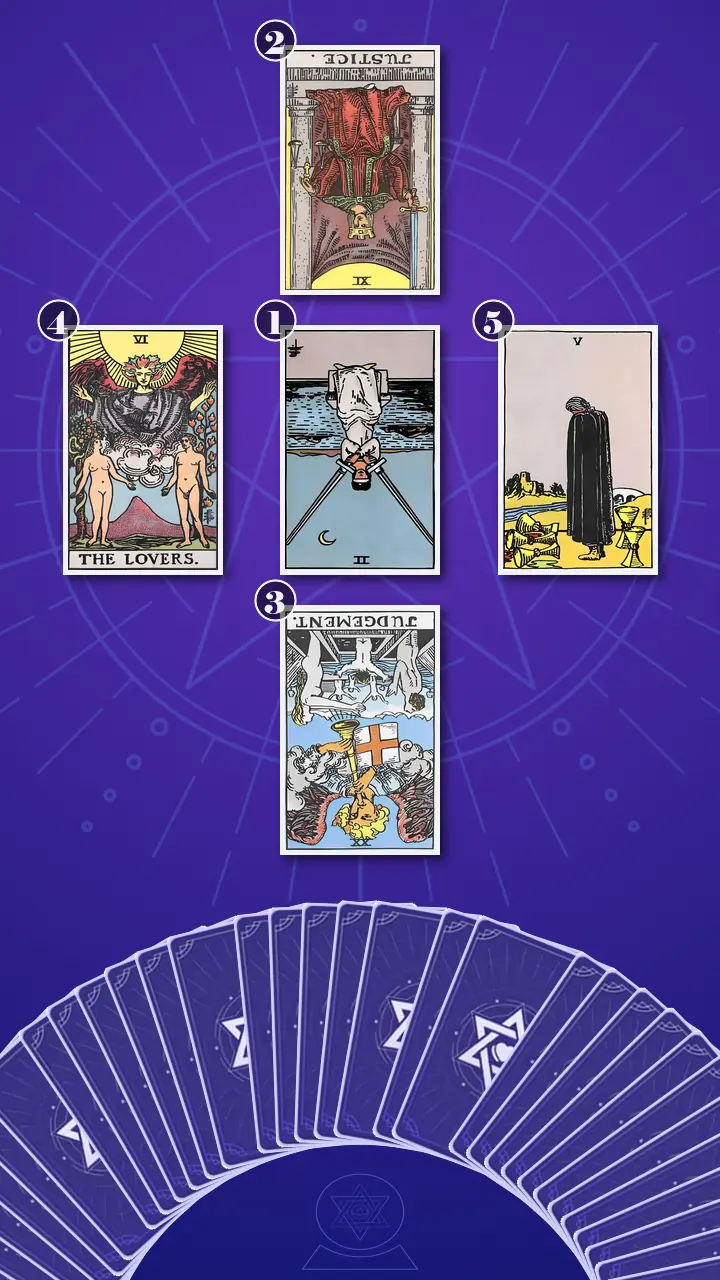
I placed the first card in the centre to show the behaviour keeping the decision open. Above it, the second would examine the conscious rule Alex used to define a "right" answer. Below, the third would reveal the fear supporting that rule. The fourth would introduce a values-based principle, and the fifth would show how to integrate the emotional cost without pretending to predict a guaranteed outcome. On the table, the cross resembled a compass: a rigid north-south line of judgment waiting for an east-west path of choice and integration.
Reading the Knot Before Pulling It Tighter
The Crossed Swords Over the Spreadsheet
The card I turned over first occupied the position representing Alex's presenting behaviour: repeatedly reopening a no-win decision because neither option could be made free of cost. It was the Two of Swords, reversed.
I pointed to the blindfold and the swords crossed over the figure's chest. Upright, the image can hold a temporary pause between competing positions. Reversed here, that air energy had become blocked and overloaded. Thought was no longer informing the choice; it was being used to maintain an increasingly exhausting stalemate.
"This is the 11:47 p.m. scene," I said. "The formula produces a clear result. Your jaw tightens at the cost attached to that result, so you adjust a criterion, reopen an article you have already read, and preserve the pause for another night. The answer appeared, but because you still felt conflicted, you decided the calculation must be wrong."
I asked which part changed first when the result felt too real: the weights, the deadline, or the question itself. Alex gave one short, bitter laugh.
"That is so accurate it feels a little cruel," they said.
I stayed with the laugh instead of trying to turn it into instant agreement. "I can understand why it lands sharply. The card is not shaming you for being thorough. Your analysis began as a responsible attempt to protect what matters. It simply kept working after the relevant facts were already present. Thoroughness crossed into postponement, and the cost of maintaining the pause became visible."
Their fingers stopped rubbing the mug handle. They did not look relieved, exactly, but I saw the first small separation between their character and their decision loop.
The Court That Rejected Every Verdict
The next card occupied the position representing the conscious rule Alex used to define a right answer and the way moral certainty shaped their criteria. I turned over Justice, reversed.
I traced the scales with one finger. In this reversal, discernment was not absent. It was in excess and distorted, like a court recalibrating its scales whenever the verdict included a painful consequence. Alex's weighted values-and-impact rubric had become a tribunal that refused every imperfect result.
"The internal rule sounds something like this," I said. "If the fair answer still leaves someone disappointed, I must have weighed it badly. So fairness stops meaning proportionate consideration and starts meaning innocence from every consequence."
I thought of the hundreds of difficult choices I had heard across coffee tables in twenty years of reading. Again and again, a useful standard became punishing when it was expected to provide emotional anaesthesia. Fairness can guide a choice; it cannot make the choice innocent of every consequence.
I mentioned The Good Place, where every attempt at perfect ethical purity collides with the complexity of participating in a real system. Alex smiled in recognition. Their decision matrix had become its own version of that running problem: every ordinary need, including Toronto rent and a sustainable workload, could be reframed as morally contaminated if the test was strict enough.
"Needing financial stability is a practical constraint," I said. "It does not become less real or less ethical because your work has a mission. The question is whether you have considered the impact responsibly, not whether you can guarantee that nobody feels the cost."
Alex's jaw tightened and their gaze held on the reversed scales. Then their shoulders shifted back by barely an inch, as if the chair had finally been permitted to carry some of their weight.
The Future Cross-Examination
The third card occupied the position representing the hidden fear that accepting a costly choice could become evidence of deficient moral worth. I turned over Judgement, reversed.
The angel's trumpet usually announces a call to honest review and renewal. Reversed, that call was blocked by an excess of self-condemnation. Alex could hear that a response was required, but they experienced the summons as a trial they had to pass.
I asked them to describe the future conversation they kept rehearsing. They looked past me toward the rain on the window.
"A colleague asks why I reduced my involvement," they said quietly. "Or future me looks back and says I chose money or comfort over something important. I keep trying to find an explanation that nobody could call selfish."
There it was: the imagined hearing. Alex was mentally fast-forwarding six months, preparing a defence for a disappointed colleague, friend, and future self. Every possible trace of regret was treated as evidence that present-day Alex could not yet be trusted.
"Reviewing a decision is not the same as judging a person," I said. "Regret can give future you information. It does not get to travel back in time and declare your current moral worth defective. You are asking for enough certainty to guarantee acquittal, but a real life can only offer enough information to take proportionate responsibility."
Their breathing paused. Their eyes went briefly unfocused, as though an old scene were replaying behind them. Then they released a low breath and said, "I think I have been writing a response to an imaginary performance review before I have even made the decision."
When The Lovers Left the Courtroom
The Choice Made in the Open
The card I turned over next occupied the position representing the values-based principle capable of reconnecting Alex's rational evaluation with their personal compass. The room seemed to quiet around it. Even the radiator, which had clicked through the first three cards, went still. I revealed The Lovers, upright.
I asked Alex to look beyond the card's common association with romance. The two figures stand unobscured beneath the angel, while a mountain remains between them. Nothing in the image promises that commitment removes difficulty. The energy is balanced because openness, values, desire, and consequence are allowed into the same frame.
At 11:47 p.m., the spreadsheet had finally produced a winner. Alex's jaw tightened, the tea had gone cold, and instead of closing the laptop, they changed one weight because the cost still felt like an accusation. The Lovers did not offer a cleaner formula. It changed the job of the decision.
I used the diagnostic lens I call Analysis Paralysis Deconstruction. Together, we stripped the decision of abstract what-ifs and identified the grounded realities: Toronto rent, actual workload, the terms of the commitment, the available timing, and Alex's present capacity. The imagined future accusations mattered emotionally, but they were not new facts about feasibility.
Then I used Complexity Reduction. I was not reducing a complicated life to "good option" versus "bad option." I was reducing the next decision question to a clean, practical pair: What value does this path enact? and What cost comes with it? That binary removed the impossible third category Alex had been searching for: the path that enacted every value and cost nothing.
I gave them the core distinction first: A cost is not a guilty verdict. The right-enough choice is the one whose value you can enact and whose trade-off you can name without pretending it disappears.
I let the sentence settle, then said the central message as plainly as I could:
Stop treating uncertainty as a guilty verdict; make the value-aligned commitment you can own, standing in the open like the figures in The Lovers.
Alex did not relax immediately. First, their breath stopped midway in; one hand froze above the mug, fingers curved but not touching it. Then their eyes lost focus, and I could almost see the spreadsheet scenes, Slack drafts, and future defences moving across their attention. Their eyebrows pulled together, not with confusion but with a sudden flash of anger.
"But doesn't that mean I have been doing all of this wrong?" they asked. "Like I wasted months because I was too scared to choose?"
"No," I said. "It means you built a careful method to protect your integrity, and then asked that method to protect you from being human. Seeing its limit is not another charge against you. It is information you can use now."
The anger softened before it disappeared. Their eyes reddened slightly. Their fist opened against the table, finger by finger, and their shoulders lowered with a long, unsteady exhale. Relief arrived, but it brought a new vulnerability with it. After the fantasy of a perfect verdict fell away, Alex faced the quiet responsibility of choosing.
"So I still have to decide," they said.
"Yes," I replied. "Tarot cannot absolve you of the trade-off, and I will not take the decision away from you. What it can do is help you see the standard you have been using and the capacity you already possess. You are the person who ranks the values, sets the boundary, makes the commitment, and responds to what happens next."
I asked, "Now, using this new perspective, think back to last week. Was there a moment when this insight could have made you feel different?"
Alex named the Slack message asking whether they had decided. Instead of hearing a demand to prove that one option was spotless, they could imagine answering with an honest value statement: "I am prioritising sustainable capacity and financial stability here, and I know that means reducing a commitment I care about."
I set a seven-minute timer and divided one page into three headings: Value I want to enact, Cost I am willing to own, and Smallest next step. Alex wrote one sentence beneath each without opening another tab or asking anyone to approve the wording. I reminded them that this was a rehearsal, not a binding decision. If it became too activating, we could stop, shorten it to two minutes, or return when they had more capacity.
That page marked a specific emotional crossing. Alex had not travelled from anxiety to total confidence. They had moved from contracted moral certainty toward vulnerable ownership of a values-aligned choice. The discomfort remained, but it was beginning to mean "this matters" rather than "I am guilty."
The Grief That Did Not Reopen the Case
The final card occupied the position representing emotional integration: how Alex could acknowledge the chosen cost without treating grief or doubt as proof of a wrong decision. I turned over the Five of Cups, upright.
I kept the spilled cups and the two standing cups in the same frame. This card introduced the water that the earlier air-heavy cards had held at a distance. The energy was not asking Alex to suppress sadness or manufacture gratitude. It was restoring enough emotional balance for loss to be felt directly instead of converted into another calculation.
"After you take a bounded step, you may still feel disappointed," I said. "You may miss what the other path protected. The old reflex will move your cursor back toward the spreadsheet because it assumes a good decision should feel settled. This card offers a different sentence: This hurts because something mattered, not necessarily because I chose wrongly."
I asked Alex to picture two short lists beside the closed file: What this costs and What this still protects. The cost could include reduced involvement, another person's disappointment, or grief for the path not taken. What remained might include income, capacity, integrity, skills, relationships, and the ability to respond again at a planned review point.
Alex swallowed and looked at the two upright cups. "I think I have never let myself grieve a decision," they said. "I put the sadness straight back into the model."
Rain slid down the window in two clear tracks. I watched their hand move away from the laptop. An aligned choice can still have a cost that needs to be grieved; allowing that grief is part of self-trust, not a betrayal of it.
Name the Value, Name the Cost, Give It a Boundary
I drew the five cards into one coherent story. The repeated comparison loop had begun as an attempt to act responsibly, and each new spreadsheet version offered brief relief from owning a trade-off. The Two of Swords reversed showed that relief hardening into gridlock. Justice reversed revealed the conscious rule beneath it: a fair choice must leave nobody with a legitimate reason for disappointment. Judgement reversed carried the failed verdict inward until uncertainty sounded like evidence against Alex's character. The Lovers restored the available resource, which was not perfect information but the ability to make a conscious values-based commitment. The Five of Cups showed the emotional work that follows: naming loss without putting the entire decision back on trial.
I told Alex that their cognitive blind spot was not a missing moral principle. It was the assumption that residual discomfort proved the evaluation was incomplete or corrupt. In reality, every available path protected one value while compromising another. The transformation direction was therefore precise: rank the values at stake, name the cost they were willing to own, and contain the choice with a decision deadline, one review point, and one concrete next action.
The spread also contained very little earth energy. It had plenty of thought, judgment, commitment, and emotion, but it needed a practical container. I gave Alex three pieces of actionable advice, each deliberately small enough to begin without another research session.
- Run the Coffee Bean Filter Protocol For the next 24 hours, write each decision variable on a separate slip of paper and sort the slips into two physical groups: "Absolute Must-Haves" and "Emotional Noise." Must-haves include material facts that change cost, timing, capacity, or feasibility, plus the top values Alex chooses to prioritise. Emotional Noise includes repeated hypotheticals, recycled opinions, and arguments already reviewed. The label does not mean feelings are irrelevant; grief is real, while a fifth version of the same imagined accusation is not new evidence. Tip: Spend ten minutes sorting, leave the piles untouched overnight, and review them once the next day. When resistance says the process is not rigorous enough, ask whether a new item changes the available options or merely changes the emotional weather.
- Complete the Seven-Minute Lovers Page On one sheet of paper, list no more than four values already present in the decision and rank them for this decision only. Then complete three sentences: "The value I want my next action to enact is..."; "The cost I am willing to own is..."; and "The smallest next step is...." Keep each answer under twenty-five words and do not open another tab while the timer runs. Tip: This is not a universal moral ranking. The minimum version is one sentence beginning, "For this decision, I am choosing to protect...." Alex could also ask one trusted friend to reflect the value they hear without recommending an option.
- Build an Earth Boundary Around the Choice Put one decision deadline and one review date in the calendar. Between those dates, place every repeated argument in a phone note titled "Already Considered." Only a genuinely material fact that changes cost, timing, feasibility, or available options may reopen the criteria. After the first bounded action, make two three-item lists titled "What this costs" and "What this still protects." Tip: If a week feels too long, use a 24-hour boundary. When the urge to recalculate arrives, write, "This may be grief about a real cost; I can acknowledge it without recalculating tonight." Revision remains available at the planned review point.
I asked Alex whether the plan felt usable rather than merely persuasive. They glanced at the three older spreadsheet versions on their screen.
"I can do seven minutes," they said. "And I can archive these without deleting them. Knowing they still exist makes closing them feel less dramatic."
"Good," I said. "We are not demanding a personality transplant. We are giving an exhausted decision a container."
A Week Later, the Quiet Proof
A week later, I received a message from Alex. They had completed the Coffee Bean Filter Protocol, archived the older spreadsheets, and written sustainable capacity at the top of the Lovers page. Their smallest next step had been to request a workload conversation and ask one concrete question about the terms of the commitment. They sent the email before they felt certain.
The decision had not become painless. A colleague's kind response made Alex feel both relieved and sad, because it confirmed that reducing their involvement was now a real possibility rather than an abstract scenario. They used the Five of Cups lists instead of treating the sadness as a command to rebuild the matrix.
"I slept through the night," they wrote. "My first thought was still, What if I am wrong? But I did not open the spreadsheet. I made coffee and went to the meeting."
I did not read that message as proof that tarot had produced the right answer. The cards had offered structure, language, and a way to see the pattern objectively. Alex supplied the honesty, ranked the values, sent the email, and kept the case closed long enough to encounter reality instead of another hypothetical.
That was the quiet proof of their Journey to Clarity: not certainty, not moral innocence, and not a life without regret. It was the first movement from contracted anxiety toward values-aligned commitment, acknowledged grief, and steadier self-trust. Alex could dislike a cost and still know why they were choosing it.
I know how tightly the jaw can stay set when every option costs something important and choosing without total innocence feels dangerously close to proving something bad about who you are. I also know that noticing the courtroom in your own mind means you are no longer only standing trial inside it; you are beginning to reclaim the role of conscious chooser.
So I leave you with the question I would place beside your own cup of coffee: if discomfort could mean "this matters" rather than "I am guilty," which value would make it through your Coffee Bean Filter, and what five-minute action would let you stand in the open behind it this week?