Why “Dealbreaker” Became “Concern”: Restoring the Original Measure

The Dealbreaker That Became a “Concern” at 12:40 a.m.
I recognize the Toronto agency person who can untangle a messy client brief by noon but rename their own “dealbreaker” as a “concern” by midnight. That kind of competence often arrives in my readings carrying a private exception list.
Jordan tilted their phone toward the camera at the start of our video session. The screenshot timestamp read 12:40 a.m. On one half of the screen sat the disclosure thread; on the other, a Notes page whose heading had just been softened from “dealbreaker” to “concern.” Blue light washed across the duvet behind them. Their radiator clicked against the hiss of traffic on wet Toronto pavement, and the device looked hot in their palm.
“I keep asking whether it is really a dealbreaker now that it is real,” Jordan said. “I know what I would tell a friend, but I can always find an exception for myself.”
I asked what had changed between the clean flash of recognition during the disclosure and the decision to edit the note. Jordan named a warm message, a good memory, five thoughtful group-chat replies, and the hollow prospect of downloading Hinge again. They did not name a new fact.
“I want my boundary to mean something,” they said, pressing their tongue briefly against a clenched jaw, “without losing something I still want.”
I heard the core conflict clearly: honoring a relationship dealbreaker once it appeared versus bargaining with themselves as soon as attachment made honoring it costly. Their ambivalence seemed to sit in the body like a subway door repeatedly closing on a bag they could neither pull inside nor release: chest pinched, jaw locked, every warning tone provoking one more attempt.
“I’m not here to tell you whether to stay or leave,” I said. “And I’m not going to treat your feelings as proof that you have failed at boundaries. Sometimes a painful cycle is a low tide, not a permanent coastline. Let’s make a map of this one and separate temporary friction from the information that actually matters.”

Choosing the Hinge: The Five-Card Shadow Spread
I invited Jordan to put both feet on the floor, take one unforced breath, and hold the question without trying to answer it. I shuffled slowly, using the repetition as a transition from midnight analysis into deliberate observation, not as a performance of mystery.
I chose The Shadow Spread, a five-card relationship boundary tarot spread. I use the word shadow to mean an unexamined trade-off, not something ominous or shameful. Jordan’s question was not about predicting the other person’s intentions or forecasting the relationship. It was about understanding why a known standard became negotiable after attachment entered the room.
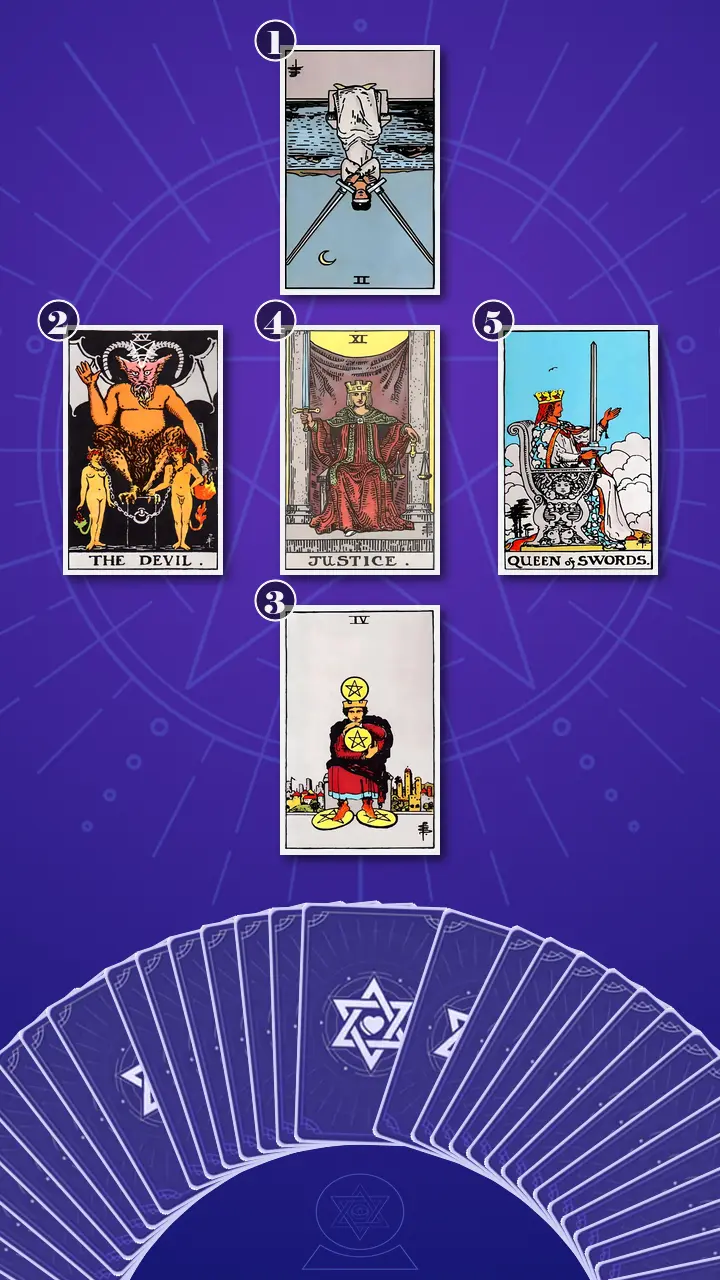
For anyone wondering how tarot works in a consultation like this, I treat the spread as an external pattern map. The card meanings matter in context: the first position shows the visible behavior; the second reveals the payoff that makes it worth repeating; the third identifies the fear underneath it; the fourth offers a corrective resource; and the fifth turns insight into a self-authored practice. A ten-card Celtic Cross would have introduced future and environmental layers we did not need. This smaller structure stayed with Jordan’s actual question.
I laid the cards in a cross that looked like a hinge. The symptom sat above, the root fear below, and Justice waited at the center. The hidden attachment appeared on the left; the integration practice would open to the right. I told Jordan that the cards could clarify the mechanism and suggest actionable next steps, but they could not own the decision. That authority would remain with them.
Reading the Loop Before It Reads You
Position One: When Reflection Becomes Recycling
I began by turning over the card representing the observable symptom: repeatedly reopening and redefining the dealbreaker after it had appeared. It was the Two of Swords, reversed.
I pointed to the blindfold, the swords crossed defensively over the chest, and the rocky water behind the seated figure. Upright, the image can hold a tense stalemate. Reversed, that arrangement has become overloaded. The crossed position can no longer be sustained comfortably, but the pressure to move produces more mental activity rather than clearer movement.
In Jordan’s life, the card was almost literal. At 12:40 a.m., the disclosure chat, a pros-and-cons note, and several friends’ replies remained open on one phone. Jordan was not missing the dealbreaker. They were changing its wording so that “this crosses my line” and “this could still work” could remain equally actionable. Each reinterpretation restored a few minutes of relief because no response had to become real yet.
I described the reversed energy as blocked Air tipping into excess. Reflection had stopped producing information, but thought continued multiplying. The inner script sounded like this: “I already know what was disclosed, but if I can find one more interpretation, I won’t have to respond yet.” Wanting nuance was reasonable. Recycling the same two conclusions was maintaining the gridlock.
Jordan gave one short, bitter laugh. “That is painfully accurate. Almost rude.” Their eyes stayed on the blindfold while one thumb rubbed the edge of the phone case.
“The card isn’t accusing you,” I said. “It is marking the point where inquiry changes jobs. Before that point, inquiry gathers information. After it, inquiry manages the emotional cost of what you already know. More interpretations are not more facts.”
I asked when the final genuinely new fact had arrived. Jordan paused, then admitted it had arrived in the original disclosure. Everything after that had been a different framing, a friend’s opinion, or a hypothetical future.
Position Two: The Warm Notification and the Loose Chain
I next turned over the card representing what the bargaining protected: the emotional payoff that made delay temporarily preferable to a boundary-congruent response. It was The Devil, upright.
I kept my focus on the loose chains around the two figures. I did not frame the central figure as an external villain, and I did not use the card to label Jordan as weak or trapped. The loose chains show a pattern that can feel compulsory while still being renewed through small, understandable choices.
Jordan told me about 8:18 a.m. on Line 1, when a warm “thinking of you” message appeared beneath the disclosure. The train brakes squealed. A wet coat brushed their arm, and someone’s paper cup smelled sharply of coffee. Their chest lifted at the affection and tightened at the fact sitting directly above it. Within minutes, the chat was active again and another voice note was on its way to the group.
The Devil’s energy was appearing as excess attachment and a narrowed field of choice: “Because I still want this, maybe I’m not allowed to close the loophole.” Desire had shifted from useful information into apparent authority. The immediate reward was continued access to the connection and a postponement of grief. The longer-term cost was declining trust in Jordan’s own standards.
I compared the loop to reopening an app after a notification delivers exactly enough reward to override the decision to mute it. Bargaining can behave like a recommendation algorithm: every click on an exception trains the system to serve another exception story. That does not make the person clicking foolish. It means the loop has learned which feeling keeps attention engaged.
Jordan’s chin dipped. Their shoulders remained high, but a slow breath escaped through their nose.
“So wanting them isn’t the problem?” they asked.
“No,” I said. “Attachment can be relevant without becoming the ruler. You can let desire sit at the table without giving it private control of the measuring scale.”
Position Three: The Possibility Held Too Tightly
I turned over the card representing the underlying fear maintaining the conflict, especially the fear of losing control when a valued possibility might close. It was the Four of Pentacles, upright.
I showed Jordan the pentacle pressed over the figure’s heart, the coin occupying the mind, and the two coins pinned beneath both feet. The image gave their strategy a body: thought, feeling, and movement had all been recruited to hold one possibility still.
Jordan’s carefully structured note preserved every caveat because deleting an exception felt like closing the connection itself. A demanding urban schedule, Hinge fatigue, and the prospect of returning to first-date small talk made one promising relationship feel scarce. Keeping every interpretive version available created temporary control, but it also left neither foot free to move.
This was fixed Earth in excess. Stability had hardened into immobility. The note had started as two sensible columns, then expanded like a Notion database with tags, exceptions, possible scenarios, friend commentary, and no easier next step. The controlling belief underneath it was simple: “If I do not finalize the meaning, I have not lost anything yet.”
Jordan’s fingers closed around the phone and brought it against their chest before they seemed to notice the gesture. Their breath went shallow. Their gaze moved away from the card, as though replaying the moment they had first understood the disclosure. Then their grip loosened by one finger at a time.
“Starting over feels awful,” they said. “I think I have been trying to avoid admitting that.”
I let the sentence stand without rushing to make it positive. No Cups appeared in the spread, and I could see how grief had been converted into research. No Wands had appeared either, so clarified thought had not yet become proportionate action. Analysis was doing emotional and behavioral work it could never complete.
After a decade of watching people interpret a difficult cycle as a permanent verdict, I have learned to distinguish temporary conditions from long-term coordinates. Looking at those fixed coins, I thought of an orbit held in a diagram: gripping one point does not stop the cycle from moving; it only exhausts the hand. Jordan did not need to eliminate grief. They needed to stop asking analysis to prevent it.
When Justice Put the Standard Back on the Scale
As I returned my hand to the center of the spread, the radiator on Jordan’s side clicked once and fell quiet. A distant streetcar bell came through the microphone, clean and singular after the room’s low mechanical hum.
Position Four: The Measure That Does Not Move with the Mood
I turned over the card representing the key transformation: a consistent method for measuring the revealed fact against the boundary Jordan had stated before attachment raised the cost. It was Justice, upright, the key card and corrective lens of the reading.
The figure’s gaze was uncovered. One hand held level scales; the other held a single upright sword. Justice did not tell Jordan whether the relationship must end. It asked a narrower and more useful question: was the disclosed fact being measured by the same standard Jordan would have used if the attachment were weaker?
Here I used a diagnostic lens I call Cyclical Variable Filtering. I separated temporary friction from the variables likely to shape Jordan’s longer-term orbit. The warm message, the anniversary carousel, the five group-chat interpretations, and the exhaustion of 12:40 a.m. were real influences, but none changed the original boundary or the verified disclosure. The critical variables were the standard Jordan had chosen, the fact they had received, and the exception they were now proposing.
I paired that with Decision Timing Calibration. A high-stakes crossroads choice made while sleep-deprived, physically contracted, freshly activated by affection, and comparing one’s life with polished relationship posts is not structurally well-timed. A pause would not decide the relationship. It would prevent temporary macro-friction from impersonating long-term truth.
I brought Jordan back to 12:40 a.m.: the disclosure thread was open, their thumb was changing “dealbreaker” to “concern,” and nothing new had happened except a warm message. Their chest had tightened as though the boundary, rather than the incompatibility, had become the immediate threat.
Clarity is not the absence of attachment. It is refusing to give attachment a private vote that changes the standard after the fact.
I left a beat of silence before giving Jordan the card’s central message.
You do not need another exception to make the dealbreaker easier to accept; use Justice's balanced scales to weigh the revealed fact against the standard you already chose, then let your next boundary match that measure.
Jordan’s inhale stopped halfway in. Their fingers hovered above the Notes app, frozen as if the next tap had suddenly become visible as a choice rather than a reflex. Their gaze lost focus for several seconds, and I watched recognition move across their face: first a slight widening of the eyes, then a tightening around the mouth as old conversations seemed to replay behind them. Their eyes reddened. A long breath finally left their chest, and both shoulders dropped, but the release was not simple. The new space seemed to make them briefly unsteady.
“But doesn’t that mean I’ve been betraying myself this whole time?” Jordan asked. The first words came out sharp; the final word thinned into a tremor.
“It means the old strategy protected you from feeling a loss before you were ready,” I said. “That protection had a cost, but recognizing the cost does not require condemning the person who used it. You were trying to preserve something valuable. Now you can choose whether that strategy still deserves the job.”
I asked Jordan to set a seven-minute timer and open a blank note. I dictated three lines: “My original dealbreaker was…”; “The verified fact is…”; “The exception I am considering is…”. I asked them to read the lines once without adding predictions, caveats, or friends’ opinions. I also made the limit explicit: they did not need to message anyone, decide the relationship, or continue if the exercise became too intense. The minimum version was one sentence naming the original dealbreaker.
Jordan wrote. Their jaw tightened at the second line, then eased as they reached the third. The crowded two-column case file had become three clean statements. Complexity remained, but it no longer concealed which sentence contained evidence and which one contained fear-driven renegotiation.
“Now, with this new perspective, think back to last week,” I said. “Was there a moment when this insight could have made the experience feel different?”
Jordan returned to the Line 1 message. “I could have let the text be affectionate without treating it as new evidence,” they said. “The affection was new. The fact wasn’t.”
I named the movement I had just witnessed. It was not certainty, and it was not a final relationship decision. It was the first step from contracted ambivalence and reassurance-seeking toward evidence-based self-trust and consistent, self-authored boundaries. The boundary was not unclear simply because honoring it hurt.
The Queen’s Sword and Her Open Hand
Position Five: Clear Without Becoming Cold
I turned over the final card, representing the integration practice through which insight could become a humane, observable response. It was the Queen of Swords, upright.
I drew Jordan’s attention to the sword held vertically in the Queen’s right hand and the open left hand extended toward the horizon. One gesture located the limit. The other remained receptive. Together, they contradicted the belief that Jordan had to choose between intimacy and a boundary, or between compassion and clarity.
In daily life, the Queen replaced a multi-paragraph defense with one self-authored sentence. Jordan could name the known fact and the immediate response they controlled, without prosecuting the other person or asking them to certify that the boundary was reasonable. A sentence such as “I value this connection, and I need time to respond in line with what I already named” could hold care and discernment at once.
The energy here was balanced, usable Air. The Two of Swords had used thought to hold opposing positions in place. The Queen used the same element to locate a conclusion, request space, or decline a next step without pretending the feelings had disappeared. Her overcorrection would have been a cold verdict sent in the heat of exhaustion. Her balanced form was concise, proportionate, and self-governed.
“Clear does not have to mean cold, and kind does not have to mean vague,” I told Jordan.
They opened the draft they had prepared earlier. I watched them delete an explanatory paragraph, pause over another, and leave one sentence on the screen. They did not send it during the reading. The point was not speed. The point was that their boundary had become visible enough to practice without outsourcing it.
The Same-Standard Check and the 72-Hour Orbit
I gathered the five cards into one coherent story. Jordan’s professional strength had trained them to resolve ambiguity through compromise, added context, and stakeholder input. Once a dealbreaker appeared in a valued connection, that useful work skill became a defense: the Two of Swords recycled interpretations, The Devil rewarded each reopening with continued access, and the Four of Pentacles held the possibility so tightly that grief and movement were postponed together. Justice restored a stable measure, and the Queen of Swords translated that measure into language Jordan could own.
The cognitive blind spot was not a lack of intelligence or nuance. It was the assumption that emotional pain proved the boundary needed revision. Jordan had been treating the cost of clarity as evidence against clarity. In my orbital language, the warm text, late-night social feed, and group-chat debate were temporary turbulence; they could affect the felt intensity of the moment without changing the coordinates Jordan had already identified.
The transformation direction was precise: instead of reopening the entire boundary whenever attachment spiked, Jordan would apply one prewritten test to the revealed fact before seeking another interpretation. The goal was not to suppress attachment. It was to let attachment and grief remain present while restoring authorship over the next response.
- Run the three-line Same-Standard Check. On one evening this week, set a seven-minute timer and write the original dealbreaker, the verified disclosure, and the proposed exception as separate sentences. Mark each phrase as “known fact,” “feeling,” or “prediction,” then ask privately, “Would I change this measure if the attachment were weaker?” Record only the first one-sentence answer. The note does not need to capture the whole relationship or produce an immediate verdict. If seven minutes feels like too much, write only the original standard and the disclosed fact.
- Use the Orbital Pause Strategy. After the next urge to rename the boundary, poll the group chat, or search for exception stories, begin a calculated 72-hour pause on renegotiating the wording. Keep practical and safety-related communication available. Use two columns labeled “New facts” and “New interpretations,” and place each new thought in the correct column without reopening the whole case. The pause is a timing tool, not a test of willpower and not a requirement to ignore urgent needs. Jordan could shorten it to 24 hours or ten minutes; the useful interval is the one that interrupts the reflex without removing choice.
- Draft one boundary sentence before drafting a case. In a private note, name one known fact and one immediate response within your control, such as requesting space, declining a date, or scheduling a later conversation. Read it aloud once and remove any sentence whose main purpose is to make the other person authorize your standard. Drafting is enough. Sending can wait until the timing, communication channel, and personal context feel appropriate.
I reminded Jordan that these practices were not instructions to end the connection. They were structures for making any next choice more deliberate. Tarot had supplied a visible model of the loop; Jordan would decide what to do with the evidence.

A Week Later: The Line Stayed Still
Six days later, I received a message from Jordan with a screenshot of the three-line note. They had completed it, muted the advice chat for their chosen pause, and drafted one sentence requesting space. “I still miss the version of this I wanted,” they wrote, “but I didn’t turn missing it into a new fact.”
Jordan told me they slept through the night after sending the sentence. Their first thought in the morning was, “What if I’m wrong?” Then they noticed the question, made coffee, and did not reopen the note.
I did not read that as a perfectly solved life or a promise about the relationship outcome. I read it as the quiet proof of a boundary remaining still while a feeling moved around it. Jordan had not become fearless; they had become able to feel fear without automatically handing it the editing permissions.
That was the Journey to Clarity in its most honest form. The cards did not rescue Jordan from uncertainty, and I did not choose their future. The reading narrowed the problem enough for Jordan’s own discernment to become usable. They remained the author of the pause, the sentence, and whatever decision followed.
I know the tight-chested moment when a valued connection makes a boundary feel suddenly expensive, and the hand begins moving the line just to keep the possibility from closing. If that is happening tonight, noticing the movement already means the loop is no longer entirely invisible. Justice does not demand that attachment disappear; it asks only that the known fact and the chosen standard remain on the scale together.
I will leave you with the question I left Jordan: if your original standard were allowed to stay still for ten minutes, what is the smallest self-authored response you can imagine making from that steadier orbit?