A Lease Question Deleted at 11:40 p.m. Was Asked Intact Six Days Later

The Relationship Future-Planning Mismatch at 11:40 p.m.
If you can lead a complex stakeholder workshop at work but rewrite one relationship question three times before sending it, your relationship timeline anxiety may not be about lacking communication skills.
Casey described the previous Tuesday to me with a UX researcher’s precision. At 11:40 p.m., she had been sitting at the kitchen table in her Toronto apartment with a Rentals.ca listing glowing on her laptop. The radiator clicked against the distant scrape of a streetcar, and cold coffee left a bitter smell beside her keyboard. Her phone felt warm in her palm as she deleted, “Would you want to choose a place together when my lease ends?” and sent, “No rush, just something to think about.”
Her throat loosened as soon as the direct sentence disappeared. Her stomach remained braced, as though her body had discovered a structural crack that her mind was still covering with fresh paint.
“We agree on the future in theory,” she told me, pressing one thumb into the opposite palm, “but theory never needs a calendar. I don’t want an ultimatum. I just don’t want another year of ‘eventually.’”
I heard the relationship future-planning mismatch beneath the sentence: Casey wanted a shared, workable plan, but feared that naming the missing terms might expose incompatible priorities. She wanted clarity, so she softened the question to protect belonging; afterward, her body still carried the information that reassurance had not provided.
“You’re not unreasonable for needing usable information,” I said. “And softening the question makes sense as a protection. It restores closeness for the evening. We’re simply going to examine what that protection costs you, and whether affection, aspiration, negotiation, and commitment have been collapsed into one category.”
I told her I would not use tarot to predict whether the relationship would last or to claim access to her partner’s private intentions. I would use it as an objective framework for separating observation from interpretation. “Let’s draw a map of the fog,” I said, “then you can decide what the landscape asks of you.”

Choosing a Plumb Line for the Bridge
I invited Casey to place both feet on the floor, take one unforced breath, and hold a single question in mind: “What mismatch do I keep minimizing in our future plans?” I shuffled slowly, not as a mystical performance, but as a psychological threshold between replaying the problem and examining it.
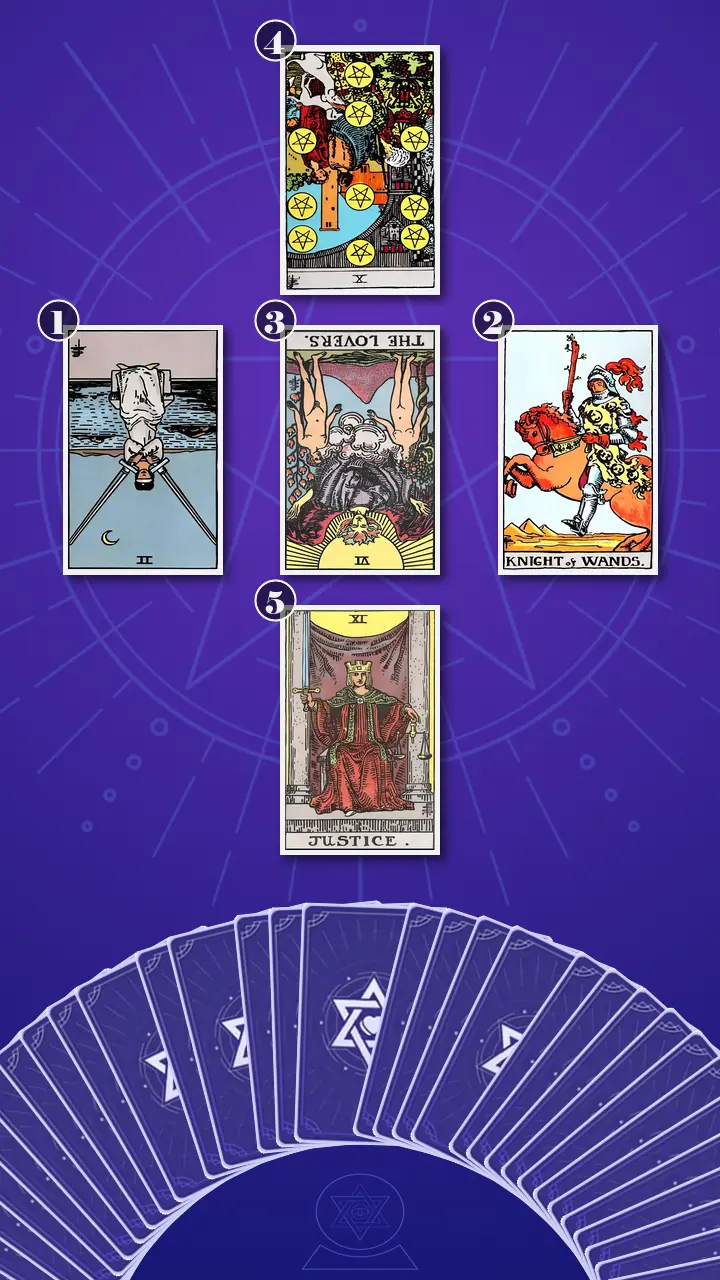
I chose the five-card Relationship Spread · Context Edition, also called the Five-card Relationship Spread - Context Edition. For readers wondering how tarot works in a relationship question, the choice of spread matters. A large predictive layout would have added noise. This compact cross could compare Casey’s contribution with her partner’s observable planning language, locate the bond’s underlying pattern, identify the practical obstacle, and offer an ethical integration practice.
I arranged the cards like a bridge under inspection. The first position would show how Casey responded to ambiguity. The second would examine only her partner’s exact statements, commitments, and follow-through, without guessing at motives. The center would reveal the foundation beneath the couple’s shared identity. Above it, a card would test the practical architecture of home, money, work, commitment, and timing. Below it, the final card would act as a plumb line, showing how to evaluate the structure fairly.
That is the value of card meanings in context: no single card becomes a verdict. Each position asks a bounded question, and the relationship among the cards reveals the pattern.
Reading the Bridge from Both Ends
Position 1: Two Swords Across the Unsent Question
I began with the card representing Casey’s current contribution to the problem: noticing ambiguity, softening direct questions, and keeping two interpretations of the future alive.
I turned over the Two of Swords, reversed.
I pointed to the blindfold and the blades crossed over the figure’s chest. Upright, the image can contain a stalemate. Reversed, that defensive arrangement becomes unstable. I read it as a blockage in discernment: Casey already had enough information to know that clarification was needed, but mental overload kept converting that need into further review.
After hearing, “We’ll work it out,” she could create two columns titled “what was said” and “what I inferred,” yet close the note before finishing. She could replace the needed question with “no pressure,” then spend the evening replaying the answer. The relief came from postponing the conclusion, not from receiving new information.
“The private sentence underneath this card sounds like, ‘I know what I need to ask, but if I ask it plainly, then I have to live with the answer,’” I said. “That isn’t a character flaw. It is an intelligent protection that has outlived its usefulness.”
Casey gave a short laugh, but there was no amusement in it. Her shoulders rose, her fingers stopped moving, and then she looked away from the card. “That’s so accurate it’s a little brutal,” she said. “I keep calling it patience, but I think I’m making the answer easier to hear before it has even been given.”
“Exactly,” I replied. “Patience leaves room for another person’s uncertainty. Self-silencing removes your own legitimate question. We don’t need to shame the first impulse to distinguish the two.”
Position 2: The Rider with Momentum but No Settled Route
I moved to the position representing the other person’s planning stance as it could actually be observed through words, commitments, responsibilities, and follow-through.
I revealed the Knight of Wands, upright.
The rearing horse carried genuine Fire: movement, confidence, possibility, and appetite for experience. I did not use that energy to label Casey’s partner deceptive or unserious. The card showed that enthusiastic future talk could be sincere while still lacking a settled route. Its Fire was not inherently a problem; the imbalance appeared because the excitement was abundant while sequence, ownership, dates, and grounded Earth remained comparatively deficient.
Casey recognized the pattern immediately. Conversations about travel, a different city, a future home, or everything they might do together felt vivid and connected. The energy dropped when she asked which city, whose lease, what form of commitment, or by when. The observable mismatch was between possibility language and practical follow-through, not proof of a hidden intention.
“Think of The Wizard of Oz,” I said. “Companions can travel the same road with genuine affection while seeking different things at the end of it. Shared movement does not automatically establish a shared destination.”
Her jaw shifted as she considered that distinction. “We’re great at imagining,” she said. “The minute I open a calendar, I feel like I’m ruining the mood.”
“Then the important evidence is not that the mood is false,” I said. “It’s that the relationship may have plenty of Fire and not yet enough Earth. Your next question is not ‘Was the enthusiasm real?’ It is ‘What did the enthusiasm become after the conversation?’”
Position 3: The Mountain Inside “We Want a Future”
I turned to the center card, representing the psychological foundation that kept the mismatch minimized: affection and a shared couple identity being used as substitutes for explicit values alignment.
The card was The Lovers, reversed.
I drew Casey’s attention away from the familiar romantic figures and toward the mountain rising between them. Reversed, The Lovers can show blocked conscious choice or unexamined differences in values. Casey and her partner could both say, “We want a future together,” while filling the words home, commitment, stability, and freedom with different meanings.
That did not make their love fraudulent. It made their alignment untested. The blockage came from treating one emotional truth, “we love each other,” as if it had already answered several practical questions. The card asked Casey to compare definitions without forcing either definition to be wrong.
“Affection can be real while alignment remains untested,” I said. “You agree on the headline, so why are you afraid to compare the fine print?”
Casey’s breath caught. Her gaze lost focus for a moment, as though she were replaying every conversation in which “future” had sounded reassuring enough to end the discussion. Her fingers tightened around her mug, then slowly released.
“Commitment,” she said at last. “I think that’s the word we use as if it means the same thing. For me, it includes making decisions around each other. I’m not sure it means that for my partner.”
I let the distinction remain visible. “That uncertainty is information, not a verdict. The Lovers reversed does not require an ultimatum. It asks for a conscious comparison. Difference becomes negotiable only after it becomes visible.”
Position 4: When the Mood Board Met the Lease Renewal
I uncovered the card representing the mismatch itself: the point where different definitions of long-term security, commitment, flexibility, or timing had become materially consequential.
It was the Ten of Pentacles, reversed.
The family beneath the stone arch presented a finished picture of continuity. Reversed, the image asked whether the apparent structure had mutually agreed supports. Here the energy of Earth was deficient and unstable. Casey was not merely asking for more romantic reassurance; she was trying to make decisions about housing costs, financial interdependence, career location, and commitment timing without knowing which parts of the structure were shared.
I asked her to picture the lease-renewal email beside the private spreadsheet she kept minimized at work. The HVAC hummed, Slack notifications clicked, and she updated the solo-rental column because “we’ll figure it out” contained no occupant, budget, responsibility, or date. She was carrying the logistical weight of a shared future that had not yet become a shared plan.
“A shared mood board is not a signed blueprint,” I said. “Two people can save the same Toronto rental listing while one is browsing possibilities and the other is preparing to apply.”
Casey’s stomach visibly tightened before she exhaled. “We can picture the same apartment,” she said, “but we’ve never agreed who would move, how we’d split things, or whether my lease ending is even relevant to the other person.”
I had seen versions of that structure in archaeological trenches: a beautiful arch still standing while the load-bearing work beneath it belonged to incompatible phases of construction. My professional instinct was not to declare the building doomed. It was to ask which supports had actually been joined.
“The blind spot is calling every difference ‘just logistics’ before you know whether it reflects timing, negotiable preferences, or different values,” I said. “Reasonable uncertainty is allowed. But an undecided answer has to remain undecided. It cannot quietly be translated into yes.”
When Justice Raised One Sword
Position 5: The Answer That Did Not Need Improving
The room seemed to settle as I reached the position offering a non-predictive integration practice: direct questions, explicit terms, fair listening, and evidence-based evaluation.
I turned over Justice, upright.
Justice held one sword upright rather than crossing two blades defensively over the body. In the other hand, the scales remained level. I read this as balanced Air: language precise enough to separate fact from interpretation, paired with fairness broad enough to hold two legitimate sets of needs. The card did not demand that Casey prosecute the relationship or extract a preferred answer. It asked her to hear what was actually said.
At 11:40 p.m., Casey had a Toronto rental listing open, a direct timeline question drafted, and her partner’s last “eventually” in her head. She deleted one sentence, added “no rush,” and felt her throat loosen even as her stomach stayed braced. Justice returned her to that exact moment, but this time it left the original question intact.
“A future is not aligned because both people speak warmly about it. It becomes aligned when definitions, timelines, and actions can be named and weighed without either person translating the other’s answer.”
I let the silence hold for a beat.
Vagueness is not compatibility; name the terms that matter, weigh both answers fairly, and let Justice's upright sword separate hope from agreement.
For one breath, Casey did not move. Her fingers hovered above the table, and her eyes widened before narrowing with a flash of resistance. “But doesn’t that mean I’ve been wrong this whole time?” she asked, her voice sharper than before. I watched the thought reach her in stages: first the physical freeze, then the distant gaze of someone replaying old messages, then the colour rising around her eyes. “No,” I said. “It means you used reassurance to protect something precious. That worked briefly, until the cost became greater than the protection.” Her fist opened a finger at a time. Her shoulders dropped, but the release left her looking momentarily unsteady, as if putting down a heavy suitcase had revealed how long she had been using its weight for balance. A low, trembling exhale escaped her. Relief had arrived, but so had responsibility: a clear question could no longer be replaced by another search tab.
“Now, with this new perspective, can you think of a moment last week when this insight might have made you feel different?” I asked.
Casey remembered reading, “Of course I see a future with you,” and mentally adding, “so we’ll probably move in next year.” “I could have let the message be loving without pretending it contained a date,” she said. “Then I could have asked the next question instead of spending two hours decoding it.”
I call the lens I used next Historical Crossroad Matching. On an archaeological map, two roads can share a gate and several miles before separating toward different cities. The crossroad does not create the divergence; it makes the geography visible. From that wider vantage point, Casey’s direct question was not a weapon against belonging. It was a signpost showing whether the route ahead remained shared, required negotiation, or divided.
I then applied my Enduring Value Assessment to Justice’s scales. On one side sat the short-term relief created by “no pressure.” On the other sat what could survive the test of time: the capacity to state a need, respect another person’s autonomy, hear an answer without editing it, and trust herself with the information. The enduring value was not certainty about the relationship. It was relational self-trust.
I set a ten-minute timer and asked Casey to open a blank note with three headings: Home, Commitment, and Timing. Under each, she wrote one question that could be answered in words or observable action. I asked her to notice every place she wanted to add a disclaimer or answer on her partner’s behalf. She did not have to send anything, and she could stop if the exercise became too activating. Her task was only to keep the questions that genuinely mattered and delete those that functioned as tests.
“Do not improve the answer before you have heard it,” I told her. “Precision is not pressure when both people can pause, disagree, or remain uncertain. Precision protects both people from having their needs guessed.”
I named the shift unfolding in front of me: this was a first movement from protecting belonging through vague reassurance toward grounded relational discernment, fair evaluation, and self-trust. It was not yet a decision. It was the capacity to tolerate honest information without abandoning herself or making the other person wrong.
The Blueprint Beneath the Mood Board
I gathered the cards into one coherent story. The Two of Swords reversed showed Casey using divided thought as protection: one version of the future came from exact words, while another came from hope. The Knight of Wands showed sincere momentum and abundant possibility, but no settled route. The Lovers reversed exposed the untested definitions beneath “we want a future.” The Ten of Pentacles reversed located the cost in practical architecture: home, money, location, responsibility, and timing. Justice transformed crossed, defensive thought into one clear instrument of discernment.
The pattern explained why Casey felt stuck. She had confused the absence of conflict with the presence of agreement. Every softened question created immediate closeness, but it also sent the planning work back into private spreadsheets, browser tabs, and mental rehearsals. The cognitive blind spot was the belief that asking for clarity might create a mismatch. The spread suggested the opposite: clarity does not create the mismatch; it reveals what the plan was already asking her to carry.
The transformation direction was specific. Casey did not need to demand a complete five-year plan or turn one conversation into a loyalty test. She needed to move from translating vague enthusiasm into agreement to asking three direct questions, recording exact answers, and evaluating words, timelines, responsibilities, and observable next steps as separate evidence.
Before choosing those next steps, I introduced the Time Stratigraphy Exercise. On a dig, I read history layer by layer rather than treating every object as if it came from the same moment. I asked Casey to imagine herself ten years from now looking back at this week. From that future layer, which concern would appear temporary: the awkwardness of asking plainly? Which value would still matter: preserving tonight’s mood, or knowing that she could participate honestly in decisions shaping her home and life? The exercise did not erase the real stakes. It cleared away the trivial anxiety surrounding them.
- The Fact-Inference Split Before Friday, take one recent future conversation and create two phone-note columns: “What was actually said” and “What I added.” Write no more than three bullets in each, preserving the speaker’s exact words. Tip: Set a five-minute timer. If you catch yourself explaining or improving an answer, return to the original sentence and stop there.
- The Three-Question Clarity Check During a mutually agreed 30-minute conversation, bring one question each about Home, Commitment, and Timing. Begin with the most immediate question: “Would you want to choose a shared home when my lease ends in October?” Record the answer in the speaker’s own words before discussing interpretations or solutions. Tip: Ask only one question if three feels too large. Either person may request a pause, and “undecided” remains a valid answer rather than being translated into yes or no.
I asked Casey to finish the conversation by marking each relevant topic Fixed, Flexible, or Undecided for each person. She did not have to resolve every mismatch immediately. Her first responsibility was to see the map accurately. The choice of what to negotiate, accept, or decline would remain hers.

A Week Later, the Question Stayed Unsoftened
Six days later, I received a message from Casey. She had opened her note before the conversation, read the original question aloud once, and resisted adding “no pressure.” Her partner’s answer was: “I’m not ready to promise October. I do want to talk about what ready would require, and decide by June whether we’re aiming for a shared place.”
It was not the complete answer Casey had once supplied in her imagination. It was more useful because it was real. She recorded it exactly, added a June conversation to their shared calendar with consent, and left “October move” marked undecided. For the first time, she did not build the next five scenarios before going to bed.
She slept through the night. In the morning, her first thought was, “What if the answer changes everything?” Then she smiled, because the question was still there, unedited, and she trusted herself to hear it.
I did not regard the conversation as proof that the relationship was aligned, nor did I treat the cards as the force that changed Casey’s future. The Five-card Relationship Spread - Context Edition had provided a structure for perception. Casey created the change by asking, listening, and refusing to abandon either person’s truth for temporary comfort.
That was her Journey to Clarity: not a leap from uncertainty into perfect confidence, but a grounded step from private translation toward fair, observable understanding. She remained tender about what the answers might reveal. She was also no longer asking hope to carry the entire blueprint alone.
When warm future talk briefly loosens your throat but your stomach stays braced, you may be feeling the cost of protecting belonging by leaving the plan undefined. Noticing that cost does not force a verdict; it simply lets your own need for clarity take its rightful place on Justice’s scales.
If you allowed one future-planning answer to remain exactly as it was given, what small question would you place in the blank space of your shared blueprint next?