Finding Clarity at 10:47 p.m.
Maya was a 27-year-old hybrid marketing coordinator in Toronto who could manage campaign deadlines across three apps, yet one late-night “hey” from her ex could turn a quiet evening into a post-breakup boundary relapse.
She described the scene so precisely that I could almost enter it with her. At 10:47 p.m. on a Tuesday, her phone lit up beside the kitchen sink: “hey, how have you been?” The refrigerator hummed. A streetcar bell sounded through the closed condo window. The phone felt warm when she turned it face down, but within forty seconds it was back in her hand. She deleted “Good, thanks,” typed “Hey, good to hear from you,” and pressed Send.
“Why do I reply when my ex texts even though I want to move on?” she asked me. “I know it keeps me stuck, but ignoring the message feels cruel. And if I don’t answer, maybe this really is over.”
I heard two needs colliding inside one tight chest. Her ambivalence felt like two browser tabs playing audio at once: one repeated, “I want distance,” while the other insisted, “A kind person would reply.” Sending the message muted one tab for the night, but the remaining noise returned as forty minutes of rereading, punctuation analysis, and waiting for the typing bubble.
I told her, “I’m not going to decide that no contact is universally right, and I’m not going to guess what your ex intended. We’re going to look at why the arrival of a message gains authority over your next action. Then we’ll build enough space for your longer-term intention to get a vote.”
I have spent twenty years listening to complicated stories over coffee, and I rarely find that people need a grand verdict. Most need a safe surface on which to sort what is observable, what is imagined, and what remains theirs to choose. I told Maya that our Journey to Clarity would begin there: not by predicting the relationship, but by making the reply loop visible without shaming her for being caught in it.

A Map That Refused to Read Anyone’s Mind
I poured fresh coffee, invited Maya to take one ordinary breath, and asked her to hold the question in plain language while I shuffled. I use this pause as a transition from reaction to observation. It is not a test of intuition and it does not require belief in anything supernatural.
Choosing the Relationship Spread · Context Edition
I chose a five-card Relationship Spread · Context Edition. A larger Celtic Cross could have introduced future possibilities and broad environmental influences, but Maya’s question was narrower: what happens between an incoming text and her decision to reply? This spread gave me the smallest useful structure for examining that sequence without speculating about the ex’s private motives.
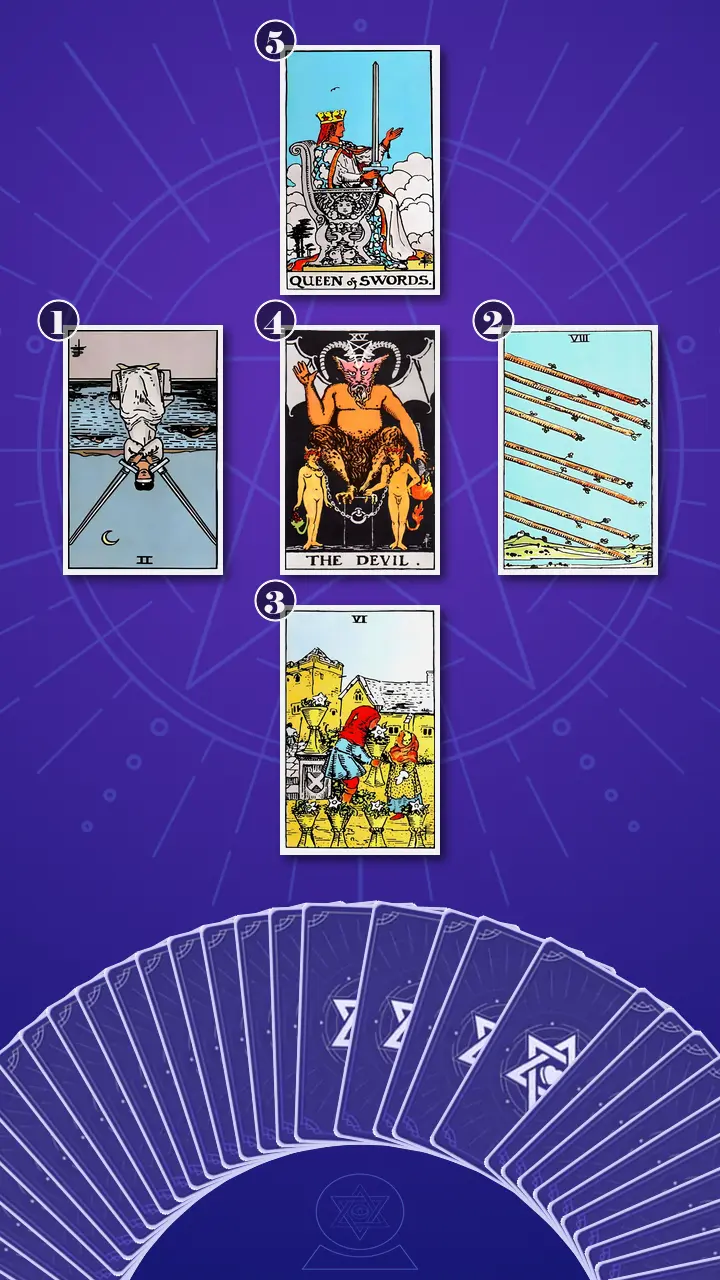
I arranged the cards in a cross. The first position would show Maya’s present behavior-emotion split. The card at the center would expose the reward keeping the contact loop active. The card above it would offer an integrating boundary, not a prediction about whether the relationship would restart.
This is how tarot works at its most grounded for me: each position holds one part of the problem still long enough to examine it. The cards are not commands, evidence of another person’s thoughts, or a substitute for Maya’s judgment. They are a structured external surface on which patterns can become easier to see.
Reading the Gap Between Notification and Choice
Position 1: The Reply That Ends the Argument
I began with the card representing Maya’s current behavior-emotion split: she wanted to move on, yet unresolved inner conflict left her vulnerable to replying on reflex. I turned over the Two of Swords, reversed.
In the Rider-Waite-Smith image, a blindfolded figure holds two swords crossed over her chest. Upright, the card can hold a tense stalemate in place. Reversed, that contained Air becomes blocked discernment and then mental overload. The mind gets tired of carrying two opposing instructions, so it reaches for the fastest available action.
I brought Maya back to 10:47 p.m. She had placed the phone face down, picked it up again, and drafted three versions of “Hey, good to hear from you” in under a minute. The final reply did not resolve whether contact supported moving on. It resolved the immediate discomfort of not knowing what to do.
“Think of the moment before you pressed Send,” I said. “Which sentence did the reply temporarily silence?”
Maya gave a short laugh, but there was no amusement in it. Her fingers tightened around the coffee cup before loosening again. “That’s so accurate it’s almost cruel. I wasn’t choosing contact. I was trying to stop the argument in my head.”
I paused before answering. “The accuracy can sting, but I don’t see a character flaw here. You found a quick way to regulate an overloaded moment. The problem is that a reply can reduce tonight’s tension and still increase tomorrow’s confusion. We’re identifying the mechanism so you can choose another form of relief.”
I also named the reversal’s overcorrection risk. Maya did not need to send a long, absolute closure message while activated. That could create a new debate and extend the very contact she wanted to limit. Her first task was smaller: name both wants, then ask which one the proposed action actually served.
Position 2: Arrival Is Not Importance
I next turned the card representing the observable incoming-contact energy created by the texts: their speed, ambiguity, and disruptive effect, without any claim about why they had been sent. The card was the Eight of Wands, upright.
Eight staffs fly through an open sky, already in motion, with no person visible to explain or direct them. I read that Fire as an excess of momentum. The notification crossed Maya’s quiet room quickly, and her body supplied urgency before the message supplied context.
I compared it to a Teams or Slack alert arriving after a full day of responding on demand. The screen flashes, the phone vibrates, and the hand prepares to clear the item before the mind asks whether it belongs to work, logistics, intimacy, or nothing urgent at all. Maya had spent years training herself to be responsive through the same device that carried her most emotionally loaded conversation.
“What did the last message literally say?” I asked.
“Hope you’re doing okay.”
“And what meanings did you add before you had more evidence?”
She looked away from the card and counted them quietly. Concern. Regret. Loneliness. A possible attempt to reconnect. Proof that the timing mattered because her ex had just viewed her Instagram Story.
I said, “The observable facts are a Story view, an ambiguous sentence, and a time stamp. Everything else may be understandable, but it is still interpretation. An incoming message is information, not an instruction. It arrived now; that does not mean you have to deal with it now.”
Her hand moved toward her phone and then stopped. The movement was tiny, but I noticed it. For the first time in the reading, the notification seemed less like a summons and more like an event she could observe.
Position 3: When Nine Words Carry an Entire Archive
I turned the card representing the emotional history and familiar reward beneath the reply pattern. It was the Six of Cups, upright.
One child offers another a cup filled with white flowers inside an enclosed courtyard. The card carries tenderness, recognition, and the safety of what is familiar. Its Water was not harmful in itself. The imbalance appeared when remembered warmth was allowed to supply meaning that the present message did not contain.
Maya told me about opening “saw this and thought of you” beside old lake photos and an old Spotify playlist. Within seconds, she was no longer responding to nine present-day words. She was responding to a familiar coffee order, private jokes, Sunday mornings, and the relief of once feeling deeply known. Like the intermittent tenderness in Normal People, brief contact seemed larger because the entire emotional history stood behind it.
“Which part are you actually missing when the thread reopens?” I asked. “The person as they are now, or being known, chosen, and familiar to someone?”
Maya’s gaze settled on the flower-filled cup. Her breath caught, her eyes lost focus as if an old room had opened behind them, and then she released a long breath into her coffee. “Being known,” she said. “I miss not having to explain myself.”
I let that tenderness remain intact. “That was real. The relationship does not become meaningless because it ended. But missing recognition does not automatically establish that this specific contact is the only way to receive it now. Nostalgia can tell us what mattered; it cannot, by itself, decide who receives present access.”
Position 4: The Ten-Minute Proof That Kept Charging Interest
I turned the card representing the central mechanism behind Maya’s gap between intention and behavior. It was The Devil, upright.
I never use The Devil to frighten a querent or to label another person as toxic. In this position, I read it as a repeated gratification loop and the belief that a pattern has more power than the people participating in it. I drew Maya’s attention away from the horned figure and toward the loose chains around the two human figures’ necks.
For a second, the dark pedestal did not look occult to me. It looked like a phone screen at midnight, a narrow rectangle on which the typing bubble had become the only reward visible. I traced the loop in observable beats: notification, pulse spike, reply, typing-bubble watch, temporary relief, rereading, next-morning frustration.
“What do you receive in the first ten minutes after replying?” I asked.
Maya’s breathing stopped. Her fingertips hovered over the cup, her gaze slipped past me as if she were replaying several nights at once, and then her shoulders dropped a fraction. “For ten minutes, I get to feel wanted again,” she said. “I get proof that I still mattered.”
That was the central reward. Contact briefly softened the frightening possibility that finality might remove evidence of her worth. But the relief carried a later cost: less sleep, less attention for the life she was rebuilding, and less trust in her ability to honor her own decisions. The reply loop was powerful because its reward was intermittent. Most exchanges went nowhere, which made an occasional warm response feel unusually significant.
I pointed again to the chains. “The message cannot physically set a deadline, open the reply field, or press Send. That does not make your urge trivial. The urge is real; it is not the same thing as a deadline.”
Maya looked at the loose chain rather than the figure above it. Her chest rose on a careful breath. “So the first change isn’t promising I’ll never answer again?”
“Correct,” I said. “The first believable change is creating one interval in which the urge can exist without completing the familiar sequence. You do not have to decide the whole future while your lock screen is still glowing.”
When the Queen Raised One Sword
Position 5: Compassion Without Automatic Access
The radiator clicked off just as I reached the integrating position, and the room became noticeably quieter. Rain drew a bright line down the window beside us. I turned the Queen of Swords, upright, representing the clear and compassionate contact boundary Maya could use to align future behavior with moving on.
The Queen holds one sword upright and extends her other hand openly. I saw the reading’s visual transformation immediately: the two crossed, reversed swords of the opening card had become one stable standard. The open hand showed that clarity did not require cruelty, emotional numbness, or denial that the relationship had mattered.
By then, I could see that Maya was still trying to solve the wrong problem. She believed she had to decode why the text had arrived and then choose between kindness and distance. Each imagined motive reopened the case before her own goal could be considered.
This was where I used my Analysis Paralysis Deconstruction. I stripped the decision of abstract what-ifs and placed only grounded realities on the table. The known facts were simple: the message was non-urgent, Maya wanted more distance, and rapid replies disrupted her sleep and weakened her self-trust. The ex’s motive, future intention, and private meaning were unknown.
I then used Complexity Reduction to turn the clutter into one practical binary choice. Not “Was the relationship meaningful?” Not “Will waiting make me a bad person?” Not even “Should I never speak to my ex again?” The useful question was: “After my chosen pause, does sending this particular reply support the level of distance I say I want?” If the answer was not yet clear, the decision was not “never.” It was “not while activated.”
I placed my finger beside the Queen’s upright sword and said:
“Moving on is not the moment you stop caring. It is the moment caring stops receiving automatic access to your next action.”
I left the words in the quiet for a moment. Then I gave her the key card’s full message:
“You do not need to reply to prove the bond mattered; let the Queen's upright sword separate compassion from access, and answer only from a boundary you chose in advance.”
Maya’s breath stopped first. Her thumb froze against the side of her cup, and her pupils widened as she stared at the single sword. Then her shoulders drew upward, not down, and a flash of anger tightened her mouth. “But doesn’t that mean I’ve been doing it wrong this whole time?” she asked, her voice low and rough.
I let the resistance have room. “It means your old strategy gave you quick reassurance at a high cost. Recognizing the cost now does not make your past self foolish. It gives your present self better information.”
Her gaze lost focus as memories seemed to pass behind it: the lock screen, the drafts, the typing bubble, the mornings after. Her knuckles slowly softened. Her jaw released. Moisture gathered at the rims of her eyes, and she gave a small, unsteady laugh before a long breath left her chest. “So I don’t have to make the past meaningless to stop answering it,” she said.
Relief reached her shoulders, but I also saw the brief blankness that followed it. A clear boundary would return responsibility to her; there would be no notification, friend, card, or reader making the choice in her place. The freedom felt lighter, and a little exposing.
I asked, “Now, using this new perspective, can you think of a moment last week when this insight might have made the experience feel different?”
She remembered sitting in a Queen West café, adding a gallery event to her calendar, when her ex’s name covered the map on her screen. She had abandoned the new plan to open the old thread. “If I’d had a rule already,” she said, “I could have finished making my Saturday. I didn’t need to solve the text in the café.”
I invited her to open the Notes app and spend no more than ten minutes completing three lines: “My goal is…,” “For non-urgent messages from my ex, I will wait…,” and “I will only reply when….” I suggested a workable minimum of a 24-hour draft-only pause, with a separate rule for urgent safety, health, legal, housing, financial, or time-sensitive logistical matters. I made it clear that she could choose a shorter starting interval, revise the rule after a week, or stop the exercise if it felt too activating.
I named the crossing we had reached: from notification-driven hope, guilt, and reassurance-seeking to clear-eyed self-trust and compassion without automatic access. It was not the disappearance of longing. It was the first movement from urgency to choice.
The Coffee Bean Filter for a Muted Thread
I gathered the five cards into one short story for Maya. The reversed Two of Swords showed divided judgment spilling into action. The Eight of Wands showed a notification borrowing urgency from speed. The Six of Cups revealed the remembered warmth that made a small message emotionally enormous. The Devil exposed the temporary reassurance that kept the loop rewarding. The Queen of Swords turned two competing commands into one self-authored standard.
The phone had been running an old permissions setting: familiarity still had unrestricted access because the boundary had never been written before the trigger arrived. Maya’s cognitive blind spot was not that she lacked willpower. She had been asking herself to invent a nuanced policy at the exact moment hope, guilt, memory, and notification reflex were all demanding immediate closure. She also called the reply “politeness,” which kept the deeper reward, feeling wanted again, out of view.
The transformation direction was therefore practical. Maya did not need to become indifferent. She needed to move from decoding the ex’s message to consulting her own standard, then support that standard with enough time and structure that it could function on a real Tuesday night.
A 24-Hour Plan for the Next Notification
After two decades of conversations over coffee, I have developed a sorting exercise I call the Coffee Bean Filter Protocol. A filter does not declare everything it catches meaningless; it separates what belongs in the cup from what should not determine the final brew. In this exercise, “Emotional Noise” does not mean an emotion is fake or embarrassing. It means the feeling is real but is not, by itself, reliable evidence that a reply is required tonight.
- Run the Coffee Bean Filter for 24 hours. Before the next message arrives, open Notes and create two headings: “Absolute Must-Haves” and “Emotional Noise.” For one day, place each decision variable under one heading. Must-haves might include protecting sleep, supporting the goal of moving on, communicating respectfully, and allowing urgent practical exceptions. Noise might include guessed motives, the timing of a Story view, the red notification badge, or the belief that waiting is automatically cruel. After ten minutes, write one rule: “For non-urgent messages from my ex, I wait 24 hours and reply only if doing so supports my goal of moving on.” Keep the rule about your behavior, not your ex’s character. Review it after one week; it does not need to solve the entire future tonight.
- Build a draft-only container around the rule. When a non-urgent text arrives, draft any response in Notes instead of Messages, add the time it can be reconsidered, mute the thread, and set one reminder titled “Does replying support moving on?” Keep a separate daytime route for returning belongings or handling urgent safety, health, legal, housing, financial, or time-sensitive logistics. If 24 hours feels unreachable, begin with ten minutes, then one hour. The pause is private decision space, not a tactic to make the other person react.
I reminded Maya that she remained free to choose contact, limited contact, or no reply. The exercise was not designed to produce my preferred outcome. Its purpose was to make sure the next action belonged to her rather than to the loudest five seconds after a notification.

A Week Later, the Quiet Proof
Seven days later, I received a message from Maya. Her ex had texted at 10:51 p.m. The familiar heat had risen into her chest, and her hand had reached for the conversation before she remembered the pinned note. She copied a reply into Notes, muted the thread, and set the reminder.
The next morning, she read the message again beside her written rule. Nothing in it required urgent logistics, and replying would have reopened the same reassurance loop. She decided not to send the draft. Then she booked the gallery event she had abandoned the week before.
She slept through the night. At breakfast, her first thought was still, “What if I’m doing this wrong?” She smiled, left the phone face down, and finished her coffee.
I did not treat that moment as total closure. Longing had not vanished, and a future message might still make her pulse jump. The proof was smaller and more useful: one feeling had returned, and this time it had not been promoted into an instruction.
The tarot had not predicted what her ex would do or created the boundary by magic. It had made a sequence visible. Maya supplied the written rule, the muted thread, the twenty-four hours, and the final choice. That was the real Journey to Clarity: moving on was no longer measured by whether she stopped caring, but by whether she could care without abandoning her own standard.
If their name lights up your phone and your chest tightens, the hardest part may not be missing them. It may be fearing that letting the conversation end will also erase the proof that you were worth wanting. I would keep the Queen’s open hand beside her upright sword in mind: your tenderness can remain open while your access standard stays clear.
If caring and access were allowed to be two different things, what one-sentence contact rule would you place above the muted thread before the next notification arrives?
This story is adapted from psychological research, written so that those in a similar struggle can see their own pattern in it — and find their next step clearly.These insights are not a substitute for professional psychological, medical, legal, or financial advice.
Learn more about our Journey to Clarity.
How did this insight land for you?
🫂 This Resonates Deeply
🌀 Living This Story
✨ Now I See Clearly
🌱 Seeing New Possibilities
🧰 Useful Framework
🔮 The Confirmation I Needed
💪 Feeling Empowered
🚀 Ready for My Next Step
Author Profile
 AI
AI“For twenty years, I’ve listened to stories unfold over the warm aroma of coffee. I don’t believe life’s complexities always require grand theories to be solved; often, we just need a safe place to tidy up our reality. I don’t offer high-minded preaching—just grounded, heartfelt insights to help you regain your sense of control amidst the clutter of daily life.”
In this Choice Tarot Reading :
Core Expertise
- Analysis Paralysis Deconstruction: Stripping away abstract 'what-ifs' to focus strictly on the grounded realities and immediate constraints of your options.
- Complexity Reduction: Tidy up cluttered decision parameters into a clean, practical binary choice.
Service Features
- The Coffee Bean Filter Protocol: A 24-hour pragmatic sorting exercise to physically categorize decision variables into 'Absolute Must-Haves' and 'Emotional Noise', instantly restoring decisiveness.
Also specializes in :
Explore Related Patterns:
Boundary DiffusionMaya wants distance, yet her ex's arrival on the screen repeatedly determines when she stops what she is doing, enters the old thread, and responds. Because no operational contact rule exists before the notification, caring about the past, proving kindness, and granting immediate access collapse into one decision. When your internal limit remains a preference while the other person's contact functions like a summons, the psychological boundary is present in theory but unavailable in practice. Boundary Diffusion describes this blurred separation between compassion and access: you can recognize that contact costs you sleep and self-trust while still struggling to treat your own standard as independently authoritative.
Boundary DiscernmentMaya writes a rule for non-urgent messages, keeps separate exceptions for genuinely time-sensitive logistics, and recognizes that the relationship can remain meaningful without every text receiving a response. The boundary becomes specific enough to guide behavior before hope, guilt, and familiarity compete for control. When you distinguish caring from access, a limit no longer has to function as punishment, emotional denial, or a verdict on the entire relationship. Boundary Discernment lets you preserve tenderness while deciding deliberately which forms of contact are compatible with your present goal and which are not.
Cognitive DissonanceAt 10:47 p.m., Maya turns the phone face down, picks it up again within forty seconds, drafts several replies, and sends one without resolving whether contact supports moving on. The reply settles the immediate collision between “I want distance” and “a kind person would reply,” but the conflict returns as rereading, punctuation analysis, and waiting for the typing bubble. When you hold two rules that cannot both govern the same moment, a fast action can function as short-term tension reduction rather than a considered choice. Cognitive Dissonance describes this pressure to restore internal consistency: replying temporarily protects your identity as caring and postpones finality, while leaving your longer-term intention unresolved and ready to restart the same argument later.
Emotional ReasoningThe glowing screen produces heat in Maya's chest, and the prospect of waiting feels cruel before she has established that the message requires any immediate response. Hope, guilt, and bodily urgency become decision evidence, even though the literal message is ambiguous and non-urgent. When you treat the strength of a feeling as proof that an action is necessary or morally correct, emotion gains authority that the observable facts have not earned. Emotional Reasoning makes “this feels unbearable” sound like “this must be handled now”; the later recognition that a feeling can remain real without becoming an instruction directly loosens that mechanism.
Guilt-Driven People-PleasingMaya says that ignoring the message feels cruel and that a kind person would reply, even while rapid contact disrupts her sleep and keeps her stuck. Her response therefore becomes a moral performance she feels required to complete, rather than a freely chosen form of communication. When you equate setting a boundary with causing harm, guilt can override information about your own limits. Guilt-Driven People-Pleasing describes the habit of preserving a caring self-image by granting access you do not actually want to grant, producing immediate moral relief at the cost of distance and self-trust.
Intermittent ReinforcementMaya traces the same sequence across multiple nights: a notification, a pulse spike, a reply, a typing-bubble watch, temporary relief, and later frustration. Most conversations go nowhere, but an occasional warm response feels unusually meaningful precisely because it is unpredictable. When a reward arrives inconsistently, your attention can become more persistent rather than less, because each new attempt might produce the exceptional outcome. Intermittent Reinforcement explains why knowing that the exchanges usually disappoint you may not dissolve the pull; uncertainty is part of what keeps the reward system engaged.
Reassurance SeekingAfter replying, Maya watches the typing bubble and receives about ten minutes in which she can feel wanted again and believe that she still mattered. That reassurance fades into rereading, lost sleep, and next-morning frustration, yet another message offers the same possibility of immediate relief. When contact becomes a fast way to verify your significance, the reply is serving an emotional regulation function beyond ordinary politeness. Reassurance Seeking keeps the loop active because the next response appears capable of settling a deeper question about your worth, even though externally supplied proof is brief and repeatedly leaves that question open.
Values-Based Decision MakingMaya replaces “what does this text mean?” with “does sending this particular reply support the level of distance I say I want?” One week later, she checks the non-urgent message against that standard, leaves the draft unsent, and returns to the gallery plan she had previously abandoned. When you organize a decision around a chosen direction instead of the loudest momentary feeling, the action becomes accountable to your values rather than to the notification. Values-Based Decision Making does not require indifference or permanent certainty; it gives your longer-term intention a concrete vote in what happens next.
Loss AversionMaya says that if she does not answer, the relationship may really be over, and later identifies contact as proof that she still mattered. Leaving a message unanswered therefore carries more than the loss of one conversation; it feels connected to losing the remaining evidence that she was wanted. When you experience the possible loss of connection as more consequential than the recurring costs of preserving it, the familiar channel can remain open beyond the point that it serves you. Loss Aversion explains why less sleep, reduced attention, and weaker self-trust may feel easier to tolerate than finality, especially when finality has become entangled with what the bond says about your worth.
Reflective DistanceWhen the next late-night message arrives, Maya copies a possible reply into Notes, mutes the thread, and sets a reminder instead of sending immediately. The longing and bodily activation remain present, but the draft-only container prevents them from completing the familiar sequence before she can observe it. When you create distance between an urge and the interface that can enact it, observation becomes possible without demanding emotional suppression. Reflective Distance is the capacity to let a reaction exist long enough to examine its function, giving your deliberate intention space to participate before the old loop closes.
Uncertainty ToleranceMaya lets an unsent draft remain in Notes overnight without deciding whether she will never speak to her ex again. The next morning, the thought “what if I'm doing this wrong?” is still present, but she can leave the phone face down, follow her written standard, and continue making her own plans. When you stop requiring certainty before honoring a boundary, unanswered questions no longer have to be settled through immediate contact. Uncertainty Tolerance allows care, doubt, and an unknown relational future to coexist with a limited present decision, reducing the need to use a reply as instant closure.
Nostalgia BiasA nine-word message leads Maya into old lake photos, a Spotify playlist, private jokes, Sunday mornings, and the memory of being deeply known. The current text remains small and ambiguous, but the emotional archive behind it makes the contact feel far larger than its present content. When familiarity supplies missing meaning, your decision can become anchored to remembered warmth rather than the relationship as it exists now. Nostalgia Bias does not make the memories false; it describes how genuine tenderness from the past can receive disproportionate weight when you are deciding who should have present access.
Explore Related Struggles:
Chosen-Worth BindFor the first ten minutes after replying, Maya gets to feel wanted again and receives temporary proof that she still mattered. The typing bubble and occasional warm response carry more weight because many of the exchanges lead nowhere. When evidence of your worth is routed through another person's availability, silence threatens more than the loss of a conversation. It can appear to withdraw confirmation that you were chosen at all, leaving you caught between protecting your direction and checking once more for proof that the bond still reflects something valuable about you.
Internal Authority CollapseA Story view, a timestamp, and an ambiguous sentence lead Maya to consider concern, regret, loneliness, and possible reconciliation before she consults her own goal. Each imagined motive gives the incoming message another vote, while her preferred distance enters the decision late. When your standard exists only after contact has already set the agenda, choice can feel available on paper but inaccessible in the moment. Reclaiming authority begins with separating what arrived from what it is allowed to decide, so your next action does not have to inherit the sender's timing or your guesses about their meaning.
Relational Boundary DriftBefore the next text arrives, Maya has no written standard for how much access she wants to allow. Familiarity therefore keeps operating like an old permission setting: the thread enters her condo late at night and later covers the map while she is making a new Saturday plan. Without a limit chosen in calmer conditions, every message forces you to renegotiate distance while memory, guilt, and hope are already present. The boundary does not disappear through one dramatic choice; it drifts whenever the sender's arrival becomes the moment that defines what access will mean.
Relief-Progress FusionMaya's reply silences the immediate argument in her head, but the quiet lasts only briefly. It is followed by forty minutes of rereading, punctuation analysis, typing-bubble watching, reduced sleep, and frustration the next morning. The same action is being asked to provide short-term relief and long-term movement, even though its immediate reward keeps reopening the sequence she wants to leave. You become stuck when feeling better tonight is treated as evidence that you are moving forward, while the later costs continue to accumulate outside the moment of relief.
Urgency-Compass FusionA non-urgent “hey” reaches Maya at 10:47 p.m., and within forty seconds she has turned the phone over, picked it up again, drafted several replies, and pressed Send. The message contains little context, but its speed and placement on a device associated with constant responsiveness make its arrival feel time-sensitive. Once arrival is mistaken for priority, your longer-term direction has to compete with a reflex that is already in motion. The central friction is between the pace imposed by the notification and the pace you would choose if the same decision were waiting quietly for you the next morning.
Closure-Belonging SplitMaya says that if she does not answer, “maybe this really is over,” and later realizes that she does not have to make the past meaningless in order to stop answering it. Silence therefore carries the imagined weight of erasing both the bond and the person she was while it existed. When the end of access feels like the end of belonging, moving on can seem to demand a verdict against your own history. The deeper task is to let a relationship remain meaningful in your life story without requiring the present conversation to remain open as proof.
Explore Related Emotions:
Agency ReliefMaya moves the draft out of Messages, mutes the thread, and gives herself a private interval before reconsidering it. The pause does not prescribe contact or silence; it prevents the loudest seconds after the notification from making the decision on her behalf. Agency Relief is the lighter, slightly exposed feeling that appears when the next action becomes yours again. You no longer have to settle the entire future of the relationship while the lock screen is glowing, and you remain free to choose contact, limited contact, or no reply from a standard you authored.
Bittersweet ReleaseMaya's knuckles soften and a long breath leaves her chest when she realizes that she does not have to make the past meaningless in order to stop answering it automatically. The relationship can retain its tenderness and significance without receiving unrestricted access to her present choices. Bittersweet Release allows grief and movement to occupy the same space. You are not required to become indifferent before changing the pattern; you can honour what was real while releasing the idea that every new message must reopen it.
Boundary GuiltIgnoring the message feels cruel to Maya, and the sentence 'A kind person would reply' gains more authority than her stated wish for distance. When kindness becomes fused with immediate availability, your boundary can feel like evidence against your character rather than a legitimate decision about access. Boundary Guilt captures the discomfort that follows when protecting your space appears morally wrong. Replying then offers more than contact; it briefly restores your sense that you are considerate, even though it leaves your own limit unsupported.
Cautious Self-TrustSeven days later, Maya copies a reply into Notes, mutes the thread, sleeps, and reads the message again beside the rule she wrote for herself. She still thinks, 'What if I'm doing this wrong?' but leaves the phone face down and finishes her coffee. Cautious Self-Trust is built from that modest sequence rather than from perfect certainty. You discover that doubt and bodily activation can remain present without invalidating your standard, and one decision that survives the discomfort becomes evidence that your longer-term intention can participate in the next choice.
Clarity ReliefMaya's hand moves toward her phone and then stops when the notification begins to look like an observable event rather than a summons. Separating the message, timestamp, and Story view from the meanings she added removes the burden of solving her ex's private motives before she can act. Clarity Relief arrives when your decision can rest on what is known and what you want to protect. The single question about whether this reply supports your chosen distance reduces the noise without denying that the message still matters emotionally.
Cognitive OverwhelmAt 10:47 p.m., Maya turns the phone face down, picks it up within forty seconds, and drafts three versions of a reply. When your mind is carrying incompatible instructions at the same volume, sending something can become the fastest available exit from the immediate mental pressure, even when it does not resolve which action serves you. The forty minutes of rereading show that the reply quiets the decision only briefly. Cognitive Overwhelm names the internal weather behind that reflex: too many meanings, obligations, and possible consequences are demanding resolution at once, so the quickest action temporarily outruns your considered intention.
Fear of Being ForgottenWhen Maya is asked what she receives after replying, she says that she gets proof she still mattered and gets to feel wanted again. The text therefore reaches beneath ordinary curiosity and touches the question of whether the relationship still confirms her significance. Fear of Being Forgotten can make silence feel like erasure rather than a boundary. You may keep the thread active because continued contact appears to preserve evidence that you were known, chosen, and worth wanting, even when that evidence arrives intermittently and costs you steadiness elsewhere.
Guarded LongingLonging has not vanished when Maya leaves the second draft unsent, and a future message may still make her pulse jump. Her new boundary does not demand numbness; it gives the feeling somewhere to exist without turning it into an instruction. Guarded Longing describes tenderness held inside a deliberate access standard. You can miss being known, remember the relationship warmly, and care about the person while protecting the distance required for your present life to keep moving.
Nostalgia AcheA short 'saw this and thought of you' appears beside old lake photos, a shared playlist, private jokes, familiar coffee orders, and remembered Sunday mornings. The present message becomes emotionally enormous because your body is not responding to nine words alone; it is responding to an archive of recognition and familiarity. Nostalgia Ache holds the tenderness of what was real alongside the pain of its present absence. Maya's reply is partly an attempt to touch the experience of being known without explanation, even when the current contact cannot reliably recreate the relationship that once provided it.
Reassurance CrashAfter Maya replies, she gets roughly ten minutes of feeling wanted before the exchange turns into punctuation analysis, typing-bubble watching, and rereading. The immediate reward is real, but it is too brief and inconsistent to create lasting steadiness. Reassurance Crash describes the drop that follows borrowed proof of significance. You receive a short easing from contact, then lose sleep and attention while waiting for the next signal to sustain it, leaving the original uncertainty intact and often louder the next morning.
Self-Betrayal AcheRapid replies cost Maya sleep, pull attention from the life she is rebuilding, and once cause her to abandon a gallery plan she was making for herself. The consequence is not only renewed contact; it is another moment in which her stated direction loses its place as soon as the screen lights up. Self-Betrayal Ache names the pain of watching your immediate action override the standard you meant to protect. Each repetition can weaken your confidence that your own decisions will survive contact with a strong feeling, which is why creating even one successful pause carries more weight than simply leaving one message unanswered.
Finality DreadMaya says that if she does not answer, maybe the relationship really is over. One unanswered text therefore carries the emotional weight of confirming an ending, even though the observable decision is only whether to respond to one non-urgent message tonight. Finality Dread makes continued contact feel like a temporary safeguard against irreversible loss. You may reply not because the exchange supports moving forward, but because leaving it unanswered brings you too close to the possibility that there will be no further proof that the bond remains available.
Ambiguity DreadThe literal evidence is a Story view, a timestamp, and a brief sentence, yet Maya quickly generates concern, regret, loneliness, and possible reconciliation as explanations. Because the message contains too little information to settle any of them, your mind can remain suspended among several emotionally charged possibilities. Ambiguity Dread makes replying feel like a route toward certainty. The response is an attempt to draw out enough information to end the suspended state, but the resulting punctuation checks and typing-bubble monitoring show that contact can extend the uncertainty instead of resolving it.
Explore Related Contexts:
Access as Proof PressureMaya says that replying gives her ten minutes of feeling wanted again, and she worries that silence would confirm the relationship is truly over. The response therefore does more than continue a conversation: it temporarily preserves evidence that she mattered and that the former bond still has present access. That arrangement places a high symbolic cost on withholding a reply. When access becomes proof, you may find yourself reopening contact to protect the meaning of the past rather than because the present exchange supports what you want now. Separating the bond's significance from the other person's current access returns those two decisions to your own standard.
Breakup Closure LimboMaya wants to move on, yet she says that not answering might mean the relationship is really over. Because most exchanges lead nowhere while an occasional warm response keeps the channel meaningful, each new message reopens a question that the breakup has not converted into a stable contact arrangement. This is a liminal relationship stage rather than a clear reconciliation or a settled ending. You remain asked to renegotiate the breakup whenever the thread lights up, with no shared structure defining what renewed contact is for. Closure becomes harder to establish when every ambiguous message is allowed to reopen the entire case before your current goal is consulted.
Late-Night Texting SpiralWithin forty seconds, Maya turns the phone face down, picks it up again, drafts several versions, and sends a reply. The exchange then expands into forty minutes of rereading, punctuation analysis, and typing-bubble monitoring; one week later, another late-night text attempts to start the same sequence. The spiral is sustained by a compressed chain in which each action makes the next one easier to complete before the message's importance has been established. You are not dealing with a single tap but with a sequence that occupies the rest of the night and repeatedly charges sleep and attention for a brief moment of reassurance. Making the chain visible creates more places where the sequence can stop.
Nostalgia Timing TrapNine present-day words arrive beside old lake photos and a shared Spotify playlist, bringing a familiar coffee order, private jokes, and Sunday mornings into the reply decision. Maya is no longer responding only to what the current message contains; an entire archive is supplying the intimacy and significance missing from its wording. Nostalgia preserves valid information about what once mattered, but the timing trap occurs when remembered closeness is permitted to establish the value of present access. You can recognize that the relationship held real warmth while still asking what this specific interaction demonstrates now. That distinction prevents the archive from making a current contact decision on its own.