Why Can't I Just Choose?

A clear look at why you delay choices to avoid regret, plus tarot cards and reading insights that mirror this pattern.

Regret Aversion
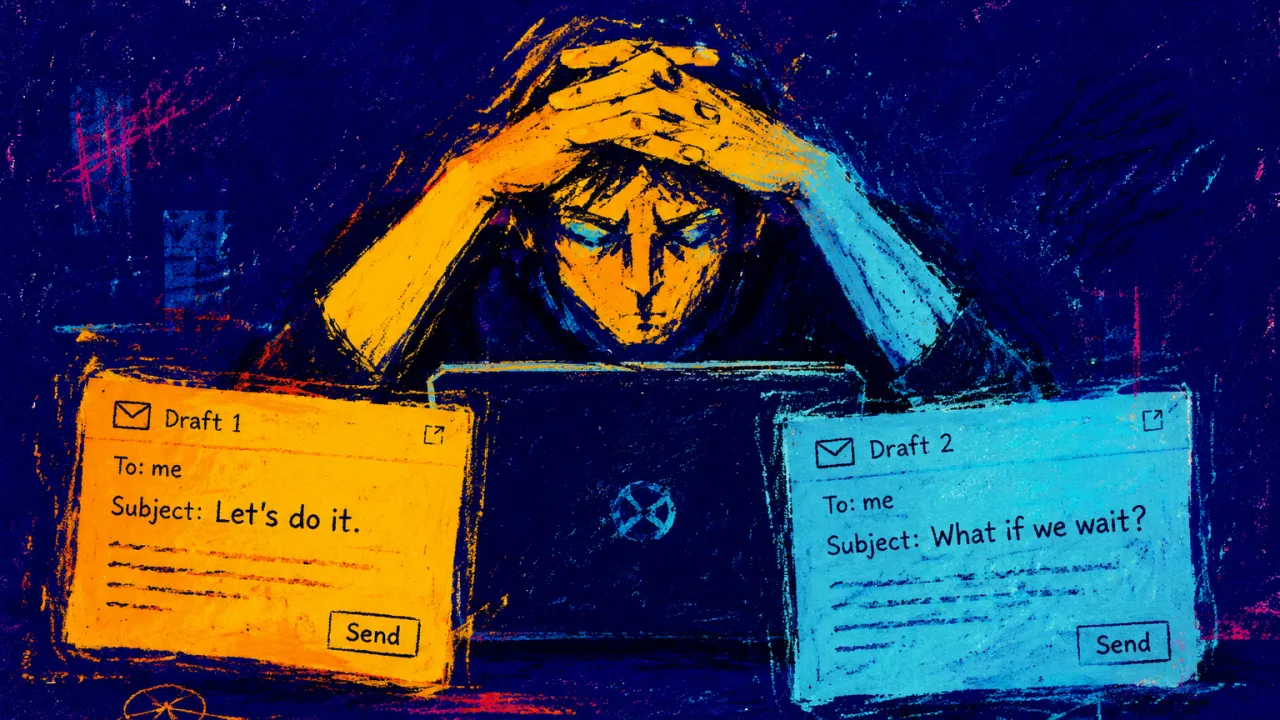
A figure with clasped hands beside two email drafts, shoulders rigid, amber and icy-blue light meeting over deep indigo.

What is this really?

You keep researching, asking for one more opinion, or delaying a choice until the decision feels sealed against future regret. You are trying to avoid the sting of a wrong call, along with the uncertainty and self-blame that might follow it. Yet the pause becomes its own loss: your body stays braced between two futures, and you can feel possible moments passing while you wait, like the blindfolded figure in the Two of Swords, two crossed swords held before them while the water waits behind.

Why did it happen?

Earlier in life, waiting for more information may have helped you avoid making a choice under pressure, especially when one wrong move seemed likely to bring lasting self-doubt. Your subconscious loop kept that rule in place: if you do not choose, you cannot be blamed for choosing badly, and now ordinary uncertainty can leave you comparing, hesitating, and feeling mentally spent while you wait for a guarantee no option can provide.

How does it feel?

  • When a friend asks where you want to go, you open the map, name three options, then slide the phone across the table with a small shrug. In the pause, your eyes keep moving between the routes and your shoulders lift before you notice; you can let the pause be present without forcing an answer.
  • At work, you leave two versions of an email open, move the cursor back and forth, reread the subject line, then bring your hands together above the laptop before closing the draft. Your eyes keep returning to the same line and your fingers feel restless even after you stop typing; allow that sensation to be noticed without turning it into a verdict.
  • At checkout, you switch between two nearly identical items, zoom into reviews, and keep one thumb hovering above the final button before locking your phone. Your breath becomes shallow and your chest feels strangely still as the screen stays open; it is okay to leave the moment unfinished while you notice what is there.
  • When you are invited to something unfamiliar, you type I'll let you know, delete it, and check the calendar again before replying. Your jaw sets and your stomach drops as the message waits; you can allow the uncertainty to sit beside you for a moment.
  • Late at night, you make a pros-and-cons list for two career paths, add a fourth column, and reopen old notes to see whether you missed something. Your forehead feels warm and your hands go still over the page; you do not have to solve the sensation before acknowledging it.

Regret Aversion in Tarot Cards

Regret aversion can show up as leaving two versions of an email open while your jaw sets and your cursor moves back and forth. Jungian archetypal theory offers a language for this inner pattern. The Tarot Cards below mirror the unconscious dynamics of that hesitation; here are the cards connected to it.

The Fool
Reversed
The white rose, light bundle, and expansive horizon frame the youth as someone carrying little proof about what comes next. In the reversed orientation, that openness becomes difficult to tolerate because a new identity cannot be evaluated with the certainty of an established one. You may keep rehearsing growth while withholding the experiment that would make it real. Regret aversion protects the current self from becoming the person who made a disappointing change, but it also prevents lived evidence from revising the fear.
The Hanged Man
Reversed
The suspended body remains fixed while the halo indicates that a different perspective is already available. In the reversed orientation, stillness no longer serves insight; it becomes a holding pattern in which waiting protects you from discovering that an earlier or later move might have been better. You may keep shifting the standard for the right moment, asking for one more sign after each usable signal arrives. Regret aversion makes perfect timing seem like insurance against self-blame, even though the opportunity continues changing during the delay.
Judgement
Reversed
The trumpet, open coffins, and upward-facing figures create a scene of total exposure to evaluation. Reversed, that collective awakening becomes an internal courtroom in which every choice can be reopened and prosecuted with hindsight. You may anticipate this later self-judgment before anything has been decided, then use more analysis to avoid becoming blameworthy. Regret aversion is maintained because postponement briefly quiets the inner verdict, even as the unresolved decision keeps returning to psychological attention.
Five of Cups
Upright
The black-cloaked figure bows toward three spilled cups while two upright cups remain outside his immediate gaze. A bridge and distant shelter are visible, yet the body's orientation is absorbed by the irreversible evidence of what went wrong. You may mentally place yourself in this posture before a decision has even occurred, rehearsing the pain and self-reproach of a disappointing outcome. Regret aversion then treats imagined grief as advance evidence against choosing, while obscuring the resources and alternatives that would remain available afterward.
Seven of Cups
Upright
The seven elevated cups present incompatible rewards and risks simultaneously, while the figure remains below them without touching any one object. The separation between viewer and options captures comparison without contact: every possibility can remain idealized or feared because none has been selected. You may add criteria whenever two options become close enough to require commitment. Regret aversion uses the expanding comparison set to postpone the moment when hypothetical possibilities become one accountable choice.
Eight of Cups
Reversed
The stacked cups mark accumulated investment while the cloaked figure faces a demanding route beyond them. In the reversed orientation, the body remains organized around departure but the value left behind keeps exerting a backward pull. You may repeatedly prepare to leave a draining role, then revisit its salary, status, familiarity, or unrealized potential as protection against regretting the exit. Regret aversion keeps the professional transition reversible in thought, but the ongoing hesitation consumes the energy needed to test a new path.
Two of Swords
Upright
The crossed swords preserve a symmetrical defense while the blindfold prevents the figure from orienting toward the wider horizon. The posture is stable enough to feel protective but too effortful to support movement, making the cost of certainty-seeking physically visible. You may believe growth should begin only after the correct path has been proven, yet transformation necessarily produces information that cannot exist in advance. Regret aversion keeps identity and behavior inside the defended middle, where no experiment can become a mistake but no experiment can revise the underlying belief.

Regret Aversion in Tarot Card Reading Insights

That pause between options, with the cursor moving back and forth while your jaw sets, is part of how Regret Aversion can enter a reading. Others have brought this hesitation into readings and sat with the cards; below are the Tarot Reading Insights connected to it.

When Calm Became a Career Verdict: Testing Fear Through Action

When Calm Became a Career Verdict: Testing Fear Through Action

Topic:Introspection Tarot Reading

Struggle:Gratitude-Agency Split

Context:Values Alignment Crossroads

An Unfinished Job Application Led to a Present-Evidence Check

An Unfinished Job Application Led to a Present-Evidence Check

Topic:Timing Tarot Reading

Struggle:Sunk Cost Paralysis

Context:Sunk Cost Exit Dilemma

The Drafted Roommate Text at 9:18: From Tabs to a Bounded Choice

The Drafted Roommate Text at 9:18: From Tabs to a Bounded Choice

Topic:Lifestyle Tarot Reading

Struggle:Regret Lock

Context:Choice Overload

When the Right Step Feels Wrong: Separating the Signal From the Story

When the Right Step Feels Wrong: Separating the Signal From the Story

Topic:Personal Growth Tarot Reading

Struggle:Intuition-Reality Split

Context:Always On Availability

Career Decision Paralysis: Turning One Email Into Real-World Data

Career Decision Paralysis: Turning One Email Into Real-World Data

Topic:Direction Tarot Reading

Struggle:Exploration-Commitment Fusion

Context:Career Transition Fog

Changing One Spreadsheet Weight, Then Naming the Cost to Own

Changing One Spreadsheet Weight, Then Naming the Cost to Own

Topic:Choice Tarot Reading

Struggle:Analysis Paralysis

Context:Values Alignment Crossroads

Cold Tea, Open Tabs, and the Seven-Day Test That Interrupted the Loop

Cold Tea, Open Tabs, and the Seven-Day Test That Interrupted the Loop

Topic:Direction Tarot Reading

Struggle:Internal Authority Collapse

Context:Authority Approval Bottleneck

Conflicting Study Advice Leaves Six Tabs Open, Then a Seven-Day Trial

Conflicting Study Advice Leaves Six Tabs Open, Then a Seven-Day Trial

Topic:Study Tarot Reading

Struggle:Agreement-Agency Split

Context:Attention Economy Study Trap

Twelve Advice Tabs, One Quiet Criterion, and a Reversible Test

Twelve Advice Tabs, One Quiet Criterion, and a Reversible Test

Topic:Choice Tarot Reading

Struggle:Inner Compass Overload

Context:Choice Overload

An Unsent Acceptance Email Became One Question Worth Testing

An Unsent Acceptance Email Became One Question Worth Testing

Topic:Choice Tarot Reading

Struggle:Inner Tribunal Lock

Context:Values Alignment Crossroads

Submission-Order Paralysis: Use One Criterion to Send the Next Draft

Submission-Order Paralysis: Use One Criterion to Send the Next Draft

Topic:Study Tarot Reading

Struggle:Visibility-Execution Split

Context:Reputation Locked Choice

Six Career Tabs, Then One Three-Line Message: Owning the Choice

Six Career Tabs, Then One Three-Line Message: Owning the Choice

Topic:Choice Tarot Reading

Struggle:Analysis Paralysis

Context:Choice Overload

Psychological Patterns Related to Regret Aversion