The 10:45 p.m. Career Choice Loop
If you are an early-career product designer in Toronto, you accepted a stable role after a long search, and a better-aligned opportunity appeared just as onboarding began, you may know this loop. It is career choice paralysis after accepting a job offer, not a lack of intelligence.
That was the loop Maya brought into my video room on a Tuesday night. At twenty-seven, she was between roles and trying to make a decision before private hesitation became a missed deadline. At 10:45 p.m., the fluorescent light above her kitchen table flattened everything into hard edges. Her laptop fan hummed beside a glass of cold tea, and she pressed her fingertips against the warm casing as if the heat might keep her in the room.
On her shared screen, I saw an unsigned withdrawal email, a color-coded comparison sheet, the accepted offer PDF, a warm recruiter thread, and one more career-forum tab. "I know which role fits me better," she said. "Then I picture who I might disappoint, and I search for one more fact." Her jaw locked whenever the cursor crossed the email draft. The guilt in her body looked like a signed invitation held so tightly that both hands were no longer free to examine the newly opened door.
"I am not here to tell you which employer to choose," I told her. "I am here to help us separate the facts, the fears, and the values that have been crowded into the same decision. Let's give this fog a map, then you can decide where to walk."

Choosing the Compass at a Career Crossroads
I asked Maya to close the offer documents, place both feet on the floor, and take one unforced breath. I shuffled while she held one question in mind: What keeps me tied to an accepted offer when a better path appears? The pause was a focusing tool, not a supernatural ritual. It marked the point where gathering opinions stopped and deliberate observation began.
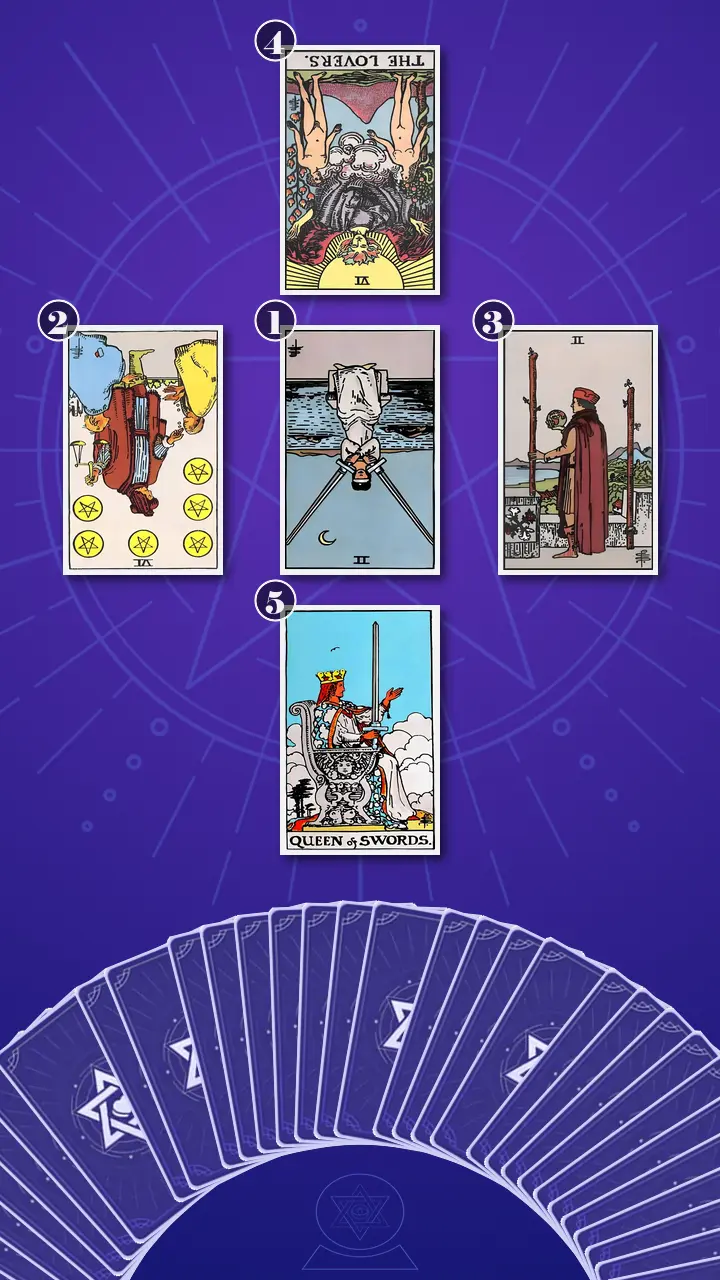
I chose a five-card Decision Cross tarot spread for comparing two career paths. When people ask how tarot works in my practice, this is what I mean: the cards provide an external structure for examining a problem that has become too crowded inside the mind. They do not predict which company will be perfect, guarantee a recruiter's reaction, or replace written terms, financial facts, and qualified advice.
The Decision Cross was the right map because Maya did not need ten more categories. She needed the smallest spread that could show the present decision knot, the pull of each offer, the hidden belief distorting the comparison, and the principle that could integrate everything into an accountable choice.
I placed the first card at the center for the cycle of comparing, drafting, deleting, and delaying. Above it would sit the hidden conflict between professional connection and personal direction. The cards to the left and right would compare the accepted offer with the emerging path. The final card below would become the decision compass: not an answer handed down to Maya, but a standard she could use herself.
The Blindfold Made of Browser Tabs
Position 1: Two Arguments That Cancel Each Other
Now I turned the card representing the present decision knot: the observable cycle of comparing, drafting, deleting, and delaying after the better path appeared. It was the Two of Swords, in reversed position.
I pointed to the blindfold and the two swords crossed over the figure's chest. Upright, this card can hold a difficult choice in suspension. Reversed, I read its Air energy as both a blockage and an excess: thought had stopped functioning as a useful instrument and had become armor. Maya was no longer missing the existence of another path. She was avoiding the moment when knowledge would have to become communication.
The card reproduced her Toronto kitchen almost exactly. Two email drafts stayed open. The accepted offer PDF occupied one tab, and the comparison spreadsheet occupied another. Whenever the emerging role scored higher on fit, Maya added a category, changed a weighting, or searched Reddit for another opinion. The spreadsheet looked like a decision tool, but it was being worn like the card's blindfold.
"More tabs will not turn imagined judgment into a fact," I said. "Which piece of information could still materially change your choice, and which thought is only another version of they might think I am unreliable?"
Maya did not nod. A short laugh escaped her, dry enough to catch in her throat. Her fingers stopped above the trackpad, her eyes moved across the open tabs as if she were seeing them from outside herself, and then her shoulders dropped by less than an inch. "That is painfully accurate," she said. "I am not waiting for information anymore. I am waiting for the guilt to disappear so I can move."
I let the sentence stand without correcting or brightening it. The Two of Swords was not accusing her of weakness. It was showing the short-term logic of the loop: no message sent meant nobody was disappointed tonight, the secure offer remained intact, and Maya received a few minutes of relief. The longer-term cost was that deadlines tightened while both paths became harder to assess calmly.
Position 4: The Warm Welcome and the Split Screen
Following the vertical axis of the spread, I next turned the card representing the hidden influence beneath the delay: the belief that preserving professional connection and following personal vision could not coexist. It was The Lovers, in reversed position.
I drew Maya's attention to the two figures standing apart beneath the angel, with difficult ground rising between them. The reversal showed a blockage in values integration. Maya had divided herself into two screen windows: the considerate professional who honors every welcome message, and the self-directed designer who wants to build a specific future. She was treating those identities as mutually exclusive.
On one side of her actual screen was a recruiter writing, "We're excited to have you." On the other was a product-design portfolio roadmap pointing toward the work she wanted to develop over the next several years. Her internal argument sounded like this: I want to be considerate, but I also want my direction to count. Guilt then performed a subtle edit. It changed that honest tension into a moral binary: stay and remain a good person, or leave and become selfish.
"The card is not asking you to choose connection or self-erasure," I said. "It is asking whether respect and self-direction can exist inside the same accountable decision. Someone may be disappointed, and you can still communicate with care. Those are not contradictory facts."
Maya's thumb tightened against the edge of her mug, then slowly released. Her gaze moved away from the cards and settled on the dark kitchen window. "I think I have been trying to make a choice that proves I am good and prevents anyone from losing anything," she said. "That choice does not exist, does it?"
"Not in the form your mind is demanding," I replied. "A choice can be thoughtful without being lossless."
After twenty years of listening to decisions unfold beside cooling coffee, I have learned to notice this particular silence. It often arrives when a person realizes that preserving approval and preserving integrity are not always the same task. I thought of Alice asking which road to take before naming where she wanted to go. No outside voice, including mine, could define Maya's better path until she named the destination for herself.
Position 2: The Invoice Nobody Sent
Now I turned the card representing the pull of the accepted offer: its security, its reciprocity concerns, and the perceived professional debt that made withdrawal feel morally dangerous. It was the Six of Pentacles, in reversed position.
The figure on the card holds scales while distributing coins. In Maya's modern version, the scales had become a moral spreadsheet. Every recruiter call, interview, introduction, welcome note, and onboarding task appeared as another line item on an invoice nobody had actually sent. The reversal showed an excess of obligation accounting and a blockage in balanced reciprocity.
I did not minimize the practical side of the accepted role. Toronto rent was real. Maya had a limited savings buffer, and a stable salary deserved a place in the comparison. Start dates, written clauses, financial thresholds, and administrative deadlines were concrete. But a future teammate's friendly Slack message was not a contractual term, and a recruiter's warmth did not transfer ownership of Maya's career.
"Warmth from a recruiter is not the same thing as a debt," I said. "Recruitment takes time on both sides. Their effort matters, and so does yours. We need to ask what was actually agreed, what your financial situation genuinely requires, and what repayment story guilt added afterward."
Maya inhaled through her nose and looked back at the recruiter thread. "They were so kind," she said quietly.
"You are allowed to appreciate that kindness," I replied. "The goal is not to make it meaningless. The goal is to stop using it as evidence that your right to reassess has disappeared. If a written obligation exists, verify it. If a financial limit exists, calculate it. If sadness or guilt exists, name it as a feeling. Each deserves respect, but they do not all carry the same decision-making authority."
Position 3: The Portfolio Roadmap Beyond the Wall
Now I turned the card representing the pull of the emerging path: the concrete qualities connecting it to Maya's longer-term vision rather than to novelty or FOMO alone. It was the Two of Wands, upright.
The figure holds a globe and looks across a broad horizon while one wand remains fixed to the wall behind him. I read this upright Fire as available, balanced agency. The accepted role remained real and materially relevant. The emerging opportunity was not automatically better merely because it was new. Its purpose in the spread was to restore a future-facing question that guilt had pushed off the screen.
I asked Maya to translate better into observable language: What would she make? What would she learn? What would she earn? Which work aligned with her values? Which kind of interest could she sustain after the launch-week excitement wore off? The emerging role could then be examined as a direction, not romanticized as an escape route.
"Better has to become observable before it can become a direction," I told her. "Your product-design brain already knows this. A Figma roadmap cannot prioritize a feature because the stakeholder was friendlier in the meeting. It compares options by the outcome they support. Google Maps cannot recommend the better route until you enter a destination."
That metaphor changed her posture. I saw a small lift through her chest, followed by a cautious crease between her brows. "So my internal OS needs a destination, not another review thread," she said. "I am not asking who deserves my loyalty. I am asking what direction I am actually choosing."
"Exactly," I said. "And direction still includes rent, compensation, timing, and risk. Values-aligned does not mean financially vague. It means all options meet the same written criteria instead of one option being scored by facts and the other by somebody's imagined reaction."
When the Queen of Swords Gave the Decision One Edge
Position 5: A Clear Standard and an Open Hand
The room became quiet enough for me to hear the faint click of Maya's radiator through the call. Now I turned the card representing the integrating decision compass: the standard and communication posture that could support an accountable choice without requiring guilt to disappear first. It was the Queen of Swords, upright.
The Queen held one sword vertically instead of crossing two swords over her chest. Her gaze was uncovered. Her other hand remained open toward the horizon. I read that balanced Air as clear-eyed discernment, a self-authored boundary, and direct communication that could remain respectful without becoming a request for permission.
In everyday terms, the Queen looked like one clear decision recorded in a project tracker, followed by a brief Slack or email update. After checking the written offer terms, timing, financial reality, and three personal criteria, Maya could state her decision, acknowledge the inconvenience, and ask for the next administrative step. She did not need to add four paragraphs whose hidden job was to persuade the recruiter that she was still a good person.
Until that moment, Maya had treated the choice as if one perfect explanation could make both teams approve, protect her rent, secure her growth, and erase regret. Her mind demanded certainty before action, although no remaining fact could promise a painless response.
This was where I used the lens I call Analysis Paralysis Deconstruction. I stripped each abstract what-if down to an immediate test: Can Maya verify this constraint, or is she rehearsing a reaction she cannot control? Then I used Complexity Reduction to give the clutter a clean binary. A concern belonged either to evidence and present constraints, or to an imagined verdict. Feelings could be honored in both categories, but only verified information could claim the authority of fact.
An accepted offer is not a moral chain; use clear criteria, make an accountable choice, and communicate it with the clean edge and open hand of the Queen of Swords.
For a beat, Maya did not relax. Her breath stopped halfway in, and her fingers remained suspended above the keyboard. Then her focus drifted past the card, as if she were replaying every night she had rewritten the same apology. Her eyes widened, the muscles beside her mouth tightened, and a flash of anger entered her voice. "But doesn't that mean I did all of this wrong?" she asked. I told her no. The delay had protected her from immediate discomfort; it had simply reached the point where its cost exceeded its usefulness. Her fist loosened against the table. She exhaled from deep in her chest, her shoulders finally descending, and her eyes turned glassy at the edges. Relief arrived, but it was followed by a brief, almost dizzy blankness. A clear path meant she would have to own a choice without controlling how everyone received it.
"Now, with this new perspective, think back to last week," I invited her. "Was there a moment when this insight could have made the decision feel different?"
"When the teammate sent the welcome message," Maya said after a pause. "I treated their excitement as a command. I could have appreciated it without letting it answer for me."
"That is the Queen's open hand," I said. "You can acknowledge the inconvenience without handing your direction to the other person's reaction. Respect can sound like a clear answer, not a paragraph of self-defense."
I named the crossing we had just witnessed: from guilt-driven career paralysis and imagined professional judgment toward explicit, values-aligned decision-making and respectful, self-authored communication. It was not total certainty. It was the first movement from using thought as armor to using thought as a tool. The tarot cards had not chosen an employer for Maya. They had made her existing pattern visible enough for her to choose deliberately.
The 24-Hour Coffee Bean Filter
I gathered the spread into one coherent story. A demanding job search and a stable accepted offer had given Maya a real need for security. The reversed Two of Swords showed that her present strategy was preserving both options by postponing both conversations. The reversed Six of Pentacles explained why the accepted role felt binding: practical value had fused with an assumed personal debt. The Two of Wands restored the horizon. The Lovers reversed exposed the hidden split between being considerate and being self-directed. The Queen of Swords turned those competing pressures into one standard and one bounded message.
The spread's central metaphor was simple: Maya had been gripping the signed invitation so tightly that she could not examine the open door. Her cognitive blind spot was the belief that commitment could only be respected through continuation. The transformation was not from loyalty to selfishness. It was from acceptance as an irreversible moral verdict to acceptance as a meaningful professional agreement that could be reviewed against new facts, actual terms, and her stated direction.
To make that shift practical, I adapted my Coffee Bean Filter Protocol. For the next twenty-four hours, Maya would sort the decision the way a filter separates what belongs in the cup from what clouds it. "Emotional noise" would not mean fake, silly, or disposable. It meant a feeling or imagined reaction that deserved acknowledgment but could not impersonate a contract, a bank balance, or a career criterion.
- Run the Actual Commitments versus Assumed Debt filter. Within the next 24 hours, open the signed offer beside a blank document. Write each reason for staying on a separate line, then place it under one of two headings: Absolute Must-Haves and Actual Commitments, or Emotional Noise and Assumed Debt. Keep written terms, deadlines, start dates, compensation, rent, and savings needs in the factual column. Place predicted judgment, warm messages treated as obligations, and the need to be universally approved in the second. Set a 10-minute timer. The minimum version is one verified fact and one assumed fear. Mark unclear contractual language for a qualified local employment adviser instead of filling the gap with forum opinions.
- Complete one Three-Criteria Career Compass. During one 20-minute calendar block, choose three observable criteria that define a genuinely better role for the next two years, such as work scope, learning direction, compensation and stability, values, or sustainable interest. Score both roles once using job descriptions, interview notes, and written terms. Finish the page with: "The path I am choosing is the one that best supports ___, ___, and ___ under the facts I currently have." Do one pass only, and do not change the categories when one option becomes uncomfortable. If one material fact is missing, identify that single question and stop.
- Write the Clean-Edge Career Message. In a notes app, draft four sentences: state the decision, thank the contact, acknowledge any inconvenience, and ask for the correct next administrative step. If Maya chose to withdraw, she would send it after checking the applicable terms and timing. If she chose to stay, she would send a clear confirmation instead of continuing to delay both sides. Read the message aloud once. Remove any sentence whose only purpose is to prove good character or control the recipient's response. Choose a specific send window before the relevant deadline.
I reminded Maya that these actions were not a ritual for producing a painless outcome. A recruiter might be disappointed. A better-aligned role could still involve trade-offs. The point was to make the decision with open eyes, grounded criteria, and realistic financial attention, then communicate promptly enough that her behavior reflected the respect she wanted to preserve.

A Week Later: The Quiet Proof
Six days later, I received a message from Maya. She had verified the written terms, calculated the minimum stability she needed for Toronto rent, and completed the Coffee Bean Filter without opening Reddit. Once the emerging offer was confirmed in writing, her three criteria pointed toward it. She chose that path herself and sent the first organization a four-sentence withdrawal email.
She sent it at 9:06 a.m., then sat alone in a cafe while a flat white cooled beside her. Relief arrived first; sadness followed three minutes later. Neither feeling was asked to reverse the decision.
"I did not feel completely clean or certain," she wrote. "But I felt honest. This morning my first thought was, what if I got it wrong? Then I opened my criteria instead of a career forum, and I could still stand behind the choice."
I did not read her message as proof that the Queen of Swords had predicted the future. The cards supplied a visible language for a hidden conflict. Maya supplied the verification, judgment, communication, and courage to act. Her Journey to Clarity ended not with universal approval, but with enough self-trust to let practical responsibility and personal direction occupy the same life.
When you keep reopening the same offer email with your jaw clenched, part of you may be trying to protect both the relationship and your sense of worth, even as staying quiet makes your own direction harder to hear. Noticing that split means you are no longer standing at the beginning of it.
If one written criterion could speak more clearly than the imagined verdict in a recruiter's inbox, what small truth would you want your next message to carry in the Queen's open hand?
This story is adapted from psychological research, written so that those in a similar struggle can see their own pattern in it — and find their next step clearly.These insights are not a substitute for professional psychological, medical, legal, or financial advice.
Learn more about our Journey to Clarity.
How did this insight land for you?
🫂 This Resonates Deeply
🌀 Living This Story
✨ Now I See Clearly
🌱 Seeing New Possibilities
🧰 Useful Framework
🔮 The Confirmation I Needed
💪 Feeling Empowered
🚀 Ready for My Next Step
Author Profile
 AI
AI“For twenty years, I’ve listened to stories unfold over the warm aroma of coffee. I don’t believe life’s complexities always require grand theories to be solved; often, we just need a safe place to tidy up our reality. I don’t offer high-minded preaching—just grounded, heartfelt insights to help you regain your sense of control amidst the clutter of daily life.”
In this Choice Tarot Reading :
Core Expertise
- Analysis Paralysis Deconstruction: Stripping away abstract 'what-ifs' to focus strictly on the grounded realities and immediate constraints of your options.
- Complexity Reduction: Tidy up cluttered decision parameters into a clean, practical binary choice.
Service Features
- The Coffee Bean Filter Protocol: A 24-hour pragmatic sorting exercise to physically categorize decision variables into 'Absolute Must-Haves' and 'Emotional Noise', instantly restoring decisiveness.
Also specializes in :
Explore Related Patterns:
Approval-Driven Decision ParalysisMaya knows which role fits better, yet her hand stops over the withdrawal draft whenever she imagines who might be disappointed. Leaving the message unsent protects her from possible disapproval for one more night, so delay becomes a defense against the social meaning of the decision rather than a response to missing facts. When approval becomes an unstated condition for action, you can remain tied to an option that no longer matches your direction. The pattern does not mean you lack judgment. It means your judgment has been made behaviorally dependent on receiving permission from reactions you cannot know or control.
Emotional ReasoningMaya says she is no longer waiting for information. She is waiting for guilt to disappear so she can move. Recruiter kindness and a teammate's welcome then feel like proof that leaving would be wrong, even though neither message changes the written agreement, her finances, or the work each role contains. Emotional reasoning occurs when the force of a feeling is mistaken for evidence about reality. You can respect guilt as information about care and social impact without granting it the authority of a contract or career criterion. Until that distinction is made, feeling bad about a choice can quietly become the same thing as believing the choice is bad.
Moral PerfectionismMaya searches for a choice that proves she is good, protects both teams, preserves security and growth, and removes regret. She also keeps revisiting the apology, as though the perfect explanation could make every person approve and leave no emotional cost behind. Moral perfectionism turns an ordinary trade-off into a character examination. You are no longer only choosing between roles. You are trying to produce a lossless decision that certifies your goodness. Because no real career choice can meet that standard, delay feels safer than accepting the normal residue of sadness, inconvenience, and uncertainty.
Analysis ParalysisMaya keeps two drafts open, changes spreadsheet weights when the emerging role scores higher, and searches for another forum opinion after the relevant choice is already visible. The tools still look analytical, but their function has shifted from improving the decision to postponing the discomfort of communicating it. Analysis becomes paralysis when thought is used as armor against an emotional consequence that information cannot remove. You may feel busy and responsible while the loop is active, yet each extra category only delays the point where evidence must become action. The useful audit is whether a specific missing fact could materially change the choice or whether more research is buying temporary relief.
Boundary DiscernmentMaya revisits the teammate's welcome message and recognizes that she treated their excitement as a command. She can now appreciate the welcome, verify the actual agreement, and still keep authority over the direction of her career. Boundary discernment separates care from compliance. You can acknowledge another person's effort and possible disappointment without becoming responsible for preventing every reaction. That distinction makes room for respectful reciprocity because both parties' time and interests count, while neither party's warmth creates ownership of the other's future.
Black-and-White ThinkingMaya divides the screen between the considerate professional who honors every welcome message and the self-directed designer who wants a particular future. Guilt turns that genuine tension into a harsher binary in which staying proves goodness and leaving proves selfishness. Black-and-white thinking removes the middle position where respect and self-direction can coexist. When your mind accepts only morally clean continuation or selfish withdrawal, an accountable change of course becomes almost impossible to recognize. Restoring nuance does not erase inconvenience. It allows you to see that another person can be disappointed while your decision remains thoughtful, bounded, and professionally communicated.
Uncertainty ToleranceMaya sends the withdrawal without feeling completely clean or certain. Relief arrives, sadness follows, and doubt returns the next morning, but none of those feelings is asked to reverse the decision. She opens her criteria rather than reopening the career forum. Uncertainty tolerance means acting from sufficient evidence without demanding emotional certainty or control over the outcome. You can own a choice while allowing regret, sadness, and another person's disappointment to remain possible. The goal is not to feel nothing. It is to keep unresolved feeling from automatically reclaiming decision authority.
Values-Based Decision MakingMaya translates better into observable questions about work scope, learning direction, compensation, stability, values, and sustainable interest. She then limits the comparison to three written criteria and scores both roles without changing the categories when one result becomes uncomfortable. Values-based decision making gives your own direction a visible place in the evidence rather than asking guilt or novelty to speak for it. The criteria do not guarantee a painless or perfect outcome. They create an accountable standard you can revisit when doubt returns, allowing practical needs and longer-term purpose to influence the same choice.
Assertive CommunicationMaya reduces the withdrawal message to four functions. She states the decision, thanks the contact, acknowledges inconvenience, and asks for the next administrative step. She then sends that four-sentence email after checking the written terms and confirming the emerging offer. Assertive communication allows your answer to remain respectful without turning it into a defense of your character. A concise message accepts responsibility for clarity and timing while leaving the recipient free to have their own response. The boundary becomes externally visible because you communicate a decision instead of asking the explanation to secure permission for it.
Reality TestingMaya places written terms, deadlines, compensation, rent, and savings needs in a different category from predicted judgment and warm messages. She verifies what can be verified and stops using forum opinions to fill gaps that belong to a contract, a financial calculation, or qualified advice. Reality testing lets you honor a feeling without letting it impersonate a fact. A recruiter's warmth can matter emotionally while carrying no contractual authority, and a fear of being judged can be understandable without becoming evidence that judgment has occurred. This separation restores thought as a decision tool instead of an instrument for rehearsing imagined verdicts.
Explore Related Struggles:
Agreement-Agency SplitMaya keeps the accepted offer PDF open like a completed moral verdict. Although the emerging opportunity introduces new information, examining it feels incompatible with respecting the commitment she has already made. Acceptance therefore changes function inside the decision. It no longer marks a meaningful agreement with specific terms and consequences; it appears to transfer authority over Maya's next move and turns reassessment into a threat to her identity as a reliable professional. When you experience commitment as the surrender of future agency, any better path that appears afterward can feel illegitimate before it is evaluated. Seeing the agreement in concrete terms allows accountability and ongoing authorship to occupy the same decision.
Autonomy Guilt BindMaya divides herself into the considerate professional who honors every welcome message and the self-directed designer who wants to build a specific future. Once those identities are placed on opposite sides of the choice, selecting a career direction also feels like selecting what kind of person she will be. That moral framing makes autonomy costly. Moving toward the better-aligned role activates the possibility of disappointment, while staying offers temporary protection for her professional image at the expense of her stated direction. When your right to choose feels legitimate only if nobody is inconvenienced, guilt becomes the price charged for self-direction. Seeing the bind clearly lets consideration remain part of your communication without giving another person's response ownership of your path.
Guilt-Evidence FusionWhenever the emerging role scores higher, Maya adds another category or searches for another opinion about how withdrawing might be perceived. The imagined verdict that she could look unreliable enters the spreadsheet beside written terms, compensation, rent, and career fit. Because another person's future reaction cannot be verified in advance, no amount of research can settle it. The comparison keeps expanding while guilt borrows the authority of evidence and makes one option answer to facts while the other must answer to a prediction. When you give anticipated judgment the same weight as a contract or bank balance, your decision remains tied to information that can never become certain. Distinguishing what is verifiable from what is emotionally significant restores clarity without requiring you to dismiss either category.
Invitation-Obligation FusionEvery recruiter call, introduction, welcome note, and onboarding task appears on Maya's internal ledger as something she owes back. A teammate's excitement is received as a command, even though nobody has explicitly said that appreciation removes her right to reconsider. Professional warmth then carries more authority than its actual function. Maya can value the kindness only by continuing with the role, so gratitude and career consent become fused inside the same response. When you experience an invitation as a debt, changing direction can feel like withholding repayment rather than revising a professional decision. Separating appreciation from obligation preserves the meaning of the welcome while returning written commitments and personal agency to their proper places.
Perfect Outcome LockMaya tries to find a choice that proves she is considerate, prevents either organization from losing anything, protects her rent, supports her growth, and removes future regret. She also searches for an explanation capable of making everyone approve of the result. No available option can satisfy that full set of conditions, so action is postponed until guilt disappears and certainty becomes painless. The decision remains open because the standard for closing it requires control over consequences and reactions that Maya cannot control. When you permit yourself to act only after every loss has been eliminated, responsibility becomes indistinguishable from perfection. Naming that impossible condition creates room for a thoughtful choice that can remain accountable even while uncertainty, disappointment, and trade-offs are still present.
Analysis ParalysisMaya keeps two email drafts open and repeatedly changes her comparison sheet whenever the emerging role scores higher. Each new category or career-forum tab delays the moment when her existing knowledge would have to become a communicated decision. The extra analysis briefly preserves both options and postpones another person's possible disappointment, but it cannot resolve a reaction that has not happened. More information therefore produces less movement, and the tightening deadline makes calm evaluation progressively harder. When you are caught in this structure, thinking has stopped serving only as a tool and has also become protection from the exposure of choosing. Recognizing that function allows you to ask whether a new fact could materially alter the decision or merely extend the pause.
Explore Related Emotions:
Approval AnxietyMaya's jaw locks whenever the cursor crosses the withdrawal draft, and every favorable score for the emerging role sends her searching for another opinion. No recruiter has condemned her, yet the possibility of being seen as unreliable begins to occupy the same mental space as written terms, salary, and role fit. When another person's imagined evaluation is granted the authority of evidence, you can feel watched by a verdict that has not happened. Approval Anxiety keeps the accepted offer emotionally binding because choosing your own direction appears to place your character, not merely your professional decision, under review.
Boundary GuiltA recruiter's warm thread and a teammate's welcome message become an invoice and a command in Maya's decision process. She does not merely appreciate their kindness; she begins to treat it as evidence that her right to reassess has disappeared. When appreciation and obedience become fused, your boundary can feel like an injury inflicted on someone else. Boundary Guilt keeps Maya tied to the accepted offer because a respectful no feels morally harsher than a self-silencing yes. Naming that feeling restores an important distinction: another person may be inconvenienced, while your right to make an accountable career decision remains intact.
Sunk Cost GuiltEvery recruiter call, interview, introduction, welcome note, and onboarding task appears on Maya's internal spreadsheet as a charge she must repay. The employer's effort is real, but the story shows no personal invoice and no agreement that appreciation requires continuing in the role regardless of new information. When prior investment is converted into a moral balance, you can feel guilty for reassessing even though both sides participated in the hiring process. Sunk Cost Guilt ties Maya to the offer by making departure feel like taking something she has not earned the right to keep, rather than revising a professional decision with care and accountability.
Certainty HungerMaya keeps searching after she can already name the better-fitting role. She wants one explanation to protect her rent, preserve both professional relationships, secure future growth, prevent regret, and leave everyone approving of the result. The search has shifted from material information to a guarantee that no available fact can supply. Certainty Hunger makes movement feel premature until every consequence has been neutralized. You remain tied to the accepted offer because its familiarity temporarily feels closer to certainty, even while the demand for a painless decision keeps certainty permanently out of reach.
Choice Paralysis OverwhelmWhenever the emerging role scores higher, Maya adds another category, adjusts a weighting, or opens one more forum tab. Her jaw locks at the draft, her fingers stop above the trackpad, and the information keeps moving inward while no message moves outward. Facts, fears, values, and predicted reactions have been crowded into one comparison process, so thought no longer produces usable movement. Choice Paralysis Overwhelm is the subjective pressure of knowing that a decision is becoming urgent while every attempt to settle it generates another layer to process. The feeling does not indicate a lack of intelligence; it reflects a decision space that has exceeded its useful capacity.
Alignment ReliefMaya turns better into three observable criteria, confirms the emerging offer in writing, and compares both paths against the same financial and professional standards. Her portfolio roadmap returns to the screen as a direction she can evaluate rather than a desire she must defend. Once practical responsibility and personal direction are allowed to occupy the same decision, the false contest between security and integrity begins to loosen. Alignment Relief is the felt release of seeing that your values do not have to replace facts; they can help organize them. The path becomes easier to inhabit because its rationale belongs to you and remains visible after the immediate pressure has passed.
Bittersweet ReleaseAt 9:06 a.m., Maya sends the withdrawal email and sits alone in a cafe while her drink cools. Relief arrives first, sadness follows three minutes later, and neither feeling is asked to cancel the decision. Letting go of the accepted role also means letting go of real security, genuine kindness, and a version of the future that had already begun to take shape. Bittersweet Release holds those losses alongside the space created by an honest choice. You do not need the sadness to disappear before the release is valid, and you do not need the release to erase what mattered about the path left behind.
Cautious Self-TrustSix days later, Maya verifies the terms, calculates the stability she needs, completes one criteria pass, and sends a four-sentence message. When doubt returns the next morning, she opens her criteria instead of a career forum and finds that she can still stand behind the choice. Self-trust here is not complete certainty or immunity from regret. It is the quieter experience of knowing that you used relevant facts, named your direction, and communicated without asking another person to authorize it. Cautious Self-Trust allows uncertainty to remain present without surrendering the decision back to the loudest imagined reaction.
Clarity ShockMaya's fingers stop when she hears herself say that she is waiting for the guilt to disappear, not for more information. Later, the clearer standard brings a flash of anger, a halted breath, and a brief blankness before her fist loosens and she exhales. Once the distinction between facts and imagined verdicts becomes visible, the old delay loses its protective explanation. Clarity Shock captures the disorienting moment when you can finally see what action requires and can no longer mistake postponement for investigation. The jolt is not a judgment on the time already spent; it is the felt impact of recovering a choice that had been hidden inside the loop.
Wrong Choice PanicMaya's breath stops when the path becomes clear enough to require action, and even after sending the withdrawal email, her first thought the next morning is that she may have got it wrong. She repeatedly searches for an explanation that could eliminate regret before choosing. A real decision closes one route without revealing every future consequence of the other. Wrong Choice Panic is the sudden internal alarm that treats uncertainty after commitment as evidence of error. You can know why a path fits and still feel pulled back toward the option that appears to protect you from having to own an unknowable outcome.
Explore Related Contexts:
Bounded Commitment TrialThe accepted offer PDF, written clauses, start date, recruiter messages, and onboarding activity do not all carry the same authority. Maya verifies the formal terms and financial requirements while recognizing that a friendly welcome remains part of the professional relationship rather than an unwritten transfer of control over her career. This creates a usable boundary around commitment. Acceptance remains meaningful because it requires timely review, honest notice, and attention to any actual obligation. It does not require Maya to treat every expression of enthusiasm as a permanent claim on her future labor. You can respect an agreement by identifying exactly what it contains and responding within those limits. That approach makes room for appreciation and inconvenience without turning either one into a request for permission to reassess new facts.
Career Stability Lock-InAfter a long search, Maya has secured a stable salary while carrying ongoing Toronto rent and only a limited savings buffer. The better-aligned opportunity appears after acceptance and at the start of onboarding, so changing direction would mean releasing the most immediate source of professional and financial certainty. That combination gives the first offer more weight than its role fit alone would justify. The lock is built from a real material asymmetry: one position is already documented and beginning, while the alternative must still be confirmed against compensation, timing, and minimum stability requirements. You can recognize this pressure without reducing it to indecision or treating security as a weakness. Naming the economic anchor makes it possible to ask which constraints are genuinely non-negotiable and which parts of the accepted role have acquired authority simply because they arrived first.
Cost-of-Living PressureToronto rent continues regardless of which portfolio direction Maya prefers, and her savings buffer is limited. The accepted offer already supplies a stable salary, while the emerging role must first be confirmed in writing and checked against compensation, timing, and her minimum stability threshold. This material pressure prevents the career decision from being a simple contest between personal meaning and social approval. Urban living costs give the secured role legitimate leverage because an employment gap or an inadequately documented alternative would carry immediate consequences for Maya's available choices. You gain more agency by calculating that constraint than by minimizing it. Once the required financial floor is explicit, stability can occupy its proper place as one criterion among several instead of operating as an undefined force that automatically closes every other route.
Reputation Locked ChoiceWhenever Maya's cursor crosses the withdrawal draft, she pictures the first employer deciding that she is unreliable or selfish. A recruiter's warm thread and a teammate's welcome message begin carrying the force of reputational evidence even though neither person has issued a threat, a demand, or a verdict. The accepted offer becomes locked through the social power of an anticipated professional judgment. Withdrawing is no longer evaluated only through written terms, timing, and inconvenience; it is made to stand as a public test of Maya's character. That shift gives people who have not yet reacted control over a decision they have not actually been asked to make. You can treat reputation as a real professional consideration without trying to pre-author everyone else's response. A clear, timely message protects the part of your reputation that remains within your control: whether your conduct is direct, informed, and respectful.
Sunk Cost Exit DilemmaRecruiter calls, interviews, introductions, welcome notes, and onboarding tasks appear on Maya's mental ledger as costs the first organization has incurred for her. Although no one sends an invoice, each completed step makes withdrawal look like an unpaid balance that can only be settled by staying. This turns a two-sided recruitment process into a one-way obligation. The employer's past effort is granted continuing authority over Maya's future placement, while her own interview time, preparation, and need to reassess new information receive less weight. The more activity that has already occurred, the harder it becomes to evaluate what either role offers from this point forward. You can acknowledge the inconvenience created by an exit without using continuation as the only acceptable repayment. Past investment explains why the decision carries weight; it does not determine which future work arrangement deserves the next portion of your time.
Values Alignment CrossroadsMaya's screen places a warm recruiter thread beside a portfolio roadmap pointing toward the work she wants to develop over the next several years. The accepted role supplies immediate stability, while the emerging role appears to support a clearer combination of work scope, learning direction, values, and sustainable interest. The decision becomes constructive when better is translated into observable criteria rather than treated as a feeling or an escape route. Compensation, rent, timing, and risk remain inside the comparison, but professional warmth is no longer allowed to score one option on a different scale from the other. You are establishing a destination before selecting a route. That does not guarantee a painless outcome, but it gives your decision a standard that can survive another person's disappointment and remain available when uncertainty returns after the message is sent.