Cold Takeout, Compassion Fatigue, and the Limit She Finally Sent

The 9:40 p.m. Voice Note: Guilt-Driven Overlistening and Compassion Fatigue in a One-Sided Friendship Role
If you spend a Toronto customer-success shift de-escalating other people's problems, then see a six-minute voice note arrive before you have eaten and type “Of course” without checking your own energy, I suspect you will recognize the particular weight Jordan carried into our reading.
When my video call connected at 9:40 p.m., Jordan (name changed for privacy) was sitting on the edge of her bed in a shared Toronto apartment. Her open takeout container had gone cold beside her. The radiator clicked behind the wall, the third voice note in a WhatsApp thread glowed blue on her screen, and her phone looked hot enough in her palm to have been held for hours. I saw her jaw flex as she typed, “Tell me what happened next,” then deleted the unfinished sentence beneath it: “I only have ten minutes tonight.”
“I care about her,” Jordan told me. “I really do. But by the time she feels lighter, I feel completely emptied out. It is easier to stay on the call than deal with the guilt afterward.”
I heard the central contradiction immediately. Jordan wanted to keep listening because she cared; she kept listening because stopping felt like abandonment. Underneath both was the quieter fear that a limit might not merely disappoint her friend, but threaten Jordan's place in the friendship.
What Jordan called exhaustion had the physical weight of a Toronto winter coat soaked through: heavy across the chest, tight around the shoulders, and difficult to remove without dripping over everything else. Concern was still present, but guilt and resentment had become stitched into its lining.
“You can care about someone and still have no room for their pain tonight,” I said. “I am not going to use tarot to decide whether your friend is good or bad, or to predict whether the friendship stays exactly as it is. I want us to understand why your automatic yes arrives before your actual capacity gets a vote. Then we can give you that vote back.”
I placed both hands beside the deck and let the room settle around us. “Our journey today is about drawing a map through this fog, not handing your choices over to the cards. You will still be the person holding the pen.”

Choosing the Compass: A Seven-Card Relationship Spread for Friendship Boundaries
I asked Jordan to place both feet on the floor, loosen her jaw, and take one unforced breath before looking at the unread message again. I shuffled slowly while she held one question in mind: “Why do I keep listening when I have no emotional room left?” The pause was not a mystical test. It was a transition from reacting to observing.
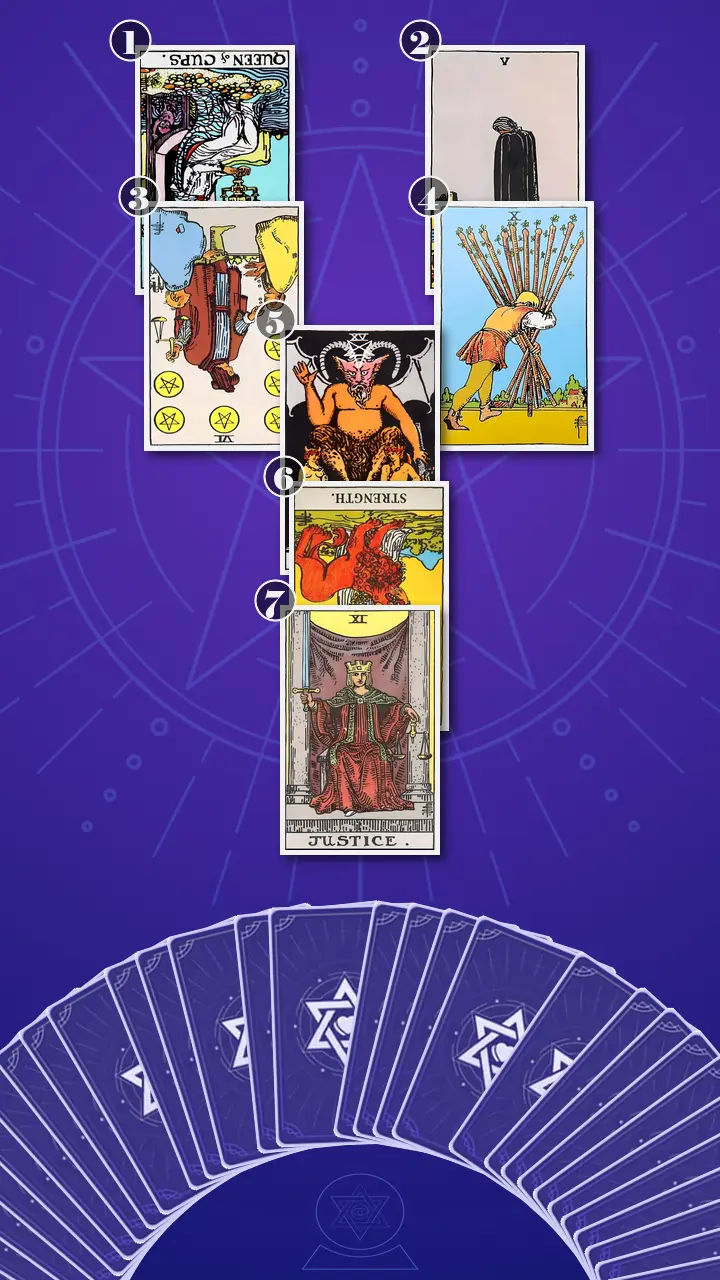
I chose the Relationship Spread · Context Edition, a seven-card relationship tarot spread designed here to examine friendship boundaries, emotional capacity, and reciprocity. I use this layout when a problem cannot be understood by looking at only one person's feelings, but I also want to avoid pretending that cards grant access to someone else's hidden motives.
For anyone wondering how tarot works in a reading like this, I treat the spread as a structured cognitive map. The first two positions separate Jordan's stance from the distress she encounters. The next two examine what she contributes and what she assumes the other person needs. The lower three cards narrow into a central spine: the binding rule, the challenge to changing it, and the part Jordan can integrate through her own choices. The cards offer symbols and questions; Jordan's lived evidence determines whether an interpretation fits.
I arranged the upper four cards as two relationship columns, then placed three cards down the middle. On my table, they looked like two streams narrowing into one channel. That shape mattered: the friendship contained more than one person's experience, but Jordan's point of agency would eventually have to become one clear, grounded action.
Reading the Two Streams Before They Narrow
Position 1: The Cup Held After Capacity Is Gone
“Now I am turning over the card that represents your current stance in this friendship, especially the depleted listening behavior and contracted state you described,” I said.
The first card was the Queen of Cups, reversed.
I angled the card toward the camera. The Queen held one ornate, lidded vessel in both hands while sitting at the edge of an immense body of water. “This Queen is still sensitive,” I explained. “Reversal does not cancel her compassion. It shows that receptivity has become saturated and poorly contained.”
I brought the image directly into Jordan's evening. She was the friend with the calm voice, careful questions, and emotionally safe replies, but her inner container was already flooded. She could open a long voice note after work, stare at unfinished dinner, and offer full attention without first checking whether she had twenty minutes, ten minutes, or zero minutes available.
The energy here was an excess of outward receptivity combined with a deficiency of inward attention. Jordan protected her friend's disclosure as if it were a sealed responsibility that must never spill, while her own dinner, sleep, attention, and physical signals remained uncovered.
“Why does your friend's distress count as urgent information,” I asked, “while your tight jaw and untouched dinner get treated as background noise?”
Jordan gave one short laugh, but there was no amusement in it. She looked away from the screen and rubbed the hinge of her jaw. “That is so accurate it is almost rude,” she said. “I ask customers about urgency and capacity all day. Then I get home and act like mine does not exist.”
“Your available energy is part of the conversation, not an inconvenient exception to it,” I replied. “The Queen is not asking you to become less caring. She is asking you to notice the condition of the cup before you offer to fill it again.”
Position 2: The Crisis That Fills the Whole Screen
“Now I am turning over the card that represents the distress as it is presented to you,” I said. “This position does not claim to describe your friend's entire personality or private inner life. It shows what reaches you in the interaction.”
The card was the Five of Cups, upright.
I pointed to the cloaked figure staring at three spilled cups while two upright cups remained behind. “The pain in this image is real,” I said. “The question is not whether your friend is genuinely having a hard time. The question is whether the conversation zooms in so tightly on the latest disappointment that every other person, time, tool, and form of support disappears beyond the edges of the screen.”
I connected it to the messages Jordan described. A conflict happened, the voice note arrived, and the crisis details filled the thread like the three spilled cups. When her friend said, “Nobody else understands,” Jordan heard not only distress but an assignment: respond now, stay available, and restore what had spilled.
The Five of Cups was upright, so I did not read its emotional energy as inherently wrong or blocked. I read it as concentrated. Grief narrows attention. In this friendship, that concentration was becoming excessive only when Jordan interpreted visible pain as proof that she must become the whole support network.
“The two standing cups matter,” I said. “They might represent another friend, a next-day call, journaling, professional support, rest, or simply a different stage of the conversation. The bridge in the card says there can be another route. You can acknowledge pain without promising to become the entire crossing.”
Jordan's fingers stopped moving over her phone case. “I never even ask whether she has spoken to anyone else,” she said. “The message sounds urgent, so I just step in.”
“That is an observable pattern,” I said, “not a character flaw. Staying until they feel better is not the only way to prove you care.”
Position 3: The Friendship Budget With No Visible Balance
“Now I am turning over the card that represents what you repeatedly contribute to the pattern, particularly the overgiving that helps you avoid immediate guilt,” I said.
The third card was the Six of Pentacles, reversed.
The figure on the card distributed coins with one hand while holding scales in the other. Reversed, the image asked a blunt structural question: who measures Jordan's remaining resources when Jordan is always the person deciding how much more to give?
I described the modern version already present in her week. Jordan took a forty-minute call, asked thoughtful follow-up questions, and postponed her own plans. When her friend briefly asked how she was doing, Jordan said, “I'm fine,” then returned to the crisis. Time, attention, and emotional labor moved outward, but her experience remained compressed into two vague words.
This was Earth energy in imbalance. The problem was not that every conversation had to be perfectly equal. Friendship is not a split bill calculated to the cent. The blockage was that there was no clear consent, no time limit, and no reliable space for Jordan's needs. She was giving from an account whose balance she refused to look at, then privately noticing the overdraft.
“I hate that I keep score afterward,” Jordan said. Her mouth tightened as soon as the words left it. “It makes me feel petty.”
“A hidden ledger often appears when a visible agreement is missing,” I replied. “Resentment is not proof that you are ungenerous. It can be evidence that you said yes with your mouth after your capacity had already said no. The goal is not scorekeeping. It is making the terms honest enough that you do not have to keep a secret account.”
Position 4: Carrying the Conversation All the Way Home
“Now I am turning over the card that represents what you perceive your friend to need from you,” I said. “I want to keep the wording precise because this card examines your assumption, not a hidden demand I can claim your friend is making.”
The fourth card was the Ten of Wands, upright.
I showed Jordan the figure carrying all ten wands at once. The bundle obscured the person's view even though the town was close. “This is what happens when agreeing to hear the first five minutes feels like a commitment to carry the entire conversation until the other person reaches relief,” I said.
In Jordan's life, the burden looked ordinary enough to escape notice. It was a postponed dinner, a deleted recovery block in Google Calendar, a planned bedtime moving later, or a TTC ride home spent replaying a voice note through one earbud. While she concentrated on completing someone else's emotional journey, she lost sight of options still nearby: a shorter text, a call tomorrow, a referral to another source of support, or a warm goodbye before the problem was resolved.
The card's Fire was in excess, but it was no longer vitality. It had become labor. Jordan was not only witnessing a burden; she was assuming that care required her to carry it to a destination.
“What evidence tells you that you must stay until she sounds better?” I asked.
Jordan was quiet long enough for the radiator to click twice. “She has never actually said I have to,” she answered. “But when she goes silent, I ask another question. I feel responsible for keeping it moving.”
“Then the pause may be where your assumption enters,” I said. “You can accompany someone for part of a road without taking every piece of luggage or guaranteeing where they arrive.”
Position 5: The Auto-Renew Contract Called “Good Friend”
“Now I am turning over the card that represents the central bond or unspoken rule turning voluntary listening into a self-reinforcing obligation,” I said.
The fifth card was The Devil, upright.
I saw Jordan's eyes move immediately to the chained figures. I brought the loose collars into the foreground before the card's heavier imagery could be mistaken for a prediction. “This card does not tell me that your friend is evil, that you are trapped forever, or that the friendship is doomed,” I said. “It names a compulsory pattern. The chains feel binding, but the image deliberately shows room to renegotiate them.”
I translated it into the moment a late-night notification became a command because an internal rule had been given administrator privileges. A voluntary act of care had started behaving like an auto-renew subscription to being the available friend: easy to begin, uncomfortable to cancel, and maintained by the fear that ending it might also end access to belonging.
This was the spread's primary blockage. I asked Jordan to listen to the private script that ran before she replied. She recited it almost without pausing: “If I do not answer, she will think I do not care. If I end the call, I am abandoning her. If I am a good friend, I stay.”
I call this kind of work Internal Monologue Auditing. As an artist, I listen not only to the words but to the genre the mind has assigned them. Jordan's internal monologue had turned an ordinary boundary conversation into psychological horror: one delayed reply became evidence of rejection, one disappointed pause became the possible loss of the whole relationship, and every scene ended with Jordan cast as the person at fault.
“A thought can be emotionally powerful without being externally verified,” I said. “The chain is real as an experience. The rule is still not the same thing as a fact.”
I watched Jordan's reaction unfold in three small movements. Her breath caught first. Then her gaze drifted past the camera as if she were replaying several late-night conversations at once. Finally, her fingers loosened around the phone, and she placed it face down beside the cold takeout.
“That is exactly what happens before I reply,” she said. “I skip straight from ‘She needs someone’ to ‘If I am not that person, I will lose her.’”
“Noticing the missing steps is how the collar begins to loosen,” I said. “You do not need to yank it off in one dramatic scene. You only need enough space to ask whether the old rule still deserves final-cut authority.”
Position 6: Gentle Strength Stops Silencing Itself
“Now I am turning over the card that represents the central challenge to changing this pattern: the belief that being gentle means tolerating more rather than speaking sooner,” I said.
The sixth card was Strength, reversed.
I focused on the woman's bare hands meeting the lion without force or a weapon. “Your calmness is real,” I told Jordan. “Your patience is real. The reversal shows that this gentle power is depleted and being turned against you. You use a soothing voice to keep your friend comfortable while spending equal effort suppressing your own instinct to stop.”
The card's energy was not absent. It was blocked by self-doubt. Jordan already possessed the exact communication skill she needed, but she had been using it only in one direction. At work she could set expectations during a customer escalation without becoming cruel. In friendship, she treated the same clarity as a threat.
Here I recognized a second pattern I call Persona Fatigue Diagnosis. Jordan had gradually been cast as the calm, perceptive person who was difficult to shock. That social character was not fake, but maintaining it without revision had become expensive. Her authentic self also got tired, needed dinner, wanted to talk about work, and sometimes had no wise follow-up question left. The problem was not that the “calm friend” persona was false. It had simply been given too many scenes and no off-hours.
“Strength would sound like this while the conversation is still manageable,” I said. “I care about you, and I have ten minutes tonight.”
Jordan inhaled, held the breath for a beat, and repeated the sentence. The first attempt came out apologetically, as if the words needed permission to exist. On the second attempt, her voice was still warm, but the end of the sentence did not rise like a question.
“That feels scary,” she said, then pressed her lips together. “But also cleaner.”
“That combination makes sense,” I replied. “A limit can be caring when it tells the truth before resentment has to do it for you. Guilt, heat in your face, or the urge to overexplain may still arrive. Those reactions are discomfort, not proof that the boundary is wrong.”
When Justice Raised the Missing Sword
Position 7: Both People's Needs Enter the Frame
The radiator clicked off, the room on Jordan's side became unusually quiet, and I turned over the card anchoring the bottom of the spread. This was the position of self-directed integration: the specific practice through which Jordan could relate more fairly without trying to control the friendship's outcome.
The card was Justice, upright.
I looked at the level scales in one hand and the upright sword in the other. The earlier cards had given us feeling, grief, resources, and effort, but no card from the Swords suit had appeared. Jordan had plenty of Water and labor. What was missing was direct language. Justice introduced that function with one blade held steadily in view.
Jordan was still caught in the thought that a good friend must produce the right emotional outcome. At 9:40 p.m., with the third voice note beside cold takeout, her friend's relief counted as evidence; her own disappearing bedtime did not.
You do not have to keep absorbing pain to prove your loyalty; make one clear capacity agreement, and let Justice's balanced scales hold both people's needs.
I let the sentence sit between us. On Jordan's phone, the bright message thread dimmed from inactivity. The cold dinner, the clock, and the unopened voice note remained in the same room, but Justice placed them back inside the evidence instead of leaving them outside the case.
As an artist, I had the familiar mental flash of an editing room. Jordan had been watching a cut of the friendship in which every frame showing her friend's pain remained, while every frame showing Jordan's commute, workday, hunger, and fatigue had been removed. Justice was not asking her to write the friend out of the film. It was restoring the missing footage so the next scene could be directed from the whole truth.
I watched the insight reach her in three stages. First, Jordan froze. Her breath stopped halfway in, her pupils widened, and one hand closed around the edge of her phone. Then her brow drew tight and resistance entered her voice. “But doesn't that mean I have been doing friendship wrong this whole time?” she asked, sharper than before. I did not rush to convert that anger into gratitude. “No,” I said. “It means a strategy that once helped you feel secure is now costing more than it protects. You were caring with the tools you trusted. Now you have more information.” Her eyes reddened without spilling into tears. Her shoulders lowered, her hand opened, and a trembling exhale escaped her chest. “So guilt can show up, and I can still stop?” she asked. Relief was there, but so was the vertigo of realizing that a clearer choice would also be hers to make.
“Now, using this new perspective, can you think of a moment last week when this insight might have made you feel different?” I asked.
Jordan described a Thursday call she had taken after cancelling a short walk. About twenty minutes in, she had started rubbing her jaw and checking the clock beneath the camera frame. “I thought the only options were to stay kind or become cold,” she said. “If I had thought in terms of an agreement, I could have said I had ten more minutes. I would not have needed to wait until I hated being there.”
I invited her to open the Notes app and write three lines: “What I feel,” “What I have capacity for,” and “What I can honestly offer.” I told her she could stop after the first line, send nothing, or choose the smallest version by waiting until morning. The exercise belonged to her; it was not another obligation disguised as self-help.
Justice's energy was balance, but not the brittle balance of making every exchange identical. It was fair-minded self-respect, reciprocal care, emotional consent, and calm clarity. In ordinary life, it meant asking what kind of support was wanted, naming the amount of time Jordan could offer, and treating “not tonight” as a caring answer rather than a moral failure.
This was the reading's decisive emotional shift: the first move from guilt-bound, automatic emotional availability to consensual, reciprocal care with clear limits. Jordan did not need to suppress her concern. She needed to stop treating concern as a contract that removed her right to choose.
The Director's Cut: Boundary Before Resentment
I drew the seven cards together into one story. Jordan's work and social role had trained her to enter difficult exchanges as the composed listener. The Queen of Cups reversed showed the present cost: she kept receiving after her container had filled. The Five of Cups showed genuine distress arriving from the other side, while the Six of Pentacles reversed revealed that time and emotional labor were leaving without clear measurement or reciprocity. The Ten of Wands exposed Jordan's assumption that she must carry each conversation to relief. The Devil named the guilt-bound identity contract beneath that assumption. Strength reversed showed that her gentleness had not disappeared; it had been recruited to silence her own protective instinct. Justice returned the missing resource: one honest sentence that allowed both people's realities into the frame.
The core metaphor was no longer a bad friend and a good friend. It was a door Jordan had kept holding open long after the room had reached capacity. The answer was not to slam the door or pretend nobody was outside. It was to check the room, state the available space, and choose when and how to open it.
I named the cognitive blind spot directly: Jordan had been treating guilt as evidence. If a boundary felt uncomfortable, she assumed it must be unkind. If her friend sounded distressed, she assumed the distress must be her assignment. Neither conclusion had been tested. The transformation direction was therefore practical: move from automatic emotional access to a capacity check, then state a specific listening window before the conversation expands.
I gave Jordan an editing tool from my own practice, The Director's Cut of Self-Compassion. When the punitive narration said, “A good friend would stay until she feels better,” Jordan could pause the scene and restore the context that self-criticism had cut: “I have listened carefully all day. I am hungry, my jaw is tight, and ten honest minutes is what I can offer without disappearing afterward.” This was not positive spin. It was a more accurate cut.
We translated the seven-card Relationship Spread · Context Edition into three small next steps. None required a dramatic confrontation or a perfect, guilt-free mindset.
- Run the 30-Second Capacity Check Before opening the next long voice note this week, Jordan will unclench her jaw, look at the time, and write one number in her Notes app: 0, 10, or 20. That number will represent the minutes she can honestly offer, not the minutes she thinks a good friend should manufacture. Tip: If the punitive inner voice starts directing the scene, use the Director's Cut and add one omitted fact, such as “I have been listening to people all day.” A private check still counts even if no message is sent.
- Use the Ten-Minute Care Agreement During one emotionally intense conversation, Jordan will say, “I can stay for ten more minutes, and then I need to stop for the night.” She will set a quiet timer labelled “care can have a limit,” then close with, “I care about you, and I am going to sleep now. I can check in tomorrow.” Tip: Heat, guilt, or the urge to add five explanations may appear. Jordan can treat those sensations as discomfort rather than a verdict, and she does not have to keep renegotiating after stating the limit.
- Make One Reciprocal Request Within the next week, Jordan will ask one trusted friend, “Do you have ten minutes to hear what happened at work?” She will notice whether consent, a time window, and room for her experience can exist without turning the friendship into a scorecard. Tip: Track only this one exchange. Reciprocity does not require equal support in every conversation; the experiment is about allowing Jordan's experience to become visible at all.
“These are tests, not commandments,” I told her. “You can shorten them, delay them, or decide a particular conversation needs a different response. Tarot has not issued a ruling about your friendship. It has helped us identify the variables your guilt was excluding. You decide what happens with that information.”
Jordan looked once more at Justice. “Care does not need an unlimited plan to be real,” she said, trying the idea in her own voice.
“Exactly,” I replied. “A boundary is not the opposite of connection. It is information that gives connection a chance to remain chosen.”

Four Days Later: The Quiet Proof
Four days after the reading, I received a message from Jordan. Another “Can I vent?” had arrived after she was already in bed. She ran the capacity check, chose zero, and wrote: “I care about you, and I do not have room tonight. I can check in tomorrow after work.” Then she put the phone face down.
Her friend replied, “Okay, tomorrow works.” Jordan did not present that response to me as proof that every future boundary would be easy. She said her stomach still tightened when she saw the notification, and she reread her own message three times before sending it. The difference was that she no longer treated the tightening as an instruction.
That night she slept through, but her first thought in the morning was, “What if I got it wrong?” She told me the old pinch of guilt was still there. This time, she smiled, reheated her coffee, and let the message wait until after breakfast.
I considered that the quiet proof of our Journey to Clarity. Jordan had not solved an entire friendship in four days. She had made one act of care consensual, time-bounded, and honest. The cards did not create that change. They gave her a clean frame in which to recognize the authority she already possessed.
I often think our lives are films still in production. Clarity is not always the final scene or a guarantee that everyone likes the next act. Sometimes it is the moment an exhausted character looks toward the camera, notices the old script in her hand, and realizes she is also the writer.
When I imagine someone staring at a late-night voice note with a clenched jaw, a warm phone, and dinner going cold, I know how easily wanting to be there can start to feel like the price of staying wanted. Merely noticing that bargain means the old contract is no longer operating completely in the dark.
So I want to leave the scales with you: if care did not have to be proven by staying until the other person felt better, what small, honest limit could you place beside their need the next time a long voice note lights your screen?