The 9:06 a.m. Figma Shrink
If you keep your cursor over Unmute while a confident coworker gets immediate engagement, then volunteer to revise their version after softening your own, you may recognize the pattern Maya brought to me: professional self-erasure disguised as collaboration.
At 9:06 on a Tuesday morning, before our reading, Maya sat at the small kitchen table in her Toronto apartment with a product critique less than an hour away. Her laptop fan hummed beside a cup of coffee that had gone cold. Blue screen light caught the edge of her notebook as she opened the team-facing Figma deck, deleted the strongest recommendation from the title slide, and replaced My recommendation is with Maybe we could consider a few options.
By the time she sat across from me that evening, she had both versions open on her laptop. Version 8 held the bold concept. Version 9, the one her team had seen, contained three carefully balanced options and no visible conclusion.
“I want them to improve the idea,” she told me. “I just don't want to take up too much space. If I present the full version and defend it, I worry I'll look difficult or self-important. So I make it smaller until everyone can get behind it.”
I watched her shoulders rise as she said the word difficult. Her throat tightened, and one hand moved to the base of her neck. What she called apprehension seemed to move through her like the sudden drop of a lift: brief, physical, and powerful enough to make every sentence reach for the nearest handrail.
“You are not confused about the idea,” I said. “You are calculating the social cost of letting people see that it is yours.”
She looked down at Version 8. “I keep calling it collaboration when I really mean permission.”
“Then I don't want the cards to tell you whether to become louder or quieter,” I said. “I want us to see the sequence clearly: what happens before you shrink the idea, what that protects, and what collaboration could look like if your contribution remained visible. Let's draw a map through the fog. You will decide what to do with it.”

Choosing the Shadow Spread: A Compass, Not a Verdict
I asked Maya to take one slow breath and hold the original question in mind: Why do I keep shrinking my ideas to look like a team player? I shuffled while she looked at the unedited slide. The pause was a focusing device, not a performance of mystery. It gave her nervous system a moment to arrive where her attention already was.
I chose The Shadow Spread, a five-card workplace tarot spread. This is how tarot works best in a career reading: not as a prediction of what coworkers will do, but as a structured external mirror. The cards give behavior, fear, defense, capacity, and action separate places on the table, making it easier to examine a pattern that otherwise arrives as one tight knot.
The spread suited Maya's question because the issue was not a lack of ideas or a simple choice between two options. A visible habit was being driven by a belonging fear and protected by a professional persona. The five positions could trace that complete chain without pretending to know how any specific colleague would react.
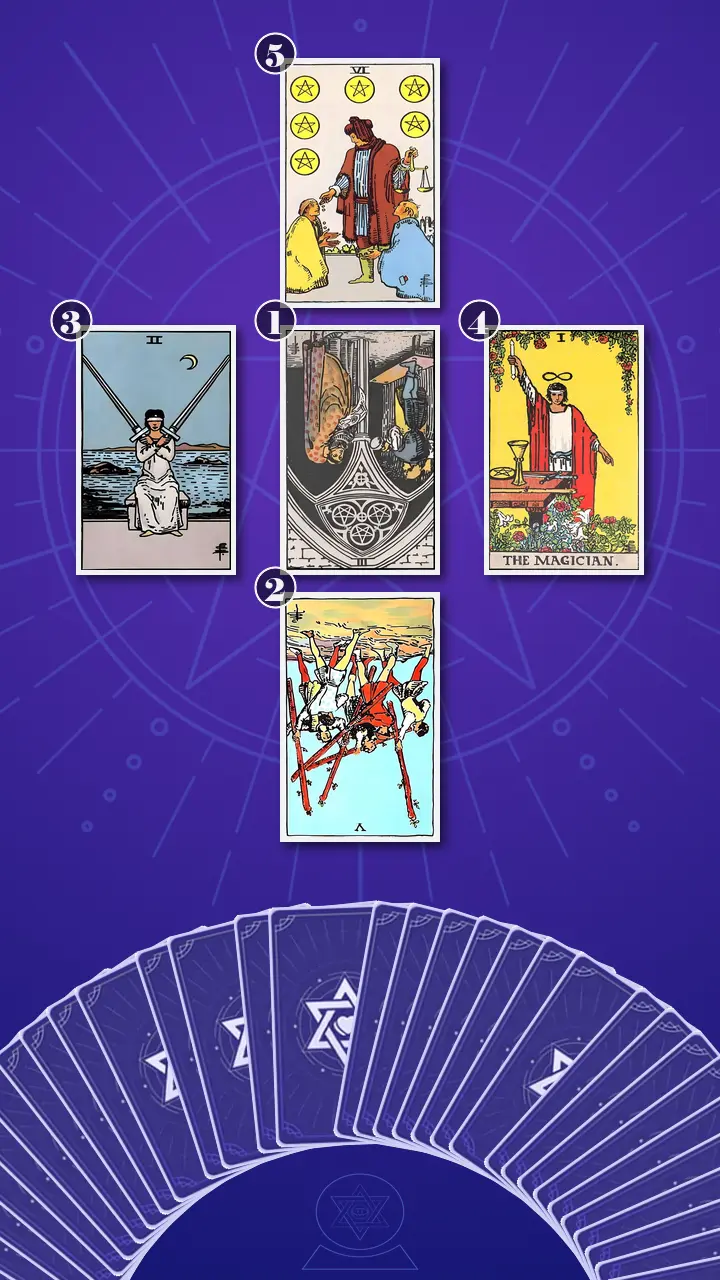
I placed the first card in the center for the behavior everyone could see. The card below would uncover the fear beneath it. The card to the left would show the protective mask; the card to the right, the reclaimed capacity. The final card above would translate the insight into reciprocal, everyday collaboration. Together, the cross resembled a compact compass, with contraction below and integration above.
Where Collaboration Became Disappearance
Position One: Skilled Work Beneath the Arch
Now I turned over the card representing the observable behavior: shrinking developed ideas, reducing their scope, and weakening their language to appear cooperative. It was the Three of Pentacles, reversed.
In the upright image, an artisan stands beneath an architectural arch while two other people consult a plan. Skill enters a shared structure and becomes part of something larger. Reversed, I saw blocked Earth and an overcorrection toward agreeableness. Maya was bringing developed product judgment into the room, then lowering its status before the team had a chance to use it.
“This is the moment in the Figma critique when you change My recommendation is to Maybe we could consider, remove the distinctive feature, and volunteer to handle the revisions,” I said. “The card is not questioning your skill. It is showing skilled work being placed beneath everyone else's imagined authority before discussion begins.”
The pattern reminded me of Severance, not as a diagnosis, but as a behavioral split. Private-draft Maya could be articulate, opinionated, and strategically clear. Team-facing Maya arrived with the authorship carefully removed, as though crossing into the workplace required a different script.
“When you open the next deck or team-channel draft, which exact sentence or feature do you reduce before anyone asks you to change it?” I asked.
Maya gave a short laugh that landed with more bitterness than humor. Her eyes stayed on the card while her thumb rubbed the corner of her laptop. “That's so accurate it feels a little brutal. I deleted the entire recommendation, then spent the meeting feeling annoyed that nobody discussed it.”
“The card is being precise, not cruel,” I said. “If the full idea never reaches the room, the response cannot tell you whether the idea had value. It can only tell you how people responded to the softened version.”
Position Two: The Objection That Became a Verdict
Next I turned over the card representing the underlying fear that visible disagreement or ownership would threaten professional belonging. The Five of Wands appeared reversed.
Five figures raise staffs in different directions, with no shared structure for the contest. Reversed, the Fire was not absent; it was blocked and driven inward. Instead of allowing different perspectives to become creative friction, Maya privately rehearsed the entire conflict and settled it against herself before anyone else had finished speaking.
I brought her back to a low-stakes roadmap meeting. A colleague had questioned one part of her onboarding concept. Maya had nodded before the objection was complete, said, “You are probably right,” removed the larger recommendation, and watched the faces on the video grid for signs of approval.
I wrote the sequence on a sheet between us: They raised one concern. They are deciding I am difficult. I should make the idea smaller.
“Only the first sentence describes what happened,” I said. “The other two are the belonging story your mind added at high speed. That story brings short-term relief because you can smooth the meeting. The long-term cost is that a real distinction disappears, and you leave carrying both the implementation work and the resentment.”
Collaboration is not pre-emptive self-erasure.
“What useful distinction would have been lost if everyone had agreed immediately in that meeting?” I asked.
Her breath paused. Her gaze moved away from the card as though she were replaying the video grid, then returned to the crossed staffs. Finally, her fingers loosened around the laptop edge. “The research showed users were hesitating at account creation. We ended up polishing the later screens instead because that was easier to agree on.”
“So the disagreement did not prove that your thinking was unwelcome,” I said. “It marked the exact place where the team needed a clearer question, stronger evidence, or a conscious decision. Suppressing the friction also suppressed that information.”
Position Three: Neutrality with Crossed Arms
I then turned over the card representing the protective mask of neutrality, flexibility, and non-attachment that concealed Maya's actual preference. It was the Two of Swords, upright.
The blindfolded figure holds two swords tightly across the chest. Rocky water waits in the distance under a crescent moon. I read the Air here as overcontained: not a deficiency of logic, but an excess of protective suspension. Maya already had enough information to choose, yet she used analysis to keep her choice inaccessible.
“This is you in a decision meeting after researching two product directions,” I said. “You present them as equally valid, say you're happy either way, and wait for somebody else to carry the risk of choosing. The blindfold is not ignorance. It is the preference you refuse to make visible. The crossed swords are carefully balanced language held over a vulnerable chest.”
I asked, “Where are you presenting two options as equal even though you already know which one you would recommend if nobody could judge your tone?”
Maya folded her arms, noticed herself doing it, and slowly unfolded them. “Our research plan. I know which method will answer the question. I called both approaches valid because the engineering lead preferred the faster one.”
“Neutrality can be ethical when the evidence is genuinely balanced,” I said. “But when neutrality is a shield, the team loses access to your judgment. You can be open to feedback without making your point of view disappear before feedback begins.”
When The Magician Put the Idea Back on the Table
Position Four: Authorship without Control
As I reached for the card on the right side of the cross, the rain against the window thinned and stopped. The radiator gave one last click. In the sudden quiet, I turned over the card representing the unclaimed capacity that could move Maya from imagined approval-seeking toward clear authorship and specific feedback.
It was The Magician, upright.
One hand raises a wand while the other points toward the ground. A cup, sword, pentacle, and wand rest on the table. This was balanced, coordinated energy: creative direction, emotional awareness, clear reasoning, and practical delivery made available at the same time. The Magician did not ask Maya to acquire another credential or wait for more permission. The tools were already present.
“In workplace language, this is a complete recommendation made usable,” I said. “You state: My recommendation is to simplify the onboarding flow because the research shows users are hesitating at account creation. Then you define the invitation: I want feedback on the strongest usability risk. The recommendation stays visible while the team examines a specific part of it.”
I used one of my core diagnostic lenses, Workplace Typecasting Analysis, to show her why this was larger than changing a sentence. I mapped the office ecosystem around her: her manager repeatedly praised reliability; her completed execution tickets were easy to see; her strategic decisions were scattered across meeting notes; and whenever disagreement appeared, she volunteered to implement the compromise. Over time, those repeated scenes had typecast her as the adaptable supporting player who made other people's direction work.
“The typecasting is not proof that your team has consciously decided what you are allowed to be,” I said. “It is a feedback loop. The environment rewards the role it can see, and your protective habits keep supplying more footage of that role. That makes the role durable, but it does not make it destiny.”
As an artist, I thought of an editing room. A supporting role can begin to look like a whole identity when every scene containing authorship is cut before the audience sees it. Leadership Narrative Construction begins by restoring one missing scene. It does not require Maya to become domineering. It requires her professional story to include visible judgment: I bring a researched point of view, I show the evidence, and I specify where other expertise can improve it.
I asked her to picture 8:47 p.m. on Line 1: promotion posts moving under her thumb, the bold private Figma draft open, the carriage rattling, and the phone warm in her hand. Relief at staying agreeable had been sitting beside resentment that nobody saw the real idea.
“The shift is not from being collaborative to being forceful,” I said. “It is from editing for imagined approval to offering one intact proposal with a clear invitation for specific critique. Your idea can remain fully yours when you present it and still become collaborative through what the team tests, adds, and changes.”
Teamwork does not require making yourself smaller; offer the idea in its full shape, then use The Magician's raised wand and grounded table to turn authorship into a clear invitation for collaboration.
For a moment, Maya stopped breathing. Her fingers remained suspended over the edge of her laptop, and her eyes moved past the card as if an old sequence of meetings were replaying on the wall behind me. Her pupils widened. Then her jaw set.
“But doesn't that mean I've been doing collaboration wrong for years?” she asked. Her voice sharpened, and a quick flash of anger crossed her face before her eyes began to shine. “I did all that work to be safe, and I helped make myself invisible.”
“I wouldn't call it wrong,” I said. “It was a protection strategy. It helped you avoid some painful exposure. We are only noticing that it now charges more than it gives back.”
She pressed her lips together. Her gaze softened first, then one hand slowly uncurled in her lap. Her shoulders dropped by a fraction. A long breath left her chest with a faint tremor, bringing relief and something more fragile: the slight dizziness of realizing that a clearer path also returned responsibility to her. The cards had not removed the risk of being seen. They had separated that risk from the certainty that visibility meant rejection.
I asked, “Now, using this new perspective, can you think of a moment last week when this insight might have changed how the situation felt?”
“The engineering lead questioned the rollout timeline,” she said after a pause. “I heard it as a rejection of the whole concept. But he only asked about rollout. I could have kept the recommendation and asked him to challenge the implementation sequence.”
“Exactly. A clear recommendation is an invitation to examine the work, not a demand for agreement.”
I set a ten-minute timer and asked her to write three lines in a private note: My recommendation is __. The evidence is __. The feedback I am actually asking for is __. I asked her to read only the first line aloud and notice her throat, shoulders, and breathing. She remained free to stop there; authorship became real the moment she let herself formulate the intact thought, whether or not she chose to share it.
This was the reading's pivotal movement: from apprehensive approval-seeking and guarded neutrality toward grounded authorship and reciprocal collaboration. It was not an instant personality change. It was one deliberate act of focused communication, using abilities Maya already possessed.
Position Five: Let the Work Change, Keep the Origin Visible
Finally, I turned over the card representing a sustainable practice of reciprocal critique, visible contribution, and balanced professional exchange. It was the Six of Pentacles, upright.
A standing figure holds level scales in one hand and deliberately distributes coins with the other. The card made the mechanics of exchange visible: who brings an idea, who offers evidence, who adds expertise, who receives recognition, and who carries the execution. Upright Earth restored the practical collaboration that had been distorted in the first card.
“This is not a promise that every workplace will distribute attention fairly,” I said. “It is a structure you can use to make the exchange more observable. You offer a developed proposal. You name the input you want. You record what the team adds. You keep your original contribution visible in the decision note. If the exchange remains consistently one-sided, that becomes useful information for your boundaries rather than evidence that you should disappear more completely.”
I asked her what balanced exchange would look like after the next critique: what she proposed, what others added, what changed, and what still remained her recommendation.
“I could write the decision summary instead of only taking the Jira tickets,” she said. Her voice was quieter now, but it no longer faded at the end of the sentence. “I could say the original proposal focused on reducing the first-step burden, and the team added a faster validation path.”
“Yes,” I said. “That is factual credit, not territorial behavior. Let the idea change through discussion without erasing where it started.”
The Protagonist Reframe for the Next Critique
I traced the whole spread for Maya. A belonging fear had taught her to turn down the volume before anyone said the music was too loud. That suppressed the Fire of useful disagreement, distorted the Earth of her skilled contribution, and froze the Air of her judgment behind neutral options. The need for belonging, the spread's mostly unspoken Water, influenced every edit without ever being named in the meeting. The Magician brought all four elements back to the same table, and the Six of Pentacles gave them a practical exchange structure.
The cognitive blind spot was the equation beneath the behavior: visible ownership equals control, smooth agreement equals collaboration, and discomfort means belonging is in danger. The cards showed a different structure. Maya could state a clear point of view without treating it as a command. Feedback could test the work without becoming a verdict on her place in the room.
“I can write the sentence here,” Maya said, tapping the private note. “But in the actual meeting, I might cave during the first two-second pause.”
“Then we design for the pause,” I said. “You do not need to feel fearless. You need a small script that remains intact while the discomfort moves through your body.”
I gave her The Protagonist Reframe Directive, my micro-behavioral strategy for disrupting an established subordinate persona. A protagonist does not control every other character or win every argument. She simply stops deleting her own line before the scene begins.
- Use one Full-Volume Recommendation.Ten minutes before the next cross-departmental product critique, duplicate the Figma deck and put one sentence at the top of a slide: My recommendation is to __ because __. Read it once from your speaker notes, present it to the product, engineering, and research group, and keep that sentence unchanged through the first round of discussion. End with one defined request, such as: I want feedback on the strongest usability risk.If the urge to add a disclaimer spikes, take one breath and read only the prepared sentence. You may stop after the first feedback round, move the discussion to writing, or revise later when evidence warrants it.
- Create a Visible Contribution Loop.Within ten minutes after one presentation, open Notion or the shared project document and add two headings: Open for feedback and Still my recommendation. Write one sentence beneath each, then send the team a factual decision summary naming what began in the original proposal, what colleagues added, and what changed.Keep the language descriptive rather than possessive. If sharing credit feels too exposed, begin with a private note and publish only the decision summary. The exercise should take less than ten minutes.
I told Maya that these were experiments, not loyalty tests and not obligations to disclose more than her workplace could handle responsibly. The purpose was to gather real information. Could the team respond to an intact idea? Could she remain present through a manageable disagreement? Could she change her mind because of evidence rather than because a pause made her throat tighten?

Six Days Later: The Sentence Still in the Deck
Six days later, Maya messaged me from Line 1. Station light slid across the dark window. She had kept one recommendation intact, asked for the biggest usability risk, and recorded the team's additions in Notion. She still replayed an awkward pause, but the original sentence remained in the deck.
I read the message twice. It did not say that every meeting had become easy, that career visibility anxiety had vanished, or that the team had suddenly recognized everything Maya could do. It offered something smaller and more reliable: the first piece of evidence that discomfort did not have to direct the edit.
The Shadow Spread had not handed Maya courage or predicted her coworkers' approval. It had made the production sequence visible: the belonging cue, the pre-emptive softening, the immediate relief, the missing contribution, and the resentment afterward. Once she could see that sequence from outside it, she could choose where to interrupt it. The pen remained in her hand.
That was Maya's Journey to Clarity: not certainty that the room would always respond well, but grounded confidence that she could let the room respond to what she actually thought.
When you hover over Unmute with your throat tight, trying to make a real idea sound harmless enough to preserve belonging, the relief of seeming easy to work with can sit beside the quiet grief of not being seen. Noticing that double feeling means the scene is already available for a different edit.
In your next conversation, if one idea could stay at full volume, which part will you place on The Magician's table and let the room examine without deciding in advance what their response says about your belonging?
This story is adapted from psychological research, written so that those in a similar struggle can see their own pattern in it — and find their next step clearly.These insights are not a substitute for professional psychological, medical, legal, or financial advice.
Learn more about our Journey to Clarity.
How did this insight land for you?
🫂 This Resonates Deeply
🌀 Living This Story
✨ Now I See Clearly
🌱 Seeing New Possibilities
🧰 Useful Framework
🔮 The Confirmation I Needed
💪 Feeling Empowered
🚀 Ready for My Next Step
Author Profile
 AI
AI“I’ve always felt our lives are films currently in production. As an artist, I know that when you feel stuck, it’s often because you’ve bravely stayed in a painful scene for just a little too long. I’m not here to coldly analyze you. I want to sit closely with you, look at those difficult moments with profound empathy, and gently hand you the pen so you have the courage to write your next beautiful act.”
In this Career Tarot Reading :
Core Expertise
- Workplace Typecasting Analysis: Identifying how your office ecosystem has boxed you into a marginalized or undervalued 'supporting role'.
- Leadership Narrative Construction: Rewriting the script of your professional identity to command authority and visibility.
Service Features
- The Protagonist Reframe Directive: A micro-behavioral script for your next cross-departmental meeting to instantly disrupt your established subordinate persona.
Also specializes in :
Explore Related Patterns:
Conflict AvoidanceNodding before the objection is complete, saying the colleague is probably right, and withdrawing the larger recommendation allow Maya to end the exposed part of the exchange quickly. The concession regulates the social discomfort of disagreement, but it also prevents the team from testing whether the objection concerns the whole idea, one assumption, or only its implementation. When you settle a disagreement against yourself before it has fully formed, immediate smoothness can feel like safety. The longer-term experience is less collaborative than it appears because useful distinctions disappear, the team's decision quality narrows, and you leave carrying work and resentment that an open discussion might have distributed differently.
People-Pleasing Resentment CycleSoftening the recommendation, volunteering to revise the compromise, and then feeling angry that nobody discussed the original idea form a complete behavioral loop. Agreeableness provides immediate relief and keeps Maya legible as the reliable team player, while the cost appears later as extra implementation work and missing recognition. When you repeatedly purchase belonging with self-reduction, resentment can emerge without an obvious external violation because part of the exchange remained unspoken. You gave the room a smaller contribution than the one you wanted recognized. The resentment is therefore useful evidence that the coping strategy protects social ease while abandoning a legitimate need for authorship and reciprocity.
Permission SeekingKeeping the bold recommendation in Version 8, presenting two approaches as equal despite knowing which one will answer the question, and waiting for someone else to choose show that Maya is not blocked by missing judgment. She is calculating whether the room has authorized her to make that judgment visible. When you treat collective comfort as permission to have a point of view, collaboration begins before your contribution has entered the room. Other people's imagined preferences become the gatekeeper for your expertise, and the team receives flexibility without access to the developed recommendation that flexibility was supposed to improve.
Rejection SensitivityMaya's rising shoulders, tightening throat, attention to faces, and hesitation over Unmute show how quickly ordinary professional exposure becomes physically significant. A limited objection or pause is not processed only as information about the work. It is experienced as a possible sign that visible ownership could threaten belonging. When your threat response assigns rejection-level meaning to low-information signals, shrinking the idea can produce powerful short-term relief. The protection is expensive because it makes anticipated exclusion more influential than the evidence in front of you, leaving your contribution governed by what the room might think rather than what anyone has actually said.
Workplace Self-SilencingDeleting the strongest recommendation, replacing direct language with tentative options, and removing the distinctive feature all happen before Maya's colleagues ask her to compromise. The edit functions as anticipatory protection. By making the contribution less identifiable as hers, she reduces the immediate risk of being seen as difficult, controlling, or self-important. When you silence a position before anyone can respond to it, the room can only evaluate the safer substitute. That can create a painful feedback loop in which your judgment remains unseen, the lack of recognition appears to confirm that you should stay small, and resentment grows around a contribution that never became publicly available.
Mind ReadingTurning one concern into "they think I am difficult," hearing a rollout question as rejection of the entire concept, and treating a short pause as a verdict all add conclusions that colleagues did not explicitly state. Ambiguity is filled with a belonging-based prediction, and that prediction becomes the evidence used to shrink the idea. When you respond to an inferred judgment as though it were an observed fact, colleagues' actual feedback loses its boundaries. A question about timing can become a judgment of your whole proposal, and a moment of silence can become a judgment of your place in the room. The resulting edit protects you from the verdict you imagined while preventing you from finding out what the signal really meant.
Assertive CommunicationKeeping one recommendation intact, stating the evidence behind it, and asking for the biggest usability risk give Maya's contribution a clear shape without turning it into a command. The prepared sentence carries her through the first pause, while the defined feedback request preserves a real role for colleagues' expertise. When you separate clear authorship from control, direct language no longer requires certainty or dominance. You can make your judgment visible and still remain open to revision. The boundary is practical because the recommendation names what you currently think, while the invitation names exactly where collaborative examination can begin.
Strategic VisibilityWriting the recommendation into the deck, distinguishing what remains her recommendation from what is open for feedback, and recording the team's additions in Notion make the contribution traceable across the decision process. Maya is no longer relying on colleagues to reconstruct authorship from scattered meeting notes or execution tickets. When you make the origin, evidence, requested input, and resulting changes observable, visibility becomes a work structure rather than a demand for attention. You can let the idea evolve without erasing where it began. That gives the team a more accurate view of your strategic judgment and gives you concrete information if contribution, recognition, and execution remain consistently one-sided.
Feedback IntegrationRecognizing that the engineering lead questioned rollout rather than the entire concept allows Maya to keep the recommendation while examining implementation separately. Asking for one defined usability risk and recording what the team adds give feedback an explicit target instead of letting it expand into a judgment of the whole idea or its author. When you preserve the scope of critique, changing part of the work does not require abandoning your original judgment. You can absorb stronger evidence, credit other expertise, and revise what needs revision while still knowing what you proposed. Collaboration becomes an exchange of information rather than a test of whether you are allowed to remain visible.
Reality TestingSeparating the colleague's actual concern from the added conclusion that Maya was being judged difficult exposes the difference between an event and the story built around it. Her later recognition that rollout timing was questioned, not the whole concept, gives that distinction a concrete workplace application. When you let the room respond to an intact recommendation, you gain evidence that a pre-emptive edit can never provide. You can observe whether feedback concerns the evidence, usability, sequencing, or something else, while also learning that bodily discomfort and an awkward pause do not automatically predict rejection. The result is clearer choice rather than forced optimism.
Explore Related Struggles:
Agreement-Agency SplitA colleague raises one concern about the onboarding concept, and Maya agrees before the objection is complete, removes the wider recommendation, and watches the video grid for approval. The meeting becomes smoother, but the research-backed distinction disappears before the group can decide whether it should shape the work. When you need agreement to confirm that you are collaborating properly, your agency can feel like a threat to teamwork rather than one of its inputs. You retain your place in the immediate consensus by withholding the judgment you were there to contribute, then carry the implementation and resentment created by that absence. The central tension is not cooperation versus dominance; it is whether agreement must be purchased by surrendering your capacity to influence the direction.
Permission ParalysisIn the research-plan meeting, you already know which method will answer the question, but you call both approaches equally valid after the engineering lead favors the faster one. In the roadmap discussion, you say "You are probably right" before the objection is complete, allowing another person's partial concern to determine the status of your entire recommendation. The blockage does not come from insufficient information. Your judgment remains intact in private, yet it cannot become an operative choice until the room appears to authorize it. A pause, preference, or question therefore carries more decision-making power than your preparation, leaving you active enough to revise and implement but unable to let your own recommendation stand long enough to be evaluated.
Self-Erasure ReliabilityMaya's manager repeatedly praises reliability, her completed tickets are easy to see, and she volunteers to implement the compromise whenever disagreement appears. Meanwhile, the recommendations that would show strategic ownership are softened, deleted, or scattered across meeting notes before they can become part of her visible professional record. When your dependability is repeatedly demonstrated through making other people's direction work, the supporting role begins to maintain itself. The workplace responds to the version of your contribution it can see, while your protective edits keep supplying more evidence for that limited role. Your capability has not disappeared, but reliability has become structurally tied to removing the scenes in which you originate, choose, and defend a direction.
Visibility-Safety SplitBefore the 9:06 critique, you delete the strongest recommendation, replace direct ownership with tentative options, and keep your cursor near Unmute while your throat tightens. The idea is already clear; the unresolved calculation concerns what being visibly attached to it might cost you in the room. That places professional visibility and interpersonal safety on opposite sides of the same decision. You can either let colleagues encounter your actual judgment or reduce your exposure before they respond, but the second option also prevents their reaction from providing reliable evidence about whether your authorship was ever unsafe. Recognizing this split separates the manageable risk of being seen from the untested certainty that being seen will cost you belonging.
Idea Ownership ErosionAfter Maya removes the recommendation, the team discusses only the softened version, and she volunteers to complete the revisions. The original thinking remains in a private draft while execution tickets, compromises, and later edits become the visible record of what happened. When you allow the work to change only after weakening its origin, collaboration cannot preserve a reliable trace of what you contributed. Your effort survives in the final product, but your authorship becomes progressively harder to locate, leaving recognition disconnected from the judgment that initiated the work. The issue is not whether an idea should remain untouched; it is whether the idea can evolve without its point of origin being erased from the exchange.
Research-Authorship SplitVersion 8 holds a bold concept, while the team-facing Version 9 offers three balanced options and no conclusion. The same split appears in the research plan: you know which method will answer the question, yet present both approaches as equal once another lead prefers the faster option. Your research still produces knowledge, but that knowledge becomes separated from visible authorship before it enters the shared decision. Colleagues can see the polished artifact and the implementation work without seeing the judgment that organized them, leaving your expertise present as labor but absent as direction. Naming this split makes it possible to distinguish genuine openness to evidence from the removal of your own evidence-based position.
Explore Related Emotions:
Approval AnxietyAt 9:06 a.m., you delete the strongest recommendation, replace direct language with tentative options, and feel your throat tighten around the possibility of appearing difficult. The idea itself is already clear; the uncertainty centers on how much social approval its visible ownership might cost. In the roadmap meeting, one concern makes you nod before the objection is complete and watch the video grid for signs that the room still accepts you. Approval Anxiety names that anticipatory scan for endorsement, and recognizing it lets you separate useful collaboration from the urge to secure approval before your work has even been examined.
Authorship AnxietyVersion 8 holds your bold concept, while Version 9 gives the team three carefully balanced options and no visible conclusion. You are not struggling to form a judgment; you are making that judgment harder to trace back to you. When a recommendation remains intact, it exposes more than an idea: it exposes you as the person willing to stand behind a professional point of view. Authorship Anxiety captures the physical and social charge around that ownership, while the later experiment shows that authorship can remain visible without becoming a demand for agreement.
Conditional Belonging FearA colleague questions one part of the onboarding concept, and you immediately hear a much larger message: the room may be deciding that you are difficult. The work question becomes a belonging question before the colleague has even finished speaking. Conditional Belonging Fear makes inclusion feel dependent on being easy to agree with, so disagreement carries more weight than its actual content supports. Once you identify that added meaning, you can let a timeline question remain a timeline question and decide what the evidence requires without treating every challenge as a verdict on your place in the team.
Consensus ReliefIn the roadmap meeting, you say, “You are probably right,” remove the larger recommendation, and watch the faces on the screen for signs of approval. The meeting becomes smoother immediately, giving your body a quick signal that the social danger has passed. That momentary settling is Consensus Relief, the reward that makes shrinking the idea feel protective even when it creates a later cost. Seeing the reward clearly matters because it explains why the pattern repeats: you are not choosing disappearance for its own sake; you are reaching for immediate social ease before the longer-term loss becomes visible.
Hidden ResentmentAfter deleting the recommendation, you spend the meeting feeling annoyed that nobody discusses it, then volunteer to implement the compromise. The room sees flexibility and reliability, while you privately carry the knowledge that the most important distinction never reached the conversation. Hidden Resentment grows in the gap between the accommodation others can see and the cost you absorb without naming. It does not prove that the team would have accepted the original idea, but it does reveal that repeatedly withholding your position and then carrying the execution leaves an emotional debt that smooth agreement cannot settle.
Self-Betrayal AcheWhen you say, “I did all that work to be safe, and I helped make myself invisible,” your voice sharpens and your eyes begin to shine. The pain comes from recognizing that a strategy built to protect your place also removed evidence of your judgment from the room. Self-Betrayal Ache names that inward sting without turning it into a moral failure. You made the edits for an understandable protective reason; the ache appears because the protection now conflicts with your need to be accurately represented, giving you a clear place to interrupt the sequence rather than punish yourself for having used it.
Unseen Effort GriefVersion 8 contains the researched concept, but the team receives Version 9 with its conclusion removed; afterward, your execution tickets remain visible while your strategic judgment is scattered across private drafts and meeting notes. You have done the thinking, yet the professional record mainly shows how well you support the direction that survives. Unseen Effort Grief is the quiet pain of contributing substantial thought without letting others encounter its full shape. The feeling is not resolved by demanding automatic credit; it becomes workable when you preserve a factual trail of what you proposed, what the team added, and what changed through genuine exchange.
Cautious Self-TrustSix days later, you still replay the awkward pause, but the original recommendation remains in the deck. You asked for the strongest usability risk, listened to what the team added, and discovered that discomfort could move through the meeting without automatically directing your edit. Cautious Self-Trust does not require certainty that the room will respond well. It grows from treating your researched judgment as something that may remain present while evidence is tested, allowing you to revise because the work improves rather than because a two-second silence makes you abandon your position.
Focused ConfidenceThe private note gives you three lines: the recommendation, the evidence, and the feedback you are actually requesting. Instead of trying to make the entire idea harmless, you define the part the team can examine and keep the central judgment visible. Focused Confidence comes from that precision, not from becoming louder or pretending to feel fearless. When you later record what began in the proposal, what colleagues added, and what changed, collaboration becomes a traceable exchange in which your contribution can stay visible without preventing the work from evolving.
Explore Related Contexts:
Praise as Performance ContractMaya's manager repeatedly praises reliability, her execution tickets remain highly visible, and she routinely volunteers to implement the compromise after disagreement. The recognition available to her is therefore concentrated around making other people's decisions workable. Praise can operate as a performance contract when it repeatedly rewards one narrow contribution and quietly establishes the behavior through which recognition remains accessible. The compliment may be sincere, but its organizational effect is to strengthen the role already on display while strategic authorship receives little comparable reinforcement. You can audit this contract by asking what conduct the praise is purchasing and which capabilities remain outside the reward loop. Reliability does not need to be abandoned; it can be joined by visible judgment so that approval for delivery no longer defines the full boundary of your professional value.
Workplace Identity FreezeMaya's manager repeatedly praises her reliability, her completed execution tickets are easy to see, and her strategic decisions are scattered across meeting notes. Whenever disagreement appears, she volunteers to implement the compromise, adding another visible scene in which she makes someone else's direction work. A workplace tends to recognize the contribution it can repeatedly observe. When authorship is removed before critique and delivery labor remains attributable, the supporting-player typecast becomes durable even without a conscious decision by the team to limit her. You encounter workplace identity freeze when your capability is broader than the role documented by your most visible actions. Mapping which work earns praise, which work enters the permanent record, and which scenes disappear can separate an accumulated organizational typecast from the actual range of roles you can perform.
Career Visibility ParalysisMaya deletes the strongest recommendation from the title slide, replaces a declarative sentence with tentative options, and sends Version 9 to the team while Version 8 remains private. The same split appears when she presents two research methods as equally valid despite already knowing which one she recommends. Team-facing artifacts determine which parts of professional judgment colleagues can evaluate, remember, and credit. When execution stays visible but the conclusion behind it is repeatedly removed, the workplace receives evidence of reliability without equivalent evidence of strategic authorship. You can recognize career visibility paralysis when your developed point of view exists in private but repeatedly disappears at the moment it could enter your professional record. Identifying the exact sentence, feature, or recommendation removed before feedback makes the obstruction observable and gives you a specific point at which to restore choice.
Conditional Belonging PressureBefore any colleague asks for a change, Maya replaces My recommendation is with Maybe we could consider, removes the distinctive feature, and watches the video grid for approval. In another meeting, one question about rollout becomes sufficient reason to withdraw the entire concept. Belonging becomes functionally conditional when continued acceptance appears to depend on smooth agreement, limited ownership, and rapid concession. The pressure does not require an explicit warning from a manager because Maya is already calculating the social cost and paying it through the shape of her contribution. You can examine this pressure by separating the observable workplace cue from the rule attached to it. A colleague's question, a pause, or a preference is real; the conclusion that your place in the room depends on immediate surrender remains a social rule that can be tested against what the team actually does.
Creative Ownership NegotiationMaya formulates a complete recommendation, connects it to research showing hesitation at account creation, and asks the team to challenge the strongest usability risk. She then distinguishes the original proposal from the faster validation path colleagues add. Creative ownership is being negotiated through the mechanics of exchange rather than through control over the final answer. Her point of view remains identifiable, while engineering, research, and product expertise can still alter how the idea is tested and delivered. You can preserve authorship by naming the recommendation, evidence, and requested input before the work begins to change. That structure allows you to revise because colleagues contribute relevant information, while keeping the origin of the judgment visible throughout the collaboration.
Safe Visibility TrialSix days later, Maya keeps one recommendation intact in the Figma deck, asks for the biggest usability risk, and records the team's additions in Notion. An awkward pause still occurs, but the original sentence remains available for colleagues to examine. The trial creates visibility with practical limits. A prepared sentence, a defined feedback target, and a written contribution record protect the distinction between presenting an idea and surrendering control of the entire interaction. You can use a safe visibility trial to gather evidence from a manageable act of authorship rather than waiting for universal confidence or guaranteed approval. The purpose is not to force disclosure in every room; it is to observe what happens when one intact contribution is allowed to enter the shared workplace record.
Collaboration Credit ImbalanceMaya contributes the research-backed concept, deletes its strongest recommendation, volunteers to revise the compromise, and leaves with the implementation work. Her Jira tickets remain easy to attribute, while the strategic origin of the work is dispersed across private drafts and meeting notes. The exchange becomes unequal because the team receives both product judgment and delivery labor, but only the downstream labor stays visibly connected to her. Credit does not have to be deliberately stolen for an imbalance to form; it can disappear through documentation practices that preserve changes and execution while losing the originating decision. You can make this structure legible without treating ideas as private territory. A factual record of what you proposed, what others added, and why the work changed allows collaboration to remain collective while preventing your contribution from becoming anonymous.