When Invisible Labor at Work Becomes Career Drift
If your hybrid workday begins with one self-directed priority and ends with meeting notes, repaired decks, and reminders for deadlines you do not own, you are not imagining the career drift created by office housework.
At 4:45 p.m. on a Tuesday, Maya sat beneath the fluorescent lights of her Toronto office with three Google Docs open. Stale coffee hung in the air. Her laptop fan pushed heat against her wrists while she corrected a meeting summary nobody had assigned her, updated a shared tracker, and sent reminders about deadlines owned by two colleagues.
Her own project brief was still untouched in the tab she had opened that morning. I watched her drag its calendar block to Friday for the third time. Her shoulders had climbed toward her ears, her eyes stung, and each breath stopped somewhere high in her chest. The exhaustion looked less like sleepiness than a browser running so many background processes that the one application she actually needed could no longer load.
“My calendar is full,” she told me, “but I cannot explain what I am building. I have become the person who catches everything, and none of it seems to count. If I stop helping, I worry the team will notice for the wrong reason.”
I let that last sentence settle before answering. “You keep the team moving, but your own direction keeps disappearing. You are not directionless; your direction keeps being interrupted. I do not want the cards to tell you whether to stay, leave, help, or refuse. I want us to make a clear map of what is consuming your attention, what keeps the pattern in place, and where your choice can re-enter it.”

Choosing a Compass for a Crowded Workweek
I asked Maya to put both feet on the floor, take one slower breath, and hold the question in plain language: “Why do I keep doing invisible office work and losing my direction?” I shuffled while she breathed. I treat this small ritual as a transition from reacting to observing, not as a performance of certainty.
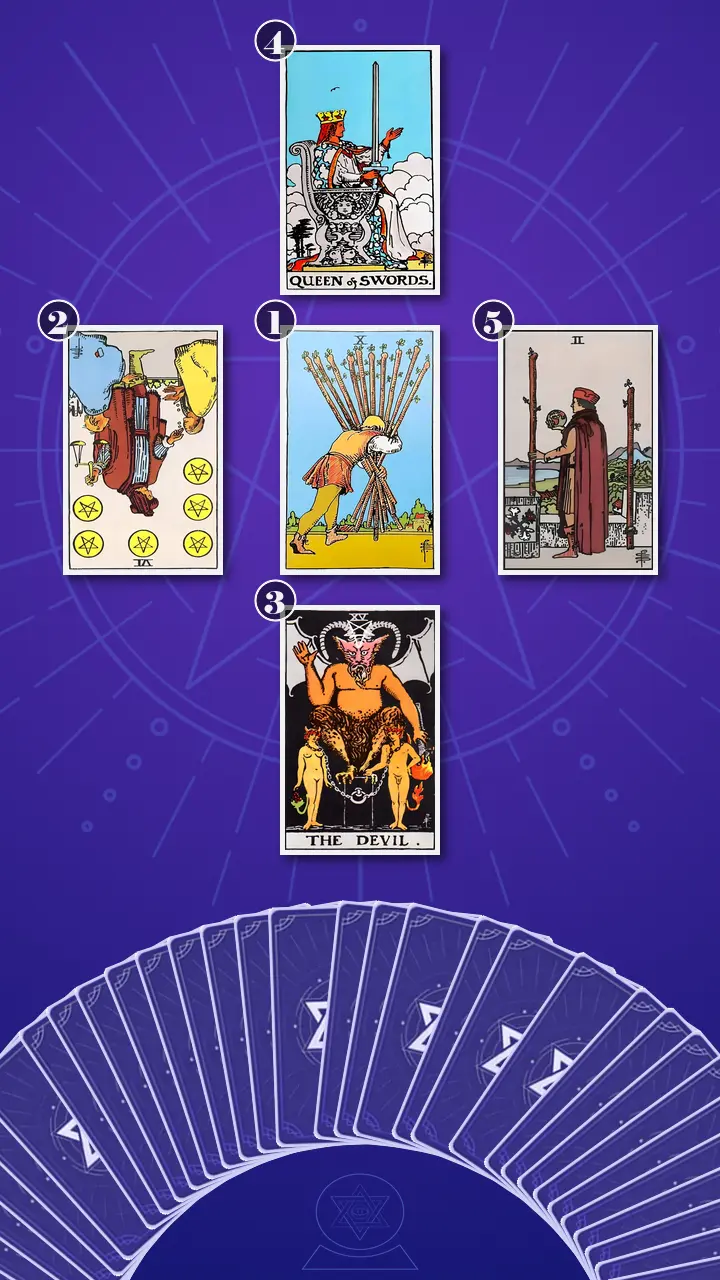
I chose the Five-Card Cross, a tarot spread for workplace boundaries, invisible labor, and career direction. I use it when a problem behaves like a loop rather than a single decision. A larger spread could have introduced more external factors, but five positions were sufficient to trace the present pattern, the obstacle maintaining it, the fear beneath it, the available resource, and the direction that resource could open.
For this reading, the center would show Maya's visible overload. The card to the left would examine the unequal exchange underneath that workload. The lower card would reveal why an unclaimed task felt personally dangerous to leave alone. Above the center, I would look for the capacity that could interrupt the reflex. The final card would point toward a practical direction, not a predicted workplace outcome.
Laid out in a cross, the cards resembled a compass whose center had become crowded by obligations. That was exactly the instrument Maya needed: not a verdict about her future, but a way to distinguish movement from direction.
Reading the Load That Hid the Road
Position 1: Ten of Wands, Upright
I turned over the card representing the observable pattern: Maya repeatedly carried unclaimed coordination work while her own priority disappeared from view. It was the Ten of Wands, upright.
I pointed to the figure bent beneath ten staffs, with the destination visible only beyond the bundle. “This is your 4:45 p.m. screen,” I said. “Meeting notes finished. Shared deck repaired. Routine questions answered. Other people's deadlines chased. Your brief is still blinking in its morning tab. You completed everything except the thing you said mattered.”
The Ten of Wands showed an Excess of fire: abundant action accumulated without selection. Maya did not lack discipline or motivation. Her energy had been fragmented across so many pieces of operational maintenance that the load itself obstructed her field of vision. The card's question was not, “How can you carry more efficiently?” It was, “Which of these wands became yours only because nobody else moved fast enough?”
Maya did not nod. She gave one short laugh, sharp at the edges, and looked away from the table. “That is painfully accurate. Honestly, it feels a little cruel.”
“I can see why,” I said. “The card is reflecting the cost of your competence, not accusing you of causing the whole system. Some of this work is structurally under-owned. What we are examining is the moment when noticing that gap becomes the same thing as adopting it.”
Position 2: Six of Pentacles, Reversed
I turned over the card representing the maintenance mechanism: support was being exchanged unevenly, while Maya's labor remained difficult to name, record, or evaluate. It was the Six of Pentacles, reversed.
I translated the tilted scales into workload accounting. Maya could spend two hours organizing the workflow behind a colleague's client presentation, yet the project plan still named that colleague as the owner. Her time survived in Google Docs comments, Slack reminders, and version history, while the visible deliverable and formal credit landed elsewhere.
The reversal showed an Excess of giving combined with a Deficiency of transparent terms. Time, ownership, and recognition were moving, but nobody was keeping a shared account of the exchange. I told Maya that this did not make every collaboration unfair. It meant she needed to distinguish reciprocal support from chronically unowned labor before resentment became her only source of information.
“Resentment can be the receipt for help that stopped feeling voluntary,” I said. “It does not automatically tell you to refuse. It tells you to inspect the exchange: who asked, who owns it, how long it will take, what it replaces, and where the contribution will be visible.”
Her fingers tightened around the cardboard sleeve of her coffee cup, then loosened. She stared at the reversed scales as if mentally searching her performance-review document again. “Most of what I do is in someone else's comment history,” she said. “I have been calling that teamwork because I did not know what else to call it.”
I also named the card's overcorrection risk. “Balance does not require you to reject every request or become unnecessarily sharp. The useful distinction is not helpful versus selfish. It is deliberate support versus automatic adoption.”
Position 3: The Devil, Upright
I turned over the card representing the fear beneath the visible workload: declining extra work might threaten Maya's worth, belonging, or professional safety. It was The Devil, upright.
I kept my attention on the loose chains around the figures' necks. During a Monday Zoom call, someone would ask, “Can somebody capture notes?” Two seconds of silence would follow, and Maya would open the template before anyone explicitly assigned it. The thought “If I see the gap, I have to fix it” felt like company policy, even though nobody had written it.
The Devil showed a Blockage created by attachment, not permanent imprisonment. Stepping in gave Maya immediate relief, a quick thank-you, and a temporary sense of control. Each repetition then trained the pattern like an algorithm optimized for rapid approval: being useful produced a reward, so her attention was shown more of the same work, even when that work no longer matched her goals.
“Being needed is not the same as being valued,” I said. “Being needed can feel safer because the evidence arrives immediately. Durable value is slower. It asks you to let people see your judgment, your priorities, and the work you chose to build.”
Maya's breath stopped. Her eyes lost focus as if the Monday silence were replaying behind them. Then her jaw released, and a low “Oh” left her chest.
“Nobody told me I had to do all of it,” she said. “But not doing it feels dangerous. Like I would be exposing that the helpful stuff is the only reason I belong there.”
I asked her to separate the fear from the instruction. The fear was real, especially in a broad role where temporary favors could become permanent expectations and financial stability mattered. But a real feeling was not the same as confirmed workplace evidence. The loose chain invited inquiry: “Is this an assigned responsibility, an organizational gap, or an old contract that says usefulness is the price of belonging?”
When the Queen of Swords Drew a Clean Line
Position 4: Queen of Swords, Upright
The room seemed to grow quieter when I reached the card above the center. Even the office sounds Maya had described felt briefly absent from our conversation. I turned over the card representing her available resource: discernment, explicit boundaries, and direct communication about priorities and ownership. It was the Queen of Swords, upright.
I saw the sword held in one precise vertical line and the Queen's other hand open to the world. This was not the energy of shutting everyone out. It was Balance: a clear criterion paired with continued receptivity. In Maya's workday, it sounded like this: “My priority today is finishing the project brief. Who owns this request, and what should move if I take it?”
Nothing in that sentence promised refusal. It interrupted the automatic sequence. Making one weekly priority visible and negotiating ownership, deadlines, and trade-offs before accepting extra support work allowed Maya's competence to appear as professional judgment rather than silent availability.
At that point, I used a lens from my own practice called Career Cycle Phase Identification. In career readings, I first separate three possibilities: a personal skill bottleneck, an industry-wide macro contraction, and an attention-allocation problem inside the current role. I do this because exhaustion can make every stalled career feel like personal inadequacy, while fear can make every organizational wobble feel like an approaching disaster.
From the evidence Maya had shared, I could not responsibly declare her company safe or predict an external outcome. I also saw no clear sign that a lack of ability was her immediate bottleneck. Her work demonstrated planning, responsiveness, and operational judgment every day. The more immediate problem was that those skills were being spent in forms that remained uncredited and left no room for a self-authored result. The Queen's sword did not forecast a promotion; it separated a presumed skill gap from a pattern of dispersed attention that Maya could begin testing now.
I brought her back to the moment that had framed the entire reading. At 4:45 p.m., the shared documents were repaired, the reminders were sent, and her own brief was still blinking in its morning tab. She had dragged it to Friday and wondered how a full day of competent work had left her with no clearer direction.
You do not have to carry every unclaimed task to prove your value; name what matters, state the boundary, and use the Queen of Swords' raised blade to separate responsibility from reflex.
Your direction is not missing; it becomes visible when every request stops receiving equal rights to your attention.
I left a few seconds around those words. Maya's breathing paused first, and her pupils widened as she looked from the upright sword to the bundle on the Ten of Wands. Her right hand hovered above the table, fingers held rigid, before settling against her palm. Recognition arrived, but relief did not arrive alone.
“But doesn't that mean I have been wrong this whole time?” she asked. The sentence came out tighter and louder than anything she had said before. Her eyes reddened, and her shoulders dropped with a movement that looked almost like losing balance after setting down something heavy. For a moment, the clearer path seemed to expose both the time she had lost and the responsibility of choosing differently.
“No,” I said. “It means a strategy that once helped you secure trust has become too expensive to run automatically. We do not need to shame the part of you that learned to be indispensable. We need to update its job description. A boundary can be a question before it becomes a no.”
I invited her to test the insight against memory. “Now, using this new perspective, think back to last week. Was there a moment when this could have made you feel different?”
She remembered a request to clean a client deck while her brief was due. She had assumed the deck was urgent because the message arrived with three exclamation marks. Nobody had named a deadline or asked her to own it. “I could have asked what should move,” she said, slowly. “I did not have to decide between being nice and being difficult. I could have asked them to make the priority visible too.”
I heard the shift in that sentence. It was not certainty, and it was not a complete career plan. It was the first movement from scattered exhaustion and compulsory usefulness toward deliberate contribution, visible priorities, and self-directed confidence.
The Horizon Beyond the Notification Feed
Position 5: Two of Wands, Upright
I turned over the final card, representing the direction available when the reading's guidance was integrated. It was the Two of Wands, upright.
I pointed to the globe held in the figure's hand and the view extending beyond the wall. In Maya's life, this was a protected 20-minute block on Friday afternoon. She would compare only two options for the coming week: one visible work outcome and one skill or portfolio outcome. She would choose one, give it a completion test, and place it in the first realistic focus block on Monday.
The Two of Wands restored fire in Balance. The Ten had dispersed her effort across many burdens; the Two concentrated it into selected possibility. This was not another Notion dashboard layered over an already crowded system. It was a deliberate zoom out from the notification feed to a one-week roadmap.
“I do not need my entire career figured out,” Maya said, looking at the card. “I need one choice that stays visible long enough for me to learn from it.”
“Exactly,” I replied. “Direction starts when one priority survives contact with the week.”
Her shoulders released a little more, though I still saw uncertainty in the way she pressed her lips together. Choosing one priority meant allowing another option to wait, and clarity often carries that small grief. The card offered perspective, not perfect confidence. Maya would remain free to revise the choice after gathering evidence.
Turning the Five-Card Cross Into Next Steps
When I read the spread as one story, I saw no shortage of ambition. The Ten of Wands showed Maya's existing energy scattered across office maintenance until the road disappeared. The reversed Six of Pentacles revealed an exchange in which time, credit, and ownership were poorly accounted for. The Devil exposed the private contract underneath it: if she noticed a gap and did not fix it, she feared her value might be questioned. The Queen of Swords offered conscious criteria, and the Two of Wands placed the recovered attention behind one chosen direction.
The spread's central metaphor was not a broken compass. It was a compass whose center had been covered by other people's luggage. Maya had been acting as the office's invisible control room, keeping every signal moving while losing sight of her own destination.
Her cognitive blind spot was subtle: she treated the discomfort of leaving a task unclaimed as evidence that taking it was the correct professional decision. The cards separated those two things. Discomfort could be noticed without being obeyed. The transformation was not from helpful to unhelpful; it was from compulsory usefulness to conscious contribution.
To test whether Maya's bottleneck was local workload design, a genuine skill need, or a wider organizational shift, I adapted my Micro-Orbit Observation. For 30 days, she would track small, observable movements rather than interpreting every difficult afternoon as destiny. I call invitations into visible work, sponsorship, funded projects, and increasing decision access “blueshifts.” I call repeated scope removal, unexplained exclusions, frozen resources, or disappearing ownership “redshifts.” One signal proves nothing. A pattern gives her better evidence for a manager conversation, a promotion strategy, or a measured career decision.
- Set the Visible Priority Anchor. On Monday morning, write one sentence on paper or in a pinned document: “My visible priority this week is ____.” Choose an outcome you can show, link, or describe by Friday. When a new request conflicts with it, use: “I can take this on. My current priority is the project brief, so which item would you like me to move?” Tip: Set a ten-minute limit. The priority does not need to represent your whole career; it only needs to guide one week.
- Run the Responsibility-or-Reflex Check. In the next low-stakes meeting where notes are unassigned, keep the document closed for ten seconds. Before accepting any request, take one full breath and ask who owns it, when it is needed, and what should move if you take it. Tip: You do not need to refuse or justify your entire workload. If direct negotiation feels unsafe, document the request and ask your manager for written prioritization.
- Begin the Micro-Orbit Observation. For 30 days, spend five minutes at the end of selected workdays recording the request, time spent, and priority displaced, plus any concrete blueshift or redshift. On Friday, use a 20-minute review to compare one visible work outcome with one skill or portfolio outcome, then protect one block for the option you choose. Tip: The minimum version is one logged day, two options, and one protected block. Treat the record as evidence, not as another perfect tracking system or a prediction of promotion or layoffs.
I reminded Maya that she controlled the size and risk of every experiment. If a boundary produced an interpersonal cost that felt disproportionate, she could pause, document what happened, and choose a different context. Tarot had clarified the pattern; it had not taken authority over her workplace judgment.

A Week Later, One Priority Survived
Seven days later, I received a message from Maya. During a planning call, the familiar request for notes had been followed by the familiar silence. She had kept the document closed for ten seconds. Her shoulders tightened, but she let the sensation remain a sensation. The facilitator then named an owner.
Maya used the reclaimed time to finish the first draft of her project brief and send it to her manager. She also added a short “coordination and enablement” section to her weekly update, naming the support work she had completed and the outcomes it enabled. She had not solved her career. She had created the first visible piece of evidence that her attention could return to something she had chosen.
That night, she slept straight through. Her first thought the next morning was, “What if they think I am difficult?” She told me she smiled at it, then opened the brief before Slack.
I think of that as the quiet proof from this Journey to Clarity. The cards did not rescue Maya or grant her permission. They helped her see the cycle clearly enough to make one different move. She remained the person steering her career, choosing when support was generous, when it was costly, and when a question could restore balance.
When the two-second silence in a meeting tightens your shoulders and makes an unclaimed task feel like a test of your value, I know it can be hard to tell where genuine helpfulness ends and fear begins. Simply noticing that hidden contract means your attention is no longer entirely inside it.
If your attention did not have to prove your worth for the next ten minutes, what small priority would you let survive the next Slack ping?
This story is adapted from psychological research, written so that those in a similar struggle can see their own pattern in it — and find their next step clearly.These insights are not a substitute for professional psychological, medical, legal, or financial advice.
Learn more about our Journey to Clarity.
How did this insight land for you?
🫂 This Resonates Deeply
🌀 Living This Story
✨ Now I See Clearly
🌱 Seeing New Possibilities
🧰 Useful Framework
🔮 The Confirmation I Needed
💪 Feeling Empowered
🚀 Ready for My Next Step
Author Profile
 AI
AI“After a decade of guiding people through the stars, I’ve come to see life much like the orbits of planets: everything has its inevitable cycles. When you feel lost, please don't blame yourself; you might just be in a natural low tide. I’m here to sit under the night sky with you, offering a gentle cosmic perspective to distinguish temporary pain from the beautiful breakthroughs just around the corner.”
In this Career Tarot Reading :
Core Expertise
- Career Cycle Phase Identification: Determining if your current bottleneck is a personal skill gap or an inevitable industry-wide macro contraction.
- Promotion Window Calibration: Mapping the trajectory of organizational shifts to locate the path of least resistance for advancement.
Service Features
- The Micro-Orbit Observation: A 30-day tracking strategy to detect subtle organizational 'blueshifts' (opportunities) and 'redshifts' (layoff risks).
Also specializes in :
Explore Related Patterns:
Defensive OverfunctioningAt 4:45 p.m., Maya is correcting an unassigned meeting summary, updating a shared tracker, and chasing deadlines owned by colleagues while her own brief remains untouched. Acting before anyone explicitly asks her closes operational gaps and reduces uncertainty, but it also turns competence into a defensive routine that keeps expanding her workload. When you repeatedly become the person who catches everything, overfunctioning can feel safer than waiting for ownership to become clear. The pattern is not that you care too much or work too well; it is that immediate intervention has become the default way to manage ambiguity, even when the intervention quietly removes time from the work that would show your judgment and direction.
Emotional ReasoningA deck request arrives with three exclamation marks, and Maya assumes it is urgent even though nobody states a deadline or asks her to own it. In meetings, bodily tension rises during a brief silence and she responds by opening the notes template before responsibility has been assigned. When you treat discomfort as proof that a task must be yours, an emotional signal is converted into a factual conclusion. Emotional Reasoning makes the reflex feel professionally necessary because fear, urgency, and responsibility become fused; separating the feeling from the available evidence creates room to ask what is actually required before acting.
People-PleasingWhen a meeting goes silent after someone asks for a note-taker, Maya opens the template before anyone assigns the role. The action brings immediate relief and often a quick thank-you, while leaving the task untouched raises the fear that the team might notice her for the wrong reason. When you use automatic helpfulness to reduce the risk of disapproval, support stops being a fully chosen contribution and becomes a way of managing belonging. People-Pleasing is maintained by that short reward cycle: stepping in resolves the social tension now, but repeatedly teaches other people and your own attention that your availability can be assumed.
Purpose OutsourcingMaya's calendar is full, but she cannot explain what she is building, and the project brief she selected that morning is moved to Friday for the third time. Unowned requests and colleagues' deadlines repeatedly determine where her attention goes, even though they do not represent the direction she wants to test. When externally generated demands keep deciding what survives your week, purpose becomes outsourced to whoever produces the next visible need. Purpose Outsourcing does not mean you have no direction; it describes a loop in which your direction receives attention only after everyone else's signals have been answered, leaving too little continuity for a self-authored outcome to take shape.
Conditional Self-WorthMaya says that not doing the helpful work feels dangerous because it might expose that usefulness is the only reason she belongs. No one has formally given her that condition, yet immediate requests provide fast, visible proof that she is needed, while recognition for her own judgment arrives more slowly. When your professional worth depends on remaining useful at all times, an ordinary workload decision can feel like a referendum on whether you deserve your place. Conditional Self-Worth keeps the invisible labor cycle running because protecting your priority is experienced as risking value, not simply allocating limited attention.
Boundary DiscernmentDuring the next planning call, Maya keeps the notes document closed for ten seconds instead of automatically adopting the task, and the facilitator names an owner. She also recognizes that a deck request carrying three exclamation marks did not establish ownership, a deadline, or a reason to displace her brief. When you pause long enough to check who owns a request, when it is needed, and what must move, a boundary becomes a decision criterion rather than an automatic refusal. Boundary Discernment allows you to remain collaborative while separating genuine support from reflexive responsibility, returning choice to the point where the old cycle usually takes over.
Explore Related Struggles:
Utility-Belonging FusionDuring the two-second silence after someone asks for a note-taker, Maya opens the template before anyone assigns the job. She later names the pressure underneath that move directly: leaving the gap alone feels as though it could reveal that helpful work is the only reason she belongs. Stepping in produces immediate proof that she is needed, while the value of her judgment and self-directed work arrives more slowly. Repetition turns usefulness from a contribution she can choose into an entry requirement she feels compelled to keep paying. You can care about the team and still be caught where protecting your attention feels like risking your membership. Seeing that hidden condition creates room to test whether belonging actually depends on constant utility, rather than allowing every moment of silence to answer the question for you.
Inner Compass OverloadAt 4:45 p.m., Maya has three shared documents open and moves her untouched project brief to Friday for the third time. Her calendar records continuous activity, yet she cannot explain what she is building because the priority she chose that morning never remained visible long enough to guide the day. Direction is being crowded out rather than absent. When every request receives equal access to attention, the fastest signal repeatedly overrides the slower work of choosing, building, and gathering evidence from a sustained priority. You may still have a clear preference beneath the crowded week, but a compass cannot direct movement while obligations keep covering its center. Recovering direction begins with giving one chosen outcome enough protected continuity to survive incoming demands and show you where your effort can lead.
Recognition-Progress SplitMaya can spend two hours organizing a colleague's client presentation while her contribution survives only in comments, reminders, and version history. The finished deliverable moves forward under someone else's ownership, and the brief that could show her own judgment remains untouched. Her work is useful enough to advance the team but too hidden to advance her narrative. Support and progress separate: one consumes the day and produces immediate operational value, while the other requires visible, attributable work that never receives protected time. You can finish a full day of consequential work and still have little evidence of what you are building. That gap can make career movement feel inaccessible even when your competence is visible everywhere except the systems that assign ownership and recognize progress.
Responsibility-Authority SplitMaya updates the shared tracker, chases deadlines owned by colleagues, and organizes the workflow behind another person's presentation. She carries responsibility for successful delivery, but the authority to define ownership, negotiate priorities, and receive formal credit remains elsewhere. That division makes her competence costly. The more responsibility she absorbs, the less control she has over where her workday leads, and her own brief becomes the item that can always be moved. You can appear highly dependable while remaining unable to protect the work attached to your own direction. The struggle is not a lack of effort; it is being held close to outcomes you must support while being kept at a distance from the authority that would let your effort build a career path.
Short-Term Maintenance TrapMeeting notes get completed, decks get repaired, trackers get updated, and other people's deadlines receive reminders. Each intervention closes a small operational gap, but Maya reaches the end of the day with her own project still waiting in its morning tab. Maintenance rewards her quickly through restored order, reduced uncertainty, and visible appreciation. The same reward keeps drawing attention back into work that preserves the present while consuming the time required to create a different future. You can become exceptionally effective at preventing disruption while making no durable movement toward what matters to you. The trap is structural because every individual task looks reasonable; its cost becomes visible only when the successful fixes are viewed together and compared with the work they repeatedly replace.
Explore Related Emotions:
Conditional Belonging FearTwo seconds of silence follow the request for a note-taker, and Maya opens the template before anyone assigns the work. The speed of that movement shows how little room exists between noticing a gap and feeling personally responsible for closing it. You are not only responding to a practical need in that moment; you are trying to prevent the silence from turning into a judgment about your usefulness. Conditional Belonging Fear is the sense that your place remains secure only while you are immediately helpful. Being needed supplies fast evidence that you matter, so allowing a task to remain unclaimed can feel much riskier than its actual scope would suggest. Naming that feeling separates a genuine workplace request from the private test of worth that has become attached to it.
Grounded AgencyDuring the next planning call, Maya keeps the notes document closed for ten seconds even as her shoulders tighten. The facilitator names an owner, and the time Maya would have surrendered remains available for her brief. You regain influence here through a small, observable pause rather than through a dramatic refusal or a perfect career decision. Grounded Agency is the felt return of choice at the point where physical tension once triggered automatic action. Asking who owns the task, when it is needed, and what should move gives your judgment somewhere concrete to operate. The tension can remain present without controlling the outcome, allowing your boundary to function as information rather than as a battle.
Invisible Labor DreadMaya's time remains visible in comments, reminders, and version history, while the formal deliverables continue to carry someone else's name. She can see evidence that she worked all day, but the organization has no equally clear language for recognizing what she held together. You may begin to experience each new request as another place where your effort could disappear without reducing what others expect from you. Invisible Labor Dread grows from that combination of dependence and erasure. The work matters enough that its absence might be noticed, yet it remains too diffuse to support your own direction or demonstrate your value cleanly. What weighs on you is the prospect of remaining necessary in practice while becoming increasingly difficult to see on paper.
Scattered OverwhelmAt 4:45 p.m., Maya has three Google Docs open, heat pressing against her wrists, and several pieces of coordination work competing for completion. Her own brief is still untouched after being moved for the third time. You can be working continuously in this state while feeling that the part of your attention capable of choosing, sequencing, and building has become unavailable. Scattered Overwhelm names the inner weather created when every small obligation stays active at once and no priority receives enough uninterrupted attention to become meaningful progress. The sensation is not simply having too much to do. It is the loss of a usable center from which you can decide what deserves your energy.
Unseen Effort GriefMaya can trace her contribution through repaired decks, document comments, deadline reminders, and workflows that now run more smoothly. The finished presentation still belongs to the named colleague, while her own brief remains a blinking tab. You can know that your effort was real and still struggle to find an outcome that lets you recognize yourself in the workday. Unseen Effort Grief holds the ache of watching skill and time become useful without becoming legible. It is not a demand for praise after every act of support. It is the accumulated sense of loss that forms when your contribution repeatedly helps other people produce visible work while leaving you with fewer artifacts, fewer claims, and less evidence of the direction you meant to build.
Cautious Self-TrustThe morning after Maya sends the first draft, the thought that colleagues may find her difficult returns. She notices it, smiles, and opens the brief before Slack. You are not waiting for every concern to disappear before treating your own priority as worthy of attention. Cautious Self-Trust develops through limited choices that remain open to evidence. You can ask for prioritization, observe the response, and revise your approach without surrendering your judgment in advance. The confidence is deliberately modest: one priority, one protected block, and one decision that stays visible long enough for you to learn whether your direction can hold.
Directionless UrgencyMaya's calendar is full, the requests keep arriving, and her own brief is repeatedly moved forward without being opened. Every action has an immediate reason, yet the completed actions do not combine into an answer when she asks what she is building. You can move quickly all day and still feel increasingly detached from any destination you would have chosen. Directionless Urgency is the pressure to keep responding without a stable criterion for what should survive the week. Motion temporarily protects you from the discomfort of an unclaimed task, but it also blocks the slower work through which direction becomes visible. Your direction has not necessarily vanished; it has been denied enough uninterrupted time to leave evidence.
Resentful ExhaustionMaya reaches late afternoon with her shoulders near her ears, her eyes stinging, and other people's deadlines still occupying her screen. The strain is intensified by the fact that the work was not clearly assigned, negotiated, or credited. You are spending real energy, but you never receive a clean moment in which you can decide whether that expenditure is still yours to offer. Resentful Exhaustion appears when sustained helpfulness no longer feels fully voluntary. The resentment does not automatically mean that every request is unfair or that collaboration should stop. It tells you that the exchange has become difficult to consent to because ownership, time, tradeoffs, and recognition remain unspoken while the physical cost continues to accumulate.
Unburdened HopeSeven days later, Maya has finished the first draft of the brief and sent it to her manager. She has not solved her career, but she now possesses one visible result produced by attention she consciously protected. You can feel the future reopen when progress stops depending on having an entire career plan and begins with one chosen outcome that actually survives the week. Unburdened Hope is lighter than certainty because it does not ask you to prove that every boundary will work or that the organization will respond well. It grows from evidence that your attention can be redirected and that direction can be tested in manageable increments. The possibility ahead feels usable because it no longer has to carry every unanswered career question at once.
Clarity ShockMaya realizes that she could have asked what should move instead of silently deciding between being nice and being difficult. Her voice becomes tighter, her eyes redden, and the insight immediately raises the question of whether she has been wrong all along. You may experience a clear explanation as physically destabilizing when it reveals both a new option and the accumulated price of not seeing that option sooner. Clarity Shock captures the jolt that arrives when confusion reorganizes faster than your feelings can follow. The insight is useful, but it also exposes lost time, an outdated strategy, and the responsibility of making future choices more consciously. That impact does not invalidate the clarity. It marks the moment when a previously automatic contract becomes visible enough for you to examine.
Explore Related Contexts:
Career Visibility ParalysisMaya drags her project brief to Friday for the third time while a full calendar produces no clear answer to what she is building. The maintenance work is real, but it repeatedly prevents a self-authored result from becoming visible to her manager or useful as evidence of professional direction. You may not lack direction; your direction may be repeatedly deprived of protected execution time. Choosing one visible outcome with a completion test lets you examine whether the role can support your growth instead of treating constant activity as the only available evidence about your career.
Collaboration Credit ImbalanceMaya can spend two hours organizing the workflow behind a colleague's client presentation while the project plan continues to name that colleague as the owner. Her labor remains in comments, reminders, and version history, separating the effort that enabled the work from the records used to recognize it. You may be contributing substantial value while the organization's visible account routes credit toward the owner of the final deliverable. Making ownership, enabled outcomes, and support time explicit gives you evidence to distinguish reciprocal collaboration from a credit imbalance that repeatedly limits your visibility.
Office Housework TrapMaya begins with one self-directed priority and ends with meeting notes, repaired decks, tracker updates, and reminders for deadlines she does not own. Because these tasks are necessary but chronically unassigned, the person who notices them fastest becomes their default owner, and the workday fills with maintenance before her own brief can advance. You are looking at an Office Housework Trap when competence keeps the shared system functional while leaving little visible evidence of what you are building. Naming the recurring tasks, their owners, and the priority they displace turns an apparently personal direction problem into a workload-design problem you can examine and renegotiate.
Responsibility Without AuthorityMaya corrects summaries, updates the shared tracker, and chases deadlines owned by other people without an explicit assignment or the authority to reprioritize the team's work. Her broad role leaves her accountable to operational gaps while formal ownership and decision rights remain elsewhere. You are in Responsibility Without Authority when you absorb the consequences of unfinished work but cannot decide its scope, timing, ownership, or tradeoffs. Asking who owns the request and what should move brings decision rights back into the same conversation as responsibility.
Clean Boundary PracticeMaya's new boundary is a concrete question: her current priority is the project brief, so who owns the incoming request and what should move if she takes it? The question preserves collaboration while requiring the team to acknowledge the tradeoff that silent adoption previously concealed. You are practicing a clean workplace boundary when support becomes deliberate, scoped, and attached to an owner instead of being triggered by silence. Each new request must enter the same priority system as your assigned work, allowing your professional judgment to become visible without requiring an automatic refusal.
Conditional Belonging PressureDuring a Monday Zoom call, two seconds of silence are enough for Maya to open the notes template before anyone assigns the task. Stepping in brings an immediate thank-you and temporary certainty, while leaving the gap alone appears to carry a risk that her team will notice her for the wrong reason. You are facing Conditional Belonging Pressure when constant usefulness becomes the most legible proof that you deserve your place, even though no formal rule requires it. Testing one low-stakes pause helps you separate observable team expectations from a professional contract that has never been stated or evaluated openly.
Career Identity AuditMaya compares one visible work outcome with one skill or portfolio outcome, chooses one for the coming week, and places it in Monday's first realistic focus block. She also begins gathering observable evidence about decision access, funded work, exclusions, resources, and changing scope rather than treating every difficult day as proof of a single explanation. You are in a Career Identity Audit when your current role no longer provides clear evidence of what you are becoming, but the next move is not yet established. A short evidence window lets you test whether the blockage comes from attention allocation, role design, a genuine skill need, or wider organizational conditions before making a larger career decision.