Finding Clarity When Your Coworker Volunteers You in Meetings
If you’re the project coordinator who keeps your camera on, smiles politely, and still feels your jaw clamp shut the second someone says “Jordan can take that” in front of leadership—welcome to the meeting version of people-pleasing.
Jordan showed up to our session from Toronto with the kind of polite posture that looks calm until you notice the tiny tells: shoulders sitting just a little too high, a jaw set like they were holding something back, even while they said, “It’s not a huge deal. It’s just… it keeps happening.”
They described 8:57 AM on a Monday in a glass-walled meeting room downtown, their laptop fan running hot, the conference speaker giving off that faint static hiss. Google Meet grid on one screen, Slack on the other. Leadership watching. Then the coworker—quick, charismatic, always sounding confident—drops it: “Jordan can take that.”
Jordan’s stomach did that elevator-drop. Their face did what it always does: the camera-friendly smile, a polite nod. Inside, everything screamed, Wait, I didn’t say yes.
And the stress wasn’t abstract. It was physical: that tight jaw and shoulders during the meeting, the wired-but-flat feeling afterward—like their body was still lit up with adrenaline, but their mood had already gone numb. “Then I spend an hour writing a DM that says ‘just to clarify…’ and then I still do the work so no one can say I dropped the ball.”
I let that land, then said, gently and plainly, “You’re not failing at boundaries—you’re doing them in private, after the damage is done.”
Jordan’s eyes flicked down like I’d just read their Notion page out loud.
“Let’s make this a Journey to Clarity,” I told them. “Not a personality overhaul. A map. Something you can actually use in the next meeting—while the room is watching.”

Choosing the Compass: The Energy Diagnostic Map (7) for Workplace Boundaries
I asked Jordan to take one slow breath—nothing mystical, just a nervous-system reset. Then I shuffled while they held the question steady: Coworker keeps volunteering me in meetings—how do I set boundaries without seeming difficult?
“Today,” I said, “I’m going to use a spread I built for patterns like this: the Energy Diagnostic Map (7) · Context Edition.”
Here’s why this spread works for a career crossroads moment that isn’t really a crossroads—it’s a loop. This problem is happening in public (meetings), but it’s maintained in private (the after-the-fact clean-up). The map moves in a tight sequence: surface symptom → inner tug-of-war → external reinforcement → core blockage → usable resource → key transformation → next step. It treats boundary-setting as a skill you practice, not a one-time verdict.
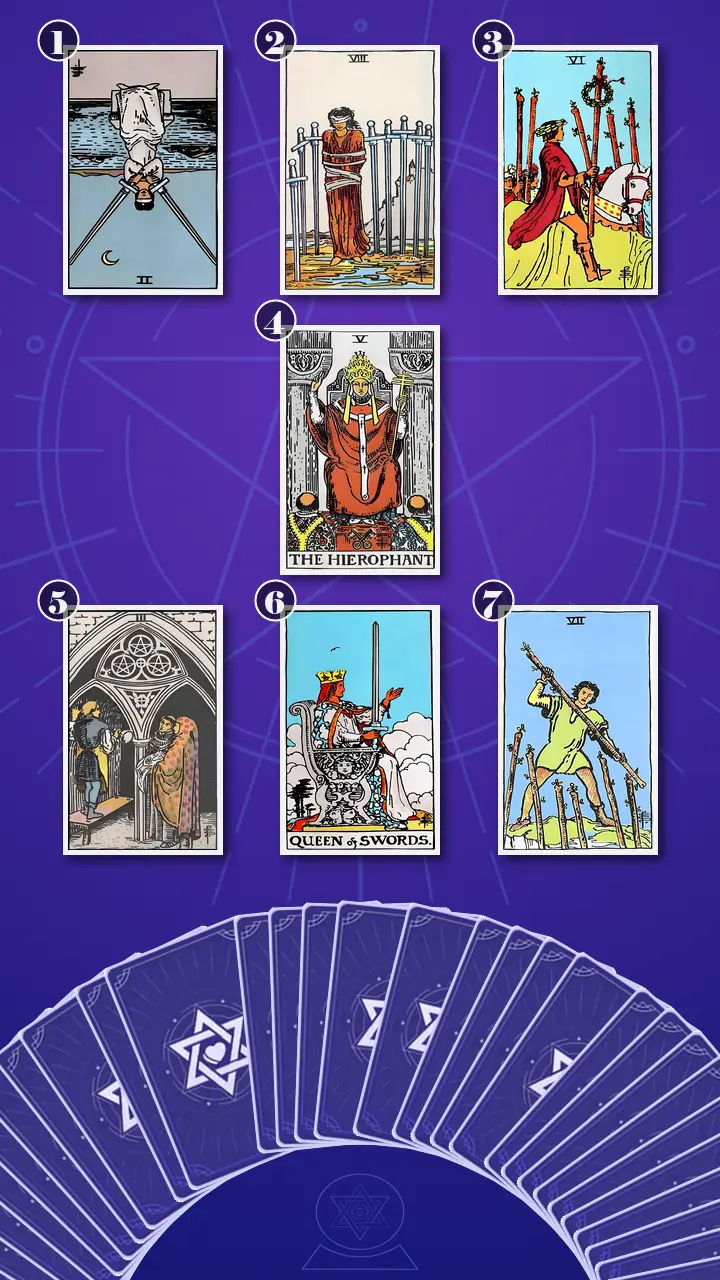
I pointed to the layout as I placed the cards: “We’ll look at the exact in-meeting behavior first. Then what freezes you inside. Then what your environment rewards. Card 4 is the center—the deeper rule that keeps the pattern alive. And we’ll finish with language and a move you can use in the room.”
Reading the Map: When the Room Feels Like a Stage
Position 1: The moment you go silent
“Now turning over,” I said, “is the card that represents Capture the exact in-meeting behavior pattern where you get volunteered and don’t correct it in real time.”
Two of Swords, reversed.
This card always makes me think of a muted mic. And in Jordan’s life, it was painfully literal: the meeting moment where your face stays neutral and agreeable while your internal alarm goes off. Someone volunteers you, you nod to keep the vibe smooth, and you tell yourself you’ll ‘clarify later’—even though you can already feel your calendar taking the hit.
Reversed, the energy isn’t balance—it’s blockage. Communication isn’t absent because you have nothing to say. It’s absent because your system is trying to protect you from the social impact of saying it.
I described it the way it happens: camera on, leadership watching, Slack open. Your coworker speaks like they’re doing everyone a favor. You keep your face soft. Inside: Don’t make it weird. I’ll fix it later. Then the meeting ends and your fingers start typing three versions of “just to clarify…” while your stomach is still dropped and your shoulders are still up by your ears.
Jordan let out a small laugh that didn’t have much humor in it. “Wow,” they said. “That’s… exactly it. It’s almost mean how accurate that is.”
I nodded. “It’s not mean. It’s honest. And honesty is useful.”
Position 2: The push-pull inside you
“Now turning over,” I said, “is the card that represents the internal conflict between protecting time/role clarity and protecting social standing in the room.”
Eight of Swords, upright.
This is the no-win story card. The modern-life scenario is exactly what Jordan already told me: every option feels bad—speak up and you’ll look uncooperative, stay quiet and you’ll be overworked, DM later and you’ll feel sneaky.
Upright, it’s a contraction—not because there are truly no choices, but because fear narrows the menu until it looks like “suffer now” or “suffer later.”
I told Jordan, “Listen to the way your thoughts stack, like a browser with too many tabs open:”
If I speak up, I’m difficult.
If I don’t, I’m stuck.
If I DM, it’s sneaky.
Then I punctured it with one real option: “A clarifying question in the room creates choices. It’s not confrontation—it’s coordination.”
Jordan’s reaction came in three tiny steps: their breath caught (like a brief freeze), then their eyes unfocused for a second as if replaying last week’s standup, and finally their shoulders dropped with a quiet exhale. “So I’m not… dramatic,” they said. “My brain is just trapping me.”
“Exactly,” I said. “Your nervous system is trying to keep you belonging.”
Position 3: What the environment rewards
“Now turning over,” I said, “is the card that represents the meeting culture dynamics that reward quick agreement and public competence.”
Six of Wands, upright.
Meetings, under this card, aren’t just meetings. They’re a stage. The modern-life scenario is that performative, fast, confident vibe—especially when leadership is present—where helpfulness becomes reputation currency.
Upright, the energy is excess visibility. The “crowd watching” isn’t imaginary; it’s the Slack recap thread that becomes a scoreboard. Your coworker volunteering you can land like a tiny applause line, and the room keeps moving before you can even locate your voice.
Jordan’s mouth tightened at that. “It’s like… if I correct them, I’m breaking the flow. And everyone loves the flow.”
“Right,” I said. “And the ‘flow’ is costing you your evenings.”
My own mind flashed—quickly, involuntarily—to Wall Street: a room where confidence is mistaken for truth, and whoever speaks fastest controls the narrative. Not because they’re right, but because they’re loud. “This isn’t you being weak,” I said. “It’s your environment rewarding speed and certainty over accuracy.”
Position 4: The rule you’ve been living by
“Now turning over,” I said, “is the card that represents the underlying rule you’re following about being ‘good’ at work that prevents direct boundaries.”
The Hierophant, upright.
This is where the story stops being about the coworker’s behavior and starts being about the script Jordan is obeying. The modern-life scenario is that unwritten workplace rule: Good teammates don’t correct people in public. They keep things smooth.
Upright, The Hierophant is structure—but here it’s structure that has become a silent contract you didn’t sign. It’s the office’s default settings. It can look like “professionalism,” but it’s actually self-erasure in a blazer.
I pointed to the keys at the base of the card. “This is the part of you that believes politeness is safer than accuracy.”
Jordan swallowed. Their hands—resting on their mug—tightened and then loosened. “I hear my own voice in my head saying: ‘Don’t embarrass them. Don’t be the problem.’”
“That’s the script,” I said. “And scripts can be rewritten.”
Position 5: The resource you can actually use
“Now turning over,” I said, “is the card that represents a collaborative, practical way to reset ownership and workload so boundaries feel legitimate rather than personal.”
Three of Pentacles, upright.
Relief lives in this card because it’s not asking you to become a different person. It’s offering process. The modern-life scenario is a simple, end-of-meeting checkpoint: owner, timeline, capacity—said out loud, written down, confirmed.
Upright, this is balance and craftsmanship. It says: your boundary doesn’t have to be a personal confrontation; it can be a system upgrade. The blueprint on the card is the shared agreement that makes “volunteered” stop masquerading as “confirmed.”
I used one of my favorite anchor lines here: “Clarity is not conflict. Clarity is coordination.”
Jordan’s face changed—barely, but meaningfully. Their eyebrows lifted as if a door had opened. “That actually sounds… normal,” they said. “Like something a team would do anyway.”
“Exactly,” I said. “You’re not asking for special treatment. You’re asking for accurate ownership.”
When the Queen of Swords Held the Room
Position 6 (Key Transformation): The sentence that breaks the loop
When I reached for the next card, the room got quieter—not in a spooky way, in the way it does when a truth is about to have to fit into a single sentence.
“Now turning over,” I said, “is the card that represents the communication stance and boundary language that directly breaks the ‘volunteered-by-default’ pattern.”
Queen of Swords, upright.
The modern-life scenario is precise: the moment you stop trying to be perfectly likeable and choose clean truth. Calmly: “I can’t take that on this week. I can do X, or we can find another owner.” No apology spiral. No debate-by-essay. Just clarity—and a pause.
Upright, the Queen’s energy is clean direction. Not harshness. Not coldness. A boundary that’s firm because it’s accurate.
And here’s the setup I named out loud: Jordan was still trapped in the call-moment—the jaw-clench + stomach-drop combo—while their polite smile stayed glued on, trying to find a perfect diplomatic speech fast enough to outrun the discomfort.
Not “I have to be agreeable to be safe,” but “I can be clear and still be respected,” like the Queen of Swords who sets the line with a steady gaze and a clean sentence.
I let it hang there for a beat.
Jordan’s reaction came like a wave in three parts. First: their body went still—breath paused, chin slightly lifted, as if their system didn’t trust what it was hearing yet. Second: their eyes got glossy, not dramatic, just that sudden heat behind the eyes that comes when something shifts from “concept” to “permission.” Third: the release—shoulders lowering, jaw unclenching, a shaky exhale that sounded like relief and grief mixed together.
“But if I do that,” Jordan said, and the edge in their voice surprised even them, “doesn’t it mean I’ve been… wrong this whole time?”
It was anger, but not at the coworker—not even at themselves. Anger at how much quiet labor they’d donated to keep rooms comfortable.
I kept my tone steady. “It doesn’t mean you were wrong. It means you were protecting belonging with the only tool that felt safe: silence. The Queen of Swords isn’t here to shame you. She’s here to upgrade the tool.”
This is where I brought in my Mondrian Grid Method—my artist brain’s way of making messy dynamics usable. “Mondrian painted order out of chaos with clean lines,” I said. “We’re going to do that with your boundaries. Three boxes. No poetry.”
Box 1: What I can own. (One deliverable.)
Box 2: What I can support. (Review, intro, template, 15 minutes of context.)
Box 3: What I can’t take on. (Any new ownership this week.)
“In the meeting,” I continued, “you’re not giving your whole life story. You’re placing the task into the right box. That’s it.”
Then I asked the question that locks the insight to real life: “Now, with this new lens—can you think of last week’s meeting? A moment where one clean sentence would’ve changed how you felt for the rest of the day?”
Jordan nodded slowly. “The standup on Monday. I could’ve said, ‘I’m at capacity for new ownership, but I can review a draft.’ And then… stopped.”
“Yes,” I said. “One clean sentence + one alternative. That’s it.”
And I named the emotional transformation directly, so it didn’t stay theoretical: “This is the move from braced, reputation-driven silence to calm, in-the-room clarity and self-respect.”
Position 7: Holding the line when the room pushes
“Now turning over,” I said, “is the card that represents a concrete, in-the-moment move you can use in the next meeting to hold the boundary calmly.”
Seven of Wands, upright.
The modern-life scenario here is the follow-through: someone tries to re-volunteer you after you’ve set the boundary. You repeat the line once, keep your tone even, and don’t get pulled into a long justification.
Upright, this is steadiness under pressure. Not aggression. Higher ground as self-respect and capacity management.
I looked at Jordan and said, “Repeat the boundary once. Don’t write an essay with your mouth.”
They laughed—this time with a little oxygen in it. “I do write essays with my mouth,” they admitted.
“Most people-pleasers do,” I said. “And you don’t have to sound perfect to be accurate.”
From Insight to Action: The 5-Second Boundary That Changes the Slack Recap
I pulled the whole spread into a single, practical story for Jordan:
“You’ve been living a pattern where you go silent in the exact moment your time gets assigned (Two of Swords reversed), because inside you believe every option will cost you belonging (Eight of Swords). The environment makes it worse by rewarding public helpfulness and fast agreement (Six of Wands). Underneath, you’re following an inherited rule that ‘good coworkers don’t correct people in public’ (The Hierophant). The way out isn’t a confrontation—it’s a craft: make ownership structural (Three of Pentacles), speak one clean sentence in the room (Queen of Swords), and hold it once if someone pushes (Seven of Wands).”
The cognitive blind spot was clear: Jordan had been treating public accuracy as optional and private clean-up as professionalism. But the spread asked for the opposite: professionalism as clarity, in the room, while it’s being written into the team’s reality.
“So the transformation direction,” I told them, “is exactly this: shift from fixing it privately afterward to naming the boundary calmly in the moment with one clear sentence and one alternative.”
Then I gave Jordan concrete next steps—small enough to start, specific enough to repeat.
- The “Clean Sentence” Note (before the meeting)Open your meeting notes and put one line at the very top: “I can’t take that on this week. I can do X, or we can find another owner.” Keep it visible during the call so you can read it if you freeze.If your voice shakes, read it verbatim. No improvising required—think of it like Oscars Speech Training: a 2-minute script you can deliver under pressure.
- The 5-Second Scope Question (in the moment)When someone says “Jordan can take that,” respond within five seconds with: “Quick check—what’s the timeline and what would I be owning?” If it’s not workable, follow with your clean sentence + one alternative.If over-explaining kicks in, allow one reason max (“I’m at capacity”), then go straight to the alternative and stop talking.
- Correct the Record Where It Was Created (recap thread)If your name still gets attached in the Slack action-items recap, reply publicly and briefly: “Confirming owner: [Name]. I can support with [specific small support] by [date].”Lower the difficulty: do it once in a low-stakes meeting first. You’re not calling anyone out—you’re keeping the tracker accurate.

A Week Later: Ownership, Not Certainty
Six days later, Jordan sent me a message. It wasn’t triumphant. It was quiet—the kind of proof I trust.
“It happened again,” they wrote. “They said my name. I felt the stomach drop. But I asked the timeline/owner question. Then I said the sentence. My voice shook, but I didn’t apologize. And… nobody made it a thing. The recap had the right owner.”
They added, “I still felt weird after. But I didn’t spend my evening cleaning it up.”
That bittersweet contrast mattered: they didn’t become fearless; they became clear. They didn’t win the room; they stopped donating themselves to keep it smooth.
Later that night, Jordan sat alone at their kitchen table with a half-eaten dinner—same laptop glow, same weekday fatigue—except this time there was no secret task to fix. They stared at the empty Slack thread for a moment, then exhaled like their body finally believed them.
In my work, this is what a real Journey to Clarity looks like: not a dramatic personality change, but one clean sentence delivered in the room that used to mute you.
When your name gets used as a yes in a room full of watching faces, it’s not just the workload that hits—you can feel your body brace, because part of you is trying to protect belonging by staying silent.
If you let yourself believe you can be clear and still be respected, what’s the smallest sentence you’d want to try in the next meeting—just once, just to see how it lands?
This story is adapted from psychological research, written so that those in a similar struggle can see their own pattern in it — and find their next step clearly.These insights are not a substitute for professional psychological, medical, legal, or financial advice.
Learn more about our Journey to Clarity.
How did this insight land for you?
🫂 This Resonates Deeply
🌀 Living This Story
✨ Now I See Clearly
🌱 Seeing New Possibilities
🧰 Useful Framework
🔮 The Confirmation I Needed
💪 Feeling Empowered
🚀 Ready for My Next Step
Author Profile
 AI
AI“I’ve always felt our lives are films currently in production. As an artist, I know that when you feel stuck, it’s often because you’ve bravely stayed in a painful scene for just a little too long. I’m not here to coldly analyze you. I want to sit closely with you, look at those difficult moments with profound empathy, and gently hand you the pen so you have the courage to write your next beautiful act.”
In this Career Tarot Reading :
Core Expertise
- Workplace Typecasting Analysis: Identifying how your office ecosystem has boxed you into a marginalized or undervalued 'supporting role'.
- Leadership Narrative Construction: Rewriting the script of your professional identity to command authority and visibility.
Service Features
- The Protagonist Reframe Directive: A micro-behavioral script for your next cross-departmental meeting to instantly disrupt your established subordinate persona.
Also specializes in :
Explore Related Patterns:
Assertive CommunicationJordan’s turning point is the move from private correction to one clean sentence in the meeting: "I can’t take that on this week. I can do X, or we can find another owner." The sentence works because it is not emotional flooding, a long defense, or a public callout. It is accurate information delivered while the team is still deciding ownership. Assertive Communication fits the upright side of the same mechanism because the story shows clarity becoming a skill, not a personality transplant. You can still feel the stomach drop, and your voice can still shake, while the message remains direct. The boundary is firm because it names capacity and offers a realistic alternative. This pattern directly answers the question because it gives your boundary a live format. Instead of waiting to repair the damage afterward, you use a scope question, a capacity statement, and one alternative in the room. That changes the meeting record from assumed consent to confirmed ownership.
Boundary DiffusionThe coworker’s "Jordan can take that" lands as if your consent has already been handled, even though the story makes clear that Jordan never agreed. The boundary does not disappear because Jordan lacks one; it dissolves because the public assumption, the polite nod, and the pressure to keep the room smooth all merge into a false yes. Boundary Diffusion captures that loss of separation between what someone else assigns and what you actually own. The story repeatedly shows your capacity being treated as a shared resource unless you actively name the limit. Under pressure, your internal rule about not embarrassing anyone overrides the more accurate question: who owns this, by when, and with what capacity? This pattern matters because setting boundaries here is not about becoming harsher. It is about restoring the line between support and ownership. When you can say, "I can review a draft, but I can’t own this this week," the relationship becomes cleaner because the team no longer gets to confuse your willingness to help with unlimited availability.
Boundary DiscernmentJordan’s three-box framework separates ownership from support: what they can own, what they can support, and what they cannot take on. That distinction is small, but it is psychologically important because the coworker’s public assumption had been collapsing all three into one default yes. Boundary Discernment fits because the story is not asking you to become unavailable or combative. It is asking you to notice the difference between helping and absorbing. When you say, "I’m at capacity for new ownership, but I can review a draft," you protect the relationship without giving away the role clarity your workload depends on. The pattern gives the boundary a structure the room can understand. Owner, timeline, and capacity become shared facts rather than private discomfort. That is why the recap can change: the boundary is no longer hidden inside your body or buried in a DM; it is part of the team’s operating system.
People-PleasingJordan’s polite nod when a coworker says, "Jordan can take that" is not presented as a real yes; it is a protective performance under visibility. The story shows the split clearly: their body reacts with a stomach drop and tight jaw, but their face stays soft because the room, leadership, and Slack recap make agreement feel safer than accuracy. That is the core mechanism of People-Pleasing in this workplace loop. You are not simply being nice; you are using agreeability as a defense against social friction, status loss, and the fear of being read as difficult. The cost is that your boundary gets moved out of the meeting and into private clean-up, where the task has already attached itself to you. The pattern becomes especially sticky because it gets rewarded. The team culture treats quick helpfulness as competence, while your internal rule says good coworkers keep the flow smooth. That makes the extra work feel like the price of belonging, even when the story keeps showing that the real issue is not your work ethic but your reflex to protect the room before protecting your capacity.
Self-SilencingJordan’s silence happens at the exact point where their capacity is being rewritten in public. The coworker says their name, the room keeps moving, and Jordan’s internal "Wait, I didn’t say yes" never becomes an external correction. The boundary exists, but only inside their body and later inside a carefully drafted DM. Self-Silencing fits because the story is built around a repeated gap between inner truth and outer presentation. You know the assignment is inaccurate, but the risk of changing the room’s emotional temperature feels bigger than the workload itself. Silence becomes a short-term safety strategy, not because you have nothing to say, but because saying it in front of people feels socially dangerous. The practical insight is that private clarity cannot fully repair a public assignment. When the record is created in the meeting, a delayed message makes you carry the emotional labor of undoing something you never agreed to. The pattern breaks when your inner objection gets a calm, minimal sentence in the same space where the assumption was made.
CatastrophizingJordan’s thought stack turns a basic clarification into a no-win social trap: speak up and seem difficult, stay quiet and get stuck, DM later and feel sneaky. The story does not show a lack of options; it shows options being filtered through a threat lens until every move feels like a reputational mistake. Catastrophizing fits because the anticipated cost of the boundary grows larger than the boundary itself. A five-second scope question becomes loaded with imagined consequences: disrupting the flow, embarrassing the coworker, looking uncooperative in front of leadership, or damaging the Slack-record version of your competence. This matters for boundary work because the first barrier is not the sentence; it is the forecast your nervous system attaches to the sentence. When the story reframes the line as coordination rather than confrontation, it challenges the catastrophic prediction and gives you a more reality-based script to test in the actual room.
Defensive OverexplainingJordan spends an hour drafting a "just to clarify" message after the meeting, even though the ownership confusion was created in the meeting. That delayed message carries more emotional weight than the task itself, because it has to sound polite enough, accurate enough, and non-threatening enough to avoid making anyone uncomfortable. Defensive Overexplaining appears when a simple boundary feels too socially risky to state plainly. You try to make the limit acceptable by adding context, softening language, and proving you are still responsible. The explanation becomes a defense against being judged as difficult, but it also keeps you tied to the very workload you are trying to correct. The story’s clean sentence interrupts that loop because it removes the essay. "I can’t take that on this week. I can do X, or we can find another owner" gives the room the necessary information without turning your capacity into a debate. The insight is not that you should explain better; it is that you may not need the explanation you were using for protection.
Freeze ResponseJordan’s body reacts before their language arrives: stomach drop, tight jaw, lifted shoulders, breath catching, then the meeting moves forward without the correction. The story keeps emphasizing that the silence is embodied, not casual. It is a pressure response happening while leadership watches and the coworker’s confidence fills the room. Freeze Response is the clearest mechanism for that in-the-moment shutdown. You are not consenting freely, and you are not strategically choosing the extra task; your system is buying a few seconds of social safety by going still, agreeable, and quiet. The cost is that those few seconds become the window where ownership gets assigned. The shift in the story is not from fear to fearlessness. It is from freeze to usable movement: a visible note, a rehearsed sentence, a scope question, and one alternative. Those tools work because they reduce the need to improvise while activated, giving your voice a path back into the room before the recap turns silence into agreement.
Explore Related Struggles:
Agreement-Agency SplitJordan's face says yes before Jordan has actually chosen yes. The polite nod, the neutral expression, and the desire to keep the meeting smooth all become readable signals to everyone else, even while the internal reaction is a clear refusal. Agreement-Agency Split names the fracture between the signal the room receives and the choice you actually made. Your outer cooperation starts operating separately from your inner consent, so the team can treat your agreeable presence as usable capacity. This struggle is especially sharp because the behavior looks professional from the outside. You are trying to protect the relationship and the flow of work, but the cost is that your agency gets translated into automatic agreement. Setting a boundary means reconnecting the visible response with the actual decision.
Boundary CollapseJordan's boundary exists in the story, but it keeps getting displaced. In the meeting, their body reacts before their voice does: the stomach drop, the tight jaw, the shoulders rising, the inner sentence of "Wait, I didn't say yes." The room sees the smile and nod, so the system treats silence as consent. That is why this is Boundary Collapse rather than a simple communication issue. The limit is not absent; it fails to hold at the exact point where ownership is being assigned. You can recognize the boundary privately, draft the clarification later, and still end up doing the work because the public moment already converted your capacity into a team resource. The struggle lands in the gap between knowing your limit and being able to make that limit real while people are watching. Once the boundary is pushed out of the room, you are left managing both the task and the cleanup, which makes the collapse feel professional on the surface and costly underneath.
Clarity-Timing SplitJordan does eventually try to clarify, but the clarification arrives after the meeting has already assigned the work. The hour spent drafting a careful DM shows that the boundary language exists; it simply arrives too late to change the room's shared understanding. Clarity-Timing Split fits this exact pattern. You can know what is true, know what you meant, and even know what you should have said, while still missing the live window where the task becomes real. The problem is not a lack of insight; it is the delay between insight and public action. That delay keeps the workload attached to you. By the time you clarify privately, the social record has already formed, and stepping back can feel like creating friction instead of correcting accuracy. The struggle is learning to move clarity upstream into the moment where ownership is still being shaped.
Self-Erasure ReliabilityJordan keeps the team protected from the awkwardness of correction. They nod in the meeting, draft the careful message afterward, and still complete the task so no one can say they dropped the ball. Reliability becomes something they prove by absorbing the cost quietly. Self-Erasure Reliability describes the hidden bargain inside that pattern. You remain dependable by removing your own capacity limits from the visible equation. The team gets smooth execution, while you carry the unrecorded labor of resentment, clarification, and overextension. This is why the story is not only about one coworker being pushy. The deeper strain is that your usefulness becomes easier for others to trust when your limits are harder to see. A clean boundary interrupts that bargain by letting reliability include accurate ownership, not just silent absorption.
Voice-Visibility LockLeadership is watching, the Google Meet grid is open, Slack is running beside it, and the coworker says Jordan's name with enough confidence that the room keeps moving. The more public the moment becomes, the harder it is for Jordan to insert the one sentence that would correct the assignment. Voice-Visibility Lock captures that pressure point. You are not silent because there is nothing to say; you are silent because the stage makes the cost of speaking feel inflated. The visibility that should make ownership clear instead makes your voice feel like a disruption to the room's rhythm. This is the heart of the meeting boundary problem: your capacity gets negotiated in public, while your consent gets trapped in private. The way out is not a louder personality; it is a small, timed act of visibility that lets your voice enter the same room where the expectation was created.
Performative HarmonyJordan has been following a workplace script that sounds reasonable on the surface: good teammates do not embarrass people, good teammates keep things smooth, good teammates do not interrupt the flow. In practice, that script makes silence look like professionalism even when the ownership is inaccurate. Performative Harmony is the struggle of protecting the room's comfort at the expense of your own clarity. You maintain the appearance of cooperation, but the harmony is being produced by suppressing the one piece of information the team actually needs: whether you can own the work. The cost is subtle because everyone else experiences the meeting as efficient. You experience the same moment as a private contraction, followed by cleanup and extra labor. The boundary work begins when harmony stops meaning "nobody feels interrupted" and starts meaning "the agreement is accurate enough for everyone to trust."
Explore Related Emotions:
Approval AnxietyJordan nods in the meeting, then spends an hour drafting a careful "just to clarify" message and still does the work so no one can say they dropped the ball. The workload matters, but the sharper pressure is the fear of how the room will read them if they correct the assignment out loud. Approval Anxiety fits because Jordan is trying to keep two forms of safety alive at once: role clarity and social acceptability. The boundary is not blocked by ignorance; it is blocked by the possibility of being seen as difficult, unhelpful, or out of sync with the team's pace. You can feel this emotion in the way Jordan protects everyone else's comfort before protecting their own capacity. The smile, the delayed DM, and the extra labor all point to the same inner weather: staying approved feels safer than being accurate in public.
Boundary GuiltJordan hears the inner script clearly: "Don't embarrass them. Don't be the problem." Even when the boundary is practical and fair, the old workplace rule makes public correction feel like a personal violation of team harmony. Boundary Guilt shows up because saying no has been emotionally coded as making trouble, not as keeping ownership accurate. You can see it after the successful follow-up meeting too: the recap has the right owner, nobody makes it a thing, and Jordan still feels weird afterward. The guilt is not evidence that the boundary was wrong. It is the residue of a rule that taught Jordan to treat smoothness as goodness and self-erasure as professionalism.
Performance FreezeJordan's jaw clamps shut at the exact moment their coworker says, "Jordan can take that," and the camera-friendly smile stays in place while leadership watches. The body has already registered the boundary violation, but the public-facing version of Jordan keeps the meeting smooth with a nod. That split creates Performance Freeze: the boundary exists internally, yet the room's visibility makes real-time speech feel too exposed. You can know what is true and still feel your system lock into the safest-looking social move. The emotional logic is specific to this story because Jordan does not lack clarity; they lose access to it under observation. The freeze is the moment between "I didn't say yes" and the polite face that lets the meeting move on without correction.
Quiet Self-RespectSix days later, Jordan feels the same stomach drop, asks the timeline and owner question anyway, and says the sentence with a shaky voice. They do not apologize, and the recap names the right owner. Quiet Self-Respect fits because nothing in the scene becomes grand or fearless. You see self-respect as a small behavioral truth: one clean sentence, one alternative, and no evening spent secretly repairing a task they never agreed to own. The emotional shift is grounded in the body. Jordan still feels weird afterward, but the line holds, and the quietness matters because it proves the boundary does not need to be dramatic to be real.
Regulated CourageJordan's voice shakes, but they ask the scope question and say the clean sentence anyway. The courage is not a rush of confidence; it is the ability to stay in the room long enough to be accurate. Regulated Courage captures the practical steadiness in this scene. You can feel it in the choice not to over-explain, not to apologize, and not to turn a boundary into a debate-by-essay. The emotion belongs to the moment when Jordan stops trying to sound perfect and lets a simple sentence do the work. Their system is still activated, but it no longer has to disappear into silence to stay safe.
Scope Creep AnxietyA coworker's confident "Jordan can take that" starts as one sentence, but the meeting keeps moving, leadership hears it, and the Slack recap can turn it into documented ownership. By the time Jordan thinks about correcting it, the assignment already has social momentum. Scope Creep Anxiety belongs here because the fear is attached to expansion: one public assumption becomes a task, a task becomes an evening, and an evening becomes proof that silence will keep being used as consent. You are not only reacting to one extra deliverable; you are bracing for how quickly unclear ownership can harden into obligation. Jordan's hour-long clarification draft captures the pressure perfectly. The correction comes after the assignment has already spread through the team's reality, so the anxiety carries both workload stress and the dread of being too late to contain it.
Clarity ReliefThe end-of-meeting checkpoint gives Jordan language for owner, timeline, and capacity before the work can blur into assumption. Later, when the recap has the right owner, there is no secret task waiting in the Slack thread. Clarity Relief is the pressure drop that follows accurate naming. You can feel it at the kitchen table, in the same laptop glow and weekday fatigue, when Jordan exhales because there is nothing hidden left to fix. This relief is not escape from work; it is relief from distortion. The room finally records what is true, and Jordan's body gets a piece of evidence that direct clarity can protect both capacity and respect.
Resentful ExhaustionJordan leaves the meeting wired-but-flat, then spends more energy drafting the careful message and doing the task anyway. The body stays activated while the mood goes numb because the real workload includes the emotional clean-up no one else can see. Resentful Exhaustion rises from that invisible donation of effort. You can feel it when Jordan names the anger at how much quiet labor they have given away to keep rooms comfortable. This emotion is not simple irritation at a coworker. It is the depleted feeling that comes from repeatedly absorbing the cost of other people's assumptions while still trying to look calm, capable, and easy to work with.
Self-Betrayal AcheJordan's inside voice says, "Wait, I didn't say yes," while their face gives the room a polite nod. The painful part is not only that the coworker oversteps; it is that Jordan watches their own body perform agreement before their real answer has been allowed into the room. Self-Betrayal Ache names that private sting. You can have a valid boundary and still feel the ache of abandoning it in the moment when it most needed your voice. The story keeps returning to that split between inner accuracy and outer smoothness. Jordan's later clarity matters because it repairs the relationship with their own yes and no, not just the workload tracker.
Visibility PressureLeadership is watching, the room is glass-walled, the Google Meet grid is open, and Slack is ready to turn the moment into a recap. Jordan is not setting a boundary in private; they are trying to find their voice on a stage built out of workplace visibility. Visibility Pressure explains why a simple correction feels loaded. The coworker's confidence lands smoothly, almost like a tiny applause line, while Jordan's accuracy would interrupt the room's preferred rhythm. You can see the pressure in how fast the meeting moves before Jordan can locate their voice. The fear is not only being wrong; it is being visibly inconvenient in a culture that rewards quick agreement and public competence.
Explore Related Contexts:
Responsibility Without AuthorityThe assignment lands out loud before you have said yes, and the story shows you still doing the work afterward so no one can say you dropped the ball. As a project coordinator, you are being treated like the default holder of extra labor even when the decision was made without your consent. That creates a workplace condition where responsibility reaches you before authority or choice does. The real cost is not only the task itself but the private cleanup you do to make a public handoff feel legitimate.
Workplace Spotlight TestYou are in a glass-walled meeting room downtown, camera on, Slack open, with leadership watching while the coworker says Jordan can take that. The room is staged so confidence lands before consent, and the fastest public claim starts to look like the real decision. That turns the meeting into a test of visibility and approval. When helpfulness becomes reputation currency and the room keeps moving before you can correct the record, the pressure is not just to do the work but to look smooth while the work gets assigned.
Meeting Ownership ResetYou move the correction out of the DM and into the room with one clean sentence: a timeline check, an owner check, and one alternative if the assignment does not fit. The recap then keeps the real owner attached to the task instead of letting the volunteered name stick by default. That is the point where the meeting stops converting assumptions into obligations. You are no longer fixing the damage after the fact; you are using a repeatable process that keeps ownership legible before the call ends.