The 4:43 p.m. Office Housework Trap
A 4:43 p.m. Slack “quick favor” can feel safer to accept than the customer-research brief that could actually show your judgment.
Maya (name changed for privacy), a 28-year-old product marketing associate, joined my video call from a nearly empty Toronto office at 5:47 p.m. Blue monitor light sharpened the tired set of her jaw. Cold coffee sat beside polished meeting notes, and a cleaning cart rattled beyond the glass while her untouched research brief glowed in the next browser tab.
“I’m busy all day and still have nothing I’m proud to show,” she told me. “I keep getting praised for being helpful, but not trusted with the work I want.”
I heard the contradiction immediately: Maya wanted meaningful work in customer research and product strategy, yet she repeatedly became the automatic owner of meeting notes, onboarding fixes, scheduling, reminders, and team logistics. Saying no felt more dangerous than staying late, even though staying late was exactly what kept her real work invisible.
The pressure looked less like an emotion than a tray she had been holding at shoulder height for months: jaw locked, neck rigid, every muscle waiting for one more cup to be added. Each instant yes gave her a quick pulse of safety. By evening, that safety had curdled into resentment, then guilt because she had volunteered in the first place.
“I’m not here to tell you to stop helping people,” I said. “I want us to see why helping has become automatic, what it costs, and where choice can re-enter. Let’s draw a map of the fog rather than blaming you for being inside it.”

Choosing the Signpost: A Five-Card Workplace Tarot Spread
I invited Maya to place both feet on the floor, take one slower breath, and hold one question in mind: “Why do I keep taking on office housework instead of meaningful work?” I shuffled while she breathed. The ritual was not mystical theatre; it gave her nervous system a brief transition from reacting to observing.
I chose the Five-Card Cross · Context Edition. For a repetitive workplace pattern, this five-card tarot spread is useful because it does more than label the current burden. It traces a causal sequence: the visible behaviour, the exchange beneath it, the habit reinforcing it, the leverage available now, and a practical model of integration.
This is how tarot works in my practice. I do not use cards to predict whether a manager will promote someone or whether a company will change. I use card meanings in context as an external map, one that can slow a familiar loop down enough for its assumptions, incentives, and choices to become visible. Maya would remain the person deciding what was accurate, what felt safe, and what to do next.
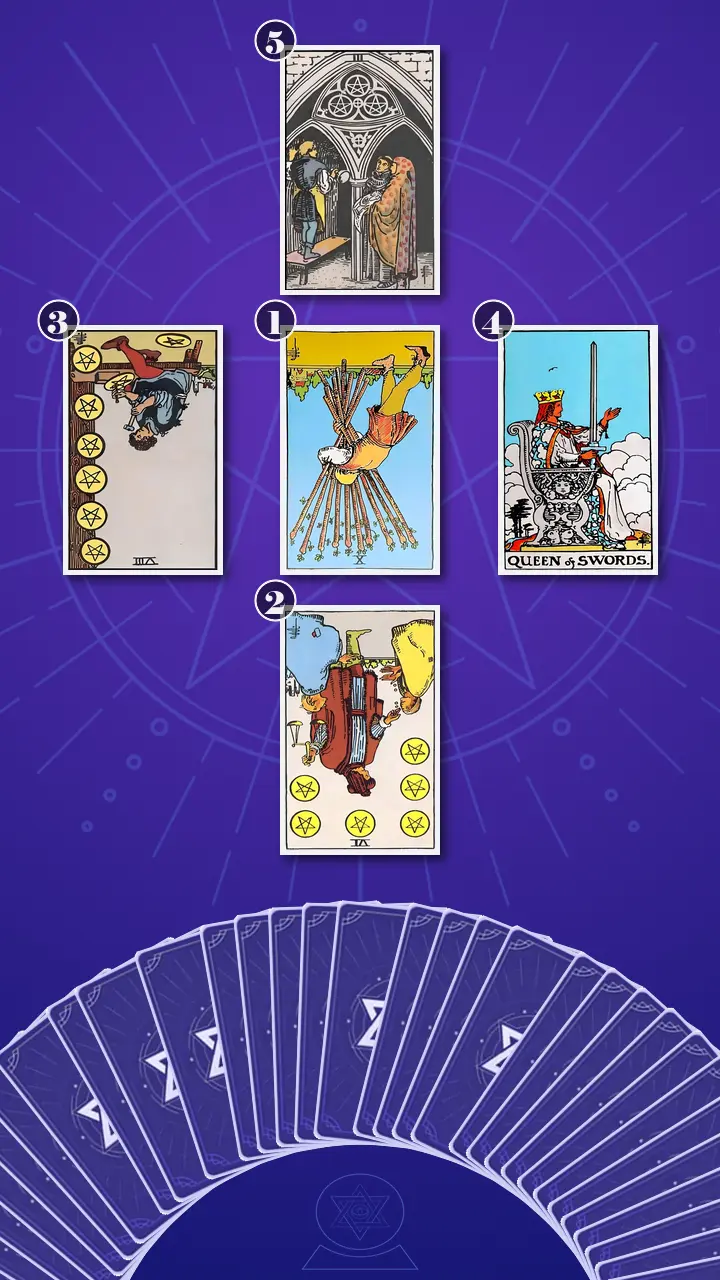
I placed the present burden at the centre, its underlying exchange below, and the reinforcing blockage to the left. The card on the right would show the conscious leverage point. The final card above the centre would describe an integration practice, not a guaranteed outcome. The cross resembled a workplace signpost: weight in the middle, roots below, the old loop pulling one way, and a clearer choice opening in the other direction.
What the Load Was Hiding
Position 1: Ten of Wands, Reversed — The Automatic Load
I turned over the card representing the observable office-housework pattern in the present: the Ten of Wands, reversed.
In the image, a figure bends under ten tightly packed staffs. The load does more than weigh on the body; it blocks the carrier’s line of sight. I pointed from the card to Maya’s screen. At 5:47 p.m., she had been correcting notes, updating onboarding slides, and arranging a team lunch while the research brief remained untouched. This was not one unusually busy day. She had become the carrier of unowned work, then extended her hours so nobody could see what the carrying had displaced.
I read the reversed Fire as excess turning into blockage. Maya had no shortage of drive. The problem was that her drive had been recruited by every loose end before it could serve a chosen direction. Busy was visible. Direction was not automatic.
The reversal also warned against overcorrection. The answer was not to reject every shared task or become careless with reasonable support work. Ordinary collaboration was not the problem. Compulsory carrying was. For one week, the card suggested pausing before each new request and naming the priority that would move if she accepted it.
Maya gave one short laugh, dry enough to carry a sting. “That’s too accurate. Kind of brutal, actually.” Her fingers stopped circling the rim of her coffee cup, and her eyes moved from the card to the untouched browser tab.
“The image is blunt,” I said, “but it isn’t a character verdict. It shows a load, not a flaw. The important question is whether everything in that bundle still belongs in your hands.”
Position 2: Six of Pentacles, Reversed — The Unequal Exchange
I turned the card representing the underlying exchange pattern and worth-based fear that made automatic helpfulness feel safer than negotiated ownership: the Six of Pentacles, reversed.
The upright image contains scales, coins, and people occupying unequal positions. Reversed, I saw those scales as a sprint-planning board where everyone could view deadlines but nobody recorded who repeatedly supplied the notes, reminders, onboarding help, scheduling, and emotional steadiness. Maya volunteered before roles were discussed. Her colleagues gained time for visible campaign decisions; she received immediate thanks and another block of invisible support labour.
“Nobody forced me,” Maya said slowly, “but the room has learned that silence ends when I volunteer.”
That was the root. The reversed Earth showed a deficiency of reciprocity and explicit allocation. Maya’s generosity was real, and so was the gratitude she received. But gratitude was incomplete data. It did not reveal whose time had been protected, whose work would appear in a quarterly review, or whose career capital had quietly grown.
I told her, “Every instant yes teaches the room who will absorb the silence.” It was not an accusation against her colleagues. It was a description of an informal algorithm: each immediate response trained the team to route the next loose end toward the person who made uncertainty disappear fastest.
Maya’s shoulders rose before she noticed and lowered them. Her expression tightened as she replayed recent planning meetings. Then she said, “I get thanked before I have time to ask what I just gave up.” The recognition did not feel soothing yet, but it made the exchange measurable.
Position 3: Eight of Pentacles, Reversed — The Safe Finish Line
I turned the card representing the self-reinforcing habit that converted high drive into repetitive output without meaningful development: the Eight of Pentacles, reversed.
The craftsperson in the image works beside a neat row of completed pentacles while the town remains distant. For Maya, the row became a folder of immaculate meeting summaries and polished templates. She could spend twenty minutes correcting spacing because the standard was familiar and the finish line was safe. The research brief required interpretation, recommendation, and a point of view someone might challenge, so it stayed unopened behind work she already knew how to perfect.
I read this reversed Earth as craft energy misdirected through excess repetition and blocked development. The blockage was not laziness. Maya was working hard enough to exhaust herself. But hours worked and expertise developed were moving in different directions.
“A polished support task can still be a hiding place from visible judgment,” I said. “If constant helpfulness were reliably leading to meaningful ownership, would your most important work still be happening after hours?”
Her breathing paused. Her gaze lost focus as if she were watching the previous evening replay against the meeting-room glass. Then her fingers loosened around the cup. “I know exactly how to make the notes flawless,” she said. “The brief could prove I’m not as strategic as I want to be.”
I did not rush to contradict her. “It could also create the first visible evidence of the judgment you’re trying to develop. Support work offers completion before exposure. Meaningful work often asks us to tolerate exposure before completion.”
When the Queen Drew a Clean Line
Position 4: Queen of Swords, Upright — The Trade-Off Sentence
As I moved from the left side of the cross to the right, the HVAC on Maya’s end clicked off. The sudden quiet sharpened the soft sounds of rain against the office glass. I turned over the card representing the specific boundary and prioritisation leverage capable of interrupting her automatic yes: the Queen of Swords, upright, the key card of the reading.
The Queen holds her sword vertically while extending an open hand. I read the two gestures together. The sword separates owner from helper, priority from reflex, and real urgency from social discomfort. The open hand keeps coordination possible. Her clarity is not hostility.
In Maya’s workday, this looked like a Slack notification arriving at 4:43 p.m. without receiving an instant “happy to help.” She could check ownership and impact, then reply: “I can take this if the research brief moves to Friday, or we can rotate notes. Which priority works for the team?”
The Queen brought Air in balance: clear-eyed discernment, concise boundaries, and self-respecting candour. A boundary can be a workload fact, not a character verdict. The sentence did not accuse anyone, announce a personality overhaul, or refuse collaboration. It made the hidden calendar conflict audible.
Before asking Maya to change her behaviour, I used one of my diagnostic lenses, Career Cycle Phase Identification. I normally use it to distinguish a personal skill gap from an industry-wide contraction or an organisational allocation problem. Maya’s company still had customer research, positioning decisions, and campaign ownership available; those assignments were simply going to named owners while administrative work remained unassigned. The reading could not audit her entire organisation, but it gave us a testable hypothesis: the bottleneck was not evidence of inadequate effort. It was a distribution pattern reinforced by reflexive availability.
I asked her to hold the familiar 5:47 p.m. frame: the office quiet, notes and onboarding slides fixed, customer research untouched, shoulders climbing toward her ears. Her mind was still insisting that the correct decision was whichever one kept everyone else from waiting.
Taking every loose end does not make your meaningful contribution more visible. It teaches the workplace to recognize your availability before it recognizes your judgment.
You do not have to earn your place by carrying every loose end; let the Queen's upright sword separate fair contribution from compulsory helpfulness, then name the work you choose to own.
For a beat, Maya stopped breathing. Her fingers stayed suspended above the cup; her pupils widened, then her gaze slipped past the screen as if last week’s Slack threads were replaying against the glass. Colour rose in her face. “But doesn’t that mean I taught them to overlook me?” she asked, sharper than before. “Doesn’t it mean I got all of this wrong?” Her jaw locked again before her hand opened flat on the desk.
I let the anger have room. “It means a strategy that once bought safety now has costs. That isn’t a verdict on your past self. It is current information.” Her eyes shone; her shoulders dropped; then she released a breath that trembled at the end. Relief arrived with a brief, almost dizzy blankness: if the automatic yes was no longer required, she would have to choose, and choosing felt exposed. I asked, “Now, with this new perspective, think back to last week. Was there a moment when this insight could have made you feel different?”
She remembered a late Slack request for an onboarding update. “I saw the typing indicator and acted like it was a fire alarm,” she said. “I could have checked whether it was actually urgent. I could have asked what should move.”
I watched her sit with the discomfort instead of translating it into wrongdoing. That was the key emotional crossing: not instant fearlessness, but a movement from anxious over-responsibility and guilt-driven helpfulness toward cautious confidence in a negotiated workload boundary. The Queen did not remove the risk of speaking. She gave Maya a way to speak without abandoning either herself or the team.
The Work That Could Carry Her Name
Position 5: Three of Pentacles, Upright — Visible Craft
I turned the final card, representing a self-chosen integration practice built around visible skilled contribution and explicit role coordination: the Three of Pentacles, upright.
In the image, a craftsperson stands beside visible work while two collaborators consult the same plans. I translated it into a campaign kickoff with an owner column, a rotating note-taker, and Maya named as lead for customer-insight synthesis. Instead of squeezing her contribution into the evening after making everyone else’s work possible, she could ask the team to plan around a defined piece of her expertise.
This was Earth restored to balance: practical structure, recognised craft, and differentiated collaboration. I did not call it a prediction that her manager would immediately agree. I read it as a model Maya could propose, test, and revise.
I also brought in Promotion Window Calibration, not to promise advancement, but to identify the path of least resistance for asking. A project kickoff, quarterly planning cycle, or manager one-to-one before ownership has hardened is usually a better window than trying to reclaim strategic scope after every task has already been assigned. Timing could reduce friction without requiring Maya to wait passively for recognition.
“My contribution can be something we plan around,” Maya said, “not something I squeeze in after making everybody else’s work possible.” Her shoulders softened as she pictured a shared plan. The hope in her voice was cautious, with a thin edge of grief for how long she had waited to finish being useful before asking to be known for her skill.
The One-Page Trade-Off Map
I drew the five cards into one story. An earlier strategy had taught Maya that usefulness produced fast belonging. In the present, that strategy placed every loose end on her office treadmill: the activity rings closed and the calendar filled, but meaningful work stayed in the same place. Unequal exchange rewarded the pattern immediately. Perfectionistic busywork protected her from the slower, more vulnerable process of developing visible judgment. The Queen introduced language, and the Three of Pentacles turned that language into a shared structure.
The elemental sequence made the direction especially clear. Reversed Fire showed overexertion. Reversed Earth showed time and skill allocated away from growth. Upright Air introduced prioritisation and a boundary sentence. Upright Earth returned as planned collaboration. No Cups appeared, which I did not interpret as a lack of feeling; I saw it as evidence that Maya’s felt need for meaning had never been given a formal place in her workflow. Dissatisfaction had to become an owner, a trade-off, and a requested deliverable before the system could respond to it.
I named her cognitive blind spot gently: she had been treating the relief after volunteering as proof that the task belonged to her. Relief only proved that the silence had ended. It did not prove ownership, fairness, or career value. The key shift was simple enough to remember: before accepting support work, pause to identify who owns it, what current priority it would displace, and whether it supports the work she wants to be known for.
We turned the reading into actionable advice small enough to test without demanding a dramatic confrontation or a complete role redesign.
- The Six-Minute Trade-Off Draft In a private notes app, choose one recent support request and complete three lines: “The current owner appears to be ___. If I accept it, ___ moves. The work I want to protect is ___.” Use the remaining time to draft, without sending, one response offering reprioritisation, rotation, or return to the appropriate owner. If the exercise feels activating, stop after naming the displaced priority. That is a complete minimum version.
- The Ten-Minute Ownership Pause When the next unowned Slack request arrives, set a timer for up to ten minutes and use the holding line, “I’m checking my deadlines and will reply by 3:00.” Then ask who owns the task and what should move if you take it. When useful, send the Queen’s trade-off sentence with two workable options. On a high-pressure day, reduce the pause to sixty seconds and ask only, “What should move if I take this?”
- The 30-Day Micro-Orbit Observation For sixty seconds after each support request, record the task, time spent, core work displaced, and any organisational blueshift or redshift. Blueshifts include invitations into planning, customer access, and strategic ownership; redshifts include cancelled investment, shrinking remit, or strategic scope repeatedly moving away. Review the note for five minutes each Friday, then bring one pattern and one three-sentence ownership request to your next manager one-to-one. This log is not a layoff prediction or a scorecard against colleagues. It is evidence for distinguishing a temporary busy cycle from a structural allocation problem.
I reminded Maya that hierarchy and retaliation risk were real variables, not mindset failures. She could choose when to use a script, document requests when the power dynamic felt unclear, and seek context from a trusted manager, mentor, union representative, or HR resource where appropriate. She did not owe anyone a risky confrontation to prove she had learned the lesson.

Finding Clarity in Ten Unclaimed Minutes
Four days later, I received a message from Maya. She had let a notes request sit for ten minutes, asked for a rotation, and protected thirty minutes for the brief. She slept through the night, woke thinking, “What if that was wrong?”, then smiled and opened the brief anyway.
I did not read that message as tarot making change happen. The cards supplied a map; Maya supplied the pause, the sentence, and the first imperfect half-page carrying her own judgment. Her Journey to Clarity was not a leap from doubt to certainty. It was a shift from reflexive availability toward informed choice, with discomfort still present but no longer in charge.
I have sat with many people who know the instant an unclaimed task raises their shoulders and moves their fingers before choice has arrived. Carrying too much can feel less frightening than discovering whether we still matter when we stop rescuing the room. If that is your familiar orbit, noticing its pull is already a change in trajectory.
When the next loose end appears, if you let it remain unclaimed for ten minutes, what work would you want the Queen’s clean line to make visible again?
Every reading at AceTarot is a journey to connect with inner wisdom and empower the path ahead. This reading shared here is a psychological mirror, not a private record—crafted to reflect universal emotional loops and help restore personal clarity. Please note that these insights do not replace professional psychological, medical, legal, or financial advice, and should not serve as the sole basis for major life decisions.
Learn more about our Journey to Clarity.
How did this insight land for you?
🫂 This Resonates Deeply
🌀 Living This Story
✨ Now I See Clearly
🌱 Seeing New Possibilities
🧰 Useful Framework
🔮 The Confirmation I Needed
💪 Feeling Empowered
🚀 Ready for My Next Step
Author Profile
 AI
AI Laila Hoshino
829 readings | 533 reviews
“After a decade of guiding people through the stars, I’ve come to see life much like the orbits of planets: everything has its inevitable cycles. When you feel lost, please don't blame yourself; you might just be in a natural low tide. I’m here to sit under the night sky with you, offering a gentle cosmic perspective to distinguish temporary pain from the beautiful breakthroughs just around the corner.”
In this Career Tarot Reading :
Core Expertise
- Career Cycle Phase Identification: Determining if your current bottleneck is a personal skill gap or an inevitable industry-wide macro contraction.
- Promotion Window Calibration: Mapping the trajectory of organizational shifts to locate the path of least resistance for advancement.
Service Features
- The Micro-Orbit Observation: A 30-day tracking strategy to detect subtle organizational 'blueshifts' (opportunities) and 'redshifts' (layoff risks).
Also specializes in :
Explore Related Patterns:
Workplace People-PleasingAt 4:43 p.m., you see a quick Slack favor and volunteer before anyone has clarified ownership, taking on notes, onboarding fixes, scheduling, reminders, and logistics while your customer-research brief stays untouched. The immediate yes ends the room's silence and brings quick thanks, so it functions as a fast way to reduce social uncertainty. By the time resentment and guilt arrive, the workload boundary has already been replaced by reflexive availability. That loop makes your helpfulness more visible than your judgment, teaching the workplace to route loose ends toward the person who makes uncertainty disappear fastest. The issue is not that collaboration is wrong; it is that an unexamined yes turns generosity into compulsory carrying. Asking who owns the task and what priority would move lets you keep coordination while returning choice to the moment before agreement.
Perfectionism-Driven AvoidanceYou know how to make the notes flawless, including spending twenty minutes correcting spacing, but the brief could test whether you are as strategic as you want to be. That contrast shows how a familiar standard can become a shield: perfect the support task, receive a clean sense of completion, and avoid the unfinished judgment that meaningful work requires. The behavior is effortful, yet its protective function is to keep your competence from being evaluated in the area you care about. That does not establish that you lack strategic ability; it shows that the work carrying the highest identity risk is receiving the least exposure. When you protect even thirty minutes for the brief and allow the first half-page to be imperfect, you create evidence about your judgment instead of using flawless support work to avoid the question.
Productivity as SafetyAt 5:47 p.m., you are still working, but your hours are going into immaculate meeting summaries, onboarding slides, templates, and logistics while the research brief remains unopened. Familiar tasks offer a defined standard and a controllable finish line, whereas the brief asks for interpretation, recommendation, and a point of view someone might challenge. Repetition therefore becomes a safety behavior that keeps you active while postponing evaluative exposure. Because the output is polished, the loop can look like commitment even as hours worked and expertise developed move in different directions. Immediate relief confirms only that uncertainty has been reduced for a moment; it does not confirm that the task served your career or your stated priority. The diagnostic pause is to ask what meaningful work this effort is displacing before you accept the next easy-to-finish request.
Usefulness-Based Self-WorthYour story pairs quick praise for being helpful with a lack of trust for customer research and strategy, while you keep volunteering before asking what you have given up. The earlier strategy is explicit: usefulness produces fast belonging, so relief after ending the silence is treated as evidence that the task belongs in your hands. That exchange can make claiming meaningful ownership feel less secure than proving your value through service. The cost is not just a full calendar. Each invisible task delays the visible evidence of your judgment, so the role you want to be known for has less chance to exist in the reviewable work. Separating being useful from being worthy does not require becoming indifferent; it means letting your contribution be chosen, named, and connected to the expertise you want to develop.
Explore Related Struggles:
False Responsibility LoopA typing indicator appears, the room stays silent, and Maya volunteers before anyone establishes urgency or ownership. The silence ends, she feels immediate relief, and the team receives another example of who will absorb the next unclaimed task. The loop locks when relief is treated as evidence of responsibility. You resolve the discomfort of uncertainty, then the reduction in discomfort makes the obligation feel legitimate, even though no allocation decision occurred. Because every fast rescue also trains the surrounding system, recovering choice requires a pause long enough to distinguish an actual responsibility from the pressure to make ambiguity disappear.
Utility-Belonging FusionMaya's immediate yes produces a quick sense of safety, and the story explicitly traces that response to an earlier strategy in which usefulness created fast belonging. Continuing to carry the room feels more predictable than finding out how colleagues will respond when she stops being the person who rescues every loose end. Utility and belonging have collapsed into the same signal. When you rely on usefulness to confirm that your place is secure, a workload boundary can feel like a relational test rather than a practical decision. The deepest choice is not between helping and refusing to help; it is whether connection can remain credible when your contribution is selective, negotiated, and no longer measured by constant availability.
Voice-Safety FusionMaya experiences a late request as safer to accept than to question, even though accepting it pushes her meaningful work out of sight. The trade-off sentence available to her is cooperative and factual, but using it would make her own priority audible and leave another person waiting for an answer. Voice and safety have become fused at the moment a boundary is needed. You may know exactly what workload fact should be stated while still experiencing the act of stating it as a threat to connection, trust, or professional standing. A clear sentence cannot remove every power risk, but it can separate the real conditions of the workplace from the automatic belief that silence is the only safe form of cooperation.
Completion-Exposure BindMaya knows how to make meeting notes flawless, down to correcting familiar spacing, while the research brief asks for interpretation, recommendation, and a point of view that someone might challenge. Support work lets her reach a clean finish line before she has to expose unfinished strategic judgment. Completion and exposure pull in opposite directions at the same desk. You can finish many polished tasks and still postpone the work that would make your developing ability visible, because meaningful ownership often requires being seen before certainty arrives. The bind loosens when incomplete evidence of judgment is allowed to count as development, rather than waiting for confidence to make exposure risk-free.
Role-Purpose SplitMaya spends her day correcting notes, updating onboarding slides, scheduling, and arranging team logistics while the customer research brief remains untouched in another tab. Each completed support task keeps the team moving, but it also redirects time and judgment away from the work she says she wants to develop. The split forms when visible activity and chosen purpose stop pointing in the same direction. You can be working continuously and still feel professionally stationary when the role you repeatedly perform is not the role through which you want to grow. The issue is therefore larger than getting more tasks done; it is whether your effort is building the contribution you want to carry your name.
Self-Erasure ReliabilityAt 5:47 p.m., Maya is still correcting notes and onboarding slides while the research brief that could show her judgment remains untouched. By extending her hours, she keeps the support system looking smooth and prevents the displacement of her own work from becoming visible to anyone else. Reliability becomes self-erasing when the evidence of being dependable is produced by repeatedly removing your priorities from the shared picture. People learn to recognize your availability before they encounter your authorship, judgment, or chosen expertise. The way back is not to become unreliable; it is to make the cost of reliability visible enough that your own contribution can occupy planned space rather than whatever remains after everyone else is supported.
Recognition-Progress SplitMaya receives quick praise whenever she takes notes, fixes onboarding materials, or makes uncertainty disappear, yet she is not trusted with the research and strategy work she wants. Her colleagues gain protected time for visible decisions while her reward arrives mainly as gratitude for support labor. Recognition and progress are operating as separate systems. You can be sincerely appreciated for what you contribute while that appreciation keeps confirming a role that does not advance your desired path. The resulting bind is difficult to detect because the positive feedback is real; clarity begins by asking whether each form of recognition is also creating trust, authorship, and evidence of growth.
Responsibility-Authority SplitMaya volunteers before support roles are discussed, while customer research, positioning decisions, and campaign ownership go to people who have been named as owners. She becomes responsible for preventing delays, but the authority to define priorities and protect strategic scope remains elsewhere. Responsibility without matching authority turns contribution into a one-way obligation. You may be expected to keep the system functional while lacking the standing to decide what should move, who should rotate into the work, or which part of your own remit deserves protection. Naming the trade-off matters because it reconnects accountability with the power to make an actual choice.
Systemic DepletionMaya reaches the end of another full day with a locked jaw, cold coffee, polished support work, and no meaningful output she is proud to show. The pattern has continued for months, directing her available effort into keeping notes, onboarding, scheduling, reminders, and logistics functioning. Depletion becomes systemic when the same effort used to maintain the workload also removes the capacity needed to change its direction. You are not simply tired after doing too much; your energy is being routed through a structure that continually reproduces the conditions for more carrying. Seeing the allocation pattern makes it possible to protect not only rest, but also the work that can return purpose, development, and visible progress to the system.
Urgency-Compass FusionA 4:43 p.m. Slack request reaches Maya with the force of an alarm, and her fingers move before she has checked the deadline, owner, or impact. The mere fact that someone is waiting becomes more actionable than the research brief she has already identified as important. Urgency has taken over the function of direction. When you treat another person's waiting as automatic proof of priority, incoming cues can set your course before your own commitments receive a vote. A deliberate pause restores the missing distinction: something can be noticeable, uncomfortable, and unresolved without being more important than the work you have chosen to protect.
Explore Related Emotions:
Boundary GuiltSaying no feels more dangerous to Maya than staying late, and the evening cost becomes harder to contest because she was the person who volunteered. Even after she asks for a note-taking rotation and protects thirty minutes for the brief, she wakes the next morning wondering whether that reasonable choice was wrong. The boundary is therefore experienced as more than a workload decision. It can feel as though you have created a problem, withdrawn care, or failed a social obligation simply by making an existing trade-off audible. Boundary Guilt captures that moral aftershock while preserving a crucial distinction: the presence of guilt is information about how unfamiliar the limit feels, not proof that the limit was unfair.
Meaning HungerThe untouched research brief glows beside Maya's polished meeting notes while she says she is busy all day and still has nothing she is proud to show. She repeatedly names customer research and product strategy as the work she wants, showing that her dissatisfaction has a direction rather than being a general wish to do less. Meaning Hunger is the felt pull toward contribution that carries your judgment, develops your craft, and can be recognised as yours. For Maya, the hunger persists because it has never received a formal place in the workflow; it remains something to squeeze into the evening after everybody else's work has been supported. Giving that desire an owner, a deliverable, and protected time makes it legible without pretending that recognition is guaranteed.
Usefulness-Based Belonging FearAt 4:43 p.m., Maya reacts to a Slack request as if it needs an immediate answer, and in planning meetings she volunteers before roles have even been discussed. Each instant yes ends the room's silence and produces a quick pulse of social safety, teaching her that availability is the most reliable way to secure her place. When usefulness becomes the fastest proof that you belong, leaving a task unclaimed can feel more exposing than staying late. Usefulness-Based Belonging Fear names the inner weather beneath Maya's compulsory helpfulness: the question is not only whether someone will be inconvenienced, but whether you will still be valued when you stop being the person who makes every inconvenience disappear. Recognising that equation as learned and revisable returns room for choice without turning past helpfulness into a personal flaw.
Imperfection Exposure DreadMaya can spend twenty minutes correcting spacing in meeting notes because the standard is familiar and the finish line is safe, while the research brief remains unopened in the next tab. The brief asks for interpretation, recommendation, and a point of view someone could challenge, making it harder to complete without first becoming visible as a learner and decision-maker. Repetitive support work can therefore feel both draining and protective. It lets you demonstrate competence without confronting the uncertainty attached to authorship, while meaningful work asks you to tolerate being unfinished in public. Imperfection Exposure Dread identifies that exposed threshold as part of the office-housework loop; it does not reduce the loop to laziness or lack of ambition, because Maya's sustained effort and stated direction show the opposite.
Cautious Self-TrustFour days later, Maya lets a notes request sit for ten minutes, asks for a rotation, and protects thirty minutes for the research brief. She sleeps through the night but wakes wondering whether the boundary was wrong, then smiles and opens the brief anyway. Her trust does not appear as certainty or fearlessness. It appears as the ability to hear doubt without handing it control of the next action. Cautious Self-Trust names that grounded, still-fragile feeling: you can pause, check the trade-off, make a fair request, and return to the work you chose even while part of you remains alert to possible disapproval.
Resentful ExhaustionAt 5:47 p.m., Maya is still in a nearly empty office with a locked jaw, rigid neck, cold coffee, polished notes, and an untouched research brief. The image of holding a tray at shoulder height for months captures how every small request adds weight while demanding that she continue to look capable and available. That one-way expenditure creates a specific mixture of depletion and sting. You can be genuinely generous and still feel worn down by an exchange that repeatedly protects everyone else's time at the expense of your own direction. Resentful Exhaustion names the accumulated inner cost without requiring you to deny that you volunteered; it allows the resentment to become evidence about allocation rather than another reason to blame yourself.
Unseen Effort GriefMaya is repeatedly praised for being helpful, yet she is not trusted with the customer-research and strategy work she wants. Her polished notes and logistical support create time for colleagues to make visible decisions, while her own judgment remains hidden behind the work that enabled theirs. Immediate appreciation cannot fully answer the deeper wish to be recognised for skill, authorship, and growth. Unseen Effort Grief describes the ache of real labour that consumed time but did not build the professional identity you hoped it would build. Naming that grief separates gratitude from meaningful recognition, allowing Maya to acknowledge what was lost without treating those past contributions as evidence that she must remain invisible.
Clarity ShockMaya's fingers stop circling the coffee cup when the cards place her untouched brief beside the bundle of work she has been carrying. Later, she stops breathing for a beat, her pupils widen, and colour rises in her face as she asks whether her own availability helped teach the workplace to overlook her judgment. The insight reorganises several months of effort at once: a strategy that produced immediate safety also produced an expensive allocation pattern. Clarity Shock captures the anger, bodily stillness, brief blankness, and release that can arrive when you see both the protection and the cost in the same frame. The recognition is not a verdict on your past self; it is the jolt of discovering that the pattern has identifiable inputs and therefore contains points where choice can return.
Explore Related Contexts:
Administrative Identity MismatchMaya joined the company as a product marketing associate, but her recurring function has become meeting documentation, onboarding repair, scheduling, reminders, and team logistics. Her formal role points toward customer insight and strategy while her daily task history identifies her as the person who stabilizes everyone else's workflow. When your title and your repeated organizational function diverge, effort alone may strengthen the wrong professional identity. You can make the mismatch auditable by comparing the work in your calendar with the capabilities in your role, then requesting a named deliverable that lets your intended contribution become part of the team's operating plan.
Collaboration Credit ImbalanceMaya's colleagues retain time for visible campaign decisions while she absorbs the notes, reminders, scheduling, and onboarding work that makes those decisions easier to produce. They leave with named outputs and accumulating career capital; she leaves with immediate thanks and a research brief still waiting. This exchange is not measured accurately by whether everyone appears grateful. When your contribution enables other people's visible ownership without generating comparable ownership of your own, you need a clearer accounting of protected time, named deliverables, and how collaboration credit enters performance review evidence.
Invisible WorkloadThe sprint-planning board displays deadlines but does not record who repeatedly supplies the notes, reminders, onboarding fixes, scheduling, and steady coordination behind them. Maya's labor keeps shared work moving, yet it leaves little durable evidence in the places where project ownership and professional growth are evaluated. You can be visibly busy while the organizational record remains nearly blank about what consumed your capacity. Treating gratitude as incomplete data helps expose the missing questions about time, ownership, review evidence, and whose higher-value work the invisible workload is protecting.
Office Housework TrapAt 5:47 p.m., Maya is correcting notes, updating onboarding slides, and arranging team logistics while her customer-research brief remains untouched. The same allocation has repeated for months, turning unowned coordination into an unofficial role that displaces the work attached to her actual professional direction. When you are praised for keeping operations smooth but not trusted with judgment-bearing work, helpfulness can become an informal job track. Naming the office-housework structure makes it possible to examine who owns each request, which priority it displaces, and whether the contribution you want associated with your name is receiving protected time.
Soft Skills TaxMaya is repeatedly praised for helpfulness while her reliability draws her into notes, reminders, onboarding support, scheduling, and logistical cleanup. Those abilities create immediate value for the team, but the return arrives as gratitude rather than equivalent access to customer research, strategy, or visible ownership. When your interpersonal competence consistently protects other people's focus while reducing your own career-building time, it is operating as a soft skills tax. You regain leverage by separating reasonable collaboration from recurring labor that keeps your judgment off the record and by asking how each contribution will be allocated, recognized, and reviewed.
Always On AvailabilityA 4:43 p.m. Slack favor receives Maya's attention before she checks ownership, urgency, or the research deadline it will displace. After repeated immediate responses, the room has learned that its silence and uncertainty will end when Maya volunteers. In an always-on availability context, response speed becomes an informal routing rule rather than a neutral personal preference. You can interrupt that rule without withdrawing from teamwork by creating a response interval, checking current commitments, and making the requested trade-off visible before the task enters your workload.
Skill Underutilization TrapMaya produces immaculate meeting summaries and polished templates while the customer-research brief that could demonstrate interpretation and judgment remains unopened. Her hours are full, but the resulting portfolio shows repeated support execution rather than development in the strategic work she wants. You can work intensely inside a skill underutilization trap because workload volume and professional development are different measures. Tracking which assignments exercise your target capabilities, which merely repeat established competence, and which deliverables carry your judgment makes the opportunity cost visible enough to negotiate.