Three Drafts in the Notes App: Asking Before Taking Over

The 10:47 p.m. Screenshot Spiral
If you work as the person who keeps projects moving in Toronto, you may start drafting your partner's family texts at 10:47 p.m. because one unanswered message feels like a new assignment called emotional labor. I recognized that assignment the first time Maya sat down across from me.
Her laptop was still open to a digital design project timeline. The phone in her palm felt warm from constant checking, the radiator clicked beside the bed, and the Notes app held three possible replies to a tense family group chat. Maya kept scrolling through screenshots, rereading every punctuation mark as if the right interpretation might be hiding beneath it.
She told me, 'I want to support my partner without becoming the family help desk. But when they send me the screenshots, I can already see how everything could get worse. If I can see the solution, how am I supposed to say nothing?' She had come to ask why she kept fixing her partner's family fights, drafting messages, suggesting apologies, and following up until everyone seemed settled.
I could see the contradiction in the way she held her body. Her jaw was a tight hinge, her shoulders had climbed toward her ears, and her thumb kept returning to the chat even when no new message had arrived. Urgent responsibility had turned her into an unpaid emergency dispatcher, one who treated every family conflict as a personal callout. Beneath the usefulness was a quieter fear: if she stopped producing peace, would she still seem caring, necessary, or safe to love?
I told her, 'You can be deeply caring and still be carrying more than the relationship asked you to carry. We do not have to make you colder to make the boundary clearer. Today, we can let the cards help us draw a map between support and conflict ownership, so you can stay connected without remaining emotionally on call.'

Choosing a Compass for a Relationship Boundary
I invited Maya to put the phone face down, take one slow breath, and name the question without trying to solve it. I shuffled slowly while she listened to the paper moving against paper. The point was not to summon a verdict. It was a small transition from reconstructing the family argument to observing her own role in it.
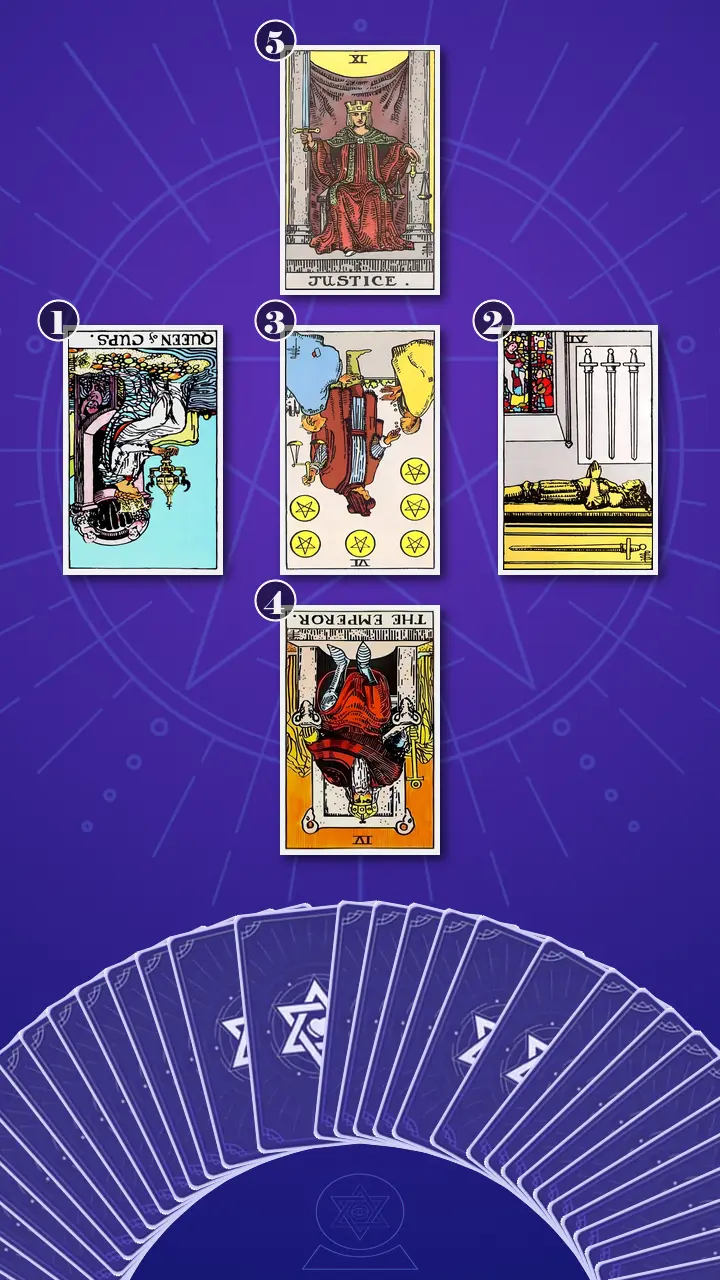
For this reading, I chose the Relationship Spread · Context Edition, a five-card relationship tarot spread designed for emotional labor, blurred boundaries, and the unequal exchange that can develop around a partner's family conflict. This is how tarot works in a grounded consultation: the cards give us images and positions that help us examine observable behavior, assumptions, and choices in context. They do not access her partner's private motives, predict a fixed outcome, or take responsibility away from either adult.
I explained the structure to Maya and to anyone reading along. The first position would show her current rescuing stance. The second would show how her partner's apparent pause landed in her, without claiming to know what the partner secretly intended. The center would reveal the shared pattern of emotional labor and transferred responsibility. Below it, we would examine the organizing strength that had become overused. Above it, the final card would point toward a boundary that preserved warmth while returning each decision to its owner.
A Celtic Cross would add layers that this question did not need, while a purely internal spread would miss the relationship dynamic. Five cards were enough to hold both people, the exchange between them, the protective mechanism underneath, and the practical growth direction. I told Maya that we would read card meanings in context, then turn the insight into small next steps she could test in real life.
The Closed Cup and the Open Chat
The Closed Cup at the Water's Edge
Now turned over is the card representing Maya's observable rescuing behavior, her emotionally contracted stance, and her tendency to treat her partner's family distress as her own assignment: the Queen of Cups, reversed.
The reversed Queen of Cups is Maya at 10:47 p.m. with her work laptop open, holding her partner's family argument in the same focused attention she would give a client crisis. She scrolls through every screenshot, drafts multiple replies, and monitors the phone for emotional weather. The ornate, lidded cup in the Queen's hands becomes the Notes app full of carefully contained wording. She is concentrating on managing someone else's emotional contents while losing contact with what her own capacity can hold.
In this reversed position, empathy has become excess and self-attunement has become blocked. The water is close, but it is not circulating freely. Maya's care absorbs the partner's distress, the relatives' possible reactions, and the imagined consequences of every sentence until her own fatigue and resentment have nowhere to go. Care is not the same as conflict ownership, but her nervous system has learned to translate distress into an instruction: read more, draft more, check again.
I asked her to finish the sentence, 'I am only checking one more time because...' She looked down and said, 'Because if I stop, I might miss the thing that makes it worse. And because doing nothing feels cruel when they are upset.' I heard the conflict clearly: she wanted to be supportive, but she also wanted the discomfort of uncertainty to stop.
Her thumb froze above the screen first. Then her eyes went unfocused, as though she were replaying the last family exchange and the message she had helped write. Finally, she gave a small, bitter laugh and let her shoulders drop by half an inch. 'That is too accurate,' she said. 'It is almost rude.'
I smiled gently. 'I am not reading your care as foolish. I am asking whether your care has been given a job it cannot complete. Before you open the screenshots, can you ask what kind of support was actually requested?'
The Silence Beneath Four Swords
Now turned over is the card representing how Maya experiences her partner's stance during family disputes, and how that perception invites her to take over: the Four of Swords, upright.
The card showed a legitimate pause. Maya's partner goes quiet after a difficult family call and places the phone face down. Maya experiences that stillness as unfinished work rather than a recovery period. She opens a blank message, rehearses possible wording, and assumes she needs to create the next move, even though the resting figure beneath the suspended swords suggests thought held in suspension instead of another immediate response.
Here, the Four of Swords offers a balanced resource, but Maya's interpretation creates a blockage around it. Her partner may need time, privacy, or simply a moment without another decision. I could not tell Maya what the silence meant from the card, and I would not pretend to know. I could only show her what the silence seemed to trigger in her: an urgent reach for the Notes app.
I said, 'A partner's silence is not automatically an empty space for you to fill. What if the pause is something they are using, rather than a vacancy you are required to manage?'
Maya nodded once, then looked toward the phone without touching it. Her shoulders remained raised, but her hand moved away from the device. She told me she often rehearsed possible reactions from relatives while riding the TTC, even when nobody had asked her for an update. She had been treating a parked train of thought as a relationship project waiting for its next manager.
The One-Way Google Doc
Now turned over is the card representing the shared cycle in which support becomes an unequal transfer of emotional labor, decision-making, and responsibility: the Six of Pentacles, reversed.
The reversed Six of Pentacles appears when Maya supplies the interpretation, exact wording, timing, reminders, and follow-up for a family dispute while her partner mainly supplies updates. It resembles a shared Google Doc where one person writes the entire repair plan and the other is asked to approve it. From the outside, it can look generous. Inside the relationship, labor and ownership are moving in one direction.
The energy here is an excess of practical giving and a blockage in reciprocal responsibility. Maya tells herself, 'I am only helping,' but her relief begins to depend on whether the suggested script works. When her partner changes the wording, delays the call, or chooses not to send the message, relief turns into irritation. She has not merely offered support; she has begun measuring the success of a repair process she cannot control.
I asked, 'In the last family dispute, who gathered the context, wrote the possible reply, tracked the response, and decided when the conversation was finished?' The answer did not require blame. It required visibility. An offer of support is not a transfer of responsibility.
Maya inhaled sharply. Her eyes dropped to her hands as if she were mentally counting messages, explanations, and check-ins. Then she pressed her lips together and said, 'I hate that I resent it. I volunteered. But I also feel like I am the only one carrying the emotional labor once I start.'
I told her, 'That resentment is not proof that you are ungenerous. It may be information about a limit you never named. Support can be warm and still have an endpoint.'
The Notion Board on the Elevator
Now turned over is the card representing Maya's organizing competence as an overused relationship resource and the protective drive for control beneath repeated intervention: The Emperor, reversed.
I brought her to the 8:05 a.m. elevator in my description because the scene was unmistakable. She was supposed to be preparing a client timeline at her digital design studio, but she was editing a family apology in Google Docs. She had added a subject line, three tone options, and a preferred send time. The elevator cables hummed, coffee tasted metallic, and the fluorescent light made the document look more official than it was.
The reversed Emperor shows organization becoming control when uncertainty feels unsafe. Maya's work skill is real. She anticipates risks, keeps people aligned, and makes complicated projects easier to navigate. But in this relationship, that strength has become a rigid throne with imaginary authority. She is trying to turn a painful family argument into a Notion board with owners, deadlines, approved wording, and a preferred outcome, even though the people involved are adults with their own choices.
This is the catalyst in the spread, not because it causes the family system, but because it reveals what Maya is trying to protect. If she organizes the conflict perfectly, nobody will feel abandoned. If she steps back, the argument might continue, her partner might suffer, and her usefulness might feel suddenly unproven. She told me, 'If I can see the solution, saying nothing feels cruel.' I answered, 'And if you manage every variable, nobody else gets to choose their own response.'
She closed her eyes for a moment. Her fingers tightened around the edge of her sleeve, then loosened. When she opened them, the expression on her face held recognition without self-condemnation. She could see a familiar strength in a new light: not a moral failure, but a strategy that had been working too hard.
When Justice Set the Air Right
The Upright Sword and the Boundary That Breathes
The room became quieter when I turned the final card. Even the radiator seemed to pause between clicks. Now turned over is the card representing the boundary practice that can interrupt rescuing while preserving warmth, consent, and reciprocal responsibility: Justice, upright, the strategic antidote in this reading.
Justice brings fairness, accountability, proportion, and clear language. Its balanced scales ask Maya to separate compassion from obligation. Its upright sword gives her a sentence direct enough to use when the family group chat interrupts dinner, bedtime, or the first quiet hour after work: she can listen, but she cannot write or manage the response for her partner. The card does not ask her to abandon closeness. It asks her to let the message, timing, and consequences remain with the person whose family relationship is involved.
As a perfumer, I use what I call Intimacy Distance Calibration. Scent tells me whether a room is suffering from emotional suffocation or from detached coldness. In Maya's case, the problem was not that love had become too close. It was that the emotional diffusion had no boundary. Her partner's family conflict was entering every room of their shared life, and Maya was trying to become the ventilation system.
I also used my Boundary Permeability Assessment with her. I asked her to distinguish where her identity ended and her partner's family responsibility began. She could offer presence, one question, or a defined listening window. Her partner could choose the message and its timing. The relatives would own their responses and consequences. That was not punishment or detached coldness. It was enough space for care to breathe.
At 10:47 p.m. in Toronto, Maya's laptop was still open from work while her partner's screenshots glowed on her phone. She had drafted three replies, checked for updates, and tightened her jaw around the belief that protection required management. I asked her to notice the moment when supporting the relationship had quietly become another person's conflict-management shift.
You do not have to carry every conflict to prove that you care; let each person hold their side of Justice's scales, and use the upright sword to name your boundary clearly.
For a second, Maya's face went still; her breath stopped halfway and her thumb hovered above the phone. Then her eyes lost focus, as though the old screenshots were replaying themselves: the relative's punctuation, the draft she had sent, the silence afterward. Her shoulders stayed high even as the tension moved into her hands. 'But doesn't that mean I was wrong before?' she asked, with a sudden edge that was closer to anger than relief. I did not correct her. I told her that the goal was not to put her past care on trial. Her lips parted, a shaky breath left her chest, and her fingers slowly released the sleeve they had been gripping. She looked at the upright sword again, not as a command to cut someone off, but as permission to speak plainly. 'I can listen, but I cannot write or manage the response for you,' she whispered. The room felt wider. A little relief arrived, followed by the dizziness of having fewer instructions. The responsibility was now hers to choose, not mine or the cards to impose.
I asked her, 'Now, use this new perspective to remember last week. Was there a moment when knowing the difference between care and ownership might have made your body feel even slightly different?'
Maya looked back at the warm phone, then at the empty space beside it. She said, 'The moment my partner put their phone face down. I thought I had to fill the silence. Maybe I could have let them have it.'
That was the first visible step from urgent responsibility and conflict-monitoring overfunctioning toward warm, consensual support with clear boundaries and genuinely shared responsibility. The card had not solved the family conflict. It had made the terms of Maya's participation visible, which meant the next choice could belong to Maya again.
The Justice Check-In: From Conflict Ownership to Shared Responsibility
I gathered the spread into one story for Maya. The Queen of Cups reversed showed care becoming a closed container that tried to hold everyone else's distress. The Four of Swords showed how her partner's pause looked like an unfinished task. Between them, the reversed Six of Pentacles turned generosity into a one-way Google Doc, while the reversed Emperor revealed why: Maya's project-management skill was trying to make uncertainty safe by assigning owners to people she could not direct. Justice did not remove the relationship from the picture. It restored the correct permissions. Her partner could own the family relationship, and Maya could offer care without becoming responsible for producing peace.
I named the blind spot plainly. Maya had been treating the problem as an information problem, as though one more screenshot, one more tone option, or one more update would finally make the right action obvious. Underneath that loop was a more tender assumption: being useful was the proof of her value. The shift was therefore not from caring to indifference. It was from automatically solving the dispute to asking what kind of support was wanted, then leaving every decision and follow-up action with her partner.
I gave her three small next steps. They were not a prescription and they were not a test of whether she was a good partner. They were experiments in finding clarity while the conflict might still remain unresolved.
- Ask before opening the Notes appThe next time your partner sends a screenshot after work, during dinner, or before bed, ask one exact question first: 'Do you want listening, brainstorming, or practical help?' If they choose listening, stay with the story for 15 minutes, then ask, 'What do you want to decide for yourself?'Use the smallest version if asking feels cold or inefficient: one question and a 10-minute listening window. If your partner does not know what they want, say, 'That is okay. I am here for ten minutes, and you can decide the next step later.'
- Try the Blank Space ProtocolWhen a family conflict arrives while you are working, cooking, commuting, or getting ready for bed, put the phone face down and create a deliberate 10-minute pause before replying. Notice your jaw, shoulders, and urge to check for updates. Then send one clear availability statement, such as, 'I care about what happened. I am finishing dinner and can listen at 8:30.'I call this the Blank Space Protocol because comfortable emotional or physical distance gives both people the oxygen to choose freely. It is not silent treatment or a tactic to create fear. If 10 minutes feels impossible, begin with two, and do not use the pause to secretly draft a solution.
- Write Mine to Offer and Theirs to DecideBefore helping with the next dispute, write two short columns. Under Mine to Offer, list one form of support and its endpoint, such as listening for 15 minutes or proofreading one message. Under Theirs to Decide, place the wording, send time, contact with relatives, and every follow-up consequence.Name the owner aloud before you help: 'You decide whether to send it; I can read one draft, then I am going back to my evening.' Repeat the boundary without defending it. You can remain on your partner's side while leaving that part with them.
I reminded Maya that a defined offer is not a withdrawal of love. It is consent made visible. She could pause the conversation, return to her own work, shower, read two pages, or finish dinner without monitoring the aftermath. The point was not to make the family argument disappear. The point was to stop placing her identity inside its outcome.

A Small Proof of Finding Clarity
Four days later, Maya sent me a message while I was blending a new sample at my studio. She had received another family screenshot. This time, before opening Notes, she asked her partner what kind of support they wanted. They chose fifteen minutes of listening. At the end, Maya asked what they wanted to decide for themselves, and her partner chose the message and the timing.
She wrote, 'I still wanted to fix it, but I put the phone down after our conversation. The conflict is not resolved. I finished my shower anyway.' I could picture the difference: not a triumphant life overhaul, just a small return to her own evening.
She later told me that her partner sent the message alone. Maya sat with cold takeout for a few minutes, hands still wanting to check the phone, then opened her book. The argument remained open, and the quiet felt lonely for a moment. But she did not reopen the family thread. That was the first evidence that shared responsibility could feel uncomfortable without being unsafe.
That is how I understand a Journey to Clarity. The cards offered images, but Maya supplied the honesty, the boundary, and the next action. She moved from being emotionally on call toward steadier care, not by caring less, but by allowing care to have a fair shape.
If a family screenshot lands and your jaw locks, it may feel safer to write the perfect reply than to let your partner own the mess, especially when pausing makes you wonder whether you still matter if you are not useful. The first moment you notice that pattern is already a little space around it.
If care could stay warm without you taking the next step for them, what is one small way you might ask what support is wanted before opening your Notes app?