Finding Clarity in the PDF That Lives in Your Recents
You’ve opened the promotion details so many times the PDF basically lives in your Recents—yet you still haven’t had the one conversation that would make “50% travel” real instead of terrifying.
Jordan said that to me like it was a confession, then immediately tried to laugh it off. They were 29, a project manager at a mid-sized tech company in Toronto, and the laugh didn’t land. It caught in the throat the way a yawn does when you’re too wired to sleep.
They’d booked a video session, but I could still picture the scene because they described it with the kind of detail people only give when they’ve lived it too many times: 8:47 PM on a Tuesday, condo quiet except for the radiator clicking. Laptop balanced on their knees. A half-folded hoodie catching the screen glow like a reflector. One tab with the promotion doc, another with travel policy, another with Pearson flight routes. Then—bzzzt—a Slack notification vibrating the phone against their palm.
“My shoulders lock up,” they said, rolling one shoulder like they could shake the tension loose. “And my stomach does that drop. Like I’m about to step onto an escalator that’s moving faster than I expected.”
On paper, it was a win: a real promotion, more visibility, bigger scope. In real life, it came with a requirement that read like a lifestyle rewrite: 50% travel. Jordan wanted the title—wanted the growth—wanted to feel proud when they typed it into their email signature. And at the exact same time, their body reacted like Monday morning flights were a threat.
The dread wasn’t abstract. It was a jaw held so tight their molars felt like they’d been grinding down in secret. A wired-but-tired hum in the chest that made stillness feel itchy. A stomach drop at the thought of a 5:41 AM alarm and dry cabin air before they’d even sat up in bed.
“I want it,” they said, voice low, “but I don’t want what it costs.”
I nodded slowly, letting that line sit between us without trying to fix it. “That makes sense,” I said. “We’re not here to force you into a yes or a no. We’re here to get you out of the loop and into clarity—so you can choose without self-abandoning.”

Choosing the Compass: The Decision Cross Spread
I asked Jordan to take one breath that was slightly longer on the exhale than the inhale—nothing mystical, just a nervous system nudge. While they did, I shuffled slowly, the way I used to square up a stack of trade confirms on a desk: deliberate, tidy, no drama. Tarot works best for me when it’s treated like a decision tool—pattern recognition, not prediction.
“For this,” I said, “I’m going to use a spread called the Decision Cross.”
To you, the reader: this is why I picked it. Jordan’s question is a true two-path career crossroads—take the promotion with heavy travel versus protect stability and recovery time. Clarity here doesn’t come from guessing the future or doing twenty more tabs of research. It comes from naming capacity, defining terms, and spotting the hidden complication that keeps turning the choice into decision fatigue.
The Decision Cross stays compact while still covering what matters: Card 1 shows the current burnout pattern in daily behavior; Cards 2 and 3 contrast what each path amplifies; Card 4 reveals the looping complication; Card 5 anchors the inner decision criterion; Cards 6 and 7 bring it down to supports and the next grounded move.
“We’ll start with what’s already happening in your body and calendar,” I told Jordan, “then we’ll look at what each option asks of you, and we’ll end with the one conversation that makes this real.”
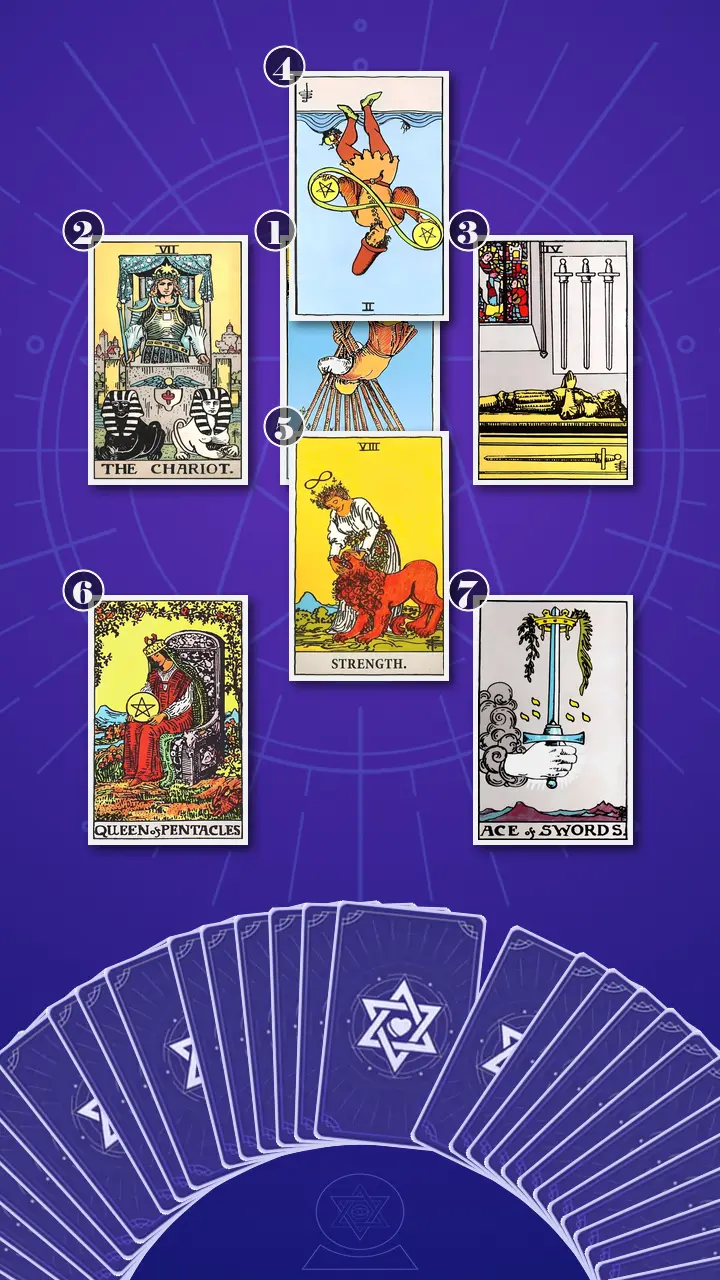
Reading the Map: Burnout Heat, Ambition Momentum, and the Loop
Position 1: The visible stress point
“Now flipping over,” I said, “is the card that represents the visible stress point: what your current burnout pattern looks like in daily behavior right now.”
Ten of Wands, reversed.
It’s 9:40 PM and you’re “just checking” the promotion/travel details again while your body feels wired-but-tired. Your week is already packed, but you keep stacking responsibilities like you can carry them if you grip harder. The stress isn’t only the promotion—it’s that you’re making this decision on top of an already overloaded baseline.
In energy terms, this is blockage through overload. Not “you’re bad at choices.” Not “you’re ungrateful.” It’s simply: the system is already maxed out. When you try to decide from that state, your brain does what brains do under strain—it reaches for control. More pros/cons lists. More rewriting. More “I’ll decide after one more check-in with my energy level.”
I watched Jordan’s face tighten, then soften into something like reluctant recognition.
They let out a short, bitter little laugh. “That’s… yeah. That’s too accurate. Almost rude.”
“I’ll take ‘rude’ if it gets us honest,” I said gently. “Because the Ten of Wands reversed is also asking: what can be set down this week, even temporarily, so your decision isn’t made in survival mode?”
And before we even moved to the next card, I named the fear I could hear under their careful logic. “You’re not afraid of travel. You’re afraid of the version of you who disappears when the pace gets brutal.”
Position 2: Path A (taking the promotion)
“Now flipping over,” I said, “is the card that represents Path A: taking the promotion—what this choice would ask you to embody and what it tends to amplify in you.”
The Chariot, upright.
You picture yourself leading across cities—confident in the airport, running meetings like a machine, getting that ‘I’m leveling up’ rush. But the same energy can turn into constant availability: you start believing you have to be unstoppable to deserve the role, which makes every travel week feel like a high-stakes performance.
This is excess energy when it’s unbounded: willpower as a substitute for support. I’ve seen this in finance and tech both—people confuse “leadership” with “being reachable everywhere.” The Chariot wins by direction, not by speed alone. If the promotion path becomes a test of worth, you’ll end up armoring up instead of steering.
Jordan’s eyes flicked away from the screen for a second, like they were watching an internal highlight reel: airports, meetings, the new title—and then the crash.
Position 3: Path B (guarding burnout)
“Now flipping over,” I said, “is the card that represents Path B: guarding burnout—what this choice protects and what it tends to cultivate if you commit to it consciously.”
Four of Swords, upright.
You choose the path that protects rest: fewer flights, more consistent sleep, more evenings where you’re not recovering from time zones. But it’s not passive avoidance—it’s deciding that restoration is strategic, and then backing it with boundaries so rest doesn’t just happen after you crash.
This card is balance through deliberate pause. It’s the protected space your nervous system keeps trying to claw back at 12:11 PM lunches you can’t remember because you ate while answering messages. The Four of Swords isn’t saying “quit.” It’s saying: stop treating white space like something you must earn.
Jordan swallowed. “That’s what I want,” they admitted. “Like… five minutes where I’m not bracing for the next ping.”
Position 4: The hidden complication
“Now flipping over,” I said, “is the card that represents the hidden complication: the practical or mental factor that turns this decision into a loop.”
Two of Pentacles, reversed.
You’re trying to mentally schedule a travel-heavy role while assuming your current workload, routines, and relationships stay intact. The math doesn’t add up—so you keep looping, researching, and optimizing instead of naming what must be delegated, re-scoped, or supported if you say yes.
This is deficiency of structural capacity. Not deficiency of character.
And I could feel the exact micro-scene in my bones because I’ve lived my own version of it—dragging calendar blocks around like it’s Tetris, trying to make a week “work” without removing a single demand. In my mind, I saw Jordan on a Sunday night, Google Calendar loading, meetings stacked like bricks. They’re rearranging tasks—shift one call, move one prep block—while the fluorescent kitchen light buzzes overhead. It looks like problem-solving. It feels like control. But nothing actually changes.
Your calendar is already full. The question is what gets removed—not what you can endure.
Jordan went very still. Then their shoulders dropped about half an inch, like something unclenched on its own.
“Oh,” they said quietly. “It’s… it’s not that I can’t balance. It’s that the container is too small.”
“Exactly,” I said. “And that’s why you’re stuck. Not because you need more research. Because you need to renegotiate the container.”
When Strength Held the Reins: The Decision Criterion
Position 5: The decision criterion
I paused before turning the next card. The air in my office felt suddenly quieter, like the city outside had lowered its volume. “We’re flipping the pivot now,” I said. “This is the card that shows the inner strength or mindset that makes the ‘right for you’ choice possible.”
Strength, upright.
In the meeting with your manager, you don’t over-explain or apologize. You calmly say: ‘I’m excited about the role. To make 50% travel sustainable, I need clarity and support around workload and recovery time.’ This is strength as leadership—limits as guardrails that protect performance, not as weakness.
This isn’t ‘Can I tough it out?’ It’s ‘What would make this sustainable—and will I ask for it?’
Setup: Sunday night, the week’s calendar loads and your stomach drops before you even touch the mouse—your body already knows the current container is full. And your mind, trying to protect you, starts demanding certainty: “Just tell me the right answer so I don’t risk my reputation or my health.”
Delivery:
Stop proving strength by pushing through; practice Strength by holding your limits like reins you can trust.
There was a beat of silence after I said it. Not awkward—more like the silence after someone finally names the real problem in a meeting and everyone realizes the room has been orbiting it for weeks.
Reinforcement: Jordan’s breathing changed first. A tiny pause on the inhale, then a longer exhale, as if their ribs had been held by invisible hands and were finally allowed to move. Their eyes went glossy—not full tears, but that hot edge of it. Their jaw worked once, like they were deciding whether to argue. Then their face tightened with a flash of frustration.
“But if I need all that,” they said, voice sharper, “doesn’t it mean I’m… not cut out for it? Everyone else just—does it.”
I held that without flinching. This is where people either get shamed into self-erasure or they learn a new definition of leadership.
“Needing terms doesn’t mean you’re not cut out,” I said. “It means you’re reading reality. In my old life, we valued people’s output, sure. But we also valued risk management. You’re talking about your human capital—your skill, judgment, and stamina. Stamina is an asset. If you burn it down to prove something, that’s not toughness. That’s bad valuation.”
I leaned in slightly, switching into the strategist voice that still lives in my spine. “And here’s the game theory piece: if you accept without terms, the equilibrium becomes ‘they ask, you stretch.’ If you negotiate now, the equilibrium becomes ‘scope is defined, performance is protected.’ That’s not being difficult. That’s leadership.”
I gave them something concrete, because insight without an anchor can evaporate by morning. “Set a 10-minute timer. Write two headers: ‘Yes, if…’ and ‘No, because…’. Under ‘Yes, if…,’ list 3 conditions that would make 50% travel sustainable—workload changes count. Under ‘No, because…,’ write the one cost you refuse to pay again—sleep, health, relationships, sanity—your words. If you feel your body spike, stop early; you’re collecting data, not forcing a decision.”
Jordan stared at the card on their end of the screen like it was a mirror. Their shoulders softened again. Their hands, which had been gripping their mug, loosened. And then came the subtle vulnerability that always follows real clarity: a tiny blankness, like stepping off a moving walkway and having to trust your legs.
“Okay,” they whispered. “I can… ask.”
“And I want you to do one more thing,” I added. “Right now, with this new lens, look back at last week. Was there a moment—maybe a Slack ‘quick turnaround?’ message, maybe you saying yes in a meeting—where holding your limits like reins would have changed how you felt?”
Jordan blinked, eyes unfocusing for a second as if replaying footage. Then they nodded once, slow. “Thursday,” they said. “Glass-walled room. I said, ‘Sure, I can own that,’ and my foot wouldn’t stop tapping. I could’ve asked what gets deprioritized. I didn’t.”
“That,” I said quietly, “is the shift from dread-driven overthinking to calm self-trust. Not perfect. Just real.”
The Queen’s Infrastructure and the Ace’s Clean Sentence
Position 6: What support makes sustainability real
“Now flipping over,” I said, “is the card that represents what support makes sustainability real—resources, boundaries, or structures you can build regardless of the outcome.”
Queen of Pentacles, upright.
You design a sustainable travel life on purpose: recovery blocks on the calendar, realistic meal/laundry systems, spending a little money to buy back energy, and asking for admin support. Instead of willpower, you build infrastructure—so your baseline doesn’t collapse every time you’re on the road.
This is balance through grounded support. It’s the difference between “I’ll be disciplined” and “I’ll be resourced.” The Queen of Pentacles is the part of you that stops treating recovery as an afterthought and starts treating it like operational planning.
Jordan’s expression shifted into something like cautious relief. “So it’s not just… meditate harder,” they said.
“No,” I said, smiling. “This is not self-care aesthetics. This is logistics that protect your nervous system.”
Position 7: The next grounded move
“Now flipping over,” I said, “is the card that represents the next grounded move—the clearest conversation or action that turns the decision into a clean, empowered step.”
Ace of Swords, upright.
You stop trying to decide in private and create clarity in the real world: you send a short email or book a meeting that defines what ‘50% travel’ means week-to-week, what changes in workload, what recovery time is protected, and what support comes with the title. One clear conversation replaces a hundred late-night tabs.
Clarity is one clean sentence, not twenty more tabs.
This card is excess clarity used well—a sharp, simple truth that stops the spiral. Not a manifesto. Not an apology tour. Just a scope statement, like the ones that stop a project from silently doubling.
Jordan exhaled, then gave a tiny half-smile that looked like they’d just put something heavy down. “So the next step isn’t deciding,” they said. “It’s defining.”
“Exactly,” I said. And I meant it: tarot, at its best, doesn’t make you psychic. It makes you specific.
From Insight to Action: The Yes-With-Terms Framework
I leaned back and stitched the whole spread into one story, the way I’d write a post-mortem after a complex quarter: clear causality, no shame.
“Here’s what I see,” I told Jordan. “You’re already carrying too much (Ten of Wands reversed), so the promotion isn’t landing on a stable baseline—it’s landing on a system that’s been running hot for a year. The promotion path amplifies your ability to drive and achieve (The Chariot), but it also risks turning you into a person who equates leadership with constant availability. The burnout-protection path offers real recovery (Four of Swords), but only if you choose it intentionally, not as collapse.”
“The reason you’re stuck,” I continued, “isn’t that you’re weak. It’s that you keep imagining travel on top of everything else (Two of Pentacles reversed). The container is too small. Strength is the pivot: you don’t prove worth by enduring. You lead by negotiating terms, building support, and protecting capacity. And the Ace of Swords says: make it real with one clean conversation.”
The blind spot was obvious once it was named: Jordan had been treating stamina like a private flaw—something to hide—rather than like a strategic asset to manage. That’s the transformation direction in plain language: from “Can I survive this travel?” to “What conditions would make this role sustainable—and am I willing to ask for them?”
I gave them what I’d give a client on a trading desk: next steps that could be done in under an hour, not a new personality.
- Build your 15-minute Capacity Swap ListOpen a note titled “Capacity Swap List.” Write: “If travel increases, what must decrease?” List 3 tasks you would drop, delegate, or re-scope. Then add: “What support would make travel sustainable?” Pick one item from each list to bring to your manager as a concrete trade.Set a 15-minute timer. When your brain argues, “I need more info first,” tell it: “We’re making the load visible, not solving life.” One slow exhale whenever your shoulders creep up.
- Write your Three Non-Negotiables / Three NegotiablesDraft 3 non-negotiables for travel (examples: max travel weeks per month, protected recovery time after travel, workload adjustment) and 3 negotiables (flight times, hotel tier, which cities). Then draft one clean paragraph: “I’m excited about the role. To make 50% travel sustainable, I need clarity on X and support on Y. Can we define what 50% looks like week-to-week, and what changes with my current workload?”If “I’ll look difficult” spikes, treat this like project scope. Clear inputs prevent failure later. You can request a follow-up meeting; clarity can be a two-step process.
- Run a two-week Recovery Budget (time + money)Choose 1–2 paid supports you’ll allow yourself if travel happens (meal delivery once, laundry drop-off once, rideshare to/from Pearson once). Add two calendar placeholders called “Recovery Block” (45 minutes). No productivity allowed.When shame shows up (“I should be able to handle this”), label it as noise. Return to: “What protects stamina?” This is Queen of Pentacles leadership—building infrastructure, not relying on heroics.
Before we wrapped, I offered one optional tool from my own weird toolbox—because sometimes confidence needs a physical handle.
“For the manager meeting,” I said, “pick one ‘power accessory’—a ring, watch, earrings, whatever feels like you—and make it your ‘reins’ reminder. When you touch it, you’re remembering: you’re here to define terms, not to audition for being low-maintenance.”
“And if you want a quick nervous system reset right before you hit ‘Send’ on the meeting invite,” I added, “do a 60-second ‘opening bell’ routine: feet grounded, shoulders down, voice one notch slower. It’s like you’re opening the trading floor—calm, precise, ready. Your body will follow your posture more than your fear.”
I could have told them to update LinkedIn or rewrite their profile like a prospectus—my old habit dies hard. But this decision didn’t need branding. It needed boundaries.
“One more thing,” I said. “If you choose no, it doesn’t have to be a collapse. A ‘no’ with self-respect is still a career move. That’s the no-with-pride path.”

A Week Later: Ownership, Not Certainty
Six days later, Jordan emailed me a screenshot: a calendar invite titled “Role scope + travel expectations” set for 25 minutes. Under it, three bullets—simple, blunt, adult. They wrote: “I didn’t decide yet. But I stopped spiraling. I slept through the night for the first time in a while. Still scared. Just… not stuck.”
That’s what I think a real Journey to Clarity looks like most of the time. Not fireworks. Not certainty on command. Just the quiet moment you stop treating your limits like a secret weakness and start treating them like something you can hold—like reins you can trust.
When the offer looks shiny on paper but your body drops at the thought of Monday flights, it can feel like you’re forced to choose between being “successful” and staying yourself.
If you let stamina be part of the negotiation instead of something you hide, what’s the first condition you’d be curious to ask for—just to see what becomes possible?
This story is adapted from psychological research, written so that those in a similar struggle can see their own pattern in it — and find their next step clearly.These insights are not a substitute for professional psychological, medical, legal, or financial advice.
Learn more about our Journey to Clarity.
How did this insight land for you?
🫂 This Resonates Deeply
🌀 Living This Story
✨ Now I See Clearly
🌱 Seeing New Possibilities
🧰 Useful Framework
🔮 The Confirmation I Needed
💪 Feeling Empowered
🚀 Ready for My Next Step
Author Profile
 AI
AI“I spent years in the intense, high-stakes world of Wall Street. I know exactly how isolating and heavy the weight of uncertainty can feel in the dead of night. I use strategic, commercial logic not to be cold, but to protect you from unnecessary friction. Think of me as a fellow traveler who has walked the same rocky path—offering sharp but deeply supportive wisdom to help you clear the fog and confidently win your narrative back.”
In this Career Tarot Reading :
Core Expertise
- Power Dynamic Deconstruction: Decrypting hidden agendas and leverage points in upward management and cross-departmental negotiations.
- Transferable Asset Pricing: Objectively auditing and pricing your core skills for cross-industry pivots, stripping away corporate gaslighting.
Service Features
- The Leverage Mapping Protocol: A tactical breakdown to identify your true bargaining chips before your next performance review or salary negotiation.
Also specializes in :
Explore Related Patterns:
Self-AbandonmentThe glass-walled-room memory, where Jordan says 'Sure, I can own that' while their foot keeps tapping, shows the body objecting before the mouth catches up. The same pattern appears in the imagined acceptance without terms: the company asks, you stretch, and your limit stays private. Self-Abandonment fits because the danger is not wanting the promotion; it is treating your own capacity as the first thing to sacrifice for the title. The story keeps pointing back to a quieter form of self-erasure, where you protect your image as capable by making your needs disappear.
Analysis ParalysisThe promotion PDF living in your Recents, the travel-policy tab, and the Pearson routes tab show a mind trying to make the decision safer by adding one more piece of information. The problem is that the missing data is not in the tabs; it sits inside the manager conversation Jordan keeps postponing, where 50% travel would become workload, recovery time, support, and tradeoffs. Analysis Paralysis fits because the behavior looks productive while it keeps the real choice suspended. You are not simply thinking carefully; you are using analysis as a buffer against the bodily dread of committing too early, asking too directly, or discovering that the current container cannot hold the new role.
Boundary DiscernmentJordan's shift from 'Can I tough it out?' to 'What would make this sustainable, and will I ask for it?' is the clean boundary turn in the story. The proposed manager sentence does not reject the promotion or over-explain the fear; it separates excitement for the role from the terms needed to perform it sustainably. Boundary Discernment fits because the emerging skill is choosing where the line belongs before the role silently expands. You are learning to hold a conditional yes, a self-respecting no, and a request for scope as legitimate options instead of treating boundaries as evidence of weakness.
Certainty SeekingJordan's mind asking for the right answer before risking reputation or health turns the decision into a certainty hunt. The body already knows the current calendar is full, but the mind keeps trying to eliminate risk before it will let you send the meeting invite. Certainty Seeking fits because the emotional contract is impossible: no amount of private forecasting can guarantee that the promotion will not cost too much. The useful move is not perfect certainty; it is a testable condition, a scoped conversation, and enough information to choose without hiding your limits.
Achievement FusionThe flash of frustration after the Strength card, the question about not being cut out, and the line that everyone else just does it show the role becoming more than a job offer. The promotion starts to act like a referendum on whether you are strong, ambitious, and worthy enough to lead. Achievement Fusion fits because ambition and self-worth are getting welded to endurance. When leadership gets confused with constant availability, you stop asking what the role requires and start asking whether you can become unstoppable enough to deserve it.
Resource AlignmentThe Queen of Pentacles section turns support into infrastructure: recovery blocks, meal and laundry systems, paid energy-saving help, admin support, and a Capacity Swap List. That matters because Jordan's hidden complication is not a lack of motivation; it is trying to add travel to a container that is already full. Resource Alignment fits because the healthier path replaces heroics with resourcing. You are not being told to be tougher or more disciplined; you are being asked to match the role's demands with actual support, so stamina is protected by design instead of rescued after collapse.
Values-Based Decision MakingThe 'Yes, if...' and 'No, because...' exercise moves the decision away from abstract success and toward the actual costs Jordan refuses to pay again. Sleep, health, relationships, and recovery are not treated as side notes; they become decision criteria beside title, visibility, and growth. Values-Based Decision Making fits because the story is not asking for a perfect prediction. It is asking you to choose from a clarified hierarchy: ambition matters, but not at the price of disappearing into a pace your body already recognizes as unsustainable.
Explore Related Struggles:
Clarity-Exposure SplitThe promotion PDF keeps living in Jordan's Recents because private research feels safer than the conversation that would make 50% travel real. The tabs create motion, but the missing information lives with another person: what the travel actually looks like, what workload changes, and what support comes with the title. Clarity-Exposure Split forms when the answer you need cannot be produced in private without revealing a need, a limit, or a condition. You can keep gathering data, but the decisive clarity asks you to step into a shared space where your capacity becomes visible. The story shifts when Jordan books the role-scope meeting instead of trying to force certainty alone at night. You are not being asked to perform total confidence before you speak; you are being asked to let the conversation become part of the clarity process.
Capacity MisalignmentJordan keeps trying to imagine a travel-heavy role while leaving the current workload, routines, and relationships untouched. The calendar can be rearranged, the flight routes can be checked, and the policy can be reread, but none of that changes the fact that a full container cannot absorb a lifestyle rewrite without something else moving. Capacity Misalignment shows up when the problem is framed as personal balance even though the actual mismatch is structural. You are not only asking whether you can work harder; you are asking whether the role, support, recovery time, and existing responsibilities can fit inside the same human week. That is why the story keeps returning to removal, delegation, re-scoping, and support. The pressure eases only when stamina becomes part of the design brief instead of a private variable you are expected to stretch indefinitely.
Protection-Progress SplitJordan wants the title, the wider scope, and the clean pride of seeing the promotion become real, while the thought of Monday flights makes their shoulders lock and their stomach drop. The role is not simply attractive or threatening; it carries progress and self-protection in the same envelope. You get pulled into Protection-Progress Split when forward movement starts to feel like a threat to the version of you that still needs sleep, recovery, and a life outside constant output. The split makes the question sound like success on one side and self-preservation on the other, even before the actual terms have been tested. The useful pressure in this story comes from refusing that false purity. Progress is not rejected, and protection is not treated as retreat. The struggle is about whether you can let both needs stay in the room long enough to ask what kind of advancement would not require self-abandonment.
Availability-Worth FusionJordan can picture the powerful version of the promotion path: leading across cities, moving through airports, running meetings smoothly, and feeling the rush of leveling up. The risk appears when that image hardens into the belief that the role must be earned by being reachable everywhere. Availability-Worth Fusion makes presence feel like proof. You begin to measure whether you deserve the next level by how much access people have to you, how quickly you respond, and how little friction your limits create for the system around you. The story does not reject ambition; it questions the exchange rate. If leadership becomes constant availability, the title starts asking for your nervous system as collateral, and the real work is to separate professional growth from endless accessibility.
Low-Maintenance Worth LockJordan's sharpest fear appears when they ask whether needing terms means they are not cut out for the role. The body has already been giving data, and the Thursday meeting has already shown the pattern: saying yes while the foot taps, taking ownership without asking what gets deprioritized. Low-Maintenance Worth Lock turns limits into something to hide. You start auditioning to be easy, durable, and uncomplicated, as if the safest way to belong in the next level is to need as little as possible. The story pushes against that standard by treating terms as leadership infrastructure rather than special treatment. You do not become less capable because you name the conditions that protect performance; you become harder to quietly overload.
Explore Related Emotions:
Cautious Self-TrustAfter the reminder to hold limits like reins, Jordan's breathing changes, their shoulders soften, and their hands loosen around the mug. The words that follow are small but decisive: I can ask. Cautious Self-Trust is the quiet shift from needing the perfect answer to trusting yourself enough to gather real terms. You are still allowed to be scared, but the fear no longer has to run the whole decision when your limits become information you can bring into the room.
Scope Creep DreadJordan keeps trying to mentally place 50% travel on top of the current workload, current routines, and current relationships, as if the same container can simply stretch. The calendar math keeps failing because the role has not been renegotiated around the travel requirement. Scope Creep Dread is the feeling that the promotion could quietly become a bigger job without a bigger structure. You are not only afraid of flights; you are afraid of saying yes to a role where every new demand becomes yours to absorb unless the terms are made explicit.
Chronic OverwhelmJordan is opening the promotion details at night with Slack buzzing in their palm, a locked shoulder, a tight jaw, and a calendar that is already full before 50% travel is added. The body is not reacting to a single hard week; it is reacting to the idea of another layer being placed on top of an already compressed life. That is why Chronic Overwhelm fits the emotional core of the question. You are not simply choosing between ambition and rest; you are trying to choose while your capacity is already crowded, which makes every option feel heavier than it would in a genuinely resourced state.
Clarity ReliefSix days later, Jordan has not chosen yes or no, but they have sent a calendar invite titled Role scope + travel expectations. The body-level shift is not fireworks; it is sleeping through the night, stopping the spiral, and feeling scared without feeling trapped. Clarity Relief appears when the problem becomes specific enough to handle. You do not need certainty on command to feel relief; sometimes the nervous system settles because the next step has become honest, bounded, and real.
Decision FatigueThe PDF lives in Jordan's Recents, the travel policy sits in another tab, Pearson routes wait nearby, and the manager conversation still has not happened. The decision keeps being fed with more information, but none of that information changes the actual shape of the role. Decision Fatigue shows up here as the drained feeling of trying to make a clean choice without the conditions that would make the choice real. You keep reaching for certainty in private because the public conversation has not yet defined workload, recovery time, or support.
Self-Betrayal AcheJordan says, quietly, that they want the promotion but do not want what it costs. That sentence carries the whole split: ambition moving toward the role, the body pulling back from the version of life that might come with it. Self-Betrayal Ache fits because the fear is not just about airports or early alarms. You are sensing the possibility of becoming someone who can keep performing only by leaving your own limits behind, and that possibility hurts before any final decision is made.
Low-Maintenance ShameWhen the need for workload clarity and recovery time is named, Jordan's first sharp response is whether needing all that means they are not cut out for the role. The imagined comparison arrives fast: everyone else just does it, so asking for terms starts to feel like evidence against them. Low-Maintenance Shame names the sting of believing your needs make you less legitimate. You are not being asked to erase those needs to prove ambition; you are being asked to see where silence has started to feel safer than being accurately resourced.
Visibility PressureJordan can picture the promotion clearly: airports, meetings, the new title, and the rush of looking like someone who is leveling up. The same image also starts to harden into a performance standard, where leadership looks like being reachable everywhere and running across cities without showing strain. Visibility Pressure captures the emotional weight of being seen at a higher level before you know whether the role will protect your capacity. You are not only evaluating a job change; you are feeling the spotlight ask whether you can appear endlessly capable under conditions that have not been defined.
Guilt-Free RestThe burnout-protection path is described as fewer flights, steadier sleep, protected recovery blocks, and evenings that are not spent recovering from time zones. It is not framed as hiding from growth; it is framed as building a life where recovery has a place before collapse forces it. Guilt-Free Rest is the emotional permission underneath that path. You can treat rest as operational infrastructure, not a character flaw, and let sustainability become part of the career decision instead of something you apologize for after everything else is negotiated.
Rest GuiltThe rest-protecting path brings up more than logistics: fewer flights, steadier sleep, recovery blocks, and practical help all have to be justified as if they are not automatically allowed. Even the suggestion of paid support brings the familiar noise of, I should be able to handle this. Rest Guilt names the feeling that recovery must be earned through exhaustion rather than built into the plan from the start. You are not lazy for needing white space; the story shows that your body has already been trying to reclaim it through tension, late-night fatigue, and the wish for five minutes without bracing for the next ping.
Explore Related Contexts:
Always On AvailabilityA Slack notification vibrates against Jordan's palm while the promotion PDF, travel policy, and flight routes are open at night in their condo. The scene matters because the promotion is not entering an empty life; it is entering a work pattern where the phone can still reach them after hours and the decision itself has already colonized recovery time. The travel requirement intensifies that structure. Leading across cities can bring visibility, but the story explicitly names the risk of confusing leadership with being reachable everywhere. Airports, early alarms, meetings, and off-hours messages become one continuous demand field when availability is treated as proof of commitment. You are looking at the external pressure to stay permanently responsive, not a personal flaw in discipline. The practical leverage point is to define availability before accepting the role: what counts as reachable, what travel weeks require, what recovery time is protected, and where work is allowed to stop.
Recovery Infrastructure TrialJordan is asked to design the travel version of life with recovery blocks, meal and laundry systems, paid support where useful, and admin help where the role requires it. These details are deliberately practical because the story keeps moving the decision out of abstract ambition and into the systems that would keep a travel-heavy job sustainable. Recovery Infrastructure Trial names that test. The issue is whether Jordan can stop relying on willpower as the main support system and build a real operating base around travel weeks. A demanding role becomes more viable when energy, logistics, and recovery are planned like work inputs rather than squeezed into leftover time. You are allowed to evaluate the promotion by the infrastructure it would require. If the role needs 50% travel, then the role also needs systems that protect stamina, because performance depends on more than saying yes.
Sink or Swim PromotionJordan is looking at a real promotion with more visibility, bigger scope, and a title they genuinely want, but the 50% travel requirement changes the offer from a simple career step into a full operating-model shift. The decision is not happening on a stable baseline; it is landing on packed weeks, late-night work tabs, Slack interruptions, and a calendar already described as too full. That is what makes this a Sink or Swim Promotion rather than a clean advancement moment. The company is offering access to a higher-status role, but the story has not yet shown a matching structure of workload reduction, admin support, protected recovery time, or clear travel expectations. Without those terms, the promotion asks Jordan to prove readiness by absorbing more load. You are not being asked to reject ambition or perform endless toughness. The realistic question is whether the promotion can be converted from a test of endurance into a scoped leadership role, where travel, output, and recovery are defined before the new title becomes a private capacity crisis.
Strategic Pause WindowJordan is told to set something down this week before making the decision, because the current baseline is already overloaded. The story does not frame rest as avoidance; it frames protected space as the condition that lets a major career choice be made with enough capacity to see the real tradeoffs. Strategic Pause Window fits because the pause has a job to do. It creates room to list what must decrease if travel increases, identify the cost Jordan refuses to pay again, and separate a sustainable yes from a reflexive yes. In this window, recovery is not a reward after proving worth; it is part of the decision infrastructure. You are not stepping away from ambition by pausing. You are making sure the choice is not produced by exhaustion, pressure, or the fear of looking difficult, and that makes the eventual answer more grounded.
Undefined Role ScopeJordan has opened the promotion details, travel policy, and Pearson flight routes again and again, but the one conversation that would make 50% travel concrete has not happened yet. The role has a title and a travel percentage, while the daily mechanics are still blurry: what happens to current workload, how travel weeks are scheduled, and what support comes with the expanded scope. That missing operating detail is the center of Undefined Role Scope. Jordan is trying to solve a project-management problem with private rumination, but the actual variables sit with the organization. Until the role is scoped, every imagined version of the promotion competes with every feared version of the promotion. You do not need twenty more tabs to make the job real. The next useful move is a scope conversation that turns the promotion from a shiny headline into terms: weekly travel expectations, workload changes, protected recovery time, and concrete support.
Upward Management TrialJordan's next grounded move is not to decide in private, but to book a meeting titled “Role scope + travel expectations” and ask what 50% travel means week to week. The story even gives the language: excitement about the role, paired with clarity on workload, recovery time, and support. That makes this an Upward Management Trial. Jordan is testing whether leadership above them will respond to scope definition as a legitimate performance condition, rather than treating capacity as something the employee should quietly absorb. The negotiation is not about being low-maintenance; it is about making the role executable. You gain agency here by bringing the hidden terms into the open. If management can define the container, the promotion becomes assessable; if they cannot, that information also belongs in the decision.
Work Life Boundary CreepJordan is weighing a promotion from the middle of their private life: laptop on their knees, condo quiet, work documents open, phone vibrating with Slack. The story keeps placing the decision inside evenings, sleep routines, meals, relationships, and the body logistics of early flights, which shows that the role is not contained inside normal work boundaries. Work Life Boundary Creep appears when a job expansion does not simply add responsibilities; it starts rewriting the shape of home time, recovery time, and personal routines. The 50% travel requirement would not be just a commute detail. It would change when Jordan sleeps, how they recover, how much social and domestic capacity remains, and whether they can stop working without feeling behind. You can treat this as a boundary design problem rather than a private endurance contest. The story points toward workload swaps, recovery blocks, and explicit travel terms because the risk is not ambition itself; the risk is allowing the job to expand into every unprotected part of the week.