The End-of-Month Burnout Cycle: Asking What Must Move Before Friday

The Cold Takeaway and the End-of-Month Burnout Cycle
If you are the reliable one in a hybrid operations job and the final five business days always become late nights, cold desk dinners, and a deleted weekend, I want to name what I see: this may be an end-of-month burnout cycle, not merely an unusually busy week.
I met Maya, a 29-year-old operations coordinator at a creative agency in Toronto, over a video call at 8:47 p.m. on the final Thursday of the month. A billing spreadsheet lit one side of her face while an unfinished status report waited behind it. Three Slack messages blinked at the edge of the screen. I could hear notification pings cutting through the apartment's quiet, and I watched her rub the wrist resting beside the warm laptop fan. A box of takeaway had gone cold near her elbow.
While we spoke, Maya opened Google Calendar and hovered over her Saturday plans. Her shoulders sat almost level with her ears.
"I keep promising that next month will be different," she said. "But if I slow down now, everything will slip. Then I get through the deadline, cancel the weekend, and I'm too drained to fix whatever caused it. I can rest when the month is closed, except by then I don't even know how to rest."
I heard the central contradiction immediately. Maya wanted to break the deadline-adrenaline crash, yet the survival-mode behaviors getting her through each close were consuming the recovery and review time needed to prevent the next one. Her exhaustion looked less like ordinary tiredness and more like wading through wet concrete while a smoke alarm kept insisting she move faster.
I also understood why "just set a boundary" would not be a serious response. Maya's rent, limited financial cushion, and reputation for catching loose ends all mattered. Her workplace pressures were real. I was not there to pretend she had unlimited control or to blame her for an overloaded system.
"I don't think the goal tonight is to make you care less about your work," I told her. "I think it is to find out why care keeps being translated into strain. Let's draw a map of the cycle and look for one place where your actual choices, however constrained, still matter."
Choosing the Hourglass Map
I asked Maya to put both feet on the floor, take one ordinary breath, and hold the question in mind: What keeps me in the same end-of-month burnout cycle? I shuffled slowly while she closed the spreadsheet. I use this preparation as a transition from reacting to observing, not as a test of belief or a mystical performance.
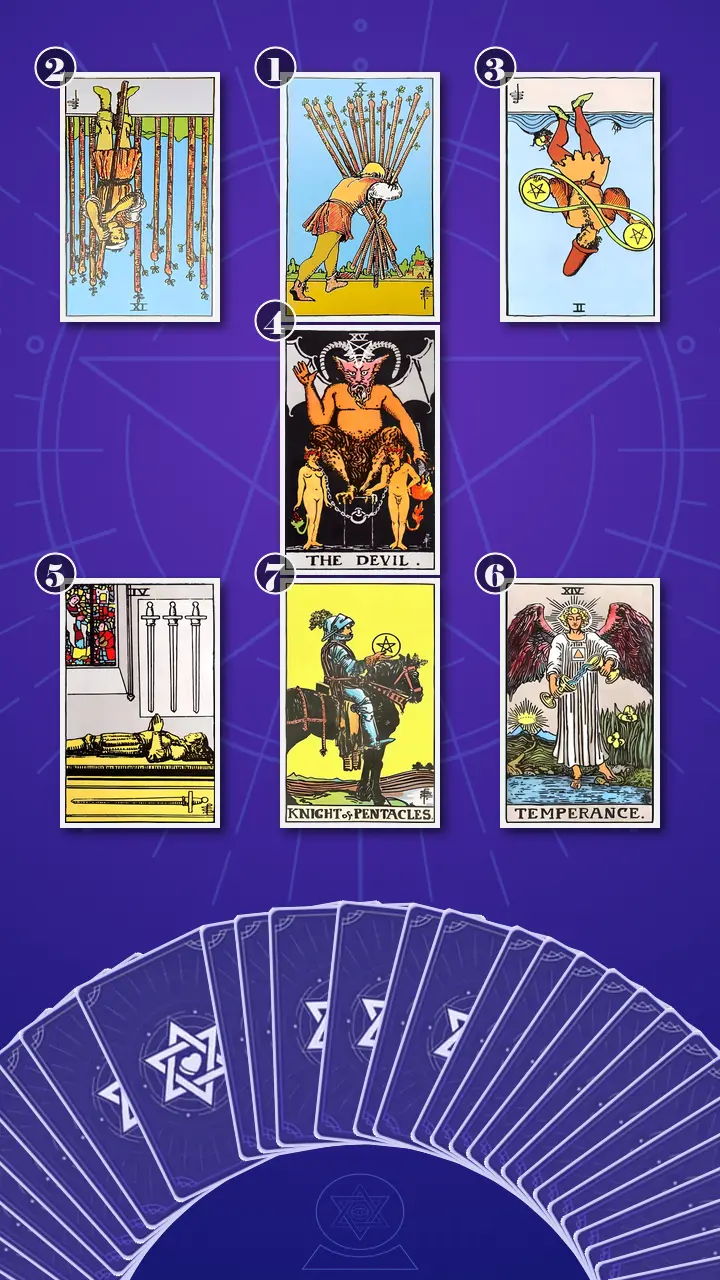
I chose the Energy Diagnostic Map · Context Edition, a seven-position tarot spread designed to trace a repeating feedback loop. For anyone wondering how tarot works in a reading like this, I do not use the cards to predict an inevitable future. I use their symbols as a structured reflection tool. Card meanings in context can separate a problem that feels like one solid wall into observable behavior, internal protection, external pressure, core mechanism, available resource, transformation, and a grounded next step.
This spread suited Maya's question because a broad predictive layout would have produced more information than we needed. Her concern was systemic: deadline pressure triggered overfunctioning; overfunctioning created recovery debt; exhaustion prevented review; and the unchanged setup recreated the pressure. The seven-card Energy Diagnostic Map was the smallest map that could show that whole loop without reducing everything to either personal mindset or workplace conditions.
I explained that the first position would show the visible final-week behavior. The second and third would separate Maya's internal survival response from the agency's external demands. The fourth, at the narrow center of the hourglass, would reveal the blockage where those forces became self-reinforcing. The fifth and sixth would open the map toward an available resource and a pivotal transformation. The final card would turn the insight into something repeatable.
"So this isn't about whether I'm destined to burn out again?" Maya asked.
"No," I said. "The cards can help us see the current pattern objectively. They cannot make your decisions, override your workplace, or own your future. That authority stays with you."
Fire in Every Open Tab
Position 1: The Bundle Blocking the Screen
I turned over the card in the position showing Maya's observable end-of-month behavior: carrying excessive responsibility, extending her work hours, and losing sight of which priorities could move. It was the Ten of Wands, upright.
The figure bends beneath ten staffs held so closely that the bundle blocks the road ahead. I pointed from the card to Maya's laptop. At 8:47 p.m., she had the billing sheet, status report, email, and three chat threads visible. She was treating every open item as something she personally had to carry across the month-end line, even though those items did not all have the same deadline, impact, or owner.
The Wands energy appeared here in excess: too much effort concentrated into the last stage of a cycle. The problem was not simply that Maya had a lot to do. The volume was pressed so close to her attention that it removed the visibility required for prioritization. Her inner rule had become: If it is open, it is mine; if it is mine, it must be finished tonight.
"Being responsible and being able to see the work clearly are not the same thing," I said. "The bundle is proof of effort, but it is also blocking the view. Which item on your screen did you actively choose to own tonight, and which one did you absorb automatically?"
Maya gave a short laugh that carried no amusement. She glanced at her tabs, pressed her lips together, and then let out a sharp breath.
"That is so accurate it feels a little cruel," she said. "The status report could probably wait until tomorrow. I just never asked. I saw it there and decided it was mine tonight."
I did not rush to turn that recognition into a command. "Then the card has already done something useful," I said. "It has separated the size of the workload from the assumption that every visible task belongs in the same hour."
Position 2: The Green Dot After Attention Goes Offline
I opened the card representing Maya's internal survival-mode response, especially depleted vigilance and the belief that she had to remain constantly available. It was the Nine of Wands, reversed.
The upright card can portray endurance after strain. Reversed, that endurance had become a blockage: Maya's protective persistence continued after it had stopped protecting the quality of her work. I asked her to recall 7:26 p.m. on a recent final-week evening. She remembered reading the same client message three times, feeling the sting of dry eyes, and still keeping Slack open after her planned stopping time.
"I know I'm not working well by then," she said, "but logging off feels more irresponsible than staying."
I saw her fingers curl around her water glass as she said it. The green Slack presence dot had become a security light. Staying visible felt protective even after useful attention had gone offline. Yet each late acknowledgment also taught the surrounding system that Maya would remain reachable whenever a notification appeared.
"Availability can look like reliability while quietly spending next week's capacity," I said. "Your fatigue is not evidence that you need to brace harder. It is information about where the current method stops working."
Her shoulders tightened first. Her gaze then moved away from the card, as though she were replaying several late evenings in sequence. Finally, she loosened her grip on the glass and nodded once, with recognition and a trace of grief.
I proposed a small reality check rather than a dramatic boundary. On one ordinary workday, Maya could choose a stopping time, leave one genuinely low-priority item overnight, and record what actually happened the next morning. The point would be to gather evidence about the feared consequence, not to prove that every workplace request was harmless.
Position 3: The Juggling Loop That Never Reaches Done
I turned to the position identifying the external month-end conditions amplifying the cycle: concurrent requests, unstable priorities, and too little agreement about capacity. The card was the Two of Pentacles, reversed.
The infinity-shaped ribbon around the pentacles mirrored Maya's movement among Slack, email, spreadsheets, and reports. She described a familiar 4:56 p.m. "quick ask" arriving while she was checking invoices and drafting the monthly report. She opened the request, rebuilt part of her calendar, answered fragments of two emails, and returned to the spreadsheet unable to remember which row she had been verifying.
The energy showed both excess and deficiency: excessive switching paired with insufficient prioritization structure. Maya was not failing to juggle quickly enough. The workload container had exceeded capacity, while the agency's channels kept allowing new work to enter without a shared ranking decision.
I thought of a packed TTC carriage at rush hour. At some point the answer is not faster boarding. The missing function is a capacity limit.
"If every request is treated as urgent, priority cannot perform its only useful job," I said. "Do not ask how to juggle faster. Ask what the new request replaces."
Maya looked from the two pentacles to the open applications on her screen. Her jaw shifted slightly.
"That question makes me uncomfortable," she said. "It sounds like admitting I can't handle everything."
"It admits that the hours are finite," I replied. "That is a workload fact, not a character verdict. The question can be about sequence, scope, ownership, or deadline. You do not have to disclose anything personal to make the trade-off visible."
The Loose Chain Inside "I Have No Choice"
Position 4: When Urgency Becomes an Operating System
I revealed the card at the exact center of the map, representing the mechanism that kept the repetition active. It was The Devil, upright.
I kept Maya's attention on the loose chains around the two figures rather than the dominant figure above them. The card did not tell me that her workload was imaginary. It showed me how real pressure had become bonded to a second belief: that urgency was necessary for performance and that setting a capacity limit would prove she had lost control.
I asked Maya to picture the latest late-day urgent message. She had accepted it while three priorities were already open, before checking its deadline or asking what should move. The inner sequence was clear: I have no choice, because asking what should move might reveal that I cannot hold everything.
The Devil's energy was a blockage made from familiarity. The agency's version of The Bear's "Every Second Counts" mode had stopped being a temporary rush response and become the permanent operating system. Each immediate yes trained an algorithm around Maya: quick responses brought more work without a capacity check, which then made future urgency feel even more compulsory.
"Urgency is doing two jobs," I said. "It is moving the work and hiding the missing limit."
Maya went still. Her breathing paused, her fingers hovered above the keyboard, and her eyes lost focus for a moment. Then she pressed a hand against her stomach.
"So when I say I have no choice, sometimes I mean I hate the choice I do have," she said quietly.
"Sometimes," I answered. "And I want to be precise about that. You may not be free to decline a request. You may not control staffing, deadlines, or the financial risk of conflict. The loose chain is not unlimited freedom; it is one uncomfortable choice that still exists. The choice is not whether to care about the work. It is whether a new task enters without replacing anything."
I watched her reread the image. Her brow remained tense, but her hand dropped away from her stomach.
"Maybe my only available choice is small," she said, "but small isn't the same as nonexistent."
That was the first believable opening in the cycle. I did not need Maya to overhaul her job or personality. I needed the phrase "I have no choice" to become one verifiable question: What does this request replace, delay, narrow, or reassign?
Position 5: Rest as Operational Information
I turned over the card showing the resource Maya's survival mode had overlooked: a deliberate pause early enough to reveal capacity before every decision became reactive. It was the Four of Swords, upright.
The three suspended swords reminded me of active demands held outside immediate response. The pressures had not disappeared, but the resting figure did not have to answer all of them simultaneously. In Maya's workday, this looked like closing Slack, turning her phone face down, and spending ten protected minutes in week three listing what must close, what can move, and what needs a ranking decision.
The energy here was balanced Air: reduced input creating enough mental room to see the queue accurately. The pause was not a reward for finishing everything. It was a diagnostic window before depletion.
I call this perspective Rest Phase Legitimacy. After years of tracking how people move through natural cycles, I have learned to treat recovery as part of an orbit rather than an embarrassing detour from productivity. No one expects the visible portion of a cycle to remain at its peak forever. A lower-energy phase is not evidence of failure; it is where the system integrates, repairs, and produces information the high-output phase cannot hear.
"You have been scheduling rest only after the crash makes the decision for you," I told Maya. "The Four of Swords moves one quiet interval earlier. The work can remain real while you stop taking in new input for ten minutes."
I saw her breathing deepen. She closed Slack while we were still speaking, and the sudden absence of notification sound changed the room. The radiator clicked once in the quiet.
"A pause I use to check capacity sounds less impossible than a break I'm supposed to earn," she said.
"Exactly," I replied. "Temporary stillness is not the opposite of reliable work. It can be the place where reliable planning becomes possible."
When Temperance Measured the Pour
Position 6: Two Cups, One Finite Pool
I reached the position representing the pivotal transformation from boom-and-bust effort to measured workload regulation. The room seemed to become quieter as I turned the key card: Temperance, upright.
Water moves steadily between two cups in the card. I translated that image into Maya's actual month: a new report could move to Monday, one section could shrink, an invoice check could receive another owner, or a recovery checkpoint could remain protected rather than being treated as the first expendable block. Temperance held responsibility and internal capacity inside the same system.
The card expressed balance, but not the passive kind. Its balance required repeated adjustment. Maya did not have to choose between caring about the work and having limits. She could make reliability depend on pacing.
This was where I brought in my Micro-Cycle Energy Mapping. I asked Maya to stop imagining capacity as a flat line that should remain identical from 9 a.m. to 9 p.m. Instead, I invited her to track her natural daily and weekly peaks and troughs. High-attention work could be placed nearer a genuine concentration peak; routine administration could sit in a lower-energy window; and a recovery interval could be protected before the final-week tide dropped below usable capacity. Temperance's cups became an allocation tool: the same finite pool of attention, workload, and recovery could be transferred deliberately instead of being poured into work until nothing remained.
At 8:47 p.m. on the final Thursday, the takeaway was cold, Slack was still blinking, and Saturday had just been deleted from the calendar. Working harder felt awful, but stopping still felt more dangerous than the crash Maya already knew. I let that contradiction sit between us before speaking.
"You do not need survival mode to prove you can handle month-end. Reliability can look like moving work between clear limits before every available hour is flooded."
Pushing until you break is not commitment; sustainable competence looks like Temperance's measured pour, moving work between clear limits instead of flooding every available hour.
I allowed a full beat of silence. I saw Maya's breath stop first. Her fingers remained suspended over the trackpad, and her pupils widened as though the sentence had interrupted an old script mid-line. Then her gaze drifted from the two cups to the canceled Saturday block still open on her calendar. I could almost follow the memories crossing her face: the 4:56 p.m. yes, the unread messages at dinner, the first-of-the-month sofa, the promise that next time would somehow be different. Her mouth tightened before her eyes reddened.
"But doesn't that mean I've been proving it the wrong way for years?" she asked, with a brief flash of anger.
I watched her shoulders begin to descend, though the release seemed to leave her slightly unsteady. One hand opened slowly on the table. Her next breath came out with a tremor.
"It means survival mode served a function," I said. "It gave you momentum when the system offered too little structure. Recognizing its cost now does not make your past self foolish. It gives your present self better information and a different responsibility."
I leaned closer to the camera. "Now, with this new perspective, think back to last week. Was there a moment when this insight could have made the situation feel different?"
Maya looked at the card again. "The Wednesday report," she said. "I assumed it had to be done Friday because everything else was Friday. I could have asked whether Monday worked. Even knowing I was allowed to ask would have changed the night."
I set an eight-minute timer and asked her to open a blank note titled What Has to Move? She listed the three outcomes that genuinely mattered before month-end, then selected one lower-priority item that could move, shrink, or be reassigned if something new arrived. At the bottom, she wrote: If a new request comes in, I will ask what it replaces before I accept it.
I reminded her that she did not have to send a message that night. Noticing the available trade-off was enough. If the exercise created more pressure than clarity, she could stop after the three-item list and return when she had capacity.
This was not instant certainty. It was the first crossing from crisis-authorized overwork and post-deadline collapse toward sustainable pacing, constrained agency, and grounded confidence in a repeatable monthly rhythm. The relief came with a new vulnerability: once Maya could see a choice, she also had to decide whether and where it was safe to use it.
Position 7: The Routine Ordinary Enough to Survive a Busy Month
I opened the final position, which grounded the transformation in a repeatable midmonth capacity review and one specific workload adjustment before the final-week surge. The card was the Knight of Pentacles, upright.
The horse stands still while the Knight holds one pentacle level in both hands. I read the card's Earth energy as stable and balanced: sustained attention to one preventive process, not another dramatic productivity overhaul attempted after exhaustion.
In Maya's calendar, the Knight looked like the same 20-minute review in weeks two and three of every month. She would use four prompts: What must close this month? What has been added? What can move? Where is recovery protected? She would finish with exactly one adjustment, then close the note.
"I can already see myself turning that into a huge Notion system with tags and dashboards," Maya said. "Then maintaining the review will become another task."
I nodded. It was a practical objection, and the Knight had a practical answer. "No new categories for four weeks. Use the same four prompts. Five minutes counts if 20 is unavailable. Make one adjustment and stop. If you miss a review, there is no catch-up session and no moral debt."
She smiled, but I could still see caution in it.
"So the boring version is the point?"
"The repeatable version is the point," I said. "Repeatability is a better measure of competence than how much strain you can survive."
The Lunar Routine and the One-In, One-Moves Rule
I looked back over the spread as a single story. The Ten of Wands showed the visible burden inherited from previous months: too much work held too close for clear ranking. The reversed Nine of Wands showed why Maya remained online after her concentration had faded. The reversed Two of Pentacles showed an environment where requests entered through multiple channels without a shared capacity gate. Those pressures narrowed into The Devil, where urgency became fused with control, safety, and Maya's identity as the person who could always absorb one more loose end.
The lower half of the map widened the path again. The Four of Swords introduced an early pause before the crash. Temperance turned that pause into ongoing regulation among workload, boundaries, and recovery. The Knight of Pentacles made the regulation ordinary enough to repeat.
Maya's cognitive blind spot was not that she failed to understand how tired she was. She knew. The blind spot was treating post-deadline collapse as the only legitimate form of rest and immediate acceptance as the only reliable response to added work. That made the cycle feel compulsory even where one narrow trade-off question remained possible.
I summarized the shift plainly: Maya did not need to wait for a crisis to authorize maximum effort. She could set one capacity limit and one recovery checkpoint before the final week began. That would not remove every unreasonable demand, but it would create earlier evidence, clearer priority conversations, and a chance to preserve some of the energy required for the next month.
I gave her three actionable next steps. Each was deliberately small enough to test without turning the reading into another impossible self-improvement project.
- Run the Eight-Minute Workload Trade-Off CheckOn the next workday in week two, block eight notification-free minutes before opening Slack or email. Write the three outcomes that genuinely must finish by month-end. If a new request arrives later, use: "I can take this on. I am currently finishing A, B, and C by Friday. Which item should move, or is next Monday workable?"If eight minutes feels risky, use a two-minute version: mute notifications, write the three outcomes, and stop. Where a direct boundary feels unsafe, ask neutrally for sequence, deadline, scope, or ownership.
- Test the Lunar Routine Sync for One WeekFor seven days, record a simple energy-tide rating from one to five at 10 a.m. and 3 p.m. Place one attention-heavy task near an observed peak, one routine task in a lower-energy window, and one pre-final-week recovery checkpoint, such as a 20-minute walk or screen-free dinner, on the same calendar as the deadlines. The purpose is to adjust output expectations to real capacity, not to increase the total workload.Treat a low-energy reading as data, not a failing. On a difficult day, keep only the recovery checkpoint or move one task; the minimum version still completes the experiment.
- Repeat the Knight-of-Pentacles ReviewSchedule one recurring 20-minute capacity review in the middle of weeks two and three. Use only four prompts: "What must close? What has been added? What can move? Where is recovery protected?" End with exactly one change to timing, scope, owner, priority, or stopping time.Do not redesign the template for four weeks. Track one repeatability measure, such as the number of workdays ended at the planned time, instead of total hours endured. Missing a week requires no compensation.
I asked Maya to choose only one place to begin. She selected the eight-minute check and saved the workload-ranking message as a Slack draft. The cards had not removed her deadlines. They had helped her see a leverage point, and she decided how to use it.

A Week Later, the Quiet Proof
Six days later, I received a message from Maya. A new request had arrived late in the afternoon while her three month-end outcomes were already listed. She used the draft and asked which item should move. Her director answered that the status report could wait until Monday.
"No one was angry," she wrote. "I still felt my stomach drop before I sent it, and I checked Slack twice during my walk. But I took the walk. The report moved. The month didn't collapse."
She slept through Thursday night. On Friday morning, her first thought was, What if this backfires? Then she saw the moved deadline, smiled once, and got out of bed.
I did not read that week as proof that Maya had solved workplace burnout or would never enter survival mode again. I read it as a micro-cycle changing direction: one request became visible as a trade-off, one recovery checkpoint survived contact with a deadline, and one limit produced information instead of catastrophe.
That was Maya's Journey to Clarity. The shift belonged to her, not to the deck. Tarot offered an objective map of burden, vigilance, constrained choice, rest, and pacing. Maya supplied the question, tested the boundary, observed the result, and began measuring competence by repeatability rather than strain.
I know that when the month-end tabs pile up, shoulders can rise before anyone consciously notices. The same pace that drains capacity can also feel like the only proof that nothing will slip. Simply recognizing that double function means the old cycle is no longer completely invisible.
If reliability did not have to look like strain, which one task could you move between Temperance's two cups, or which small recovery phase could you place in your orbit before the final week?