Taking on Office Housework for a Promotion: From Anxiety to Evidence

The 4:52 p.m. Slack Yes
I recognized the invisible-labor promotion trap before Maya sat down: a late-twenties marketing coordinator in Toronto who answers “I can take it” before checking her calendar. I have seen that reflex disguise itself as reliability, ambition, and being a good teammate, even when it quietly moves the work that could support a promotion into personal time.
At 4:52 p.m. on Friday, Maya had been sitting at the small desk in her apartment when a Slack message appeared: “Can anyone organize Monday’s meeting?” Rain tapped the window. Her laptop fan whirred against the soft hiss of the radiator. She typed, “I can do it,” before opening Google Calendar, while her campaign deadline waited in another tab like a door she had already promised herself she would walk through.
She wanted a promotion into more strategic work, but each automatic yes consumed the hours in which she might have produced the evidence for it. She told me about meeting notes, scheduling, lunch orders, onboarding documents, celebrations, and shared-file cleanup. Then she said, almost apologetically, “Somehow I’m indispensable and still not moving.”
Her anxious longing for recognition seemed to move through her like an elevator stalled between floors: the doors opened just enough to show the next title, then closed before she could step out. Her shoulders had risen toward her ears, and her jaw held the hard pressure of a question she had been chewing instead of asking. I told her, “It makes sense that this feels risky. If Toronto rent makes a salary increase materially important, every Slack request can start to feel like a hidden promotion test. We don’t have to shame your helpfulness or force a dramatic refusal. Let’s use the cards as a clear, grounded map of the exchange you are making, the cost it carries, and the choices you still have.”

The Cross That Could Hold the Whole Career Question
I invited Maya to place both feet on the floor, take one slow breath, and name the question without trying to solve it first. I shuffled slowly, not as a performance of mystery, but as a small psychological threshold: a way to move from the speed of Slack into deliberate attention.
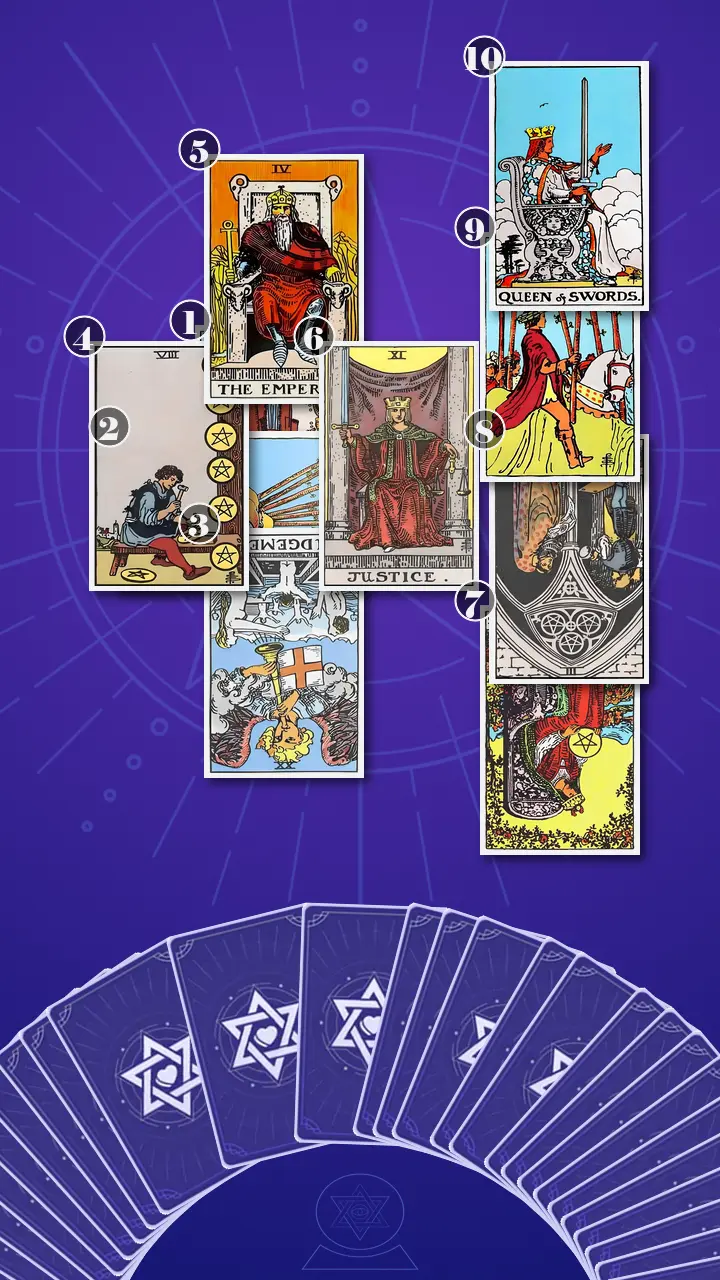
I explained to Maya, and to anyone following this career tarot reading, that we would use the classic Celtic Cross spread. The question contains more than a simple choice between accepting and declining meeting notes. The words “keep taking” point to a repeated feedback loop, while “hoping it earns a promotion” reveals an unspoken exchange involving workload, self-worth, team structure, recognition, and external evaluation.
A smaller decision spread might compare two immediate options, but it would not show the root fear beneath the habit, the diligent strategy learned in the past, the leadership goal Maya consciously wants, the workplace system that keeps recruiting her, or the direction in which she can integrate all of that. The Celtic Cross is a compact established structure for holding those layers without pretending to predict whether a manager will grant a promotion. This is how tarot works here: card meanings in context become visual prompts for evidence, questions, and self-observation.
I told her that the central cards would show the present exchange and its crossing burden; the card beneath them would reveal the fear beneath the behavior; the cards above and to the right would clarify the leadership goal and the next influence she could cultivate. The vertical staff would then examine her self-position, the team environment, her hopes and fears around recognition, and the direction of integration.
The Work Hidden Inside the Word Reliable
The Unpublished Promotion Account
For position 1, which presents the observable current pattern of accepting office housework as an implied exchange for promotion recognition, I turned over the Six of Pentacles, in reversed position.
In the card’s image, the standing giver controls both the scales and the coins, while the recipients remain lower and dependent on the distribution. In Maya’s working life, that became the 4:52 p.m. Slack request: she accepts an unassigned meeting task before checking the campaign deadline, then privately treats a coworker’s “You’re a lifesaver!” as a deposit toward promotion. The terms exist in her hope, not in a shared promotion framework.
The reversed energy is an imbalance and a blockage in the exchange. Generosity itself is not the problem. Maya can genuinely enjoy helping a colleague, and a rotating note-taking task can be perfectly reasonable. The problem begins when she cannot tell who owns the work, whether it will rotate, what priority it will displace, or whether anyone has agreed that it counts toward advancement. She is trying to use practical labor as currency while another person controls the rewards policy.
I said, “Gratitude is not a promotion criterion.” Then I returned to the thought she had offered me: “If I do this, maybe they’ll remember. If I ask whether it counts, maybe I’ll sound difficult.” I contrasted chosen teamwork with a private bargain whose other party had never agreed to the bargain. I was not asking her to become less generous. I was asking her to notice whether both sides could see the same transaction.
Maya did not nod. First, her breath paused and her thumb stopped rubbing the edge of her phone. Then her eyes lost focus, as if she were replaying the last dozen quick yeses in the team channel. Finally, she gave a short, bitter laugh and said, “I keep thinking the next extra task will be the one they remember.” Her shoulders dropped only slightly, but the small movement told me that recognition had begun to separate from proof of worth.
The Bundle That Hid the Destination
For position 2, which reveals the immediate cost and obstacle created when extra support work competes with higher-impact responsibilities, I laid the Ten of Wands, in upright position across the Six of Pentacles.
The figure in the card carries so many wands that the destination is almost hidden. I saw the same obstruction in Maya’s 8:41 p.m. apartment scene: her campaign analysis was open beside a reheated dinner, the microwave had hummed its cycle, the food had gone lukewarm, and her neck ached from leaning toward the screen. Notes, onboarding fixes, scheduling, and document cleanup had each looked small in isolation. Together, they had occupied the workday that should have demonstrated her strategic capability.
The upright energy is accumulated responsibility becoming a physical barrier. It is not a deficiency of effort. Maya is already exerting plenty of effort; the excess is indiscriminate availability. Her calendar has become a place where every empty square is treated as public storage, leaving no uninterrupted block for the work she wants attached to her name. I told her, “Reliability becomes a trap when the cost stays private.”
“I can carry both,” she said quietly. “I just need to work later.” I asked her to notice how that sentence turned a workload decision into a personal endurance test. The promotion-relevant deliverable did not become less important because she had agreed to help. It simply became invisible behind the bundle.
She exhaled through her nose and looked toward the rain-streaked window. Her hand moved from the phone to the calendar, where small fifteen-minute requests crowded the week like pebbles poured into every gap. I watched her lower her shoulders another fraction. She was no longer interpreting exhaustion as evidence that she needed to become more efficient; she was beginning to see it as information about direction.
The Verdict She Kept Waiting For
For position 3, which reveals the underlying fear that an external promotion verdict will determine whether Maya’s contribution and personal worth are sufficient, I placed Judgement, in reversed position beneath the center.
The scene I connected to it was a Wednesday one-to-one in a glass meeting room. Her manager had said, “You’re incredibly dependable,” and then offered the familiar instruction to “keep showing leadership.” The coffee beside Maya had gone cold. The HVAC clicked overhead. She had opened her mouth to ask for the three outcomes that would support progression, then closed it and said, “That makes sense.” Later, she drafted the direct question, deleted it, and waited for management to recognize the pattern without prompting.
Reversed, Judgement shows a blocked call to evaluation. Maya has handed the authority to assess her strategy to a future promotion decision, then treated every quiet week as another private verdict. A manager’s silence about criteria becomes, in her mind, evidence that she has not done enough. The card’s energy is not a prediction of failure; it is an overpersonalized interpretation of incomplete information.
I asked, “What if a promotion decision is an evaluation of specific evidence in a specific system, rather than a jury verdict on your whole person?” I mentioned the familiar Wizard of Oz parallel carefully, not as destiny but as a workplace image: Maya has been approaching authority hoping it will bestow proof of value, while the overlooked shift is learning to test the claims, request the rubric, and exercise her own judgement.
Her fingers closed around the cold coffee cup. “If I have to ask how my work counts,” she said, “I worry it means it never counted.” I let the sentence remain in the room. The fear was not only about a title. It was about whether asking for evidence would expose her as someone who had never been valuable enough to advance.
The Craft That Became a Currency
For position 4, which shows the established strategy of using diligence, repetition, and reliable execution to earn progress and approval, I turned over the Eight of Pentacles, in upright position.
The craftsperson on the card makes one pentacle after another, concentrating on the workbench while the town remains distant. I connected that patient craftsmanship to Maya perfecting another onboarding template, cleaning the formatting in a shared document, and making polished checklists in Notion. Completing tangible tasks feels controllable. A finished file gives her something she can point to when the promotion conversation remains vague.
The upright energy is genuine competence, disciplined practice, and improvement through repetition. I did not want to strip that strength from her story. Her work ethic has built real skills. But when diligence becomes the only proof she trusts, it tips into excess: every new task looks like another chance to demonstrate seriousness, even when the task does not build the scope, judgement, or measurable impact required for the next role.
I said, “The row of completed pentacles is not worthless. It is simply not self-interpreting. Quantity completed does not automatically become strategic readiness.” Maya glanced at the Six of Pentacles, then at the Eight. She could see how the old strategy had once protected her: do the next task well, make yourself useful, avoid being dismissed. She could also see that the same strategy now kept her waiting at the edge of a larger role.
The Throne Beyond Being Available
For position 5, which clarifies Maya’s conscious goal of promotion, authority, defined scope, and credible leadership, I laid The Emperor, in upright position above the center.
The Emperor’s stone throne, ram heads, armor beneath the red robe, and barren mountains suggested durable authority rather than approval earned through caretaking. Maya did want a title and the salary increase that would change her monthly breathing room, but she also wanted to decide what mattered, own larger outcomes, and have a credible path into strategic responsibility.
The upright energy is structure, boundaries, resource allocation, and organized responsibility. It asks whether Maya is practising the decisions of leadership now, or approaching the throne while carrying everyone else’s loose ends. “Leadership is not limitless availability,” I told her. “It is accountable allocation.” A leader does not personally carry every passenger’s luggage; a leader decides what can move, who owns it, and which priority must wait.
Maya sat a little taller. The movement was hopeful, but not triumphant. I asked, “If you had the role you want next month, which three decisions, outcomes, or areas of ownership would you expect to be responsible for?” She answered with campaign direction, clearer measurement, and stakeholder decisions. None of those answers involved being the fastest person to organize lunch.
When Justice Replaced the Unwritten Rule
The Scales Both People Can Read
For position 6, which identifies the next influence Maya can deliberately cultivate—explicit criteria, evidence, fair workload decisions, and accountable trade-offs—I turned over the Justice, in upright position. The atmosphere changed. The room did not become mystical; it became unusually exact. Even the grey light on the table seemed to arrange itself into a clean vertical line beside the card.
Justice’s open scales answered the privately controlled scales of the reversed Six of Pentacles. The upright sword represented the direct question Maya had been avoiding: What counts, who owns it, what evidence demonstrates readiness, and what must move if she accepts another task? This card offers a method, not a guarantee. It does not promise that her manager will respond perfectly or that the next promotion decision will be favorable. It gives her a way to stop letting an unspoken bargain decide how she spends her capacity.
At this point I used the diagnostic lens I call Core Competency Excavation. After a lifetime around archaeological sites and the layered remains of civilizations, I know that the visible surface is rarely the whole structure. I asked Maya to dig through the strata of her past roles and recurring tasks rather than treating old job titles as the final definition of her value. Beneath meeting notes, onboarding maintenance, and coordination, I could see transferable foundations: stakeholder awareness, information architecture, pattern recognition, prioritisation, follow-through, and the ability to notice where a system is about to fail. Those are not proof of promotion by themselves, but they are more durable than the label of “the person who always helps.”
The Moment the Private Ledger Became Visible
At 4:52 on Friday, the Slack request appears. You type “I can do it” before opening your calendar, then reheat dinner beside the campaign deck you hoped would prove your strategic range. Your shoulders rise before the message even sends.
You do not have to keep paying for recognition with invisible labor; name the terms, weigh the trade-off, and let Justice's scales replace hope with evidence.
First, Maya went completely still. The muscles around her eyes tightened, and her pupils widened as if the words had opened a brighter room inside the dim one. Then her frown deepened; for a moment, resistance arrived before relief. “But doesn’t that mean I’ve been doing it wrong?” she asked, her voice low and uneven. I did not rush to contradict her. Her gaze moved from the reversed scales to Justice’s level ones, replaying every thank-you that had felt warm for thirty seconds but had never named ownership. Finally, her clenched hand loosened against her knee. A long breath moved out of her chest, and her shoulders sank with it. Outside, a streetcar bell sounded through the rain, clear and brief. “I can tolerate the answer being imperfect,” she said. “I just don’t want to keep building my future around a rule no one will say aloud.”
“Now, use this new perspective to think back: was there a moment last week when this insight could have made you feel or act differently?”
Maya looked at the card again. The first shift was not from helpful to unhelpful. It was from anxious recognition-seeking and invisible overwork toward evidence-based self-advocacy and selective leadership. She could still contribute. She no longer had to make her professional worth depend on whether every contribution was accepted, praised, or remembered.
The Caretaker Who Ran Out of Private Space
For position 7, which shows Maya’s self-position as a practical caretaker whose resourcefulness has become overextension and self-deprioritisation, I moved to the bottom of the vertical staff and turned over the Queen of Pentacles, in reversed position.
I brought her to 12:37 p.m. on Monday in the office kitchenette. She was placing the team lunch order when she noticed that the onboarding guide was outdated. The refrigerator hummed. Reheated curry hung in the air. Her campaign dashboard was still open upstairs, and her stomach tightened as she thought, “It’ll be faster if I just do it.”
The reversed energy is practical care turned inward into depletion. Maya notices the missing agenda, the broken link, the unassigned logistics, and the person who may need context before anyone asks. That resourcefulness is real. The blockage appears when her own strategic priorities, development time, lunch, and capacity become the renewable resource that keeps the workplace comfortable.
I said, “The question is not whether you are allowed to care. The question is whether care is chosen, shared, and connected to an outcome—or whether it is being used to preserve the identity of the reliable caretaker.” Maya looked down at her hands. She was not being asked to become cold. She was being asked to stop making herself the cost of every operational gap.
The Workplace Blueprint with No Owner Field
For position 8, which audits the workplace environment for unclear task ownership, weak rotation, misaligned collaboration, and vague recognition standards, I placed the Three of Pentacles, in reversed position.
The card shows people gathered around an architectural plan, but reversed, the collaboration feels misaligned. I shifted the scene from Maya’s personality to her team channel. The campaign dashboard had owners and deadlines, yet meeting notes, onboarding maintenance, celebrations, and scheduling had no rota, no owner field, and no capacity record. Informal volunteering kept the system running while preventing anyone from seeing its full cost.
The reversed energy is a structural blockage: unclear standards, weak coordination, and work that is not properly valued. Maya has choices, but the workplace blueprint also matters. A request that reaches whoever feels most anxious about being overlooked is not a healthy ownership system. I asked her to hold both truths at once: “Maybe I’m the problem because I keep saying yes—but why does this system depend on someone feeling guilty enough to volunteer?”
She stopped looking at me and stared at the blank space beside the card. First, her eyebrows drew together as if she were preparing to defend herself. Then her eyes moved over the team channel in her memory, from one unassigned request to the next. Finally, she gave a small nod and said, “I’ve been treating the structure as a personality test.” The nod was not permission to blame the team. It was permission to name a missing process.
The Laurel Wreath on the TTC
For position 9, which holds the paired hope for visible promotion and the fear that recognition is the only reliable proof of professional worth, I turned over the Six of Wands, in upright position.
I connected it to the Tuesday morning TTC ride near Bloor–Yonge. Maya had scrolled past a former coworker’s LinkedIn promotion announcement, complete with the familiar “I’m thrilled to share” and a stream of congratulatory comments. The carriage smelled of damp coats. The rails shrieked in the tunnel. Her thumb hovered over a volunteer request, and another unmeasured favour suddenly felt faster than another direct question.
The upright energy is healthy ambition, visible achievement, confidence, and public acknowledgment. There is nothing wrong with wanting greater scope, a better salary, or the relief of seeing effort count. The tension is that Maya has begun treating the laurel wreath as the only trustworthy evidence of competence. The two sixes now spoke to each other: one asked, “What am I giving?” The other asked, “What do I hope to receive?”
I asked her to separate the title into its parts: the work and scope of the role, the material change in pay, the public recognition, and the emotional relief of no longer feeling overlooked. She did not have to pretend those desires were interchangeable. Naming them would help her pursue advancement without turning every office task into a bid for the crowd’s approval.
The Sentence That Kept the Door Open
For position 10, which describes the integrative direction of direct communication, selective contribution, and boundaries grounded in evidence, I placed the Queen of Swords, in upright position at the top of the staff.
The Queen’s raised sword separates what matters from what does not, while her open hand keeps dialogue possible. Her clear sky and forward gaze suggested honesty without hostility. The balanced energy here is discernment: Maya can remain collaborative while naming the difference between strategic contribution and unowned support labour.
I offered her a sentence drawn directly from the card’s modern workplace meaning: “I can take the notes if we rotate the role and move the campaign deadline; otherwise I need to stay with the work tied to my agreed goals.” It was not a resignation. It was not a punishment. It was one precise sentence that made capacity and consequence visible.
Maya read it twice. Her first reaction was a slight tightening around the mouth, the old fear of sounding cold. Then she softened the beginning of the sentence, testing how it felt when collaboration remained possible. Finally, she placed her phone face down and said, “I’m not refusing teamwork. I’m making the trade-off visible.” I could hear the difference between an imagined boundary and a usable one.
The Missing Field in Maya’s Promotion Case
When I joined the cards together, I saw a workplace loyalty-points programme whose rewards policy had never been published. The reversed Six of Pentacles showed Maya making deposits through automatic helpfulness. The Ten of Wands showed those deposits consuming the capacity needed for strategic work. Judgement reversed revealed why she kept paying: a future manager’s verdict had begun to carry the weight of deciding whether both her work and she were valuable. The Eight of Pentacles explained the old solution—complete one more task perfectly—while the Emperor clarified the role she actually wanted: authority to prioritise, allocate, and protect resources. Justice offered the missing relation field between task completed and promotion criterion. The reversed Queen and Three showed that the team’s unclear blueprint was recruiting her caretaker reflex. The Six of Wands named the longing for recognition, and the Queen of Swords gave that longing language.
The cognitive blind spot was not that Maya was too kind, too ambitious, or insufficiently assertive. It was that she had treated an information and ownership problem as an endurance test. She assumed that the safest way to become visible was to become endlessly available, even though availability was displacing the evidence she needed. The key shift is from automatically accepting office housework for implied credit to asking how each task maps to promotion criteria, who owns it, and what current priority must move.
In my Career Epoch Analogy, Maya was standing at the fracture between two professional eras. The old era was built on proving value by absorbing loose ends. The next era can be built on strategic judgement, explicit standards, and selective leadership. Archaeological fractures are not prophecies of ruin; they are evidence that a structure changed under pressure. I wanted her to see the crack as information and foundation, not as a sentence.
So I translated the reading into small, practical next steps. I also used my Resume Stratigraphy Review, a framework for rewriting a professional narrative by highlighting enduring assets over obsolete job titles. We did not erase the meeting notes or onboarding work. We excavated what those tasks revealed, separated the transferable skills from the uncredited repetition, and connected the durable skills to the outcomes of the role Maya wanted.
The Resume Stratigraphy Review
I told Maya that these were actionable next steps, not tests she had to pass perfectly. She could begin with the smallest version and adjust for her workplace’s level of safety and authority.
- Excavate the promotion evidenceAt least 24 hours before her next one-to-one, Maya would open a one-page Google Doc titled “Promotion Criteria Check” and use the Resume Stratigraphy Review in four sections: target role, three expected outcomes, current evidence, and missing evidence. She would spend ten minutes identifying foundational skills beneath her past roles—analysis, stakeholder coordination, pattern recognition, prioritisation, and follow-through—then ask her manager, “Which decisions, metrics, or scope would demonstrate readiness, and which current activities do not materially support that case?” Within one workday, she would send a four-bullet recap of the criteria and agreed next steps.If the full conversation feels too exposed, use the minimum version: write one agenda line or ask only, “What are the top three outcomes that would support progression?” Record the exact answer instead of filling any vagueness with more labour.
- Use the trade-off before saying yesThe next time a team channel asks, “Can anyone take notes?” Maya would wait five minutes, open Google Calendar, and identify the specific campaign task or deadline that accepting it would displace. She would keep one 90-minute focus block that week, labelled with an outcome such as “Campaign analysis: retention recommendation,” and save this response for the requester or manager: “I can help if we move X or rotate Y; otherwise I need to stay with the campaign work tied to my current goals.” She could keep one support task whose ownership or rotation was clear and release one recurring task by naming a different owner or revised deadline.The boundary describes capacity and trade-offs, not the worth of the task or the person asking. If direct refusal creates workplace risk, Maya can ask her manager to choose the priority instead. Selective contribution is the goal, not rejecting every request.
- Build one shared-ownership rotaIn the existing team document or Slack channel, Maya would propose a lightweight four-week rotation for one recurring task, such as meeting notes, with named dates and an option to swap. She would add an owner field and an estimated-time field to the template, then ask at the next planning meeting, “Who owns this going forward?” If someone asked her to absorb another task, she would make the trade-off explicit: “Should I pause the campaign analysis, move the onboarding update, or find another owner for this?”Four names in a shared table are enough; the process does not need to become another unpaid coordination project. If the team will not adopt a full rota, ask for one named owner for one month and notice whether the structure changes.

A Week Later, the Quiet Proof
Four days later, Maya emailed me from a café: “I asked for the three outcomes and proposed a notes rotation.” There was no new title yet, and she still woke thinking, “What if they say no?” This time, she opened the criteria document before Slack.
That was the first proof. The tarot had not awarded her a promotion, and I had never promised that a direct question would produce one. What changed was more practical: she had begun moving from hoped-for gratitude to visible evidence, from private mental arithmetic to a shared workplace conversation, and from limitless availability to grounded, selective leadership.
When the next volunteer request lands and your shoulders lift before your hand does, it may feel as though one careful no could erase every yes and reveal that you were never worth promoting in the first place. I want to offer the same steadiness I offered Maya: your worth is not waiting inside another person’s unpublished rewards policy, and your generosity does not need to disappear for your boundaries to become real.
If your next contribution did not have to purchase recognition, what is one small question you might let yourself ask before answering?