Three Sessions Shifted Course Hopping Toward Evidence-Based Self-Trust

The 8:47 p.m. Course-Hopping Loop
"I'm an early-career professional studying after work in Toronto, and the moment a lesson stops making sense, tutorial hell begins to look like a problem with the course." That was how Jordan (name changed for privacy) introduced themself when our video call connected. They had just come home from a crowded TTC Line 1 train, where they had spent the ride saving a Reddit thread titled "best certificate course" while the practice exercise they meant to finish remained untouched.
Jordan described the brakes squealing between stations, the smell of rain caught in damp coats, and the phone growing warm in their palm. Their jaw had tightened as they tried to protect a scarce study hour from the risk of a bad choice. By the time they reached their stop, the attempt to protect that hour had already consumed most of it.
On my screen, blue light from a course dashboard flattened the kitchen behind them. A kettle clicked off beside the laptop. Jordan had the current course open, along with a YouTube playlist, four review tabs, and a half-built Notion study dashboard. Their shoulders sat high and heavy, and their restless fingers kept drifting toward the trackpad.
"I keep looking for the resource that will finally make this easy," they said. "Then I hit one question I don't understand and think, maybe the course is too basic, maybe the teacher isn't clear, maybe I should restart properly. Starting over feels more productive than admitting I haven't practised enough."
I heard the real contradiction immediately. Jordan wanted a study resource that would help them move forward, but the repeated search for that resource had become the exact place where movement stopped. Their frustration looked less like an abstract emotion and more like trying to push a cursor through wet cement while seven pop-ups argued about the correct direction.
"It makes sense that comparison gives you a quick sense of control," I told them. "Your study time feels expensive, and you don't want to waste it. I'm not going to tell you which course fate has selected for you. Tarot cannot responsibly guarantee that. What I can do is help us map the loop, separate a genuine resource mismatch from the discomfort of learning, and find a small way to gather better evidence."
I placed both hands on the table so Jordan could see them. "Let's give this fog a structure. The goal tonight is clarity, but not the brittle kind that demands certainty before you act. We're looking for enough clarity to run the next useful experiment."

A Six-Card Staircase Through the Library
I asked Jordan to take one unforced breath and hold the question in plain language: "Why do I keep choosing study resources that leave me stuck?" I shuffled slowly, not as a mystical performance, but as a deliberate transition from scrolling and comparing into sustained attention.
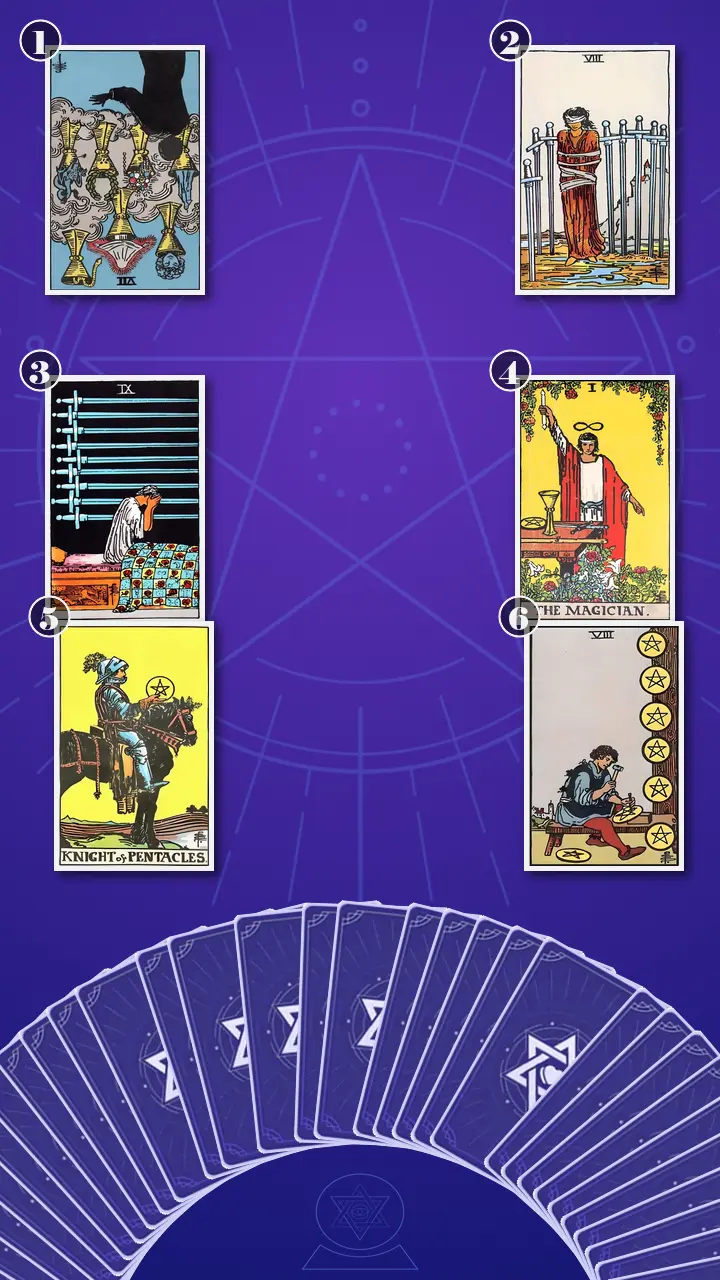
I chose the Transformation Path Grid (6) · Context Edition. For anyone wondering how tarot works in a practical reading, I use a spread like this as a structured sequence of questions. The cards do not predict which platform will succeed. They help externalise a pattern so the person sitting with me can inspect it without being trapped inside it.
A simple decision spread would have implied that Jordan was choosing between two fixed courses. That was not the real issue. The same cycle kept recreating itself across Coursera reviews, YouTube explainers, Reddit recommendations, productivity apps, and new course purchases. A larger Celtic Cross would have added more positions than this focused problem required. Six positions were enough to trace the visible pattern, the immediate blockage, the fear beneath it, the catalyst for change, the practical action, and the lesson that could be integrated.
I arranged the cards in a two-column, three-row grid. The top row would show the resource-switching pattern and the rule that kept it in place. The middle row would reveal the self-worth fear and the key trigger that could restore agency. The bottom row would turn that insight into repeated practice and a more grounded definition of progress.
To me, the layout resembled a compact staircase through a library. Each card would narrow the distance between searching for knowledge and actually using it.
Seven Promises and No Finished Exercise
Position 1: When Abundance Becomes Avoidance
"Now I'm turning over the card representing the presenting pattern, the visible study-resource loop where repeated choosing becomes the point at which progress stops." I revealed the Seven of Cups, reversed.
I pointed to the seven cups rising separately from the cloud. "This is your kitchen counter at the beginning of an evening study block. You have the current course, two YouTube teachers, a discounted platform, a Reddit study guide, a colleague's recommendation, and a new app. Every alternative appears to contain the possibility of rescue before it has taught you anything."
I repeated the sequence Jordan had already described: "Maybe this course is too basic. Maybe that teacher explains it better. Maybe I should restart properly." In the card's reversed state, the energy of possibility had become excessive while discernment was blocked. Abundance was no longer expanding Jordan's options. It was hiding the absence of a completed task.
It was the learning version of browsing every streaming service for an hour and going to bed without pressing play. Each resource might have had real value, but their value could not be measured while Jordan remained in selection mode.
"New-resource relief is not the same as learning evidence," I said. "The relief is genuine, but it arrives before the new resource has been tested. That makes it an emotional reward, not proof that the switch was strategically useful."
Jordan's breath caught. Their fingers hovered above the trackpad as though they had been interrupted mid-click. Their gaze moved from the card to the open tabs behind it, and then they gave a short laugh with a bitter edge.
"That's so accurate it's almost rude," they said. "I call it research, but I'm usually trying to get away from the moment I might find out what I don't understand."
"That distinction matters," I replied. "It doesn't make you lazy or unserious. It tells us what the switching is doing for you. Before you open the next resource, the useful question is: which single practice task could give you evidence that comparison cannot?"
Position 2: The Permission Rule Around Learning
"Now I'm turning over the card representing the blockage, the internal rule that makes the correct resource feel like permission you must obtain before learning can begin." I revealed the Eight of Swords, upright.
The blindfolded figure stood inside a ring of swords, apparently trapped, although the bindings around the body were loose. I told Jordan that this card did not mean their external constraints were imaginary. Their workload, commute, cost concerns, and limited weeknight energy were real. The card focused on the additional mental restriction created by one rule: "I must know this is the right course before I can start."
"You already have enough material to attempt the first exercise," I said. "But every imperfect option feels capable of wasting your scarce time, so starting looks unavailable. It is like waiting for every TTC connection to be delay-free before leaving home. Uncertainty gets mistaken for the absence of a workable route."
The upright Swords energy was constricted and overactive at the same time. Analysis kept producing reasons not to move, while the ability to test one step remained underused. The loose binding mattered because it showed a narrow action was still available: attempt the first step, name the exact gap, and gather evidence before making a larger decision.
I asked, "When you last froze in front of an exercise, which rule were you obeying? Was it 'I need a better explanation,' 'I need to know this is the right course,' or something even more specific?"
Jordan pressed their lips together and looked beyond the screen. Their jaw tightened first. Then their eyes lost focus as if they were replaying a recent study session. Finally, one shoulder dropped.
"It was, 'If I commit to the wrong thing, I'll lose another month,'" they said. "I didn't realise I was treating that thought like an actual policy."
"A protective policy," I said, "but one that now requires certainty no resource can provide before use. We don't need to delete the concern. We need to test whether it deserves veto power over every first attempt."
Position 3: The Midnight Verdict
"Now I'm turning over the card representing the root, the fear that staying confused after choosing a resource could become evidence against your worth as a capable learner." I revealed the Nine of Swords, upright.
I saw Jordan's face change before I finished naming the card. The figure sitting upright in bed, hands covering their face, carried the private cost of the loop. The nine swords on the wall looked orderly and objective because they were familiar and neatly aligned. They were still thoughts, not evidence.
Jordan had already told me about 12:18 a.m. the previous Thursday. Rain tapped the window while wet traffic hissed on the street below. A former classmate's LinkedIn certificate announcement glowed on their phone, followed by the unfinished lesson they had reopened in the dark. One fact had escalated through four conclusions: "I didn't finish this exercise. I chose badly. I'm falling behind. Maybe I'm not capable."
The Nine of Swords showed an excess of mental projection. One limited data point was being expanded into an annual performance review of the entire self. Searching for another course felt safer because it postponed the test of that final, painful conclusion.
"This card does not predict failure," I said. "It shows the distance between the observable event and the verdict added afterward. Difficulty is a data point, not a verdict."
Jordan went completely still. Their breathing paused, their gaze settled on the swords, and their hands slowly unclasped beneath the camera frame.
"That's the part I don't say out loud," they said. "If I stay with the course and I'm still stuck, I can't blame the platform anymore."
"You also would not have to blame yourself," I replied. "You could blame no one. You could discover that a prerequisite is missing, the explanation is weak, the task needs feedback, or the skill simply requires more than one attempt. Those possibilities become visible only when we keep the fact separate from the feared conclusion."
When the Magician Cleared the Desk
Position 4: The Test That Restores Agency
The rain against my own window softened as I reached for the fourth card. The room seemed to narrow around the two-column grid, and the refrigerator hum from Jordan's kitchen suddenly sounded louder. I told them, "This is the central catalyst in the reading, the card that challenges the demand for a perfect resource and redirects attention toward agency and testing."
I revealed The Magician, upright.
The Magician stood behind a table holding the tools of all four suits. One hand pointed upward and the other downward, translating intention into material action. In Jordan's life, the table became one existing resource, one blank note titled "What is unclear?", a ten-minute timer, and one practice problem.
"This is a balanced use of energy," I said. "The Magician does not collect more tools to feel powerful. The Magician arranges what is already available and makes something observable happen. For you, that means closing the comparison tabs, opening the selected lesson, and using a bounded attempt to discover what you can do, where the reasoning breaks, and which adjustment has evidence behind it."
I could hear Jordan caught inside the demand to make the correct choice before beginning. A new resource promised relief, but committed practice threatened to reveal a gap. The Magician did not remove that vulnerability. The card changed the question from "Which option can rescue me?" to "What can I test now?"
The image pulled me briefly back to my years on Wall Street. I remembered glossy investment decks that looked convincing until someone asked what return the underlying position had actually produced, under what conditions, and at what cost. A polished promise was never the same thing as demonstrated yield.
I use a related lens in learning decisions called Academic ROI Auditing. The point is not to reduce education to money or productivity. It is to protect the learner from confusing presentation quality with strategic value. A course's real return cannot be audited from its landing page alone. I need to see what happens after a bounded amount of use: which exercise was attempted, what became clearer, where the explanation failed, what support was required, and whether the resource remained accessible enough to continue.
"Right now," I told Jordan, "you're trying to audit the return before allowing even a small test investment. The Magician proposes a prototype instead. You are not choosing this course forever. You are using it to learn one true thing."
You do not need to find a perfect resource before you begin; use the tools already in your hands and let deliberate practice create evidence, like the Magician arranging every instrument on the table.
I left a few seconds of silence around the sentence, then made the principle even plainer: "The resource does not have to prove you are capable; one deliberate attempt can show you what the resource, the method, and your next question are actually capable of doing."
Jordan's reaction came in layers. First, their breathing stopped and their fingers froze halfway around the mug. Then their pupils widened slightly as they stared at the four tools on the card, apparently replaying every evening they had asked a course page to guarantee the future. Their eyebrows pulled together, and the first emotion in their voice was not relief but anger. "But doesn't that mean I've been wrong this whole time?" they asked. The words came out sharp, then thinned at the end. Their grip loosened. Their shoulders sank, and their eyes reddened without spilling into tears. After one unsteady exhale, they looked almost dizzy, as though setting down the burden of perfect selection had also removed a structure they had relied on. "If the course doesn't decide whether I'm capable," they said more quietly, "then I have to decide what to do next."
"Yes, but that does not make your earlier choices foolish," I said. "Comparison was trying to protect you from wasted time and a painful self-judgment. We are updating the strategy because its long-term cost is now larger than its benefit. Agency brings responsibility, but it also gives you exit criteria. You can test, review, supplement, switch, or stop. The card does not order you to persist."
I leaned closer to the camera. "Now, with this new perspective, think back: was there a moment last week when this insight could have made you feel different?"
Jordan returned to the 8:47 p.m. TTC ride. "I could have saved the thread without reading it," they said. "Then I could have gone home and tried the first step. I wasn't choosing the course forever. I was choosing what to test that night."
That was the breakthrough. It was not certainty, and it did not erase the fear of falling behind. It was the first movement from comparison-driven resource switching and self-doubt toward evidence-based adjustment and grounded learner self-trust. External rescue was giving way to focused agency.
"You do not need a better promise," I said. "You need one small receipt from practice."
The Slow Evidence of Ordinary Evenings
Position 5: Staying for the Experiment
"Now I'm turning over the card representing action, the small and observable study behaviour that interrupts switching and creates evidence through repetition." I revealed the Knight of Pentacles, upright.
The knight sat on a still horse and held one pentacle steadily at chest height. Behind the figure, the field had been cultivated in measured lines. I translated that scene into three realistic 20-minute sessions with the same adequate resource, each with one finish line: attempt questions one to three, recreate an example without looking, or explain one concept in five sentences.
"This is balanced earth energy," I said. "It narrows the commitment until it can survive an ordinary week. The knight is not asking you to become a productivity influencer with a flawless morning routine. The card values reliability over novelty and a bounded trial over forced completion."
I described the same chair, the same resource, and the same calendar block across three sessions. One session might be missed. The cycle would continue without an all-or-nothing reset. The useful inner line was simple: "Boring does not mean useless; this is the evidence phase."
Jordan shook their head. "But Tuesdays after work are a write-off. I barely have enough energy to make dinner. Even 20 minutes can feel impossible."
I did not argue with their calendar. "Then Tuesday does not get the ideal version. Use five minutes after dinner, or move that session to Saturday at the library. The minimum version is one attempted step and one written unknown. A method that only works for an imaginary, fully rested version of you is not a good method."
I tapped the still horse. "Stay for the experiment, not forever. If three completed attempts show that the material is inaccessible, factually unreliable, missing essential prerequisites, or consistently mismatched with how you need to learn, changing resources is evidence-based adjustment. Leaving at the first appearance of discomfort and leaving after a fair test are not the same decision."
Jordan looked at their phone calendar rather than another course tab. Their mouth tightened when they considered Tuesday, softened when they moved one block to Saturday morning, and settled into a cautious half-smile after choosing Thursday evening for the third.
Position 6: A Visible Body of Imperfect Work
"Now I'm turning over the card representing integration, the perspective that lets completed practice, correction, and self-trust replace an endlessly improved resource list." I revealed the Eight of Pentacles, upright.
The craftsperson worked on one pentacle while a row of completed pieces remained visible nearby. I asked Jordan to imagine a phone note with one line per study block: date, task attempted, error noticed, correction made, and next question. Some rows could end with "still unclear." An incomplete answer would remain part of the record rather than disappearing under a redesigned study plan.
"This is what balanced repetition looks like," I said. "The same numerical structure appeared earlier in the Eight of Swords. In that card, repeated swords formed an enclosure governed by fear. Here, repetition becomes a chosen structure governed by practice. Structure itself was never the enemy. The question was who or what directed it."
I compared the log to a Git history of small working commits rather than a downloads folder full of untouched starter projects. Each entry preserved what Jordan had actually tried. The inner line I offered was: "These marks do not prove I know everything; they prove I returned and learned something specific."
The Pentacles energy gave physical form to progress. Instead of asking whether the plan looked organised, Jordan could ask whether there was work to review. Instead of measuring commitment through the number of bookmarked resources, they could measure learning through attempted exercises, corrected errors, and better questions.
Jordan reached for a sticky note and wrote, "Practice receipt, not perfect plan." Their hand moved slowly at first, then more decisively. "I think I've been deleting the evidence whenever it wasn't impressive," they said. "I only keep polished notes, so every difficult session looks like nothing happened."
"Then the integration is not to make every session successful," I replied. "It is to stop making imperfect work invisible. Skill grows through visible refinement, not through a spotless record."
The Adequate Workbench Cycle
I drew the six cards together into one causal story. The Seven of Cups showed a visible habit of course hopping, where possibility replaced practice. The Eight of Swords revealed the protective rule underneath it: the correct resource had to be identified before learning could begin. The Nine of Swords showed why that rule carried so much force. One hard exercise risked becoming a verdict on Jordan's intelligence and future. The Magician interrupted the loop by converting available tools into a deliberate test. The Knight of Pentacles bounded that test across ordinary sessions, and the Eight of Pentacles changed the measure of progress from resource collection to a visible body of work.
The cognitive blind spot was not simply "too many tabs." It was the assumption that discomfort could judge a resource before completed practice had produced enough evidence. Jordan had also been treating a polished plan as proof of movement while dismissing unfinished attempts as proof of nothing. That made novelty feel informative and practice feel threatening.
The transformation direction was precise: choose one adequate resource for a defined short cycle, let completed practice reveal the actual gap, and adjust from evidence rather than from the first wave of discomfort. An adequate workbench can teach you more than a perfect showroom.
To turn that insight into actionable next steps, I adapted my Research Sunk-Cost Audit. Time and money already spent would not become reasons to stay, and the excitement of a new option would not become a reason to leave. We would evaluate only future usefulness, based on a small body of completed practice. The audit would end with one of four legitimate decisions: continue, supplement one specific gap, switch with a stated reason, or stop.
- Run the Magician's Table Test tonight. At the kitchen counter or desk, leave only the current resource, one blank note titled "What is unclear?", and one practice question in view. Put every alternative into a bookmark folder called "Review After Three Sessions." Set a ten-minute phone timer, attempt the question without opening comparison tabs, and write the first exact step where your understanding breaks. If ten minutes feels too demanding, use two minutes, attempt one step, and name one unknown. This is a temporary boundary, not a promise to finish an unsuitable course.
- Use the Three-Session Evidence Rule. Choose three realistic blocks within the next seven days, such as Thursday after dinner, Saturday morning at the library, and Monday evening. Keep the same adequate resource for the cycle. At the start of each block, write one finish line: "attempt questions 1-3," "recreate the example," or "explain the concept in five sentences." Evaluate nothing until the block ends. A five-minute session still counts if it produces an attempted step. A missed day does not erase the cycle. Stay for the experiment, not forever.
- Complete the Research Sunk-Cost Audit after session three. At the same desk, spend five minutes under three headings: "completed," "repeatedly unclear," and "next adjustment." Add one-line practice receipts showing the task, error, correction, and next question. Continue only if the future learning value looks reasonable. Supplement, switch, or stop if the evidence shows poor explanations, missing prerequisites, accessibility problems, excessive strain, or another genuine mismatch. Do not redesign the log or ask which whole course someone else prefers. If feedback would help, send a mentor or colleague one narrow question, such as, "Can you check where my reasoning changes between steps two and three?"
Jordan looked over the list and said, "This feels less like choosing my educational destiny and more like running a small test."
"Exactly," I said. "The test is allowed to produce a no. Your power is not in forcing the current course to work. It is in creating enough evidence to make the next decision your own."
A Week Later, Three Small Receipts
A week later, Jordan sent me a photograph from a corner desk at a Toronto Public Library branch. A printer sat blurred in the background. On the desk were one course page, one timer, one practice question, and a sticky note reading, "I am not choosing this forever. I am learning one true thing."
They had completed three short sessions. One exercise remained unfinished, but the practice log showed that the same prerequisite concept had caused the break each time. Instead of buying another course, Jordan watched one targeted explanation, returned to the original problem, and sent a colleague a narrow question about the transition between two steps.
The answer did not solve the certificate or turn every lesson into an easy one. It did let Jordan correct the exercise. More importantly, the correction had come from evidence rather than another promise.
A week later, Jordan told me they had slept through the night. Their first thought on waking was still, "What if I chose wrong?" This time, they laughed, checked the three-session log, and made coffee before deciding.
I did not read that laugh as permanent confidence. I heard seen relief and cautious curiosity, the first proof that clarity could coexist with vulnerability. Jordan had moved one step from comparison-driven switching toward grounded learner self-trust, and the movement belonged to them. The cards supplied an objective map and a vocabulary for the pattern. Jordan supplied the attempt, the evidence, and the decision.
That is the value I see in a six-position Transformation Path Grid for study choice paralysis. It does not appoint tarot as an authority over the learner. It makes the loop visible, gives each fear a place on the table, and returns authorship to the person who must decide what happens next.
If tonight a hard lesson tightens your forehead and pulls your hand toward a new tab, remember that the pain may not be confusion alone. It may be the fear that staying long enough to struggle will turn one unfinished exercise into a verdict on your ability. Simply noticing that leap from fact to verdict means you are no longer standing at the library doorway without a map.
If one adequate resource could be a temporary workbench rather than a verdict on your ability, what tiny piece of practice would you feel curious enough to place on the Magician's table this week?