Closing the Reorg Form at 9:47, Then Sending a Three-Line Message

The 9:47 p.m. Loop of Reorg-Era Self-Silencing
If your influence depends more on framing than title, career reorg anxiety can look like rewriting a 40-word clarification until the response deadline is closer than the certainty you were waiting for. That was the loop Casey, a 29-year-old Product Operations Specialist in Toronto, brought into my reading room.
At 9:47 on a Tuesday night, Casey had been sitting at their kitchen table with the employee feedback form open beside Slack. The radiator clicked against the wall. Their laptop fan pushed warm air across one hand while yesterday's coffee sat cold and metallic on their tongue. They changed “I think” to “Could we clarify” for the third time, noticed a new leadership update, and closed the form.
They described their jaw as locked and their shoulders as if they had been quietly bracing for impact since the last all-hands. What they called apprehension felt to me like an unsent sentence held between the teeth: small enough to swallow, sharp enough to make the whole body tense.
“I want to influence the structure while the feedback window is still open,” Casey told me. “But I don't want to sound territorial when the roles are still moving. If I speak now and it changes tomorrow, people might decide I read the room badly.”
I heard the central contradiction immediately. Casey wanted to help shape the reorg while it was editable, yet believed speaking before it settled might weaken the credibility they were trying to protect. Their silence was not an absence of insight. It was certainty-gated self-silencing during an unsettled company reorganization.
“You are not silent because you have nothing to say,” I said. “You are waiting for certainty to certify what you already see. I won't use tarot to predict the final org chart or tell you what outcome is guaranteed. I want us to use it as a mirror, so we can see which constraints are real, which rule has been added around them, and where your choice still lives. Let us draw a map through this fog.”
Choosing a Bridge Map While the Walls Were Moving
I asked Casey to place both feet on the floor, let their exhale last a little longer than their inhale, and state the question once without editing it: “Why do I keep waiting for the reorg to settle before speaking up?” I shuffled slowly. The pause was a focusing device, not a performance of mystery; it gave their nervous system a threshold between replaying the workplace and examining it.
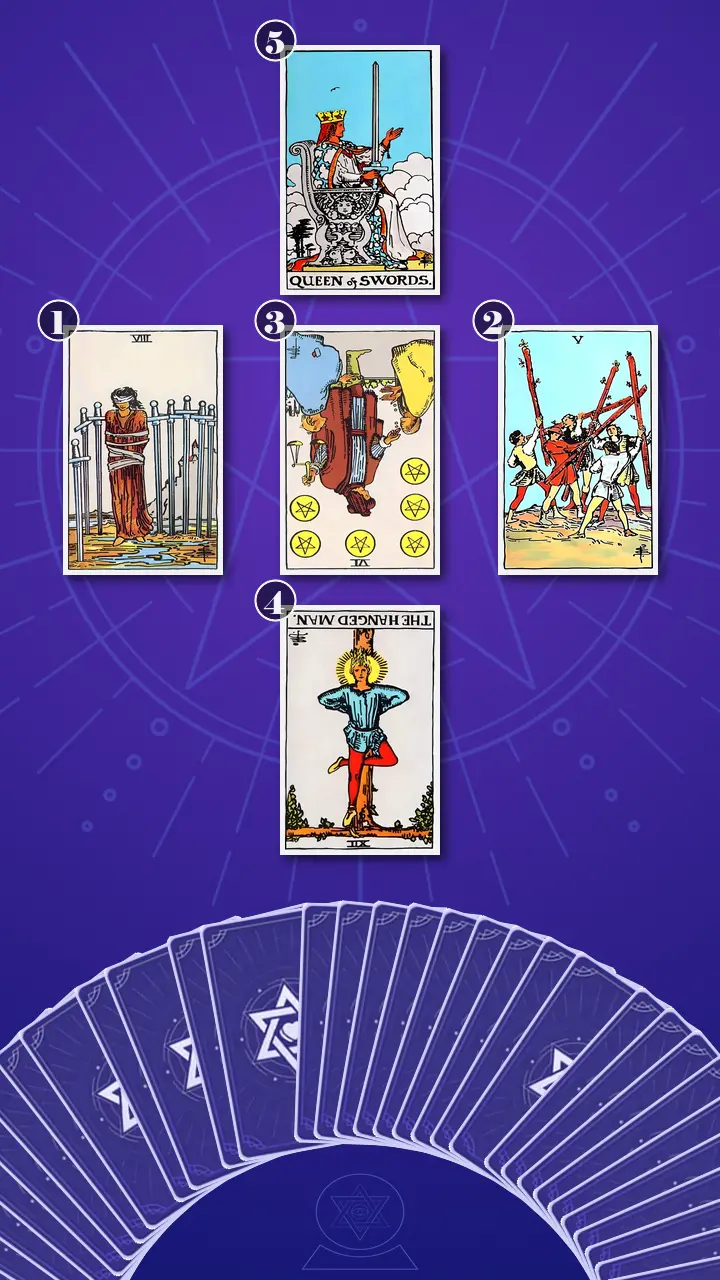
I chose a five-card Relationship Spread: Context Edition. I use this spread when the difficulty is neither solely inside a person nor solely caused by an external system. Here, the real issue was the live exchange between Casey's restrained voice and a workplace where competing provisional voices were already shaping decisions.
A timeline spread might have encouraged the idea that the answer would arrive later, once the company became more stable. A larger Celtic Cross would have added breadth without improving the central diagnosis. These five cards were enough to show Casey's contribution, the reorg environment, the exchange of access and influence between them, the rule holding the impasse in place, and a practical way forward. This is how tarot works in my practice: the cards do not issue a verdict; their images make patterns visible enough to question.
I laid the cards in a cross. Casey's stance would sit on the left and the changing organization on the right. The central card would reveal where those forces met. Beneath it, one card would expose the psychological mechanism sustaining the pattern. Above it, the final card would show how Casey could participate without pretending to possess a final answer. The layout resembled a bridge tower: two sides under tension, a concentrated load in the middle, a hidden anchor below, and a clear lookout point above.
Reading the Tension Across the Reorg
Position 1: The Gap Inside the Swords
The card I turned first represented the behavior Casey was contributing to the dynamic: withholding prepared questions and treating incomplete information as a restriction against speaking. It was the Eight of Swords, upright.
I showed Casey the blindfolded, loosely bound figure and the swords standing around her. The blindfold did not tell me that Casey's uncertainty was imaginary. Their access to the reorg was genuinely partial. Yet the visible gap between the swords mattered just as much as the blindfold. Restricted visibility was present; total immobility was not.
I connected the image to the planning meetings Casey had described. They had already typed a concise ownership question, but one reporting line remained unresolved on the latest org chart. From that missing fact, they concluded that the whole question was unavailable. The pattern could be written as a single internal sentence: “I know two teams are touching the same approval step, but because I cannot confirm the final reporting line, I tell myself I am not allowed to ask who owns the interim decision.”
The Eight of Swords showed Air in blockage. Thought was abundant, but it was circulating privately through revisions, imagined reactions, and contingency plans. Casey was treating a Google Doc as view-only because two headings were unfinished, even though comments were enabled and leadership was actively requesting input.
“Which missing fact would genuinely make the ownership question irrelevant?” I asked. “And which uncertainty could simply be acknowledged inside the question?”
Casey gave one short, bitter laugh. Their thumb stopped rubbing the edge of their phone, and their gaze moved from the card to the cold coffee beside them. “That is painfully accurate,” they said. “I keep acting like the whole document is locked when I have actually been invited to comment.”
“The card is not blaming you for lacking information,” I said. “It is showing a narrow option that remains available because the uncertainty can be named: ‘Based on the current workflow...’ or ‘For the interim period...’ You can put uncertainty inside the sentence instead of waiting for it to leave the room.”
Position 2: Five Teams Holding the Same Stick
The next card represented the external situation of the reorg response window: competing priorities, provisional authority, and the organizational signals Casey was attempting to read. I turned the Five of Wands, upright.
Five figures raised their staffs in different directions without a shared target. I translated the scene into a planning call where Product, Operations, and Customer Success each described the same intake or approval step as part of their interim remit. Slack notifications continued landing while each confident statement altered the working model, even though no speaker possessed a complete mandate.
The card carried Fire in excess: active, scattered, and insufficiently coordinated. It validated that Casey was not inventing the instability or experiencing a simple personal confidence problem. The organizational field was genuinely noisy. Waiting for a conflict-free moment, however, could mean waiting until the period of influence had already closed.
“A provisional structure is already being shaped by provisional voices,” I said. “Participation is not the same as domination. You do not have to win the conversation, claim territory, or compete for volume. You only need to add one relevant piece of evidence to the working version.”
I asked Casey to remember a recent call. They described three teams talking over adjacent parts of the same workflow while their own question remained in the notes app. Their shoulders rose as they recalled it, then lowered by a fraction when I asked, “If everyone else is speaking provisionally, why does your contribution feel like the only one that must be final?”
“Because I assume their rough ideas will be forgiven as participation,” Casey said, “but mine will be remembered as bad judgment.”
I did not dispute the workplace politics behind that fear. Not everyone receives the same margin for error, and tarot should never turn unequal conditions into a character flaw. I simply marked the distinction the Five of Wands offered: the disorder was real, but useful participation did not require Casey to become aggressive or certain.
Position 3: The Slack Thread With Uneven Scales
The center card represented the core struggle of soft power strain: the way Casey's withheld voice and the organization's contested attention combined to create an unequal exchange of access and influence. It was the Six of Pentacles, reversed.
In the traditional image, a standing figure controls the scales and distributes coins to people below. Reversed, the apparent balance becomes unstable. I saw blocked Earth here: information, airtime, invitations, and practical influence were not moving evenly through the organization.
I brought the card into Casey's daily reality. They were waiting for leadership to distribute complete context before contributing. Meanwhile, colleagues who publicly asked for interim scope, sponsorship, or decision rights received answers, follow-up invitations, and more context. The imbalance was systemic as well as personal. Equal competence was not producing equal visibility because private preparation could not enter an exchange that rewarded legible requests.
“It is like an algorithm that gives more reach to people who post,” I said, “and then treats their greater visibility as proof that their input matters more. I do not say that to glorify posting or blame you for the algorithm. I say it because an invisible draft cannot generate the answer you are waiting to receive.”
Casey's lips pressed together. Their eyes lost focus for a moment, as though they were replaying a Slack thread where a colleague's phrase “for now” had accumulated checkmark reactions until it looked like policy.
“I keep waiting to be given enough context before I speak,” they said slowly, “while speaking is how other people are getting more context.”
The sentence landed with a sting. I let it remain precise rather than turning it into a slogan about being louder. The Six of Pentacles reversed was not asking Casey to challenge the entire power structure in one message. It suggested one bounded intervention: name one observable allocation problem and ask the smallest relevant owner or forum to clarify it.
When Waiting Outlived Its Wisdom
Position 4: The Pause That Stopped Producing Perspective
The fourth card represented the psychological mechanism beneath the impasse: delayed gratification functioning as a rule that present influence must be sacrificed for future certainty and credibility. I turned The Hanged Man, reversed.
I looked first at the halo. Casey had already gained insight through observation. They had tracked duplicated approvals across three leadership updates and could explain the operational consequence clearly. Yet the reversed figure's fixed suspension showed a reflective pause that had stopped yielding new perspective. Its energy was no longer balanced surrender; it had become blockage.
The winters of my Highland childhood came back to me then: fields appearing still while roots conserved energy below the frost. In the healing language passed through my family, I use what I call Seasonal Energy Diagnostics. I ask whether a quiet period is true winter dormancy, which restores strength and gathers what the next season needs, or whether it is enforced suspension, which consumes energy while calling the depletion patience.
Casey's pause had once been seasonally wise. Early in the reorg, waiting allowed them to observe rather than react to every rumour. But now the same question was rolling from one agenda to the next. Their jaw tightened during meetings, and their body carried restless energy afterward. That was not replenishing winter. It was a progress bar stuck at 99 percent because the last one percent had been defined as complete organizational certainty.
“Waiting used to help you observe,” I said. “Now you are waiting for a condition this reorg cannot provide. The structure has moved three times, but the duplicated approval step has not. The evidence you need to name has remained stable.”
Casey's fingers tightened around their cup, then loosened. “So I have just been wasting time?” they asked, with more irritation than relief.
“No,” I said. “That would turn a useful diagnosis into punishment. The pause protected you until it stopped producing information. A strategy can be intelligent in one season and costly in the next. We are not declaring your earlier caution wrong; we are noticing that its job is complete.”
I asked what would change if Casey replaced “after the next org-chart update” with a self-chosen release condition: one stable observation, one relevant channel, and no more than 24 hours before deciding to send, ask privately, or deliberately discard. Their jaw remained tight, but I saw their shoulders settle as the timing moved, for the first time, from an organizational promise into their own hands.
When the Queen of Swords Extended Her Hand
Position 5: Credibility Without Omniscience
The last card represented the practical transformation available to Casey: one evidence-based observation and one clarifying question, offered without pretending the reorg was settled. Before I turned it, I brought them back to 9:47 p.m.: the feedback form beside Slack, one more wording change, one more update, and a draft being asked to survive every possible future.
The room became very still as I revealed the Queen of Swords, upright.
I pointed to her single vertical blade and her extended open hand. Her sword was disciplined Air: exact wording, a clear standard, and an independent judgment. Her open hand kept that judgment receptive to correction. She modeled directness without territoriality, not by softening the evidence into meaninglessness but by separating observation from assumption.
Perfect timing is not the price of credibility; make one precise, receptive intervention, like the Queen of Swords holding her blade upright while extending an open hand.
I allowed the sentence to remain in the quiet before I added, “You can name what you observe, mark what remains uncertain, and ask one bounded question without pretending to hold the final answer.”
For one beat, Casey did not move. Their breath stopped halfway in, and their fingers hovered above the rim of the cup. Then their eyes shifted away from me and went unfocused, as though the 9:47 p.m. draft, the Teams mute icon, and the Slack checkmarks were replaying in sequence. Colour rose into their face.
“But doesn't that mean I have been wrong this whole time?” they said. The question came out sharper than anything they had said earlier. Under the anger, their voice trembled.
“It means you used caution to protect your credibility,” I replied, “and the protection began costing you the influence it was meant to preserve. Recognition is not an indictment. It is the moment a choice becomes visible.”
Casey's fist opened against their thigh. Their shoulders dropped on a long exhale, but the release was followed by a small, exposed stillness, like the dizziness that comes after putting down a load carried for too long. Their eyes shone. They sat a little straighter, then admitted in a low voice, “If I cannot blame the timing anymore, I have to choose whether I am willing to be seen asking.”
“Yes,” I said gently. “And being seen asking is not the same as being seen failing.”
This was where I used my second diagnostic lens, Social Clock Decoupling. Casey had attached their worth to an artificial workplace clock: the belief that the org chart would eventually strike the correct hour and certify their right to speak. I asked them to separate the company's evolving timeline from the value of their present judgment. The reorg could set a feedback deadline, but it could not decide whether Casey's evidence was respectable enough to exist.
I placed the Queen's image beside a three-sentence draft: “The current version gives two teams responsibility for the same approval step. That could duplicate review time. Who owns the decision during the interim period?” The first sentence was the blade: one observable fact. The second made the operational impact legible. The question was the open hand, leaving room for an answer, correction, or change.
“Now, using this new perspective, think back to last week,” I invited. “Was there a moment when this insight might have made you feel different?”
Casey described the planning call where a director had said the model was still evolving. “I lowered my hand because I heard ‘still evolving’ as proof that my question was premature,” they said. “I could have heard it as the reason to ask who owned the decision for the interim period.”
I opened a blank note and set a 10-minute timer. I asked Casey to write only three lines: Fact, one workflow detail they could directly observe; Impact, one concrete consequence for delivery, customers, or duplicated effort; and Question, one decision or interim owner needing clarification. I stopped them at 53 words.
“You do not have to send it this second,” I said. “If it feels too exposing, save it privately or reduce it to the factual line and one question. If you do send it, choose the smallest forum that can answer. Precision is the action; maximum exposure is not.”
I named the transition plainly. This was a step from guarded apprehension and certainty-gated silence to measured self-trust and precise provisional influence. It did not remove the politics, settle the reporting lines, or guarantee a favourable response. It returned one usable decision to Casey: whether to make a bounded observation visible while it could still matter.
One Fact, One Impact, One Question
I read the five cards back as one coherent workplace story. The Eight of Swords showed Casey responding to genuine gaps in information by adding a rule that no uncertainty could enter their speech. The Five of Wands confirmed that the reorg was truly contested, so a perfectly calm moment was unlikely to arrive. The reversed Six of Pentacles showed the resulting soft-power loop: public requests generated context and visibility while private preparation remained invisible. The reversed Hanged Man exposed the waiting rule that kept the loop intact. The Queen of Swords offered the available resource: disciplined language that could enter uncertainty without claiming to resolve it.
The core metaphor was construction dust. Casey had been waiting for the dust to clear before pointing out where a doorway should go, even though the wall was still being built. Their cognitive blind spot was the belief that silence preserved credibility neutrally. In practice, silence left no trace in the decision record and allowed other provisional framings to gather weight through repetition.
The transformation was not “be more confident” or “own the room.” I would never flatten a politically uncertain workplace into a pep talk. The direction was smaller and more testable: acknowledge what remains unknown, state one stable observation, name one operational consequence, and ask one question that a relevant person can answer.
One fact. One impact. One question.
- Write the 60-word brief. Before the next planning meeting, open a phone note titled Fact / Impact / Question. Spend 10 minutes writing one sentence beneath each heading about the duplicated approval step, then stop at 60 words. Tip: If the urge to add every caveat appears, keep only the uncertainty that would materially change whether the question is relevant.
- Use a 24-hour release condition. When one workflow problem survives the latest update, create a calendar task to raise it within 24 hours through the meeting, the existing feedback form, or a private message to the directly relevant decision owner. Tip: At the deadline, choose send, ask privately, or intentionally discard. Do not move it to another undefined leadership update.
- Begin the Winter Dormancy Ritual. For seven days, consciously do nothing after 7 p.m. about the blocked goal of making the entire reorg predictable. Once the bounded contribution has a scheduled decision point, close Slack and let the organization's unresolved structure remain unresolved overnight. Tip: This is restoration, not withdrawal. Unless Casey is covering an assigned incident, the evening task is to rebuild organic energy, not monitor the org chart for permission.
Casey looked at the list and raised a practical objection. “Some days I genuinely cannot find 10 minutes before the meeting. I am already moving between calls.”
I adjusted the exercise immediately. “Then use the 90-second version between calls: one fact and one question. The impact can be spoken only if there is time. A useful method should reduce friction, not become another standard you can fail.”
I also made the boundary explicit. The Winter Dormancy Ritual did not mean ignoring the closing feedback window. Casey would act on the specific, stable workflow issue and then stop trying to solve the entire organization after hours. In seasonal terms, they could plant one marker without demanding a spring harvest that same night.
Nothing in the spread guaranteed that leadership would agree, respond well, or distribute influence fairly. The actionable advice was valuable because Casey could test it without surrendering their wellbeing or pretending to control other people's perceptions. Tarot had helped us identify the pattern; Casey remained the person deciding what to say, where to say it, and how much exposure was appropriate.

A Week Later, the Quiet Proof
Five days later, I received a short message from Casey: “Sent the three lines through the feedback form at 2:54. I used ‘for the interim period’ and did not add the six caveats. The reply was: ‘Good catch. We have not assigned that decision clearly. Adding it to role mapping.’”
The duplicated step was not instantly solved, and Casey had not transformed into the loudest person in the room. Their observation had simply entered the shared record while the structure was still editable. That was the first proof that dialogue could create some of the clarity they had been waiting to receive in finished form.
Casey also told me they slept through the night after sending it. Their first thought the next morning was still, “What if I read it wrong?” This time, they smiled at the thought, made coffee, and did not reopen Slack before breakfast.
I did not credit the cards with sending the message. The Eight of Swords made a narrow path visible, the Hanged Man showed that waiting had completed its work, and the Queen of Swords offered a structure for speech. Casey supplied the judgment, the boundary, and the click on Send. Their Journey to Clarity was not a journey toward certainty; it was a return to ownership inside uncertainty.
If your own feedback window is closing while your jaw stays tight above Send, I hope Casey's reading leaves you with this: the hardest part may not be lacking a point, but fearing that one provisional sentence could make your competence look less solid than your silence. Noticing that certainty has become the entry fee means you are no longer at the beginning.
So, if credibility can include the Queen's upright blade and open hand, what is the smallest observable fact you might allow into the room, with one impact and one bounded question, before the structure is final?