The Slack Ping That Turned a Chart Into a Verdict
You’re a mid-level tech PM in Toronto and a new org chart in Slack just turned your brain into a full-time analyst of titles, reporting lines, and who’s ‘close to leadership’ now.
Jordan didn’t say that as a joke. They said it the way people confess they’ve been chewing the inside of their cheek for days. On our video call, their camera showed a Toronto condo corner—neutral wall, a half-full water glass, and the kind of laptop glow that makes skin look a little too pale.
They described it like an iconic scene I’ve heard in a hundred modern variations: 9:06 AM on a Monday, radiator clicking, Slack already lit up, and the org chart link sitting there like a dare. The blue light felt harsh. Their jaw tightened as they zoomed in on titles. Fingers hovered over the trackpad, restless—like the next click might finally make them feel safe.
“I know it’s just a chart,” they told me, voice low, almost annoyed at themselves. “But it doesn’t feel like just a chart. If my title doesn’t move, it’s like I’m invisible. And now I can’t focus. I keep rewriting my status updates like I’m pitching a TV show.”
What they called “caring too much” I recognized immediately as a very specific engine: wanting recognition and security in the hierarchy vs fearing you’re being quietly deprioritized or seen as replaceable. It’s the corporate version of treating a subway map as a mirror—reading routes as a verdict on who you are.
The feeling in their body wasn’t abstract. It was a tight chest and jaw, restless hands, and a buzzy pressure behind the eyes when they tried to focus—like trying to do deep work while a phone vibrates on the desk all day: not loud enough to justify stopping, loud enough to keep you split.
“You’re not dramatic,” I said, and I meant it. “You’re reacting to a system that makes worth feel negotiable. Let’s see if we can turn this fog into a map—something that gives you clarity and a next step you can actually do this week.”
Choosing the Compass: A 2x3 Grid for Reorg Anxiety
I asked Jordan to take one slow breath—not as a ritual, but as a boundary. A way of telling the nervous system, we’re not sprinting for answers right now. While they held their question in mind, I shuffled the deck on camera in my Cambridge study, where books and small labeled fragments from digs sit behind me like quiet witnesses.
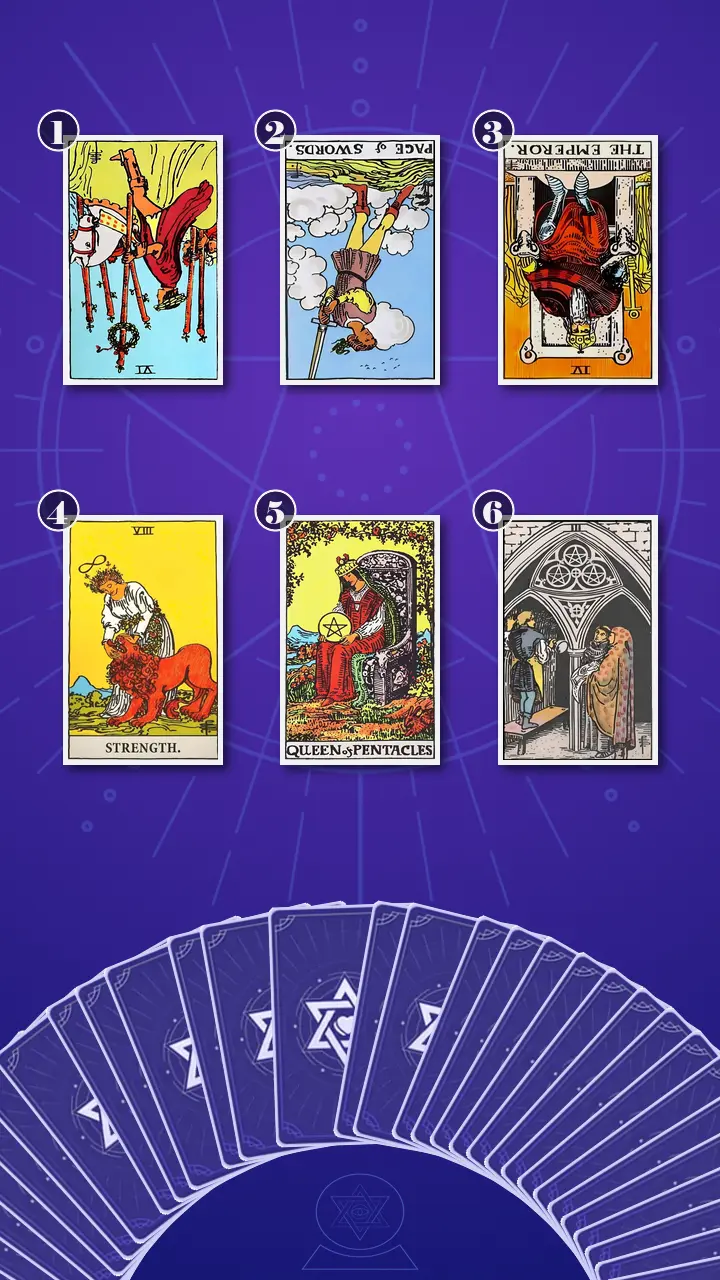
“Today I’m using a spread I call the Transformation Path Grid (6) · Context Edition,” I explained. “It’s a simple 2x3 storyboard. The top row shows the loop—symptom, blockage, root. The bottom row shows the exit ramp—turning point, grounded action, integration.”
For readers who wonder how tarot works in a situation like this: I’m not asking the cards to predict what your company will do. I’m using structure to separate a messy inner experience into parts you can work with. Reorg anxiety feels like one giant weather system. This grid breaks it into: what’s happening on the surface, what habit keeps it going, what fear is fueling it, and what lever actually changes your day-to-day behavior.
“Card 1 will name how status anxiety is hijacking your attention right now,” I told Jordan. “Card 3 will show the deeper fear the org chart is poking. And Card 4 is the pivot—the inner shift that brings your focus back.”
Reading the Map: From Head Noise to Hands-On Clarity
Position 1 — The visible symptom: The Loop That Feels Like ‘Being Strategic’
“Now turning over,” I said, “is the card representing the visible symptom: how status anxiety is hijacking attention and shaping day-to-day behavior at work right now.”
Six of Wands, reversed.
I nodded toward the card’s classic imagery—victory, the raised wand, the watching crowd—and translated it directly into Jordan’s Monday morning. “The org chart drops in a Confluence link and suddenly your day turns into a visibility audit,” I said. “You’re not reading it for logistics—you’re reading it like a social verdict: who got a cleaner title, who moved closer to a VP, whose box got bigger.”
In reversed form, the Six of Wands isn’t a lack of ambition. It’s ambition trapped in a scoreboard. The energy is in excess and unstable—fire that wants recognition, but can’t hold confidence without applause. “You start polishing a status update like it’s a PR release,” I continued, “then stall on the actual backlog item that would create real impact. You’re chasing the feeling of being seen, but the scoreboard never stops moving.”
Jordan let out a small laugh that wasn’t really laughter. Their shoulders lifted, then dropped. “Okay,” they said, blinking hard. “That’s… too accurate. Like, borderline rude.”
“It’s accurate because it’s common,” I replied. “This is what a new org chart does when your brain equates visibility with safety. It turns normal career awareness into a public leaderboard you didn’t consent to.”
Position 2 — The active blockage: Information Grazing That Eats Deep Work
“Now turning over,” I said, “is the card representing the active blockage: the thought habit, information pattern, or reflex that keeps pulling you out of deep work.”
Page of Swords, reversed.
“Your brain turns into an investigative journalist with a deadline,” I said, and Jordan’s eyes flicked downward—like they could see their own browser history reflected in the table. “You refresh Slack threads, scan meeting invites for who’s included, and re-open the org chart ‘just to confirm’ something you already saw.”
The Page of Swords is mental alertness. Reversed, that air-energy becomes blocked and scattered—vigilance without landing. It shows up as clipped, scanning thoughts: Why wasn’t I on that invite?Who reports to who now?Did they remove my team?Am I missing something?
“You draft three versions of the same update in your head—one humble, one confident, one strategically impressive—then post none of them,” I continued. “The blockage isn’t lack of skill. It’s information grazing that keeps you in reaction mode instead of build mode.”
Jordan went very still. Then they exhaled like they’d just realized they’d been holding their breath. Their hands—restless until now—finally settled on the edge of their desk.
Position 3 — The root driver: When Structure Gets Mistaken for Safety
“Now turning over,” I said, “is the card representing the root driver: the deeper fear about power, safety, or worth that the org chart is touching.”
The Emperor, reversed.
My mind did what it always does with the Emperor: it went to stone. Not metaphorically—literally. I’ve spent years with my palms on ancient walls, reading the difference between a stabilizing structure and a collapsing one. The Emperor is the part of us that loves a clear chain of command and sturdy edges. Reversed, it shows what happens when we outsource our inner authority to the system.
“Under the reorg, you’re treating structure like safety,” I said. “If the reporting line is unclear, your nervous system reads it as danger; if your spot isn’t ‘up’ enough, it feels like you’re one reprioritization away from being labeled nonessential.”
I watched Jordan’s jaw tighten—exactly where they’d described it. “There’s an internal manager voice here,” I said gently, “the rigid Emperor in shadow. It says: Show me the chain of command or we’re not safe. And then you try to control perception—extra meetings, extra documentation, extra certainty-seeking—because it feels safer than admitting you want security and recognition.”
I paused and gave them a sentence to hold onto, the way you hand someone a railing on a steep staircase: “An org chart is a logistics map, not a worth report.”
Jordan swallowed. Their eyes went glassy for a second, then focused again. “That… lands,” they said quietly. “I hate how much I’ve been letting it be a mood ring.”
When Strength Spoke: The Calm Manager of Your Nervous System
Position 4 — The key shift: The Micro-Pivot That Reclaims Focus
The air in the room changed—not dramatically, but noticeably, the way it does when someone finally tells the truth in a meeting. “We’ve reached the pivot,” I said. “Now turning over is the card representing the key shift: the most transformative reframe or inner capacity that loosens the loop and reclaims focus.”
Strength, upright.
“This is the moment you catch your hand reaching for the org chart tab—and you don’t obey it,” I told them. “You name what’s happening—status anxiety—take one slow breath, and decide to lead your attention like a calm manager, not a panicked intern.”
In my own work, I have a framework I call Skill Archaeology: we unearth overlooked talents that get buried under noise. And Strength is, frankly, an archaeologist’s card. You don’t excavate a fragile relic with force. You don’t dominate the site. You steady your hands, brush gently, and work with patience—because the goal is retrieval, not performance.
Jordan’s eyes narrowed—not in disagreement, but in that “I’m trying not to cry on a work call” way. They were stuck in a very familiar mental scene:
It’s 9:12 PM in your Toronto condo, laptop glow on your hands, Slack quiet for a second—and you still can’t stop toggling back to the org chart like it’s going to finally explain where you stand.
Stop trying to dominate the story with external proof—start steadying your nervous system and guiding your ambition gently, like Strength calming the lion.
Jordan’s reaction came in a chain, not a single emotion. First: a physical freeze—their breath caught and their cursor stopped moving midair. Second: the cognitive shift—their gaze unfocused for a beat, like their brain was replaying every time they’d rewritten an update to sound “bigger.” Third: the emotional pushback. “But—” they said, a flash of heat in their voice, “if I stop doing that… doesn’t that mean I’ve been wrong? Like I’ve been wasting time?”
“It means you’ve been trying to survive,” I said. “And survival strategies are not moral failures. But they do have costs.”
I watched their shoulders drop half an inch. Their jaw unclenched, then tightened again, then unclenched—like a muscle learning a new pattern. Their eyes went a little red at the edges. “Okay,” they whispered. “So what does Strength look like in my actual day?”
“It looks small,” I said. “A manual override for your attention.” I offered them the simplest version of the ‘Strength Pause’: set 90 seconds, write two lines—Facts and Stories—then pick one task that makes your work visible through substance. “Treat the anxiety as a signal,” I added, “don’t treat it as a command.”
Then I asked the question that turns insight into memory: “Now, with this new perspective, think back to last week—was there a moment when the org chart pulled you in, and this would have let you feel different?”
Jordan nodded slowly. “Thursday,” they said. “I kept checking who got looped into a leadership thread instead of finishing a decision doc. I was trying to feel… positioned. I could’ve just… finished the doc.”
That was the bridge: from status-driven comparison spirals and compulsive monitoring to calm self-trust and self-defined success. Not a personality transplant—just one clean pivot toward steadier focus.
Position 5 — The grounded next step: Treat Attention Like an Asset
“Now turning over,” I said, “is the card representing the grounded next step: one practical approach to stabilize attention and build self-defined security this week.”
Queen of Pentacles, upright.
“You build security the boring, effective way,” I told Jordan, “protected focus blocks, a real lunch, fewer performative meetings, and one tangible deliverable that exists even if nobody claps.”
This is earth-energy in balance. Where the Page of Swords reversed scatters you into a hundred micro-checks, the Queen gathers you into a schedule you can live inside. “You stop letting Slack dictate your nervous system,” I said, “and you start treating attention like an asset.”
I could almost see Jordan testing the idea against their calendar. Their face softened, then tightened with a practical worry. “But what if I miss something important?”
“Then we design for that,” I said. “Not with all-day monitoring. With boundaries.”
Position 6 — Integration: Healthy Status With Receipts
“Now turning over,” I said, “is the card representing integration: what ‘healthy status’ looks like when the lesson lands—how to relate to hierarchy without losing yourself.”
Three of Pentacles, upright.
“Healthy status shows up as being the person people trust to ship and collaborate with,” I said, “not the person constantly broadcasting their importance.”
The Three of Pentacles is the opposite of lonely performing. It’s shared artifacts—blueprints, docs, decisions, shipped work. Recognition that has receipts. “You align with stakeholders, clarify scope, and make your contribution easy for the right people to see,” I told them. “You’re no longer performing for the whole crowd; you’re building with the people who actually touch the work.”
I let myself be a little wry, because sometimes a clean phrase cuts through the fog: “Stop living in the 6—win the room. Start living in the 3—build the work.”
The Craft-Over-Chart Method: Actionable Next Steps for This Week
Here’s the story the six cards told, in plain language. The new org chart lit a fire in you (Six of Wands reversed): visibility equals safety. Your mind tried to control that fire by turning into constant monitoring (Page of Swords reversed): tabs, threads, invites, LinkedIn “Thrilled to announce…” spirals. Underneath, the real fear wasn’t vanity—it was outsourced authority (Emperor reversed): if the structure doesn’t confirm my value, I’m not safe. Strength restored agency by moving power back into your body and attention. Then the Queen and Three of Pentacles grounded it into routines and collaborative proof.
The cognitive blind spot is subtle: you’ve been treating hierarchy changes as if they’re personal verdicts—and trying to argue your case by over-documenting and over-performing. The transformation direction is cleaner: move from “prove I’m positioned well” to “define what success looks like this week and take one concrete step that makes my work visible.”
I offered Jordan three small experiments, borrowing another of my field habits—what I call Relic Authentication. In archaeology, we don’t trust the first story we hear about an object; we test it against evidence. Your anxiety deserves the same respect: listen, verify, then choose.
- Set Two Daily “Signal Windows”Pick two 10-minute blocks (e.g., 11:30 AM and 4:30 PM) to check the org chart/Slack announcements. Outside those windows, keep the org chart tab closed and notifications muted except DMs.If two windows feels impossible, start with one today. Widen to 15 minutes rather than abandoning it—this is training steadiness, not willpower.
- Run a “Facts vs Stories” Check (90 seconds)When you feel the urge to scan, open a note titled “Facts vs Stories.” Add exactly one line under Facts (verifiable) and one line under Stories (predictions). Then choose one next task and work on it for the remaining time.Put a sticky note on your laptop: “Check later—build now.” Expect your brain to protest; that protest is the loop, not a prophecy.
- Visibility Without PerformingDo one substance-based “visibility action” per day: post a crisp update once (Outcome → Next step → Ask) to the right channel or to 2–3 key people. No rewrites after the first clean pass.Keep it to five sentences max so you can’t over-polish it. Remember: legibility to the right people beats performance to the whole org.
If Jordan wanted to take it further, I added a final frame—my Megalith Transport strategy: when something feels too heavy to move, you don’t muscle it alone. You break it into stones you can carry. One doc header today. One decision bullet tomorrow. One stakeholder ask the next day. That’s how focus comes back: not by winning the chart, but by moving the work.
A Week Later: The Quiet Proof of Finding Clarity
Six days later, Jordan messaged me a screenshot—nothing flashy. Two calendar holds labeled “Non-negotiable build time.” A Notes app page titled “Facts vs Stories.” And a Slack update posted once, unedited, with a clear outcome and a simple ask. “I didn’t spiral,” they wrote. “I wanted to. But I did the 90-second thing. Then I shipped.”
They added one line that felt bittersweet in the way real change often does: they finally slept through the night, but woke up and still thought, What if I’m wrong?—and then, instead of opening Slack, they made coffee and opened their doc anyway.
That’s the Journey to Clarity I trust. Not certainty. Ownership. Not pretending hierarchy doesn’t matter—just refusing to let hierarchy run your nervous system.
When the org chart shifts, it can feel like your worth is being renegotiated in real time—so your body goes tense, your brain starts scanning, and you can’t tell whether you’re staying sharp or quietly panicking.
If you didn’t need the org chart to tell you you’re safe, what’s one small thing you’d choose to build—or make visible—this week anyway?
This story is adapted from psychological research, written so that those in a similar struggle can see their own pattern in it — and find their next step clearly.These insights are not a substitute for professional psychological, medical, legal, or financial advice.
Learn more about our Journey to Clarity.
How did this insight land for you?
🫂 This Resonates Deeply
🌀 Living This Story
✨ Now I See Clearly
🌱 Seeing New Possibilities
🧰 Useful Framework
🔮 The Confirmation I Needed
💪 Feeling Empowered
🚀 Ready for My Next Step
Author Profile
 AI
AI“Having spent a lifetime at Cambridge and on archaeological digs, I’ve witnessed the rise and fall of countless civilizations. Please know that your current struggles are not a permanent fate, but merely a necessary fracture before rebuilding. I won't lecture you; instead, I invite you to sit with me in the ruins, using a patient, historical perspective to gently dust off the true, enduring value hidden beneath your temporary doubts.”
In this Career Tarot Reading :
Core Expertise
- Core Competency Excavation: Digging through the 'strata' of your past roles to uncover undervalued, highly transferable foundational skills.
- Career Epoch Analogies: Contextualizing your career plateau as the end of one professional era and the necessary foundation for the next.
Service Features
- The Resume Stratigraphy Review: A structured framework to rewrite your professional narrative, highlighting immutable assets over obsolete job titles.
Also specializes in :
Explore Related Patterns:
Comparison TrapJordan's eyes go straight to who got a cleaner title, who moved closer to a VP, and whose box looks bigger on the chart. The comparison is not casual benchmarking; it becomes a ranking exercise where every coworker's apparent position seems to say something about Jordan's own value. Comparison Trap works by narrowing attention until relative position feels more real than actual contribution. You begin tracking other people's proximity to power as if it can answer the private question of whether you are safe, respected, or falling behind. The trap is especially sticky because it borrows the language of strategy. It feels like you are gathering useful career intelligence, but the emotional engine is comparison-based threat detection, which is why the more you scan, the less grounded you feel.
Status DefenseThe Slack org chart does not stay a logistics document for Jordan; it turns into a live audit of titles, reporting lines, and who appears closer to leadership. Once the chart is read as a verdict, attention stops serving the actual work and starts defending the self against the possibility of being invisible, replaceable, or quietly deprioritized. That is the mechanism of Status Defense: status cues become emotional safety cues. You are not simply caring about career growth; you are trying to use hierarchy as proof that you still matter, which makes every ambiguous signal feel urgent. The focus hijack happens because the mind treats status uncertainty as a threat to identity. Until the org chart is returned to its real function as a logistics map, your nervous system keeps trying to extract self-worth from a system that was never designed to provide it.
Certainty SeekingJordan keeps reopening the org chart, refreshing Slack threads, and scanning meeting invites for signs of who is included or excluded. The next click seems to promise relief, but it only creates another question to verify. Certainty Seeking turns ambiguity into a problem the mind believes it can solve with more data. You are trying to calm status anxiety by collecting signals, but the checking behavior trains the brain to believe that safety is always one more confirmation away. That is why focus gets split. Deep work requires enough internal permission to stay with one task, while certainty seeking keeps pulling attention back into the system to ask, again and again, whether you are still positioned safely inside it.
Strategic VisibilityJordan's grounded move is not to disappear or broadcast harder; it is to post one crisp update with an outcome, a next step, and a clear ask. The audience shrinks from the whole org to the right people who can actually use the information. Strategic Visibility turns recognition into a communication practice rather than an emotional rescue mission. You make the work legible through substance, scope, and collaboration instead of trying to win safety through constant performance. That shift gives status a healthier container. Visibility still matters, but it stops being a referendum on your worth and becomes a tool for alignment, trust, and shared execution.
Competence TheaterJordan does not just write a status update; they rewrite it like a pitch, testing versions that sound humble, confident, or strategically impressive. The update becomes a stage where the real goal is not communication but proof of relevance. Competence Theater appears when the performance of being valuable starts replacing the quieter work of creating value. You are trying to manage how capable you seem because the hierarchy has made visibility feel unstable. The cost is subtle but concrete: the polished update gets more attention than the backlog item or decision doc that would actually build trust. The performance is meant to reduce anxiety, but it keeps you dependent on the audience you are trying to impress.
Reality TestingJordan's 90-second Facts vs Stories check turns the org chart spiral into something testable. Instead of letting every anxious interpretation become a command, they separate what is verifiable from what is a prediction. Reality Testing restores the difference between data and threat narrative. You are not forcing yourself to ignore the reorg; you are checking whether your mind is treating ambiguity as evidence before you give it control over your next hour. The week-later moment matters because the anxious thought still appears: What if I’m wrong? The change is that Jordan opens the doc anyway, which shows the pattern shifting from compulsive interpretation to evidence-based action.
Explore Related Struggles:
Approval-Safety FusionThe Slack org chart lands at 9:06 AM, and your attention goes straight to titles, reporting lines, and who sits closer to leadership. The body reaction is immediate: jaw tight, hands restless, chest charged, as if the chart is not a logistics document but a live signal of whether you are protected. The friction is that recognition is being asked to do the job of safety. When a title does not move, it does not simply look disappointing; it starts to feel like invisibility, deprioritization, or replaceability. You keep looking for proof that the system still sees you because the hierarchy has become the place where security is being negotiated. Approval-Safety Fusion fits because the loop is not vanity or ordinary ambition. It is the moment visibility becomes a stabilizer for your sense of safety, so every missing invite, unchanged title, or quiet Slack thread can hijack focus until you reclaim the difference between being seen by the system and being anchored in your own agency.
Identity Verdict LockThe org chart sits in Slack like a dare, and every box, title, and reporting line starts to look personally addressed. You are not only asking where the team sits now; you are asking what the new structure says about whether you count. An unchanged title becomes invisibility. A missing leadership thread becomes a warning signal. A move closer to a VP becomes proof that someone else has been chosen by the map. The workplace diagram turns into a mirror, and the reflection keeps shifting before you can land. Identity Verdict Lock fits because the hierarchy starts delivering verdicts it was never built to deliver. When a chart becomes a worth report, focus gets replaced by self-trial; when it becomes a map again, you can still read power clearly without letting it define who you are.
Internal Authority CollapseThe clearest line in the reading is the one where the org chart stops being a logistics map and starts acting like an authority over your inner state. If the reporting line is unclear, your body reads it as danger; if your box is not high enough, it feels like the system has already started lowering your value. This is where focus gets hijacked at the root. Your own assessment of contribution, capacity, and next right action gets handed over to the chart, the invite list, the leadership thread, or the title architecture. The system becomes the voice that tells you whether you are allowed to feel steady. Internal Authority Collapse fits because the hierarchy is doing more than organizing teams; it is temporarily replacing your own center of judgment. Reclaiming focus means bringing authority back into the body and the calendar: what is factual, what is useful, what needs to be built, and what evidence you can create through action.
Monitoring-Safety FusionYou refresh Slack threads, scan meeting invites, and reopen the org chart to confirm something your eyes already registered. The action looks like workplace awareness from the outside, but inside the loop it functions like a safety check that never fully resolves. The problem is not that you want information. The problem is that monitoring has become the doorway through which you try to feel secure, so every new thread or missing invite restarts the audit. Your attention keeps paying a toll to the hierarchy before it is allowed to return to the work in front of you. Monitoring-Safety Fusion names the way vigilance turns into a false anchor. It gives you the sensation of staying prepared while quietly draining the focus you need to ship, decide, write, and build with actual leverage.
Visibility-Execution SplitYour status update gets rewritten like a PR release while the backlog item, decision doc, or concrete deliverable waits. The story makes the split physical: one part of you is trying to sound positioned, strategic, and visible; another part knows the real proof would come from finishing the work. That tension matters because visibility and execution are both legitimate needs in a corporate system. You do need your work to be legible. You also need enough protected focus to create the substance that makes visibility more than performance. Visibility-Execution Split fits because the org chart pulls you toward being seen before you have a chance to build. The way out is not to disappear or over-broadcast; it is to make contribution visible through receipts, not through constant self-presentation.
Explore Related Emotions:
Replaceability DreadJordan says that if their title does not move, it feels like they are invisible, and later the unclear reporting line starts to feel like being one reprioritization away from nonessential. Invite lists, team boxes, and leadership proximity become early-warning signals for whether their place is still secure. Replaceability Dread is the background chill of feeling that your value could be quietly downgraded without a direct conversation. It hijacks focus because the mind starts monitoring for removal before any removal has happened, turning routine organizational noise into a test of whether you still matter.
Status AnxietyAt 9:06 AM, the Slack org chart link lands in Jordan's day and their body starts treating it like live status data: jaw tight, fingers restless, attention narrowing around titles and reporting lines. The chart is not only read for logistics; it becomes a ranking surface where proximity to leadership seems to say something about personal standing. That is why focus gets hijacked. Your mind is trying to solve a social-positioning problem while pretending it is doing normal work analysis, so every invite, title shift, and Slack thread becomes another clue. Status Anxiety names the inner weather of needing the hierarchy to confirm that you are still visible, still valued, and still safe enough to concentrate.
Verdict DreadThe org chart sits in Slack like a dare, and Jordan keeps zooming in as if the next box or reporting line might finally explain where they stand. A workplace map starts carrying the weight of a worth report, so the ordinary question of who reports to whom turns into a private ruling on whether they count. Verdict Dread captures that suspended feeling of waiting for a system to pronounce something about you without ever saying it directly. Your focus keeps returning to the chart because part of you is listening for a decision that the chart was never designed to deliver.
Visibility PressureJordan keeps rewriting status updates like they are pitching a TV show, then stalls on the actual backlog item that would create impact. The update is no longer just communication; it becomes a small stage where every word has to prove they are strategic, positioned, and worth noticing. Visibility Pressure names the squeeze that appears when being seen starts demanding performance before substance. Your attention leaves the work and moves toward the imagined audience, trying to manage perception so tightly that the useful next step becomes harder to take.
Hollow RecognitionJordan is chasing the feeling of being seen, but the scoreboard never stops moving. A cleaner title, a closer reporting line, or the right meeting invite might soothe the moment, yet the story keeps showing how quickly the mind asks for the next receipt. Hollow Recognition names the thinness of proof that depends entirely on external display. Your focus stays hooked because the recognition being pursued is not stable enough to nourish you; it can flash brightly and still leave the deeper question of worth unsettled.
Hypervigilant AnxietyJordan refreshes Slack threads, scans meeting invites, and reopens the org chart just to confirm something they already saw. Their hands stay restless, their eyes carry a buzzy pressure, and the workday starts to feel like a desk with a phone vibrating on it all day. Hypervigilant Anxiety names alertness that cannot land. Your attention keeps scanning for the next tiny signal because the previous signal never gives enough relief, so deep work becomes almost impossible while your mind stays on patrol.
Performance FreezeJordan drafts three versions of the same update in their head, one humble, one confident, one strategically impressive, and then posts none of them. On Thursday, they check who got looped into a leadership thread instead of finishing a decision doc. Performance Freeze names the jam that happens when action has to carry too much image-management weight. Your work pauses because every move feels like it might be evaluated as proof of your position, so the safest action starts to look like not moving at all.
Scattered OverwhelmThe story describes deep work being interrupted by refreshes, invite scans, rewritten updates, and one more return to the org chart. None of these checks is huge on its own, but together they break the day into fragments. Scattered Overwhelm is the feeling of too many status signals competing for the same attention channel. Your focus is not absent; it is over-distributed across threads, titles, predictions, and imagined consequences until the actual next task has no clean space to occupy.
Grounded AgencySix days later, Jordan sends a screenshot of two calendar holds labeled Non-negotiable build time, a Notes page titled Facts vs Stories, and a Slack update posted once, unedited. The important detail is not that the uncertainty vanished; it is that their next action no longer has to wait for the chart to calm down. Grounded Agency is the felt shift from being pulled around by status signals to choosing a concrete move inside the day. You reclaim focus by making the boundary small enough to use: check later, build now, post once, return to the work.
Hard-Won ComposureJordan's jaw unclenches, tightens again, then unclenches, like a muscle learning a new pattern. A week later, they still want to spiral, but they use the 90-second practice and ship anyway. Hard-Won Composure is not a glossy calm where nothing gets triggered. It is steadiness built while the pull is still present, the kind where your body may still brace, but your hand can choose the doc over another round of checking.
Quiet Self-TrustJordan wakes up still thinking, What if I'm wrong, and then makes coffee and opens the doc anyway. That small move matters because it does not require total certainty before action; it lets useful work become the reference point again. Quiet Self-Trust is low-volume confidence with receipts. Your attention comes back when you stop asking the org chart to certify your worth first and start letting one honest, visible piece of work carry the day forward.
Explore Related Contexts:
Career Visibility ParalysisJordan keeps rewriting status updates like they are pitching a TV show, then stalls on the backlog item and later names the Thursday pattern clearly: they were checking who got looped into a leadership thread instead of finishing a decision doc. The work that would create substance is present, but the pressure to look positioned keeps interrupting it. Career Visibility Paralysis forms when being seen at work starts to feel so consequential that presentation blocks production. The external workplace does not have to explicitly demand constant performance for the pressure to become real; the combination of Slack visibility, leadership access, and reorg ambiguity is enough to make every update feel loaded. For You, this context reframes the hijacked focus as a visibility problem, not a competence problem. The loop says, polish the signal until it proves your place. The more useful audit asks which deliverable, decision, or stakeholder alignment would make your contribution visible through evidence rather than performance.
Promotion Criteria Black BoxJordan studies who has a cleaner title, who moved closer to a VP, and whose box appears bigger, but none of those signals actually explains how recognition or advancement will be decided after the reorg. The visible hierarchy gives them plenty to inspect and very little to trust. Promotion Criteria Black Box fits because the company’s status markers are legible while the rules behind them remain opaque. A title, invite list, or reporting line may look like evidence, but without clear criteria it becomes a projection screen for uncertainty about whether the organization sees your contribution. For You, the attention hijack is partly an attempt to reverse-engineer a system that has not made its standards clear. That can trap you in signal-reading instead of action. The more agency-preserving move is to ask for criteria, define the week’s proof of impact, and make contribution visible to the people who can actually evaluate the work.
Status Anxiety CircleThe new org chart arrives in Slack and immediately turns Jordan’s day into an audit of titles, reporting lines, leadership proximity, and who seems more visible now. Their attention does not stay on the logistics of the reorg; it keeps returning to the chart as if each box might confirm whether they still matter inside the company. That is the structure of a status anxiety circle: a workplace hierarchy produces visible ranking signals, but those signals do not come with enough interpretive clarity to let the employee settle. You start scanning, comparing, polishing, and checking because the organization has made status feel consequential while leaving its meaning unstable. For You, this context explains why focus keeps getting hijacked. The problem is not simply distraction; it is a corporate environment where recognition, security, and position seem to be renegotiated through small public signals. The way back to agency starts with separating useful career information from the scoreboard logic that turns every update, invite, and reporting line into a referendum on your value.
Productivity TheaterJordan’s status update becomes a performance object: one version humble, one confident, one strategically impressive, while the actual backlog item and decision doc sit waiting. The story keeps returning to a sharp contrast between visible workplace signaling and work that would produce concrete value. Productivity Theater appears when the environment rewards the appearance of being strategic, present, and important enough that performative work competes with useful work. Slack, meeting threads, polished updates, and reorg visibility create a stage where looking positioned can feel safer than building something finished. For You, this context matters because it shows how focus gets redirected into managing perception. The exit is not to become invisible; it is to replace broad performance with narrow, evidence-based visibility: one clear update, one concrete ask, one shipped artifact, one decision moved forward.