Past Survival Became a Forecast: Reading Today's Reorg Evidence
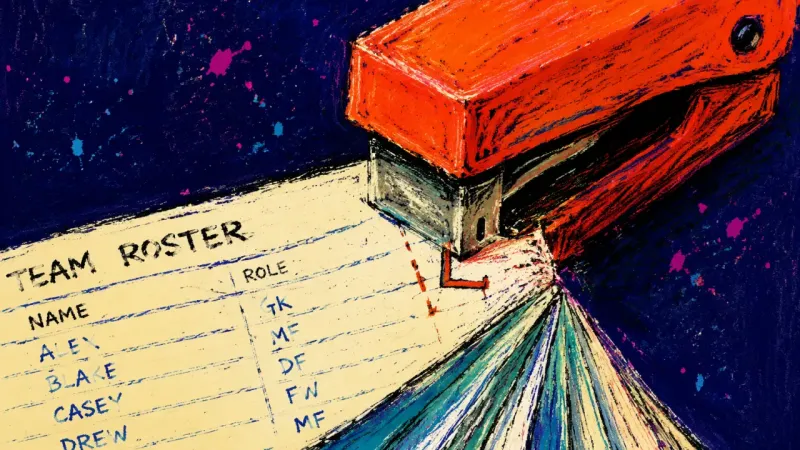
The 9:18 p.m. Resume Tab
I often begin with a recognition trigger: 'If you are a late-twenties product operations specialist in Toronto who sees an unagended all-hands meeting, calls it another normal corporate moment, and returns to your metrics deck while the rent auto-payment notification sits unread, you may be living the search term reorganization normalcy bias.'
That was Jordan. At 9:18 p.m. in their Toronto condo, I watched them reread a vague leadership post while the kitchen light threw a hard rectangle across the table. The laptop fan hummed beside a cooling mug of tea. Jordan opened an old resume, kept the cursor blinking beneath a job title that no longer quite described their work, closed the file after two minutes, and returned to polishing a metrics deck that was already finished.
'I have seen this movie before, and I was fine,' Jordan told me. 'If I keep delivering, I should be safe. Updating my resume would make the threat feel real. I do not want to overreact to another vague org chart.'
The presenting question was direct: why do I ignore reorg signals because I survived before? I heard the contradiction underneath it: Jordan wanted to trust the resilience that had carried them through earlier reorganizations, while fearing that taking the current signals seriously would reveal how little control anyone could have over what a company changed next.
Their unease moved like a smoke alarm whose warning chirp had been folded into the ordinary hum of the refrigerator: the stomach dropped, the shoulders braced, and then a clean slide deck covered the missing agenda. Competent confidence brought temporary relief, but it also filtered the evidence that might have required a different response.
I said, 'You are not foolish for wanting stability, and you are not required to turn one vague update into a catastrophe. We can look at what is actually happening without asking the cards to predict your employment. Today, our Journey to Clarity is simply to give the uncertainty a map and return the decisions to you.'

The Compass Around the Blind Spot
I asked Jordan to put their phone face down, take one slow breath, and name the question without trying to solve it. I shuffled slowly while they listened to the cards move, using the ritual as a transition from automatic task mode into deliberate attention rather than as a test of supernatural certainty.
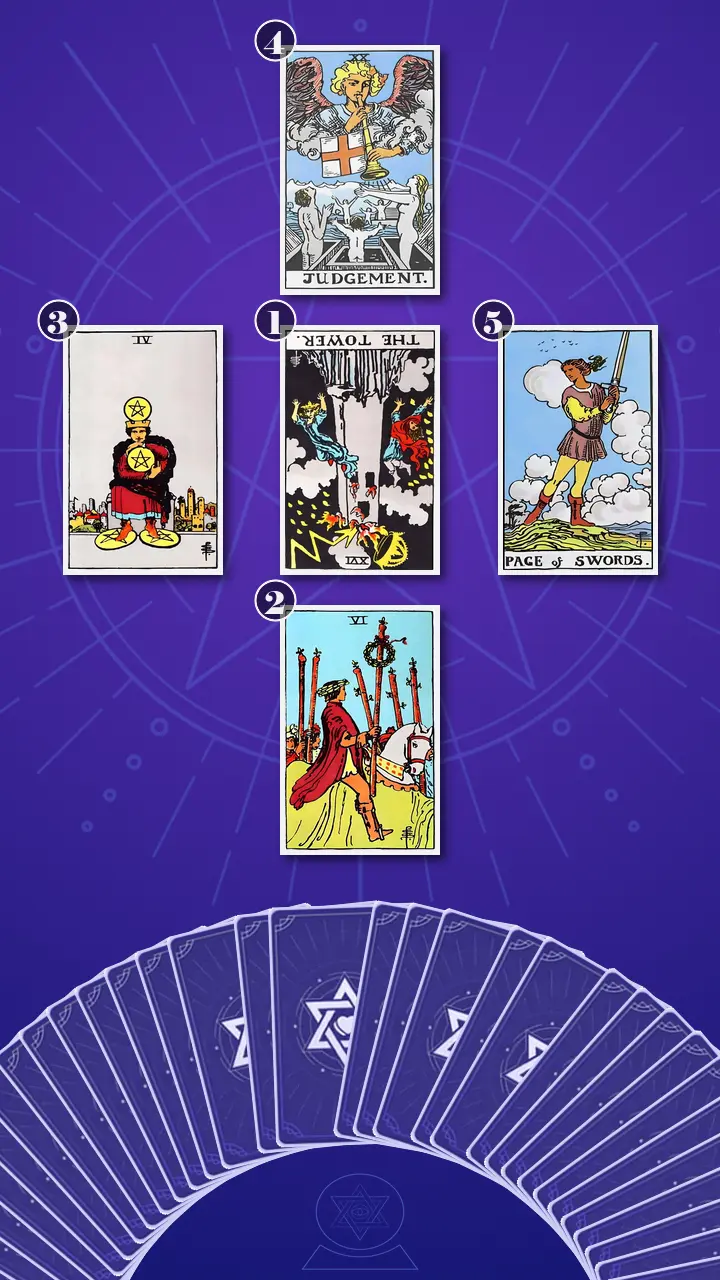
For this reading, I chose The Shadow Spread, a classic five-card spread designed for focused inner excavation. For anyone wondering how tarot works in a practical setting, the structure matters: it lets card meanings in context examine a repeated defense without turning an organizational reorganization into a prophecy. The question was not whether Jordan would keep their job. It was why familiar survival kept muting present evidence, what that defense protected, and how awareness could become a reversible response.
The first position would reveal the presenting shadow behavior: seeing a signal and filing it under probably nothing. The second would trace the root to the remembered success story. The third would show the protective function behind the grip on routine and income. Above those cards, the fourth would offer the awakening insight, and the fifth would translate that insight into practical next steps.
I explained that the cross was deliberately smaller than a Celtic Cross. A broader spread could add more atmosphere, other people, and imagined outcomes, but it would not answer the focused question as cleanly. This layout followed a compass around one blind spot: from visible pattern, to origin, to protection, to conscious reassessment, and finally to evidence-led action.
Reading the Org Chart with a Loose Crown
The Warning Filed Under Routine
I began at the centre of the cross. 'Now I am turning over the card that represents the presenting shadow behavior: noticing reorganization signals and then minimizing them through the story that previous survival guarantees present safety. Its standard meaning is the shadow pattern currently seeking recognition.'
The card was The Tower, in reversed position.
In this position, The Tower reversed shows disruption being resisted, internalized, or deferred. Its energy is blocked rather than absent. The lightning still strikes; the crown is already coming loose; the structure is visibly under pressure. The card is not predicting job loss. It is showing the moment a workplace structure shifts in view while the person underneath keeps formatting the slide deck.
In ordinary work life, this is the unagended all-hands meeting, the changed reporting line, or the project that quietly loses its second sprint while each development gets interpreted separately. A familiar stakeholder disappears from Slack. Leadership repeats phrases such as operating model, resource alignment, and more to come. Jordan notices the signal, feels a brief drop in the stomach, and then returns to a deliverable so the disturbance never has to become a pattern.
I told Jordan that their past-survival story had become an algorithm. Every new notification was being sorted as safe because the previous reorganization had been survivable. Like muting a smoke alarm after several false alarms, the silence restored calm, but it could not prove that the wiring was fine. On the TTC, Jordan could screenshot an all-hands invite marked Attendance Expected, answer a routine Slack question before the next stop, and still call the reaction overthinking.
Jordan gave a short, bitter laugh. 'That is almost rude,' they said. 'I keep calling it calm.'
I let the laugh stay in the room. 'That recognition is useful, not shameful. If this were your first reorganization, which current signal would deserve investigation before your old story explained it away?'
Jordan looked down at the card, pressed their lips together, and rubbed one thumb along the edge of the table. The body had registered the warning before the confident explanation arrived. I did not ask them to decide what the signal meant. I asked them to notice that it had been noticed.
The Laurel Wreath from the Last Reorganization
I moved downward to the root. 'Now I am turning over the card that traces the pattern to its past origin: prior survival has become a success narrative that is overgeneralized into a prediction about current conditions. Its standard meaning is the formative experience that gave the shadow its shape.'
The card was the Six of Wands, in upright position.
The Six of Wands carries the energy of victory, recognition, and confidence after a difficult passage. Here, that fire is genuine but overgeneralized. Jordan stayed employed through the last reorganization, continued delivering, and came through with their role intact. That was a real success. The blockage begins when the laurel wreath from that particular victory gets carried into a different organization, with different leaders, different product priorities, and different evidence, as if it were a permanent security badge.
I connected the card to a Thursday evening message from a former teammate: 'We survived the last one somehow.' Jordan had laughed, replied with a confident thumbs-up, and closed the old resume tab. Their chest loosened because the familiar story restored competence: 'I have seen this movie before, and I was fine.' What remained unexamined was which actions Jordan had actively taken last time and which parts of the outcome had simply been shaped by circumstances outside their control.
'A past win can tell you something about your capacity,' I said. 'It cannot answer a question about a present organization it has never met. What did you actively do during the last reorg, and what did other people or circumstances make possible?'
Jordan's hand hovered over the Six of Wands, then withdrew. I saw the defensiveness soften into a more exact kind of thinking. Their previous survival no longer had to be taken away; it only had to be returned to its proper time and context.
The Grip That Makes the Browser Look Calm
I crossed to the left side of the spread. 'Now I am turning over the card that identifies the protective function behind the defense: preserving professional stability, material continuity, and control by keeping uncertainty outside conscious attention. Its standard meaning is the vulnerability the shadow attempts to guard.'
The card was the Four of Pentacles, in upright position.
The Four of Pentacles is practical security when its earth is flexible. In this reading, that energy has tightened into a grip. The pentacle pressed against the figure's chest became Jordan's current role, salary, routine, benefits, and identity as a person who remained useful. The feet pinning down the other coins became familiar reporting tasks that kept attention from moving toward wider options. The coin above the head became the thought occupying every quiet space: if preparation cannot guarantee protection, why make vulnerability feel more real?
I returned to the condo scene and the blinking resume cursor. I asked Jordan to complete the sentence in the private syntax of the pattern: 'If I prepare, then I am admitting ____. If I do not prepare, I can keep believing ____.'
Jordan stared at the cooling tea. 'If I prepare, then I am admitting the role can change and I cannot control it. If I do not prepare, I can keep believing that delivery will keep me safe.'
For a moment, their shoulders lifted as if they were carrying a heavy bag. Then they settled when I mentioned the finished metrics deck. The measurable task had not been pointless; it had given their nervous system a place to stand. But the relief was temporary, not evidence that the organization was stable. I said, 'You can keep doing your job without pretending the org chart is unchanged. Protection does not have to mean keeping every important browser tab closed.'
Jordan nodded slowly. Their expression held recognition and a small ache. They were not ignoring signals because they did not care about their future. They were avoiding what the signals might make them responsible for feeling, asking, and preparing.
When Judgement Sounded Through the Closed Loop
The Trumpet That Asked for Present Evidence
I lifted the card above the centre of the cross and let the room grow quiet. 'Now I am turning over the card that reveals the key transformation required by this case: reassessing current evidence on its own terms and redefining resilience as responsiveness rather than guaranteed safety. Its standard meaning is the lesson or new awareness hidden within the shadow.'
The card was Judgement, in upright position.
Judgement is an awakening, an honest review, and a deliberate answer to information. The trumpet is not a forecast of what the company will do. It is the calendar ping, the leadership phrase, or the direct question that finally gets through the closed loop. The rising figures show attention returning to a situation that had been managed through avoidance. The transformation is not dramatic certainty. It is willingness to hear the signal before deciding what it means.
At this point, I used one of my signature diagnostic lenses, Career Cycle Phase Identification. I developed it to distinguish a personal skill gap from a wider industry or organizational contraction. It is not a way to predict layoffs, promotions, or any fixed outcome. It asks a more useful question: is the difficulty coming from something I can develop, or from a larger cycle in the environment that deserves evidence before I turn it into a judgment about myself?
For Jordan, the lens separated an old organizational phase from the present one. Surviving before could show adaptability, but it could not certify that the current leadership, reporting lines, and product priorities were following the same cycle. That distinction gave Jordan somewhere to stand between denial and doomscrolling.
Jordan was still inside the old argument: if the previous reorganization ended with their job intact, taking this one seriously would be needless; if preparation could not guarantee protection, it might only expose vulnerability. At 9:18, the resume tab had closed and the finished deck had offered its familiar alibi.
Past survival is not a verdict on the present; answer Judgement's trumpet by reviewing what has changed and taking one reversible preparation step.
Jordan's fingers stopped above the card. Their breath paused, and their eyes widened before settling on the image. For a few seconds, their gaze lost focus and moved past my lamp, as if replaying the blank org chart, the director's phrase about the operating model, the reduced project scope, and the resume tab closing again. Their jaw tightened once. Then they whispered, 'Wait.' Their shoulders lowered unevenly, first on the left and then on the right, while the hand that had been gripping the table opened finger by finger. A breath left their chest with a thin tremor. The release was not pure relief; it carried a brief, light-headed blankness, the strange responsibility of having a clear next view without a guaranteed result. 'I can look at this without deciding my entire future tonight,' Jordan said. I watched their eyes return to the trumpet, no longer as a warning of collapse but as a call to attention.
I asked, 'Now, use this new lens to remember last week: was there a moment when this insight could have made you feel differently?'
Jordan named the Monday meeting at 4:55 p.m., when a director had said, 'We are still working through the operating model,' while a new org chart showed several blank boxes. They had almost deleted the note because the last reorg had ended with their job intact. Judgement made the note worth keeping. This was the key shift from guarded reassurance based on past survival to sober curiosity and evidence-led agency: a small opening in a rigid pattern, not a demand for instant courage.
The Sword Instead of the Panic Button
The Question Held Upright
I moved to the final card on the right. 'Now I am turning over the card that translates the new awareness into conscious behavior: asking focused questions, tracking observable signals, and keeping career options usable without predicting an outcome. Its standard meaning is the practical way to integrate the insight.'
The card was the Page of Swords, in upright position.
The Page of Swords brings alert curiosity, candid inquiry, and readiness to learn. Its air is mobile rather than frantic. The raised sword becomes a direct workplace question, not a weapon. The fast-moving clouds and circling birds become partial announcements, shifting Slack messages, and information that may need revision. The Page does not freeze until certainty arrives, and the Page does not charge into an overnight application spree.
I pictured Jordan with one clean Notes document open beside a changing Slack channel. The useful posture was simple: What do I know? What do I not know? What one question would improve my position? A manager's vague answer could be recorded as still unclear rather than inflated into proof of imminent job loss. One updated resume bullet could preserve an option without announcing a resignation.
'A question is not a panic button,' I said. 'It is a way to gather agency. You can ask which responsibilities are confirmed to stay with the team, which are still being reviewed, and what has materially changed in decision-making. You do not have to become the unofficial investigator for the whole company.'
Jordan wrote the question into their phone, then turned the screen toward me: 'I want to make sure I am working from the same information. Which responsibilities are confirmed to stay with our team, and which are still being reviewed?'
Their thumb hovered over the save button before pressing it. That tiny motion mattered. I could see the old reflex waiting nearby, ready to return to routine work, but it no longer had the entire room to itself. The Page of Swords offered a way to stay alert while continuing the job, a form of preparation compatible with self-trust.
Finding Clarity in a 30-Day Micro-Orbit
The Pattern Behind the Closed Resume
I laid the five cards back into their cross and linked the story aloud. The Tower reversed showed the workplace signal being noticed and then downgraded. The Six of Wands showed why: a real past victory had become a credential for judging a present situation that had not yet been examined. The Four of Pentacles showed what that credential protected: role, income, routine, housing continuity, and the feeling of being able to manage one more deliverable. Judgement opened the grip by asking for an honest review. The Page of Swords gave that review a usable shape through questions, dated notes, and reversible preparation.
The blind spot was not that Jordan failed to see signals. It was that the calm produced by returning to routine had been mistaken for evidence that the situation was calm. Every uneventful day became a small argument for postponement, while information, options, and response time quietly narrowed. The old strategy converted familiarity into reassurance, much like a phone held at one percent battery and gripped harder in the hope that pressure might create more charge.
The direction of change was precise: move from using past survival as proof of present safety to treating past survival as evidence of a capacity to respond. I was not asking Jordan to quit, panic-apply, confront leadership, or predict a layoff. I was asking for a weekly present-evidence review paired with one reversible career-readiness step. That was the actionable advice: small enough to begin, bounded enough to stop, and owned by Jordan rather than by the cards.
I then introduced my personal communication strategy, The Micro-Orbit Observation. For thirty days, Jordan would track subtle organizational blueshifts, such as clearer ownership or expanding scope, and redshifts, such as reduced scope or decision-makers disappearing. Those labels were observation prompts, not predictions. The purpose was to notice movement in the environment without turning every Slack phrase into a threat assessment.
- Micro-Orbit ObservationFor the next 30 days, reserve one 20-minute Sunday or Monday block in Apple Notes, Google Docs, or Notion. Record three observed workplace signals, one neutral alternative explanation for each, one fact that remains unknown, and one question worth asking. Date the note, and close it when the timer ends.Keep facts, interpretations, and fears on separate lines. If three signals feel too activating, begin with one signal and one sentence. The review is a bounded evidence check, not an all-night forecast or a reason to investigate coworkers.
- One Question, Not a ForecastBefore the next all-hands, manager one-to-one, or team meeting, save one neutral question on your phone: 'Which responsibilities are confirmed to stay with our team, and which are still being reviewed?' Ask it in the meeting, in Slack, or privately with the manager, then record the answer under confirmed and still unclear.If speaking feels too exposed, send the question privately and begin with, 'I want to make sure I am working from the same information.' One question is enough. Uncertainty is information, not an instruction to make a major career decision tonight.
- One-Bullet ReadinessSet a 15-minute timer on Wednesday evening and update one resume bullet with a recent outcome, tool, or cross-functional responsibility from your product operations work. Save the revised file in a clearly named folder and stop. Do not apply for jobs unless you independently choose to.Copy language from a recent performance review if the blank page feels exposing. A current resume is an available option, not a declaration of defeat. The task is one sentence of maintenance, not a demand to reorganize your life.
I reminded Jordan that these steps could be paused. If the body moved from a stomach drop into racing thoughts or compulsive checking, the correct response was to close the note, look around the room, and choose whether to return another day. Preparation was meant to widen choice, not become another way to overwork.

The Quiet Proof of a Usable Option
Six days later, I received a message from Jordan while I was making tea. It read, 'I did the 20-minute review. I logged the new meeting, the reduced project scope, and the manager's exact wording. I asked one question in my one-to-one, and I updated one resume bullet. Nothing dramatic happened, but I am no longer pretending that not knowing means nothing changed.'
That evening, Jordan slept through the night but woke with the thought, 'What if I am wrong?' They smiled at the ceiling; the question remained, but it no longer closed the resume tab.
I held that as the first evidence of change. Tarot had not decided what the company would do, and the spread had not promised Jordan protection. The cards had helped separate observation from interpretation, preparation from panic, and resilience from the fantasy of control. Jordan remained the person with the authority to ask, pause, stay, revise, or move. The journey had shifted from guarded reassurance based on the last reorganization to sober curiosity about the present one.
When a vague org update makes your stomach drop and your shoulders brace, it can feel safer to call it nothing than to admit that your hard-won resilience cannot guarantee control over what the company changes next.
If your past survival could be evidence that you can respond, rather than a guarantee that nothing will change, what small fact or usable option might you feel curious enough to notice this week?