Working Hard, Still Not Learning?

A grounded look at this study loop, its related tarot cards, and reading insights from similar academic questions.

Misaligned Study Loop
What does this feel like?

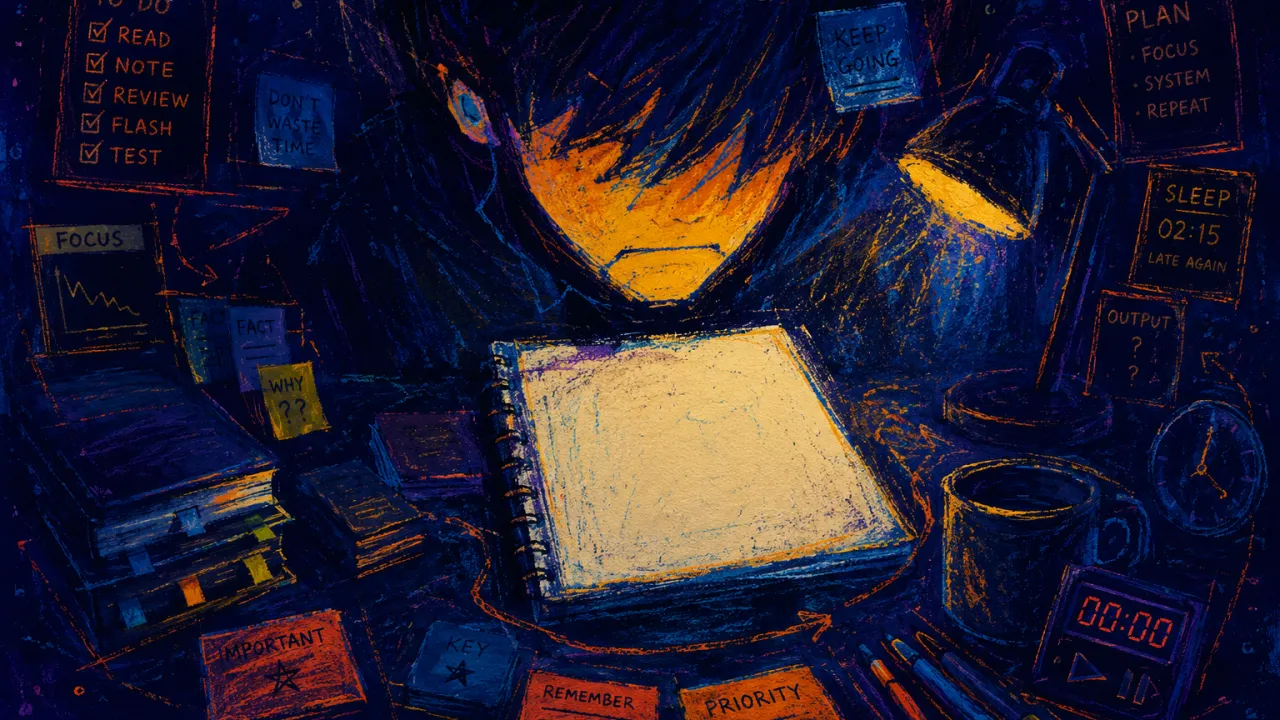
Misaligned Study Loop — you sit down with the intention to finally study properly, and the first thing you do is open the safest file, the cleanest document, the place where effort has a shape you can control. You adjust the title, rewrite a paragraph from your notes, highlight a line that already felt important last time, then open another tab because maybe a different explanation will make the whole thing click. Your shoulders creep upward while your eyes move across the screen, and the strange part is that you are not avoiding work; you are working, intensely, carefully, with the kind of focus that should be getting you somewhere. But underneath the motion there is a small, blunt knowing: you still cannot answer the practice question, still cannot start the essay, still cannot explain the concept without looking back at the page. So you keep making the study surface more convincing. The notes become neater, the schedule becomes stricter, the folder becomes cleaner, the flashcards multiply, and every visible sign says you are being responsible, while the part of the task that would prove learning is happening stays just out of contact. When someone asks how it's going, you count the hours because the hours are easier to defend than the result. When you try to stop, a pressure rises behind your ribs, as if stepping away would expose the whole day as unfinished, so you return to the method that calms you for ten minutes and drains you for three more hours. The cost is not just time; it is the quiet erosion of trust in your own effort, the feeling that you can pour yourself into something and still not reach it, much like the Eight of Pentacles in reverse, where the tools, bench, hammer, chisel, and coin form a small closed world of work while the wider purpose has slipped out of view.

What's pulling at you?

You're caught between the need to feel like you're doing enough and the need to face whether the method is actually working. The loop stays powerful because familiar study actions give immediate proof of effort, while testing, writing, recalling, or adapting the method brings you into contact with the part that still feels uncertain. So the harder you try inside the same system, the more stuck you can feel outside the result.

How It Shows Up?

  • You open your laptop after dinner and promise yourself this session will be different, then twenty minutes later you're rewriting the same lecture notes with cleaner headings and color-coded boxes. Your neck is bent, your eyes feel dry, and your hand keeps moving even though part of you knows the question you need to answer still hasn't been touched. The page is starting to look polished, almost like the craftsman's bench on the Eight of Pentacles, but the work is circling the tool instead of reaching the outcome. You can let that recognition arrive without turning it into another task.
  • You sit down to revise for an exam and immediately choose the safest part: the chapter you already half understand. You highlight lines you've highlighted before, nod at sentences that feel familiar, and get a small flash of relief because at least you're doing something. Then you try one practice question and your chest tightens when the answer doesn't come out cleanly. It's okay to notice that familiarity and readiness are not the same thing.
  • A friend asks how studying is going, and you hear yourself say, 'Yeah, I'm getting through it,' because the hours are technically there. Your shoulders lift slightly as you say it, like your body is protecting the answer from being inspected too closely. You can picture the folders, the tabs, the flashcards, the calendar blocks, all the visible proof that you've been trying, while your stomach knows the output still feels thin. You don't have to defend the effort before you understand what it is producing.
  • You're in the library with other people quietly working around you, and everyone looks like they know exactly what their next step is. You keep switching between tabs, lecture slides, notes, and a blank document, making small improvements that don't ask you to face the hard part. Your breathing gets shallow when the cursor blinks at the top of the page, and your jaw tightens as if the blank space is asking for evidence you don't have yet. You can pause at the edge of that blank page without pretending the loop is progress.
  • It's late, and you're still at your desk because stopping would make the whole day feel questionable. The room is dim, your lower back aches, and the same sentence has been copied into your notes three different ways. You feel locked into a small circle of screen, notebook, pen, and tired eyes, like a boat making the same stroke beside the shore without crossing the water. You are allowed to step back before the method takes the rest of the night just to prove it exists.

Misaligned Study Loop in Tarot Cards

Misaligned Study Loop lives in the moment when effort keeps moving, but the work still isn't contacting the exam question, essay argument, or feedback standard. You can feel it in the shallow breathing at a blank document, the tight jaw over rewritten notes, and the tired eyes still scanning the same sentence. From an existential perspective, the structural framework is about what happens when familiar effort becomes safer than evidence that the method is no longer carrying knowledge forward. The Tarot Cards below make that loop visible through tools, blocked feedback, repeated motion, and effort that cannot quite land.

Eight of Pentacles Reversed
The craftsman’s tools are precise, but in the reversed state the precision can become self-enclosed. Hammer, chisel, bench, and coin create a small world where continued activity looks legitimate even when the wider purpose has disappeared from view. Misaligned Study Loop appears when academic labor keeps the shape of productivity while losing contact with the actual demand. You may be highlighting, rewriting notes, rewatching lectures, or drilling familiar tasks, but the method is no longer calibrated to the exam question, essay argument, research problem, or feedback standard. The Eight of Pentacles makes that loop visible through the gap between tool and outcome. It shows a system that is not idle, but misfitted: energy continues to move, while learning, retention, and output stop receiving the force in a useful form.
Page of Pentacles Reversed
The coin still looks like the center of work, but the body has been arranged around maintaining that center. The Page's attention returns to the same small surface while the wide field, the route ahead, and the surrounding resources remain physically present but functionally unused. In study life, this is the loop where revising, highlighting, rewriting notes, or watching another explanation can look responsible while the learning system quietly fails to integrate. More effort goes into preserving the appearance of study than into creating retention, flexibility, or output. The card locates the exhaustion inside the method, not inside your character. The loop keeps consuming energy because the study action and the learning result are no longer connected by the same pathway.
Knight of Pentacles Reversed
The same armor, reins, horse, and pentacle can form a closed circuit when the system keeps inspecting its own preparedness instead of making contact with the field. In that reversed structure, the tools look responsible while the work surface remains untouched. In study, this is the loop of rereading, rewriting notes, and rebuilding routines that feel productive but fail to create retention or usable output. The card places the friction in the method itself: your effort is moving, but the route keeps returning to the hand that holds the pentacle.
King of Pentacles Reversed
The King's hands keep the visible objects in place while the larger scene stays motionless. The scepter, coin, armor, vines, and castle all signal capacity, but none of them are being converted into a new act. In academic work, that becomes the loop of organizing notes, refining folders, collecting sources, adjusting schedules, and highlighting pages while the actual retrieval, writing, or synthesis remains delayed. The system looks productive because the symbols of work are active, but the learning mechanism is circling its own display. The black marble throne gives the loop its weight. It shows how a study method can feel solid and responsible while quietly locking the body into the wrong action cycle.
Two of Swords Reversed
The blindfold blocks feedback while the hands keep the swords held in the same defensive configuration. The posture can look disciplined, but it cannot tell whether the effort is still useful, because the sensing channel has been cut off. Misaligned Study Loop appears when a student keeps rereading, highlighting, copying notes, making flashcards, or reorganizing schedules without checking whether the method is producing retention or output. The card anchors that loop in a body maintaining control while losing contact with evidence. This is not a simple productivity issue. The struggle sits deeper, where familiar effort feels safer than adaptive learning, and changing the method would mean admitting that the current structure has been consuming energy without moving knowledge forward.
Six of Swords Reversed
The long oar disturbs the water on one side while the six swords stay planted in the boat with perfect order. In a reversed texture, that order can become the proof of effort while the vessel remains heavy, slow, and dependent on the same repeated stroke. Academic effort can get trapped in the same mechanics. Rereading, rewriting notes, reorganizing folders, remaking schedules, or collecting more sources may create visible movement, but the method can keep the student circling the water beside the boat instead of reaching the task that actually matters. Misaligned Study Loop names the hidden mismatch between effort and passage. The card shows a system that is not lazy or empty; it is over-structured around a method that feels safe while quietly failing to transport knowledge into performance.
Seven of Swords Reversed
The tiptoeing figure is loaded with five swords, and every part of the route depends on a narrow, awkward rhythm. The body is moving, but the backward gaze and overloaded hands keep the motion from becoming a clean exit. When this structure folds inward, study effort can start to resemble motion without transfer. You may reread, reorganize notes, collect more resources, or restart the same routine, while the material still fails to settle into memory or assessed output. The reversed Seven of Swords does not show laziness. It shows a method that has become a corridor, where effort keeps proving that you are trying while quietly preventing the learning system from changing shape.
Page of Swords Reversed
The Page's sword is ready, but the body's attention is not organized around a single usable path. In the reversed structure, that misalignment becomes a loop: the same alert movement repeats because it feels like responsibility, even when it is not contacting the real obstacle. In study, this looks like rereading, highlighting, rewriting notes, or over-researching in ways that feel serious but keep missing the point where retention or output actually breaks down. The rugged ridge matters because the method has become normalized; the unstable route starts to feel like the only route. Misaligned Study Loop names the friction between effort and learning impact. The card gives that loop a shape: a sharpened tool, a clouded target, and a body trained to keep moving along a path that does not resolve the academic blockage.
King of Swords Reversed
The sword is designed to cut cleanly, but in reversal its precision can keep repeating the same motion after the learning material has stopped responding. The King's posture still looks disciplined, yet the connection between effort and outcome has gone thin. In study, this is the loop of rereading, highlighting, rewriting notes, overplanning, or chasing the method that looks serious while the actual retention or output barely changes. The elevated throne makes the loop harder to question because the method carries the aura of authority; it feels correct even when it is not working. Misaligned Study Loop names the point where academic effort remains intense but the interface between effort and learning is wrong. The card frames the struggle as a structural mismatch between a rigid tool and a living process, not as laziness or lack of ambition.
Five of Wands Reversed
The repeated movement of the wands can become a closed circuit when the scene is read as an internalized academic pattern. Effort keeps entering the field, but each new action is absorbed by the same crowded mechanics. Misaligned Study Loop is the structure where studying harder does not create better retention because the method and the mind are moving on incompatible tracks. The issue is not the presence of effort; the card is full of effort. The issue is that the effort cannot land where it needs to land. In revision, note-taking, flashcards, problem sets, or reading marathons, this card marks the point where increasing intensity only deepens the loop. You can see the boundary of the struggle when motion becomes proof of pressure rather than evidence of learning.
Seven of Wands Reversed
In the reversed Seven of Wands, the wand’s diagonal path can become less like a clean defense and more like a repeated block. The figure keeps meeting pressure, but the motion does not naturally convert into ground gained, understanding integrated, or work completed. This is the academic loop where more effort does not become more retention. One method is pushed against readings, essays, exams, feedback, and deadlines as if they were the same kind of force, so the student stays busy without finding the channel that actually fits the task. The card gives the loop a physical shape: contact is happening, energy is real, but the interface is wrong. You are not doing nothing; the struggle is that the effort keeps returning to the same defensive circuit instead of entering the place where learning can consolidate.
Eight of Wands Reversed
The eight wands hold one clean formation across terrain that is not uniform. Water, hill, house, and open ground all receive the same diagonal force, even though each surface would ask for a different kind of contact. In academic life, this becomes the loop of applying one study method to every subject, every exam style, and every cognitive state. The routine may look disciplined from the outside, but the card shows a mismatch between the method's fixed vector and the material's actual shape. The reversed structure makes that mismatch harder to detect because the formation still appears neat. You keep seeing order, while the deeper learning system keeps signaling that order alone is not adaptation.

Misaligned Study Loop in Tarot Card Reading Insights

Misaligned Study Loop is the pattern people bring into readings when study hours are present, but retention, writing, or exam performance still feels out of reach. The focus shifts from the cards themselves to what comes up when others ask about effort that looks disciplined but keeps missing the task. Tarot Reading Insights on this struggle are gathered below.

Psychological struggles related to Misaligned Study Loop