Public Mask Collapse at Work: From a Deleted Draft to One Clear Reply

The Central Line Replay: Fear of Public Mask Collapse
I recognized the pattern before Alex finished sitting down: they had rehearsed a neutral answer before a presentation, edited the sharper version out of a Slack draft, and still heard their voice change when someone challenged them. Alex was twenty-eight, working as a junior communications strategist in London, where looking polished, approachable, and easy to trust could feel like part of the job description.
I asked Alex to take me back to the moment that brought them in. At 8:47 p.m. on the Central line, they were scrolling through the meeting chat while fluorescent carriage lights buzzed overhead and their phone warmed their palm. I watched their shoulders stay lifted as they reread the sentence that had sounded sharper than planned, station after station, caught between wanting to be understood and promising to reveal less next time.
They looked at me and said, "Why does the side I hide keep taking over in public? I can be honest later, once I know how everyone will react. But when someone interrupts me, I either say the thing I promised myself I would keep private, go completely quiet, or explain everything afterward." Their recent searches could easily have read how to stop oversharing at work, why do I shut down when challenged, and how to set a boundary without overexplaining.
I did not experience their shame as an abstract label. I saw it as a hot coin held under the tongue: too painful to swallow, too visible to pretend was not there. Beneath it sat a tight throat, a tense jaw, restless hands, and the stomach-drop that arrived whenever an unscripted reaction crossed the carefully managed public identity.
I told Alex that the hidden side was not evidence of a bad character or a doomed social future. I would use the cards as a reflective cognitive tool, not as a verdict: we would observe the sequence before, during, and after the public reaction, then look for the point where choice could return. "We are not here to force every private feeling into the room," I said. "We are here to draw a map through the fog, so you can decide what belongs in public, what needs time, and what remains yours."

Choosing a Map for the Loop
I invited Alex to place both feet on the floor, breathe out slowly, and hold the question without trying to solve it. I shuffled at an even pace. The small ritual was a transition into attention: no supernatural performance, no demand for certainty, just enough quiet to notice what the mind usually rushes past.
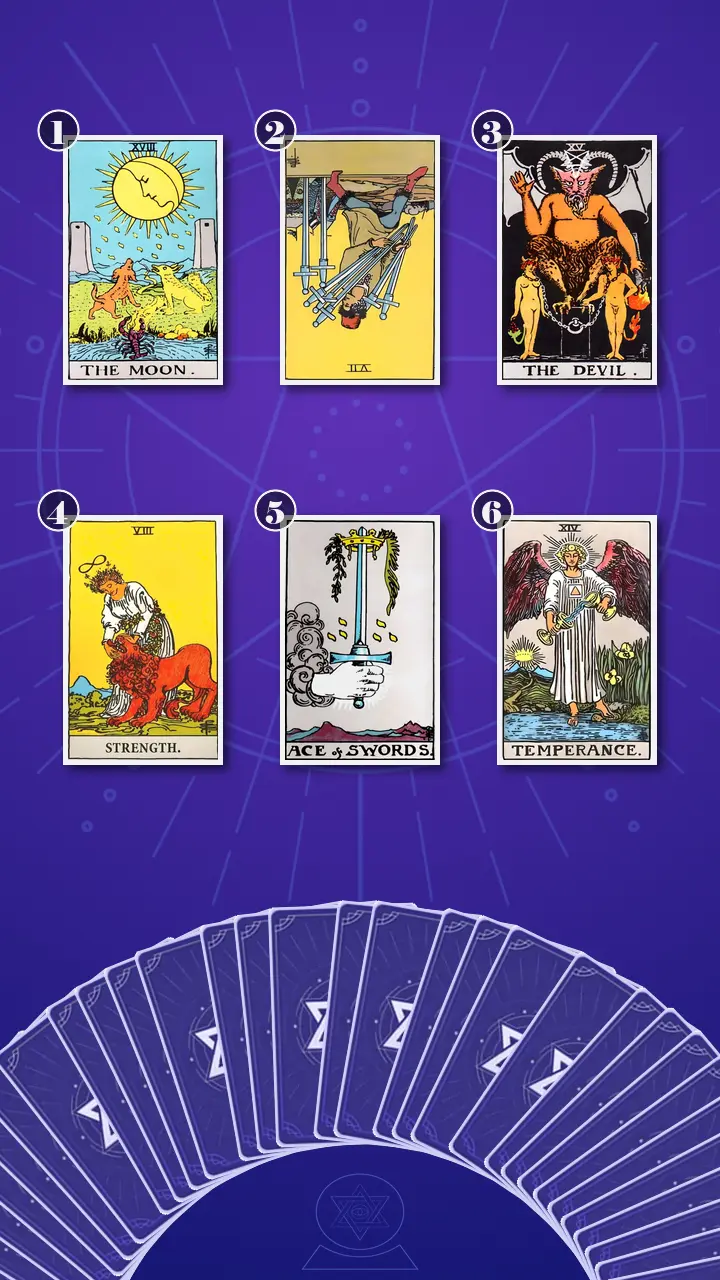
I chose the Transformation Path Grid (6) · Context Edition. For anyone wondering how tarot works when a hidden side keeps coming out in public, this spread is useful because it maps a self-reinforcing pattern rather than pretending one card can explain a whole personality. It follows the sequence of current pattern, blocking defense, repeating root, catalyst, action experiment, and integration practice.
I explained why I was not using a broad Celtic Cross or a timeline spread. Alex was not asking when something would happen or which option would guarantee belonging. They were asking why the same public mask collapse kept repeating. The six-card grid gave us the smallest structure that could show how suppression becomes pressure, how pressure becomes a public reaction, and where a deliberate interruption might begin.
I told Alex that the upper row would reveal the present pattern, the public-mask defense, and the repeating root. The lower row would then show the key catalyst, one practical communication experiment, and a sustainable form of visibility. The cards could make the loop visible; Alex would still be the person choosing what to do with that knowledge.
The Moon in the Fluorescent Light
Position 1: The Feeling That Arrives Before the Facts
Now turned over was the card representing Current pattern: the observable way the hidden side begins to feel present or takes over in public, including uncertainty and post-event shame. It was The Moon, upright.
The large Moon, the winding path between two towers, and the dog and wolf facing the same light gave me a precise image of Alex's first difficulty. Before a 9:00 a.m. presentation near Old Street, they saw a colleague's neutral expression and immediately imagined dislike. Their throat tightened, their hands became restless, and their stomach dropped before the facts had arrived. By the Tube ride home, the imagined judgment felt as real as the sharper comment they eventually made.
I read the upright Moon as an excess of uncertainty and a blockage of verification, not as proof that Alex's instincts were false. A private reaction that has not yet been understood can grow larger in the dark. The question I put beside the card was simple: which part belongs to this colleague, this meeting, and this exact sentence, and which part belongs to an old expectation of rejection?
Alex did not nod. Their breath paused, their eyes moved from the Moon to the winding path as if replaying a route, and then a dry laugh escaped from somewhere low in the chest. "That is too accurate," they said. "Almost rude." I let the laugh be useful rather than treating it as resistance. I asked what their body had known before their mind had built its explanation, and their fingers slowly loosened around the edge of the chair.
The Deleted Sentence in Slack
Position 2: The Public Mask That Calls Itself Safety
Now turned over was the card representing Blocking defense: the concrete public-mask strategy that temporarily protects Alex but contributes to the collapse through rehearsal, concealment, withdrawal, or over-explaining. It was the Seven of Swords, reversed.
The figure carrying five swords while looking back at the two left behind became Alex managing the public version of a message while leaving the original feeling unresolved. Alex wrote a Slack message with the direct sentence they actually meant, deleted it, and sent a polished version instead. In the meeting, the same feeling returned as an unusually sharp remark. That evening, they monitored the chat and drafted explanations for a comment nobody had questioned.
The reversal showed concealment turning inward: an excess of self-monitoring and a deficiency of direct, proportionate expression. The strategy gave short-term control, but it also made the unspoken reaction carry more pressure. I said, "The mask is not failing at random; it is under pressure." The grey sky and distant tents on the card seemed to hold the same unfinished quality as the unsent sentence.
I described the loop in the language Alex already knew from their Notes app: "If I stay edited, I am safe" versus "If I keep editing, the pressure has nowhere to go." Alex looked down, reached for their phone, and then stopped before unlocking it. The urge to explain themselves was visible in the small forward movement of their hand; the choice not to obey it was equally visible.
The Auto-Renewing Bargain
Position 3: The Rule Nobody Can Find in Writing
Now turned over was the card representing Repeating root: the underlying bargain, attachment, or fear that sustains the repetition compulsion and links visibility with a threat to belonging. It was The Devil, upright.
The loose chains around the two figures' necks and the shared pedestal translated into a familiar career bargain: perform agreeable safety to protect belonging, then use the resulting tension and public rupture as evidence that more control is needed. After a difficult meeting, Alex decided the only safe option was to say less, disclose nothing personal, and avoid spontaneous conversations. The rule briefly lowered the heat, but it left irritation and vulnerability with no chosen outlet. The next interruption then felt like another confirmation that the hidden side was dangerous.
Here I used my Limiting Belief Deconstruction lens. I asked Alex to audit the self-sabotage mechanism at the moment authentic expression came close to becoming visible. The belief was not simply I am too much. It was more specific: if people see the sharper or more exposed part of me, they will reject me, and that rejection will prove I do not belong. The mask offered temporary control, then charged interest through tension, shame, and the next rupture.
I also named the difference between an attachment and a destiny. The Devil's chains were loose in the image. I was not telling Alex they were permanently trapped; I was showing them the familiar arrangement that had started to feel inevitable. "The chain is a strategy you learned to trust," I said, "not a description of who you are."
Alex's breathing went shallow. First their fingers tightened around the phone, then their eyes lost focus as the late-night replay and the deleted Slack sentence seemed to overlap. Finally, they let out a long, reluctant breath and said, "If I keep editing, the pressure has nowhere to go." The room became quieter around that sentence. I could see shame beginning to separate from self-condemnation, making space for recognition.
When Strength Put a Hand on the Lion
Position 4: The Catalyst Before the Mask Breaks
The room changed when I placed the fourth card below The Moon. I slowed my hands and let the silence stay long enough for the turning point to feel different from another explanation.
Now turned over was the card representing Key catalyst: the quality that can interrupt the hidden-side takeover by helping Alex stay in contact with instinct while choosing how it is expressed publicly. It was Strength, upright, the bridge of the spread.
The woman's calm hand on the lion, the lion's open mouth, and the infinity symbol above her head gave me the alternative Alex had not been allowing themselves. During a meeting, they could notice their jaw tightening after being interrupted, take one breath, silently name the feeling, and say, "I see the issue differently." The reaction would remain real, but it would no longer have to choose the entire response.
Strength's energy was steady contact rather than domination: neither the excess of forceful suppression nor the deficiency of trust in their own regulation. I brought in my Imposter Syndrome Decoding lens here, not as a diagnosis but as a way to separate authentic potential from the fear of being found out or judged unworthy. Alex's directness, intensity, humour, and frustration were already known by trusted friends. The presence of those traits did not prove that public respect would disappear. The fear had been confusing an unedited reaction with an unmanageable identity.
I asked Alex to picture the exact scene from the aha setup: 8:47 p.m. on the Central line, their phone warm in their hand, meeting messages glowing beneath fluorescent light, and the sentence replaying after their voice sharpened. They had promised to hide that reaction, yet the promise itself was what had made it arrive with so much force.
The hidden side is not a public takeover that must be crushed; meet it with Strength's calm hand, name what it is signaling, and choose a measured expression before the mask has to break.
For a second, Alex's breathing stopped. Their eyes fixed on the lion, then lost focus as the replay moved through them: the colleague interrupting, the sharpened voice, the promise to say less. Their jaw tightened again, and a small flush rose across their face. "But doesn't that mean I was wrong before?" they asked, with more anger than relief. I let the question stand. The fingers that had been gripping the chair loosened one at a time. Alex tested a breath; it caught at the throat, returned lower in the chest, and left the shoulders a fraction closer to the chair. Their expression moved from defence to recognition, then to a wary blankness, the brief dizziness of seeing a path where the old rule had been. I said the reaction could stay present without becoming a verdict. The inner sequence was: "The reaction is here" -> "It is information, not an emergency" -> "I choose its public shape." A quiet exhale followed. I asked Alex to feel both feet, unclench the jaw by five percent, and picture saying, "I see the issue differently." The strength was small, physical, and theirs.
I then asked, "Now, with this new view, can you recall last week and find one moment when this insight might have made the next breath feel different?" Alex named the interruption without trying to rewrite the whole meeting. That was the first movement from shame-driven hypervigilant self-monitoring toward steady self-regulation and bounded truthful expression: not a transformation into a flawless public self, but a moment in which the hidden reaction became information instead of an emergency.
I wanted to make the catalyst practical. Strength was not a dramatic personality change. It was both feet under the chair, a jaw unclenched by five percent, one private word for the feeling, and one chosen sentence. It was the difference between smiling through irritation, releasing it as sarcasm, and staying in the room for one extra breath.
The Sentence That Cuts a Clean Boundary
Position 5: The Action Experiment in Plain Language
Now turned over was the card representing Action experiment: one small act of clarity, boundary-setting, or bounded honesty that Alex can try in a real public interaction this week. It was the Ace of Swords, upright.
The hand emerging from the cloud, the upright sword, and the crown pierced by its blade turned clarity into a usable communication tool. When a colleague asks for an immediate answer, Alex can say, "I need a moment to think before I respond." On another day, they can say, "I disagree with that part of the plan." They do not need to apologise, add a joke, or attach the entire private story to the sentence.
The Ace carries balanced clarity but also a warning against turning precision into another weapon against the self. Its clean edge cuts through both the edited mask and the urge to explain everything. I told Alex, "One honest sentence is different from telling everyone everything." Alex wrote one line in their Notes app, stared at it, and then turned the phone face down. For once, the sentence did not immediately become the beginning of twelve more tabs.
Two Cups, No False Binary
Position 6: The Practice of Measured Visibility
Now turned over was the card representing Integration practice: a sustainable public presence in which privacy and honesty coexist without total masking or total disclosure. It was Temperance, upright.
The angel pouring water between two cups, with one foot on land and one in water, gave us a flexible visibility setting rather than a permanent new identity. After a tense exchange, Alex could tell a colleague, "I want to come back to that point when I have thought it through," then share the fuller emotional context with a close friend later. The relevant part could be public, the deeper context could be personal, and some details could remain private.
Temperance balanced the Moon's uncertainty, Strength's embodied courage, and the Ace's precise language. Its energy was moderation through repeated adjustment, not one dramatic revelation. I said, "Privacy is not the same thing as disappearance." I asked Alex to consider which part of a reaction was relevant to this person and this setting, which part belonged with a trusted friend, and which part they wanted to keep for themselves.
Alex sat back. Their shoulders did not fully relax, but they no longer looked as if they were waiting for a final verdict. I watched them separate honesty from total disclosure and imagine the two cups as choices that could coexist in one ordinary day. The hidden side did not vanish. It gained a channel.
From Insight to Action: A Clearer Channel
When I connected the six cards, the story was coherent. The Moon showed the reaction arriving through uncertainty; the reversed Seven of Swords showed rehearsal, deletion, and self-monitoring turning inward; The Devil exposed the auto-renewing bargain that equated control with belonging. Strength supplied the interruption, the Ace of Swords supplied one clean sentence, and Temperance showed how to keep private feeling and public expression in a measured relationship.
The cognitive blind spot was not that Alex lacked enough control. It was the assumption that control was the only form of safety, and that visibility had only two settings: total masking or uncontrolled exposure. The transformation direction was from suppression and hypervigilance to compassionate self-regulation, bounded honesty, and deliberate visibility. I reminded Alex that the goal was not to make the hidden side public. It was to identify the impulse in the moment, then choose its form.
I introduced my Cognitive Reframing Protocol as the bridge from vague fear to actionable, logical risk-management data. Instead of asking whether a reaction was acceptable in the abstract, Alex could write what was felt, what was relevant, what was safe to say now, and what the evidence actually showed. The protocol did not pressure disclosure. It created enough structure to make a small choice under pressure.
The Bounded Truth Practice
- The Strength PauseBefore one low-stakes meeting or conversation this week, place both feet on the floor, notice the jaw and throat, take one measured breath, and name one feeling in the phone Notes app. Use the pause once before replying, even if the eventual sentence stays brief.Start with one breath and a word such as irritation, embarrassment, fear, or wanting to be understood. If naming the feeling feels too exposed, use a neutral delay line or choose to answer later.
- The One-Sentence What-I-Mean LineBefore one manageable workplace or social exchange in the next seven days, set a ten-minute timer and write: What I feel is ___; what I am willing to say is ___. Choose one sentence under fifteen words, such as I see it differently or I need a moment to think, and say it once without the full backstory. Afterward, record two facts about what happened and one assumption about how you were judged.This is my Cognitive Reframing Protocol in its smallest form. The first pause may feel artificial; the point is to turn fear into information, not to produce a perfect performance.
- The Privacy-Honesty SplitBefore a specific conversation, write one detail relevant to share now, one detail for a trusted friend later, and one detail you want to keep private. Share only the first category if you choose, then notice whether the smaller disclosure lets you stay present for thirty more seconds instead of withdrawing or explaining everything.Use three settings rather than a yes-or-no choice between openness and secrecy. A boundary remains valid if another person is disappointed, and privacy does not require disappearance.
I made the scale deliberately small. A successful experiment was not a perfect meeting or universal approval. It was one visible pause, one bounded truth, or one decision to keep a detail private without turning that choice into self-erasure. Alex remained the author of the public version they offered.

A Week Later, the Quiet Proof
Three days later, I received a message from Alex: "In the meeting, I said, I need a moment to think. Nobody exploded." They had slept through the night, though What if I am wrong? still arrived first at breakfast. Alex wrote the sentence in Notes and went to work.
I held on to the modesty of that update. The cards had not taken over Alex's public identity, and I had not solved their life for them. The Transformation Path Grid had made the mask-collapse cycle observable; Alex had supplied the breath, the boundary, and the next choice. That was the Journey to Clarity: not certainty, but enough steadiness to decide how to be visible.
When someone has spent the whole day keeping their throat tight, their jaw polite, and their sharper truth behind their teeth, a sudden comment can feel like proof that they are either perfectly contained or too much to belong. Alex found a third possibility: a private reaction can be noticed, named, and given a chosen channel without becoming a public performance.
If you could let one private reaction be noticed by you, without making it public or explaining it away, what small, honest sentence might you choose for the next room you enter?