The Message-Rewrite Loop Behind the Cracking Public Mask
I began by telling Jordan (name changed for privacy), "You are the early-career London communications person who can make a Slack update sound effortless, then spends the Tube ride home rewriting one sentence after a colleague asks, 'Are you okay?' That is the loop behind the fear of being seen as inconsistent."
Jordan had described the scene in their intake note and then walked me through it again. At 8:47 p.m. on the Northern line, they were scrolling through an Instagram Story of colleagues at a rooftop bar while rereading a WhatsApp reply in the warm light of their phone. The carriage smelled faintly of wet coats and metal, fluorescent lights buzzed overhead, and their shoulders rose as their jaw tightened. Three versions of the message were already in the chat; each one had removed something more human.
"What did you remove so the message could still sound like you had everything under control?" I asked.
Jordan looked down at their hands. They wanted to appear whole, composed, and publicly consistent. At the same time, they feared that a cracking public mask would expose inner conflict and make them unacceptable, unreliable, or less capable than everyone assumed. They told me, "I do not know whether I am private or just afraid of being accurately seen."
Shame moved through the room like a red notification that would not clear: hot behind the eyes, tight in the throat, impossible to swipe away. Beneath it sat exposure fear, confusion, and a quieter longing for relief. I did not treat privacy as a problem or honesty as an obligation. I said, "You are not hiding because you have no feelings; you are editing because one visible contradiction feels like evidence against your worth. We can look at that editing without judging it. Today, we are going to give this feeling a map and find a little clarity without handing your whole inner life to anyone."
A Four-Card Shadow Spread for the Narrow Hallway
I asked Jordan to place their phone face down and take three slow breaths. I shuffled the cards gradually, using the motion as a practical transition from the noisy London commute into a focused conversation, not as a test of fate.
For anyone wondering how tarot works in this kind of self-exploration, I use the cards as an objective cognitive tool. The images give a concrete structure to patterns that are often hard to name, while the querent remains the person who tests each interpretation against lived reality. The cards do not predict how a friend, colleague, or audience will react, and they do not decide what Jordan owes anyone.
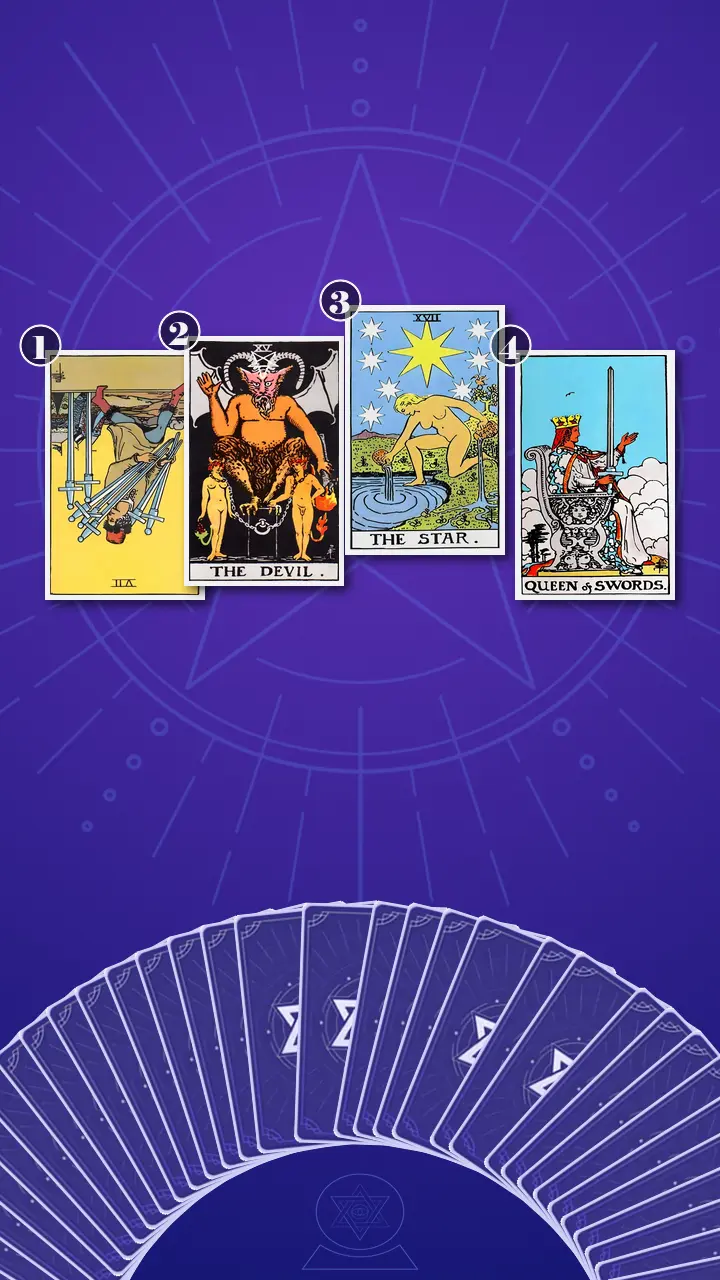
I chose The Shadow Spread, a four-card tarot spread for examining visible concealment, hidden self-worth rules, unmasked needs, and integrating boundaries. It fit because Jordan was not asking me to compare two external options or forecast a relationship. The question was inside the mask: what appears first, what keeps it in place, what honest need is waiting beneath it, and what practical boundary could let that need speak?
I explained the route. The first position, The Cracking Mask, would show the present situation and the observable public behavior that appears when selective disclosure can no longer maintain a coherent image. The second, The Hidden Contract, would uncover the shadow influence and conditional rule beneath it. The third, The Unmasked Need, would identify what wanted recognition. The fourth, The Integrating Boundary, would turn the insight into one limited, self-directed next step.
The Backward Glance in the Drafts
The Cracking Mask: Seven of Swords Reversed
Now I turned over the card representing The Cracking Mask, the position that reveals the observable public behavior when editing, joking, changing the subject, or withdrawing can no longer keep the image perfectly coherent. The card was the Seven of Swords, in reversed position.
In the Rider-Waite-Smith image, the figure looks back over one shoulder while carrying five swords and leaving two behind. I saw Jordan in that backward glance, monitoring the imagined audience while deciding which parts of the truth were safe to carry into public view. The two swords on the ground were not forbidden secrets. They were the sentence about uncertainty, the need for reassurance, and the contradiction that Jordan kept abandoning in drafts.
The modern-life version was almost literal. A candid Slack update, Instagram caption, or WhatsApp reply revealed more feeling than Jordan intended, so they looked back at the audience and started cutting. The sentence about uncertainty became a softer phrase. The need became a joke. The honest parts stayed behind in drafts. The issue was not that Jordan had to confess everything; it was that selective disclosure was protecting a polished image while leaving them alone with the original feeling.
Reversed, the Seven of Swords showed a blockage beginning to reveal itself. The editing strategy was losing efficiency: every revision lowered the immediate risk of exposure, but it also made the message less true and the next crack more frightening. I also named the overcorrection risk. Once someone notices concealment, they can swing toward sending one enormous message that exposes every contradiction at once. That is not automatically honesty. Intensity can replace discernment and leave a person feeling unprotected.
"I do this after one sentence lands too honestly," Jordan said. They gave a small, bitter laugh. "That is almost cruelly accurate." I let the laugh have its place instead of turning it into a breakthrough on demand. "Then we will not use this card to force a disclosure," I replied. "We will use it to notice the cut. A crack in the mask is not proof that you are false. It is information about what your editing reflex is trying to protect."
Jordan stopped smiling. Their thumb moved once across the edge of their phone, then went still. I asked them to remember the last message they had changed because it sounded too needy or uncertain. They named a phrase they had deleted and, for the first time, did not immediately explain why deleting it had been reasonable.
The Price of Sounding Fine
The Hidden Contract: The Devil Upright
Now I turned over the card representing The Hidden Contract, the position that uncovers the unconscious attachment and conditional rule sustaining the performance of wholeness. It was The Devil, in upright position.
I told Jordan plainly that this was not a prediction of danger and not a moral verdict. In the Rider-Waite-Smith image, the two figures are chained to a dark pedestal beneath the imposing central figure, but the chains sit loosely around their necks. The symbol points to attachment: a rule that feels compulsory even when some room for choice remains visible.
The modern scene was a London communications meeting near Old Street. Jordan could say, "I am not okay with this timeline," but the invisible contract arrived first. Respected people were easygoing. Capable people did not need reassurance. Reliable people did not show inner conflict. Composure had become the admission price for belonging, and the mask was enforcing a bargain between public consistency and self-worth.
The upright energy was an excess of authority given to that bargain. Jordan was not simply choosing a professional tone; they were paying for respect with the fatigue of maintaining an always-on social character. I call this pattern Persona Fatigue Diagnosis: I look at the psychological toll of carrying an artificial role after it has stopped being a useful tool and started demanding access before any real need can enter the room. It does not mean the persona is fake. It means the role has been asked to carry too much.
I used the language Jordan had already given me. "If I say what I actually need, then they might decide..." I prompted.
Jordan's breath stopped halfway in. Their fingers hovered above the phone as if a send button had appeared between us. Their eyes then lost focus and moved toward the window, replaying a meeting, a Slack thread, and a friend's follow-up question. Finally, the feeling broke through as a low, frustrated voice: "I only feel safe when I sound certain."
"That is the contract," I said. "It explains the pressure without becoming your identity. The chains are loose in the image, but I would never tell you to simply break them on command. First we name the rule. Then we decide, in a specific situation, whether it is protecting a boundary or erasing evidence that you are conflicted."
Jordan nodded once, though the nod carried no easy relief. They pressed their lips together, then released them. I watched the shame become more precise. It was no longer an endless verdict about being defective; it had a sentence attached to it, and sentences can be examined.
When The Star Let Two Truths Share One Sky
The Unmasked Need: The Star Upright
The room grew unusually quiet when I reached the centre-right card. Even the radiator seemed to pause between clicks. I turned over the card representing The Unmasked Need, the position that identifies the honest inner quality seeking recognition and integration. It was The Star, in upright position.
The Star's energy was hopeful openness, but not forced optimism. Its unclothed figure kneels beside the water, pouring from two vessels, one stream into the pool and one onto the land. I explained that the image did not ask Jordan to become publicly exposed. It offered a different arrangement: private feeling and public presence could share the same reality without either one becoming a performance.
The living translation was a small conversation with one trusted friend. Jordan might say, "I am still conflicted about this," and let the sentence stand. No confident conclusion would be attached to make the feeling easier for someone else. No lesson would be extracted. No post would be published for a wider audience. Not total concealment versus total exposure, but one honest sentence with the rest of the room still private.
This was where I used my signature lens, Internal Monologue Auditing. I asked Jordan to listen for the genre of the inner script rather than assuming every thought was a neutral fact. The line "If I cannot explain the contradiction perfectly, I should cover it" was being filmed as a psychological horror story: one visible feeling became evidence, the audience became a jury, and the ending was always rejection. We did not replace it with a sugary fairy tale. We checked the script. A feeling can be unfinished without being dangerous, and a pause can be information rather than proof of incapability.
The Sentence the Water Would Not Edit
At that sentence, Jordan was back on the 8:47 p.m. Northern line: phone warm in hand, WhatsApp edited three times, the needy sentence in drafts while the polished version waited. The old rule insisted an unfinished feeling had to be solved before it could be seen.
Stop treating a cracked mask as proof that you are false; like the Star's figure pouring water onto both land and pool, let inner conflict and public presence coexist while you speak one honest truth.
The sentence stayed in the air. Jordan froze first, breath caught and fingers held above the phone. Their pupils widened slightly; then their gaze went unfocused, as if a series of small edits were replaying behind their eyes. A brief flush rose across their cheeks. "But doesn't that mean I have been doing it wrong?" they asked, with irritation underneath the fear. I did not rush to turn that anger into gratitude. I said that the old strategy had once helped them manage exposure, and recognizing its cost was not a confession of failure. The radiator clicked. Jordan's shoulders lowered by a fraction, their jaw loosened, and a long breath left the body with a tremor. Their hand opened on the table. For one quiet second, the relief brought its own vulnerability, a slight dizziness at having fewer instructions. Then Jordan whispered, "I could be conflicted and still be here."
I asked, "Now, using this new perspective, revisit last week: was there a moment when this insight could have let you feel differently?"
Jordan remembered the colleague who had asked whether the timeline was realistic. They had answered, "Happy to explore options," while their stomach tightened around the concern they actually needed to raise. The memory did not become a failure montage. It became a possible rehearsal: what if I name the feeling before I make it useful?
I named the movement plainly: from shame-driven impression management and fear of public exposure toward grounded self-acceptance and clear, bounded self-expression. Wholeness is not the performance of having one feeling at a time. It is the capacity to hold contradiction with awareness, timing, and self-respect. The Star did not make a decision for Jordan. It gave the unfinished feeling enough room to become legible to its own owner.
The Sword at the Threshold
The Integrating Boundary: Queen of Swords Upright
Now I turned over the card representing The Integrating Boundary, the position for guidance and the practical next step available to the querent. It was Queen of Swords, in upright position.
The upright sword and the Queen's extended open hand gave the Star's openness a shape. This was clear perception, direct language, independence, and chosen privacy. The energy was balanced rather than excessive: enough Air to speak, enough distance to decide what remained yours, and no demand to explain the entire archive of your inner life.
I gave Jordan the sentence the card was offering: "I need time to work out how I feel, and I am not ready to discuss every detail." That wording did not return to false ease, but it did not compensate with oversharing. It was like setting a privacy filter for a clear audience. Direct does not mean public. Honest does not mean accessible to everyone. A clean boundary can hold complexity without disguising it.
Jordan considered the sentence and said, "It sounds less impressive than a perfect explanation." I smiled. "It is more accurate than one. A clear sentence can be honest and still leave the rest private. The question is not whether the mask must be smashed. The question is whether it can become an honest boundary around a complicated inner life."
The Director's Cut of a Whole Person
I laid the four cards in their shallow arc and read the sequence back to Jordan. The Seven of Swords reversed showed the old editing loop: public expressions revealed uncertainty, then the backward glance cut the need from the visible story. The Devil revealed the load-bearing belief beneath it, the hidden contract that said composure was the admission price for respect. The Star supplied the unmasked need, allowing feeling and public presence to occupy the same ground. The Queen of Swords gave that openness a threshold, so one true sentence could cross while the rest remained Jordan's.
As an artist, I know the temptation to stay in a painful scene because changing the cut can feel more frightening than repeating the take. I have sat with a rough draft long enough to confuse familiarity with truth. Looking at the cards, I thought of a film in production: a persona can be a useful scene, but it is not the whole film, and a rough cut is not evidence that the story has failed.
Jordan's cognitive blind spot was not simply that they edited too much. It was that they treated emotional consistency as evidence of worth. They confused privacy with concealment, and they treated any unscripted feeling as a reputational event. The transformation direction was therefore modest and exact: replace the performance of wholeness with one honest, bounded disclosure that allows conflicting feelings to exist without requiring an immediate explanation.
I introduced my communication practice, The Director's Cut of Self-Compassion. When the punitive inner judge begins narrating a tragedy about one awkward message, Jordan can pause the spiral, name the original line without arguing with it, and make a second cut from the voice of an objective, supportive observer. The goal is not to flatter the self or force a positive ending. It is to remove the verdict and keep the usable information.
I gave Jordan these small next steps. Each one preserved their choice of audience, timing, and privacy.
- Make one sentence visible.In one WhatsApp, Slack, or in-person conversation this week with a trusted friend or colleague, say, "I am still working out how I feel, and I do not need to present a finished answer today." Keep the exchange to two lines if that is enough.Read it once without adding a joke, apology, or explanation. You can send it, save it as a draft, or delete it; choosing the audience still counts as self-expression.
- Run the ten-minute unfinished-feeling note.On one evening, open a private notes app, set a ten-minute timer, and write three versions of the same feeling: the polished version, the overexposed version, and the one-sentence version beginning, "I am still conflicted about..."Circle the version that is honest while protecting your privacy. Leave it unsent for the rest of the evening and record what happens in your jaw, breath, eyes, and stomach. If the body response spikes, write only the feeling word.
- Name the respect admission fee.In the same private note, finish the sentence, "People will only respect me if I..." with the behaviour you perform, such as never needing help or always sounding certain. Then write, "I can be respected while taking time to work out what I mean."Use the Director's Cut: let the second line be a possibility to examine, not a belief you must adopt. Stop when the timer ends and do not force a disclosure.
A Week Later, One Sentence Crossed the Threshold
Six days later, I received a WhatsApp from Jordan: "I told Sam I was still working it out. I did not add the joke." They had slept through the night, but woke with the familiar thought, "What if I am wrong?" It stayed beside their coffee instead of taking over the morning.
That was the proof I trusted: not a repaired life, a perfect friendship, or a suddenly fearless public persona. Just one sentence that crossed the threshold while the rest of Jordan's private life remained their own. The cards had not created the change. Jordan had noticed the old contract, made room for an unfinished feeling, and chosen a boundary they could actually keep.
That is the journey to clarity as I understand it. It moves from self-monitoring and shame, through the jolt of being seen without a script, toward naming the conflict without polishing it away. The next act belongs to the person holding the pen.
When your jaw locks after one unscripted feeling slips into the room, it can feel safer to edit yourself back into consistency than risk being seen as needy or incapable. But the part you are hiding may simply be the conflict that still needs a name, and noticing it means you are no longer at the beginning.
If you could let one unfinished feeling be true without explaining it or handing over the rest of your private life, what small sentence would you keep for yourself today, letting one stream move into language while the other remains yours?

Every reading at AceTarot is a journey to connect with inner wisdom and empower the path ahead. This reading shared here is a psychological mirror, not a private record—crafted to reflect universal emotional loops and help restore personal clarity. Please note that these insights do not replace professional psychological, medical, legal, or financial advice, and should not serve as the sole basis for major life decisions.
Learn more about our Journey to Clarity.
How did this insight land for you?
🫂 This Resonates Deeply
🌀 Living This Story
✨ Now I See Clearly
🌱 Seeing New Possibilities
🧰 Useful Framework
🔮 The Confirmation I Needed
💪 Feeling Empowered
🚀 Ready for My Next Step
Author Profile
AI Juniper Wilde
1056 readings | 537 reviews
“I’ve always felt our lives are films currently in production. As an artist, I know that when you feel stuck, it’s often because you’ve bravely stayed in a painful scene for just a little too long. I’m not here to coldly analyze you. I want to sit closely with you, look at those difficult moments with profound empathy, and gently hand you the pen so you have the courage to write your next beautiful act.”
In this Introspection Tarot Reading :
Core Expertise
- Internal Monologue Auditing: Identifying the destructive 'genre' (e.g., tragedy, horror) of your subconscious thoughts that constantly induces anxiety.
- Persona Fatigue Diagnosis: Assessing the heavy psychological toll of maintaining an artificial 'social character' that conflicts with your authentic self.
Service Features
- The Director's Cut of Self-Compassion: A mental editing technique to pause a spiral of self-hatred, reframing the internal narrative from a punitive judge to an objective, supportive observer.
Also specializes in :
Explore Related Patterns:
Certainty-Gated Self-SilencingIn the meeting, you said, "Happy to explore options," while the concern you needed to raise stayed behind the polished wording. You also named the rule directly: "I only feel safe when I sound certain." That rule allows speech only after ambiguity has been removed, so silence or softened language becomes a protective gate. It hides not a lack of thought but the unfinished, reassurance-seeking, conflicted part that has not yet earned entry under your internal standard. Naming the gate lets you decide when uncertainty is private, shareable, or simply still in process.
Competence TheaterYou can make a Slack update sound effortless, then keep an always-on character running after work while rewriting a warmer, less certain reply. The performance is especially visible in the belief that capable and reliable people should not need reassurance or show conflict. Competence becomes something you stage for the imagined audience instead of one capacity you can possess while still being unsure. The role is not fake; it has simply been asked to carry your belonging and safety, which is why a small crack feels disproportionately exposing. What sits behind it is the ordinary human need to be seen without having to perform finished capability.
Emotional PerfectionismYou delete the sentence about uncertainty because you believe an unfinished contradiction must be explained perfectly before it can be seen. When the thought "If I cannot explain the contradiction perfectly, I should cover it" appears, the feeling is forced into a finished, useful form. The defense fails by making emotional clarity a precondition for honest contact, so the unresolved part is hidden and the editing never quite ends. You are not hiding because you have no coherent self; you are hiding the fact that two truths can be present before you know how to reconcile them. Letting one sentence remain unfinished interrupts the demand for a perfect inner script without requiring total exposure.
Visibility Shame LoopWhen one unscripted feeling slips into a message, you look back at the imagined audience, soften the wording, and try to restore a consistent public image. The fear is not limited to the sentence itself; it is the possibility that being accurately seen will expose you as unreliable, needy, or less capable. Because the revision briefly quiets that fear, it reinforces the next round of monitoring. The same loop turns visibility into shame and shame into more concealment, even though the later message to Sam shows that a bounded disclosure can cross the threshold without surrendering your private life. You are hiding the vulnerable uncertainty that the shame loop keeps treating as evidence against you.
Conditional Self-WorthYou fear that a visible contradiction would make you unacceptable, unreliable, or less capable than others assume, and the story makes composure the admission price for belonging. The same bargain treats emotional consistency as evidence of value. That is how a communication choice becomes a worth test. A sentence is no longer just a sentence; it becomes evidence for or against your right to be respected. Maintaining certainty protects status in the short term, but makes ordinary ambivalence feel like a threat to identity. What sits behind the mask is the belief that you must sound composed to remain worthy of regard.
Emotional Self-CensorshipAfter one WhatsApp sentence sounded too honest, you reread it on the Northern line, created three versions, and removed the uncertainty and need. When a colleague later asked whether the timeline was realistic, you answered smoothly while your stomach tightened, showing the same exposure check moving from a private draft into a live conversation. The edit lowers risk for a moment, but it also leaves the original feeling unresolved, so the next unscripted glimpse feels more dangerous. Shame turns a small disclosure into a verdict about your worth and keeps you in a loop of monitoring, cutting, and temporary relief. The crack is useful information about that loop, not proof that your public self is false.
Explore Related Struggles:
Performance-Worth FusionJordan describes a strict social rule in which respected people stay easygoing, capable people do not need reassurance, and reliable people do not show inner conflict. That rule turns a professional tone into more than a communication choice because every unscripted feeling can now be counted as evidence for or against the whole person. When your worth depends on performing composure, uncertainty cannot remain a temporary state; it becomes a threat to your place in the room. You may be hiding a need for reassurance, a realistic objection, or the fact that two responses coexist because the performance has been assigned the job of proving your value. Performance-Worth Fusion makes that bargain visible so capability no longer has to mean appearing internally uncomplicated at every moment.
Self-Editing ExhaustionJordan rereads the WhatsApp reply on the Northern line and produces three versions, each one less human than the last. The revisions lower the immediate chance of being seen as needy or uncertain, but they do not settle the original feeling; they transfer it into another draft, another commute, and another round of audience monitoring. When you repeatedly edit yourself back into composure, the hidden material is not necessarily a secret you owe anyone. It may be the unfinished concern, request for reassurance, or contradiction that the polished message cannot carry. Self-Editing Exhaustion names the locked exchange in which every correction buys a brief sense of control while increasing the work required to keep your public voice separate from what you actually need to say.
Visibility-Safety SplitA candid sentence appears in Jordan's Slack or WhatsApp message, and the backward glance begins almost immediately. The uncertainty is softened, the need becomes a joke, or the entire line is returned to drafts because accurate visibility and personal safety have started pulling in opposite directions. When you expect one visible contradiction to alter how others judge your reliability, being understood can feel as risky as being misread. What remains hidden is often the part of you that has not reached a confident conclusion but still wants recognition. Visibility-Safety Split captures the difficulty of letting that part become legible while preserving your right to choose the audience, timing, and limits of disclosure.
Wholeness Performance TrapJordan can make a Slack update sound effortless and then spend the journey home removing every sign that the person behind it is conflicted. Jokes, softened phrases, and withdrawals keep the public image coherent, while the concern that initiated the message remains in the body and in the drafts. When the mask is required to show only one feeling at a time, a crack can seem to discredit the entire presentation. You are then forced to maintain the appearance of wholeness by excluding ordinary uncertainty from the definition of who you are. Wholeness Performance Trap names the locked structure in which the effort to appear complete keeps your actual complexity from being included in your public presence.
Completion-Exposure BindJordan deletes the phrase that sounds too needy or uncertain and reaches for a complete explanation of why the deletion was reasonable. The message is allowed to become visible only after the feeling has been polished into something settled, useful, and difficult to challenge. When you believe a contradiction must be solved before it can be spoken, the parts most likely to stay hidden are the ones still changing shape. A concern without a recommendation, a need without a justification, or a feeling without a final meaning cannot pass the test. Completion-Exposure Bind identifies the impossible requirement to finish your inner process before anyone can witness even a carefully limited part of it.
Vulnerability Containment StrainJordan asks whether they are genuinely private or simply afraid of being accurately seen, then later tells Sam they are still working it out without adding the usual joke. Only one sentence crosses the threshold, and the rest of Jordan's inner life remains private by choice. When concealment and total exposure appear to be the only options, even a small disclosure can feel as though it will remove every boundary at once. You may hide an unfinished need because you have not yet found a container that protects both honesty and consent. Vulnerability Containment Strain describes the effort to let something real be witnessed without making your full interior available to everyone who can see the public version of you.
Explore Related Emotions:
Conditional Belonging FearIn the imagined Old Street meeting, Jordan could say that the timeline is unrealistic, but an internal contract speaks first: respected people are easygoing, capable people do not need reassurance, and reliable people do not show conflict. Composure therefore becomes an admission fee rather than a flexible professional choice. When belonging appears conditional on maintaining one socially acceptable version of yourself, every contradiction carries the possibility of relational exclusion. Conditional Belonging Fear names the apprehension beneath the mask: you may still be welcomed while performing certainty, but you cannot yet trust that the conflicted person underneath would receive the same place.
Exposure ShameAt 8:47 p.m. on the Northern line, Jordan rereads a WhatsApp reply while their shoulders rise and their jaw tightens. Three versions are already in the chat, each containing less of the person who first wrote the sentence. A colleague's ordinary question has turned visibility into an imagined public hearing, where one contradiction appears capable of disproving the entire composed identity. When being accurately seen feels like being caught in a disqualifying inconsistency, you do not merely protect information; you brace against a verdict about your worth. Exposure Shame names the heat behind the eyes and tightness in the throat that arrive when a private conflict crosses into view before it has been made polished, coherent, or defensible.
Need Exposure DreadJordan removes the sentence that asks for reassurance, softens the uncertainty, and turns the remaining need into a joke. The message still reaches another person, but the part that could actually receive care is left behind in the drafts. This keeps the public interaction manageable while making need itself feel like dangerous evidence. You may experience an unfinished request as more exposing than the feeling that created it. Need Exposure Dread captures the moment when wanting support seems capable of making you look incapable, unreliable, or too much, so anticipation closes the channel before anyone has the opportunity to respond.
Clarity ReliefJordan names the phrase they deleted and does not immediately defend the decision to remove it. Later, the diffuse verdict about being defective becomes a specific sentence: 'I only feel safe when I sound certain.' What had filled the whole room now has a discernible shape, a context, and a rule that can be tested. Clarity Relief is the release that comes when an engulfing reaction becomes precise enough to examine. You are no longer required to argue with your entire identity; you can identify the link between composure and worth, notice when that link activates, and decide what information it contains without automatically obeying its verdict.
Cautious Self-RespectJordan considers the sentence, 'I need time to work out how I feel, and I am not ready to discuss every detail.' It is less impressive than a perfect explanation, but it is more accurate. The wording neither restores false ease nor compensates with unrestricted disclosure; it gives uncertainty a voice and privacy a clear edge. Cautious Self-Respect emerges when you stop treating access to your inner life as the price of honesty. You can acknowledge what is true, limit what is shared, and choose who receives it. The resulting steadiness is modest rather than triumphant, built through a boundary that protects complexity without erasing it.
Cautious VulnerabilitySix days later, Jordan tells Sam, 'I was still working it out,' and does not add the joke. Only one sentence crosses the threshold; the rest of Jordan's inner life remains private. The act is small enough to preserve choice while still allowing another person to encounter something unfinished and real. Cautious Vulnerability is the tender exposure created by letting yourself be partially known without surrendering control of the whole story. You can choose the audience, timing, and depth, allowing openness to become a measured form of contact rather than an all-or-nothing demand for concealment or total disclosure.
Inner ClaustrophobiaThe imagined audience follows Jordan out of work, onto the Northern line, through Instagram Stories, and into the private WhatsApp draft. Even before a sentence is sent, it is evaluated from the viewpoints of colleagues, friends, and the capable public persona. The inner room narrows until certainty appears to be the only state with enough space to stand upright. Inner Claustrophobia describes what it is like when no unfinished feeling seems fully private, because every internal contradiction is immediately assessed for social consequences. You may hide irritation, need, and uncertainty because your inner life has become crowded with anticipated reactions, leaving little room to discover what you feel before deciding how it should appear.
Polished AlienationThree polished WhatsApp versions reach the chat while the original uncertainty remains with Jordan on the Tube. The same split appears in the meeting response, where 'Happy to explore options' travels outward and the concern stays tightened in the stomach. Communication continues, but contact with the unedited experience does not. Polished Alienation is the distance created when your socially fluent version is highly visible while the feeling that needed recognition remains unrepresented. You can appear connected, responsive, and competent and still feel strangely absent from your own interactions because nobody, including you in the moment, is allowed to meet the original line.
Grounded AcceptanceWhen Jordan says, 'I could be conflicted and still be here,' their shoulders lower, their jaw loosens, and a long breath leaves with a tremor. The contradiction has not been solved, but it is no longer treated as evidence that Jordan must disappear, explain everything, or repair the public image immediately. Grounded Acceptance is the steadying experience of remaining present while more than one truth exists. You do not have to approve of every feeling or turn uncertainty into confidence; you allow the unfinished state to occupy its actual size, with enough structure around it that it no longer becomes a verdict on the whole self.
Explore Related Contexts:
Conditional Belonging PressureIn the Old Street meeting Jordan could have said that the timeline was not workable, but the rule governing the interaction arrived first. Respected people were supposed to be easygoing, capable people were not supposed to need reassurance, and reliable people were not supposed to show conflict. Conditional Belonging Pressure describes a social landscape in which access to credibility appears tied to performing a narrow version of composure. You encounter the pressure when a normal request for time, clarification, or support seems capable of changing how others rank your competence. That makes public consistency function like an admission fee rather than a communication preference, and it pushes unresolved information out of the exchange before anyone can respond to it. Mapping the condition gives you a more precise choice: you can examine which audience has actually earned access, what the situation genuinely requires, and whether the assumed price of belonging has ever been made explicit.
Public Mask CollapseAt 8:47 p.m. on the Northern line, Jordan has already produced three versions of a WhatsApp reply after a colleague asks whether they are okay. Each version removes more uncertainty, need, and contradiction, yet the editing no longer restores a reliably seamless image. Public Mask Collapse names this point where a carefully maintained persona starts revealing its construction through repeated corrections, visible hesitation, and increasingly costly attempts to sound consistent. You may recognize this stage when an ordinary unscripted sentence begins to carry the weight of a reputational event. The structural issue is not that privacy has failed or that everything must be disclosed. It is that the existing method of preserving public credibility now requires so much monitoring that every small inconsistency produces another round of repair. Seeing that mechanism clearly lets you separate a manageable moment of visibility from the larger assumption that your entire social position is coming apart.
Public Mask MaintenanceThree versions of Jordan's message sit in the chat, and each one has removed something more human. The same labor appears in Slack updates, WhatsApp replies, meeting language, and the habit of turning a need into a joke. Public Mask Maintenance captures the externally visible workload of keeping one composed and professionally credible identity consistent across multiple audiences and communication channels. You are not simply choosing words carefully in this context. Your off-hours attention becomes an extension of public image management, with commuting time used to repair any sentence that sounds unfinished, needy, or conflicted. The practical leverage begins with identifying where appropriate professional editing ends and unpaid persona maintenance begins, because that boundary shows which parts of the performance are useful and which parts are consuming resources without improving the actual exchange.