From Dating-App Decision Paralysis to a Boundary You Can Own at Work
The 6:18 Streetcar Loop: Finding Clarity in Coworker Dating-App Decision Paralysis
'You are a late-twenties city professional who can coordinate five moving workstreams, yet one coworker match has you typing Hey, deleting it, and calling the loop dating-app decision paralysis,' I said. Jordan sat across from me with their phone face down beside a mug of tea, as though the screen might restart the whole argument by itself.
Jordan had described the scene from the night before at 6:18 p.m. on the crowded 504 King streetcar. One hand had gripped a cold metal pole while the other held a phone warmed by constant use. Wet coats smelled faintly of rain, the brakes squealed at the next stop, and Jordan typed Hey, funny seeing you here before deleting it. Their chest tightened. Their thumb froze over Unmatch.
'A message feels too forward, but unmatching feels too final,' Jordan told me. 'Doing nothing is somehow becoming the loudest option. I keep telling myself I will decide after the next normal work interaction, but then every normal interaction becomes another thing to analyze.'
I heard the core contradiction clearly: Jordan wanted to break the coworker-match limbo by messaging or unmatching, yet hesitated to make either move. The apprehension had become an algorithm trained only on worst-case office scenarios. Every neutral greeting was recommended as evidence; every two-second app choice was treated like a company announcement requiring legal review.
I rested my hands on the table and met Jordan's eyes. 'I am not here to tell you what the coworker thinks, and I am not going to turn either button into a moral test. We can use the cards as an objective cognitive tool, a way to separate what is observable from what your mind is rehearsing. Let us look closely at the difficult scene, then hand the pen back to you. Our shared task is simple: we will draw a map through the fog and see what kind of boundary you can actually live with.'
A Compass for the Work-and-Dating Overlap
I asked Jordan to place both feet on the floor, take one unhurried breath, and name the question without trying to solve it. I shuffled slowly while they listened to the cards move, using the small ritual as a psychological transition from the workday's noise into deliberate attention, not as a promise of supernatural certainty.
'Today I am using the Relationship Spread · Context Edition,' I explained. 'For anyone wondering how tarot works in a situation like this, the cards do not give me access to another person's private thoughts. They organize attention. They give us a sequence of useful questions so the facts, projections, values, and boundaries do not all arrive as one undifferentiated alarm.'
This five-card relationship tarot reading fit because the question contained two visible actions but a deeper relational overlap. A decision spread could compare messaging and unmatching, but it would not fully examine how one person occupying both the work and dating contexts changes the emotional field. A Celtic Cross would add more layers than this focused question needs. This contextual relationship spread is the smallest structure that can move from Jordan's observable stalemate, through the perceived coworker factor and the shared dynamic, into the no-win belief beneath it and finally toward a self-directed boundary.
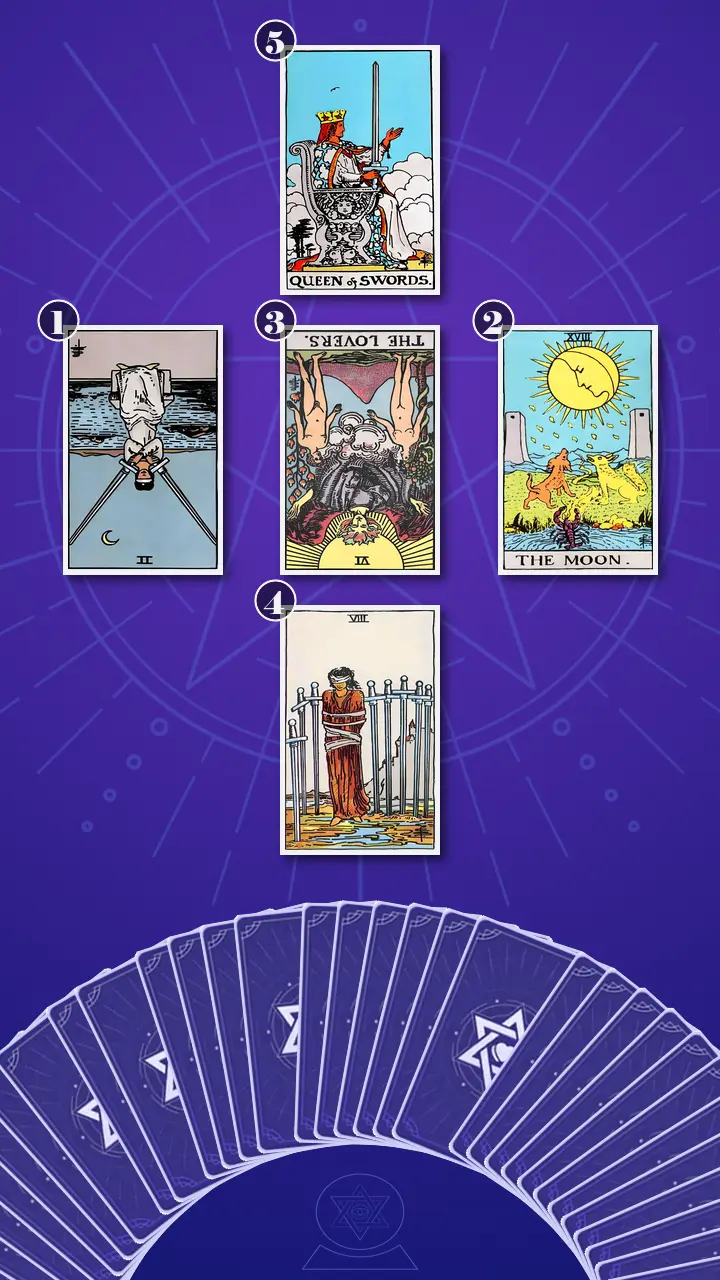
I placed the center card first, then set one card to its left and one to its right. A fourth card rested below the center, with the fifth above it. The first would show the present symptom; the second would examine the coworker factor as Jordan perceived it without claiming to know the coworker's mind; the center would reveal the work-and-dating field; the lower card would name the blockage; and the upper card would offer an integrating perspective rather than a guaranteed outcome.
Reading the Map: When Neutral Moments Become Evidence
I began at the left side of the cross. I wanted Jordan to see the movement of their own attention before we discussed what any other person might feel. The first card would keep us close to the actual behavior: the phone, the draft, the profile, the hovering thumb, and the withdrawal.
Position 1: The Thumb Between Two Blades
Now I turn over the card for the present symptom: Jordan's repeated drafting, hovering, checking, and withdrawal without either messaging or unmatching.
The card is the Two of Swords, in reversed position.
The image gave us an almost exact modern translation. On the 504 King streetcar after work, Jordan types a neutral greeting, deletes it, rereads the profile, moves toward Unmatch, and locks the phone. In the Two of Swords reversed, both options remain available, but every argument for one instantly produces an argument against it. Checking the profile becomes a substitute for choosing, and keeping both options technically open starts draining the attention that Jordan hoped to protect.
In this reversed position, the sword energy is blocked and excessive at the same time: excessive mental motion, deficient completion. The blindfold is not proof that Jordan has no information. It represents the demand to decide without any uncertainty at all. The crossed swords mirror Message and Unmatch, two defended positions held so evenly that neither can move. The still water behind the figure reflects emotion being contained rather than processed.
I voiced the loop as I saw it. 'If I message, then I make Monday awkward; but if I unmatch, then I look like I am making a pointed judgment. If I wait, I keep my options open; but if I wait, I keep checking the same profile.' The clauses cancelled each other out until silence looked like the only neutral position.
Jordan gave a short, bitter laugh and exhaled sharply. 'That is so accurate it feels a little rude.'
'The card is describing a strategy, not judging you,' I said. 'It is a strategy that gives you a few seconds of relief every time you close the app, then sends the question back with more volume. Doing nothing is not staying neutral when you have to keep checking that nothing has changed.'
Jordan's thumb moved away from the phone. Their shoulders did not relax yet, but their gaze became steadier. The first recognition was not a dramatic revelation. It was the quieter realization that the visible problem was a repeated decision loop, not a lack of available options.
Position 2: The Moonlight Around an Ordinary Morning
Now I turn over the card for the coworker factor as Jordan currently perceives it, including the unknowns and projected workplace consequences. I made the limit explicit: this position examines Jordan's perception; it does not claim access to the coworker's private thoughts.
The card is The Moon, upright.
The next morning, at 9:07 a.m. in the office kitchen, the espresso machine hisses while the coworker says an ordinary Morning and reaches for a mug. Jordan feels the cold edge of the counter beneath one palm and notices a quick drop in their stomach. On the walk back to their desk, that one greeting becomes material for several incompatible stories. They said Morning, so maybe they saw the match and are pretending nothing happened. Maybe they are interested and trying to make it easy. Maybe the greeting meant absolutely nothing.
The Moon shows uncertainty and projection, but not hidden knowledge. Its upright energy is a kind of partial visibility: enough light to keep moving, not enough light to prove what waits around every bend. The winding path between the towers resembles the limited facts Jordan actually has. The dog and wolf mirror the alternating impulses to approach and withdraw. The darker water beneath the scene suggests vulnerability rising into awareness, not danger approaching from outside.
'A prediction can feel urgent without becoming a fact,' I said. 'The coworker said Morning. That is the known event. The warmth, the performance, the judgment, or the secret message inside the tone are interpretations. They may feel compelling, but they are not confirmed by the greeting itself.'
Jordan paused with their fingers resting against the tea mug. Their eyes moved toward the window, where rain blurred the buildings into low-resolution shapes. 'The only thing I can prove is the word Morning,' they said. 'I keep increasing the contrast on a blurry screenshot until the compression artifacts look like facts.'
I nodded. 'That is caution trying to become certainty-seeking. We can respect the caution without letting it impersonate evidence. The useful question is not what the coworker secretly means. It is which workplace moments you have been using as clues, and what part of your interpretation cannot actually be confirmed.'
Position 3: When Work and Dating Share a Calendar
Now I turn over the card for the relational field created by the same person occupying both coworker and dating-app-match roles, and for the value conflict this overlap activates.
The card is The Lovers, in reversed position.
Its modern-life scene was immediate. Jordan sees the coworker's name in a team meeting invite and later in the dating app, as if one calendar event has been layered into both Work and Dating categories. Keeping the match open seems to preserve romantic possibility, professional normality, and protection from rejection all at once. Yet the unresolved choice aligns with none of those values in practice; it keeps pulling Jordan's attention back to the overlap.
The Lovers reversed does not pronounce a verdict on dating a coworker. It shows misalignment between what Jordan wants to protect and what indefinite non-choice is actually doing. Romantic openness, professional containment, and freedom from vulnerability cannot all be preserved symbolically forever without one of them becoming strained. The energy is blocked at the level of values: Jordan has been trying to make the action mean nothing, while also hoping it will reveal everything.
I thought of the television series Severance, where the work-self and private-self are separated by an almost impossible boundary. Real life is less tidy. The same name can appear in a meeting grid, a Slack thread, and a dating app without any of those contexts becoming fully controllable. That does not mean the contexts have to merge. It means Jordan gets to choose the rule that keeps them appropriately apart.
'I want to stay open, and I want work to stay uncomplicated, and I do not want either choice to define me,' Jordan said. 'I want clarity without having to create the moment that gives me clarity.'
I watched their fingers tighten around the mug and then release it. 'The match is asking for less mind-reading and more boundary-reading,' I said. 'The question is shifting from What does this person mean? to Which value do I want my next action to express?'
Position 4: The Office-Sized Fence of Imagined Consequences
Now I turn over the card for the mechanism beneath the stalemate: Jordan's belief that both visible choices carry uncontrollable consequences and that inaction is the only containable option.
The card is the Eight of Swords, upright.
At 11:42 p.m., Jordan reopens the profile in bed. Blue light catches the edge of the duvet; street noise rises through the apartment window; the phone's glow makes the room feel smaller. They mentally populate the next month with an uncomfortable elevator ride, a changed meeting tone, a colleague noticing something, a Slack reaction that suddenly sounds loaded, or the coworker silently judging an unmatch. The immediate reality is one screen and two possible actions, but the imagined office has become an incomplete sword fence that feels solid.
The Eight of Swords is the energy of perceived restriction and narrowed perspective. The bindings are loose, and the sword enclosure has visible gaps, but the blindfold makes those openings difficult to trust. In Jordan's case, predicted reactions have hardened into barriers. Messaging and unmatching are treated as routes to consequences that cannot be contained, so delay appears safer even while the unresolved match becomes more mentally visible.
I use a diagnostic lens I call Safe-Choice Sabotage Recognition. It helps me notice when the seemingly logical option, waiting for a calmer day with more information and zero awkwardness, is actually a defense mechanism against the necessary inciting incident of making one bounded choice. I do not use the word sabotage to blame Jordan. I use it to make the protective pattern visible enough to renegotiate.
'If I do A, they might react like this. If I do B, they might react like that,' I said, writing each ending down. 'Now let us label them accurately. These are forecasts, not facts. You are not trapped between two buttons; you are trapped inside the demand that one button must be consequence-free.'
Jordan's chest tightened first. Their breath paused, and their thumb hovered above the phone even though the app was closed. Then their gaze went unfocused, as if the office kitchen, the meeting grid, the elevator, and the bed were being replayed in a silent loop. Finally, a long breath moved through their ribs. Their jaw loosened by a fraction, and they whispered, 'Oh. The fence is partly made of things I have not observed.'
'Exactly,' I said. 'That does not make every action easy or every outcome harmless. It gives you a more honest map. A reporting relationship, a workplace policy, or a prior interaction that made you uncomfortable would be a real boundary fact. An imagined tone in next month's elevator is information about what you fear, not a fixed barrier.'
When the Queen of Swords Cut Through the Office Fog
Position 5: The Boundary I Can Carry into Monday
The room became unusually quiet when I reached for the card above the center. Rain moved softly against my window, and a streetcar bell sounded several blocks away. I turned over the card for the integration point: a self-directed boundary or concise communication choice Jordan could enact without requiring certainty about the coworker's reaction.
The card is the Queen of Swords, upright.
The Queen of Swords tarot meaning in this context is clear discernment, truthful communication, emotional self-possession, and a boundary that is firm without being needlessly harsh. Her single upright sword does not cut another person down. It separates known facts from projected outcomes. Her open hand allows communication without pursuit, performance, or grasping. The moving clouds suggest that thoughts can be observed and sorted rather than obeyed.
This is not a command to message. It is not a command to unmatch. It is the first card in the spread that turns thought into a usable criterion. Jordan can ask: Could I own this action without explaining it at work, chasing a response, or monitoring the coworker's interpretation? If the answer is no, the boundary needs adjusting before the button is pressed.
At this point I brought in my signature skill, Narrative Fork Analysis. I laid the choices out as competing plotlines rather than as moral verdicts. The message plotline could contain brief, direct curiosity and a clear work boundary. The unmatch plotline could contain privacy, closure, and an uncomplicated professional surface. The limbo plotline could preserve possibility for another evening, but it also keeps spending Jordan's attention and postpones the scene in which their values become visible through conduct.
I was not trying to predict which plotline would produce romance, approval, or zero awkwardness. I was asking which one genuinely serves Jordan's ultimate character growth arc: becoming someone who can choose a proportionate boundary under uncertainty and return to ordinary life. The Queen does not become the author of Jordan's story. She gives Jordan one clean line of discernment, and Jordan decides whether to write it.
Then I gave the insight its simplest form. At 6:18 p.m. on the streetcar, your phone is warm, your thumb is frozen between the message box and Unmatch, and the ordinary workday you just left is suddenly being rewritten as evidence for every possible outcome. I could hear the cost of asking a dating app to guarantee a future it cannot know.
You do not need a perfect forecast of their reaction. You need one boundary you can own before, during, and after the choice.
I let the sentence settle between us. Then I placed my finger beside the Queen's upright sword and sharpened the card's central instruction.
Stop treating perfect certainty as the price of action; choose the clean boundary you can own, and let the Queen's upright sword separate known facts from imagined outcomes.
Jordan's face went still. For one beat, their breath stopped; their phone remained suspended above the table, and their fingers tightened around its edge. Then their eyes lost focus, replaying the streetcar, the kitchen greeting, and the imaginary Monday elevator. A faint crease formed between their brows, and their lips parted without sound. 'But if I choose,' they said, 'does that mean I was wrong to wait?' I shook my head. 'No. It means waiting was a strategy that bought you ten seconds of relief. You can retire a strategy without condemning the person who needed it.' Their shoulders lowered slowly. The fist at their knee opened. A small, shaky oh rose from the centre of their chest; their eyes shone, not with a promise that everything would be easy, but with the shock of having less to solve. For a moment, the new clarity made them slightly dizzy. 'Now,' I said, 'use this view to remember last week. Was there a moment when separating a known fact from a predicted reaction might have let you feel even slightly different?'
Once Jordan's breathing steadied, I asked them to set a seven-minute timer and divide a note into three lines: Known Fact, Predicted Reaction, My Boundary. They were not required to message or unmatch during that exercise. I asked them to circle only the boundary they could still respect during the next workday, and to reduce the exercise to one confirmed fact if three lines felt too exposing.
Jordan turned the phone face down, opened Notes, and wrote: 'At work, I want to protect privacy, professional ease, and my ability to say hello without making the app part of the room.' They set a calendar reminder for a decision point within 48 hours. The movement was intentionally unglamorous: not a dramatic declaration, just one sentence and a limit on further research.
I watched the shift take shape. Jordan was moving from apprehensive scenario rehearsal and certainty-seeking toward calm, values-based boundary ownership. The relief was real, but so was the brief blankness that followed. Once the mind is no longer assigned to monitor every possible reaction, it can feel strangely empty. That empty space was not failure. It was room for a chosen next act.
The Clean Boundary, Not the Perfect Forecast
When I gathered the five cards into one story, the pattern was direct. Jordan's wish to preserve openness and professional composure had created the original tension. The reversed Two of Swords showed the visible draft-delete-check loop. The Moon showed how limited workplace facts were being enlarged into incompatible stories. The Lovers reversed showed that trying to preserve every value through indefinite non-choice had itself become a choice. The Eight of Swords revealed the no-win belief underneath it. The Queen of Swords supplied the missing structure: one boundary, stated plainly, followed by one proportionate action.
I told Jordan that the match had not become significant because the available facts justified a huge conclusion. It had become significant because an ordinary ambiguity crossed a boundary Jordan had not yet named. Holding two elevator buttons without pressing either one kept the lift stationary while making the decision feel more urgent each time Jordan looked at the panel.
The cognitive blind spot was treating temporary relief as evidence that postponement was the safest boundary. The deeper issue was not a shortage of clever messages or clues hidden in the coworker's profile. It was the belief that one action must be completely safe before it could be taken. The transformation direction was therefore practical: move from rehearsing every possible outcome to using one written boundary criterion and a 48-hour decision window for a clear, proportionate action.
'You do not need to decide what this means for the coworker,' I said. 'You need to decide what your own conduct will mean to you. If there is a reporting relationship, an actual workplace restriction, or a prior interaction that made you feel unsafe, that fact changes the boundary. No tarot reading overrides it. Otherwise, we can test both options against the same standard instead of inventing a separate emergency for each one.'
The Fact-or-Forecast Split and the Protagonist Pivot
I gave Jordan three small next steps. They were designed to supply the fire and earth missing from a spread dominated by air: a time limit, a physical action, and a definition of done.
- The Fact-or-Forecast SplitTonight, open Notes, set a seven-minute timer, and make two headings: Known Facts and Predicted Reactions. Write no more than three items under each. Include only concrete information such as the existing match, the shared workplace, any reporting relationship, a relevant written policy, or a prior interaction that caused discomfort. Put attraction, offense, judgment, and imagined future awkwardness under predictions unless they are directly confirmed.Cap the exercise at three facts and three forecasts. When the timer ends, close the app for the rest of the evening; do not turn the note into another research project.
- The Work-Safe Scope CheckDuring one private lunch break this week, complete the sentence At work, I want to protect... Then test both messaging and unmatching against one question: Could I own this action without chasing, explaining, or monitoring the coworker's reaction during the next team meeting? Add one scope limit, such as no work-channel flirting, no colleague debrief, and no follow-up unless interest is clearly reciprocated.Do not write a criterion that guarantees zero awkwardness. The minimum version is five minutes and one line beginning At work, I want to protect. A reporting relationship, policy restriction, or personal unsafety is a reason to choose closure or seek appropriate workplace guidance, not a challenge to push through.
- The Protagonist Pivot ActionUse my Protagonist Pivot Action as a 24-hour creative mandate: within the next day, take one micro-action aligned with the most daunting but authentic plotline. Either write and edit a two-sentence dating-app message once, or prepare the clean unmatch route. Then place a private ten-minute Match Boundary Decision block no later than 48 hours after the original note. At that block, send the concise message only if it fits the boundary, or unmatch once if closure fits better. Keep the action in the dating app, never a work channel.After the chosen action, use a 24-hour no-checking boundary and redirect the next ten minutes into something physical, such as making tea, taking a short walk, or packing tomorrow's lunch. The body needs an ending as much as the mind does.
This was actionable advice, not a dare. The purpose of the 48-hour match decision window was to prevent an anxiety spike from becoming the decision-maker while also preventing indefinite delay from posing as neutrality. The purpose of the two-sentence limit was to keep a message proportionate. The purpose of the unmatch option was to make clear that closure requires no explanatory performance.
This is what I mean by a Relationship Spread · Context Edition for coworker dating-app boundary decisions. It is a reflective tool for putting card meanings in context, separating a known workplace fact from a projected reaction, and finding clarity that can survive contact with the next ordinary workday. It does not predict the coworker's feelings or remove the possibility of discomfort. It helps return the decision to the person who has to live their values after the reading: Jordan.

A Small Choice, and the Quiet Proof of Ownership
Three days later, Jordan sent me a message: 'I used the boundary, not the imagined reaction. I unmatched.' I read it twice, noticing the plainness of the sentence. The cards had not selected that route. Jordan had decided that protecting privacy and keeping work ordinary mattered more than preserving a possibility they were not prepared to explore.
On Friday, Jordan completed the unmatch during the calendar block, closed the app, and sat alone in a cafe while coffee cooled. The action was clean; they stared at the empty match list for three minutes, lighter and a little wistful about a possibility that had never become a relationship.
At the next Monday stand-up, the coworker said an ordinary Morning. Jordan said it back. I was told that their chest still gave one brief warning squeeze, but this time they did not search the coworker's face, open the profile, or rewrite the greeting on the walk to their desk. The uncertainty had not vanished. It had stopped running the meeting.
That was the first evidence of the emotional transformation: not a solved love life, not a guarantee that every future choice would feel easy, but a movement from apprehensive scenario rehearsal to quiet self-trust. Jordan had chosen a proportionate boundary, enacted it, and returned attention to the rest of their life. The protagonist had not been rescued from the scene. They had taken back the pen.
When your breath catches and your thumb freezes over a two-second choice, I do not hear proof that you are incapable of choosing. I hear the effort to protect both your curiosity and your professional composure from a reaction you cannot control. Seeing that effort without shaming it may be the first clean fact on your side of the table.
If you trusted one clear boundary more than a perfect forecast, what might the smallest clean choice look like for you: the one sentence that keeps work at work, the brief message with an honest exit, the closed match, or a 24-hour Protagonist Pivot Action you could still stand behind at tomorrow's meeting?