When Every Meaningful Path Costs Something

A grounded look at competing mission-led roles, related tarot cards, and tarot reading insights drawn from past sessions.

Mission-driven Career Crossroads
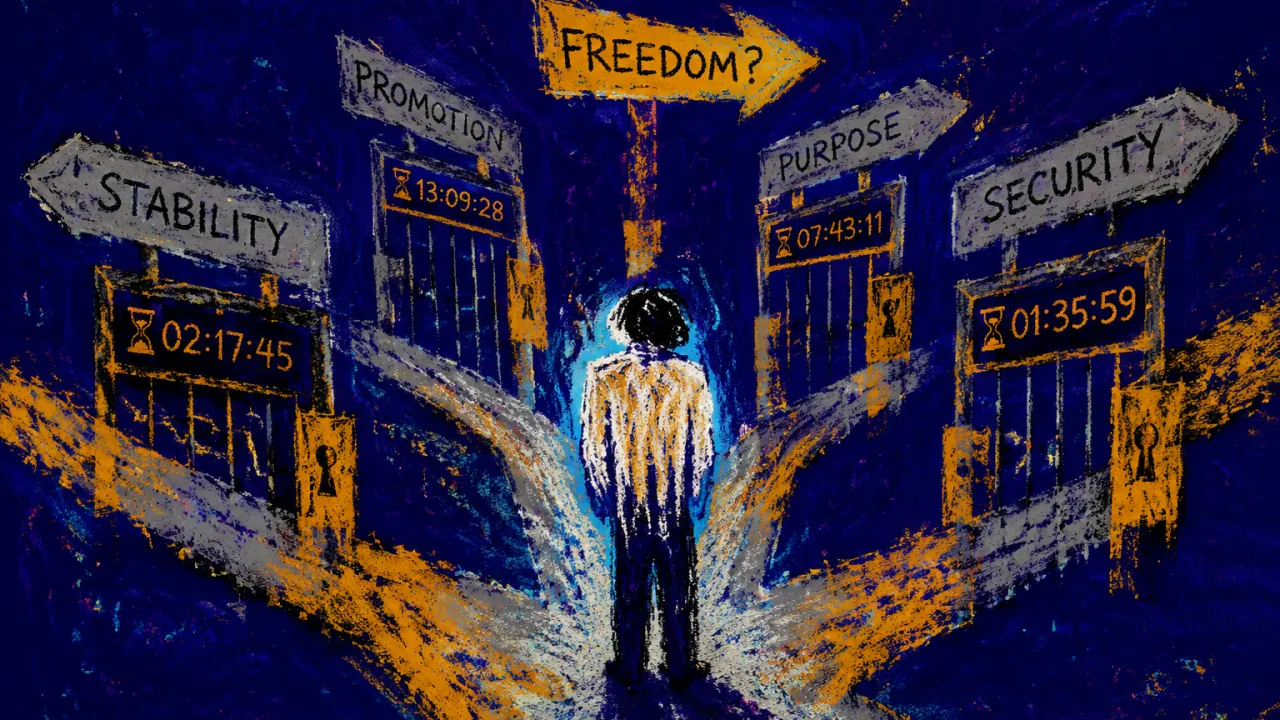
A solitary figure with shoulders framed by converging signposts, timed gates narrowing separate paths in amber and indigo.

What is this situation?

Mission-Driven Career Crossroads: you reach it when a grant ends, your team restructures, or two hiring processes converge, and every available role moves one part of the work forward while putting another out of reach. One posting offers direct contact with the people or issue you care about, but the salary barely covers city rent and the contract ends with the funding cycle; another offers benefits, a permanent title, and a clear promotion track, but places you several layers away from the work itself. A third promises influence at scale, then the interview reveals donor priorities, growth targets, relocation, or evenings that are quietly treated as standard. Recruiters ask for a decision before another employer has finished its final round. Managers describe understaffing as passion, job descriptions expand between interviews, and senior leaders keep the authority to define what impact means while you are asked to absorb the practical cost. Your weekdays fill with salary spreadsheets, application tabs, calendar holds, and careful questions about funding runway; by the third call, your shoulders are tight and your back is rigid from comparing options that were never built on equal terms. Friends may reduce it to following your purpose or taking the stable job, but neither line accounts for rent, healthcare coverage, visa or location limits, existing commitments, and the fact that access to meaningful work is controlled by organizations with their own deadlines and incentives. The decision keeps returning at your desk, on the commute, and each time an email subject line says next steps, because the market has bundled purpose, security, authority, and time into separate packages, much like the Two of Wands, where a figure stands at a parapet with one wand fixed beside him, another in hand, and a broad landscape waiting beyond the wall.

Why it's not you?

This is not a failure to know what matters. Employers, funders, and labor markets often split direct impact, sustainable pay, decision-making power, and job security across different roles, then attach deadlines that block a clean comparison. The choice stays difficult because the available terms are materially uneven, not because you are indecisive.

Mission-driven Career Crossroads in Tarot Cards

At a Mission-Driven Career Crossroads, each role can move one part of the work forward while putting another out of reach, leaving your shoulders tight as decision deadlines overlap. This is an environmental and structural dynamic: employers, funders, and labor-market terms distribute impact, pay, security, authority, and time unevenly. The Tarot Cards below mirror the contours of that constrained choice.

The Emperor
Reversed
An armored authority sits on a rigid stone throne before a severe mountain landscape, holding the symbols of command while remaining physically removed from the terrain below. In the reversed orientation, the fixed seat becomes a blocked governance structure: senior leaders, boards, or funders retain the right to define impact and strategy while the proposed role carries implementation costs without meaningful control. The institutional distance explains why a title promising influence can still leave you several layers away from decisions. You may be accountable for growth targets, donor expectations, relocation, or delivery while lacking authority to change the conditions producing those demands. The reversal makes the power gap explicit, separating formal responsibility from genuine agency inside the organization.
The Lovers
Upright
Two figures stand on separate sides of the scene beneath an angel, with contrasting trees behind them and a mountain rising between their positions. Their line of attention moves upward through different levels, creating a visual hierarchy between immediate attraction, conscious values, and the larger commitment under which a consequential choice is made. The upright image gives values a visible role without pretending that values settle every material question. You can recognize that direct service, institutional influence, income, security, and personal time express different commitments, then examine which employment package allows those commitments to coexist in practice. Alignment here is not the most inspiring job description; it is the option whose terms can support the relationship you intend to have with the mission.
Wheel of Fortune
Upright
A large wheel turns while one figure rises, another descends, and four winged figures remain positioned around its changing motion. The image mirrors a career market governed by grant cycles, restructuring windows, notice periods, funding approvals, and separate hiring calendars that can bring several possibilities together without making their deadlines compatible. The upright wheel keeps movement available even when no single actor controls the whole cycle. You can locate each offer within its actual timing structure: one role may be closing because funding expires, another may be waiting on approval, and a third may be accelerating toward a decision. The crossroads becomes a coordination problem between institutional cycles, not proof that a perfect moment has been missed.
Justice
Upright
A seated authority holds scales and a raised sword between institutional pillars, placing distribution and enforcement in the same frame. That structure mirrors mission-driven workplaces in which senior leaders define impact, funders shape priorities, and written contracts distribute security and risk while applicants are expected to absorb the practical consequences. The upright orientation preserves the possibility of making the employment relationship legible. You can examine whether responsibility is matched by authority, whether a permanent title is matched by workable scope, and whether a mission claim is supported by pay and staffing. The image does not guarantee a fair organization; it makes the standard of reciprocity visible enough to audit.
The Hanged Man
Upright
A haloed figure hangs by one foot from a living wooden frame, with the free leg folded and the body held in deliberate suspension. The image captures the interval between a deadline already imposed by one employer and information that has not yet arrived from another, when movement is constrained even though the larger career decision remains active. The upright halo makes the pause cognitively usable rather than empty. You can see which sacrifice each timeline is demanding, including the loss of bargaining room, the abandonment of another process, or the acceptance of uncertainty. The suspended position does not remove the deadline, but it reveals how timing itself is changing the apparent value of the options.
Seven of Cups
Upright
Seven cups float in a cloud, each presenting a different object, including a castle, jewels, a serpent, and a veiled form. The display resembles a field of mission-led roles in which each posting foregrounds one compelling asset while the full employment package remains obscured: proximity to the work, prestige, scale, security, authority, and compensation appear in separate containers. The upright image keeps the options visible while exposing how presentation can outrun substance. You can notice which offer is being evaluated through its most attractive promise and which unanswered terms remain inside the cloud. The choice becomes more navigable when the visible benefit and the concealed operational cost are treated as parts of the same cup.
Two of Pentacles
Upright
Two pentacles remain in motion inside one continuous loop, while the sea behind the figure prevents either side from becoming permanently stable. The image captures a choice in which direct impact and sustainable conditions cannot simply be ranked once: salary affects housing, contract length affects mobility, influence affects distance from the work, and one employer's deadline changes the value of waiting for another. The upright orientation supplies adaptive range, but it does not pretend the two packages are equivalent. You can observe which tradeoffs recur and which option depends on permanent overextension to stay afloat. The moving loop turns the decision from a slogan about purpose versus stability into a comparison of systems that must continue working after the offer is accepted.
Six of Pentacles
Reversed
A standing distributor holds scales while releasing coins to two kneeling figures, making control over measurement and control over resources part of the same position. In the reversed orientation, that concentration of power becomes the central blockage: funders and senior leaders can define impact, set grant conditions, and decide which roles receive security while workers remain responsible for delivery without equivalent influence over the terms. The uneven heights show why mission commitment cannot correct the bargaining imbalance by itself. You may be offered proximity to meaningful work only by accepting temporary funding, low pay, or conditional support, while the institution retains the authority to change priorities. The image makes the dependency visible, allowing the offer to be understood as a resource arrangement rather than as a personal test of generosity.
Two of Swords
Upright
A blindfolded figure holds two swords in a stable cross while a rocky shoreline interrupts the water behind her. The blindfold resembles the information gap created when one employer demands an answer before another finishes its final round, or when funding, scope, and evening expectations remain unclear until late in the process. The upright posture is a bounded pause, not evidence that you do not know your values. The crossed blades protect the decision point while incomplete data and incompatible deadlines prevent a clean comparison. A path remains available through recognizing which facts are missing, which deadline is externally imposed, and which apparent binary has been produced by the hiring sequence rather than by the full range of career possibilities.
Seven of Swords
Upright
A figure carries five swords away from a camp while looking back, leaving two swords standing behind him. The partial removal, backward glance, and visible camp resemble a hiring process in which important terms move outside the formal job description: evening availability is treated as obvious, donor constraints appear late, and responsibilities expand between interviews. The upright image preserves tactical visibility because the manoeuvre is incomplete and leaves evidence behind. You can notice discrepancies between the posting, interview language, written offer, and actual operating expectations without needing to reduce the entire organization to a single motive. The career path becomes clearer when omissions and scope shifts are treated as structural information about how the workplace handles consent and accountability.
Two of Wands
Upright
The figure surveys a wide territory from behind a constructed wall, with one wand attached to the institution and another available in hand. The image captures a career position in which access to meaningful work is broad in theory but channelled through employers, funders, titles, and organizational hierarchies that determine how close you can stand to the issue and how much authority accompanies the role. The globe keeps the larger mission in view while the upright stance creates room to audit the actual employment architecture. You can separate a prestigious title from decision-making power, a claim of impact from direct contact, and a permanent contract from the time or location costs attached to it. The route remains open, but its viability becomes visible only when the whole package is assessed.
Eight of Wands
Upright
Eight wands travel through open air in the same direction, with no visible person slowing or redirecting their descent. The scene resembles the compressed period when interview invitations, final-round updates, reference checks, revised job descriptions, and offer deadlines arrive almost at once, each carrying consequences before the other processes have settled. The upright formation gives the movement a readable trajectory even though it is fast. You can distinguish genuine momentum from manufactured urgency by seeing which message changes the material decision and which merely increases pressure. The clear landscape preserves a path through the acceleration: the timing structure can be named, compared, and understood rather than experienced as a command to react to every incoming email.
Ten of Wands
Upright
Ten wands are carried by one person, obscuring his view even though the destination is close enough to see. The concentration of the entire load in one body mirrors organizations that describe understaffing as passion, expand job scope during interviews, and offer responsibility for outcomes without enough staffing, time, or decision-making power. The upright scene keeps the burden visible rather than normalizing it as the price of meaningful work. You can distinguish the mission from the workload model used to deliver it and examine whether the role has a defined endpoint, adequate support, and authority proportionate to responsibility. The career path remains possible, but its actual carrying structure is part of the offer.

Mission-driven Career Crossroads in Tarot Card Reading Insights

Others have brought this same mission-driven career crossroads, with competing roles, uneven terms, and time-limited decisions, into their readings. The Tarot Reading Insights below gather what surfaced in those sessions.

Psychological Contexts Related to Mission-driven Career Crossroads