Finding Clarity in the 11:40 p.m. Split Screen
The first thing Jordan (name changed for privacy) showed me was a screenshot timestamped 11:40 p.m. Jordan was 29, working at a globally recognised London firm, and their Career Pivot Anxiety arrived whenever a genuinely interesting role came with a title nobody at drinks would immediately recognise. On the warm laptop screen, a public-interest design-research vacancy sat beside a LinkedIn promotion post and an employer-ranking page. Traffic hissed on the wet street below their rented flat. A mug of stale coffee waited by the trackpad, leaving a metallic taste each time they reached for it.
Jordan had highlighted nearly every responsibility in the meaningful role. Then they had imagined its small organisation name in a LinkedIn announcement, opened the rankings page, and closed the application. Before going to bed, they answered an email volunteering for another visible consulting pitch. They wanted meaningful work, but the moment an imagined audience became visible, they began researching until the prestigious choice was the only one they could defend.
“Everyone says I am doing well,” Jordan told me, pressing a thumb into the hinge of their jaw. “So why does it feel like I am disappearing? I can explain why the prestigious option is smart. I cannot explain why I want it.”
I heard the core contradiction clearly: Jordan wanted to pursue the path that interested them, yet kept surrendering agency to prestige because approval made the choice feel safer. Their ambivalence seemed to pull across their ribcage like two Underground doors trying to close in opposite directions: longing on one side, anticipated judgement on the other.
“That sounds exhausting,” I said. “And I am not going to tell you that salary, rent, reputation, or the work you have already invested do not matter. Our aim is not to force a dramatic career pivot. Let us make a map of the fog, separate practical risk from public scoring, and find out what your own evidence has been trying to say.”

Choosing the Compass: A Five-Card Shadow Spread
I invited Jordan to take one unforced breath while holding the question in mind: “Why do I keep choosing prestige over the path I actually want?” I shuffled slowly. The pause was not mystical theatre; it was a transition from rehearsed explanations into focused observation.
I chose The Shadow Spread, a five-card tarot spread for uncovering the prestige bargain behind career decisions. For anyone wondering how tarot works in a consultation like this, I use the cards as a structured mirror, not a forecast. This spread suited Jordan because it would follow one complete chain: the visible behaviour, the hidden bargain beneath it, the fear keeping that bargain alive, the inner resource that could loosen it, and one practical way to gather better evidence.
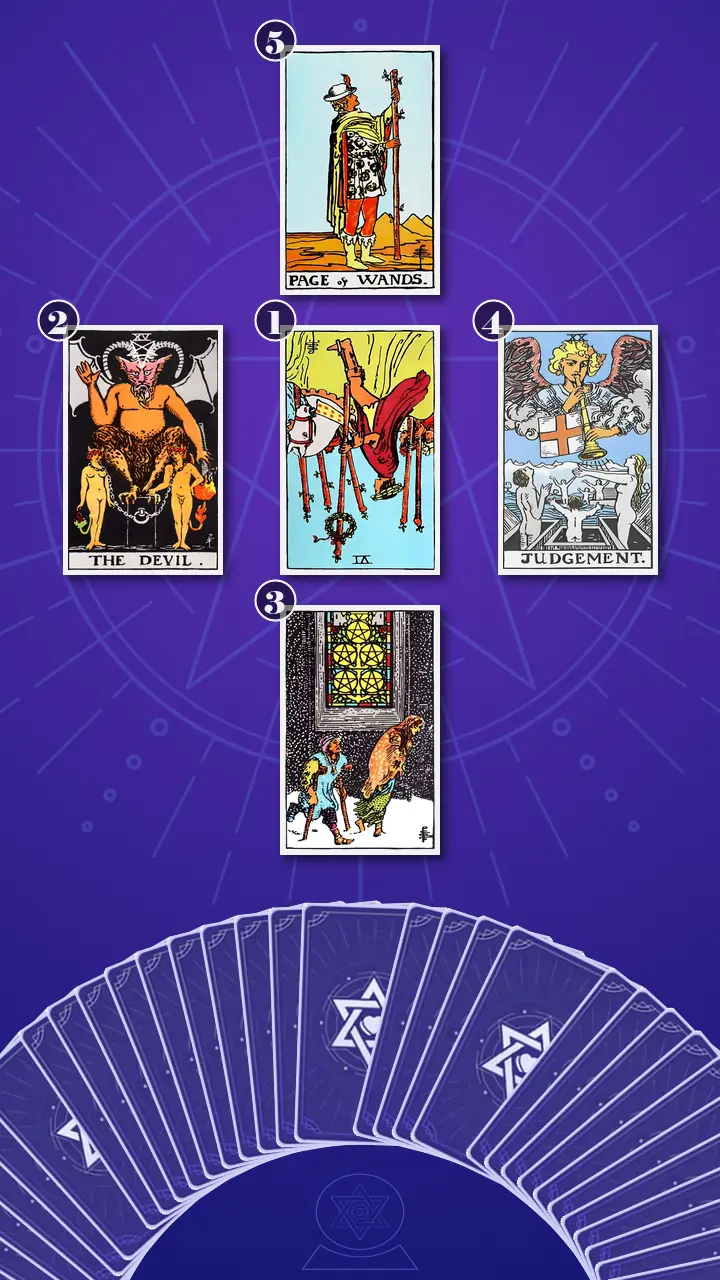
I placed the first card at the centre for Jordan's observable prestige-first pattern. The card to the left would expose the hidden exchange of agency for approval; the card below would name the fear supporting it. To the right, I would look for recovered self-evaluation. The final card above the centre would turn that insight into a low-risk next step. The layout resembled a compass, with the current choice at its centre and exploratory agency pointing upward.
Reading the Prestige Scoreboard
Position 1: The Victory That Needed an Audience
I turned over the card representing Jordan's observable prestige-first behaviour: the Six of Wands, reversed. The rider wore one laurel wreath while another hung from the raised wand. Public proof appeared twice, as if doing well were insufficient until success could also be displayed.
I connected it to the 11:40 p.m. scene. Jordan had been interested in nearly every ordinary task in the public-interest role. Then the smaller organisation name triggered an imagined, unimpressive LinkedIn headline. An employer-ranking page opened, direct interest disappeared below the fold, and the application closed. I described the reversed card as a Blockage in healthy Wands fire combined with an Excess reliance on recognition. Ambition was present, but instead of carrying Jordan toward desired work, it circled the crowd and waited for applause to identify the winning path.
“It is like letting LinkedIn's engagement algorithm rank career fit,” I said. “The most publicly legible option rises, while quieter interest gets buried. The prestigious option is easy to explain; you are the one who has to live its ordinary Tuesday.”
I asked, “If the employer name, job title, and announcement disappeared, what would still attract you to that role?”
Jordan did not nod. Their mouth tightened, then they gave one short, bitter laugh. “That is accurate enough to be rude,” they said. Their fingers stopped rubbing the mug, and their eyes returned to the highlighted tasks in the screenshot. “I was interested until I imagined explaining it.”
The Contract Beneath the Applause
Position 2: The Prestige Subscription That Kept Renewing
I turned over the card exposing the hidden prestige bargain: The Devil, upright. I pointed first to the chains around the two figures. They were restrictive, but visibly loose. I did not read that detail as blame, and I certainly did not read the card as a warning of doom. I read it as an invitation to distinguish a genuine constraint from an agreement repeatedly renewed because it provides emotional protection.
Jordan had recently received praise for a visible consulting pitch and immediately volunteered for its next phase, even though the work would consume the weekend reserved for a design-research application. The prestigious firm had become a gatekeeper of legitimacy. Status supplied a clean surge of relief from self-doubt; Jordan paid for that relief with time, curiosity, and decision authority.
“The chain works like an auto-renewing status subscription,” I said. “Every rankings search and every reflexive yes to visible work buys short-term reassurance, then renews the belief that worth must come through an impressive institution. No one is physically forcing the choice, but choosing differently can still feel socially impossible.”
I thought of Severance, and of the polished workplace identity that becomes so dominant the person outside the title begins to seem inconvenient. “Prestige offers legibility, not belonging,” I told Jordan. “What protection did the famous name offer at the exact moment you volunteered?”
Jordan's shoulders rose before the answer came. “It made me feel undeniable,” they said. After a pause, their shoulders lowered again. “For about ten minutes.”
Position 3: The Lit Window in the Snow
I turned over the card representing the fear maintaining the sacrifice-agency split: the Five of Pentacles, upright. Two figures moved through snow beneath an illuminated window without looking toward it. I saw Jordan's fear of leaving the recognised institution and finding themselves outside professional legitimacy, support, and material safety.
When Jordan imagined a lower salary, the thought did not stop at a smaller payslip. It accelerated into London rent becoming impossible, previous experience losing its value, momentum vanishing, and peers deciding they had never been capable. None of those outcomes had yet been calculated. The card showed scarcity operating in Excess, while awareness of transferable skills, savings, supportive relationships, and reversible transition options remained in Deficiency.
“But rent is real,” Jordan said. Their breath caught, their gaze moved to the window, and their fingers closed around the mug. “I do not want this turned into a story about being too scared to follow my passion.”
“Nor do I,” I replied. “The card is not asking you to romanticise insecurity. It is asking for accuracy. Which fear is a number, which is an assumption, and which is anticipated shame? A real cash-flow gap deserves a plan. The fear of looking less successful deserves to be named, but it should not be allowed to impersonate a bank statement.”
Jordan's grip loosened. The room stayed quiet while rain traced the glass, echoing the card's snow without turning it into a catastrophe. I watched them begin to separate two experiences that had previously arrived as one tight band across the chest: material risk and diminished worth.
When Judgement's Trumpet Replaced the Crowd
Position 4: Excavating the Authority Beneath the Title
The room seemed to narrow around the next card. I turned over the position representing the resource Jordan could recover through honest engagement with the shadow: Judgement, upright.
It was 11:40 p.m. again in Jordan's mind: the meaningful application remained open, LinkedIn displayed someone else's promotion, and their jaw tightened as they replaced a felt preference with another comparison they could defend. They were still trying to make certainty arrive through public proof.
I placed Judgement beside the reversed Six of Wands. One card held a rider surrounded by a validating crowd; the other held a single trumpet calling the figures to rise and respond. I explained that Judgement did not promise the perfect path. Its energy was Balance: honest self-assessment in which practical evidence, genuine interest, and consciously chosen values could speak before the crowd delivered its verdict.
“Prestige can prove that a path is admired; it cannot prove that the life inside that path belongs to you.”
Prestige is not proof that a path belongs to you; let your own lived criteria make the call, then answer Judgement's trumpet with one testable step.
I let the sentence settle. Years on archaeological digs had taught me that monumental inscriptions tell us how a regime wanted to be seen, while worn thresholds, repaired bowls, and ordinary tools reveal how people actually lived. I call the career version of that distinction Core Artifact Excavation. The title and employer logo were Jordan's monument. The enduring artifacts were the tasks that held their attention, the working rhythm their body could sustain, the social usefulness they valued, and the level of financial stability that preserved real choice.
“An epoch can end without making everything built during it worthless,” I said. “Your consulting years do not become a mistake if you stop asking them to dictate every year that follows. We preserve the skills and material foundations that still serve you. We do not preserve the entire monument merely because it once kept you safe.”
Jordan's breath stopped first. Their fingers hovered above the edge of the table, motionless. Then their gaze lost focus, as though they were replaying every abandoned application and every quick yes to work they did not want more of. Their pupils widened; the set line of their jaw softened. A breath finally left them, shaky and longer than the one they had taken at the start. Their shoulders dropped, but the release brought a moment of visible disorientation, the slight dizziness that can follow when a burden has become familiar enough to feel structural.
Then resistance flashed across their face. “But does that mean I have been wrong for years?” they asked, their voice sharper than before. Their eyes had reddened, though they did not look away.
“No,” I said. “It means prestige was a strategy. It gave you income, training, recognition, and protection when those things mattered. We are not putting your past on trial. We are noticing that an old survival agreement now has too much authority over the future.”
I asked, “Now, using this new perspective, think back to last week. Was there a moment when this insight could have made you feel different?”
Jordan remembered the partner praising the high-profile pitch. “I could have let the praise be praise,” they said slowly, “without treating it as an instruction to volunteer again.”
I gave them an eight-minute experiment. I asked them to open one saved role, hide the organisation name, title, and salary, then write only three notes: one task they wanted to try, one working condition they valued, and one question only direct experience could answer. The timer would end the exercise before it became another comparison marathon. If it felt too exposing, they could close the tab and keep only the first note.
This was the reading's central movement: from prestige-driven defensive certainty to grounded, self-authored career confidence based on lived evidence. It was not a completed transformation or a demand for certainty. It was the first transfer of authority from the public scoreboard back to the person living the ordinary week.
The Page and the Smallest Honest Experiment
Position 5: Curiosity Without the Career Rebrand
I turned over the final card, representing practical integration through a low-risk experiment: the Page of Wands, upright. The Page studied the sprouting wand instead of displaying it to a crowd. Ambition had returned, but now its Wands energy was in Balance: curiosity moving toward direct contact rather than recognition.
I translated the card into Jordan's real life. Instead of resigning from consulting or announcing a dramatic pivot, they could spend 30 minutes completing one public-interest design-research exercise and ask one practitioner about the least glamorous parts of an ordinary week. Afterwards, they could record where attention sharpened, where energy fell, and what they wanted to test next.
“Think of it as a sandbox, not a full professional rebrand,” I said. “You do not need a new identity yet; you need one piece of lived evidence. Success means learning something, not producing impressive work.”
Jordan leaned back for the first time. Their hands opened on their knees, and a small smile appeared beside the remaining uncertainty. “I know exactly who I could ask,” they said. “I have been following her work for six months and pretending that counted as research.”
What Survives When the Monument Falls
I drew the five cards into one coherent account. Years of visible achievement had trained Jordan to experience recognition as security. The reversed Six of Wands showed the current symptom: imagined applause overruling direct interest. The Devil revealed the hidden bargain: agency exchanged for temporary protection. The Five of Pentacles named the force beneath it, where financial concern and fear of social exclusion had fused. Judgement recovered Jordan's ability to evaluate an ordinary week by personally meaningful criteria. The Page of Wands turned that authority into a small test rather than a dramatic leap.
I pointed out the cognitive blind spot gently. Jordan's spreadsheets felt objective because they contained numbers, rankings, and brand value, but the columns for task interest, working rhythm, social usefulness, and sustainable energy had been left blank. Worse, meaningful work remained untested, so the absence of lived evidence was being mistaken for evidence that prestige was safer and better.
I framed the next steps through The Stratigraphic Review, my weekend exercise for separating passing status signals from foundational value. In archaeology, a site becomes intelligible when each layer is examined in context. Jordan's decision needed the same discipline: social surface, material structure, and enduring personal artifacts should not be compressed into one prestige score.
- Run the Saturday Stratigraphic Review.Set a 20-minute timer and divide one page into three layers: public signals such as title, employer name, and imagined LinkedIn reaction; measurable structures such as rent, minimum salary, benefits, savings runway, and notice period; foundational artifacts such as task interest, preferred working rhythm, social usefulness, and learning. Choose three foundational criteria, then score one saved vacancy after hiding its employer name, title, and salary.Tip: Treat the criteria as testable hypotheses, not permanent truths. The three-minute version is one criterion and one sentence describing a Tuesday you would consent to repeat.
- Gather one Page of Wands data point.Within seven days, complete one private 30-minute design-research exercise using a public brief. When the timer ends, record three lines in a phone note: I leaned in when..., I lost energy when..., and The next thing I want to test is.... If useful, follow it with one 15-minute practitioner conversation about the ordinary workday.Tip: Cap the test firmly. Information is the outcome; polished work, unpaid labour, resignation, and a public career announcement are not required.
I reminded Jordan that these actions did not commit them to leaving, taking a pay cut, or rejecting ambition. They simply ensured that personal meaning and direct evidence entered the evaluation before prestige took over. The cards had supplied a structure for finding clarity; Jordan would decide what to preserve, what to renegotiate, and where to go next.

A Week Later: The Quiet Proof
Six days later, Jordan sent me a photo from a quiet library near King's Cross. Two anonymised job descriptions lay on the desk. The public-interest role held more highlights. Beside it was a phone note from the 30-minute exercise: I leaned in when I had to understand why people behaved as they did. Jordan had also booked the practitioner call.
They had not resigned. They had not solved their entire career identity crisis. They had simply gathered evidence before requesting a verdict from the crowd, and the meaningful path no longer existed only as an embarrassing preference.
On Sunday, they slept through the night. Their first thought on waking was, “What if I am wrong?” Then they smiled, opened the note from the exercise, and kept the practitioner call in their calendar.
I understood that as the quiet proof of our Journey to Clarity. Tarot had not chosen Jordan's future or promised that one path would be painless. It had helped them examine the decision system, recover what mattered beneath the monument, and reclaim the right to gather their own evidence.
When everyone can see that you are succeeding but your jaw still tightens at the thought of choosing what you want, the hardest part may be the fear that one less impressive title will expose a less worthy version of you. I would ask you to remember what Jordan recovered: a preference can be information without becoming a verdict, and noticing the old bargain means you are no longer standing at its beginning.
If your preference were allowed to count as one enduring artifact, what tiny Page of Wands experiment would you try before the crowd around the Six of Wands gets a vote?
This story is adapted from psychological research, written so that those in a similar struggle can see their own pattern in it — and find their next step clearly.These insights are not a substitute for professional psychological, medical, legal, or financial advice.
Learn more about our Journey to Clarity.
How did this insight land for you?
🫂 This Resonates Deeply
🌀 Living This Story
✨ Now I See Clearly
🌱 Seeing New Possibilities
🧰 Useful Framework
🔮 The Confirmation I Needed
💪 Feeling Empowered
🚀 Ready for My Next Step
Author Profile
 AI
AI Hilary Cromwell
911 readings | 529 reviews
“Having spent a lifetime at Cambridge and on archaeological digs, I’ve witnessed the rise and fall of countless civilizations. Please know that your current struggles are not a permanent fate, but merely a necessary fracture before rebuilding. I won't lecture you; instead, I invite you to sit with me in the ruins, using a patient, historical perspective to gently dust off the true, enduring value hidden beneath your temporary doubts.”
In this Direction Tarot Reading :
Core Expertise
- Historical Epoch Analogies: Comparing your current life transition to macro-historical shifts, contextualizing your profound loss of meaning.
- Core Artifact Excavation: Identifying the immutable principles and core values that must survive the collapse of your old trajectory to guide the new one.
Service Features
- The Stratigraphic Review: A structured weekend exercise separating passing societal trends from your foundational life values, establishing a robust anchor for your future.
Also specializes in :
Explore Related Patterns:
Career Optics ParalysisJordan is interested in nearly every ordinary responsibility in the public-interest role, yet the application closes as soon as they imagine announcing its unfamiliar organisation name. They then volunteer for visible consulting work that takes the weekend allocated to the application. You are not merely comparing two jobs in that sequence; public optics interrupt action before direct evidence about career fit can be gathered. The remembered abandoned applications and repeated quick agreements to visible work show that this is a recurring decision loop rather than a single cautious pause. Career Optics Paralysis names the blockage created when title recognition and announcement value become prerequisites for movement. Hiding the employer name and limiting the experiment interrupts the loop by letting you encounter the work before requiring the choice to survive an imagined audience.
External ValidationJordan highlights nearly every responsibility in the public-interest role, but imagining its smaller organisation name in a LinkedIn announcement sends them to an employer-ranking page and then out of the application. The work itself has not become less interesting; what changes is the evaluator whose verdict is allowed to count. You can see how public recognition begins regulating uncertainty, making the prestigious option feel safer before either path has been tested. The quick agreement to more visible consulting work shows why this mechanism repeats. Praise makes Jordan feel "undeniable" for about ten minutes, so reassurance is purchased again whenever self-doubt returns. External Validation names the point at which recognition stops being useful feedback and starts functioning as decision authority; separating praise from instruction allows approval to remain information without letting it choose your ordinary week.
Status DefenseJordan receives praise for a high-profile consulting pitch and immediately volunteers for the next phase, even though it will consume the weekend reserved for the design-research application. When the famous institution makes them feel "undeniable" for about ten minutes, prestige is performing a protective function. You reach for a recognisable status marker because it rapidly shields you from uncertainty about competence, belonging, and how your choice will be interpreted. The defense works well enough to keep renewing itself: another visible assignment settles the question temporarily, even though the work content has not become more personally meaningful. Status Defense names the use of rank and institutional legibility as emotional protection, not ambition itself. Once that function is visible, you can preserve genuine ambition while asking whether a particular opportunity serves your life or mainly quiets doubt.
Achievement-Based Self-WorthJordan says, "Everyone says I am doing well," and then asks why it feels as though they are disappearing. That contradiction shows that visible achievement is doing more than documenting career progress: it has become a primary source of self-evaluation. You may then experience a less recognisable title not simply as different work, but as exposure of a supposedly less worthy or less capable self. Jordan's sharp question about having been "wrong for years" reveals how deeply identity has become attached to the achievement record. Achievement-Based Self-Worth does not mean the achievements are empty or undeserved; it describes a conditional scoring system in which worth feels secure only while success remains publicly legible. Preserving the income, training, and skills of the past does not require giving a title permanent authority over who you are allowed to become.
RationalizationAt 11:40 p.m., Jordan moves from a role whose responsibilities they have highlighted to employer rankings and a choice they can publicly defend. Their own summary is precise: they can explain why the prestigious option is smart, but they cannot explain why they want it. You can use apparently objective analysis to place distance between a decision and the harder feelings underneath it, especially shame, uncertainty, or the fear of becoming less legible to other people. Jordan's spreadsheets contain real information, but their columns privilege rankings, brand value, and salary while leaving task interest, working rhythm, social usefulness, and sustainable energy blank. Rationalization does not require false facts; it works by selecting the facts that support the emotionally safer conclusion and excluding evidence that could complicate it. The audit begins when you ask not only whether each metric is valid, but also why some valid criteria were never permitted onto the page.
Sunk Cost Identity AttachmentJordan responds to the possibility of loosening prestige's authority by asking whether they have therefore been wrong for years. They also fear that moving away from the recognised path will make previous experience lose its value. You can experience a future choice as a retrospective verdict on the identity, effort, and competence represented by everything already invested. The consulting years produced real income, training, recognition, and protection, so the past does not need to be dismissed for this pattern to operate. Sunk Cost Identity Attachment appears when preserving the value of those years becomes confused with preserving the entire path indefinitely. Distinguishing transferable skills from a permanent career mandate lets you retain what still serves you without requiring every future year to validate every past decision.
Values-Based Decision MakingJordan hides employer names and titles, records one task they want to try, and later compares two anonymised job descriptions. Six days after the consultation, they have also completed a short design-research exercise and kept a practitioner call in the calendar. You create a different decision process when direct experience is gathered before a public verdict is requested. The new criteria include task interest, working rhythm, social usefulness, learning, and adequate financial stability, so prestige is neither automatically obeyed nor simplistically rejected. Values-Based Decision Making means allowing consciously chosen priorities to share authority with practical constraints and external information. Jordan still wakes with the thought, "What if I am wrong?" but uncertainty no longer prevents the next test, which shows that self-authored choice does not require perfect certainty.
Explore Related Struggles:
Approval-Safety FusionPraise for Jordan's high-profile pitch is followed by an immediate offer to do more visible work, even though it will consume the weekend reserved for the design-research application. The famous firm makes them feel undeniable, but the reassurance lasts for only about ten minutes. Approval is carrying more than social pleasure in this decision. It is being asked to certify competence, protect professional belonging, and make practical uncertainty feel manageable. When you rely on that signal for several forms of safety at once, a quieter choice can register as dangerous before its actual risks have been separated and measured. Approval-Safety Fusion names that structural compression. Recognition becomes difficult to receive as simple praise because it starts functioning like an instruction about which future is safe enough to choose.
Prestige Path LockJordan's abandoned applications, rankings searches, and quick yeses to visible consulting work repeat the same sequence. An interesting route appears, its public status is imagined, and the route closes while the established prestige track receives more time and labour. Prestige has become more than an attractive feature of a job. It controls whether an alternative can enter serious consideration at all. You can see the path you want and even gather evidence in its favour, yet the decision system keeps requiring a recognisable title before that evidence is permitted to authorise movement. Prestige Path Lock names this closed circuit. The impressive route remains easy to defend even as Jordan feels themselves disappearing inside it, while the personally meaningful route must repeatedly prove its right to exist before it can be explored.
Prestige-Fit SplitJordan highlights nearly every responsibility in the public-interest role, but the smaller organisation name changes the decision before the work itself changes. The application closes when Jordan imagines having to explain the title, while another publicly visible consulting pitch receives an immediate yes. That sequence leaves two standards active inside the same choice. You can recognise that the ordinary tasks fit your attention and values while also treating public legibility as the condition that makes the choice defensible. The friction comes from having to live according to one standard while being evaluated, or imagining yourself evaluated, by another. Prestige-Fit Split captures the resulting career bind. The admired option can win the comparison without answering whether its ordinary Tuesday fits the person who must keep living it, while the better-fitting work remains difficult to authorise because its value is less instantly visible.
Sacrifice-Agency SplitAt 11:40 p.m., Jordan closes the application containing the work they highlighted and answers an email volunteering for another visible consulting pitch. The choice preserves a career story that others can immediately validate, but it uses the time Jordan had reserved to investigate what they actually want. The conflict is not simply between two jobs. You can retain a clear preference and still transfer the authority to act on it to an imagined audience. Each transfer buys immediate protection from doubt while reducing the space available for curiosity, direct evidence, and a self-authored decision. Sacrifice-Agency Split describes that bargain between keeping approval intact and keeping ownership of the next move. The sacrifice is embedded in small, repeatable decisions, so agency can be surrendered without any single moment looking dramatic enough to challenge.
Metric-Compass FusionJordan opens an employer-ranking page after noticing strong interest in nearly every responsibility of the public-interest role. The spreadsheets and comparison tabs contain numbers, brands, and publicly readable signals, while the columns for task interest, working rhythm, social usefulness, and sustainable energy remain blank. The scoring system therefore measures what can be defended more readily than what can be lived. You may still notice your own evidence, but it cannot change the decision when the metric has become the authority that decides which evidence is legitimate. Metric-Compass Fusion captures the point at which measurement stops supporting direction and starts replacing it. Rankings can show which path is admired, but once they operate as the compass, the unranked parts of a workable life become functionally invisible.
Scarcity Compass LockWhen Jordan imagines a lower salary, the thought moves rapidly from a smaller payslip to unaffordable London rent, lost momentum, devalued experience, and peers deciding they were never capable. Those outcomes arrive before the cash-flow gap, savings runway, transferable skills, or transition options have been calculated. Material caution is necessary, but it cannot perform its proper function when it has fused with anticipated shame. You then face one undifferentiated warning in which financial exposure and reduced worth appear to prove each other, leaving little room to discover which risk is measurable and which verdict has only been projected. Scarcity Compass Lock describes the narrowing that follows. Scarcity no longer marks a constraint to plan around; it selects the direction in advance and makes a less prestigious path appear illegitimate before its real conditions can be examined.
Explore Related Emotions:
Approval AnxietyJordan highlights nearly every responsibility in the public-interest role, then imagines its small organisation name in a LinkedIn announcement, opens an employer-ranking page, and closes the application. Direct interest is present until the anticipated audience becomes psychologically active and turns a private career preference into a public evaluation. When approval functions as the quickest available signal of safety, you can become more attentive to whether a choice is defensible than to whether its ordinary work fits. Approval Anxiety names the pressure produced by that arrangement: your preference remains available, but its authority contracts whenever other people's imagined reactions enter the room.
Hollow RecognitionJordan receives praise for a visible consulting pitch and immediately volunteers for its next phase, even though it will consume the weekend reserved for the design-research application. The recognition makes them feel undeniable, but only for about ten minutes, and it offers no durable answer about whether they want the work itself. Hollow Recognition describes achievement that lands publicly but does not settle internally. You can genuinely value praise and still notice that its emotional effect expires quickly, leaving you dependent on the next visible win while the deeper questions of fit, belonging, and meaning remain unanswered.
Ordinariness ShameJordan imagines announcing a role with a title nobody at drinks would immediately recognise, and the work they found compelling suddenly appears socially diminished. The smaller name does more than reduce prestige; it threatens to reveal a version of Jordan who cannot rely on institutional status to look unquestionably successful. Ordinariness Shame captures the feeling that a less impressive label might expose you as less worthy rather than merely less legible. When identity has been reinforced through visible achievement, choosing an ordinary-looking path can feel like consenting to public shrinkage, even when the daily work may fit more honestly.
Preference Exposure DreadJordan remains interested while reading the role itself. The rupture comes when they imagine having to explain the smaller organisation name, at which point the preference stops feeling like useful information and starts feeling like something that could expose them to judgement. Preference Exposure Dread captures the inner weather of wanting something that feels harder to publicly justify than the prestigious alternative. You may know what draws you toward a path and still recoil when choosing it would reveal values that cannot be protected by a famous employer, a recognisable title, or an instantly impressive announcement.
Agency ReliefJordan's grip loosens when a real cash-flow question is separated from the anticipated judgement attached to it. They later recognise that the partner's praise could have remained praise without becoming an instruction to volunteer, and the next experiment does not require resignation or public reinvention. Agency Relief is the release that comes from discovering that your choices do not have to be governed by either the crowd or a dramatic rejection of everything practical. You regain room to set criteria, gather evidence, and decide what the next step means instead of accepting the emotional urgency of prestige as the decision itself.
Cautious Self-TrustJordan hides the organisation name, title, and salary, completes a private exercise, records where their attention sharpened, and books the practitioner call. Six days later, they still have not resigned or declared a new identity; they have simply allowed their own responses to become part of the evidence. Cautious Self-Trust grows through that limited transfer of authority. You do not need absolute confidence in a new path to let your attention, energy, values, and constraints count. Trust becomes credible because it is being tested alongside practical reality rather than asserted against it.
Self-Betrayal AcheJordan highlights nearly every responsibility in the meaningful role, closes the application after checking its public standing, and then gives the protected weekend to another visible consulting pitch. The sequence repeats a painful division: their attention points toward one path while their behaviour protects the other. Self-Betrayal Ache names the hurt that accumulates when your own preference repeatedly loses its vote. The prestigious choices may remain rational in several respects, but the ache comes from noticing that external legibility has been allowed to overrule your lived evidence before that evidence receives a fair hearing.
Grounded CuriosityJordan spends thirty minutes doing the work itself, notes when they leaned in and lost energy, and books a conversation about the least glamorous parts of an ordinary week. The experiment remains private and bounded, so interest can move toward direct contact without being forced into a career announcement. Grounded Curiosity is the openness that appears when exploration no longer has to justify a complete reinvention. You can become interested in what the work reveals rather than what the title signals, using lived experience to refine the question before asking yourself for a final answer.
Explore Related Contexts:
External Scorecard PressureAt 11:40 p.m., Jordan's screen holds a public-interest vacancy beside a LinkedIn promotion post and an employer-ranking page. The role's responsibilities have already earned sustained attention, yet the visible metrics determine which option remains open. LinkedIn announcements, employer rankings, partner praise, and anticipated conversations at drinks form an external scoring environment. They convert a complex career decision into a public legibility contest in which recognisable institutions receive evidence of value before the work itself has been tested. When your evaluation is organised around that scoreboard, quieter information about task fit and a sustainable working week is structurally disadvantaged. Naming External Scorecard Pressure allows you to separate measurable material constraints from metrics designed to make achievement visible to other people.
Golden HandcuffsJordan's recognised London firm has supplied income, training, recognition, and protection, while a possible lower salary is immediately linked to rent pressure, lost momentum, and reduced professional legitimacy. Those benefits are real resources, but they are concentrated inside one prestigious institution. Leaving therefore appears to risk several layers of security at once: current income, the market value of prior experience, access to a respected title, and a career trajectory that other people can easily understand. When a prestigious role combines valuable material support with a high perceived exit cost, Golden Handcuffs describes the external bind. You can inventory which benefits genuinely need protection and which status assumptions still require evidence, preserving useful career capital without allowing one employer to own every future decision.
Prestige TrapJordan highlights almost every responsibility in the public-interest role, then opens an employer-ranking page and closes the application once the smaller organisation's name enters the imagined announcement. That sequence places the employer brand above the work itself. A globally recognised firm offers an immediately legible social position, so prestige becomes the admission price for a career choice Jordan can defend to peers even when the ordinary tasks point elsewhere. When your options are filtered through that hierarchy, Prestige Trap names the external stage: status systems narrow which paths are allowed to count before you can test them. Separating the title from the weekly work lets you examine that constraint without pretending salary, rent, or accumulated career capital are irrelevant.
Sunk Cost Exit DilemmaJordan predicts that leaving the recognised institution could strip value from previous experience, erase career momentum, and imply that the consulting years were wrong. Salary, London rent, and the work already invested all enter the decision before the alternative role receives a practical test. Accumulated career capital becomes a form of path dependency when its value appears conditional on continuing along the same institutional track. The past is no longer only a source of skills and material foundations; it is treated as a commitment that the future must keep renewing. When prior investment raises the social and material price of changing direction, Sunk Cost Exit Dilemma captures the resulting career stage. You can preserve training, credibility, and financial safeguards as portable assets while examining whether continued prestige work is still the only viable use of them.