Career Decision Paralysis: From Unsent Email to One Real-World Test
The Spreadsheet at the Point of No Return
At 11:48 p.m., I watched Jordan, a 29-year-old product designer in Toronto, change two criteria in the same colour-coded decision matrix and then hover over an email with no send date. Blue laptop light sharpened the tired planes of their face; the fan whirred beneath three tabs containing other people's career stories, and cooling coffee gave off a faintly burnt smell. Their phone was warm in one hand, their jaw locked, and the field marked “chosen direction” remained blank.
Jordan had joined our video consultation with the composed vocabulary of someone who could explain every option in a polished deck. The moment I asked what they actually wanted, however, their eyes moved back to the spreadsheet.
“I keep waiting for the option that doesn't close any doors,” they said. “The closer I get to choosing, the more reasons I find to pause. There's an email I could send, but sending it would make one future real. I guess what I'm asking is: what keeps me circling the point of no return instead of choosing?”
Their ambivalence felt less like standing between two road signs and more like gripping the rail of a revolving door: every turn required effort, every turn offered a glimpse of an exit, and every turn returned them to the same lobby with a tighter chest. A dependable income, Toronto rent, workplace benefits, and years of accumulated credibility pulled one way. The wish to spend their energy on something that felt genuinely meaningful pulled another.
“You call it more research,” I said gently. “Your body experiences it as the moment the choice might become real. I don't think we need to force a verdict tonight. Let's make a map of the fog, separate practical caution from protective repetition, and see what kind of clarity is already trying to form.”
I also made my role explicit. “Tarot won't decide your career or predict which path is guaranteed to work. I'll use the cards as an objective reflection tool. You decide what is accurate, what is useful, and what you do next.”
Choosing the Compass: The Decision Cross
I asked Jordan to close the matrix, leave the email unsent for the moment, and place their phone face down. I invited three slow breaths while I shuffled on my side of the screen. The pause was not a mystical test; it was a way to interrupt the stream of Slack messages, comparison tabs, and counterarguments long enough for one question to receive undivided attention.
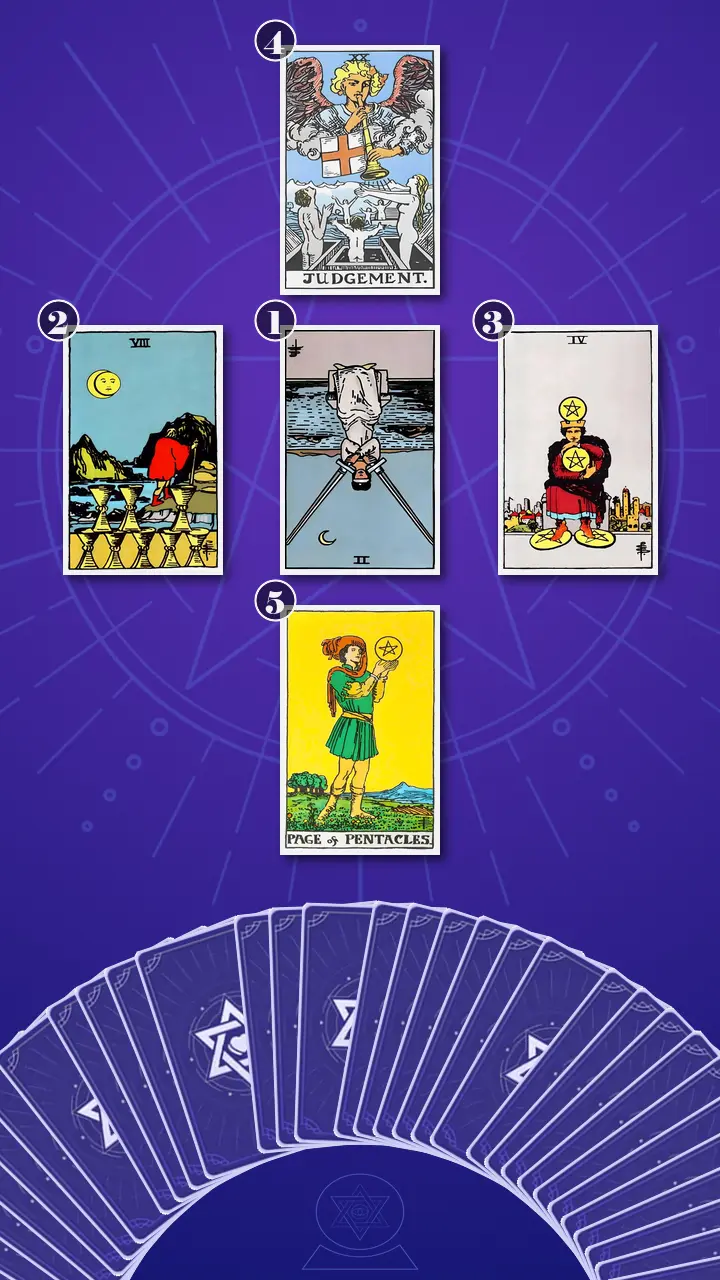
I chose the five-card Decision Cross tarot spread. I use this spread for high-stakes choices because it is compact enough to avoid manufacturing ten more variables while still showing the whole mechanism of a decision: the present stalemate, the desire pulling forward, the resistance pulling back, the principle that can reorganise the conflict, and the practical next step.
Through my overhead camera, I placed the first card at the centre as the knot. The second went to its left for the desire beneath the drift, and the third went to its right for the fear or practical attachment resisting movement. The fourth sat above the centre as the clarifying truth; the fifth rested below it as the point where insight would enter ordinary life.
The spread looked like a compass held over a threshold. Its horizontal line would examine meaning versus preservation. Its vertical line would trace recognition into practice. This is how tarot works best in a decision reading: card meanings in context become structured hypotheses to test against lived reality, not commands delivered by fate.
The Blindfold Made of Criteria
Position 1: Two of Swords Reversed, the Loop That Looked Like Research
The card I turned at the centre represented Jordan's current symptom: repeatedly revising the decision without committing while mental conflict and bodily tension continued to build. It was the Two of Swords, reversed.
The blindfolded figure and crossed blades gave the spreadsheet a startlingly literal shape. At the centre of Jordan's decision, the colour-coded matrix had become a blindfold made of criteria. Every new review, friend's opinion, or career story added another sword across the chest. The file looked increasingly sophisticated while the chosen direction and send date remained blank.
In energy terms, Air was both excessive and blocked. Jordan had plenty of thought, but the thought no longer moved toward communication or choice. It circulated defensively. Useful research had crossed into information overload, and every new variable helped keep felt preference far enough away that no trade-off had to be acknowledged.
I described the loop in the language Jordan had been using with themself: “Maybe I just need to check one more thing, because choosing before I know everything would be irresponsible.” Then I pointed to the observable sequence. They reopened the Notion page, changed the criteria when the answer became uncomfortable, opened one more tab, adjusted the email, and avoided choosing a send date. Their stated goal was clarity; their behaviour was protecting them from finality.
“When you reopen the file,” I asked, “what exact moment makes you change the criteria?”
Jordan's fingers stopped over the trackpad. Their eyes lost focus for a beat, then they gave a short laugh with a bitter edge. “That's painfully specific. Honestly, it's a little brutal. I do it when one option starts winning.”
I let the laugh land without turning it into a confession. “The card isn't accusing you of being irrational. This is an intelligent protection strategy. It gives immediate relief from the grief of closing a door. We're only noticing that the strategy now has a cost.”
I thought of an edit timeline crowded with alternate takes. As an artist, I know how safe it can feel to preserve every version of a scene. Yet if no cut is ever chosen, the film never becomes more than footage. Jordan's decision file was not missing another take; it was missing permission to make an edit that could later be reviewed.
“You are not waiting for clarity,” I said. “You are waiting for a choice that cannot cost you anything.”
The line tightened their mouth, but they nodded once. The Two of Swords reversed did not tell Jordan to rush. It asked them to notice the precise moment when careful thinking became a barrier against the emotional and practical cost of choosing.
Position 2: Eight of Cups and the Gap in a Successful Life
The card I turned to the left represented the genuine desire beneath Jordan's existential drift: the pull to move beyond a familiar but emotionally depleted direction in search of greater meaning. It was the Eight of Cups, upright.
The cups were carefully arranged, and most of the structure remained intact. Yet one visible gap disturbed the pattern. In Jordan's modern life, this was a credible product-design career that still functioned from the outside. The salary arrived. The benefits mattered. Their LinkedIn profile told a coherent story. Still, the missing space kept asking how they actually wanted to spend their attention and creative energy.
Water was moving here in a balanced, available form. The card did not create a command to quit, relocate, or overturn a life. It restored emotional information that Jordan's analysis had been treating as inadmissible evidence. A path can be respectable and materially useful while no longer answering the deeper question it once answered.
“Nothing is obviously broken, so why does staying feel like disappearing?” I asked, offering the sentence rather than assigning it to them.
Jordan looked away from the cards toward the dark kitchen window. Their thumb rubbed once along the edge of the mug. “That's the part I keep trying to score out of the spreadsheet,” they said. “I want more creative ownership. Then I tell myself that's too vague to count.”
“It may be too vague to dictate the entire decision,” I replied, “but it isn't too vague to count as data.”
I held the Eight of Cups beside the practical concerns still waiting on the other side of the spread. Meaning and preservation belonged in the same frame. Longing did not have to become an instruction, and security did not have to silence longing. The card simply asked Jordan to treat the persistent absence as real enough to investigate.
Their shoulders did not drop yet. Instead, their fingers tightened around the mug and then slowly loosened. I could see the grief arrive before the clarity: the recognition that choosing one life meant no longer using every unlived life as a private backup plan.
Position 3: Four of Pentacles and the Security That Pinned Both Feet Down
The card I turned to the right represented the underlying resistance: holding tightly to predictability because an irreversible choice appeared to threaten control, material security, and a familiar professional identity. It was the Four of Pentacles, upright.
The figure clutched one pentacle against the chest, balanced another on the head, and pinned two beneath the feet. I translated the image into Jordan's city-life inventory: rent autopay, workplace benefits, dependable income, accumulated experience, and the fear of having to explain a move that later looked wrong. Those resources were real. The problem appeared when one choice was required to preserve all of them, in exactly their present form, forever.
Earth had moved into excess. Stability had hardened into immobility. The same resources that gave Jordan a foundation were being asked to guarantee emotional certainty as well as material safety, a job no budget or benefits portal could perform.
“If I let this go and regret it, I'll have no excuse,” Jordan said quietly. “It'll mean I got my own life wrong.” Their palm flattened against the table as though keeping the surface steady.
“That sentence matters,” I said. “It shows us that regret isn't only an unpleasant feeling in this decision. You've been treating it as possible evidence that you can't trust yourself.”
This was where I used what I call Safe-Choice Sabotage Recognition. The point is not to mock the sensible option or romanticise risk. I examine whether the apparently logical choice genuinely protects a defined need, or whether “being responsible” has become a defence against the inciting incident that would make growth testable. A safe choice can be deeply authentic. It becomes sabotage only when safety is asked to prevent every possible loss and postpone every honest experiment.
I briefly thought of a production budget with every dollar held for contingencies and nothing allocated to shoot the actual scene. Prudence matters. So does noticing when preservation has consumed the entire purpose of the project.
“Which resource truly needs protection?” I asked.
Jordan inhaled through their nose. “Rent. A basic income floor. Access to health benefits, at least while I test something. The rest is more like... not wanting to stop being the person who knows what they're doing.”
That distinction changed the texture of the spread. Rent and an income floor could be measured. The wish never to feel inexperienced could not be secured by a spreadsheet. I placed the Eight of Cups and Four of Pentacles in Jordan's view like a split screen: in one frame, a figure walked toward uncertain mountains; in the other, a figure protected valuable resources so tightly that movement stopped.
Neither figure was the villain. This was not courage versus cowardice. It was a legitimate conflict between meaning and preservation, complicated by a hidden demand for total control.
“Keeping every door open can become a way of never walking through one,” I said. Jordan's gaze returned to the unsent email, but this time they did not touch the trackpad.
When Judgement's Trumpet Reached the Kitchen
Position 4: Judgement and the Direction Jordan Could Honestly Own
The card I turned above the central knot represented the truth that had to be recognised for the decision to become clear: an honest evaluation of which direction Jordan could consciously take responsibility for now. It was Judgement, upright, the catalyst card of the reading.
Through Jordan's microphone, I heard the refrigerator motor click off. The kitchen became abruptly quiet. On the card, an angel sounded a trumpet while figures rose with uncovered eyes, open chests, and lifted arms. The visual movement carried us from the blindfold and crossed swords of the first card toward an answer that was already audible.
Judgement brought energy into balance through awakening and accountable response. Its trumpet did not contain a flawless five-year plan. It functioned more like a clear calendar notification that required an answer, or the moment in a design critique when everyone stopped polishing edge cases and finally named the decision the team had been avoiding.
At 11:48 p.m., the same matrix was still open and the consequential email remained unsent. Jordan had been changing two scores again, hoping the right numbers would spare them the grief of closing a door. Meanwhile, the untouched send date was quietly making its own decision.
I used my Narrative Fork Analysis to separate three competing plotlines. In the first, Jordan kept every future theoretically alive through polished inaction. In the second, they forced a dramatic leap merely to prove they were brave. Neither plotline served their real growth. The third was less cinematic but more honest: Jordan would name one present value, protect a defined security floor, and let one bounded action produce evidence. Their character arc was not “stay versus leave.” It was “outsource authorship to impossible certainty versus consciously author the next scene.”
The old belief that every choice must preserve every possible future is keeping you suspended; answer the direction you can honestly own now, as the figures in Judgement rise when the trumpet sounds.
I let the sentence rest in the quiet kitchen, then translated it into the clearest practical language I could.
You do not need a choice that guarantees no regret. You need a direction you can honestly take responsibility for now, then one concrete step that lets real experience speak louder than another hypothetical future.
Jordan's breath stopped first; their fingers froze above the trackpad, and the pulse at their throat became visible. Their gaze slipped past the screen, as if they were replaying every late-night edit to the matrix. Then their eyebrows drew together and the first release came out as anger: “But doesn't that mean I've been doing this wrong for months?” The words arrived sharper than anything they had said so far. I answered, “It means this strategy protected you from feeling the loss until the strategy began creating a different loss. That isn't a moral failure. It is a cue that the scene needs a new choice.” Their eyes shone, but they did not look relieved yet; there was a brief blankness, the slight dizziness of realising that clarity would return responsibility to them. Their fist opened against the tabletop. A long breath left their chest, and their shoulders dropped by perhaps an inch.
“Now, using this new perspective, think back: was there a moment last week when this insight might have made you feel differently?” I asked.
Jordan stayed silent long enough for the laptop fan to become audible again. “Thursday,” they said at last. “I could have sent the email as a request to explore, not as a declaration of who I have to be forever. I treated the send button like a point of no return.”
“And what value would that email have answered?”
“Creative ownership,” they said. Their voice was low, but the words came without a qualifying paragraph. “Not guaranteed happiness. Just the chance to find out whether I feel more present in that kind of work.”
I set a ten-minute timer. I asked Jordan to write two plain sentences: “The value I most want this decision to serve is...” and “One small, reversible step I can take this week is...” During those ten minutes, they were not to open another review or ask anyone for an opinion. I also reminded them that the exercise was permission-based: if it became too intense, they could close the note and decide whether or when to return.
Jordan wrote. Their hand moved toward the browser once and stopped. When the timer ended, they read only the first sentence aloud: “The value I most want this decision to serve is creative ownership without abandoning my actual financial floor.”
That was the key crossing in this Journey to Clarity. It did not erase uncertainty or grief. It marked a movement from regret-avoidant analysis and protective control toward an accountable, values-based choice. Jordan no longer had to prove they could predict every consequence. They were beginning to trust that they could meet consequences as the person who had chosen deliberately.
“Regret is a possible cost,” I said. “It is not proof that the decision is wrong.”
One Pentacle, One Real Experiment
Position 5: The Page of Pentacles Becomes a Beginner
The final card I turned below the centre represented integration: a modest, observable experiment that could build self-trust without demanding total certainty. It was the Page of Pentacles, upright.
The Page held one pentacle at eye level. Behind the figure, the field was workable rather than guaranteed, and the mountains remained far beyond the first patch of cultivated ground. In Jordan's life, this meant choosing one dated experiment related to the preferred direction, such as a focused piece of work or a specific exploratory conversation, and evaluating what direct experience revealed instead of reading another account written by someone else.
Earth appeared here in a balanced and receptive form. The Four of Pentacles had used material reality to immobilise; the Page used material reality to learn. A calendar date, a sent message, a visible output, and a review point could ground Judgement's insight without pretending to settle the whole future.
I also pointed out that no Wands appeared anywhere in the spread. Jordan already had thought, feeling, and practical awareness. What was missing was not another category of evidence. It was initiating fire. Judgement supplied the call; the Page supplied the small piece of ground on which to answer it.
“I don't have to become the future version of myself today,” Jordan said, testing the language. “I only have to answer with one honest action.”
“Exactly. An identity-defining choice doesn't require you to arrive as a fully formed future self. It may require you to tolerate being a beginner.”
Jordan chose a concrete Page-of-Pentacles experiment: within twenty-four hours, they would send the existing email as a request for one exploratory conversation. The result would not be a permanent career announcement. The visible output would simply be a sent message, followed by one conversation and a dated review of what they learned.
“The next step is evidence, not a verdict,” I said. “A real choice trades some imagined futures for one lived experiment.”
The One-Page Route Out of the Loop
When I read the spread as one story, the logic was clear. Jordan had built a credible career through skill, momentum, and years of accumulated identity. The Eight of Cups showed that something meaningful had gone missing inside that functioning structure. The reversed Two of Swords converted the missing feeling into more analysis, while the Four of Pentacles made total preservation the hidden standard every option had to meet. Judgement restored honest authorship, and the Page of Pentacles reduced the scale from “choose a permanent self” to “gather lived evidence through one deliberate action.”
The central blind spot was the belief that delay remained neutral and that a responsible decision should eliminate regret before action began. In reality, repeated postponement was already shaping Jordan's timeline, weakening trust in their own judgement, and allowing the familiar path to continue by default.
I returned to the film metaphor that guides much of my work. Jordan had bravely stayed in a painful scene because every possible next act contained a loss. The way forward was not to burn the script or pretend the budget did not matter. It was to choose the value that deserved the next scene, define what the production genuinely needed to protect, and shoot one small piece of footage.
I gave Jordan three pieces of actionable advice. Each one had a stopping point, because a boundary around reflection was as important as the reflection itself.
- The Two-Criteria Decision Reset Jordan would place one 30-minute block in Google Calendar that week for the decision they kept reopening. Before the timer began, they would write only two personal criteria: creative ownership and financial steadiness. When time ended, they would record one provisional direction and the next question it would test, then close the document until a scheduled review date. Tip: Expect the urge to reopen the spreadsheet as soon as the timer ends. No new forums, reviews, or outside opinions enter this session. If thirty minutes feels too demanding, use a five-minute minimum version.
- The Security Floor Check In a private phone note, Jordan would spend 15 minutes listing rent, essential bills, benefits, savings buffer, and a minimum income floor. Each item would be marked “must protect,” “can change,” or “fear wants guaranteed.” Only an option that genuinely violated the first category would be ruled out on security grounds. Tip: Keep the exercise factual and private. If a full budget becomes another research project, list only rent, essential bills, benefits, and the minimum runway needed for one experiment.
- The Protagonist Pivot Action Within 24 hours, Jordan would complete “The choice I can take responsibility for now is...” and “I am willing to accept that this may close...” Then they would execute one micro-action aligned with the daunting but authentic plotline: send the short email requesting an exploratory conversation and schedule a one-week review of what the experience taught them. Tip: The 24-hour boundary is a creative constraint, not coercion. The email is a testable response to the present value, not a promise about the next five years. Jordan still controls whether any later step follows.
I told Jordan that grief might arrive after these actions, especially once an imagined future stopped functioning as an endlessly available backup. That grief would not invalidate the choice. It would show that the trade-off had become real enough to feel.
The cards had not selected Jordan's path. They had made the competing forces visible, exposed the rule that no real option could satisfy, and offered a way to collect evidence without surrendering agency. Jordan remained the author, editor, and decision-maker.

A Week Later: The Quiet Proof
Six days later, Jordan messaged me: the exploratory email was sent, and the conversation sat on Tuesday's calendar. They had slept through the night; in the morning, “What if I'm wrong?” returned. This time, they noticed it, smiled once, and made coffee.
I did not read that message as proof that a whole career problem had been solved. I read it as the first observable movement from protective over-analysis toward grounded self-trust. Uncertainty remained in the room, but it no longer controlled the calendar.
That was the quiet proof of Jordan's Journey to Clarity. Clarity had not arrived as a guarantee that closed every argument. It arrived as one personally meaningful criterion, one honest trade-off, and one action small enough to let reality answer back.
If your chest tightens whenever a decision becomes real, I hope you remember what Jordan discovered: keeping every door open can feel like control even as the circling quietly chooses more of your life for you. Simply recognising that conflict means you are no longer standing at its untouched beginning.
If one present value were allowed to matter more than preserving every possible future, what tiny, time-bounded Page-of-Pentacles experiment could you place on your calendar as the next scene you are willing to make real?