Desire Guilt at a Blinking Cursor: Four Lines Toward Self-Trust

The Moral Trial Behind the Late-Night Scroll: Moralized Over-Analysis and Decision Paralysis
If you work in a values-driven field and still feel guilty for wanting money, recognition, creative control, rest, or a different life, the pressure may be less 'What is practical?' and more 'What am I allowed to want?'
Jordan, a 28-year-old non-binary communications coordinator at a small Toronto arts nonprofit, sat across from me with their phone face down on the table. I had the sense that the phone was not really resting. It was waiting to be called back into evidence.
At 11:48 p.m. on the Tuesday before our session, Jordan had opened a Notes file called 'Things I Might Want.' The Parkdale radiator hissed beside them, blue screen-light warmed one palm, and a cold mug left a faint ring on the desk. They typed one honest sentence about a creative opportunity, felt their chest lift for half a second, then deleted it and replaced it with three respectable reasons to wait.
Jordan could explain every reason to stay in their sensible job, every reason to delay an honest invitation, and every reason a new direction might look selfish or ungrateful. When I asked what they actually wanted, they looked down at their hands. 'I can explain every reason to wait,' they said, 'but I cannot say what I actually want.'
I recognized the physical grammar of desire guilt: a chest tightened like a smoke alarm wired to the word want, a jaw locked around an explanation, a body holding still while the mind rehearsed a trial. Under the guilt I could feel shame, confusion, and longing moving like water beneath a frozen sidewalk.
'Why does wanting something feel like a confession?' Jordan asked.
I did not ask them to prove the desire was harmless, practical, or impossible to criticize. I told them, 'You are not deciding whether to act yet. You are already defending your right to have the feeling. We can slow that down together. Our Journey to Clarity is not about forcing a choice. It is about drawing a map of what is present, what was inherited, and what you want to decide for yourself.'
Choosing a Cross-Section of the Self
I invited Jordan to place both feet on the floor, take one unhurried breath, and hold the question without trying to improve it. Then I shuffled slowly. The small ritual was a point of focus and a psychological transition, not a supernatural demand for certainty.
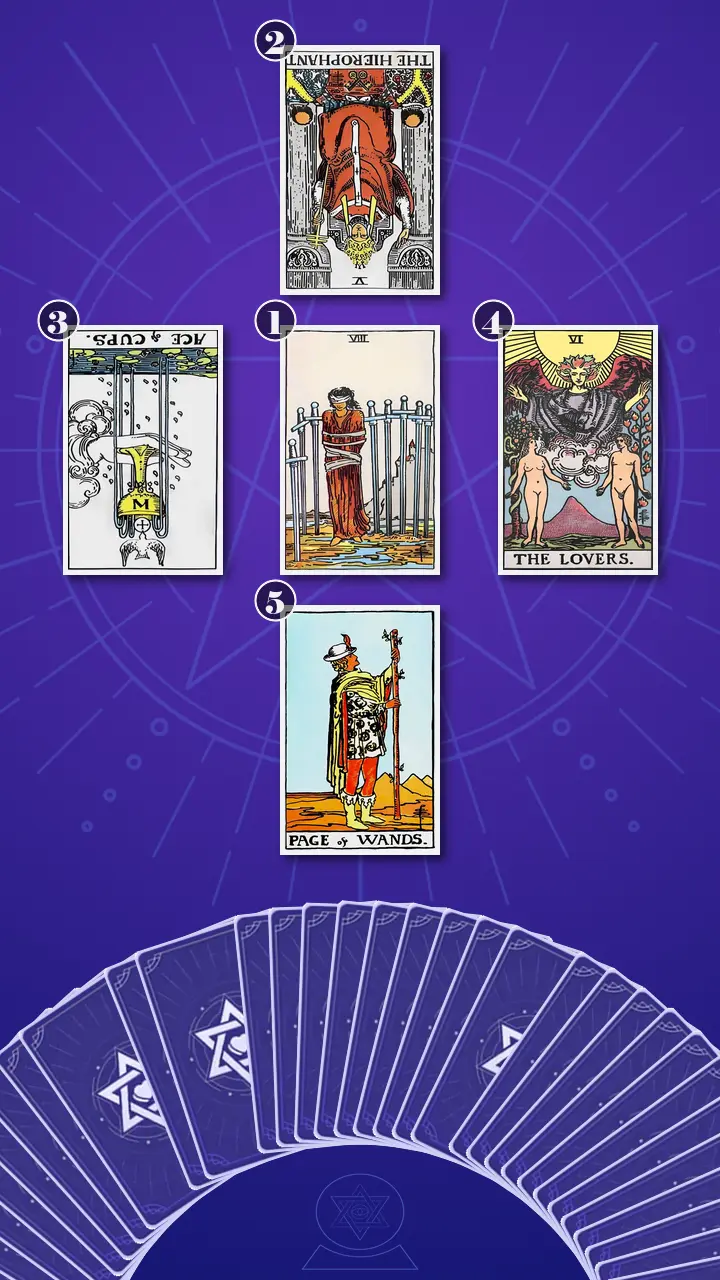
For this inward question, I chose The Shadow Spread - Context Edition, a five-card cross tarot spread for inner self-exploration. I use it when the visible problem is decision paralysis but the deeper issue may be an internalized permission system. It lets us examine the guilt without treating guilt as an oracle, diagnosis, or final moral authority.
The center would show the visible shadow and presenting tension: the behavior already shaping Jordan's choices. Above it, the root pattern would reveal the inherited rule system beneath the guilt. To the left, the disowned emotional truth would show the feeling being interrupted. To the right, the integrating choice would offer a way to bring desire, values, boundaries, capacity, and mutuality into the same conversation. Below, the conscious integration step would translate insight into a small, reversible action.
This focused structure suited the question better than a broad Celtic Cross. A ten-position reading could scatter attention across general life domains, while this five-card cross kept the card meanings in context and followed one clear movement: mental enclosure, inherited authority, blocked feeling, conscious choice, and bounded curiosity. I wanted a spread that could help Jordan explore what they wanted without making a decision on their behalf.
Reading the Ruins Beneath the Want
Position 1: The Blindfolded Draft
Now I turned over the card representing the visible shadow and presenting tension, the part of the situation already affecting conscious behavior: Eight of Swords, upright position.
In the traditional image, a blindfolded and bound figure stands among eight swords. I read the upright energy here as an excess of Air: thought has become so fast and repetitive that it narrows the field of attention. This does not mean Jordan is literally powerless. The available options are still on the screen, like the distant castle in the card, but the inner cross-examination makes each one look forbidden.
At this position, Jordan feels a clear impulse to send a message or begin an application, then opens advice tabs and a private pros-and-cons note. Nothing external blocks the next click. Their attention simply contracts around every reason the desire could be selfish, reckless, embarrassing, or insufficiently respectable. By the time the research ends, postponement feels like the only choice that cannot be used as evidence against their character.
I returned us to the blinking cursor in the Notes app. 'If I can prove this is harmless, sensible, and impossible to criticize,' I said, 'then maybe I can admit I want it. But the question has quietly changed from What do I want? to How do I become acceptable for wanting it?'
Jordan gave a small, bitter laugh. 'That is too accurate. Almost cruel.'
I let the reaction stand. The card was not accusing them; it was showing the mechanism. First, Jordan's breath stopped at the top of a shallow inhale and their thumb hovered above the phone. Then their eyes lost focus, as if the deleted sentence had begun replaying. Finally, a long breath left their chest, and their shoulders moved down by a fraction. Recognition had arrived before agreement.
'The blindfold is narrowed attention,' I said. 'It is not proof that no path exists. Which part of the restriction protects a current value, and which part may be an inherited judgment?'
Position 2: The Old Admin Setting
Now I turned over the card representing the root pattern beneath the guilt, the inherited rule system that gives the shadow its authority: The Hierophant, reversed position.
The Hierophant usually brings teaching, tradition, institutional morality, and formal guidance into view. Reversed in the root position, it suggested a rule that was being questioned but still operating rigidly from inside. I described it as an old admin setting still blocking an adult account, even though the original account owner was no longer logged in.
At this position, Jordan hears the phrase 'a good person would not want this' after a date, a career opportunity, or a creative spark. The thought arrives with the tone of a universal truth. The old purity culture hangover does not need another person in the room. It has already learned to speak in Jordan's voice.
'An inherited warning can sound like intuition when it has been rehearsed for long enough,' I said. 'I hear this in my voice, but did I choose it? And what present value, if any, is the warning trying to protect?'
I made the distinction carefully. Questioning an old rule did not mean rejecting every boundary, treating restraint as oppression, or pursuing anything simply because it felt transgressive. Consent, capacity, honesty, mutuality, and personal limits still mattered. The work was to separate received permission from self-authored ethics.
Jordan went very still. Their fingers tightened around the edge of the chair, then loosened. They reread the words I had written: inherited rule, chosen value. I watched their expression change from defending the old standard to locating it. 'I hear my grandmother's phrase,' they said quietly, 'but I also hear it in a version of my own voice. I am not sure when it became mine.'
'That uncertainty is useful,' I replied. 'It is the first credible gap between the rule and the person being ruled by it.'
Position 3: The Feeling That Never Gets Received
Now I turned over the card representing the disowned emotional truth, the feeling or longing being kept outside awareness: Ace of Cups, reversed position.
The Ace of Cups is the beginning of emotional openness and receptivity. Reversed, the cup's flow turns inward or becomes difficult to receive. I read this as a blockage in Water, not as evidence that Jordan's desire was wise or unwise. A feeling was appearing, but it was being interrupted before it could become usable information.
I asked Jordan to picture the moment after a warm text, an intimate conversation, or a promising idea. For three seconds, their face softened. Their chest lifted. Then they labelled the response complicated, locked the phone, opened Instagram, and filled the evening with logistics. It was a little like pausing a song after the first few seconds and deciding it had no meaning because it never had time to develop.
'A feeling can be acknowledged without being obeyed, defended, or condemned,' I said. 'You can name tenderness without promising a relationship. You can notice creative excitement without quitting your job. You can admit a desire without sending it to a public vote.'
Jordan exhaled through their nose. Their eyes shone, though they kept looking at the reversed card. 'I felt something clear for three seconds,' they said. 'Then I made it complicated enough not to receive it.'
The words brought a brief sadness into the room. I could hear rain ticking against the window, and for a moment the sound seemed to follow the interrupted stream beneath the overturned cup. Jordan's hand moved toward the phone, stopped, and rested open on the table. The longing had not become a command. It had become visible.
When The Lovers Opened the Gate
Position 4: The Honest Choice Beneath the Angel
The room became quieter as I reached the fourth position. Now I turned over the card representing the integrating choice, the perspective that could bring divided parts into a workable relationship: The Lovers, upright position.
The Lovers is not a promise of romance and not a prediction that one path will be rewarded. In this position, it represents conscious choice, alignment between values and action, responsibility, mutuality, and the integration of parts that have been forced into opposition. The two open figures stand in a wider landscape, while the mountain between them preserves the effort and consequence involved in choosing.
Its modern translation was precise. Jordan could stop asking whether a desire would earn universal approval and instead write four lines: what they want, which value they choose, what boundary protects their capacity or mutuality, and what remains unknown. The desire would neither be obeyed automatically nor prosecuted as evidence of bad character. It would enter an honest decision process.
This is where I used my signature lens, Cognitive Stratigraphy. On an archaeological site, the first object found is a surface artifact. It may be important, but it does not explain the whole settlement. I treated Jordan's sudden chest tightening as a surface artifact and asked what layer lay beneath it: a concrete present risk, a boundary that needed attention, or an obsolete belief system still claiming authority.
I placed The Lovers opposite the Eight of Swords. The contrast was immediate: blindfolded enclosure on one side, two unbound figures meeting openly on the other. I told Jordan that the goal was not to excavate until every desire became innocent. It was to uncover enough of the structure to choose how to relate to the desire now.
At 11:48 p.m. in the Toronto rental, the Notes app had been open to 'Things I Might Want.' Jordan had typed one honest line, felt the chest lift, then deleted it and built a case for waiting. They were still trapped in the belief that a desire needed a clean moral certificate before it could be acknowledged.
The sentence on my reading sheet was simple, but I wanted the image to give it weight:
Stop treating guilt as proof that wanting is wrong; use The Lovers' open figures as a symbol of bringing desire and responsibility into honest dialogue, then take one values-aligned step.
I let the silence hold for a breath, then gave Jordan the shorter line I hoped they would remember:
Wanting is information, not a verdict. The ethical question is not whether desire appears, but how you meet it with chosen values, boundaries, capacity, and mutuality.
Jordan did not answer at once. First, their breath caught and their pupils widened slightly, as if the sentence had interrupted a familiar internal script. Then their jaw loosened, and their eyes moved from the card to the four empty lines in my notebook. For a moment, irritation crossed their face, almost an objection: if guilt did not decide the matter, then Jordan would have to decide. The anger softened into a tremor around their mouth. Their fingers, which had been curled tightly against the chair, opened one by one. A low, unsteady breath left their chest. The radiator hissed, a streetcar bell sounded faintly beyond the rain, and the room seemed to make space around the new possibility. Jordan reached for their phone, saved the insight, and looked at the screen without opening another advice tab.
'Now, use this new perspective to recall whether there was a moment last week when this insight might have made you feel differently,' I said. 'Not to rewrite the past. Just to notice which part of the reaction belonged to the present and which part arrived from an older layer.'
I named the crossing clearly: this was a first movement from moralized guilt and self-censorship to self-trust and grounded clarity through chosen values and bounded curiosity. The guilt had not vanished. Jordan had begun to stop handing it the entire decision.
Position 5: The Beginner's Small Flame
Now I turned over the card representing the conscious integration step, the practical behavior through which insight could become lived self-trust: Page of Wands, upright position.
The Page of Wands studies a sprouting wand rather than presenting a finished identity. The open landscape gives the new idea room to develop. Upright, this is Fire in a useful form: curiosity, discovery, and the willingness to begin before certainty is complete. For Jordan, it was not a demand for a dramatic career pivot, a public declaration, or a relationship verdict. It was permission to gather direct information.
I suggested one bounded beginning: a 30-minute private creative session, one informational email about a role with more creative control, or one honest invitation with a clear opt-out. 'Make it a small test, not a testimony about who you are forever,' I said.
Jordan opened their calendar, then closed it again. 'What if I schedule the experiment and still cannot tell whether it is the right thing?'
'Then the experiment has done its job,' I said. 'It gives you evidence about energy, discomfort, alignment, and capacity. It does not have to deliver a permanent identity. Curiosity can be honest even when the answer is not yet clear.'
Jordan reopened the calendar. I watched them create a half-hour block. Their shoulders were still slightly raised, and their thumb paused before adding an exit time, but the pause was no longer a courtroom. It was a person learning how to hold a choice.
Finding Clarity at the Doorway After the Rulebook
When I stepped back from the cross, the sequence formed a coherent story. The Eight of Swords showed the current permission audit, where thought narrowed until postponement looked blameless. The reversed Hierophant revealed the inherited rule system beneath it, the old authority that made desire sound like a threat to belonging. The reversed Ace of Cups showed the cost: tenderness, attraction, creative energy, or hope being interrupted before Jordan could receive its information.
The Lovers did not erase that history. It offered a different architecture. Desire and responsibility could stand in the same decision process, while chosen values supplied the standards. The Page of Wands then carried the choice into a small experiment. The elemental movement was Air, overworked into mental enclosure; Water, turned inward; and Fire, returning as curiosity. Because no Pentacles card appeared, the reading supplied no automatic material grounding. I had to build that grounding deliberately through a timer, a boundary, an exit condition, and a review date.
I told Jordan that the cognitive blind spot was not simply 'I do not know what I want.' It was the assumption that the loudness of guilt measured the ethical quality of the desire. A present boundary might deserve attention. A real risk might require restraint. But anticipated judgment and inherited conditioning could also be making noise. Guilt was data to examine, not a verdict to obey.
My own Ruins Restoration Thinking helped me phrase the rest. I did not see a ruined self sitting beneath the cards. I saw a structure in transition, with some foundations still sound and some old walls no longer carrying the life Jordan wanted to build. Restoration did not mean blowing through every limit. It meant carefully preserving consent, capacity, mutuality, and chosen ethics while clearing away what had been mistaken for permanent law.
This is how I understand The Shadow Spread - Context Edition, a five-card cross tarot spread for inner self-exploration. The cards acted as an objective cognitive tool: they externalized a pattern, gave each layer a position, and made it easier to compare an inherited judgment with a present value. They did not tell Jordan what to want, whom to love, which job to take, or whether a desire should become action. Jordan remained the querent and the author of the next choice.
I offered three pieces of actionable advice. Each one was deliberately small enough to begin without waiting for guilt to disappear.
- The eight-minute Desire-Rule-Value-Boundary CheckOn Tuesday evening at home, set an eight-minute phone timer and write four one-sentence lines in Notes: 'I want...', 'The old rule says...', 'A value I choose now is...', and 'A boundary that keeps this workable is...'.Keep every line to one sentence. If the urge to make it morally airtight rises, use the minimum version, write only the first two lines, and close the note. Naming a desire is not a commitment, disclosure, or instruction to override anyone's consent.
- The Trigger Excavation ExerciseBefore asking a friend for permission this week, spend ten minutes tracing the current reaction: write what happened now, the older phrase or epoch it activated, the present facts, and the value or boundary you may be trying to protect. Then ask your friend, 'I am not looking for permission; could you help me hear which value I am trying to protect?'Use this when your reaction feels disproportionate after a date, creative spark, or career opportunity. The aim is to separate the past from the present, not to shame the rule that once helped you belong.
- Small Test, Not Final AnswerChoose one desire and schedule a 30-minute private trial this week: draft a creative pitch, research one personally meaningful course, outline an invitation, or send one low-stakes informational message. Add a spending limit, privacy boundary, exit condition, and review date before you begin.Define success as collecting direct information, not feeling fearless or reaching a particular result. Afterward, record three observations under 'energizing,' 'uncomfortable,' and 'misaligned,' then wait 48 hours before asking anyone for a verdict.

A Week Later, the Doorway Was Still There
A week later, Jordan texted me: 'I scheduled the 30-minute trial and slept a full night. At breakfast, the first thought was still, “What if I am wrong?” I noticed it, smiled, and kept eating before opening an advice tab.' The clarity was real, but it was not glossy. It arrived with a question still attached.
I had not given Jordan permission to want more. I had helped them notice the old rulebook, listen to the interrupted feeling, name a chosen value, and place one boundary around a small experiment. That was the Journey to Clarity: not a prophecy, not a personality verdict, and not the promise that every desire should be pursued. It was the first evidence of self-trust becoming practical.
When something you want makes your chest tighten before you have even acted, the hardest part is often not the choice itself but the fear that naming it could cost you belonging or expose you as unworthy. If wanting could be information rather than a verdict, what tiny, reversible possibility would you be curious to imagine at that doorway, with the old rulebook set down and your own values and boundaries beside you?