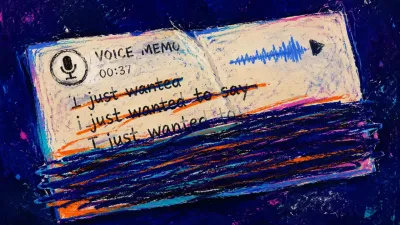
The Six-Word Slack Message and the Cost of Editing Yourself to Fit In
If you are the person who can read every room but still rewrites a six-word Slack message four times, this may feel familiar. Jordan (name changed for privacy), a 26-year-old junior product designer in Toronto, arrived on my screen holding a mug in both hands, their shoulders lifted as if they were bracing for feedback that had not yet come.
They took me back to 9:07 that morning. At the narrow counter in their condo kitchen, the radiator had ticked beside a cup of bitter coffee while blue screen light caught each revision. Jordan had typed a direct but friendly warning about a usability risk, deleted the joke beneath it, replaced two phrases with language their manager often used, and reread the Slack draft four times. Then they sent six words: “Sounds good to me.”
“By the time a message feels safe enough to send, it barely sounds like me,” Jordan said. “I know how to read the room, but I’m tired of disappearing into it. Why do I keep editing myself just to feel included?”
I heard the contradiction clearly: Jordan wanted to show up without editing away their personality, but feared that an unmistakably personal sentence might cost them access to the room. The belonging anxiety sat in their body like a smoke alarm wired directly to the throat; humour, enthusiasm, disagreement, or one firm verb could make the whole system flare.
“It makes sense that you learned to protect something as important as belonging,” I told them. “I’m not going to tell you to ‘just be yourself’ as though every workplace is equally safe or context never matters. I want us to find the line between deliberate adaptation and compulsory disappearance. Let’s give this fog a map, then put the pen back in your hand.”

Choosing Four Rungs Through the Fog
I invited Jordan to place both feet on the floor, take one ordinary breath, and hold the question in mind while I shuffled. I use this pause as a transition, not as a test of spiritual concentration. It simply gives the nervous system a moment to arrive before the analysis begins.
I chose the Four-Layer Insight Ladder, a four-card tarot spread for self-censorship and belonging anxiety. Jordan’s question was not asking for a prediction about whether every colleague or friend would approve of them. It was asking why the same approval filter kept taking over. The ladder was precise enough to trace that pattern without burying it beneath unnecessary positions.
This is how tarot works in my practice: the cards create a shared visual object through which I can separate behaviour, fear, resource, and action. Card meanings in context do not overrule lived evidence. They help me place competing thoughts where Jordan can inspect them rather than experience them as one undifferentiated verdict.
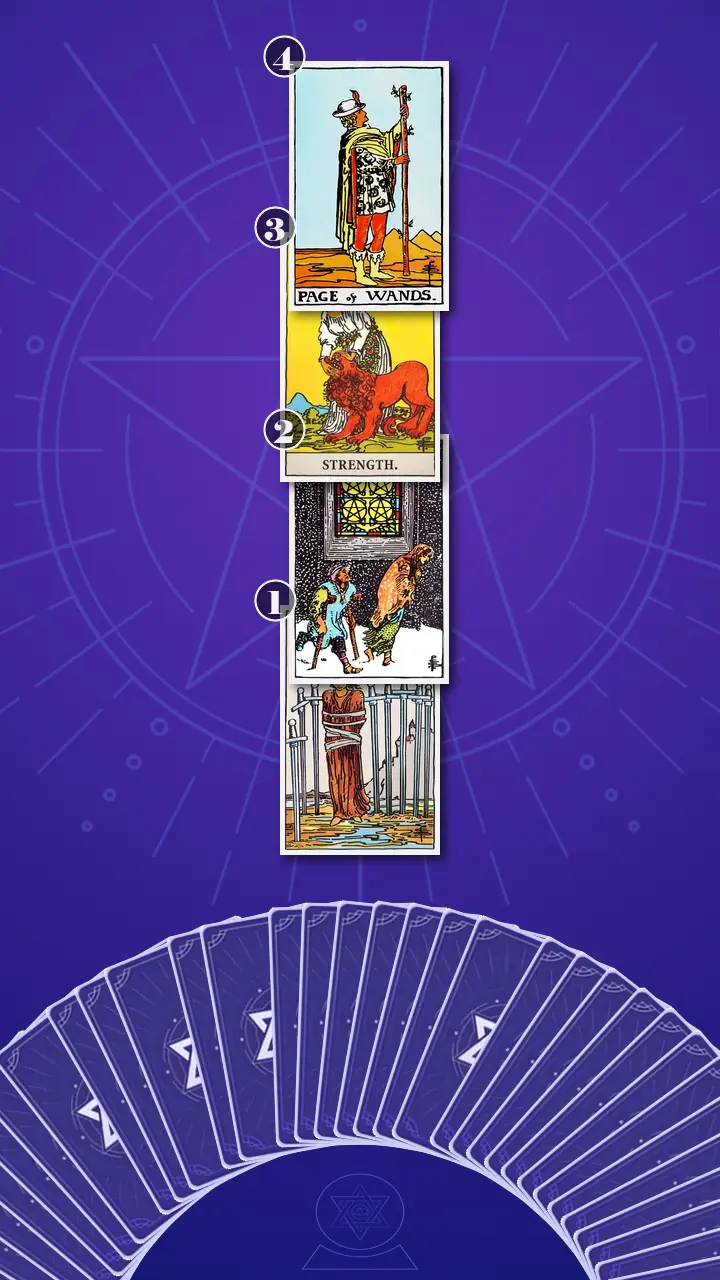
I arranged the cards vertically. The bottom position would show the visible editing behaviour. The second would reveal the fear maintaining it. The third would identify the internal quality capable of changing the pattern. The final position would turn that quality into one bounded experiment. The eye would climb from restriction to movement, one rung at a time.
Reading the Invisible Approval Filter
Position One: The Slack Draft Surrounded by Reactions That Never Happened
The first card I turned represented Jordan’s diagnosis-level behaviour: rewriting, softening, mirroring, or withholding speech whenever inclusion felt uncertain. It was the Eight of Swords, upright.
I pointed to the blindfold, the loose cloth bindings, and the incomplete enclosure of swords. “This card does not say every restriction is imaginary,” I said. “It says you currently cannot see which limits are externally enforced, which are habitual, and which might be negotiable. Partial information is being treated as a complete social forecast.”
I brought the image directly into Jordan’s morning. At 9:07, imagined reactions had become louder than the wording, the context, or any response that had actually occurred. The original contribution contained a design concern and a trace of humour. After the joke disappeared and the manager’s vocabulary took its place, only “Sounds good to me” remained. The immediate risk felt lower, but the team received neither Jordan’s concern nor Jordan’s voice.
The Eight of Swords showed Air energy in excess until it became a blockage. Thought was no longer helping Jordan communicate; it was generating simulated consequences faster than evidence could arrive. The internal script ran sentence by sentence: “If I remove the joke, soften the verb, add one more qualifier, and borrow the safest wording, maybe nobody can read me as difficult.”
The split had an unnerving Severance quality. The professional version remained functional and agreeable while the expressive person waited outside the meeting. Even the familiar Slack-message search spiral, “Is this too direct?” and “How many exclamation marks are professional?”, had become less about clarity than control.
Jordan gave a short laugh with a bitter edge. “That is so accurate it feels a little brutal.” Their fingers tightened around the mug, then loosened.
I let the reaction have room. “I’m not calling your caution irrational,” I said. “You work in a junior role, informal influence matters, and career stability is real. I’m asking whether the safety strategy is now operating in situations where nobody has supplied enough evidence to justify the full edit. Reading the room is a skill. Disappearing into it is a cost.”
I asked Jordan to picture the last message they had edited more than twice. “What did you remove first, and what exact reaction were you trying to prevent?”
“Usually the humour,” they said. “Then the direct verb. I’m trying to stop someone from deciding I’m difficult before I can explain myself.”
Position Two: Inside the Invite, Outside the Warmth
The next card represented the mechanism beneath the behaviour: the fear that an unedited presence would threaten belonging and expose social welcome as conditional. I turned over the Five of Pentacles, upright.
The card showed two figures moving through snow outside an illuminated window. “You can be physically close to a group and still experience its warmth as inaccessible,” I said. “This card is not predicting rejection. It is showing what happens when welcome feels scarce enough that every interaction becomes a renewal interview.”
Jordan had described a downtown hybrid meeting at 4:42 p.m. They had a seat, a calendar invitation, and their name in the shared document. When they raised a point, the facilitator replied, “Okay, noted,” and moved on. Fluorescent lights humm above the glass room, and the air carried the dry smell of whiteboard marker. Jordan’s throat closed. For the rest of the meeting, they nodded and took notes.
The Five of Pentacles gave the Eight of Swords a root. Its Earth energy had become blocked around scarcity and material security. High Toronto housing costs and the vulnerability of a junior role meant that being perceived as difficult did not feel like a purely social inconvenience. I did not dismiss that context. I separated it from the unsupported conclusion that one flat response meant Jordan’s place had already begun to disappear.
“A neutral reply is data-poor, not proof of rejection,” I said. “It may be disappointing. It may deserve attention if it forms part of a repeated pattern. But by itself, ‘Okay, noted’ cannot tell us whether the person disagreed, felt rushed, wanted to return later, or barely registered their own tone.”
Jordan’s thumb stopped moving around the mug handle. Their gaze drifted past the screen as though an old meeting were replaying behind it. Then they released a low breath and pressed a palm briefly to their chest.
“I’m technically in the room,” they said, “but I act like one wrong sentence could reveal that I was never really one of them. Then I’m angry later because nobody knows what I actually think.”
I noticed something else in the spread: no Cups card had appeared. The longing, hurt, and resentment were present, but Jordan usually translated those feelings into more analysis before naming them directly. The cards were not asking for indiscriminate emotional disclosure. They were showing me that an unspoken need for welcome had been allowed to edit almost every sentence.
When Strength Put a Hand on the Volume Dial
Position Three: The Voice Was Never the Threat
The radiator behind Jordan stopped ticking as I reached for the third card, and the sudden quiet made the room feel wider. This position represented the key shift from approval-driven self-erasure to calm, context-aware expression grounded in self-trust. I turned over Strength, upright.
I held the card closer to the camera. A woman rested gentle hands at a lion’s jaws. She did not dominate the animal, abandon it, or pretend its energy did not exist. Her steadiness created relationship. In Jordan’s life, that could look like noticing the urge to dilute a usability concern, feeling both feet on the floor, and allowing one proportionate sentence to remain: “I see one risk with this flow; can I show you where?”
I brought us back to 9:07 a.m.: the deleted joke, the manager’s borrowed language, four rereads, then “Sounds good to me.” The message had landed safely, but Jordan’s tight throat had registered the hidden fact. The person who wrote it had barely arrived.
As an artist, I know that editing can give a scene shape. I also know what happens when every distinctive line is cut because somebody in an imagined audience might object: the character becomes impossible to know. I used one of my core lenses, Persona Fatigue Diagnosis, to name what I was seeing. Jordan’s professional persona was not fake or dishonest. It was exhausted from performing full-time security work, constantly smoothing the path before the fuller person was permitted to enter.
I also audited the genre of Jordan’s internal monologue. It had quietly become workplace suspense: every pause foreshadowed exile, every neutral emoji concealed a verdict, and every natural phrase looked like the scene where access might be revoked. Strength changed the genre. It did not promise a happy ending or universal applause. It moved Jordan from horror-trailer prediction into grounded observation.
“Strength is not the mute button,” I said. “It is the hand on the volume dial. You can lower the heat without deleting the point. Context can shape your sentence without deleting its author.”
You do not need to muzzle your natural voice to earn a place; practise one honest, proportionate expression, as Strength's gentle hands guide the lion without extinguishing its power.
Jordan’s inhale stopped halfway. The index finger that had been tracing the mug handle hovered in place, and their mouth parted without sound. For a few seconds, their gaze slipped away from the card; I could almost see them replaying drafts, meetings, and train rides home. Their pupils widened, then their eyes brightened at the edges. One shoulder dropped, followed by the other. Their free hand opened against the desk, and a breath left their chest with a faint tremor. Then their jaw tightened again. “But doesn’t that mean I’ve been doing this wrong for years?” they asked, sharper than before. The relief had opened a door, but responsibility stood just behind it. For a moment, Jordan looked almost dizzy with the idea that a future sentence might genuinely be theirs to choose.
“No,” I said. “It means adaptation protected you, sometimes intelligently. We are not putting that part of you on trial. We are updating its job description. It can still notice hierarchy, bias, timing, and risk. It just no longer gets automatic authority to remove you from every low-stakes scene.”
I asked, “Now, using this new perspective, think back to last week. Was there a moment when this insight might have let you feel different?”
Jordan remembered a design review in which they had spotted an accessibility issue, softened it twice, and finally said nothing. “I didn’t need to make a speech,” they said slowly. “I could have kept one sentence. I could have said, ‘Can we check the contrast before we lock this?’”
That was the pivotal crossing in our Journey to Clarity: from approval-driven social scanning and self-erasure to embodied self-trust and context-aware participation. It was not fearlessness. It was the first small recognition that possible disapproval did not deserve a veto before Jordan had even spoken.
The Page Who Treated One Sentence as a Beta
Position Four: Expression Without a Final Examination
The final card represented the action layer: one low-stakes experiment with natural wording, followed by observation of the actual response. I turned over the Page of Wands, upright.
The Page studied a sprouting wand with curiosity rather than certainty. I read the image as an emerging message, alive enough to test but not required to carry an entire identity. For Jordan, this could mean sending one warm, direct message after a single edit while preserving a clear preference, a piece of humour, or a respectful disagreement.
The Page restored Fire that had been underused in the first half of the spread. This was not reckless expression or unfiltered disclosure. It was exploratory energy in balance: small enough to be proportionate, real enough to produce evidence. One honest message would be a beta test, not a global product launch.
“Let one sentence stop auditioning,” I said. “After you send it, write down what you predicted and what observably happened. A delayed reply is ‘unknown.’ It is not rejection, and it is not secret approval. It is simply data that has not arrived.”
Jordan reached for their phone and opened Notes. Their shoulders were not completely relaxed, but I saw more space between them and their ears. “So the message can teach me something,” they said, “without proving whether everyone approves of me.”
“Exactly,” I replied. “The Page does not ask you to defend a finished product. It asks you to enter the conversation as a learner who is also allowed to be visible.”
The Director’s Cut of the Next Forty-Eight Hours
I placed all four cards back into the vertical ladder. The Eight of Swords showed the visible loop: monitor. The Five of Pentacles revealed what the monitoring tried to secure: welcome. Strength supplied the missing hinge: regulate without erasing. The Page of Wands carried the result outward: express, observe, and learn.
I did not need to invent a dramatic origin story to explain why Jordan felt stuck. Repeated exposure to polished workplace language, ambiguous responses, different social codes, and materially meaningful career pressure had trained the approval filter to act early. Each edit created short-term relief. But every erased opinion gave other people less information about Jordan, so the resulting distance seemed to confirm that belonging required even more editing.
The cognitive blind spot was not social sensitivity itself. It was treating predicted disapproval as though it were observed feedback, then treating universal approval as the admission price for participation. The transformation direction was equally specific: move from rewriting every contribution for maximum acceptability to making one low-stakes, values-aligned contribution in natural wording and observing what actually follows.
“I could turn the log into another performance review,” Jordan warned. “I know myself. I’ll analyse every minute of silence.”
“Then the boundary around the experiment matters as much as the experiment,” I said. I introduced my Director’s Cut of Self-Compassion, a mental editing technique for interrupting the punitive review. Instead of letting an internal judge recut the scene until Jordan became the villain, I asked them to pause and describe the moment as an objective, supportive director would: what was said, what happened, and what remained unknown.
Three Small Practices That Return the Author
- Use the feet-down Strength pause. Before one routine team message this week, take sixty seconds. Put both feet on the floor, lower your shoulders once, and identify the single point you do not want the edit to erase. Read the draft as a supportive observer and ask, “What genuinely needs context, and what am I punishing only because it sounds like me?” Use this only in a setting you judge to be low-risk. In a hostile, discriminatory, or materially unsafe environment, keeping the message in drafts, adapting further, or not sending it can be the wiser choice.
- Run the One-Edit Voice Test. On Wednesday before 11 a.m., choose one routine Slack or Teams contribution. Preserve one natural phrase, clear preference, light joke, or respectful disagreement, then send it after no more than one edit. A workable example is, “I see one usability risk with this direction; can I show you where?” If one edit feels too exposing, allow two while keeping one authentic element. A saved draft still counts as useful information about where the approval filter appears.
- Build the four-column Actual Response Log. Open a note with four headings: prediction, exact wording sent, observable response, and how participation felt. Spend no more than three minutes recording exact words, emoji, a follow-up question, a topic change, or “no reply yet.” Check once after twenty-four hours and label genuinely ambiguous outcomes “unknown.” Do not infer tone from silence. If the log increases vigilance instead of reducing it, stop tracking and keep only the original message as evidence that you participated.
I reminded Jordan that none of these actions required them to become unguarded, endlessly candid, or easy for every group to understand. Deliberate code-switching can be skillful and protective. The question was whether Jordan was choosing the adjustment or automatically treating their personality as a defect that needed correction.
The cards had not issued a verdict about where Jordan belonged. They had created a storyboard: the constricting scene, the fear beneath it, the internal resource, and the next available action. Jordan still held the pen. Tarot could illuminate the edit, but only Jordan could decide which line to restore.

One Week Later, the Sentence Still Had an Author
A week later, Jordan messaged me. They sent, “I see one usability risk; can I show you where?” after one edit. Their manager replied, “Good catch.” Jordan slept all night. In the morning, “What if I overdid it?” returned, but it no longer got final cut.
I did not treat the reply as proof that natural expression would always be rewarded. One “Good catch” could not settle Jordan’s workplace, relationships, or future. It did offer a small piece of reality where a predicted rejection had once stood. Jordan had spoken, remained considerate, and survived an incomplete outcome without converting it into a verdict on their worth.
That was the quiet proof of our Journey to Clarity. The transformation was still in production, imperfect and sometimes uncomfortable. Yet Jordan had moved one step from approval-driven self-erasure toward grounded participation, not because the cards changed their fate, but because they used the reading to make a conscious choice.
When your throat tightens over a six-word message, the hardest part is rarely finding perfect phrasing. It is wondering whether the room will still want you when the words sound unmistakably like yours. If you can notice that silent tug-of-war between “be easy to approve” and “let me be known,” you have already returned to the author’s chair.
So, when your next six-word message starts auditioning for universal approval, what natural phrase, clear preference, or spark of humour will you leave in the director’s cut?

Every reading at AceTarot is a journey to connect with inner wisdom and empower the path ahead. This reading shared here is a psychological mirror, not a private record—crafted to reflect universal emotional loops and help restore personal clarity. Please note that these insights do not replace professional psychological, medical, legal, or financial advice, and should not serve as the sole basis for major life decisions.
Learn more about our Journey to Clarity.
How did this insight land for you?
🫂 This Resonates Deeply
🌀 Living This Story
✨ Now I See Clearly
🌱 Seeing New Possibilities
🧰 Useful Framework
🔮 The Confirmation I Needed
💪 Feeling Empowered
🚀 Ready for My Next Step
Author Profile
AI Juniper Wilde
1056 readings | 537 reviews
“I’ve always felt our lives are films currently in production. As an artist, I know that when you feel stuck, it’s often because you’ve bravely stayed in a painful scene for just a little too long. I’m not here to coldly analyze you. I want to sit closely with you, look at those difficult moments with profound empathy, and gently hand you the pen so you have the courage to write your next beautiful act.”
In this Introspection Tarot Reading :
Core Expertise
- Internal Monologue Auditing: Identifying the destructive 'genre' (e.g., tragedy, horror) of your subconscious thoughts that constantly induces anxiety.
- Persona Fatigue Diagnosis: Assessing the heavy psychological toll of maintaining an artificial 'social character' that conflicts with your authentic self.
Service Features
- The Director's Cut of Self-Compassion: A mental editing technique to pause a spiral of self-hatred, reframing the internal narrative from a punitive judge to an objective, supportive observer.
Also specializes in :
Explore Related Patterns:
Approval-Driven Self-SilencingAt 9:07, Jordan deletes the joke, borrows their manager's vocabulary, rereads the draft four times, and sends "Sounds good to me" even though they see a usability risk. The same sequence returns in a design review, where an accessibility concern is softened twice and finally withheld. Each removal lowers immediate exposure, teaching your protective system that a less recognizable version of your message is the price of keeping access to the room. That short-term relief gives the pattern its staying power. When every sentence feels like a fresh test of whether you are acceptable, professional adaptation stops being a conscious choice and becomes a pre-emptive veto on your humour, judgment, and disagreement. This is approval-driven self-silencing because the strategy does not merely improve the delivery; it removes the contribution and the person who authored it.
Rejection SensitivityAfter the facilitator replies "Okay, noted," Jordan's throat closes even though the reply contains too little information to establish rejection. They already have a seat, an invitation, and their name in the document, yet one flat response feels capable of revealing that they were never truly part of the group. The reaction is organized around the anticipated loss of welcome, not only around disagreement with the design point. When rejection sensitivity takes over, your attention gives ambiguous signs more weight than concrete evidence of inclusion. Editing then becomes a preventive defence: if you can remove whatever might be judged difficult, perhaps you can stop exclusion before it begins. The cost is that acceptance remains conditional in your mind even when no condition has been stated, so each new sentence has to earn safety again.
Mind ReadingBefore Jordan sends the Slack message, imagined reactions become louder than the actual wording, context, or feedback available. A joke is treated as potentially dangerous, a direct verb as potentially difficult, and the facilitator's "Okay, noted" as a possible verdict on belonging. The missing information is filled with a specific story about what other people have decided. Mind reading converts prediction into apparent evidence. Once you assume that a pause, neutral emoji, or flat response conceals disapproval, editing feels like a rational response to feedback even though the feedback has not been observed. This cognitive distortion keeps the approval filter persuasive because you are no longer responding to uncertainty as uncertainty; you are responding to an imagined judgment as though it has already been delivered.
Self-Fulfilling ProphecyThe six-word agreement lowers Jordan's immediate social risk, but it also prevents the team from receiving either the usability concern or Jordan's distinctive voice. Jordan later feels angry that nobody knows what they think, while the distance created by withholding appears to confirm that genuine inclusion is unavailable. The protective action quietly helps produce the interpersonal outcome it was designed to prevent. A self-fulfilling prophecy forms when your forecast changes your behaviour in ways that make the forecast seem increasingly true. If predicted rejection leads you to reveal less, other people have fewer opportunities to respond to the fuller contribution, and the resulting lack of recognition can look like proof that visibility was never safe. Seeing the loop separates actual exclusion from distance generated by the defence itself.
Workplace HypervigilanceJordan arrives with their shoulders already raised for feedback that has not happened, then monitors jokes, verbs, qualifiers, borrowed vocabulary, pauses, and neutral replies for possible danger. After a facilitator says only "Okay, noted," their throat closes and they spend the rest of the meeting nodding and taking notes. The visible sequence shows a workplace threat detector acting before the available evidence can support its conclusion. Your awareness of hierarchy and professional risk can be useful, especially when status and career stability genuinely matter. Workplace hypervigilance begins when that awareness stays continuously activated and treats every ordinary interaction as a renewal interview. The result is not simply careful communication; it is sustained scanning that narrows attention, braces the body, and makes withdrawal feel necessary before anyone has clearly rejected the contribution.
Boundary DiscernmentThe consultation draws a precise line between deliberate adaptation and compulsory disappearance, and Jordan limits the first experiment to a setting they judge low risk. They do not attempt total openness or ignore the realities of hierarchy. They preserve one proportionate work concern while allowing their manager to have a separate, uncontrollable response. Boundary discernment means your context awareness can inform the sentence without becoming its sole author. You can decide what genuinely needs adaptation, what remains unknown, and which essential point belongs to you to keep. This restores a clear distinction between another person's possible judgment and your own right to contribute, making caution a chosen boundary rather than an automatic surrender of voice.
Strategic VisibilityJordan keeps the sentence "I see one usability risk; can I show you where?" and sends it after one edit in a low-risk setting. The message remains concise and considerate, but the usability concern and its author are both present. Even when "What if I overdid it?" returns the next morning, that thought no longer receives final authority over the completed interaction. Strategic visibility replaces the demand for either total concealment or unfiltered disclosure with a bounded experiment in being recognizable. You retain context awareness, regulate the level of exposure, and keep one meaningful element that the approval filter would normally erase. Visibility becomes a choice you can calibrate, rather than a high-stakes referendum on whether everyone will continue to include you.
Explore Related Struggles:
Approval-Safety FusionA facilitator says, "Okay, noted," and Jordan spends the rest of the meeting nodding instead of contributing. The response is ambiguous, but the stakes of a junior role and career stability give it the force of an approval decision that appears capable of changing their access to the group. When approval becomes the working evidence of safety, every pause, flat reply, or natural phrase can feel like a security check. You are then pushed to optimize for a favorable reaction before ordinary participation has even occurred. Separating observable consequences from anticipated disapproval makes room for caution that is evidence-based rather than automatically governed by the need to be approved.
Belonging-Authenticity SplitJordan begins with a real usability concern and a trace of humour, then removes both until the message says only, "Sounds good to me." The edit keeps them visibly cooperative, but it also prevents the room from encountering the judgment, personality, and disagreement they wanted to contribute. When you experience recognizable self-expression as a possible cost of admission, belonging and authenticity pull in opposite directions. You can remain included on paper while wondering whether the welcome applies to you or only to the version of you that creates no friction. Seeing that split clearly returns the decision to you: context may shape your expression, but it does not automatically need to erase its author.
Evidence DisconnectionAt 9:07, imagined reactions become louder than Jordan's actual wording before anyone has seen it. Later, "Okay, noted" and the possibility of a delayed reply are made to carry conclusions that the available facts cannot yet support. Your actions become disconnected from evidence when a simulated consequence is allowed to function as observed feedback. You respond to the rejection forecast by removing the very contribution that could generate new information, so reality has fewer chances to correct the forecast. Naming "unknown" as a complete and legitimate data state reopens that feedback path without requiring you to assume either rejection or approval.
Masked Self-DivisionThe professional version of Jordan remains functional, agreeable, and present while the person who noticed the risk and wanted to use humour is left outside the exchange. Colleagues encounter smooth cooperation, but the concealed concern later returns as frustration that nobody knows what Jordan actually thinks. Masked Self-Division develops when the public version is allowed to occupy the full relationship space while the expressive version is repeatedly denied entry. You can remain competent enough to preserve access and absent enough to feel unknown at the same time. The task is not to discard a useful professional persona; it is to notice when that persona has stopped representing you and started replacing you.
Self-Editing ExhaustionJordan rereads six words four times after already deleting the joke, softening the concern, and replacing their own phrasing. The labor invested in the message keeps increasing while the amount of meaningful information reaching the team keeps shrinking. You enter Self-Editing Exhaustion when revision is no longer serving clarity and instead performs continuous social security work. Each edit brings brief relief, but the erased opinion leaves other people with less of you to respond to; that distance can then appear to confirm the need for more editing. The system stays busy without delivering either reliable safety or genuine participation, making the distinction between useful adaptation and compulsory revision essential.
Voice-Safety FusionJordan removes the joke first, softens the direct verb next, and then borrows the manager's vocabulary. Each recognizable feature of their voice is handled as another point of exposure, even though no colleague has yet responded to the original wording. You face a Voice-Safety Fusion when speaking in your own proportionate language and remaining secure in the room start to feel mutually exclusive. The conflict does not require reckless disclosure or pretending hierarchy is irrelevant. It asks whether the actual context is choosing the adjustment, or whether a predicted verdict is preemptively deciding that your voice itself is unsafe.
Welcome-Perfection BindJordan has a calendar invitation, a seat in the meeting, and a name in the shared document, yet one imperfectly received sentence seems capable of cancelling all three forms of inclusion. Even a routine Slack message begins auditioning until humour, preference, and disagreement have been removed. You are caught in a Welcome-Perfection Bind when formal inclusion cannot register as welcome unless each new interaction secures approval again. The standard leaves no room for ordinary ambiguity, neutral tone, or respectful friction, so participation never becomes settled enough to feel inhabited. Recognizing the impossible admission standard lets you evaluate individual interactions without making each one responsible for proving your entire place in the room.
Internal Authority CollapseJordan replaces two phrases with language their manager often uses and allows anticipated reactions to decide whether the original concern can be spoken. The approval filter does not merely advise caution; it receives the final decision before Jordan has assessed what the specific situation actually requires. Internal Authority Collapse occurs when your own contextual judgment loses its governing position to an imagined external panel. You may still compose the sentence, but someone else's vocabulary, standards, and possible verdict effectively hold the pen. Reclaiming authority does not require ignoring hierarchy or risk; it means letting observed context inform your choice without granting predicted disapproval an automatic veto.
Explore Related Emotions:
Approval AnxietyJordan rewrites a six-word Slack message four times, borrows their manager's language, and braces for feedback before anyone has responded. The draft is no longer being edited only for clarity; it is being asked to prevent every possible negative interpretation in advance. You can feel Approval Anxiety when another person's imagined verdict gains access to your words before your own meaning does. The repeated editing offers immediate protection, but it also keeps your attention fixed on whether you are acceptable enough to enter the room, making approval feel like a condition that must be solved before participation can begin.
Cautious Self-TrustJordan places both feet on the floor, lowers their shoulders, and identifies the one point the edit must not erase. They do not stop reading context or pretending that hierarchy is irrelevant; they begin deciding which adjustments serve the situation and which ones remove the speaker. You develop Cautious Self-Trust when your own observation is allowed to remain credible without requiring total certainty or total exposure. Here, trust is not a demand to say everything. It is the growing conviction that you can assess the room, preserve one honest sentence, and still decide for yourself how much of your voice the moment can responsibly hold.
Conditional Belonging FearJordan has a calendar invitation, a seat in the glass meeting room, and a name in the shared document, yet "Okay, noted" makes their throat close. Formal access is present, but it does not settle the deeper question of whether that access can survive a distinct opinion. You experience Conditional Belonging Fear when inclusion feels renewable rather than secure, as though each sentence must prove that keeping you in the room is still worthwhile. Under that pressure, self-editing becomes an attempt to preserve membership, because sounding unmistakably like yourself feels capable of exposing the welcome as temporary.
Grounded AgencyJordan limits one routine message to a single edit, preserves the design concern, and separates what they predicted from what observably happened. When the manager replies "Good catch," the response becomes one piece of evidence rather than a permanent ruling on Jordan's acceptability. You feel Grounded Agency when participation becomes an action you can choose instead of a test you must pass. The shift does not place other people's responses under your control. It returns control to the decisions that are actually yours: what to say, what context requires, what remains unknown, and whether an edit improves the message or merely removes its author.
Regulated CourageJordan sends "I see one usability risk; can I show you where?" after one edit. The sentence is direct without becoming a speech, and the body does not need to feel completely relaxed before the message is allowed to leave the draft. You embody Regulated Courage when tension is present but no longer receives automatic veto power. The courage lies in proportion: you acknowledge context, keep the temperature manageable, and let the essential point survive. Your voice does not have to become louder than the room; it only has to remain present enough to take part in it.
Voice Erasure DreadJordan deletes the joke, removes the direct verb, substitutes their manager's vocabulary, and finally sends "Sounds good to me." In another review, an accessibility concern is softened twice and then withheld completely. The protective edit does more than lower the temperature; it removes the person who had something useful to say. You meet Voice Erasure Dread when recognisable expression feels dangerous enough that silence or borrowed language seems safer than authorship. The dread is not simply about choosing the wrong words. It is the expectation that your own verbal signature could cost you access, even as repeatedly removing it leaves you present in name but absent from the exchange.
Self-Betrayal AcheJordan begins with a real usability concern and ends with six words of agreement that barely sound like them. The message reaches the team, but the observation, humour, and preference that gave it an author have been removed along the way. You feel Self-Betrayal Ache when the version of you that earns immediate social safety is also the version that conceals what you know and how you naturally speak. The pain comes after the successful edit: the room has not rejected you, yet you still experience a loss because you were required to leave yourself outside before entering it.
Shocked ClarityJordan's finger stops on the mug handle, one shoulder drops after the other, and then their jaw tightens as they ask whether they have been doing this wrong for years. The insight lands all at once: adaptation was sometimes intelligent protection, yet it has been given more authority than every present situation requires. You experience Shocked Clarity when a familiar behaviour suddenly becomes visible as a choice-bearing process. The clarity carries release because the pattern can be adjusted, and impact because authorship brings responsibility back into view. A future sentence may still be difficult, but it no longer has to be edited by an unquestioned prediction before you have consciously chosen what the moment needs.
Explore Related Contexts:
Code-Switching Inclusion GapAt 9:07 a.m., Jordan deletes a joke, replaces two phrases with their manager's vocabulary, rereads the draft four times, and finally sends "Sounds good to me." These edits do more than refine tone: they exchange a recognizable contribution for language associated with authority, acceptability, and continued access. In a junior role where informal influence matters, code-switching can be a deliberate professional skill. It becomes an inclusion gap when the translated version is the only version permitted into the room, leaving humour, disagreement, and specialist judgment outside even while formal membership remains intact. You may therefore appear fully included while colleagues receive too little of your actual perspective to know or respond to it. The useful distinction is whether you are choosing an adjustment for a specific context or automatically paying for participation by removing the author from every sentence.
Conditional Belonging PressureJordan has a seat in the hybrid meeting, a calendar invitation, and their name in the shared document. After the facilitator responds "Okay, noted" and moves on, however, Jordan spends the rest of the meeting nodding and taking notes rather than testing whether their point still has room to develop. That scene places formal inclusion beside uncertain social permission. Junior status, informal influence, and high housing costs make continued workplace access materially meaningful, while the group's ambiguous responses provide no dependable map for how much disagreement or personality the room will tolerate. Under those conditions, you can begin treating every interaction as another admission test even when nobody has issued an explicit rejection. Naming the pressure makes it possible to separate actual exclusion signals from incomplete feedback and to decide which rooms require strategic adaptation, which permit a measured test, and which repeatedly demand too high a price for belonging.