Fear of Family Disapproval Closed the Course Tab; a Pilot Followed

When Family Approval Becomes the Acceptance Letter
You know what work you want until a weekly family call turns your career pivot into a debate about benefits, status, and whether it is realistic. I heard that sentence in the way Maya, twenty-eight and working in corporate communications in Toronto, placed her phone face down on my table.
At 10:40 p.m. on a Sunday in her rental, the illustration-course checkout glowed beside an updated corporate CV. A family voice note about job security crackled through the phone's tinny speaker; the radiator clicked, her cold tea tasted metallic, and I watched her close the course tab before editing her LinkedIn headline.
"I know what I want until I hear their reaction," she said. "Why do I keep choosing family approval over the work I actually want?" She had completed paid illustration projects and kept a portfolio alive for years, yet every possible move toward editorial illustration became a request for permission before it became a decision.
I recognized approval-driven career self-abandonment: the repeated retreat from vocational fit into a family-approved corporate path. Maya was not simply choosing between illustration and stability. In the moment her throat tightened, she was choosing between the immediate relief of approval and the feared meaning of pursuing work that might disappoint people she loved.
Her guilt-tinged anxiety felt, in the body, like a seatbelt cinched across her upper chest by an invisible audience. The more she rehearsed how to explain herself, the less room remained for the quiet pull toward the work itself. I told her I would not use the cards to predict whether her family would agree or whether illustration would guarantee a career. I would use them as an objective symbolic map of the pattern already operating, so we could separate measurable risk from anticipated rejection and let her make the decision.
"We do not have to solve your entire future tonight," I said. "We can make the fog specific enough to walk through. Our Journey to Clarity starts by seeing what has been choosing for you."

Choosing a Compass for the Career Crossroads
I invited Maya to take one slow breath, name the question without softening it, and notice what happened in her throat and chest before she reached for another explanation. Then I shuffled slowly. The pause was a psychological transition, not a test of faith: it gave her attention somewhere to rest while I translated the cards into questions she could check against her lived experience.
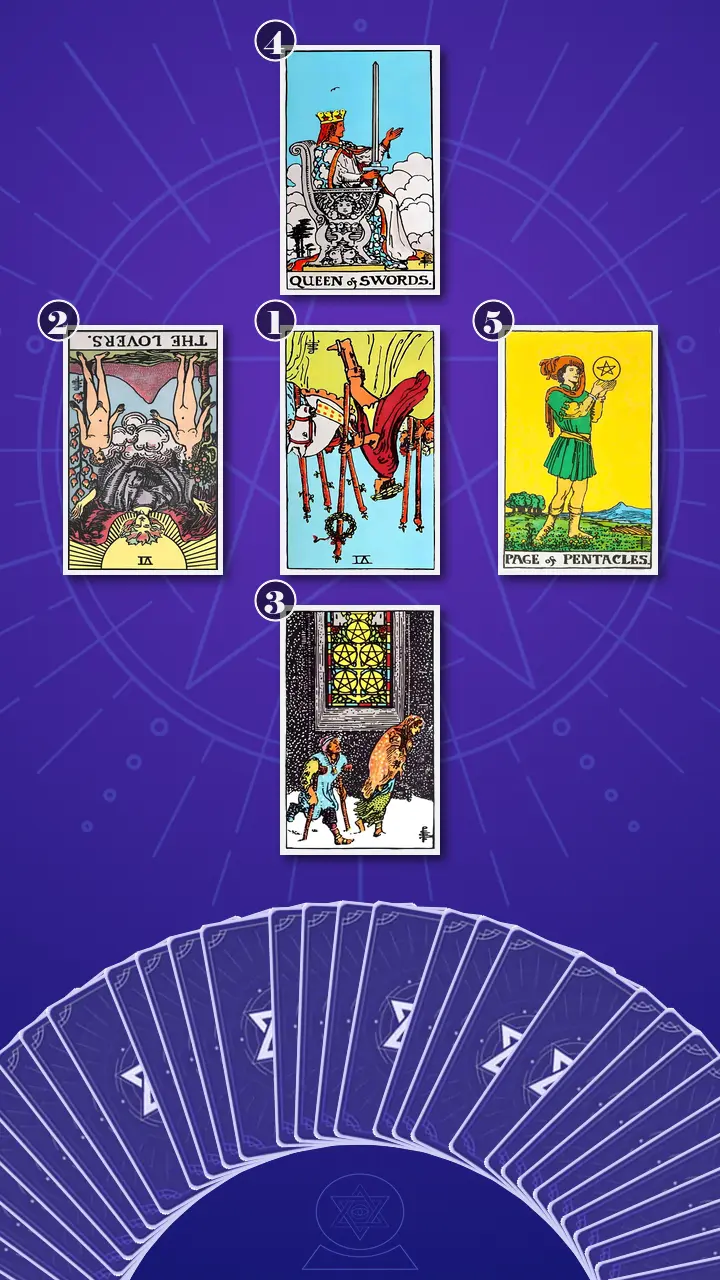
"Today I am using a five-card Shadow Spread in a classic cross layout," I explained. "For me, this is how tarot works as a reflective tool. The cards externalize a pattern so we can examine it without treating any symbol as a verdict."
This spread suits a question about repeated self-abandonment because it follows a complete inner excavation rather than comparing two job offers. The five positions move from the visible approval loop, to the hidden value conflict, to the belonging fear beneath it, then upward to a boundary-based resource and across to a practical experiment. A simple outcome spread might ask which career looks better; this one asks why Maya keeps handing the decision away.
I told her that the center would show the behavior she could already observe, the card to its left would reveal the disowned conflict beneath it, and the card below would identify the fear giving the pattern its force. Above the center, we would find the quality she needed to reclaim. Finally, the card to the right would turn insight into a small next action rather than another round of research.
The Map Begins Where the Applause Takes Over
The Rider Beneath the Applause
"The card I am turning now represents the observable approval-seeking behavior in the diagnosis: the moment you pause or abandon desired work after an uncertain family response," I said.
The full card was the Six of Wands, in reversed position.
In the Rider-Waite-Smith image, a laurel-crowned rider passes through a crowd while victory wreaths make recognition visible. Reversed, that fire is blocked and overdependent on witnesses. The energy is not a lack of motivation; it is an excess of external scanning combined with too little inward recognition. The crowd has become a scorecard, and the score changes whenever the audience changes.
I connected it directly to the Sunday-night ritual. Maya had been one click from enrolling in an illustration course. After replaying a cautious voice note about employability, she closed the enrollment page, removed an illustration link from her materials, and updated her corporate CV. The approved option gave her a brief physical release because her family's response had become more authoritative than her contact with the work.
"It is like refreshing LinkedIn reactions before deciding whether the project itself held your attention," I said. "Their reaction has become the acceptance letter. A doubtful tone now sounds like evidence that the work is objectively wrong, even though it may only be evidence that someone is worried."
I compared the split inside her to the workplace identity in Severance: competent in public, increasingly detached from the private self who wants a different kind of day. The card did not make her family villains. It showed that Maya had placed an audience between herself and the work, then mistaken the interruption for a reliable career assessment.
Maya gave a short, bitter laugh. "That is too accurate. Almost cruel."
I stayed with the reaction rather than rushing to reassure her. "I hear the cruelty in the repetition, not in your family," I said. "The useful question is what you do in the ten minutes after you hear concern. Do you return to your own criteria, or do you let the audience close the tab for you?"
Her thumb stopped above her phone. First her breath caught and her fingers froze; then her eyes moved away from the card as if replaying the family voice note word by word; finally she exhaled through her nose and looked back at the course page. I saw recognition arrive before agreement: "I was excited until they sounded uncertain, so uncertainty must mean the choice is wrong."
The Shared Document with No Author
"The next card represents the hidden value conflict beneath that behavior: the place where your vocational desire has been subordinated to family agreement before you have defined your own criteria," I said.
The Lovers appeared in reversed position.
The card concerns relationship, meaningful choice, and alignment with values. Reversed, its energy is a blockage between what Maya says she wants and the standards she actually uses to choose. The problem is not that she cares about her family. The blockage is that family agreement has occupied the place where self-defined consent should have been.
I described Maya's decision process as a shared Google Doc in which her family's concerns had edit access while her own values remained an unwritten draft. Her Notion pages contained rows for salary, benefits, status, and predicted family reactions, but no field for visual storytelling, creative engagement, or the kind of week she wanted to live.
"I need them to understand before I am allowed to know what I think," she said quietly.
I asked her to look at the blank space rather than defend the completed columns. "Before you open the family chat, what would you need from the work if nobody else were reviewing the document?"
Her shoulders lifted, then settled only slightly. She went quiet, felt the familiar small tightening in her chest, and began mentally scanning her latest pros-and-cons list. I watched her realize that the list contained everyone else's criteria except her own. She picked up a pen and wrote three headings before reaching for her phone: creative engagement, workable finances, and learning potential.
"Their concern can be real," she said, reading the words back to herself, "and my criteria can still exist."
That was the first loosened connection between care and permission. I did not ask her to reject practical advice or prove independence through a dramatic break. I asked her to notice that reactive independence would still leave the family at the center. A values-led choice would put her own criteria there, with room for useful information around them.
The Lit Window in the Toronto Cold
"The card below the center identifies the psychological root described by this pattern: the fear that choosing differently could cost you secure belonging," I said.
The card was the Five of Pentacles, upright.
Two figures move through snow beside an illuminated window. I did not read the image as a prediction of loss. I read its energy as concentrated earth-based fear: material caution had become fused with anticipated exclusion. Toronto rent, benefits, and freelance volatility were real facts. The extra meaning Maya attached to them was not yet a fact: If I choose differently, I may have to carry the consequences alone.
I placed her outside a warm apartment window after one of the family calls, phone cooling in her hand while she imagined colder conversations and emotional distance that had not actually been confirmed. One practical question about stable income could land like an eviction notice from belonging. The measurable financial risk and the imagined relational exile were being filed under the same category.
"This card asks us to separate what can be budgeted from what has only been feared," I said. "You may need a spending cap, a timeline, or a benefits plan. None of those facts can tell us in advance what your family will feel, and their concern cannot tell us whether you are allowed to explore the work."
Maya paused over the lit window. Her fingers tightened around the pen; her eyes went unfocused as if she were standing outside that imagined building; then her jaw released and she touched the three criteria on the page. "I keep treating a rent notification and a family rupture as the same kind of risk," she said. "One can be measured. The other has not even happened."
When the Queen of Swords Made Room for Finding Clarity
The Bridge with One Blade and an Open Hand
The room became quieter when I lifted the card above the center. Outside the window, a bus hissed along the wet street, and a break in the cloud laid a pale stripe of light across the table.
"The card now represents the key transformation resource: distinguishing care from permission through clear criteria, direct communication, and relational boundaries," I said.
The Queen of Swords appeared upright.
Her sword stands vertically, making decision ownership unmistakable, while her other hand remains open toward the horizon. Her energy is balanced air: clear judgment without emotional closure, directness without punishment. She does not ask Maya to stop listening. She asks Maya to decide who holds the final responsibility for the criteria.
The modern version would be simple and difficult: before the next family call, Maya writes her three criteria and says, "I am open to specific questions about cost and timing, but I am not asking for a verdict on whether illustration is worth exploring." She can listen for useful information, write it down, and end the conversation without building a courtroom case for unanimous approval.
Decoupling the Fear from the Logic
This was where I used my signature lens, Fear-Driven Logic Decoupling. I separated Maya's authentic desire for visual storytelling and editorial work from the subconscious fear that a failed attempt would be interpreted as disloyalty, recklessness, or proof that she did not deserve secure belonging. The desire and the fear had been entering her decision matrix as if they were one fact.
Then I used Hidden Cost Deconstruction. I asked her to name the visible bill attached to the illustration option: course cost, protected hours, possible income volatility, and a review date. Beside it, I asked her to name the emotional bill attached to the approved corporate option: immediate relief, continued retreat, resentment, depleted attention, and another month without direct evidence about the work. The spreadsheet can measure risk; it cannot decide whose life this is.
My mind briefly returned to a lesson my work across cultures has taught me repeatedly: the language of care can sound like a risk assessment, but the sound of concern does not determine ownership. I kept that thought to myself for a moment, then gave Maya the sentence the Queen made possible.
It was 10:40 on Sunday night, the course checkout was open, a family voice note was replaying, and Maya's corporate CV waited in the next tab. She already knew which window guilt would make her close.
You do not need unanimous approval to make a valid choice; define your own criteria and speak them clearly, like the Queen of Swords holding one blade upright while keeping one hand open.
For a beat, neither of us moved. The sentence did not promise that the family would agree or that the course would succeed. It only returned the final vote to the person whose time, money, attention, and life would carry the decision.
At first, Maya stopped breathing. Her pupils widened slightly, her mouth parted, and the hand holding the pen hovered above the paper. Then her gaze went past me toward the rain-streaked window; I could see her replaying the last family call, the moment she had heard worry and immediately rewritten her own plan. Her brow tightened as the thought reached its sharper edge: perhaps the exhausting part was not proving the work sensible, but trying to make concern disappear before allowing herself to begin. Finally, her shoulders dropped a fraction. The pen touched the page. A breath came out of her chest with a small tremor, followed by a quiet, almost embarrassed laugh. Relief arrived with vulnerability: if nobody else could authorize the choice, then she would have to own the next small step. "Now," I asked, "using this new angle, can you think back to last week and find one moment when this insight might have let you feel differently?"
She remembered a Wednesday call about benefits. The old response would have been to defend or surrender. The new possibility was narrower and steadier: "I could have said, I am listening to the financial question, but I am not asking you to decide whether the work matters."
This was not a leap from fear to certainty. It was the first step from guilt-driven family approval seeking and career retreat toward self-authored, evidence-based experimentation with continued relational connection. Belonging that requires self-erasure will always make clarity feel dangerous, but a boundary can let connection remain present without letting connection write the whole plan.
The Work Itself Gets a Vote
The Apprentice with One Pentacle
"The final card translates integration into the target behavior: testing the work you want through a small, time-bound, financially legible experiment rather than requesting advance certainty," I said.
The Page of Pentacles appeared upright.
The Page studies one pentacle at eye level in a cultivated landscape. This is balanced earth after the scarcity of the Five of Pentacles: practical reality becomes a medium for learning instead of a reason to stop. The Page does not need a dramatic announcement or a permanent career identity. The Page needs a defined task, protected time, a manageable cost, and enough attention to produce honest evidence.
I translated the card into a four-week editorial-illustration pilot: two protected hours each week, one brief, a fixed spending cap, and a calendar review date. At the first session, Maya could choose one article, write a one-sentence visual concept, and make three thumbnail sketches with the tools she already owned. At the review, she could record actual hours, cost, energy, skill gaps, and whether she wanted another bounded test.
"You do not need to defend a ten-year future to test four honest weeks," I said. "You need one honest piece of evidence from the work itself."
Maya opened her calendar. The decision became smaller without becoming trivial. Her fingers moved over the screen, and her breathing grew easier as she stopped imagining a resignation announcement and began imagining one finished brief.
"I do not need to prove the whole future," she said. "I need to find out what happens when I give this one real piece of work protected time."
The Spreadsheet Can Measure Risk
When I laid the five cards together, their story was direct. The Six of Wands reversed showed genuine creative motivation trapped in an audience-monitoring loop. The Lovers reversed showed why: family agreement had taken the place of self-defined vocational consent. The Five of Pentacles revealed the deeper fear, where real financial caution had become indistinguishable from anticipated relational exile. The Queen of Swords supplied the bridge, and the Page of Pentacles carried that bridge into practice.
The central cognitive blind spot was not that Maya ignored reality. She was studying reality constantly. The blind spot was assuming that the family's worry was a neutral measurement of career viability, then using the resulting fear to avoid creating any evidence of her own. She had been treating concern as authorization.
The transformation direction was not passion over money, family over self, or independence through rupture. It was the more precise movement from asking whether her family found a choice acceptable to evaluating that choice through three self-owned criteria and testing it through one bounded experiment. Family input could remain information. It no longer had to become the final authorization.
"The Shadow Spread has taken us from behavior to value misalignment, from value misalignment to belonging fear, from fear to compassionate boundaries, and from boundaries to an evidence-producing action," I said. "That is why a five-card Shadow Spread tarot reading can be useful for career approval patterns and self-abandonment: it does not choose a career for you. It shows which part of the decision has been holding the pen."
I gave Maya three small next steps. I kept them reversible because clarity should make action more possible, not create a new performance she could fail.
- The Three-Criteria Career CheckBefore the next family call, open a private phone note titled My Criteria Before Commentary. Write three qualities you want work to provide, then score the illustration course or another current option from 0 to 5 for creative engagement, financial viability, and learning potential before asking anyone for feedback. For one week, record each career decision before discussing it with family and finish the sentence, If no audience were present, my next small step would be...If three criteria feels too exposed, write one private sentence instead. The note does not obligate Maya to enroll, share it, reject advice, or decide today.
- The Concern-Is-Input BoundaryI asked Maya to write and read aloud once: I am open to specific questions about cost and timing, but I am not asking for permission to explore illustration. Then, over the next 48 hours, she could use my Shadow Choice Experiment on paper: intentionally choose the more feared option in writing, imagine the four-week illustration pilot as already selected, and list which objections are measurable costs and which are feared family rejection. She would not enroll, resign, spend money, or announce anything during the exercise.Keep the conversation warm and under ten minutes. If the paper exercise feels too exposed, complete only one five-minute side and use an exit line such as, I have heard the concern, and I am going to think with my criteria now.
- The Four-Week Apprentice PilotSet two protected hours per week for four weeks, choose one editorial brief, define a fixed spending cap, and put a review date on the calendar. At the first session, write one visual concept and make three thumbnail sketches with existing tools. At the review, record actual hours, cost, output, energy before and after each session, and whether another bounded test feels useful.Keep the pilot deliberately small. It does not need to prove a whole career, and stopping at the review date is allowed without calling the experiment a failure.
I reminded her that a boundary was not a demand for agreement and an experiment was not a promise to change careers. If a direct conversation ever felt unsafe or carried consequences she could not absorb, she could keep the criteria private, use a delayed written response, or postpone the discussion. Self-authorship does not require performing independence for anyone.

A Week Later, the Quiet Proof
Six days later, I received a message from Maya: "I finished the first two-hour brief before the family call. It is not a career yet, but it is mine." The illustration was only a rough editorial concept, but it had finally received protected time instead of leftover attention.
She told me she slept a full night after putting the pilot on her calendar, then woke with the old thought, What if I am wrong? She smiled at it, made coffee, and kept the session. The clarity was real, but it was still becoming.
I did not give Maya permission to choose illustration. The cards helped us distinguish the applause meter from the compass, the measurable bill from the emotional bill, and concern from authorization. Maya made the choice to test the work, and that small act moved her from guilt-driven retreat toward steadier self-trust without requiring her to sever connection.
If a worried family reaction has ever tightened your throat and made your own plan suddenly look selfish, the hardest part may not be choosing between two jobs. It may be wondering whether choosing your work will cost you your place in the relationship. Naming that fear is already a way of making the fog less powerful.
If family concern could remain part of the conversation without becoming the final vote, what is one small experiment, with one brief, one budget, and one review date, that you would feel curious enough to place on your calendar?