Finding Clarity in the Sunday-Scaries Scroll
You’re a 20-something early-career professional in Toronto who can write a killer cover letter, but the second someone says “Tell me about yourself” on Zoom, your mind goes blank—classic interview freeze.
Alex came to me with that exact problem, but what I remember most wasn’t the question—it was what her body did when she described it. Even through a video call, I could see the tightness gather in her throat like a drawstring being pulled, the jaw going still, the breath turning shallow as if her lungs were suddenly a smaller room.
“It’s the easiest question,” she said, and the way she laughed was… careful. Like she didn’t want the sound to count as emotion. “I hate that it’s the one that makes me blank.”
She told me about 9:58 PM on a Sunday in her condo bedroom—the cool blue glow of her laptop turning her hands a little ghostly as she rewrote the first sentence of her self-intro in Notes. The kettle clicked off in the kitchen. She could practically hear the Zoom chime in advance. Her thumb hovered over delete the way people hover over “Send” when they’re trying to predict every possible reaction.
“I keep thinking one imperfect opener will expose me as not ready,” she admitted. “Like—if I don’t start strong, I’m done.”
I nodded, not because it was “true,” but because it was real. I’ve sat with enough people to recognize the difference. And I said the sentence I say when I want someone to stop making their nervous system into a character flaw: Your brain isn’t empty—you’re just trying to live-edit your identity under a spotlight.
The panic she called “blanking” felt, to me, like standing in winter surf: everything in you bracing for the cold shock, your throat tightening around one fear—say the wrong thing, and you’ll be judged as unqualified.
“Let’s not treat this like a personality issue,” I told her. “Let’s treat it like a pattern. We’ll map the pattern, find the lever that shifts it, and leave you with next steps you can actually do this week. That’s our journey to clarity.”
Choosing the Compass: A Tarot Spread for Interview Anxiety
I asked Alex to take one slow breath—not for drama, not for mysticism, but as a clean handoff from spiraling to observing. While she breathed, I shuffled. The sound of cards sliding against each other is one of my favorite ordinary anchors: it tells the mind, we are doing one thing now.
“Today we’ll use something I designed for moments exactly like this,” I said. “It’s called the Transformation Path Grid (6) · Context Edition.”
And for anyone reading along who’s ever Googled “Why do I freeze when they ask ‘tell me about yourself’ in interviews?” at 11 PM: I chose this spread because Alex didn’t need a prediction. She needed a mechanism.
This six-card grid is built to track a repeatable performance freeze—symptom → immediate block → root driver → the turning point that restores agency → a practical practice step → what integration feels like when it finally becomes natural. It’s a way of showing how tarot works when you use it as a mirror: not fortune-telling, but pattern-finding and decision support.
I also warned her what we’d be looking at: “The first card will name what happens in your first three seconds. The second will show the reflex that shuts you down. The fourth is the pivot—what changes the whole camera angle. Then we’ll ground it into a practice plan.”
Reading the Map: From Mind-Trap to Interview-Ready Rhythm
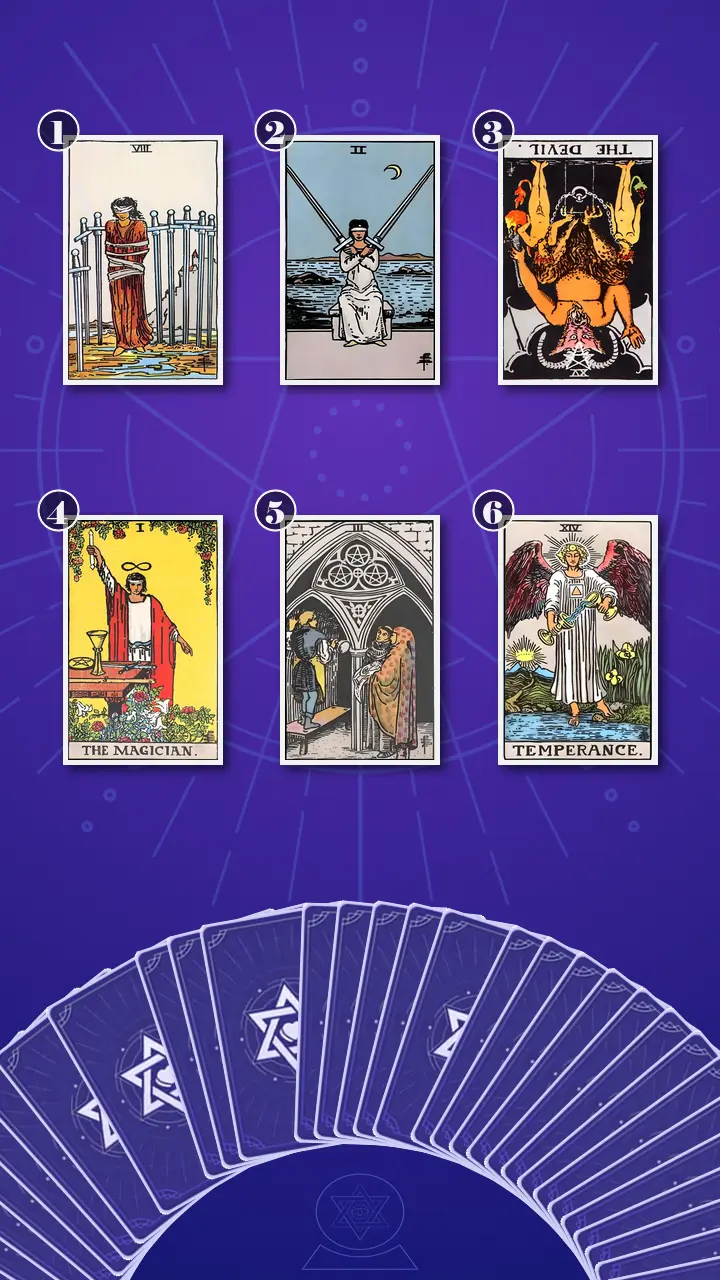
Position 1: The presenting symptom in the interview moment
“Now flipped over,” I said, “is the card that represents the presenting symptom in the interview moment: what you do when the prompt lands and the freeze happens.”
Eight of Swords, upright.
In the picture, a blindfolded figure stands surrounded by swords—yet the bindings are loose, and there’s open ground nearby. I told Alex what that looked like in real life, using the scene she’d practically handed me: In the first 10 seconds after “Tell me about yourself,” you’re not unprepared—you’re trapped in self-monitoring. Throat tight. Jaw locked. Brain scanning for the single best sentence like it’s a safety code.
“It’s like having twenty browser tabs open,” I added, “and the moment you click the one you need, everything crashes.”
The energy here is blocked Air: overthinking that becomes paralysis. Not a lack of experience—an attention narrowing. A blindfold.
Alex stared at the card, then she let out a small, bitter laugh—an unexpected little pop of sound. “That’s… mean,” she said, but her eyes softened. “Accurate. But mean.”
“I’ll take accurate,” I replied gently. “Accurate means workable.”
Position 2: The immediate block that shuts down your words
“Now,” I said, “we’re looking at the immediate block: the in-the-moment mental move that shuts down access to words and self-story.”
Two of Swords, upright.
This card always makes me think of a body trying to stay safe by becoming still. Crossed arms. Closed chest. The sea behind it calm on the surface, full of depth underneath.
I translated it into Alex’s exact modern life scenario: Your in-the-moment move is to withhold until you can guarantee a strong start. You stall, smile, silently weigh ten possible versions of yourself—then freeze because interviews don’t wait for the perfect edit.
And I let the inner monologue contrast land, just as it shows up in so many Zoom waiting rooms:
“One voice says, Say something. Another says, Don’t commit yet. Pick the right version. Don’t sound scattered. You hover over unmute like you’re hovering over ‘Send’—and the longer you hover, the more your heartbeat becomes the loudest thing in the room.”
This is protective overcontrol. A strategy that probably helped you once—maybe in school, maybe in a workplace where mistakes were punished. But in real-time conversation, it backfires. Interviews aren’t a document you can revise; they’re a live exchange.
Alex’s shoulders lifted the tiniest bit, then dropped as if she’d realized she’d been holding them up for years. She gave me a tight nod—more body than words.
Position 3: The root driver under the freeze
“Now we go underneath,” I said. “This card represents the root driver: the deeper belief or fear that makes this prompt feel high-stakes and risky.”
The Devil, reversed.
Reversed, The Devil often shows the moment someone notices the chain—and hates that it’s there. It’s not “evil.” It’s the invisible contract you never agreed to out loud: My worth equals my performance.
I brought it to her Sunday-night reality: late-night LinkedIn scrolling, the harsh phone glow two inches from your face, seeing someone your age post “I’m thrilled to announce…” and feeling your chest tighten before your thoughts even catch up. Then the frantic search—best tell me about yourself answer marketing interview—as if the right template could protect you from shame.
“This is the hook,” I told her. “The interview room turns into a judgment chamber in your nervous system. One awkward sentence feels like it could ‘prove’ you’re not legitimate.”
The energy here is loosening bondage—but not fully free yet. A chain that feels tight in the throat even when the clasp is actually within reach.
Alex exhaled like she’d been holding something in her mouth. “I don’t even think I believe that consciously,” she said. “But my body does.”
“Exactly,” I said. “And bodies don’t respond to pep talks. They respond to safety and repetition.”
Position 4: The turning point that restores agency
“This,” I said, letting my hand rest on the deck for a beat, “is the pivot. The lever. The key turning point: what shifts the energy from freezing to speaking, without forcing a fake persona.”
The Magician, upright.
The room felt quieter—not because anything outside changed, but because attention changed. That’s what The Magician does. It takes scattered energy and gathers it into one purposeful act.
Setup. Alex was trapped in that first minute on Zoom: the screen lights up, the chime hits, throat tightens, and her mind tries to write the perfect first sentence live—as if her identity has to be flawless before her voice is allowed to exist.
Delivery.
You don’t need a flawless identity on the spot; you need a chosen script and tools—like The Magician—so your words can actually show up.
I let the sentence hang there for a breath.
Reinforcement. I watched Alex’s face do the three-step thing I’ve come to trust more than any “yes.” First: a tiny freeze—her eyes widening just a fraction, like a window opening in a stuffy room. Second: a faraway look, as if her mind replayed every moment she’d hovered over unmute, editing a sentence that didn’t exist yet. Third: the release—her shoulders lowered, her jaw unclenched, and she swallowed once, not in panic but in recognition.
“But if I choose a script,” she said, and there was a flash of resistance—almost anger—“doesn’t that mean I’ve been doing it wrong? Like… all this time?”
I kept my voice steady. “No. It means you’ve been protecting yourself with the tools you had. The Magician isn’t here to shame you. He’s here to hand you tools that work in real time.”
This is where my family’s way of seeing comes in—my Nature Empathy Technique. In the Highlands, you learn quickly that the weather doesn’t care about your perfect plan. You don’t stand on the hillside arguing with the wind. You watch. You choose your route. You pack what you need. Intuition isn’t magic—it’s attention trained by reality.
“Right now,” I told Alex, “your attention is blindfolded by evaluation. The Magician’s direct gaze is the antidote. It’s the switch from watching yourself being watched to choosing what you want them to understand.”
“So… what do I choose?” she asked, quieter now.
“Three anchors,” I said. “Role-now. Through-line strength. One proof story. Not your whole life. A self-intro isn’t a verdict. It’s a chosen angle.”
Then I asked her the question that turns insight into a lived memory: “Using this new lens—think back to last week. Was there a moment you froze where, if you’d had those three anchors in front of you, you would’ve felt even 5% different in your throat or breath?”
She nodded slowly, almost surprised by herself. “Thursday. The pause. I could feel my jaw lock. If I’d had a default first line… I think I would’ve started.”
And there it was—the first step of the transformation: from panic-driven self-monitoring to agency.
Position 5: The next practical step for the next seven days
“Now,” I said, “we land this in the real world. This card represents the next practical step: a concrete way to practice and deliver a grounded, repeatable answer within a week.”
Three of Pentacles, upright.
This is the card of building skill where it can be seen—apprentice work, feedback, refinement. It doesn’t romanticize confidence. It engineers it.
I used the card’s modern translation exactly: Your next step is to make your self-intro a practiced skill, not a private document. Two short reps this week—one recorded voice memo, one mock run with a friend/mentor—so you can refine based on what actually lands.
The energy here is Earth: structure, repetition, the dignity of doing it more than once.
Alex grimaced. “I always think I’ll practice when it sounds authentic,” she admitted.
“That’s the trap,” I said, not unkindly. “Authentic isn’t something you discover by polishing alone. You hear it by speaking.”
And I gave her the line I’ve watched people borrow and carry: Clarity comes from reps, not from a flawless script.
Position 6: Integration—what success feels like internally
“Finally,” I said, “this card represents integration: what ‘success’ looks like internally—how it feels when the answer becomes natural and balanced.”
Temperance, upright.
Temperance is the angel pouring between two cups—blending, not forcing. One foot on land, one in water. A path leading toward a rising sun. It’s not dramatic. It’s steady.
I brought it into modern language: Integration looks like a calm, conversational rhythm: you can give your intro in ~60 seconds, pause without panicking, and adjust when they ask follow-ups. You sound like a real person who’s competent—not a robot reciting a script.
This is balanced Water and Fire: warmth without oversharing, structure without stiffness.
“Structure is a container, not a costume,” I reminded her. “Temperance isn’t asking you to perform. It’s asking you to mix your professional facts with your human tone until your voice feels like it belongs to you again.”
The One-Week System: The Chosen Angle + One-Take Rep
When I looked back across the whole grid, the story was clean: Eight of Swords showed the symptom—blanking, tight throat, jaw locked—because attention narrows into self-policing. Two of Swords revealed the reflex—protective withholding, “say nothing until it’s perfect,” the decision jam. The Devil reversed named the root—an invisible worth = performance contract that turns a normal prompt into a threat. Then The Magician broke the spell with agency: you don’t find the perfect you; you choose what to highlight and you use tools. Three of Pentacles turned it into a process. Temperance promised the felt result: warm, steady, adaptable.
The cognitive blind spot here is subtle: you’ve been treating starting as if it has to prove your worth. That’s why you freeze. The transformation direction is simpler—and kinder: shift from searching for the perfect self-description in the moment to delivering a practiced three-part outline you can adapt.
Here are the next steps I gave Alex—small enough to start, real enough to change something.
- Build the Three-Anchor Outline (10 minutes)In your Notes app, write a 3-part outline (not a script) for “Tell me about yourself”: (1) role-now, (2) through-line strength (what you’re consistently good at), (3) one proof story (a specific project with a result). Keep it to 6 bullet points max.If you feel the urge to add “one more achievement,” stop and ask: “Am I adding clarity—or trying to earn worth?” Choose clarity.
- Choose Your Always-Start Sentence (2 minutes)Pick one default opening line you can say even when nervous (example: “Sure—quick overview: I’m a marketing specialist focused on X, and I’ve been building Y…”). Save it as the first line of the note above so it’s always there before interviews.Energy protection tip: block LinkedIn for 60 minutes before interviews. Comparison isn’t “motivation” when your nervous system is already braced.
- Do Rep 1 Out Loud (One take, 60 seconds)Record one 60-second voice memo today using your three anchors. No re-records. Title it “Rep 1.” If you want extra grounding, do it while walking slowly around your room and letting environmental sounds (the fridge hum, traffic, your footsteps) keep you present.Expect your brain to label the first rep as “cringe.” That’s your internal editor hearing reality. Set a 3-minute timer and stop when it rings—ending is part of the boundary.
And because Alex’s spiral peaked at night, I added one more stabilizer from my own toolkit—quiet, practical, and surprisingly powerful: a 3-minute bedtime energy review. “Before sleep,” I told her, “name one neutral note (structure/pacing) and one kind note (what sounded real). Then stop. No post-interview rumination, no reopening Notes to write FINAL v7.”
Temperance also gets seasonal about it, in my experience. Toronto winter air can make throats feel tighter, voices thinner. I suggested a small seasonal self-care adjustment: warm tea, earlier sleep the night before a call, and a conscious exhale when the question lands—because your voice is part body, not just branding.

A Week Later: The Quiet Proof
Six days later, Alex sent me a message that made me smile into my mug. “Did Rep 1,” it read. “Didn’t delete it. My throat still tightened at first, but once I started the always-start line, it loosened. I scheduled a mock with my friend for Thursday.”
That’s what change looks like most of the time: not a dramatic personality makeover, but a small proof that the pattern can be interrupted.
She told me something else too—bittersweet in the way real growth often is: she slept a full night for the first time in weeks, but in the morning her first thought was still, What if I mess it up? Then, she said, she actually smiled. Not because the fear vanished—because it no longer had the whole microphone.
That’s the journey tarot is good at, when we use it honestly: moving from panic-driven self-monitoring and blanking out to calm, flexible confidence built through a chosen, practiced story structure. Not certainty. Ownership.
When that question lands, it can feel like your throat tightens around one fear: that a single imperfect sentence could expose you as not worthy of the room you’ve already earned a seat in.
If you didn’t have to find the perfect “you” on the spot, what’s one simple three-part outline you’d be willing to choose—and practice—just enough to let your real voice show up?
This story is adapted from psychological research, written so that those in a similar struggle can see their own pattern in it — and find their next step clearly.These insights are not a substitute for professional psychological, medical, legal, or financial advice.
Learn more about our Journey to Clarity.
How did this insight land for you?
🫂 This Resonates Deeply
🌀 Living This Story
✨ Now I See Clearly
🌱 Seeing New Possibilities
🧰 Useful Framework
🔮 The Confirmation I Needed
💪 Feeling Empowered
🚀 Ready for My Next Step
Author Profile
 AI
AI“As the seventh generation of a Highland healing family, I see modern anxieties as a simple, temporary disconnection from nature's rhythm. I bring 67 years of lived seasons not to instruct you, but to hold space for you. Using tarot as a mirror, I want to gently guide you out of the chaos, helping you breathe deeply and rediscover the organic, steady heartbeat of your own life.”
In this Personal Growth Tarot Reading :
Core Expertise
Service Features
Also specializes in :
Explore Related Patterns:
Achievement FusionAlex names the hidden contract directly: "My worth equals my performance." That belief makes the interview opener feel much larger than a professional prompt; it becomes a live test of whether she is legitimate, ready, and worthy of the room. Achievement Fusion happens when performance stops being something you do and starts feeling like proof of who you are. You are not simply trying to answer well. You are trying to prevent one awkward sentence from becoming evidence against your identity. The way out is not to care less about the interview. It is to separate the task from the self. A self-intro can be a chosen angle, a role-now statement, a through-line strength, and one proof story, without carrying the impossible job of validating your entire worth.
Analysis ParalysisAlex silently weighs ten possible versions of herself, hovers over unmute, and tries to choose the right sentence before the interview has even begun. The story compares the experience to too many browser tabs open at once, with the system crashing right when she needs access. Analysis Paralysis shows up when thinking becomes a substitute for movement. You are not short on material; you are overloaded by options, consequences, and self-presentation choices, so the mind keeps evaluating instead of selecting. The three-anchor outline is effective because it reduces the decision field. Role-now, through-line strength, and one proof story give your brain fewer doors to check, making it easier to start before optimization turns into silence.
Authentic Self-ExpressionAlex's breakthrough comes when the self-intro stops being a flawless identity performance and becomes a chosen professional angle. The script is not used to fake a persona; it gives her voice a place to start when pressure would otherwise make her disappear. Authentic Self-Expression here is not raw spontaneity. It is the ability to speak truthfully within a clear container, blending professional facts with a human tone so the answer feels grounded rather than over-rehearsed or hidden. For you, the pattern points toward permission to be structured without being artificial. A role-now statement, a through-line strength, and one proof story can make your real voice more available because the whole self no longer has to be improvised under pressure.
Feedback IntegrationAlex's next step is deliberately visible: one recorded voice memo and one mock run with a friend or mentor. That moves the self-intro out of private polishing and into a feedback loop where the answer can be heard, adjusted, and repeated. Feedback Integration is the pattern of letting reality refine the work instead of letting the internal editor control everything in advance. You practice before it feels perfect, tolerate the first rep, and use what actually lands as data rather than as a verdict. This matters because confidence in the story is engineered through exposure, not imagined into existence. The timer, the one-take recording, and the mock interview all create boundaries that keep practice from becoming another perfection ritual.
Freeze ResponseAlex's throat tightening, jaw locking, shallow breathing, and blank mind show a body that is bracing before language can organize itself. The prompt is objectively simple, but her nervous system treats the first few seconds as if one wrong sentence could expose her as unqualified. That is the logic of a Freeze Response: the mind is not empty, but access to speech gets blocked by threat monitoring. You are trying to protect yourself from evaluation by becoming still, scanning for the safest answer, and delaying movement until the risk feels lower. The important shift is that the freeze is workable once it is treated as a pattern rather than a character flaw. A default opening line and three-anchor structure give your body a rehearsed first move, so the interview stops being a spotlight test and becomes a sequence your nervous system can enter.
Imposter SyndromeAlex can write a strong cover letter, but the moment she has to introduce herself live, one imperfect opener feels like it could expose her as not ready. The story keeps returning to that fear of being revealed as less legitimate than the opportunity suggests. Imposter Syndrome is the pattern where evidence of competence cannot fully land, while small imperfections feel loaded with meaning. You scan for the safest sentence because the wrong one seems capable of disqualifying you, even when the interview itself implies that someone already saw enough potential to invite you in. The practical shift is to stop treating the first line as a fraud test. A practiced opening gives you enough structure to begin, while the proof story lets competence show up through specifics instead of through a perfect performance of confidence.
Perfectionism-Driven AvoidanceAlex rewriting the first sentence on Sunday night, hovering over delete, and imagining the Zoom chime in advance shows preparation turning into a control ritual. The answer is not being shaped for clarity anymore; it is being polished as if perfection could prevent shame. Perfectionism-Driven Avoidance appears when the mind says, "Do not begin until the opening is strong enough to protect you." You are not avoiding the interview because you do not care. You are avoiding the live, imperfect moment because committing to one sentence feels like exposing your whole competence to judgment. The three-anchor outline interrupts that loop by giving the answer a boundary. Instead of trying to find the flawless version of yourself on the spot, you choose a usable structure, practice it out loud, and let authenticity emerge through reps rather than endless private editing.
Spotlight EffectAlex's attention moves from the interviewer and the conversation into the imagined gaze on her first sentence. She is "watching herself being watched," trying to live-edit her identity while the room feels like a judgment chamber. That is the Spotlight Effect in action: the mind overestimates how intensely one moment will be noticed, remembered, and used against you. You become an object under inspection in your own awareness, which leaves less attention available for speaking, listening, and connecting. The Magician-style pivot in the story works because it redirects attention from self-surveillance to intention. Instead of asking, "How am I being perceived right now?" you choose what you want them to understand, then let the structure carry the first minute.
Strategic VisibilityAlex starts to change when the question becomes less about being perfectly seen and more about choosing what to make visible. The three anchors help her decide what the interviewer needs to understand without turning the answer into her whole life story. Strategic Visibility is a bounded form of self-presentation. You are not hiding, oversharing, or trying to perform a flawless identity; you are selecting the clearest angle for the room you are in. That makes the next step practical: choose the role-now frame, name the through-line strength, and give one proof story. Visibility becomes something you can direct, rather than something that happens to you under a spotlight.
Explore Related Struggles:
Identity Verdict LockAlex is not simply choosing wording; she is trying to choose the version of herself that will be safest under evaluation. The story shows her weighing ten possible selves, scrolling other people's career announcements, and treating one awkward sentence as evidence that she might not be legitimate. Identity Verdict Lock fits because the self-introduction has been overloaded into a final ruling on who you are professionally. Instead of being a 60-second angle, it becomes a compressed identity trial where every phrase feels like it could confirm or disqualify you. The relief in the reading comes from reducing the size of the task. A self-intro is not your whole identity on display; it is role-now, through-line strength, and one proof story. When the answer becomes a chosen angle rather than a verdict, your voice has more room to move.
Monitoring-Safety FusionAlex keeps trying to protect herself by monitoring the answer before anyone else can hear it. The story makes this visible in the Sunday-night rewrite, the template search, the hovering over delete, and the way the interview room becomes a place where one sentence might expose her. Monitoring-Safety Fusion is the deeper reversed structure here. Self-observation has stopped being a useful check and has become the main source of safety, so letting words out before they are fully inspected feels dangerous. You can know intellectually that an interview is just a conversation while your body still treats unedited speech like exposure. The pivot is not to stop caring how you come across. It is to move safety out of constant self-surveillance and into repeatable structure: a chosen opener, three anchors, one spoken rep, and feedback from reality instead of endless prediction.
Performance-Worth FusionAlex keeps returning to the first sentence as if it has to do more than begin an answer. It has to prove she is ready, sound polished, prevent judgment, and protect her from being seen as unqualified, all before the conversation has even started. Performance-Worth Fusion names the pressure underneath that setup. A normal interview prompt stops being a prompt and becomes a verdict, so every possible opener feels loaded with evidence for or against your legitimacy. The freeze makes sense inside that structure: if the first line feels like proof of worth, choosing any line can feel too risky. The reading loosens this by separating competence from live perfection. You do not need one flawless sentence to certify your value; you need a chosen structure that lets your actual experience become speakable under pressure.
Visibility-Safety SplitAlex can prepare on paper, but the moment a real person asks her to speak, her body treats visibility like danger. Her throat tightens, her jaw locks, and the first sentence becomes a threshold she cannot cross unless it feels completely safe. That is why Visibility-Safety Split fits the story so closely. The struggle is not about having nothing to say; it is about being caught between wanting to be seen as competent and needing to avoid the risk of being judged in real time. You are watching yourself from the outside before your own voice has a chance to arrive. The next step in the reading works because it does not ask for a flawless personality performance. It shifts the pressure from being perfectly visible to choosing a small, prepared angle you can stand behind, so speaking becomes an act of agency rather than a test of whether you deserve the room.
Perfect Readiness TrapAlex says she always thinks she will practice when the answer sounds authentic. Until then, she rewrites, searches, and waits for the version that will feel safe enough to say out loud. Perfect Readiness Trap captures the way readiness gets postponed by the demand for readiness itself. The preparation is not fake, but it keeps circling the same gate: once the opener is perfect, then you can begin. Because interviews require live speech, the waiting becomes part of the freeze. The one-week system breaks that trap by making the first rep deliberately imperfect and bounded. You do not practice because the answer is already flawless; you practice so your body learns that starting can be survivable, adjustable, and real.
Self-Editing ExhaustionAlex is shown late on Sunday night rewriting the opener, hovering over delete, and trying to predict how every version might land. By the time the interview arrives, the answer has been handled like a fragile object instead of practiced as a living sentence. Self-Editing Exhaustion captures the cost of that loop. The mind keeps revising in order to protect the self, but the live moment does not offer a delete key. You end up spending your best energy on monitoring, polishing, and pre-empting reactions, then have less access to the simple act the interview requires: speaking. The practical shift toward a three-anchor outline and one-take reps matters because it moves the answer out of private perfection and into usable rhythm. Your voice gets stronger when it is allowed to exist before it is fully optimized.
Vigilance-Execution SplitAlex's body does a very specific thing when the prompt lands: the throat tightens, the jaw stills, the breath gets smaller, and the answer cannot cross into speech. At the same time, her mind is working hard, scanning for the sentence that will keep her safe from judgment. Vigilance-Execution Split names the lock created by that mismatch. The part of you watching for danger becomes so active that the part of you meant to act loses the floor. Preparation keeps happening, but execution cannot use it because the system is busy checking for risk. The reading's next step is effective because it gives execution a track to run on. A default opening line and spoken reps reduce the need for live surveillance, letting the answer begin before the internal monitor takes over the whole room.
Explore Related Emotions:
Imposter Exposure FearOne imperfect opener feels like it could expose you as not ready, not legitimate, or not worthy of the room. The story repeats that pressure in different forms: the judgment chamber of the interview, the LinkedIn glow of other people's announcements, and the thought that one awkward sentence could prove something final about your competence. Imposter Exposure Fear fits because the danger is not the question itself; it is what the question seems to reveal. You are not just trying to describe your experience. You are trying to prevent a tiny verbal flaw from being treated as evidence that you never belonged there.
Micro-Performance ShameShe calls it 'the easiest question,' then laughs carefully, as if even the laugh might count against her. The opener becomes a small performance with oversized consequences: one sentence, one pause, one imperfect tone, and suddenly the whole professional self feels on trial. Micro-Performance Shame names the sting of a tiny moment carrying too much proof. You do not need the entire interview to go badly for the shame signal to fire; the story shows it gathering around the first line, the first pause, and the private belief that a normal human start should have been effortless.
Performance FreezeYour throat tightens like a drawstring, your jaw goes still, and the first ten seconds after 'Tell me about yourself' become a narrow tunnel. The story shows the freeze through the body before it explains it through thought: shallow breath, locked jaw, shoulders lifted, and a brain scanning for one perfect opening line as if it were a safety code. Performance Freeze fits because the block is not a lack of preparation; it is the felt collapse of access under live evaluation. You have material on the page, but the moment the room asks for a spoken self-story, attention clamps down around not making a mistake, and the words cannot move.
Self-Audit AnxietyAt 9:58 PM, the first sentence sits in Notes getting rewritten while your thumb hovers over delete, already trying to predict every possible reaction. The same monitoring shows up on Zoom when you hover over unmute, silently weighing ten possible versions of yourself before any one of them gets permission to speak. Self-Audit Anxiety names that split attention: one part of you tries to answer, while another part grades the answer before it exists. The pressure comes from being both speaker and evaluator at once, which turns a simple introduction into a live inspection of your own identity.
Anticipatory ShameThe Zoom chime is already audible in your head before the call happens, and the Sunday-night room turns into a rehearsal space for possible embarrassment. The Notes app, the template searches, the LinkedIn scroll, and the morning thought of 'What if I mess it up?' all show the same emotional event arriving early. Anticipatory Shame fits because the painful part begins before anyone asks the question. You are not only preparing an answer; you are trying to pre-edit away the future moment where you might feel exposed, awkward, or behind.
Cautious Self-Trust'Did Rep 1. Didn't delete it.' is the quiet proof at the center of the change. The voice memo is not polished, and the throat does not become perfectly relaxed, but you keep the evidence instead of erasing it. Cautious Self-Trust fits because the story shows trust forming through small, observable actions. You schedule the mock, keep the first imperfect take, and let practice give you a record of capability that does not depend on feeling fully ready first.
Grounded AgencyThe shift begins when the self-intro stops being a perfect identity test and becomes three anchors: role-now, through-line strength, and one proof story. You are no longer trying to find the flawless version of yourself on the spot; you are choosing what the interviewer needs to understand. Grounded Agency fits because the story's next step is not hype or blind confidence. It is a practical return of choice: a default first line, a one-take rep, a mock run, and a structure that lets your voice show up without waiting for total certainty.
Hard-Won ComposureSix days later, your throat still tightens at first, but the always-start line gives the body somewhere to go, and the tightness loosens once speech begins. The fear is still present in the morning, yet it no longer has the whole microphone. Hard-Won Composure fits because the calm in this story is earned through contact with the same trigger, not through avoiding it. You are building a steadier rhythm under pressure, where a pause can be survived, a first line can be used, and the room no longer has to be conquered before you speak.
Sunday ScariesAt 9:58 PM on Sunday, the laptop glow makes your hands look ghostly while the kettle clicks off and the coming Zoom call already presses into the bedroom. The scene is not just prep; it is the workweek entering your rest space before Monday has even started. Sunday Scaries fits because the dread has a time, a room, and a ritual. You scroll, rewrite, compare, and search for the right answer late at night, while the next professional performance starts occupying the body before it has actually arrived.
Explore Related Contexts:
Career Visibility ParalysisThe first ten seconds after the Zoom prompt are where Alex's preparation stops converting into action. She has material, skill, and a cover-letter voice, but the live career gate requires her to become visible before she can perfect the wording. Career Visibility Paralysis names that external mismatch: the opportunity requires public professional clarity, while the format gives almost no time for private revision. You are not dealing with a generic communication problem; You are being asked to turn preparation into visible career presence in a compressed, watched moment. The next step in the story works because it changes visibility from an all-or-nothing event into a rehearsal path. A one-take voice memo and a mock run make being heard less dependent on the interview's first shock and more dependent on practiced access to a simple structure.
Junior Role Legitimacy ScrutinyAlex is a 20-something early-career professional, and the line that exposes the structure is her fear that one imperfect opener will show she is not ready. The self-introduction is not being experienced as small talk; it is being treated as proof that she deserves the seat she is trying to occupy. Junior Role Legitimacy Scrutiny fits because early-career interviews often compress competence, confidence, and belonging into tiny performance cues. You are not just answering a prompt; You are trying to avoid being read as unqualified before the interviewer has heard the actual evidence of Your work. The story's practical move reduces the scrutiny load. A default first sentence and one proof story let the opening point toward evidence instead of asking the opener itself to carry the entire burden of legitimacy.
Workplace Identity FreezeAlex can write a strong cover letter, but the moment an interviewer asks for a self-introduction on Zoom, her throat tightens, her jaw goes still, and her mind searches for the one opener that will not expose her. The task has stopped being a simple answer and has become a live demand to package a professional identity under evaluation. That is why Workplace Identity Freeze fits the story so closely. The external hiring ritual turns self-description into a legitimacy test, so You are pushed to edit your identity before your voice is allowed to start. The pressure is not coming from a lack of preparation; it is coming from a social format that asks for instant clarity about who You are professionally. The useful shift is to narrow the stage. Instead of trying to prove an entire self in the first sentence, the story points toward a bounded professional frame: role-now, through-line strength, and one proof story. That gives You a way to enter the room with a chosen angle rather than waiting for a flawless identity to appear on command.
Safe Visibility TrialAlex's next step is specific: one recorded voice memo and one mock run with a friend or mentor. That moves the self-intro out of the private Notes app and into a controlled space where the words can be heard, tested, and refined. Safe Visibility Trial is the constructive counter-stage in the story. You still practice being seen and heard, but the stakes are scaled down enough for feedback to become usable instead of crushing. Visibility becomes a training environment rather than a sudden public verdict. This is why the plan avoids endless polishing. The point is not to make the first rep impressive; it is to give You a visible, repeatable bridge between preparation and the live interview room.
Personal Brand PerformanceAlex's Sunday-night scene is full of brand pressure: the laptop glow, the rewritten opener in Notes, the LinkedIn announcements from people her age, and the search for the best interview answer. The external culture around career presentation is teaching her that a polished self must come before a real voice. Personal Brand Performance captures the wider stage around the freeze. You are not only preparing for an interviewer; You are navigating a professional attention economy where peers announce wins, templates promise protection, and every sentence can start to feel like a public signal of worth. The story breaks that pressure by replacing brand polish with a chosen professional angle. A three-anchor outline does not ask You to become a perfect marketable persona; it gives You enough shape to speak as a competent person with a specific through-line.