The 11:47 p.m. LinkedIn Voice Spiral
You can write copy for brands in your sleep, but the second you have to write a 3-sentence work bio about yourself, you go full LinkedIn voice panic.
Jordan said it like they were confessing to a crime, not describing a totally normal human reaction to workplace visibility. They sat across from me on a video call, Toronto evening light still faintly blue behind them, hoodie half-zipped like they’d been meaning to sleep but got pulled back into the doc again.
They described the scene with the precision of someone who has lived it too many times: 11:47 p.m. on a Wednesday in their condo bedroom. The laptop fan humming like a tiny engine that wouldn’t shut off. The LED desk lamp making the keyboard look harsher than it deserved. Their phone warm from constant scrolling. Three tabs open—Google Doc, LinkedIn profiles, Thesaurus.com—while their hands hovered between backspace and refresh, jaw clenched, shoulders creeping toward their ears.
“HR needs it by end of day tomorrow,” they said. “And I keep… toggling. If I sound confident, I feel fake. If I sound honest, I feel small.”
I could almost feel it in my own body: that tight chest and jaw, the restless fingers trying to delete the risk of being seen. Like trying to walk into a new room wearing a suit that technically fits the dress code but feels itchy and wrong.
“If writing your bio makes your skin crawl,” I told them, “that’s not a personality flaw—it’s visibility hitting your nervous system. Let’s not treat this like a branding problem. Let’s treat it like a clarity problem. We’ll map what’s really happening, and then we’ll get you to a draft you can actually submit.”

Choosing the Compass: the Celtic Cross · Context Edition
I asked Jordan to take one slow breath—not as a ritual for luck, but as a hard reset for attention. Then I shuffled while they held the question in mind: Do I hype myself up, or face why this feels so wrong?
“I’m going to use a spread called the Celtic Cross · Context Edition,” I said. “It works well when a situation has layers: a visible deadline, an internal identity conflict, and an environment—like LinkedIn—that turns everything into comparison.”
To you, reading along, here’s why this spread fits: it separates the on-screen loop (what you’re doing at midnight) from the deeper driver (what you’re afraid it might prove), then shows both the social pressure around it and the most practical next move for the next seven days. It’s less ‘prediction,’ more ‘diagnostic map.’
“We’ll start with the center,” I added, “because that’s the present loop. The crossing card will name what pressure is distorting the whole task. Then we’ll go beneath it to the root fear. And at the top of the spread, we’ll look for integration—what changes if you practice the lesson instead of chasing a perfect sentence.”
Reading the Map: Card Meanings in Context
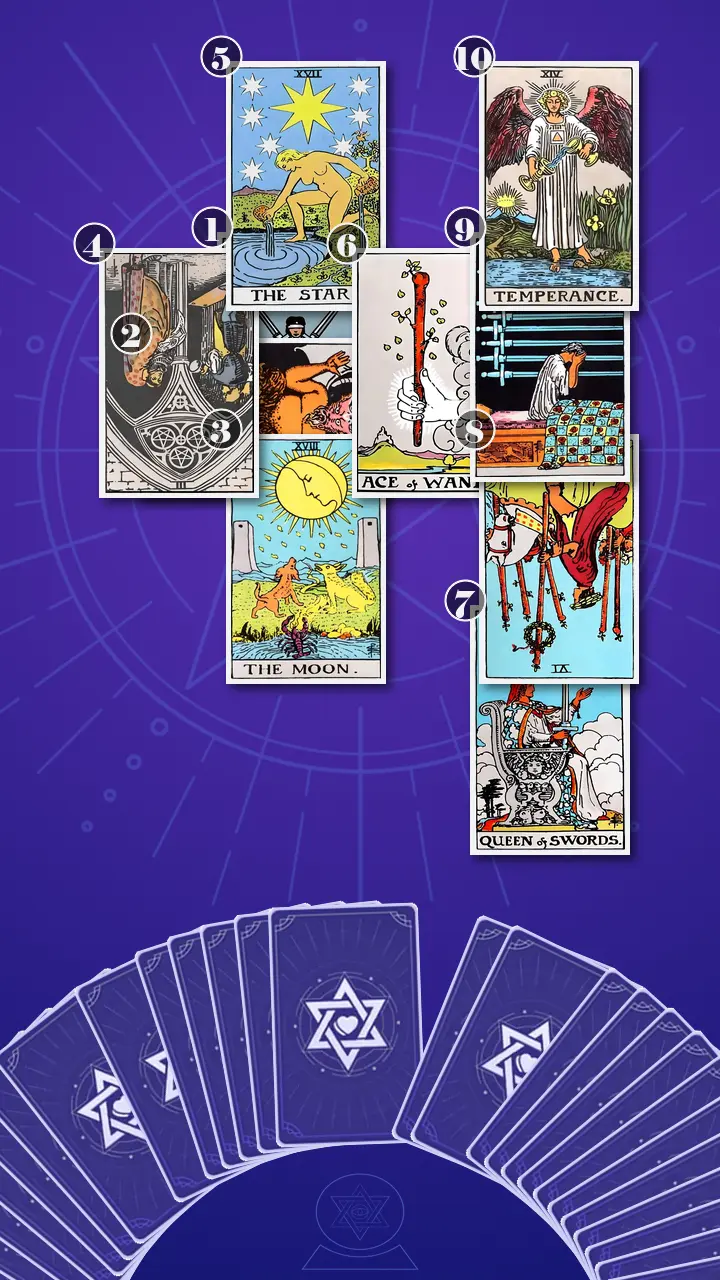
Position 1 (Present Loop): Two of Swords, upright
“Now flipped over is the card that shows the current bio-writing loop—the exact on-screen moment you can’t move past.”
Two of Swords, upright.
“This is you staring at the company bio form like it’s a personality test you can fail,” I said. “You keep toggling between two ‘acceptable’ tones—polished corporate LinkedIn voice versus honest human voice—then freeze, because choosing one feels like locking in a version of yourself for the whole office to quietly judge.”
In the Two of Swords, the energy isn’t lack of intelligence. It’s blockage—a self-protective pause. The blindfold says, I can’t know how this will land. The crossed swords over the heart say, So I won’t commit. And the cost is exactly what Jordan described: nothing moves, but the pressure builds.
Jordan let out a small laugh—sharp, almost embarrassed—then looked down at their hands. “That’s… brutal,” they said. “But yeah. That’s exactly it.”
Position 2 (What Crosses You): The Devil, upright
“Now flipped over is the card that names the main psychological pressure distorting your self-description—what makes the bio feel ‘wrong.’”
The Devil, upright.
“This is where the bio stops being a practical intro and turns into a high-stakes audition,” I said. “You write one power line—‘results-driven,’ ‘spearheaded,’ ‘award-winning’—and you immediately feel trapped. Like you just signed a contract to perform that persona every day on Slack, in meetings, and on client calls.”
The Devil’s energy is excess: too much weight placed on approval, status, and being un-criticizable. And the detail I always come back to is the loose chain. The pressure is real, but the bondage is partly maintained by an internal rule like: If I don’t sound exceptional, I won’t belong.
I watched Jordan’s throat move as they swallowed. Their shoulders rose a fraction, like bracing for impact.
“This is the line your nervous system is running at midnight,” I said, keeping my voice gentle: “If they can’t criticize the wording, they can’t criticize me. But that turns every verb choice into a safety purchase. And safety is expensive.”
Jordan nodded once, tight. “I’m writing like it’s… a performance review I haven’t earned yet.”
“Exactly,” I said. “And here’s the reframe we’ll keep using: A bio is not a verdict. It’s an orientation tool. It’s not a trial. It’s directions.”
Position 3 (Foundation): The Moon, upright
“Now flipped over is the card that reveals the underlying fear and belief driving the discomfort around self-promotion.”
The Moon, upright.
“You’re trying to describe your place in a new job before you’ve fully felt the job,” I said. “So your brain fills in the blanks: imagined judgment, vague ‘they’ll regret hiring me’ stories, mind-reading about what coworkers ‘really’ think—because the path isn’t visible yet and you want certainty now.”
The Moon is deficiency of clarity, not deficiency of capability. In onboarding, you’re in low visibility. Like navigating a new city with low-signal GPS—your brain starts inventing turns, then panics about missing them.
I asked Jordan to do something very un-mystical: “Open a note and split it down the middle. Left side: Facts I know. Right side: Stories I’m predicting.”
They blinked, then their gaze went slightly unfocused—like they were replaying the last week of Slack messages in their head. “Oh,” they said quietly. “I’m trying to write an identity I haven’t fully lived yet.”
“Yes,” I said. “That’s not failure. That’s a threshold.”
Position 4 (Recent Past): Three of Pentacles, reversed
“Now flipped over is the card that shows the recent experiences with evaluation or belonging that shaped your self-trust.”
Three of Pentacles, reversed.
“Old mixed feedback is still in the room with you while you write,” I said. “You can name the work you did, but you don’t trust how it gets evaluated—so you try to package it perfectly, like you’re pre-defending yourself against a rubric nobody actually stated.”
Reversed, this card reads as blockage in confidence-through-craft: the work was real, but the recognition and standards were inconsistent enough that you learned to over-control presentation. That’s why your hands reach for adjectives and ‘high-status’ verbs. You’re trying to make the outcome undeniable.
Jordan’s mouth tightened. “My last manager would say things like, ‘Great initiative,’ and then… nothing. No specifics. No growth plan. Just vibes.”
“That would make anyone distrust their own internal scorecard,” I said. “So you outsource it to the wording. But wording can’t give you belonging. Evidence can give you steadiness.”
Position 5 (Conscious Goal): The Star, upright
“Now flipped over is the card that clarifies what you actually want the bio to accomplish—beyond meeting the deadline.”
The Star, upright.
“What you actually want isn’t attention—it’s relief,” I said. “A bio that feels clean to read, where nothing is inflated and you don’t have to brace for someone calling you out. You want to be credible in a way that still feels like your real speaking voice.”
The Star is balance—a steady, honest pour. Not flashy. Not defensive. It’s your system saying: Please let me be real.
I saw Jordan’s shoulders drop a millimeter, like their body recognized that goal as permission. “Yes,” they said. “Relief. That’s the word.”
Position 6 (Next 7 Days Writing Move): Ace of Wands, upright
“Now flipped over is the card that points to the most helpful writing move in the next seven days—something that breaks the loop without forcing a fake persona.”
Ace of Wands, upright.
“This is a clean restart,” I said. “You stop trying to craft the perfect headline and you just draft. Timer on, 15 minutes, write it like you’re introducing yourself to a new teammate on day one—simple, direct, slightly imperfect, but alive. Momentum breaks the spell.”
The Ace’s energy is excess of life in the best way: a spark strong enough to cut through analysis paralysis. It doesn’t ask you to solve identity forever; it asks you to start.
Jordan exhaled, surprised. “I can do fifteen minutes,” they said, like it was the first doable thing anyone had offered all week.
Position 7 (Self / Your Best Stance): Queen of Swords, upright
“Now flipped over is the card that describes your internal stance—the voice you can access when you stop negotiating with the inner critic.”
Queen of Swords, upright.
“You access a sharper, calmer voice: fewer adjectives, more facts, and no begging to be liked,” I said. “You write one sentence that names your lane and one sentence that proves impact, and you stop negotiating with imaginary critics about whether you sound ‘impressive enough.’”
Queen of Swords energy is balance through precision. It’s not cold. It’s clean. I often demonstrate it with a line pair:
“Buzzword version: ‘Results-driven marketer spearheading innovative go-to-market strategies.’”
“Queen version: ‘I lead lifecycle and paid campaigns across email and search, and I’ve improved conversion rates by X% by testing and iterating weekly.’”
I watched Jordan’s face change as the second version landed in their nervous system. Their jaw unclenched slightly.
“Clarity reads as confidence—buzzwords read as fear,” I said.
Jordan nodded, immediate. “The second one feels… like I can breathe.”
Position 8 (Environment): Six of Wands, reversed
“Now flipped over is the card that shows the social and workplace context shaping this pressure.”
Six of Wands, reversed.
“Your environment is a visibility scoreboard,” I said. “Job updates, promotion posts, coworker intros, the subtle pressure to seem ‘thriving.’ Even if nobody is actually judging your bio that hard, your feed teaches your nervous system that being seen equals being ranked.”
Reversed, the energy is blockage in recognition: applause feels conditional, so you try to control perception. That’s why you keep checking other people’s ‘About’ sections like they’re the answer key.
Jordan grimaced. “Toronto grind culture is… loud.”
“It is,” I agreed. “So we’re going to write for one real audience, not for the crowd.”
Position 9 (Hopes & Fears): Nine of Swords, upright
“Now flipped over is the card that surfaces what you secretly hope the bio will secure—and what you fear it might expose.”
Nine of Swords, upright.
“The bio leaks into bedtime,” I said. “You wake up remembering one phrase, re-run it like a courtroom cross-examination, and imagine every possible misread. Part of you hopes the ‘perfect’ bio will finally let you sleep—like flawless wording could guarantee safety.”
This is excess mental pressure. Not because the bio is big, but because your brain is treating it like an emergency alarm. And when a paragraph becomes responsible for proving your worth, of course your body reacts like there’s a spotlight with no script.
Jordan’s eyes flicked away from the screen. “I literally woke up at 2 a.m. last night and almost opened the doc,” they admitted.
“Then let’s lower the stakes again,” I said. “A bio is not a verdict. It’s an orientation tool. It should not be stealing your sleep.”
When Temperance Wrote a Livable Voice (and the Room Went Quiet)
Position 10 (Integration / Direction): Temperance, upright
I took a breath before turning the last card. “This is the integration position,” I said. “Not a fixed prediction. It’s what becomes likely if you practice what the spread is teaching.”
Temperance, upright.
“This is you writing a bio you can live inside,” I said. “Real achievements plus a human tone, blended. Confident without being loud. Specific without being defensive. It reads like someone competent who isn’t trying to win a debate—just telling the truth clearly.”
Temperance is balance through alchemy—mixing two cups that used to feel like enemies: hype and honesty. And for someone in marketing, it’s familiar: proof points plus voice. Except the ‘brand’ is you, and it has to be livable on a random Tuesday.
Here’s where my old life on Wall Street flashed in—quick and sharp. I used to watch smart people torture themselves trying to pick the “perfect” deal, as if certainty existed. The professionals weren’t the ones who sounded most confident. They were the ones who could say: Here are the facts. Here are the risks. Here is the plan.
“Jordan,” I said, “I want to run my Risk-Reward Matrix on your bio voice—three-scenario forecasting, like we’d do for a valuation.”
“Scenario A: Full hype persona. It might feel powerful for two minutes, but the cost is you feel trapped—like you have to perform it daily.”
“Scenario B: Full disappearing act. Safer emotionally tonight, but it under-prices your work and keeps you anxious that you’re unseen.”
“Scenario C: Temperance. Earned facts plus one human sentence. Highest probability of sustainable confidence, because it’s checkable. You can stand behind it without bracing.”
Jordan’s eyes went still. The kind of stillness that isn’t zoning out—it’s something landing.
And then I slowed down, because this was the hinge of the whole reading.
Setup: It’s 11:47 p.m. You’re in bed with your laptop glowing, LinkedIn open in one tab, your bio doc in another, and your hand keeps doing that restless backspace-hover like you’re trying to delete the risk of being seen. You’re trapped between “sound impressive” and “say nothing.”
Stop trying to sound like a perfect headline and start mixing honest facts with calm confidence—Temperance writes your bio by blending what’s true with what’s earned.
I let the sentence sit there. No extra explanation. Just air.
Jordan’s reaction came in a chain I’ve learned to respect: first, a brief physiological freeze—breath held, fingers stopped moving entirely, like their body was checking if this was safe. Second, their eyes softened and unfocused for a second, as if replaying the last week of drafts and deletions through a new lens. Third, the release: a long exhale that sounded like their chest finally had room.
“But…” they started, and there was a flash of irritation—real, protective. “If it’s that simple, does that mean I’ve been doing it wrong? Like I made this whole thing up?”
I didn’t rush to soothe it. “It doesn’t mean you made it up,” I said. “It means your nervous system chose a strategy that tried to keep you safe: performance. It worked short-term—momentary control. It just isn’t working anymore.”
“Your bio doesn’t need a ‘winning voice,’” I added. “It needs a livable one: calm confidence built from specific, checkable truths.”
Then I gave them the reinforcement as an actual practice, not a vibe. “Here’s a 10-minute ‘Temperance Blend’ micro-practice. Stop anytime if you feel yourself spiraling:
1) Set a 10-minute timer.
2) Write 3 bullet facts only (no adjectives): role + domain, one measurable win, one collaboration/skill proof.
3) Add exactly ONE human values sentence (how you like to work / what you care about).
4) Read it out loud once. If your jaw tightens, don’t rewrite everything—only swap one verb for a simpler one.
Boundary reminder: this is a draft, not a verdict. If you feel flooded, close the doc and come back later; you’re allowed to work in short passes.
I leaned in slightly. “Now, with this new frame—earned facts plus calm confidence—can you think back to last week? Was there a moment where you could’ve written one checkable truth instead of chasing the perfect tone?”
Jordan nodded, slow. “Yesterday,” they said. “I deleted the only line that was actually true. The one with the metric. Because it felt… too plain.”
“That’s the shift,” I said. “This isn’t just about a bio. It’s about moving from dread-driven self-editing and comparison anxiety to steadier self-respect through specific, livable self-expression.”
From Insight to Action: The One-Page Decision Ledger for Your Bio
I summarized what the spread had told us in plain language: the Two of Swords showed the freeze—your on-screen stalemate. The Devil showed why it tightens—approval as a chain, making the bio feel like a test. The Moon showed the root—low-visibility onboarding fog, where your mind projects judgment. The Star showed what you actually want—relief through honesty. The Ace of Wands and Queen of Swords showed how you get there—draft first, then edit for clarity. And Temperance closed it: integration, not extremes.
“Here’s your cognitive blind spot,” I said. “You’ve been treating polish like proof. Like if the tone is bulletproof, you’ll be safe. But that’s the same loop keeping you stuck. Your transformation direction is the opposite: stop performing an impressive persona and start stating measurable truths in plain language—then let your work speak.”
Jordan gave me a look that was half laugh, half exhausted honesty. “But I genuinely don’t have time,” they said. “My calendar is wall-to-wall onboarding. I can’t do some two-hour writing exercise.”
“Good,” I said, and I meant it. “We’re not doing two hours. We’re doing boardroom rules: short, timed, decision-based.”
I used my Pre-commitment ritual—a trading-floor focus technique I still use when something triggers perfectionism. “Before you write,” I told them, “you commit to the container.”
- The 10-Minute Temperance Blend DraftTonight or tomorrow morning, set a 10-minute timer. Write 3 bullet facts only (role + domain, 1 measurable win, 1 collaboration/skill proof). Then add exactly ONE human values sentence. Paste it into the bio field as a draft.If you feel the urge to rewrite everything, only swap one verb for a simpler one. Drafts are allowed to be plain.
- The One-Audience BioPick ONE real audience—your immediate team or one client type. Write the bio as if it’s for that person, not “everyone on LinkedIn.” Literally title the doc: “Bio for My Team.”Before you start, close LinkedIn. If you “need inspiration,” you get one example only—then you write from memory.
- The Clarity-Only Final PassDo one last edit pass with one rule: remove one buzzword and add one concrete proof point (number, scope, or outcome). Then submit.Say out loud: “Stop editing for safety. Edit for truth you can stand behind tomorrow.” If your jaw tightens, you’re editing for safety.

A Week Later: Ownership, Not Perfect Certainty
Six days later, I got a message from Jordan while I was making coffee. “Submitted,” it read. “60-ish words. Two metrics. One human line. Didn’t check LinkedIn first. Felt weird. Then… I slept.”
I pictured it: not fireworks, not a grand reinvention. Just a quiet win—closing the tab, writing the facts, letting one sentence stand. Clear, specific, grounded. A bio that wasn’t a costume.
That’s the journey to clarity I trust most: not the kind that erases uncertainty, but the kind that gives you something sturdy to stand on—reality, stated plainly, with a human voice you can live inside.
When you’re trying to sound confident but you’re terrified confidence will expose you, even a simple bio can feel like standing under a spotlight with no script.
If you let your bio be a blend—one measurable truth plus one human sentence—what’s the smallest line you’d be willing to let stand today?
This story is adapted from psychological research, written so that those in a similar struggle can see their own pattern in it — and find their next step clearly.These insights are not a substitute for professional psychological, medical, legal, or financial advice.
Learn more about our Journey to Clarity.
How did this insight land for you?
🫂 This Resonates Deeply
🌀 Living This Story
✨ Now I See Clearly
🌱 Seeing New Possibilities
🧰 Useful Framework
🔮 The Confirmation I Needed
💪 Feeling Empowered
🚀 Ready for My Next Step
Author Profile
 AI
AI“I spent years in the intense, high-stakes world of Wall Street. I know exactly how isolating and heavy the weight of uncertainty can feel in the dead of night. I use strategic, commercial logic not to be cold, but to protect you from unnecessary friction. Think of me as a fellow traveler who has walked the same rocky path—offering sharp but deeply supportive wisdom to help you clear the fog and confidently win your narrative back.”
In this Choice Tarot Reading :
Core Expertise
- Sunk Cost Neutralization: Objectively decoupling past investments (time, money, emotion) from future opportunity costs in your decision matrix.
- Asymmetric Risk-Benefit Analysis: Evaluating high-stakes choices for structural advantages and long-term scalability.
Service Features
- The 3rd-Option Leverage Test: A rigorous 72-hour strategic exercise to map out a hidden 'third path' when Option A and Option B both appear to be zero-sum dead ends.
Also specializes in :
Explore Related Patterns:
Competence TheaterJordan reaching for results-driven and spearheaded shows the defensive costume forming in real time. The words are not chosen because they fit the evidence best; they are chosen because they seem harder to dismiss. The cost is that the bio starts to feel like a persona contract. You can feel the trap: the language may create a quick hit of status, but then the self has to keep performing that inflated version on Slack, in meetings, and on client calls. Competence becomes theater when proof gets replaced by a fear-managed performance of being exceptional.
Imposter SyndromeJordan's line about confident wording feeling fake and honest wording feeling small is the clearest pressure point in the whole bio loop. You are not watching a simple writing preference; you are watching confidence get cross-examined before it can become language. The new job context makes the mechanism sharper because the role has not fully become lived identity yet. When the mind fills that gap with 'they'll regret hiring me' stories, every achievement line starts to feel like evidence that could be challenged, so self-description becomes less about accuracy and more about avoiding exposure.
Visibility Shame LoopJordan's body reacts to the bio before the document is even solved: jaw tight, shoulders lifted, fingers trying to delete the risk of being seen. The task is not only asking for three sentences; it is asking for public recognizability in a workplace where visibility feels tied to ranking. That loop makes self-expression feel unsafe from both directions. If you sound confident, you risk being exposed as too much; if you sound plain, you risk disappearing. The shame is not in the bio itself, but in the nervous-system rule that being visible must be controlled before it can be allowed.
Mind ReadingJordan trying to predict what coworkers will really think turns a low-information onboarding moment into a courtroom in their head. Because the audience is imagined, it can keep changing shape: HR, the new team, LinkedIn, the old manager's standards, and every possible misread. Mind reading gives the illusion of preparation, but it makes the draft answer to people who have not actually spoken. You start editing for predicted judgment instead of available facts, and the bio feels wrong because it is being written for an invisible panel instead of a real reader.
Perfectionism-Driven AvoidanceJordan's hands hovering between backspace and refresh while three tabs stayed open turns the bio from a 60-word task into a control ritual. You can see the sentence become safer only if it becomes more polished, so drafting gets replaced by micro-editing, scrolling, and trying to make every verb impossible to criticize. That is why the avoidance does not look like laziness. It looks like effort with no release: polish is being used as emotional armor, and the more the wording has to guarantee safety, the less room there is to submit something true enough.
Comparison TrapJordan keeping LinkedIn profiles open beside the draft turns the bio into a comparison exercise before a real sentence can land. Other people's About sections become an answer key, even though they cannot tell Jordan what is true, earned, or livable in their own voice. The comparison trap works by pretending to offer orientation while quietly raising the threat level. You look outward to reduce uncertainty, but the feed teaches the body that being seen means being ranked, so the draft becomes less connected to your work and more controlled by the imagined scoreboard.
Authentic Self-ExpressionJordan's relief appears when the bio is allowed to sound like a real person with real evidence. The version that lands is not louder; it is more inhabitable, built from two metrics and one human line rather than a borrowed LinkedIn voice. Authentic self-expression here is not raw oversharing or anti-professional rebellion. It is the disciplined choice to let checkable truths carry confidence, while a human sentence keeps the voice connected to how you actually want to work. That is why the final draft can feel weird and still be safe enough to submit.
Cognitive DissonanceJordan's split between sounding confident and sounding honest creates a no-win identity bind. One side protects credibility, the other protects authenticity, and the draft freezes because each sentence seems to betray one of those needs. The discomfort makes sense once the conflict is named as a clash of internal rules rather than a lack of writing ability. You are trying to reconcile professional visibility with self-respect, and the way out is not choosing hype or disappearance; it is building language where earned facts and human tone can exist in the same sentence.
Reality TestingJordan splitting the note into facts and predicted stories changes the whole task architecture. The bio stops being a test of whether the future office will approve of them and becomes a smaller evidence problem: what is known, what is earned, and what is only being projected. Reality testing gives you a way to face why the bio feels wrong without getting swallowed by the feeling. When you replace one buzzword with one concrete proof point, you are not hyping yourself or shrinking yourself. You are returning the draft to reality, where confidence can be checked instead of performed.
Anxiety SpiralThe bio leaking into bedtime shows the loop has moved beyond ordinary editing. One phrase can wake Jordan at 2 a.m., and the body starts treating a short paragraph like an emergency signal that has to be solved before rest is allowed. The spiral feeds on attempted certainty. Each reread is meant to lower the stakes, but it produces another possible misread, another wording threat, another reason to reopen the document. You are not just thinking about the bio; the bio has become the container for the whole fear of being evaluated.
Explore Related Struggles:
Approval-Safety FusionJordan keeps trying to make the wording uncriticizable, as if a bulletproof line could keep the person behind it safe. You see it in the shift from simple evidence to high-status verbs, then in the thought that if they cannot criticize the wording, they cannot criticize me. Approval-Safety Fusion names the point where approval stops being a nice outcome and becomes the thing your body asks for before it will relax. The bio becomes expensive because every adjective is being asked to buy safety, belonging, and sleep at the same time.
Identity Verdict LockJordan looks at a three-sentence bio and experiences it like a personality test they can fail. You are trying to describe your place in a new job before the job has fully become lived experience, so the blank space starts acting like a verdict about who you are allowed to be there. Identity Verdict Lock captures the hidden weight on the form: the bio is no longer an orientation tool, but a ruling on competence, belonging, and whether the hire was justified. That is why a small paragraph can feel wrong in the body; it is being asked to decide an identity that is still crossing the threshold.
Performance-Worth FusionJordan says they are writing like it is a performance review they have not earned yet, and the bio starts carrying the burden of proving their value before the role has settled. You are not only choosing wording; you are trying to prevent a future version of yourself from being found insufficient. Performance-Worth Fusion fits because the performance layer becomes inseparable from the worth question. When one paragraph is made responsible for proving you deserve the room, every verb becomes a test and every plain sentence feels underpowered.
Visibility-Safety SplitAt 11:47 p.m., the task is still only a work bio, but Jordan’s body treats the screen like a spotlight: jaw tight, shoulders up, fingers deleting the risk of being seen. You can feel the split between needing to be visible enough for a new team and wanting enough cover to stay unranked. The LinkedIn feed, promotion posts, and imagined office judgment turn visibility into a safety calculation. Visibility-Safety Split fits because the bio is not blocked by a lack of ability; it is blocked by the cost your system attaches to being readable, searchable, and assessed.
Voice-Visibility LockJordan can write brand copy in their sleep, but the moment the copy is about them, their hands hover between backspace and refresh. You are watching a skilled communicator lose access to their voice because the sentence is no longer just information; it becomes a public self-object. The bio asks for a small orientation, yet the room around it expands into Slack, meetings, client calls, and coworkers quietly deciding who you are. Voice-Visibility Lock names that compression: the more your voice has to be seen, the more it feels like it could trap you inside a version of yourself you did not consent to perform.
Binary Choice LockJordan’s question is built as a trap before the draft even starts: hype myself up or face why it feels wrong, sound confident or sound honest, full persona or disappearing act. You keep returning to the same two doors, and both feel like they cost too much. Binary Choice Lock fits because the stuckness comes from treating the bio as a forced choice between inflation and self-erasure. The livable movement appears only when the draft can hold a third option: earned facts with one human line, specific enough to stand behind without becoming a costume.
Clarity-Exposure SplitJordan deleted the one line that was actually true because the metric felt too plain. You can see the conflict: concrete evidence would finish the draft, but clarity also removes the fog that makes self-protection feel possible. Clarity-Exposure Split names the moment where plain truth feels more exposing than polished language. The path out is not louder branding; it is learning that a checkable fact can hold confidence without forcing you into a persona.
Comparison EntrapmentJordan keeps LinkedIn profiles open like answer keys, scanning other people's About sections while their own draft gets harder to trust. You are pulled out of the actual audience and into a scoreboard where every intro, promotion post, and polished line teaches you to rank yourself before anyone else does. Comparison Entrapment fits because the comparison field does not give Jordan a better bio; it multiplies possible judges. The more the feed is consulted for safety, the less their own evidence feels usable.
Explore Related Emotions:
Approval AnxietyPower verbs like results-driven and award-winning briefly promise safety, then immediately make you feel trapped in a persona you would have to perform on Slack, in meetings, and on client calls. The wording starts acting like a shield, as if the right phrasing could make you impossible to criticize. Approval Anxiety fits because the bio is being written for an imagined panel rather than a real reader. You are not only trying to communicate competence; you are trying to pre-earn acceptance in a workplace where old vague feedback and public comparison have made approval feel conditional.
Imposter Exposure FearWhen you sound confident, you feel fake; when you sound honest, you feel small. That split becomes sharper because the new job is still unfamiliar, and the bio asks you to describe a professional identity before you have fully lived inside it. Imposter Exposure Fear names the fear that visibility will not show your competence, but reveal a gap between the person on the page and the person you are still becoming. The deleted metric matters here because the plainest true line is also the one that makes you feel most available to judgment.
Verdict DreadThe company bio form starts to feel less like an intro and more like a personality test you can fail. One line about your work becomes a courtroom object, something that could prove whether you deserve to be in the room or whether everyone will quietly notice you oversold yourself. Verdict Dread names the way a practical paragraph gets inflated into a ruling on your worth. The sentence is no longer serving the reader; it is being asked to protect you from criticism, belonging uncertainty, and the fear of being assessed before you feel settled enough to be seen.
Ambiguity DreadYou are trying to describe your place in a new job before the job has fully become familiar. In that low-visibility stretch, the mind starts filling blank space with imagined judgment, possible misreads, and stories about coworkers regretting the hire. Ambiguity Dread fits because the discomfort is not only about self-promotion; it is about being asked for certainty before reality has given you enough data. Splitting facts from predicted stories gives the fear a boundary, because the bio no longer has to solve every unknown about the role at once.
Clarity ReliefThe facts-versus-stories note gives the task a clean edge. Once the known details sit apart from predicted judgment, the bio stops absorbing every imagined reaction and starts becoming a document with a job to do. Clarity Relief fits because the body responds when the wording becomes specific and checkable. Fewer adjectives and more facts do not erase uncertainty, but they give you something sturdy enough to stand on, which is why the plain version reads less like self-defense and more like air returning to the room.
Identity PR FatigueThe Google Doc, LinkedIn profiles, and Thesaurus.com tab turn your bedroom into a tiny personal branding studio at the worst possible hour. You are not just editing a bio; you are trying to package a version of yourself that can survive the office, the feed, and your own discomfort with sounding polished. Identity PR Fatigue fits because the strain comes from having to market the self while still wanting to feel real. The polished voice feels inflated, the honest voice feels underpowered, and the constant toggling wears you down because neither extreme gives you a self-description you can actually live inside.
Visibility ReliefSix days later, the message is simple: submitted, around sixty words, two metrics, one human line, and no LinkedIn check first. The win is quiet because the bio no longer has to be a costume; it can be a clear surface that points to real work. Visibility Relief fits because being seen becomes less punishing when the audience is bounded and the wording is livable. You are still visible, but you are not handing the crowd a manufactured self; you are offering a grounded introduction that can close the tab and let you sleep.
Performance FreezeAt 11:47 p.m., you are back in the doc with three tabs open, your jaw clenched, your shoulders climbing, and your hands suspended between backspace and refresh. The task is only a short work bio, but the body handles one sentence as if it could lock you into a public version of yourself. Performance Freeze fits because the writing loop turns movement into exposure. You can see that a sentence needs to be written, but every tone feels like a commitment that coworkers could silently evaluate later, so the safest-looking move becomes no move at all.
Quiet Self-RespectThe steadier draft names your lane, shows a measurable win, and adds one human values sentence without begging to be liked. It does not try to win the room through volume; it lets earned facts carry their own weight. Quiet Self-Respect fits because the new voice is not a hype persona or a disappearing act. It is the feeling of allowing a true line to stand, even when it seems plain, because plain can still be precise, credible, and yours.
Comparison FatigueYour phone is warm from constant scrolling, and other people's About sections begin to look like the answer key for how a competent person is supposed to sound. Instead of helping, the feed keeps adding more polished selves to the room. Comparison Fatigue fits because the bio gets heavier each time the audience expands from one real team to a crowd of profiles, promotion posts, and workplace performance cues. The more you compare, the less your own facts feel usable, even when they are the most stable material you have.
Explore Related Contexts:
Career Visibility ParalysisAt 11:47 p.m., Jordan is stuck between a Google Doc, LinkedIn profiles, and Thesaurus.com, with hands hovering between backspace and refresh while HR's deadline gets closer. The block appears exactly where career visibility becomes mandatory, through a short bio that will place them in front of coworkers before they feel ready to be read. For you, the paralysis is not a competence gap. The outer facts are clear: a capable copywriter can move language for brands, but action freezes when the product becomes their own professional self. The external pressure is a workplace visibility requirement with social consequences attached, so the path forward has to reduce the stage before it edits the sentence.
LinkedIn Performance LoopJordan keeps checking other people's About sections while the feed supplies job updates, promotion posts, coworker intros, and the constant signal that everyone else is already thriving. The platform turns a three-sentence HR task into a comparison arena where being seen starts to feel like being ranked. For you, the loop is created by the environment as much as by the document. LinkedIn offers examples, but it also trains a scoreboard mentality, so every phrase gets measured against a crowd instead of against the actual audience that needs orientation. Closing the feed is not avoidance here; it is restoring the scale of the task.
Personal Brand PerformanceJordan can write copy for brands easily, but the moment the brand becomes their own name, the language turns into 'results-driven,' 'spearheaded,' and 'award-winning' theater. The bio stops functioning as a simple introduction and starts demanding a polished workplace persona. For you, this is the pressure of personal branding entering a new job before trust has had time to form. The external script says a professional should arrive already packaged, optimized, and impressive; the workable counter-move is to make the bio accountable to evidence rather than to an image you would have to maintain every Tuesday.
Praise as Performance ContractJordan says one confident power line feels like signing a contract to perform that persona every day on Slack, in meetings, and on client calls. The issue is not praise itself; it is the social cost of language that sounds bigger than the life they can realistically live inside. For you, the wrongness comes from the gap between earned facts and implied obligation. Inflated wording buys a moment of approval, then hands the workplace a version of you that must be continually defended. A livable bio lowers that contract pressure by making every claim specific enough to stand behind.
Safe Visibility TrialJordan stops checking LinkedIn, writes around sixty words, includes two metrics and one human line, and submits the bio without trying to win the entire internet. The task becomes bounded: one real audience, one short draft, one final clarity pass. For you, that is the outer structure of a safe visibility trial: being seen in a limited professional context without turning the moment into a public referendum. It keeps agency inside the frame by making visibility specific, checkable, and sustainable instead of global and performative.
Manager Feedback VoidJordan's last manager gave vague lines like 'Great initiative' and then no specifics, no growth plan, and no usable standard. That kind of feedback leaves the work technically recognized but structurally unsupported, so the next self-description task inherits a missing rubric. For you, the past evaluation environment matters because it explains why wording starts carrying too much responsibility. When recognition has been inconsistent, a bio can become a substitute scorecard, as if perfect phrasing could create the clarity a manager failed to provide. The more stable move is to rebuild the bio from concrete evidence rather than borrowed approval.