The 8:56 a.m. Calendar Invite, Open Too Early
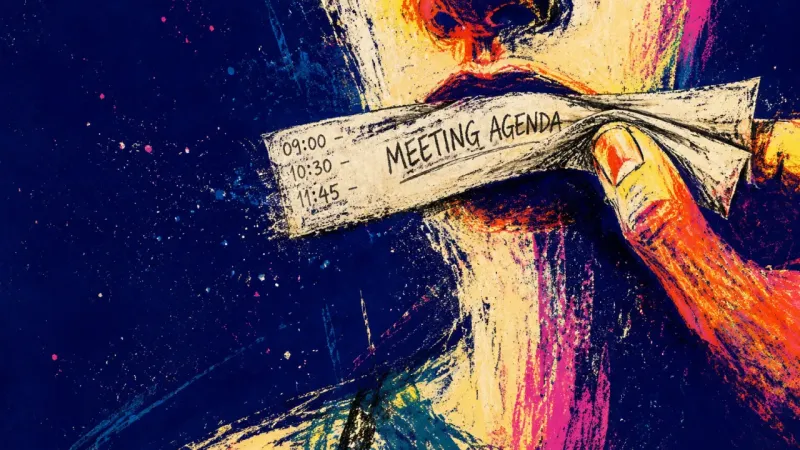
You open the calendar invite early, read the agenda twice, and still go on mute the second the meeting starts—classic “too quiet” feedback spiral.
Taylor met me over a late-afternoon video call from Toronto, the kind where the sky looks like it’s been rinsed in dishwater and the city feels a little too honest. In her condo kitchen, a kettle hissed while Slack pings stacked up like impatient knocks. She’d already opened tomorrow’s invite. Again. Her thumb kept worrying the trackpad as if she could polish the anxiety off the screen.
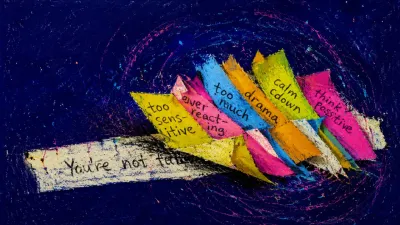
“My manager said I’m ‘too quiet,’” she told me. “And now I… hide. I’m in the meeting, but I’m not in the meeting.”
I watched her swallow before she finished the sentence—tight throat, held breath. It was the kind of self-consciousness that doesn’t live in your thoughts first; it lives in your airway, like a hand gently but firmly closing a door the moment you try to speak.
What she wanted was simple: to be seen as competent and valuable. What her body did was equally simple: brace for real-time judgment, then choose silence as armor.
“If meetings feel like a trial, silence starts to feel like legal counsel,” I said, not to excuse the pattern—only to name it without shame. “Let’s make today a Journey to Clarity. We’re not here to make you louder. We’re here to understand why you hide, and find a way for your voice to feel useful instead of dangerous.”
Choosing the Compass: The Four-Layer Insight Ladder for Workplace Visibility
I asked Taylor to take one slow breath—not a mystical ritual, just a nervous-system handrail—and to hold one specific question in mind: After ‘too quiet’ feedback, why do I hide at work? While she did that, I shuffled. The point wasn’t magic. It was focus: letting the mind stop free-associating and start telling the truth in sequence.
For this, I use a spread I built for modern “feedback anxiety” loops: the Four-Layer Insight Ladder · Context Edition. If you’ve ever Googled “Why do I go silent in meetings after feedback?” you already know this isn’t a simple confidence issue, and it’s not a prediction problem. It’s an inner-pattern loop.
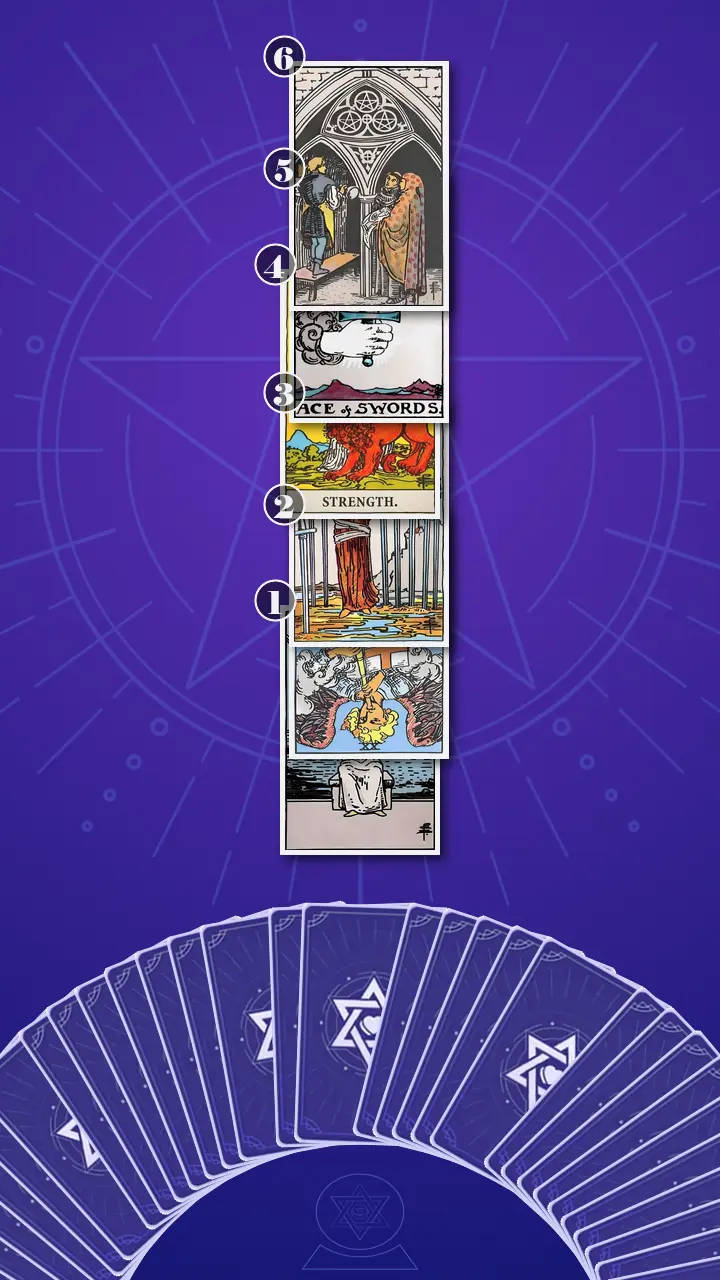
This ladder works because it’s the smallest tarot spread that still shows the full mechanism: the visible behavior (how hiding looks on Zoom/Slack), the trigger (how the feedback lands), the deeper belief (what makes speaking feel risky), and then the resource + pivot + practical integration. Six positions keeps the narrative tight: present symptom → trigger → root block → resource → turning point → next steps.
As we read upward, think of it like archaeology: we don’t yell at the soil for being dense—we sift carefully until the structure is visible.
Reading the Map: From “Read-Only Mode” to Real Participation
Position 1: The Presenting Behavior—How You Hide in Plain Sight
“Now flipped over is the card that shows the specific, observable way you ‘hide’ at work after the feedback,” I said.
Two of Swords, upright.
I nodded toward the image: blindfold, crossed swords held close. “This is protective neutrality. Air energy paused—blocked on purpose. Not because you have nothing to say, but because saying it feels like stepping into a spotlight with no rehearsal.”
And then I used the scene it most often becomes in 2026: It’s 10:02 AM on a Tuesday. You’re on Google Meet with your camera off ‘because bandwidth,’ but really because being seen feels like being graded. You’re taking immaculate notes in a Notion page titled ‘Weekly Sync’… you have a useful point—one risk, one dependency—but you hold it behind your teeth. When the topic moves on, you tell yourself you’ll fix it later in a follow-up message that’s longer than anything you would’ve said out loud.
“That,” Taylor said, and she gave a quiet laugh that had a little bitterness in it, “is… cruelly accurate.”
Her reaction came in a small sequence: her shoulders rose as if bracing for criticism, her eyes flicked away from the screen like she’d been caught, and then she exhaled through her nose—resigned, but relieved to be seen.
“It’s not cruel,” I told her. “It’s data. Two of Swords doesn’t call you incompetent. It calls you protected. You’re in what I’d call ‘read-only mode’—present, tracking, even doing excellent work, but unfindable in public.”
Position 2: The Catalyst—How the Feedback Gets Interpreted in Real Time
“Now flipped over is the card that reveals how the ‘too quiet’ feedback is being interpreted internally and what it triggers in real time,” I said.
Judgement, reversed.
“Judgement is the call, the wake-up, the public prompt,” I explained. “Reversed, that energy gets stuck. Instead of ‘here’s a useful adjustment,’ it becomes ‘this is who I am and it’s bad.’ The recalibration is blocked.”
In modern terms, it looked exactly like her week: After the ‘too quiet’ feedback, every meeting starts with an invisible scoreboard in your head. When your manager says, ‘Any thoughts?’ you don’t hear a normal prompt—you hear a test. You start scanning faces, Slack reactions, and who’s speaking first… defaulting to the safest option: say nothing now, send something polished later, and hope that counts as presence.
She nodded once—tight, contained. “Yes. I treat it like a label, not a data point.”
“Good,” I said, gentle but precise. “Because naming it gives you leverage.” I let a beat pass and then said the line that often snaps the loop into focus: “The feedback wasn’t a verdict—your brain just filed it like one.”
Her eyes softened, like she’d been carrying a legal folder labeled Exhibit A: Me Failing and someone finally pointed out the folder was self-made.
Position 3: The Root Block—The Belief That Turns Speaking into Danger
“Now flipped over is the card that names the underlying fear/belief that makes speaking feel risky,” I said.
Eight of Swords, upright.
“This is the self-made cage,” I told her. “Air energy tightened into constraint. Notice the loose bindings, the open space. The prison is partly imagined consequences.”
Then I anchored it to her daily loop: You’re not quiet because you’re empty—you’re quiet because you’re braced. Your mind runs a whole ‘what if’ thread: what if you stumble, what if they ask a follow-up, what if your sentence becomes the thing people quote later. So you pre-censor… like being trapped inside your own internal PR team: everything must be approved before it can exist.
“That’s the thing,” she whispered. “I’m always trying not to leave evidence.”
“Exactly,” I said. “Eight of Swords is reputational fear dressed up as professionalism. The meeting moves on in thirty seconds, but your brain acts like one imperfect sentence becomes your whole personal brand.”
Her body responded in that three-part way I’ve learned to watch for: first a tiny freeze (breath caught), then a distant look (as if replaying a specific moment), then a slow exhale that finally dropped into her chest. “I’m the one tying my own hands,” she said.
Position 4: The Hidden Resource—Strength That Fits Your Personality
“Now flipped over is the card that identifies a personal strength or supportive approach that fits your personality,” I said. “Not ‘be louder.’ Something truer.”
Strength, upright.
“Strength isn’t hype,” I said. “It’s steadiness. Fire energy that regulates rather than explodes.”
I translated it into her actual gifts: Your strength isn’t hype; it’s steadiness. You’re the person who notices what’s missing in the plan, who can summarize chaos into something workable. The resource here is learning to stay in your body when visibility spikes—feet on the floor, one breath, one sentence—so your nervous system doesn’t yank you into disappearance.
As an archaeologist, I’ve learned you don’t move a fragile relic by gripping harder. You stabilize the surrounding soil first. “Strength says your work voice is already there,” I told her. “We just need to give it a stable nervous system to stand on.”
Taylor’s mouth twitched into the smallest smile. “I could try one sentence,” she said. “Not… a whole new personality.”
When the Ace of Swords Cut Through the Courtroom
Position 5 (Key Card): The Turning Point—A Clean Pivot in How You Use Your Voice
I could feel the room shift—one of those quiet moments where even over video call the air seems to still. “We’re turning over the most pivotal card in your ladder,” I said. “The one that changes the trajectory.”
“Now flipped over is the card that defines the key shift in how you use your voice so you can be seen without feeling exposed.”
Ace of Swords, upright.
Her pattern was so clear it almost hurt: join the call early, scan the agenda twice, watch the first few voices take the air like it’s already booked—mic muted while her best point turns into a perfect draft. She was trapped in “I must sound flawless,” which makes every sentence feel like it carries a verdict.
Stop treating your voice like a verdict on your competence; start using it like a clear blade that cuts through confusion—one honest sentence at a time.
She didn’t relax right away. First, her eyes widened like the sentence had accused her of something. Then her jaw tightened—brief, defensive. “But if I’m not careful,” she said, a flash of anger in it, “doesn’t that mean I’ve been doing it wrong this whole time?”
I kept my voice calm. “Not wrong. Protective. Ace of Swords doesn’t mock the protection—it upgrades it.”
And then I used my own framework—what I call Skill Archaeology. “In a dig, we don’t judge the layers for being layered,” I told her. “We date them. We learn why they formed. Your ‘quiet’ isn’t emptiness. It’s a talent buried under a safety strategy: you can summarize, you can spot risk, you can make decisions cleaner. The Ace is asking you to unearth one usable shard at a time.”
Her reaction arrived in waves: (1) a physical thaw—her shoulders dropped a fraction; (2) a cognitive click—her gaze steadied on the card instead of darting to my face for approval; (3) an emotional release—she exhaled, shaky but real, like she’d been holding her breath since that performance review.
“You don’t need to be louder,” I added, letting it land as simply as possible. “You need to be earlier and cleaner.”
I watched her hand lift to her collarbone, as if checking whether the tightness was still there. It was—just less. “Okay,” she said, voice quieter but steadier. “Earlier and cleaner… that feels doable.”
“Now,” I asked, “with this new lens—voice as a tool, not a trial—can you think of one moment last week where one honest sentence would’ve changed how you felt in that meeting?”
She blinked, then nodded slowly. “When someone asked about blockers. I had one. I just didn’t have the perfect version.”
“That’s the bridge,” I said. “This isn’t about becoming extroverted. It’s about moving from fear-driven hiding to clear, timely participation—and letting steadier self-trust follow behind it.”
Position 6: Integration—How Visibility Gets Built Without Performing
“Now flipped over is the card that gives a grounded, week-level action for participation and visibility that builds trust over time,” I said.
Three of Pentacles, upright.
“This is the workshop,” I told her. “Craftsmanship, collaboration, recognition through building.”
And in her world it looked like this: You bring a rough draft into the room: a one-page timeline, a decision doc, a list of open questions. You share your screen, point to the one part that needs input, and ask, ‘Can I get one reaction from each of you?’ Now your visibility is structured—you’re not performing, you’re facilitating the build.
I gave her the simplest reframe I know for hybrid-office politics: “Stop auditioning in meetings. Start building in them.”
She sat back, like she’d been leaning forward for months. “If it’s about the doc,” she said, “I can do that. I can hold onto something.”
From Courtroom to Workshop: Actionable Next Steps You Can Actually Do
I summarized what the ladder had shown us, the way I might summarize a site report after an excavation: clear layers, clear causation.
“Here’s your story,” I said. “You started with protective silence (Two of Swords). Then one piece of feedback got filed as a permanent judgement (Judgement reversed), which tightened into a self-imposed constraint (Eight of Swords). Strength shows you already have the steadiness to stay present through discomfort. Ace of Swords gives you the pivot: speaking is not a performance—it’s a small, useful contribution. And Three of Pentacles grounds it: you become visible through structured collaboration, not charisma.”
“Your cognitive blind spot,” I added, “is that you’ve been treating real-time speaking as an identity test. That makes you over-prepare and hide, which ironically keeps the ‘too quiet’ feedback alive. The transformation direction is the opposite: shift from ‘speaking must be flawless’ to ‘speaking is a useful tool for the shared work.’”
I brought in one of my most practical strategies—Megalith Transport. “In prehistory,” I said, “people moved stones that looked impossible to move. They didn’t do it with one heroic heave. They did it with rollers, leverage, and small coordinated pulls. We’re going to move your visibility the same way.”
- The 10-Second Unmute (One Clean Sentence Rule)Before one meeting this week, write one clean sentence that would help the work move forward (a question, a risk, or a decision summary). When that topic shows up, unmute within 10 seconds and say only that sentence—then stop.If your throat spikes, do one longer exhale than inhale first. The win is the rep, not sounding smooth. Afterward, write one neutral fact: “I spoke once.”
- Draft-First Collaboration (Visibility with Structure)Bring a rough artifact into one meeting (a one-page timeline, decision doc, or open questions list). Share your screen for 2 minutes, point to the one section that needs input, and ask: “Is this the decision to make today, or do we need one more data point?”Make it structural, not emotional. Set a boundary like, “I’m going to take 60 seconds to summarize where we are,” then actually stop at 60 seconds.
- Retire the Director’s Cut Follow-UpAfter the meeting, don’t send a three-paragraph “perfect” follow-up unless it adds new information. If you want to send something, keep it to three lines: (1) what we decided, (2) next step, (3) owner.If you feel the urge to over-explain, ask yourself: “Am I adding clarity—or trying to erase evidence of being human?”
A Week Later, a Small Proof in a Small Voice
A week later, Taylor messaged me: “I did the 10-second unmute thing. My voice shook. I said the one sentence anyway. No one died. Someone actually said, ‘Good catch.’”
Her update wasn’t triumphant. It was quieter than that—more honest. She’d done the meeting, then sat alone in a café afterward for half an hour, not celebrating exactly, just letting her nervous system learn the new fact: visibility can be contained. The next morning, the first thought was still, What if I mess up again?—but this time she smiled a little as she made coffee.
That’s the work I trust most: not a personality rewrite, but a repeatable shift. Tarot, when it’s done well, doesn’t hypnotize you into confidence. It shows you the mechanism—then hands you a lever. In this case, the lever was clarity: one honest sentence at a time.
When you want to be seen as capable but your body locks up in real time, it can feel like you’re watching your own value disappear behind a muted mic and a held breath.
If you treated your next meeting like a shared workshop—not a performance—what’s one clean, low-stakes sentence you’d be willing to say out loud, even with a little shake in your voice?
This story is adapted from psychological research, written so that those in a similar struggle can see their own pattern in it — and find their next step clearly.These insights are not a substitute for professional psychological, medical, legal, or financial advice.
Learn more about our Journey to Clarity.
How did this insight land for you?
🫂 This Resonates Deeply
🌀 Living This Story
✨ Now I See Clearly
🌱 Seeing New Possibilities
🧰 Useful Framework
🔮 The Confirmation I Needed
💪 Feeling Empowered
🚀 Ready for My Next Step
Author Profile
 AI
AI“Having spent a lifetime at Cambridge and on archaeological digs, I’ve witnessed the rise and fall of countless civilizations. Please know that your current struggles are not a permanent fate, but merely a necessary fracture before rebuilding. I won't lecture you; instead, I invite you to sit with me in the ruins, using a patient, historical perspective to gently dust off the true, enduring value hidden beneath your temporary doubts.”
In this Career Tarot Reading :
Core Expertise
- Core Competency Excavation: Digging through the 'strata' of your past roles to uncover undervalued, highly transferable foundational skills.
- Career Epoch Analogies: Contextualizing your career plateau as the end of one professional era and the necessary foundation for the next.
Service Features
- The Resume Stratigraphy Review: A structured framework to rewrite your professional narrative, highlighting immutable assets over obsolete job titles.
Also specializes in :
Explore Related Patterns:
HypervigilanceAfter the feedback, Taylor enters meetings with an invisible scoreboard running in her head. Instead of hearing 'Any thoughts?' as a normal prompt, she scans faces, Slack reactions, timing, and who has already spoken, searching for the safest opening. That scanning is a defensive attention pattern. Her nervous system treats the meeting like a threat environment, so her focus narrows around social cues that might predict judgment. The problem is that constant monitoring drains the same mental bandwidth she needs for clear participation. Hypervigilance fits because Taylor is not simply thinking ahead; she is tracking the room as if one wrong signal could expose her. You can feel the cost in the story: the more she monitors, the harder it becomes to speak, and the perfect moment disappears while she is still checking whether it is safe.
Self-SilencingTaylor has useful information in the meeting, including risks, blockers, and dependencies, but she holds it behind her teeth until the topic moves on. The silence is active: she is editing herself before anyone else can respond, then trying to recover the contribution later in a more polished, less exposed format. The defense underneath is pre-censorship. When she says she is 'always trying not to leave evidence,' speaking stops being a normal workplace behavior and becomes a reputational risk. You can see how the boundary around her voice gets too tight: it protects her from being judged, but it also prevents her from taking up legitimate space. Self-Silencing fits because the pattern is not about having nothing to say. It is about suppressing what you know in order to avoid the discomfort of being witnessed in real time. The cost is subtle but real: You stay safe from immediate scrutiny while your competence becomes harder for other people to see.
Shame BindingTaylor names the core shift herself when she says she treated the feedback like a label, not a data point. The comment 'too quiet' stops being information about a behavior and starts attaching itself to identity, as if it proves something bad or deficient about who she is at work. That is the binding mechanism: a specific piece of feedback fuses with self-worth. Once that happens, speaking in real time feels like risking confirmation of the label. Pre-censoring, over-polishing, and trying not to leave evidence become ways to avoid a shame hit rather than ways to improve the meeting. Shame Binding fits because the pain is not only fear of making a mistake; it is fear that the mistake will reveal the self. You regain leverage when the feedback is moved back to its proper scale: not a verdict on your competence, but a workable signal about how your voice enters the room.
Spotlight EffectTaylor hears ordinary meeting prompts as if they carry more evaluative weight than they actually do. When her manager asks for thoughts, the moment does not feel like a routine invitation; it feels like a test where every face, pause, and reaction might confirm something about her competence. The cognitive distortion is an inflated sense of being observed. Her brain treats one imperfect sentence as if it could become her whole personal brand, which makes normal participation feel like standing under a spotlight. That is why even a useful point can feel too risky to say out loud. Spotlight Effect fits because the story repeatedly shows Taylor overestimating how much attention others will give to a small speaking moment. You are likely not being studied as closely as your nervous system predicts, but the felt intensity of that spotlight is enough to push you back into silence.
Strategic VisibilityTaylor's turning point is practical: she does the 10-second unmute and says one clean sentence even though her voice shakes. The action is small, but it changes the meaning of visibility from 'being judged' to 'moving the work forward.' The psychological mechanism is a deliberate exposure to participation with structure around it. By preparing one useful sentence or bringing a rough artifact into the room, she gives her voice a job. That shifts attention away from performance and toward contribution. Strategic Visibility fits because the goal is not constant visibility or a personality rewrite. You become easier to see through timed, contained, relevant participation: a question, a risk, a decision summary, or a document that helps the group build together.
Visibility AvoidanceTaylor going on mute the second the meeting starts is the clearest behavioral anchor: she is present, tracking, and prepared, but she becomes publicly hard to find. The 'too quiet' feedback turns workplace participation into a visibility threat, so silence starts functioning like armor rather than preference. The psychological mechanism is not simple shyness. Her mind files feedback as a verdict, then her body braces for real-time judgment through held breath, tight throat, scanning, and delayed participation. You can see the defensive loop: the more she wants to appear competent, the more she avoids the exact public moments where competence could be witnessed. Visibility Avoidance fits because the pattern protects her from immediate exposure while quietly keeping the original feedback alive. The muted mic, camera-off excuse, polished follow-up, and internal courtroom all point to the same mechanism: You are trying to stay safe by reducing your visibility, but the cost is that your useful voice becomes unavailable when it would matter most.
Perfectionism-Driven AvoidanceTaylor opens the calendar invite early, reads the agenda twice, takes immaculate notes, and still goes quiet when the meeting starts. The preparation is real, but it does not become participation because the sentence has to feel fully approved before it can exist out loud. The mechanism is a perfectionistic safety strategy. Her mind tries to protect her by making speech pass through an internal approval process, as if one rough sentence could damage her professional identity. This turns preparation into a hiding place: more thinking, more polishing, more waiting, and less timely contribution. Perfectionism-Driven Avoidance fits because the avoidance is not random. You are not avoiding the work; you are avoiding the visibility of an imperfect version of the work. The loop becomes painful because the standard of 'flawless' makes the usable sentence arrive too late, after the meeting has already moved on.
Secure VisibilityTaylor can participate more easily when the meeting becomes a workshop rather than an audition. Sharing a timeline, decision doc, or list of open questions gives her a concrete object to hold onto, so visibility is organized around the work instead of her personality. The mechanism is relational containment. Structure reduces the felt exposure of speaking because the attention is distributed across the artifact, the decision, and the group's input. That makes public contribution feel less like being evaluated and more like facilitating a build. Secure Visibility fits because the story points toward being seen without over-performing. You do not disappear, and you do not have to dominate the room; you create a stable format where your thinking can be witnessed in a way your nervous system can actually tolerate.
Feedback IntegrationTaylor's feedback begins as a verdict in her mind: 'too quiet' becomes a global statement about her value at work. The story shifts when that same feedback is reframed as behavioral information, something specific enough to work with instead of absorb as identity. The mechanism is cognitive reappraisal with a cleaner boundary between behavior and self-worth. Once silence is named as protective rather than defective, Taylor can update the strategy without attacking herself. Feedback becomes a signal for adjustment, not evidence for self-judgment. Feedback Integration fits because the central repair is learning how to metabolize criticism without becoming trapped by it. You do not have to dismiss the feedback or obey it as a verdict; you can translate it into one clear, workable behavior that keeps your agency intact.
Emotional RegulationTaylor's useful pivot begins when participation is made small enough for her body to tolerate: feet on the floor, one breath, one sentence. The story does not ask her to become louder or more extroverted; it asks her to stay present through the first spike of visibility. The mechanism is nervous-system regulation under social evaluation. Instead of letting throat tightness and held breath decide the whole meeting, she creates a small behavioral container that keeps the body from yanking her into disappearance. The sentence can shake and still count as participation. Emotional Regulation fits because the change is not based on forcing confidence. You build a steadier relationship with visibility by giving your body repeated evidence that speaking can be contained, useful, and survivable without turning into a performance.
Explore Related Struggles:
Identity Verdict LockThe manager's 'too quiet' feedback lands, and every meeting afterward begins with an invisible scoreboard. Instead of treating the comment as adjustable data, you file it as evidence about who you are, then scan faces and Slack reactions as if the room is confirming the label. That is the lock: a single piece of feedback becomes a verdict on identity. Once the verdict is active, one imperfect sentence feels large enough to define your competence, so you choose the safest legal strategy: say nothing now, polish later. The work is not to argue with the feedback; it is to restore its actual size.
Performance-Competence SplitThe work itself shows competence: you notice missing risks, summarize chaos, and can turn a rough decision into something workable. The meeting, though, turns that competence into a stage, and the moment you feel watched, the skill gets separated from the person who could use it out loud. This split makes visibility feel like auditioning instead of contributing. You hide because the room seems to ask for a performance of confidence, while your actual value is quieter, sharper, and more practical. When participation becomes a build instead of a test, competence has a structure to travel through.
Visibility-Safety SplitCamera off, mic muted, Notion notes open: you are there, but the room cannot quite find you. Being seen has started to feel like being graded, so the safest version of presence becomes a version with as little live exposure as possible. The split is that you want recognition through the work, while the conditions that create recognition also activate withdrawal. You are not choosing invisibility because you have no value to offer; you are choosing it because visibility has become too uncontained. A small, bounded contribution lets being seen become measurable again instead of total.
Voice-Safety FusionThe calendar invite is open before the workday even arrives, and when the meeting starts the mic still goes quiet. You are not empty in the room: you are tracking the agenda, holding a risk or dependency, and trying to keep your competence visible without putting your voice on the line. The struggle forms because speaking has been coded as a safety event. After the 'too quiet' comment, a normal prompt like 'Any thoughts?' stops feeling like collaboration and starts feeling like a live assessment, so silence becomes armor. You hide because the system has fused voice with danger; reclaiming clarity starts with separating one useful sentence from the fear that it has to protect your whole self.
Clarity-Exposure SplitThe story keeps returning to small pieces of clarity: one risk, one dependency, one blocker, one sentence that would have helped the meeting move. Each piece is useful, but live delivery makes it feel like the spotlight moves from the work to you. That is the split between clarity and exposure. You can see what needs to be said, yet saying it in real time feels like leaving evidence that can be judged later. When the sentence is treated as a tool for the shared work, not a display of the whole self, clarity can enter the room without demanding a personality rewrite.
Perfect Readiness TrapTaylor opens the invite early, rereads the agenda, takes immaculate notes, and still waits until the topic has moved on. The useful point exists, but it is held back until it can become a polished follow-up with fewer live edges. The trap is not laziness or lack of preparation; it is preparation becoming the place where participation gets stuck. You keep trying to earn a frictionless entrance into the conversation, but the standard of 'ready enough' moves every time visibility gets close. The more flawless the sentence has to be, the less likely it is to arrive when the team can use it.
Explore Related Emotions:
Exposure DreadTaylor keeps the camera off, calls it bandwidth, and sits behind a muted mic while a useful point stays behind her teeth. Being seen in the room does not feel neutral; it feels like being graded before she has had time to rehearse. That sense of exposure turns ordinary participation into a spotlight. The meeting may only need one risk, one dependency, or one clear question, but her body treats the sentence as if it will make her too visible to recover from. Exposure Dread names the fear of becoming observable before you feel fully controlled. You are not avoiding visibility because you have nothing to offer; you are avoiding the rawness of being witnessed while still imperfect.
Feedback DreadTaylor opens the calendar invite early, reads the agenda twice, and still goes quiet the moment the meeting begins. The feedback has stopped being a neutral workplace note; it now arrives ahead of the meeting like a pressure system, making her body prepare for judgment before anyone has asked her to speak. Because the comment came from a manager, the room starts to feel charged with evaluation. A normal prompt like “Any thoughts?” does not land as an invitation to contribute; it lands as a moment where her value could be measured in real time. That is why Feedback Dread fits this story so closely. You are not simply nervous about meetings in general; the specific feedback has become emotionally preloaded, turning each future meeting into a place where your silence feels watched and your voice feels risky.
Micro-Performance ShameTaylor is not being asked to give a keynote. She is being asked for a thought in a meeting, yet the prompt lands as if one small sentence has to prove she belongs there. Because the stakes feel inflated, she moves the contribution into a safer format: a longer follow-up, a cleaner draft, a version that arrives after the live moment has passed. The shame gathers around the tiny scale of the ask and the huge emotional charge attached to it. Micro-Performance Shame fits the story because every small act of participation becomes a public performance in miniature. You are not scared of speaking for hours; you are scared that ten seconds of being heard will reveal too much.
Performance FreezeTaylor goes on mute the second the meeting starts, even when she has already read the agenda and knows the work. She can track the discussion, notice a blocker, and draft the better answer in her head, but the live moment closes around her before the sentence can leave her mouth. The freeze is not a lack of competence. It is a body-level shutdown around being evaluated while speaking, where silence starts to feel safer than letting an imperfect thought exist in the room. Performance Freeze names the exact weather of being mentally present but physically locked. You are there, you are working, and you may even have the useful point, but the moment participation becomes visible, your system chooses stillness as protection.
Quiet ShameTaylor describes herself as being in the meeting but not in the meeting. When the pattern is named, her shoulders brace, her eyes move away, and the laugh that comes out has a bitter edge, as if being accurately seen also stings. The shame here does not announce itself loudly. It folds inward, making her monitor her own quietness while also hiding the fact that she is monitoring it. The more she notices herself disappearing, the more exposed the disappearance feels. Quiet Shame fits because the pain is attached to being perceived as too small, too silent, or not enough in a professional room. You are not only trying to avoid a mistake; you are trying to avoid the private humiliation of being seen hiding.
Verdict DreadTaylor says she treats the feedback like a label, not a data point. Once that happens, every meeting carries a hidden courtroom quality: one sentence could become evidence, one stumble could become a story about who she is. Her fear is not limited to getting a detail wrong. The deeper pressure is that speaking might expose something permanent about her competence, value, or professional identity, so the safest move becomes saying nothing until the thought is polished beyond risk. Verdict Dread captures that distortion with precision. You are not only afraid of talking; you are afraid that talking will hand the room a final ruling about you.
Identity PR FatigueTaylor says she is always trying not to leave evidence. Before speaking, her mind runs the whole risk thread: what if she stumbles, what if someone asks a follow-up, what if the sentence becomes the thing people remember. That turns ordinary communication into reputation management. Every thought has to pass through an internal approval process before it is allowed to exist, and by the time it is approved, the meeting has moved on. Identity PR Fatigue belongs here because the exhausting part is not only the work meeting; it is the constant management of how the work self might be interpreted. You are trying to protect your professional image so intensely that the protection starts consuming the voice it was meant to defend.
Cautious Self-TrustTaylor does not leave the reading with a new personality. She leaves with one sentence, one unmute, and the idea that her voice can be useful before it is flawless. A week later, her voice shakes and she speaks anyway. The important detail is not that the fear disappears; it is that she gains a new fact her body can keep: being visible can be contained, and a small contribution can land without becoming a disaster. Cautious Self-Trust is the quiet turning point underneath the action. You are not forcing confidence onto yourself; you are collecting evidence that your voice can survive the room one clean sentence at a time.
Clarity ReliefTaylor softens when the feedback is separated from identity. The sentence “The feedback wasn’t a verdict” gives her a way to stop treating the comment as proof of failure and start seeing the sequence that formed around it. Once the mechanism is visible, the problem becomes less foggy. Protective silence, over-polished follow-up, and the fear of leaving evidence are no longer random flaws; they are linked parts of a loop that can be worked with. Clarity Relief names the release that comes when the pattern becomes specific. You may still feel the meeting pressure, but you are no longer trapped inside a vague belief that something is simply wrong with you.
Cognitive OverwhelmTaylor is not just listening to the meeting. She is reading the agenda, tracking Slack pings, scanning faces, watching who speaks first, and measuring what each signal might mean for her next move. That much monitoring makes a simple contribution feel crowded before it begins. The useful sentence has to fight through too many internal tabs: timing, tone, status, safety, and whether speaking now will count against her. Cognitive Overwhelm explains why hiding can feel automatic even when the answer is available. You may know what you want to say, but the mental room is so full of evaluation data that the path from thought to voice gets blocked.
Regulated CourageTaylor’s next step is small enough to hold: one clean sentence, spoken within the moment it can help. The plan does not demand charisma or a total personality rewrite; it gives her body a contained way to stay present while visible. When she tries it, her voice shakes. She still says the sentence, and the room keeps moving. Courage here is not the absence of activation; it is the ability to participate without letting the activation make the decision. Regulated Courage fits because the story’s growth is grounded, not performative. You are learning to act with a little shake in your voice while keeping the experience inside a size your system can handle.
Explore Related Contexts:
Career Visibility ParalysisYou open the calendar invite early, read the agenda twice, and still go on mute the second the meeting starts. The story keeps showing the same work pattern: useful analysis is present, but it stays in private notes, behind a muted mic, or inside a follow-up message that arrives after the live moment has moved on. In a hybrid workplace, competence is often registered through public timing. The problem is not that you have no contribution; the problem is that the workplace stage rewards immediate visibility while your safest strategy is to become hard to locate. Camera-off presence, careful notes, and polished aftermath let you keep working, but they also make your value less visible to the people evaluating participation. Career Visibility Paralysis fits because the external demand is not just to do good work, but to be seen doing usable work in real time. Once 'too quiet' enters the room, every meeting becomes a place where your professional value has to pass through a narrow public channel. Naming that structure gives you a cleaner target: not becoming louder, but making one useful contribution visible before the window closes.
Feedback Friction WindowThe manager's 'too quiet' comment enters as one line of workplace feedback, but it changes the shape of the next meetings. When someone asks for thoughts, the prompt no longer feels like ordinary collaboration; it carries the weight of being measured against the label. Feedback becomes hard to use when it arrives as a broad trait judgment instead of a scoped behavior. Taylor is left trying to translate 'be less quiet' into live meeting tactics while also managing the social risk of speaking imperfectly. That creates friction between the stated development goal and the actual conditions required to practice it. Feedback Friction Window captures the external problem: the workplace has opened a performance adjustment window, but the rules for succeeding inside it are vague and socially exposed. You are not simply resisting feedback; you are trying to act on feedback in a setting where every attempt feels like fresh evidence being collected.
Workplace Spotlight TestThe meeting scene keeps giving the same cues: camera off 'because bandwidth,' mic muted, a useful point ready, and a manager prompt that lands like a test. Taylor is not outside the meeting; she is watching the room closely, reading faces, Slack reactions, and the order of speakers before deciding whether it is safe to enter. That is a workplace spotlight problem, not a simple confidence problem. Hybrid meetings compress status, timing, visibility, and evaluation into one public moment. A single sentence can feel like it has to represent the whole professional self, so silence becomes a way to avoid being graded in real time. Workplace Spotlight Test fits because the external stage is doing a lot of the pressure work. You are being asked to contribute under conditions where visibility feels immediate, public, and hard to revise. The path back is not theatrical confidence; it is reducing the size of the spotlight until one timely sentence can function as a work tool rather than a personal audition.