Pitch Perfectionism: How One Defined Share Restarts the Process

The 11:48 p.m. Pitch: Perfectionism-Driven Creative Procrastination in Blue Light
“You are a London freelancer who can explain the big idea in two minutes, yet the pitch deck is still unsent because one rough headline keeps reopening the whole strategy,” I said to Avery.
At 11:48 p.m., their screen share showed the pitch deck glowing beside the live submission page. I could hear the laptop fan humming through our call. Blue light washed across the kitchen table as Avery lifted the mug beside the trackpad, discovered the tea had gone cold, and set it down again without drinking. Their jaw was locked. Their shoulders had climbed towards their ears. The cursor was replacing a headline they had approved at lunch.
“The idea is coherent,” Avery said. “The research is there. I can literally see the Send button. But if they notice one rough edge and decide I am not at the level they expected... I just need one more pass.”
The apprehension in their body resembled a browser security warning generated by their own mind: the page was available, but every imagined criticism was being flagged as a reason not to proceed. They were torn between sharing the pitch while the opportunity remained open and delaying it until the work felt impossible to dismiss.
“It is almost ready,” they said, rubbing two fingers against their temple, “which is exactly why I cannot send it yet.”
I let the contradiction sit between us without treating it as laziness or lack of discipline. Polishing is real work; it just is not always the work of being seen. Avery had invested care, time, and scarce freelance energy in the deck. The problem was that the closer it came to being shareable, the more dangerous sharing seemed, so moving the definition of ready provided a few minutes of relief while tightening the deadline around them.
“I am not going to tell you to just send it,” I said. “The income matters. The client relationship matters. Confidentiality and professional standards matter. What we can do is separate those real requirements from the extra conditions your fear has added. Let us draw a map of this fog and find the smallest move that returns the decision to you.”

Choosing a Map for the Moving Finish Line
I asked Avery to take their hands off the keyboard for one breath and say the question aloud: “Why do I keep delaying my pitch until it feels perfect?” I shuffled slowly, not to manufacture certainty, but to mark a psychological transition from editing the work to observing the pattern around it.
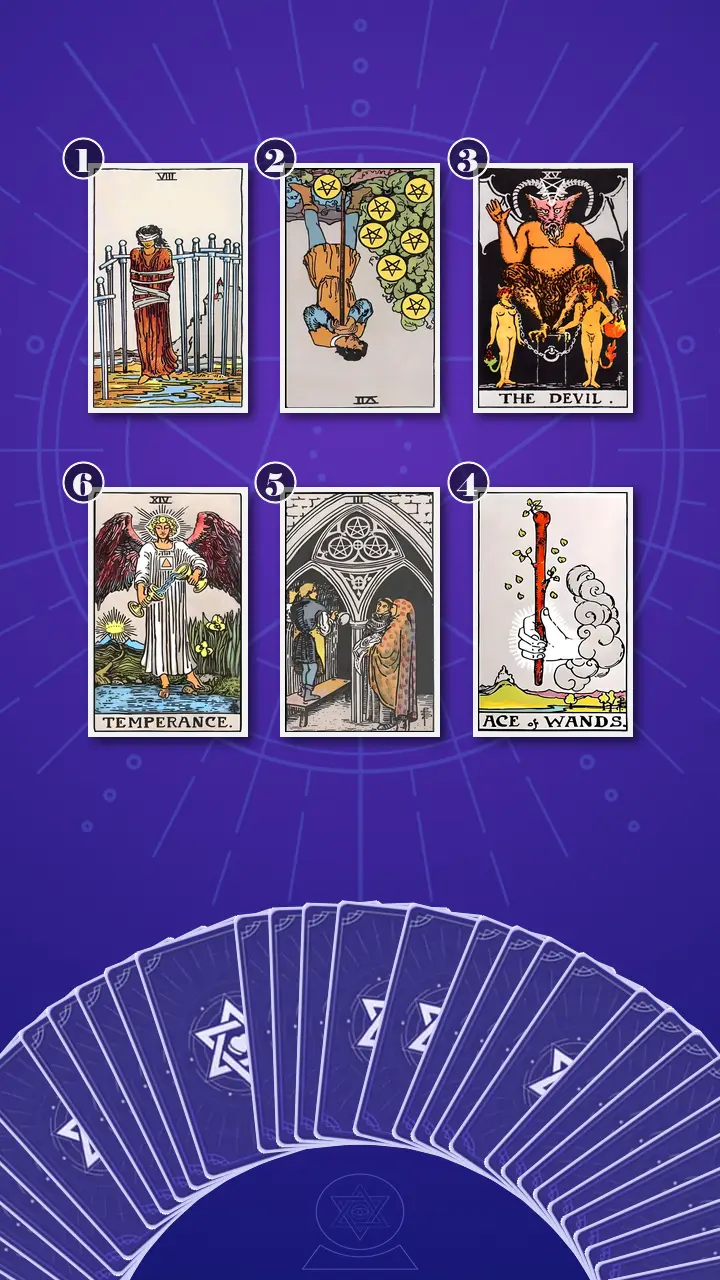
I chose the Transformation Path Grid (6) · Context Edition. I use this six-card tarot spread when a person is not choosing between two external options but is caught inside a self-reinforcing loop. A simple decision spread would have implied that “send” and “wait” were equally separate paths. Avery needed a causal map: what the delay looked like, what blocked movement, what belief sustained it, and what could convert insight into a repeatable process.
This is how tarot works in my practice. I do not use the cards to predict whether a client will approve a pitch. I use their images and positions to make an internal system visible enough to examine. Card meanings in context become structured questions: What is actually happening? Which rule is being mistaken for reality? Where is the smallest point of leverage?
I placed the six cards in two rows of three. The upper row would show the visible restriction, the blockage, and the root bargain. The path would then turn down through the fourth card, the key trigger, before moving across the practical action and the sustainable integration. On the table, the layout looked like a switchback path through a garden: first the idea trapped under inspection, then the route by which it could be allowed to grow.
Where the Send Button Disappeared
Current State: The Eight of Swords and the Available Next Step
The first card I turned over occupied the position representing Avery's current state: the concrete delay behaviour and contracted mental energy visible whenever they revised the pitch instead of sharing it. It was the Eight of Swords, upright.
I pointed to the blindfolded figure, the crossed swords, and the bindings that looked restrictive without being fully tight. “This is not a picture of somebody with no options,” I said. “It is a picture of somebody who cannot currently experience the available option as safe.”
At 11:48 p.m., Avery had the coherent deck and the submission page open side by side. The required sections were present. The deadline was real. Nothing external prevented a share, yet each sword had become an anticipated objection: the headline might be too obvious; the rough diagram might look junior; the market evidence might be too thin; the client might know another strategist who would have phrased it better.
I heard the internal sequence in the way Avery described it: “I could send this now, but what if they notice the diagram? I could fix the diagram, but then the headline might overpromise. I could soften the headline, but then the whole story may need another proof point.” The imagined requirements multiplied each time an actual requirement was met.
The Swords energy was in excess as rehearsed criticism and in blockage as action. Hyper-analysis had crowded the pitch window until mental safety looked like professionalism. Changing one sentence reduced the immediate pressure, but it did not produce information from the market, the client, or a trusted reader.
Avery gave a short laugh, but there was no amusement in it. Their fingers stopped over the trackpad, then curled into their palm. “That is so accurate it feels a little brutal.”
“The card is not calling you foolish,” I said. “It is showing us the difference between feeling trapped and having no available next step. Precision can sting, but it also gives us something workable.”
I asked them to name the last edit they had made. It was the replacement of “A new way to” with “A smarter way to.” The change was not required by the brief, factual accuracy, accessibility, confidentiality, or comprehension. Its purpose was to reduce the sensation of being judged.
“That does not mean the edit was bad,” I said. “It means we now know which job the edit was performing.”
Blockage: The Seven of Pentacles Reversed and the Forced Blooming Trap
The next card represented the blockage: the Forced Blooming Trap and the premature evaluation that made normal creative development feel like evidence of unreadiness. I revealed the Seven of Pentacles, reversed.
The traditional image shows a person leaning on a tool and inspecting a crop that is still developing. Reversed, that pause had become stalled assessment. I connected it directly to Avery reviewing the deck at 125 percent zoom, comparing a development-stage diagram with polished agency case studies, and deciding that the hours already invested should have produced something more finished.
“It is like refreshing the analytics before a post has had time to circulate,” I said. “Or checking a seedling for flowers every few hours and treating the absence of petals as evidence that it is failing.”
This Pentacles energy showed blocked patience and excessive evaluation. Avery was not abandoning the work. They were keeping it under inspection. When a thirty-minute review block ended without producing the internal feeling of completion, they added another market-context section. That section created three new decisions, which justified another postponement.
“It has taken this long, so it should look more finished by now,” Avery said, recognising the script as they spoke it. “And if it does not, I assume the answer is more work.”
I watched their shoulders tighten before dropping by half an inch. Their mouth pulled into a rueful line. The painful part was not simply the lost time. It was the secret shame of working for hours without producing a sendable event.
“Cultivation and postponement can look identical from the outside,” I said. “The difference is whether the work has a defined purpose for this stage. A draft can be unfinished and still be complete enough to answer one useful question.”
Avery looked back at the deck. “I have been asking whether it looks fully grown. I have not asked what this version actually needs to do.”
Root: The Devil and the Price of Creative Legitimacy
The third card represented the root: the delayed-gratification bargain and the fear that an imperfect pitch could prove a lack of creative worth. I turned over The Devil, upright.
I kept my voice measured. This card did not mean that Avery was doomed, corrupted, or under an external force. In this position, The Devil showed attachment to a conditional bargain. The loose chains around the figures mattered more than the imposing figure above them: the rule felt compulsory, but it could still be examined.
Avery had variable income, an approaching rent payment, and a client opportunity that could genuinely matter. I did not minimise those stakes. I showed them how the practical importance of the pitch had acquired a second meaning. The deck was no longer being asked only to communicate an idea. It was being asked to prove that Avery belonged in the industry.
The private bargain sounded like this: “If the pitch is flawless, they cannot dismiss me. If they dismiss it, perhaps I never belonged in the room.” The work-self split in Severance offered an uncomfortable contrast. Avery wanted the deck to remain a contained professional object, but their perfection rule kept merging its reception with their entire creative identity.
The Devil's energy appeared as excessive attachment and blocked choice. Each postponement supplied immediate protection from exposure, but the cost was that an imagined evaluator gained more authority over Avery's self-respect. A private draft could protect their hope, but it could not give them information.
I asked, “When you say you are protecting quality, which standards help the client understand the idea, and which edits are trying to remove every possible reason someone could question you?”
Avery's breathing paused. Their gaze moved away from the card and towards the dark window, as if they were replaying a series of late-night edits against that distinction. Then they exhaled through their nose and said, “I thought I was protecting the pitch. Some of the time, I am protecting myself from finding out what the pitch means to someone else.”
I nodded. “That protection makes sense. It is also expensive. The chain loosens when you recognise it as a strategy rather than a law.”
When the Sprouting Wand Crossed the Table
Key Trigger: The Ace of Wands and the First Testable Share
The room became noticeably quieter as I reached the lower-right corner of the grid. Rain that had been ticking against Avery's window softened to an irregular drip, and even the laptop fan seemed to settle. I turned over the card representing the smallest shift that could reopen movement. It was the Ace of Wands, upright.
A hand emerged from a cloud, offering a wand already alive with fresh leaves. I asked Avery to notice what the image did not contain. There was no finished tree, no full flower, no applause, and no guarantee. There was a deliberate offering of living potential.
The Ace translated cleanly into a modern creative act: Avery could duplicate the current deck, label the copy “Draft for Direction,” keep the coherent proposition and supporting logic, and place it in the hands of one relevant collaborator. The rough diagram could remain. The language could still change. Its incompleteness could tell the reader what kind of response was useful instead of functioning as hidden evidence against Avery.
I named the pressure concentrated in the 11:48 p.m. scene: the submission tab open, the jaw locked, and the lunch-approved headline being replaced. Avery was no longer asking only, “Is this clear?” They were asking, “Can I make this impossible to use against me?”
Perfection is not the gate that makes the pitch worthy; let the hand offering a sprouting wand mark a first, testable share and let the idea grow through contact.
I stopped speaking. For a moment, Avery's breath appeared to freeze halfway into their chest. Their fingers hovered above the keyboard without touching it. Then their gaze lost focus, and I watched their eyes move slightly from side to side as if they were replaying the Friday Slack message asking for a draft by end of day. Their eyebrows drew together; their jaw tightened once more before releasing.
“But does that mean I wasted all those nights?” they asked. The first words came out sharper than the rest. “If I could have shared earlier, then I have been doing this to myself.”
The anger held for a beat. Their eyes reddened, not quite with tears, but with the sting of seeing how much energy the bargain had consumed. Then their fist loosened on the table. A long breath left their chest, their shoulders sank, and their expression shifted from resistance to a slightly dazed openness. The relief was real, but so was the vulnerability that arrived behind it: without perfection as the gatekeeper, Avery would have to choose when to act.
“No,” I said. “Some of those nights improved the work. We are not putting every revision on trial. We are identifying the point where revision stopped increasing clarity and started purchasing temporary safety. You used the best protection you had. Now you can build a more efficient one.”
Looking at the sprouting wand, I flashed back to my years on Wall Street. No serious decision became risk-free because another analyst adjusted the formatting. We acted when the required facts, downside boundaries, available resources, and market timing supported the next controlled move. Readiness was not invulnerability. It was sufficient alignment for a defined action.
I brought that logic into what I call a Resource Readiness Assessment. Avery's external timing was clear: the opportunity was open and narrowing. Their internal assets were also clear: the core proposition was coherent, the supporting material existed, the required sections were present, and one discreet, relevant reader was available. The remaining risks were specific: confidential information, factual gaps, a broken file, or an unclear requested next step. “Nobody could criticise this” was not a readiness requirement. It was an impossible insurance policy.
“You are not necessarily ready for a final public launch,” I said. “You are resource-ready for a bounded test. That is a different claim, and it is enough for the next move.”
This was also a matter of Strike Timing Calibration. The optimal node was not an impulsive midnight send to everyone, and it was not another indefinite research cycle. It was a deliberate first share to one qualified person while enough time remained to use the response.
“Now, using this new view, think back to last week,” I said. “Was there a moment when this distinction could have changed how the pitch felt?”
Avery looked at the Slack thread. “Friday at 4:37. They asked for a draft, not a masterpiece. I heard it as, ‘Show us whether you deserve the project.’ I could have asked whether they wanted the strategic direction or the finished deck.”
I invited Avery into a nine-minute experiment. They duplicated the deck so the original remained untouched, named the copy “Draft for Direction,” chose one relevant and trustworthy reader, and wrote one prompt: “Where is the idea clearest, and where do you lose the thread?” I made the boundary explicit: they did not have to send it during our session, confidential material would remain excluded, and the minimum version was simply putting the reader's name in their Notes app.
When the nine minutes ended, Avery stared at the new filename. “This version does not have to prove the whole idea,” they said slowly. “It only has to make contact.”
That sentence marked the breakthrough: a first movement from apprehensive perfectionism and identity-protective delay towards tolerable vulnerability, iterative learning, and steadier creative self-trust. The pitch was becoming a prototype rather than a referendum on whether Avery was creative enough to belong.
Building Quality Where Other People Can See It
Action Plan: The Three of Pentacles and Bounded Craft Feedback
The fifth card represented the action plan: a concrete way to share one defined draft with one relevant reader and convert exposure into specific craft feedback. I revealed the Three of Pentacles, upright.
I pointed to the craftsperson working while two other figures reviewed the architectural plan. The work was visible, the roles were clear, and the conversation concerned a shared object. Nobody in the scene was being asked to declare whether the maker deserved an identity.
In Avery's life, this card looked like one trusted collaborator opening the “Draft for Direction” PDF or Google Slides file. Instead of asking, “Is this good?” Avery would ask where the value proposition became clear and where the narrative lost momentum. The collaborator might leave three focused observations. Avery could choose which two served the pitch and leave the third unused.
The Pentacles energy was balanced here: skill met reality through structured practice. Collaboration was not a surrender of creative authority. It was a way to obtain information that private polishing could never produce.
“One draft. One reader. One question,” I said. “Not five readers, not a public post, and not a request for reassurance about your talent.”
Avery opened their contacts and named a former producer who understood both the client's sector and early-stage strategy work. I saw their hand start to tighten around the phone, then relax when they repeated the feedback prompt. The task had stopped sounding like “put yourself out there” and started sounding like a focused review.
“I do not need approval from them,” Avery said. “I need one piece of information for the next version.”
Integration: Temperance and the Draft-Share-Revise Rhythm
The final card represented integration: a sustainable rhythm in which drafting, sharing, feedback, and revision could coexist without requiring perfection before action. I turned over Temperance, upright.
The angel moved water between two cups, with one foot on land and one in water. I read the land as practical delivery and the water as creative experimentation. Neither side had to overpower the other. Intuition could shape the pitch without receiving unlimited time, and a deadline could guide action without demanding a careless or unsafe send.
In daily life, Temperance looked like a calendar with separate blocks: thirty minutes for purposeful revision, ten minutes for the defined share, and twenty minutes on a later day to review feedback. It also looked like a stopping rule at the top of the deck notes: “This version is ready when the core idea, audience value, and requested next step can each be stated in one sentence.”
The card carried balanced energy rather than excess or deficiency. It did not ask Avery to lower their standards. It asked them to stop making one task called “finish the pitch” expand until it consumed every available hour. Let revision happen after contact, not instead of it.
I watched Avery open their calendar. They created three separate blocks, then paused over the send block. Their breath shortened for a second, but they did not delete it. “This still feels exposed,” they said.
“It should feel more manageable, not magically comfortable,” I replied. “Tolerable vulnerability is enough. Confidence does not have to arrive before the process begins.”
A Strategic Holding Pattern That Actually Moves
I read the spread back to Avery as one continuous story. The Eight of Swords showed the visible loop: a coherent pitch remained private because imagined criticism obscured an available next step. The reversed Seven of Pentacles showed why the loop intensified over time: development-stage work was being inspected for final-stage proof. The Devil revealed the deeper bargain: postponement protected Avery from letting one response feel like a verdict on their creative worth.
Then the lower row changed the direction of the system. The Ace of Wands treated the pitch as a living first offering. The Three of Pentacles turned exposure into a bounded craft conversation. Temperance prevented the solution from becoming another extreme by separating making, sharing, and reviewing into a rhythm Avery could control.
The core metaphor was no longer a seedling trapped beneath a harsh grow light until it produced a full flower. Avery could move the plant into ordinary daylight, let one informed person see its current condition, and use that contact to decide what it needed next.
The cognitive blind spot was the assumption that an absent feeling of certainty proved an absent state of readiness. It did not. Sometimes the lack of a perfect feeling was simply the bodily sensation of approaching visibility. The transformation direction was not from “imperfect” to “perfect.” It was from private certainty-seeking to real-world information, and from treating feedback as identity judgement to treating it as selective input about one version.
I adapted my Strategic Holding Pattern for Avery. In market terms, a holding pattern is useful only when it protects resources while preparing a defined next move. It must have an expiry condition. Otherwise, strategic patience quietly becomes avoidance. For Avery, the waiting period would now prepare the share instead of postponing it.
The six-card Transformation Path Grid had turned the vague instruction to “just send it” into a bounded first-share feedback process with two concrete next steps:
- Run the nine-minute Draft for Direction setup. In the Notes app, write four lines: the version name, what is already coherent, what is intentionally unfinished, and the single decision the feedback should inform. Then duplicate the deck, remove only confidential or genuinely broken material, and export it as “ProjectName_Draft-for-Direction_v1.pdf” without reopening the design system. Tip: If nine minutes feels too exposing, use the two-minute minimum: write only the scope note and the name of one discreet, relevant reader. Preparing the experiment does not obligate you to send it immediately.
- Create one bounded feedback exchange. Put a specific ten-minute send block on this week's calendar. Send the defined draft to one reader with: “What is the clearest part of this idea, and where do you lose the thread?” Request one response format, such as slide comments or a fifteen-minute call, then schedule a separate twenty-minute review block. Record the response in a two-column note titled “Signal / My Choice.” Tip: Give the reader an easy exit, keep unauthorised client material out of the file, and remember that feedback is optional input. On a low-capacity day, share only the one-page proposition rather than expanding the preparation window.
“The cards are not assigning you a deadline,” I told Avery. “They are showing you where your agency re-enters the loop. You choose the reader, the scope, the timing, the confidentiality boundary, and which feedback to use. Tarot can reveal the structure. It cannot take the action for you, and it should not take ownership of the decision away from you.”

A Week Later: The Quiet Proof
A week later, I received Avery's message: they had sent the “Draft for Direction” PDF to one collaborator, then slept through the night. In the morning, their first thought was, “What if I got it wrong?” They told me they smiled, opened the feedback, and made coffee before editing.
The collaborator had understood the central idea and lost the thread on one transition. Avery revised that transition during the scheduled review block. They did not rebuild the whole deck, and they did not use the positive response as proof that every future pitch would succeed. The modest result was more useful: contact had produced information, and Avery had remained the author of what happened next.
I saw this Journey to Clarity as ownership rather than certainty. Tarot had not made the pitch worthy, predicted the client's answer, or granted Avery creative legitimacy. It had helped Avery notice that the legitimacy they were trying to earn from a flawless draft was already present in their capacity to think, choose, test, learn, and revise.
When your cursor hovers over Send and your jaw tightens, it can feel as though every rough edge is about to become evidence that you never belonged in the room. If that happens, remember the loose bindings of the Eight of Swords and the living leaves of the Ace: noticing when polishing changes from craft into shelter means you are no longer standing at the beginning of the loop.
If your pitch could be a sprouting wand rather than a final verdict, what is the smallest “Draft for Direction” you would feel curious about placing in one relevant person's hands this week?