The Fresh Start and the Old Rulebook
The first image Casey (name changed for privacy) gave me was 8:47 p.m. on a Tuesday. At 28, three weeks into a content design role in London, she was sitting on the Northern line with last year's performance notes open before a new Slack thread. The carriage brakes squealed, fluorescent lights buzzed, and her phone had gone warm in her palm. She wanted the new job to feel like relief, but one unclear request had sent her searching the past for proof of what might go wrong. She was using an old workplace to decide whether it was safe to speak in the new one, and calling it preparation.
When she sat across from me later that week, she kept one hand around a mug she had stopped drinking from. Rain softened the studio windows behind her. Her shoulders remained slightly raised, as though her body was still waiting for a correction that had not arrived.
“I thought a fresh start was supposed to make me feel different by now,” she said. “But I get one vague comment, and suddenly I'm rereading old feedback, rewriting a two-line reply, or staying online until stupid o'clock. I promised myself I wouldn't do this here.”
What she called anxiety looked to me like a seat belt ratcheting tighter every time the road became unfamiliar: tight chest, held breath, tense shoulders, and a hand repeatedly reaching for the phone. Beneath the frustration sat the real contradiction. Casey genuinely wanted to begin again, but the wish for a new chapter kept activating the old coping habits she used to survive earlier ones.
“I don't think this makes you incapable of changing,” I told her. “It tells me that part of you still believes uncertainty requires emergency measures. A fresh start is not a personality test. Let's use the cards to make the loop visible, then look for one place where you can choose rather than react. We're not asking tarot to write your next act. We're drawing a map so you can take the pen back.”

Choosing a Map With a Hinge
I asked Casey to place both feet on the floor, take one unforced breath, and hold the question in plain language: “Why do I carry old coping habits into every fresh start?” I shuffled slowly. I treat this preparation as a transition for attention, not a mystical performance; it helps the mind stop arguing with six different questions at once.
I chose the Transformation Path Grid (6) · Context Edition. For anyone wondering how tarot works in a reading like this, the value lies in separating a tangled experience into observable layers. A three-card Past-Present-Future spread would have compressed Casey's loop too heavily, while a Celtic Cross would have added broader positions we did not need. This six-card tarot spread was focused enough to follow the full mechanism without pretending to predict an unavoidable outcome.
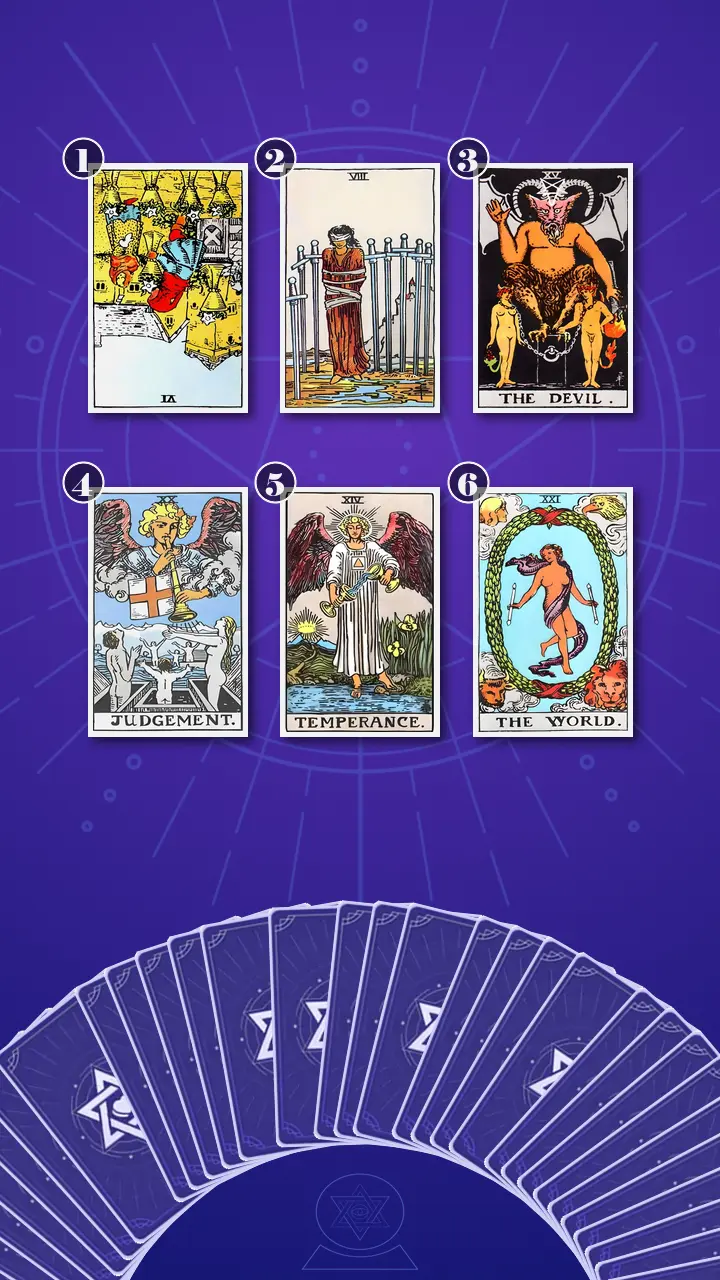
I laid three cards across the upper row and three beneath them. The first row would show the current pattern, the self-protective belief maintaining it, and the deeper attachment that made it feel useful. The lower row would begin with a conscious interruption, continue into a small action experiment, and end with an integrated self-understanding. The layout had a hinge: diagnosis above, choice below.
That distinction mattered. Tarot could give Casey enough distance to examine the pattern objectively, but the cards would not choose, send, ask, rest, or set a boundary for her. Those verbs would remain hers.
Reading the Upper Row of the Loop
Position 1: Six of Cups Reversed and the Borrowed Forecast
I turned over the card representing Casey's current pattern, the observable way old coping habits entered a fresh start. It was the Six of Cups, reversed.
In the Rider-Waite-Smith image, a child offers a flower-filled cup within a walled village. Reversed, I read that exchange as memory being carried forward without enough review. In Casey's life, it looked like opening old performance notes before the current brief, comparing the new team's wording with a previous disappointment, and delaying her first visible draft before the present team had supplied any evidence of its own.
The card showed Water in a blocked, backward-moving state. Memory was not simply informing Casey; it was flooding the new setting and turning recollection into a forecast. It was like opening a clean Notion workspace but running the same recycled “total reset” template underneath. The interface had changed. The rule had not.
“When you reach for the old feedback,” I asked, “which part is a useful lesson, and which part belongs to a scene that has already ended?”
Casey gave a short laugh, but there was no amusement in it. She rubbed her thumb along the mug handle and said, “That's so accurate it's almost rude. I tell myself I'm learning from experience, but half the time I'm just putting the old manager in the new meeting.”
Her answer mattered because it separated remembering from reenacting. The Six of Cups was not asking her to reject experience or abandon sensible preparation. It was asking her to notice when the past had begun impersonating present-day evidence.
Position 2: Eight of Swords and the Certainty Rule
I turned to the card representing the self-protective loop, especially the belief that certainty must arrive before participation. It was the Eight of Swords, upright.
I described the familiar scene back to her: a reviewer leaves “small tweak” on a Figma frame; the cursor blinks under the cold blue monitor light; several Slack replies accumulate in draft form. Casey believes she cannot answer until she understands the exact tone, implication, and likely reaction. Meanwhile, one ordinary option remains available: ask a clear question.
The Eight of Swords was Air in blockage and excess at once. Thought had become so crowded that it narrowed her field of action. The blindfold did not mean she was foolish, and the ring of swords did not mean there was literally no route out. They showed limited visibility being interpreted as total helplessness.
“Preparation can be a lesson, or a hiding place,” I said. “Your internal line seems to be, ‘I don't have enough information yet, so I have no move.' But those are two different claims. You may not have full information. You can still have one proportionate move.”
Casey's breath paused. Her fingers hovered above the card, then tightened around the mug as though she were replaying the Figma thread. Finally, she released the handle and looked toward the window. “I could have asked what they meant,” she said quietly. “I just thought asking would prove I wasn't ready.”
I nodded. “That is the enclosure this card is showing: not an absence of choices, but a rule that disqualifies every choice made before certainty.”
Position 3: The Devil and the Ten-Minute Bargain
I turned over the card representing the underlying attachment, the short-term promise that kept the coping habit connected to Casey's sense of safety. It was The Devil, upright.
I was careful with this card. I do not use The Devil to frighten people or imply that an outside force controls them. In this position, it described attachment through reward. When an ambiguous message appeared, Casey told herself that checking Slack once more would protect her from embarrassment. The check briefly steadied her breathing, but it also postponed a direct response, consumed her evening, and reinforced the belief that control was the only route to safety.
The attachment energy was in excess. The strategy had gained more authority than its actual usefulness justified. On the card, the chains around the two figures are loose. I read that space as important: the habit could feel compulsory while still containing room for a pause. It worked like a free trial that kept auto-renewing. The immediate price looked small; the hidden charge was time, rest, visibility, and the opportunity to gather new information.
“What does one more check promise you for the next ten minutes?” I asked. “And what does it quietly postpone over the next month?”
Casey looked down at her warm phone beside the spread. “It promises I won't be caught off guard,” she said. “But it postpones actually being part of the team. And apparently sleep.”
I heard the edge of shame in the joke, so I slowed down. “The fact that the strategy offers relief explains why it survived. We don't need to shame the protection to question the price. We only need to stop confusing short-term relief with long-term support.”
When Judgement Interrupted the Rewrite
Position 4: The Call Hidden Inside the Pattern
The rain against the window thinned as I reached the card representing conscious interruption, the turning point where a learned response could become visible and answerable. The radiator gave one metallic click and fell quiet. I turned over Judgement, upright.
The card showed an angel sounding a trumpet while figures rose to answer it. I explained that Judgement was not a sentence handed down against Casey. Its energy was clarifying and catalytic: honest review without identity condemnation. In modern terms, it was the moment she noticed herself rewriting a new email in the same cautious language she had used after an old conflict, named what was happening, and sent a clear first version that fit the current situation.
Looking at the trumpet, I thought of an editing room rather than a courtroom. As an artist, I know that footage can remain in the version history without belonging in the final sequence. A previous scene can explain a character's reflex without earning the right to direct every scene that follows.
This is where I used my Hero's Journey Alignment. I told Casey that what story structure calls the “Refusal of the Call” is not proof that the hero is weak or unworthy. It is the threshold beat where the old survival logic makes one last persuasive case for staying in the known world. Casey's checking, rehearsing, and disappearing were not the end of her character arc. They were the moment before she could hear the call consciously.
At 8:47 p.m. on the Northern line, she had been caught between past evidence and present information. The old rulebook was already open, her shoulders were tight, and the phone was warm in her hand. She believed she had to become completely different before she could act differently.
You do not have to erase your past to begin again; answer Judgement's trumpet by naming the old script and choosing a present-day response.
I let the sentence stand without explaining it away.
For a second, Casey did not move. Her inhale stopped halfway, and her fingers stayed suspended above the card as if touching it would confirm something she was not ready to know. Then her gaze slipped past me toward the rain-streaked window. I could almost see the version history replaying behind her eyes: old conflict, cautious email, fresh message, same defensive architecture. Her pupils widened; colour rose beneath her eyes. She loosened one hand, then the other, and her shoulders dropped by a fraction. A breath left her with a quiet, shaky “Oh.” Relief arrived, but not cleanly. She looked briefly unmoored, like someone who had set down a suitcase and only then noticed how long she had been leaning against its weight. Her jaw tightened again. “But doesn't that mean I did all of this wrong?” she asked. “That I could've just stopped?” The responsibility inside the new clarity seemed to make her almost angry.
“No,” I said. “It means the habit was learned because it did something for you. You are not at fault for having needed protection, and you are still responsible for deciding whether that protection fits the present. Self-forgiveness does not require you to keep renewing the bargain.”
I leaned forward slightly. “Now, with this new perspective, think back to last week. Was there a moment when this insight might have made you feel different?”
Casey stared at the trumpet. Then she told me about a Wednesday email she had rewritten six times after remembering an old workplace conflict. “I kept adding context nobody asked for,” she said. “If I'd named it, I could have said, ‘I'm explaining everything before asking.' That would have made it a pattern I was noticing, not proof that I was failing again.”
That was the opening Judgement offered. A repeated coping habit was evidence of a learned response, not proof that her identity was fixed. The inner line became: “If I can name what I am repeating, it does not get to define who I am.” This was the first real movement from anxious pattern-scanning and shame toward conscious interruption and measured participation.
I gave Casey a boundary around the insight so it would not become another giant self-improvement project. I asked her to set a ten-minute timer and write two private lines in her Notes app: “The old script says...” and “This situation has actually shown...” Then she could choose one response that was 10 percent different. If the exercise became too intense or distracting, she could stop and return to something ordinary and grounding. The choice to pause would count as part of the boundary, not as failure.
Two Cups and a Wider Frame
Position 5: Temperance and the Measured Reply
I turned over the card representing the action experiment, the repeatable behavior that could replace automatic overplanning, withdrawal, or overwork. It was Temperance, upright.
The angel pours water between two cups, with one foot on land and one in water. I translated the image into Casey's actual working day. She could give herself ten minutes to read an unfamiliar brief, then send one clarifying Slack question before opening old feedback, adding another planning template, or donating the evening to hypothetical problems.
Temperance showed balanced energy: caution and participation sharing the same workflow. It did not ask Casey to expose herself recklessly, ignore useful context, or fire off work she had not read. It also did not allow caution to expand into an all-night audit. The middle response was specific: notice the old impulse, make one moderate move, and let the present send back information.
“The line here is, ‘I can protect my attention without disappearing,'” I told her. “New evidence needs one visible action.”
Casey nodded slowly. “Ten minutes, one question. I can feel my brain trying to negotiate for twenty-five.”
“Then noticing the negotiation is already part of the experiment,” I said. “The timer isn't a test of discipline. It is a boundary around the old habit's appetite.”
Position 6: The World Without Self-Erasure
The final card represented integrated self-understanding, the state in which Casey could keep useful lessons from the past without letting old coping habits define every beginning. It was The World, upright.
I pointed to the dancing figure inside the wreath, movement held within a stable frame. In Casey's life, this meant acknowledging that overpreparing had once helped her feel less exposed while deciding that it would no longer control how she entered every new team, project, routine, or relationship. The old strategy could remain in her portfolio of experience without becoming the only file she was allowed to open.
The World's energy was integrated rather than absolute. It did not guarantee that Casey would never check twice, withdraw after a difficult comment, or wake with her shoulders tight. It described a wider identity capable of holding earlier versions, present limits, useful caution, and new evidence at the same time.
“You can carry the lesson without carrying the command,” I said.
Casey's eyes returned to the first card, then moved across the full grid. “So the goal isn't to become someone who has no old reactions.”
“Exactly. The goal is to become someone who can recognise an old reaction before handing it the director's chair.”
The Character Bible for the Next Ten Minutes
I read the spread back to Casey as one coherent film. The reversed Six of Cups showed the old script entering the new setting. The Eight of Swords revealed the certainty rule that made participation feel unavailable. The Devil explained why the habit persisted: checking, silence, and overwork offered immediate relief. Judgement separated the learned move from Casey's identity. Temperance converted that insight into a measured experiment, and The World placed the past inside a larger story rather than demanding its deletion.
The cognitive blind spot was not simply “I plan too much.” It was the assumption that a familiar alarm must be accurate evidence, followed by the belief that repeating a response revealed a fixed flaw in her character. That belief made preparation feel like the only proof she was changing, even when preparation prevented the very participation that could produce new evidence.
The shift was smaller and more demanding than a total reset: name one inherited response, then make one present-day move before adding more analysis. I used my Character Bible Directive to make that shift concrete. Instead of inventing a flawless future self, I asked Casey to write the behavioral specification for her next ordinary scene. Who is she when uncertainty appears at 9:14 on a Wednesday, not in an imaginary life where uncertainty has disappeared?
- Write one scene in the Character Bible. Before opening the next unfamiliar brief, spend two minutes in the Notes app writing: “The old script says I must...” and “Present-day Casey can...” Give the future version of Casey one visible behavior, such as asking a clear question before rereading old feedback. Keep it to two lines. Do not turn it into a new dashboard, personality audit, or verdict about whether you are improving.
- Run the ten-minute Temperance experiment. On the next new work brief, set a ten-minute timer, read the actual request once, and make one visible move when the timer ends: send one clarifying Slack question, upload a rough outline, or share a two-sentence first draft. If sending feels too exposed, save the draft for five minutes and ask whether it is sufficient to gather information. The aim is 10 percent different, not perfectly fearless.
I reminded Casey that she could adapt, delay, or stop either practice. Actionable advice should increase choice, not become another authority in the room. The experiment was designed to gather evidence, not certify that she had finally become a different person.

A Week Later, One Ordinary Reply
Five days later, I received a message from Casey. A new brief had landed at 9:14 a.m. Her first impulse was to open an old feedback document. Instead, she wrote, “The old script says I need to predict every interpretation. Present-day Casey can ask what success looks like here.” She set the timer and sent one clarifying question in Slack.
Her manager replied, “Yep, exactly. A rough structure is plenty for today.” No dramatic transformation followed. Casey still checked the draft twice. The difference was that she uploaded it before lunch, received useful feedback, and logged off at the time she had planned.
That night, she slept through. Her first thought the next morning was, “What if I still got it wrong?” She noticed the reflex, smiled once, and got out of bed without opening Slack.
I thought of the six cards and the hinge between the two rows. Tarot had not fixed Casey, predicted her manager's response, or removed uncertainty from her life. It had helped her see a sequence clearly enough to interrupt it. The cards did not send the question. Casey did. The next act changed because she took back the pen.
The Line the Old Rulebook Cannot Finish
I want to leave you with what I learned beside Casey: when a fresh start tightens your chest and sends you back to checking, silence, or late-night work, you may be trying to prove you can change without risking the fear that repetition means you are not enough. Noticing that pull does not place you back at the beginning. It gives you a place to choose.
If you let one new beginning become a place to gather evidence instead of a personality test, what small, measured response would you write into the scene before your old rulebook finishes the sentence?

Every reading at AceTarot is a journey to connect with inner wisdom and empower the path ahead. This reading shared here is a psychological mirror, not a private record—crafted to reflect universal emotional loops and help restore personal clarity. Please note that these insights do not replace professional psychological, medical, legal, or financial advice, and should not serve as the sole basis for major life decisions.
Learn more about our Journey to Clarity.
How did this insight land for you?
🫂 This Resonates Deeply
🌀 Living This Story
✨ Now I See Clearly
🌱 Seeing New Possibilities
🧰 Useful Framework
🔮 The Confirmation I Needed
💪 Feeling Empowered
🚀 Ready for My Next Step
Author Profile
AI Juniper Wilde
1056 readings | 537 reviews
“I’ve always felt our lives are films currently in production. As an artist, I know that when you feel stuck, it’s often because you’ve bravely stayed in a painful scene for just a little too long. I’m not here to coldly analyze you. I want to sit closely with you, look at those difficult moments with profound empathy, and gently hand you the pen so you have the courage to write your next beautiful act.”
In this Personal Growth Tarot Reading :
Core Expertise
- Hero's Journey Alignment: Identifying your current stagnation as the classic 'Refusal of the Call' before a major character evolution.
- Vision Actualization: Rewriting the limiting narrative that insists you are not ready for the next stage of your life's plotline.
Service Features
- The Character Bible Directive: A creative visualization protocol to write the exact psychological and behavioral specs of your 'future self' to begin embodying today.
Also specializes in :
Explore Related Patterns:
Perfectionism-Driven AvoidanceCasey delays her first visible draft, leaves Slack replies in draft form, and rewrites a Wednesday email six times because asking for clarification feels like proof that she is not ready. Her standard is not simply to do careful work; it is to eliminate the risk of misunderstanding before anyone can see her participate. When you require total readiness before visibility, perfectionism can drive avoidance while still looking productive from the outside. Rewriting and reviewing protect you from the immediate exposure of sending, but they also block the feedback that could correct your prediction. The fresh start carries the old habit because each unfamiliar request revives the same impossible bargain: become certain enough to avoid risk before taking the action that would create certainty.
Workplace HypervigilanceOne vague comment sends Casey into old-note review, repeated rewriting, phone checking, and late-night work, while her raised shoulders and held breath suggest that she is still waiting for a correction that has not arrived. The new team has not reproduced the old workplace dynamic, but her attention and body are already organised around detecting it. When you enter a fresh start in this state, workplace hypervigilance treats ambiguity as a possible threat cue rather than neutral missing information. Scanning, rehearsing, and overpreparing try to prevent you from being caught off guard, which explains why the strategy can survive a change of manager or company. The setting changes immediately; the threat-monitoring system updates only after it receives and accepts enough new evidence.
Anchoring BiasCasey opens last year's performance notes before answering a new Slack thread, compares the new team's wording with a previous disappointment, and recognises that she is putting the old manager in the new meeting. The earlier workplace becomes her starting reference point, so present ambiguity is interpreted through a previous outcome before the current team has produced evidence of its own. When you anchor a new situation to the most emotionally available old one, returning to the past can feel like sensible preparation. The hidden effect is that memory begins setting the range of outcomes you expect, making a recycled forecast feel like a current observation. This explains how a genuinely fresh environment can activate an old rulebook before you have consciously chosen to use it.
Certainty SeekingA reviewer's small Figma comment leaves Casey trying to determine the exact tone, implication, and likely reaction while several possible replies remain in draft. She can ask a clear question, but her internal rule says that asking would expose her as unready and that participation is unsafe until interpretation is complete. When you use certainty as the admission price for action, preparation becomes a way to postpone the vulnerability of being seen with incomplete information. Certainty seeking promises protection from embarrassment, but it disqualifies every proportionate move that could gather the missing evidence. A fresh start therefore activates the old habit because unfamiliarity creates exactly the uncertainty that this rule was built to control.
Compulsive CheckingCasey's phone grows warm as she reaches for it repeatedly, reopens old feedback, and tells herself that one more Slack check will prevent her from being caught off guard. Each check briefly steadies her breathing, yet it also postpones the direct response, extends the evening, and leaves the original uncertainty unresolved. When checking produces short-term relief, your mind can learn the sequence through negative reinforcement: uncertainty rises, checking lowers it for a moment, and the temporary drop makes another check more likely next time. The behaviour then feels compulsory even when it is no longer informative. This is why a new beginning can inherit an old checking ritual despite offering none of the old evidence that originally made the ritual feel necessary.
Productivity as SafetyCasey stays online until late, expands a routine request into an all-night audit, and gives her evening to planning, reviewing, and hypothetical problems. The additional labour promises that she will not be caught off guard, so effort becomes more than task completion; it becomes evidence that she is protected and prepared. When you use productivity as safety, doing more regulates the discomfort that uncertainty creates. Because the relief comes from increased effort rather than from the actual usefulness of the work, a new role can intensify the pattern instead of resetting it. Every unfamiliar brief offers the old protective equation another chance to operate: more labour means more control, and more control is temporarily mistaken for more safety.
Defensive OverexplainingCasey rewrites a two-line reply, adds context nobody requested, and later revises another email six times in the cautious language she used after an old workplace conflict. The extra explanation is not responding to a stated need from the new team; it is pre-answering objections she imagines might arrive. When you overexplain defensively, detail becomes a buffer against correction, embarrassment, or misinterpretation. You take responsibility for managing every possible reading of the message instead of allowing the other person to ask for what they actually need. That defence travels easily into a fresh start because it is built into how you communicate under uncertainty, not into the specific relationship that first taught you to use it.
Explore Related Struggles:
Protection-Progress SplitCasey wants the new role to be a new chapter, yet an unclear request sends her into the same sequence of old notes, repeated drafts, silence, and late work. Every protective action reduces immediate exposure while delaying the participation that would let the new role become genuinely different. When you depend on a safeguard that blocks the evidence required for forward movement, protection and progress pull against each other at the same threshold. The strategy can still explain how you got through an earlier setting while no longer supporting how you want to enter the present one. Her measured Slack question creates movement without demanding reckless exposure. The point is not to discard caution, but to keep caution from occupying the entire path through which current experience can reach you.
Then-Now SplitCasey opens last year's performance notes before answering a new Slack thread, allowing one vague request to place an old manager inside a new meeting. The present team has not yet shown how it handles questions or rough work, but the former workplace is already supplying the forecast. When you use earlier consequences to interpret a setting that has not yet answered for itself, the fresh start changes externally while the old rules continue to govern participation. Memory stops serving as context and begins deciding what current evidence is allowed to mean. The divide becomes visible when Casey asks one present-day question and receives a proportionate answer: a rough structure is enough. That action does not erase what happened before; it gives the current setting a chance to establish its own record.
Certainty-Safety FusionSeveral Slack replies remain in draft while Casey tries to determine the exact tone, implication, and likely reaction behind a small comment. A clear question is available, but she treats asking it as evidence that she was not ready for the role. When you make certainty the admission price for participation, incomplete information starts to look like the absence of any valid move. The bind is self-sealing because the action that could create clarity also carries the exposure you are trying to avoid. Casey's ten-minute question shows a more proportionate use of agency. She does not need total knowledge before acting; she needs one current response that can return real information and loosen certainty's control over the next decision.
Monitoring-Safety FusionCasey's phone is warm in her hand on the Northern line, and one more Slack check briefly steadies her breathing. The check does not answer the unclear request, but its immediate effect is enough to postpone a direct response and justify returning to the screen again. When monitoring becomes the action that makes you feel temporarily prepared, the loop can keep running without producing the information it promises. Attention remains fixed on detecting danger while the commute, evening, and first moments of the next day become extensions of the unresolved thread. The available point of agency is the space between noticing and checking. Casey's ten-minute boundary lets her gather what the current brief actually contains, make one visible move, and allow another person to provide evidence that monitoring alone cannot generate.
Visibility-Safety SplitCasey keeps multiple Slack replies in draft, delays her first visible outline, and adds context that nobody requested. She remains intensely engaged around the work while withholding the unfinished question or rough version that would make her participation visible to the team. When being seen before everything is resolved feels like evidence of incompetence, visibility becomes both the route into connection and a threat to safety. You can work harder and stay online longer while still disappearing at the precise moment another person could respond to what you actually need. The rough outline and clarifying question give visibility a boundary: one limited action, offered for information rather than as a final verdict on competence. That makes room to participate without requiring you to expose more than the present task asks for.
Habit-Identity FusionAfter recognizing that she rewrote a Wednesday email six times in the language of an old conflict, Casey asks whether she has done all of this wrong and could simply have stopped. The repeated response is no longer only something she did; it is beginning to function as evidence that she has failed to become a different person. When you turn the return of a learned habit into a verdict on identity, every fresh start becomes a personality test. The pressure to prove complete transformation makes an ordinary recurrence feel definitive, which can drive even more preparation, self-surveillance, and shame-laden correction. Naming the old script changes its position without denying its history. You can recognize why the response survived, examine whether it fits the present, and choose a different action without requiring that one choice certify a permanently transformed self.
Productivity-Safety FusionA vague comment turns Casey's two-line reply into repeated rewrites, unrequested context, and work that continues until late at night. The extra labor looks like preparation, but it does not bring her into closer contact with what the current team has actually asked for. When productivity becomes proof that you are protected from correction, stopping can feel more dangerous than continuing. Hours, revisions, and constant availability are then used to purchase a sense of readiness, even as the work expands into travel, sleep, and the attention needed for the next day. The ten-minute experiment places a limit around effort before effort becomes its own safety ritual. One question or rough outline can gather more useful evidence than another evening of hypothetical work, allowing productivity to serve the task without being asked to guarantee your safety.
Explore Related Emotions:
Cautious Self-TrustYou ask what success looks like in the new setting without waiting to decode every possible reaction, then you notice the next-morning reflex and get out of bed without opening Slack. Those choices are small, but they show your judgment beginning to rely on current information and chosen boundaries rather than automatic review. The trust is cautious because uncertainty has not vanished and you still check the draft twice. It is nevertheless real: you can move, receive feedback, and remain intact when the response is not fully known in advance. Each proportionate action gives the present a chance to become a source of evidence you can believe.
Certainty HungerAfter a reviewer leaves a small tweak on a Figma frame, you rewrite the reply six times and treat a clear question as evidence that you are not ready. Thought keeps searching for exact tone, implication, and reaction before you participate, so incomplete information feels like a locked door rather than a normal feature of a new role. The felt pull is a demand for one more piece of certainty before any visible move. It makes preparation feel safer than participation, even though participation is the only way the new setting can answer back. The emotional weight comes from wanting safety so precisely that no imperfect first step feels admissible.
Grounded AgencyYou keep the verbs of the next act in your own hands: name the old script, ask what success looks like, send one clarifying question, and decide whether to pause or stop. When the manager replies that a rough structure is enough, the new information is not merely comforting; it is evidence gathered through your participation. The sense of agency here is quiet and practical. You do not need to feel fearless before acting, because the choice can be small, bounded, and reversible. Taking the pen back means allowing your present behavior to create information instead of asking an old rulebook to approve the scene first.
Nostalgia Loop AnxietyOn the Northern line, you open last year's performance notes before the new brief, then compare the new team's wording with an earlier disappointment. The old manager enters the new meeting before the present team has offered its own evidence, so memory stops being context and starts writing a forecast. You are left scanning a new beginning for the shape of an old correction, carrying the past forward as a tense expectation rather than usable information. That loop makes a fresh start feel familiar in the least relieving way. The unease is not about remembering itself; it comes from the moment recollection begins impersonating current evidence and keeps you waiting for history to repeat. Naming that distinction gives the present a chance to supply facts of its own.
White-Knuckle SecurityWhen an ambiguous message appears, another Slack check promises that you will not be caught off guard. Your chest tightens, your breath pauses, your shoulders rise, and your hand returns to the warm phone; the body treats repeated checking as a small safety device even as the evening, rest, and visibility are quietly charged against it. The strategy survived because it does provide a brief sense of protection. Its emotional grip comes from holding safety with both hands while mistrusting any room you have not fully inspected. Seeing the bargain clearly lets you ask what the check is protecting for ten minutes and what it is taking from the month ahead.
Backslide AnxietyYou promised yourself you would not repeat the old pattern in the new role, yet one vague comment sent you back to old notes, rewritten replies, silence, and late-night work. The recurrence makes the fresh start feel like a test of whether change has actually happened, with every familiar reaction treated as evidence that the old version is still in charge. The dread gathers around the possibility of returning to a response you thought you had outgrown. It can make one recheck feel larger than it is, because the action seems to speak for your whole identity. When you identify the reflex as a learned move, a recurrence becomes information about the loop rather than a final statement about you.
Cautious MomentumWith a ten-minute timer, you read the actual brief once and make one visible move before opening the old feedback document. A question, rough outline, or two-sentence draft lets the day advance while caution remains present and proportionate. The movement is deliberately modest because the aim is not a dramatic reset. You are building forward motion that can survive uncertainty, then letting the team's reply shape the next step. The feeling has a measured quality: enough movement to participate, enough restraint to keep the experiment from becoming another demand.
Rulebook ShameAfter the insight lands, you ask whether you did all of this wrong and whether you could have simply stopped. Earlier, asking for clarification felt like proof that you were not ready, so a repeated coping response gets turned into a verdict about your character rather than recognized as something you learned to use. That is where the old rulebook acquires emotional authority. You are not only trying to answer a new message; you are trying to avoid confirming an accusation about your capability. Separating the learned protection from the person using it makes responsibility more precise and leaves room for self-forgiveness without renewing the bargain.
Integration ReliefAfter uploading the draft before lunch, you log off at the planned time and sleep through the night. The relief is not clean or absolute; it arrives alongside the old question about getting it wrong, yet the day no longer has to be surrendered to repeated checking. You begin to hold the useful lesson and the present limit in the same frame. Earlier overpreparation can remain part of your experience without directing every new team, project, routine, or relationship. The release comes from no longer treating a fresh beginning as a demand to erase every earlier version of yourself.
Cognitive OverwhelmUnder the cold blue monitor light, several Slack replies accumulate in draft form while you keep adding context nobody asked for. The mind is not simply gathering information; it is carrying every possible interpretation at once, and the number of imagined reactions crowds out the one clear question available. That crowding turns a small request into an evening-sized problem. The resulting inner weather feels heavy and static, with each extra check offering a momentary sense of order while making the next action harder to see. Naming the overload separates useful preparation from the mental volume that keeps the present unreadable.
Explore Related Contexts:
First 30 Days TrialCasey is three weeks into a new content design role, facing unfamiliar briefs, new Slack threads, and a team whose working expectations have not yet become routine. This is a real early-role testing period: the available information is partial, while participation is already required. The workplace provides present-day evidence when Casey asks what success looks like and her manager replies that a rough structure is enough. That exchange shows an onboarding environment where clarity can be built through small, legitimate questions rather than extracted from old performance records. You can treat this stage as a chance to gather current evidence about the role, the team, and your place within it. A visible, proportionate move gives the new setting an opportunity to show what it actually requires.